
Judge, 1917-11-17 · page 9 of 28
Judge — November 17, 1917 — page 9: what you’re looking at
What you’re looking at
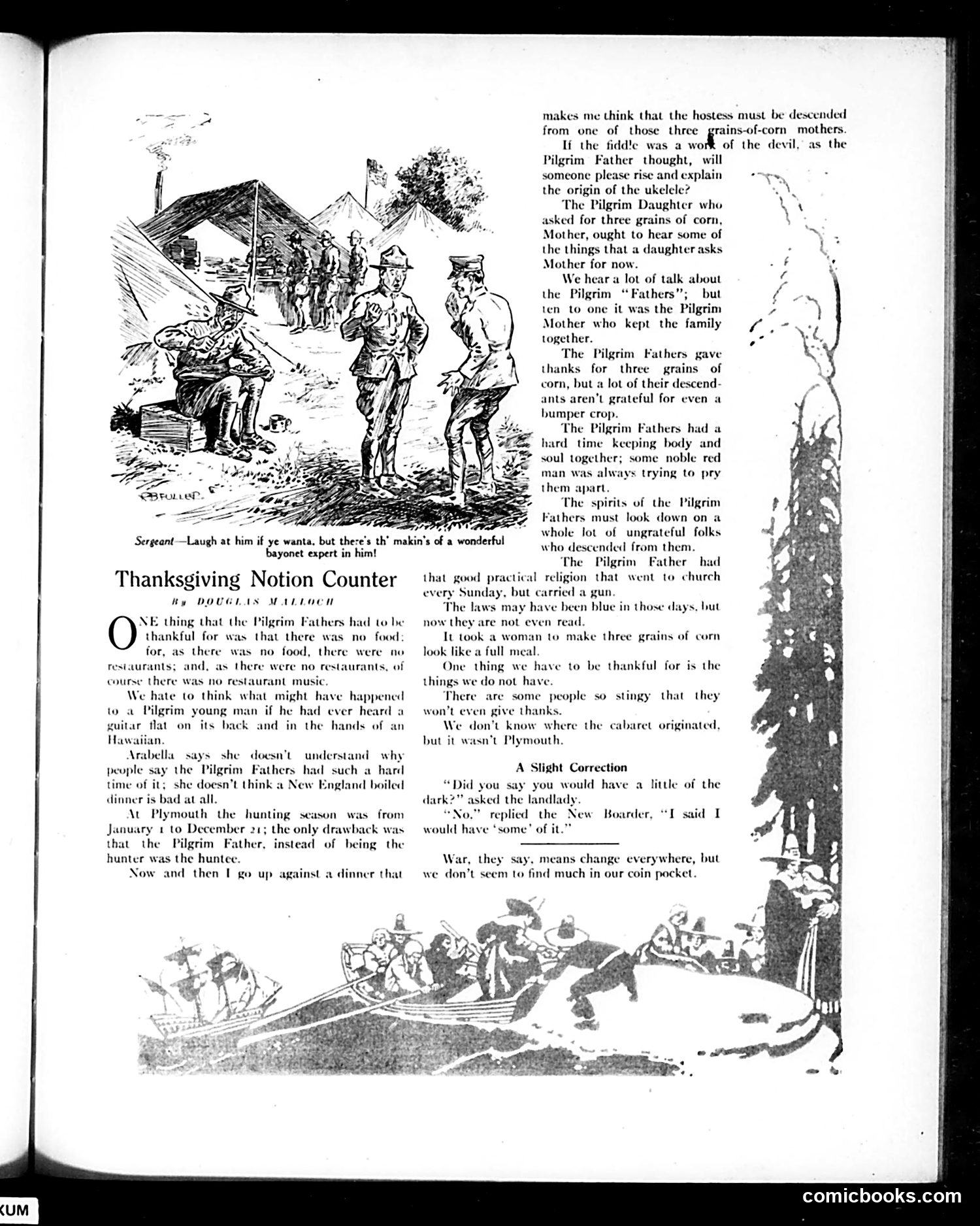
This satirical piece by Douglas Malloch uses the Pilgrim Fathers as a framework to critique modern American society circa WWI era. The humor operates through contrast: the Pilgrims' austere gratitude for minimal resources versus contemporary Americans' ingratitude despite abundance. **Key satirical targets:** - **Restaurant music**: Mocks the proliferation of commercial entertainment and Hawaiian guitar fads as cultural degradation - **Modern daughters vs. Pilgrim daughters**: Suggests spoiled entitlement in younger generations - **Ungrateful descendants**: Criticizes Americans who don't appreciate prosperity their ancestors built - **"Blue laws" no longer read"**: References outdated Puritan moral codes now ignored - **Cabaret origin**: Implies modern vice establishments contradict Pilgrim values - **War and coin pockets**: A topical jab at economic hardship despite wartime The cartoon accompanying shows soldiers, referencing WWI. Overall, the piece expresses nostalgic anxiety about American moral decline—a common Judge magazine theme during this period—using Thanksgiving as an occasion to contrast historical virtue with contemporary excess and ingratitude.
📄 Transcribed text from this page (OCR, searchable)
Machine-transcribed from the original scan — historical spelling and the odd misread are preserved.
Sergeant —Laugh at him if ye wanta, but theze’s th’ makin’s of a wonderful bayonet expert in him! Thanksgiving Notion Counter MaALLOCn NE thing that the Pilgrim Fathers had to be O thankful for was that there was no food: for, as there was no food, there were no resturants; and, as there were no resturants, of course there was no restaurant: music We hate to think what might have happened to a Pilgrim young man if he had ever hearc guitar flat on its back and in the hands of an Hawaiian. Arabella says she doesn’t understand why people say the Pilgrim Fathers had such a hard time of it; she doesn’t think a New England boiled dinner is bad at all. At Plymouth the hunting season was from January 1 to December 21; the only drawback was that the Pilgrim her, instead of being the hunter was the huntee. Now and then FE go up against a dinner that hy DOUGLAS from one of those three If the fidd!e was a wor Pilgrim Father thought, will someone please rise and explain the origin of the ukelele? The Pilgrim Daughter who asked for three grains of corn, Mother, ought to hear some of the things that a daughter asks Mother for now. We hear a lot of talk about the Pilgrim “Fathers”; but ten to one it was the Pilgrim Mother who kept the family together. The Pilgrim Fathers gave thanks for three grains of corn, but a lot of their descend- ants aren't grateful for even a bumper crop. The Pilgrim Fathers had a hard time keeping body and some noble red ys trying to pry The spirits of the Pilgrim Fathers must look down on a whole lot of ungrateful folks who descended from them. The Pilgrim) Father had that good practical religion that went to church every Sunday, but carried a gun. The laws may have been blue in those days, but now they are not even read. It took a woman to make three grains of corn look like a full meal. One thing we have to be thankful for is the things we do not have. There are some people so stingy that won’t even give thanks. We don’t know where the cabaret originated, but it wasn’t Plymouth. they A Slight Correction “Did you say you would have a little of the dark?” asked the landlady. “No.” replied the New would have ‘some’ of it.” Boarder, “I said I War, they say, means change everywhere, but we don’t seem to find much in our coin pocket. makes me think that the hostess must be descended vrains-of-corn of the devil, mothers. as the comicbooks.com