
A complete issue · 28 pages · 1917
Judge — November 3, 1917
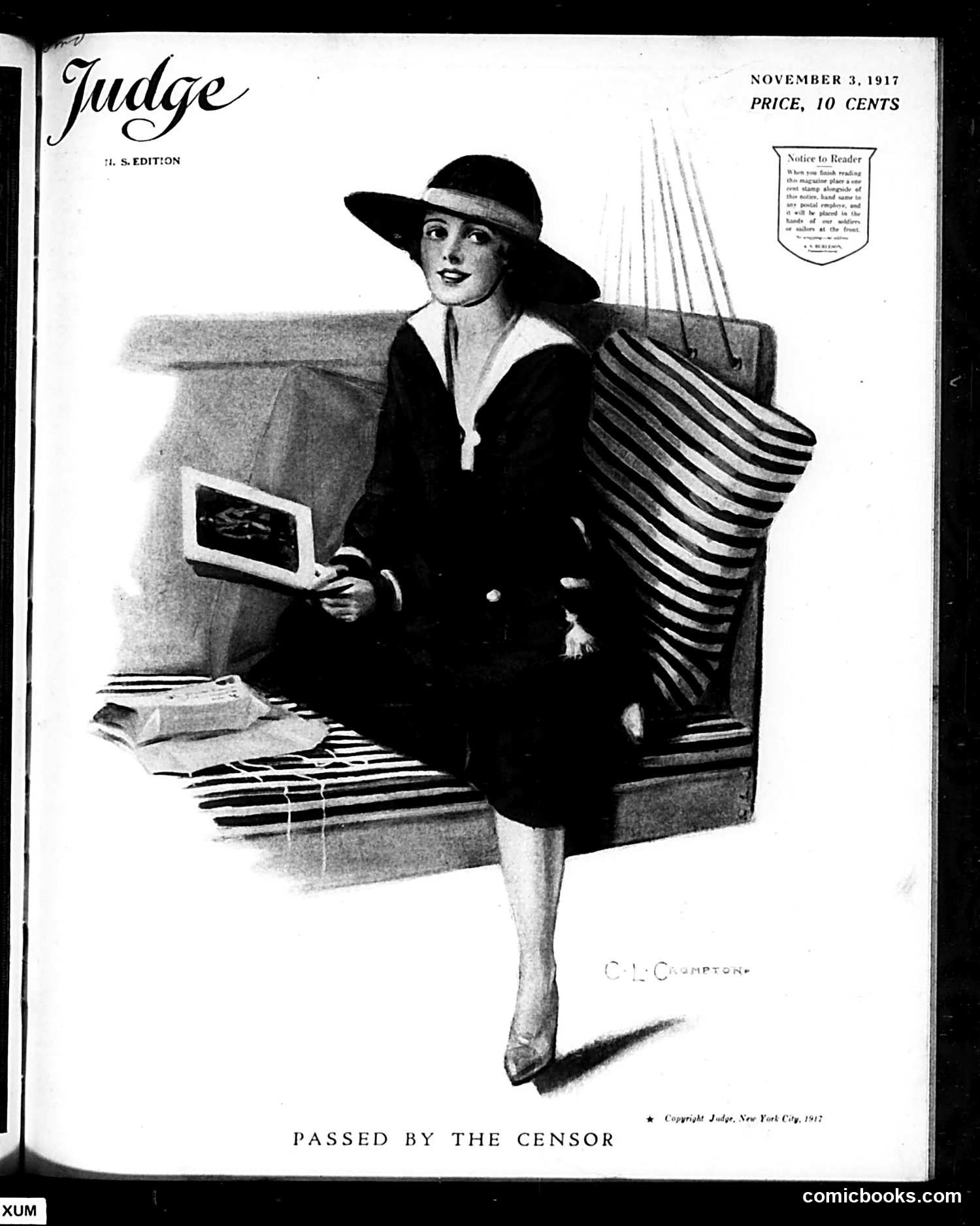
This satirical cover depicts a fashionable woman carrying travel items—a suitcase, striped fabric (possibly a beach tent or blanket), and books—suggesting leisure travel. The illustration is titled "PASSED BY THE CENSOR," indicating this is commentary on World War I censorship. The satire likely critiques either: - **Frivolous civilian behavior** during wartime (women traveling for pleasure while the nation was at war—America entered WWI in April 1917) - **Censorship absurdities**—that trivial society content passes official review while serious material gets blocked - **Class commentary**—wealthy women's carefree vacationing contrasted with wartime restrictions The "Notice to Reader" box in the corner appears to explain the censorship theme. The artist's signature reads "C.D. Champioñe" (or similar).
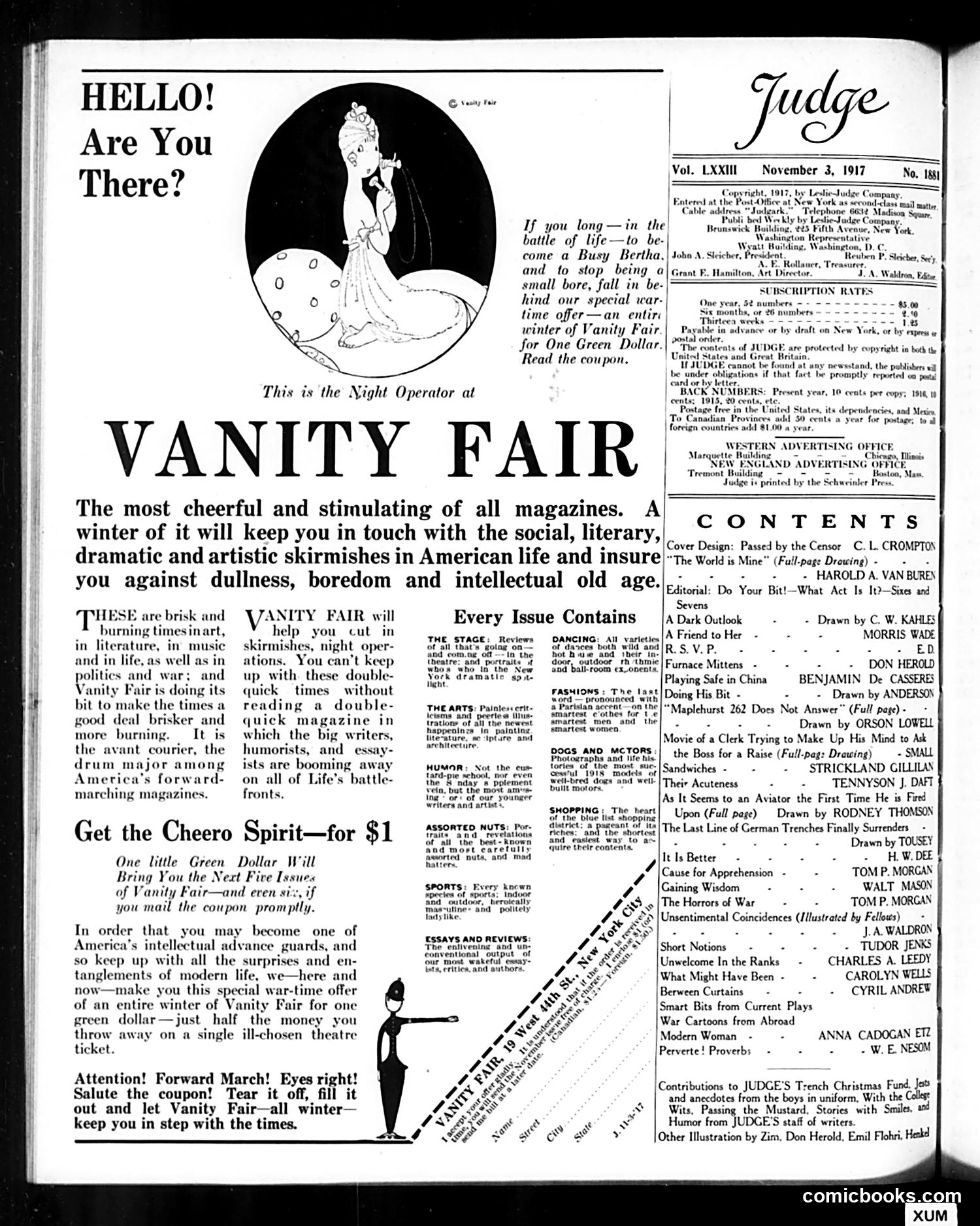
This page is primarily a **Vanity Fair magazine advertisement**, not a political cartoon. The illustration depicts "the Night Operator"—a stylized female telephone operator in an evening gown, positioned dramatically at a switchboard. This personification was common advertising imagery of the era. The ad promotes Vanity Fair as "the most cheerful and stimulating of all magazines," emphasizing its coverage of literature, drama, society, and the arts. The "$1 for five issues" offer reflects pre-WWI magazine pricing. The "Green Dollar" coupon mechanism was a standard subscription incentive. The publication date (November 1917) places this during America's involvement in World War I, though the advertisement itself avoids wartime references entirely, instead focusing on escapism and cultural sophistication.
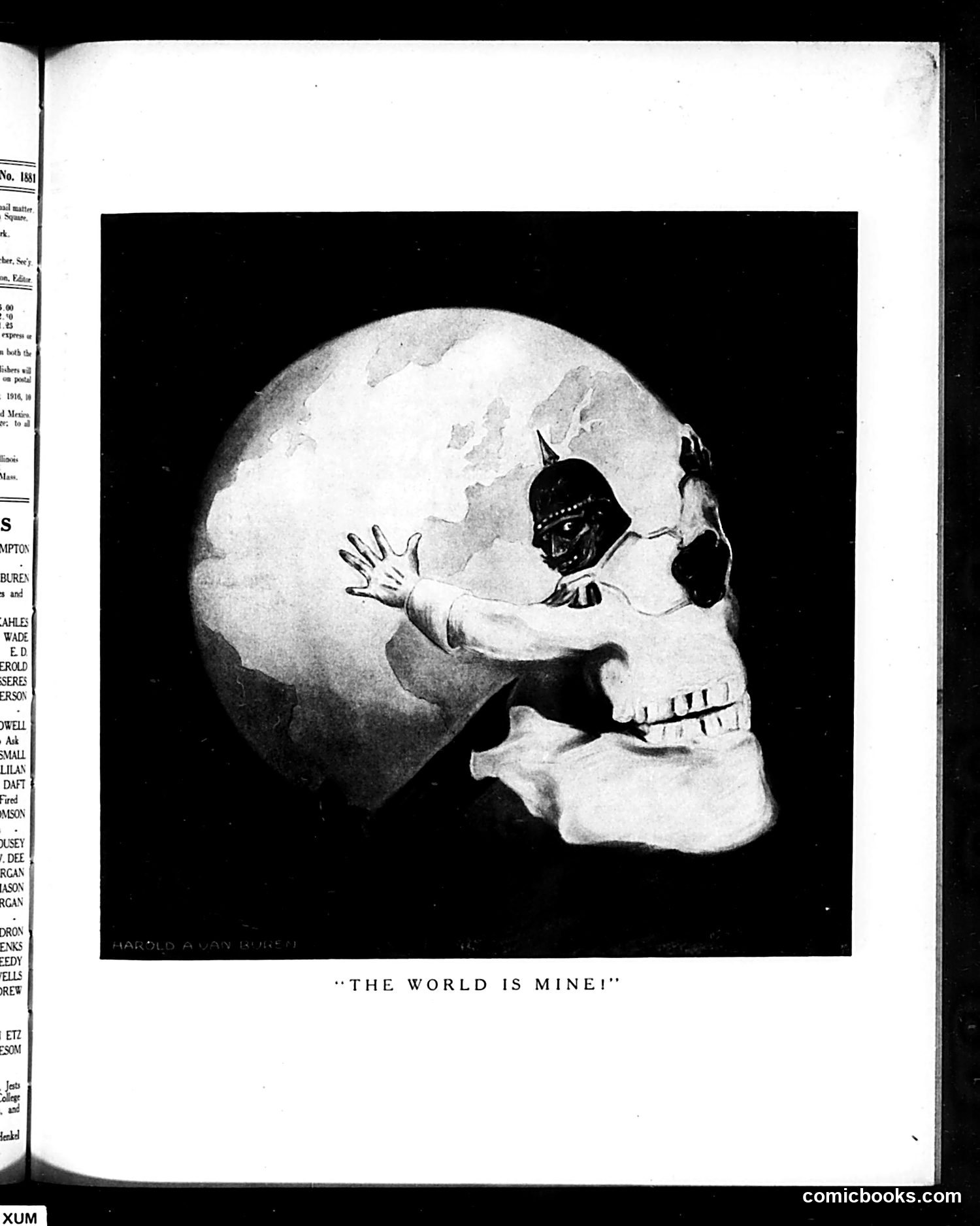
This image depicts a human skull wearing a spiked Prussian military helmet (Pickelhaube), with one skeletal hand grasping outward in a possessive gesture. The caption reads "The World is Mine!" This is anti-German war propaganda, likely from World War I. The skull symbolizes death and destruction, while the Prussian helmet identifies the aggressor as Germany. The skeleton's grasping hand and boastful declaration satirize German imperial ambitions and militarism. The image equates German military conquest with death itself—suggesting that German expansionism brings only mortality and devastation rather than legitimate rule. This was a common rhetorical strategy in Allied propaganda, portraying the Central Powers' war aims as inherently destructive to civilization.
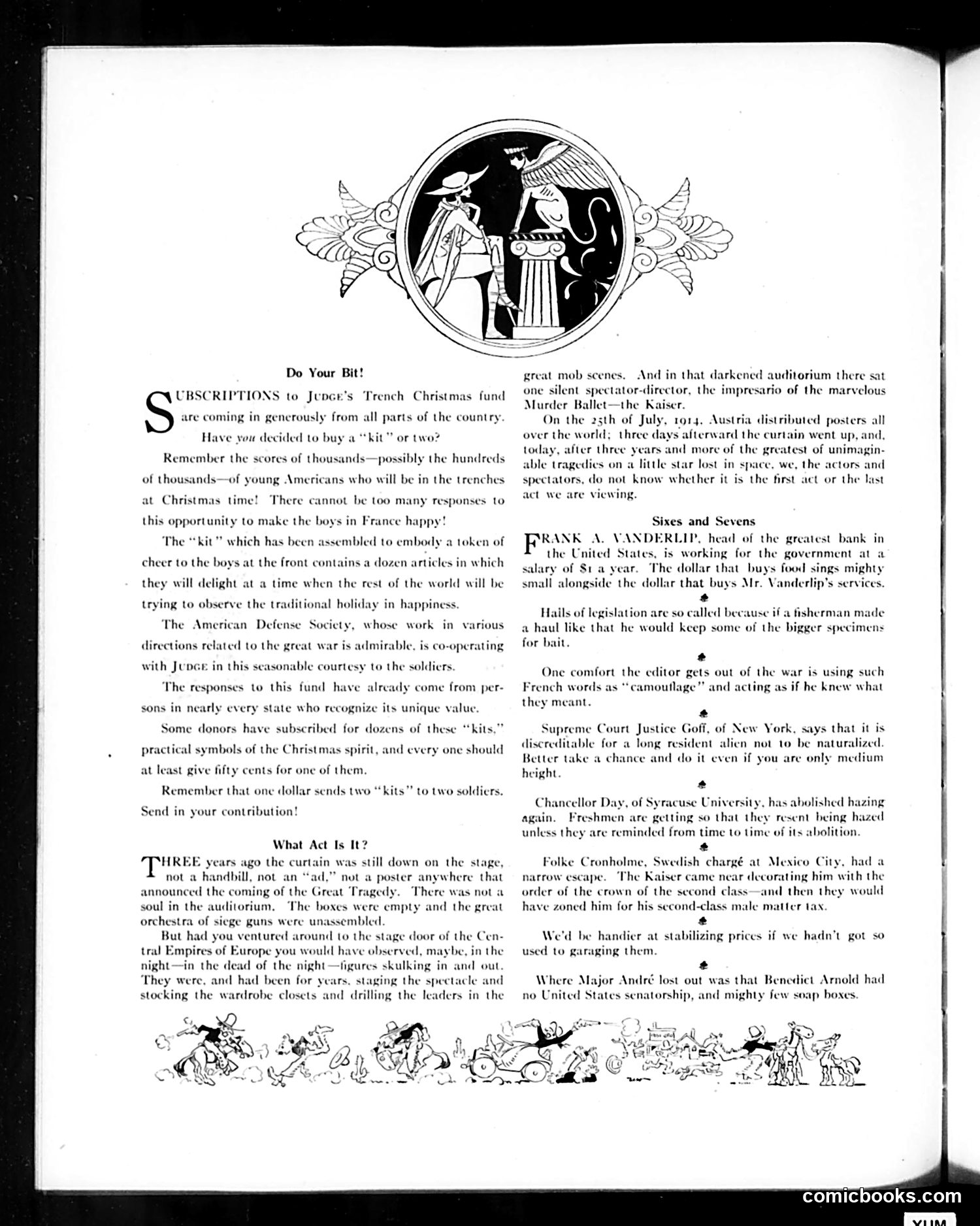
The main illustration depicts two classical figures in a circular medallion—likely representing **Minerva (wisdom) and Mercury (commerce)**—flanked by decorative wings. This classical framing introduces content about WWI fundraising. The left column discusses **Judge's French Christmas fund** for soldiers in trenches, urging American donations. The right column, titled "Sixes and Sevens," contains brief satirical observations about wartime America, including commentary on Supreme Court Justice Goff's naturalization stance and Chancellor Day's abolition of college hazing. The satire targets civilian attitudes during wartime—critiquing both privileged concerns (naturalization debates, university traditions) and linguistic pretension (mocking French words used affectedly). The overall message contrasts trivial domestic controversies with soldiers' real suffering.
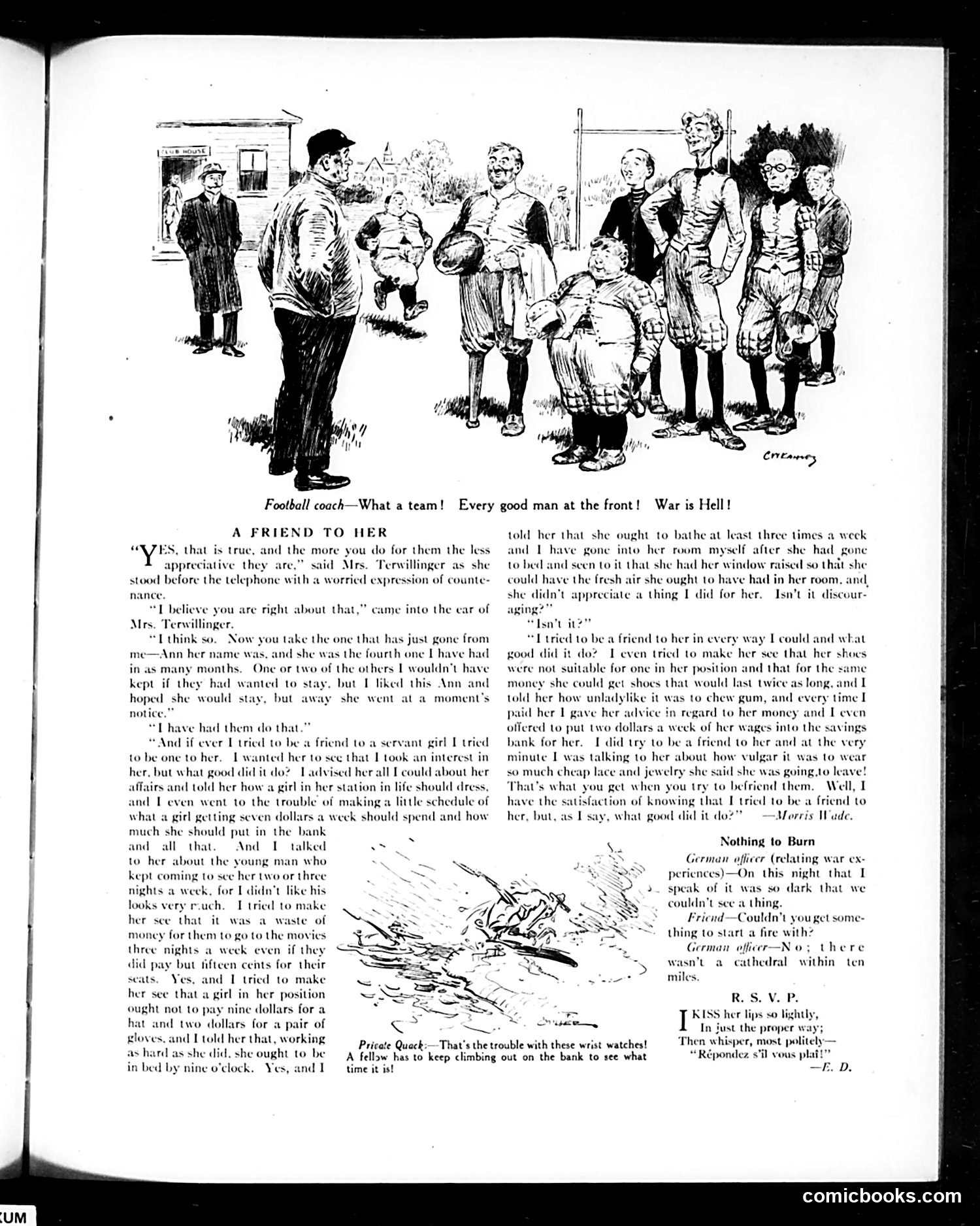
The top cartoon satirizes a **football coach addressing young players**, captioned "What a team! Every good man at the front! War is Hell!" This appears to reference **WWI recruitment messaging**—using sports team language to encourage military enlistment by framing war participation as patriotic duty comparable to athletic competition. Below are several humorous anecdotes, including "A Friend to Her" (about a woman giving advice to a servant girl) and "Nothing to Burn" (a brief exchange about starting a fire). These are typical period humor pieces. The illustrations and conversational tone are characteristic of **early-20th-century satirical magazine** content, blending social commentary with lighthearted domestic scenarios and wartime references common during or shortly after WWI.
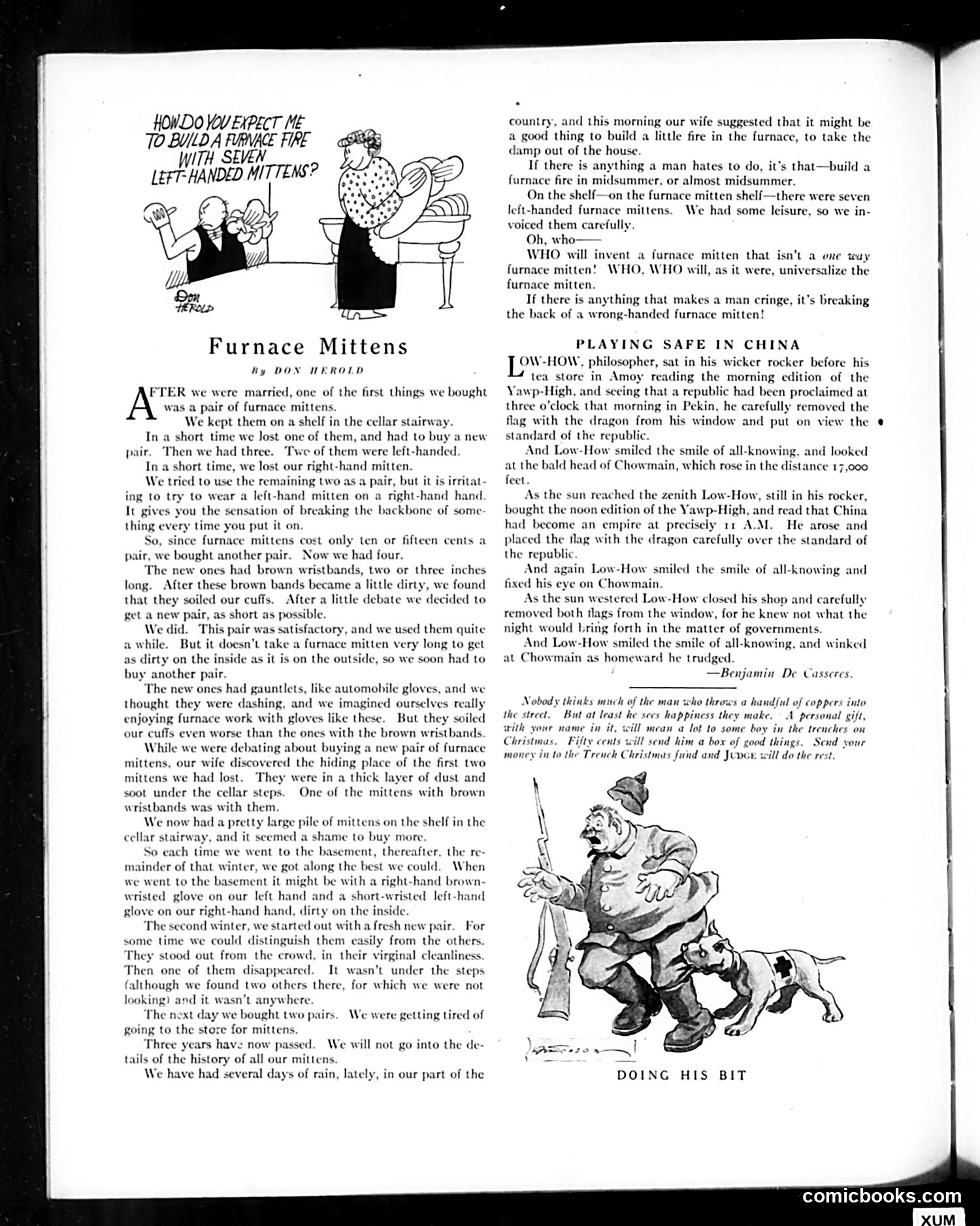
**"Furnace Mittens" cartoon (left):** This is a humorous domestic piece by Don Herald about the impracticality of left-handed mittens for building furnace fires. The joke plays on a mundane household frustration—the author and his wife purchased multiple left-handed mittens from a store, only to discover they're essentially useless. The satire gently mocks consumer product design and domestic inconvenience, suggesting nobody has bothered to create truly universalized furnace mittens. This reflects early 20th-century domestic humor focused on marriage and household management. **"Playing Safe in China" (right):** This brief story by Benjamin De Casseres satirizes diplomatic caution during China's political upheaval (appears to reference early Republican period). Low-How's careful removal of both nationalist and republican flags suggests mockery of fence-sitting neutrality during revolutionary change—a commentary on timid political positioning.
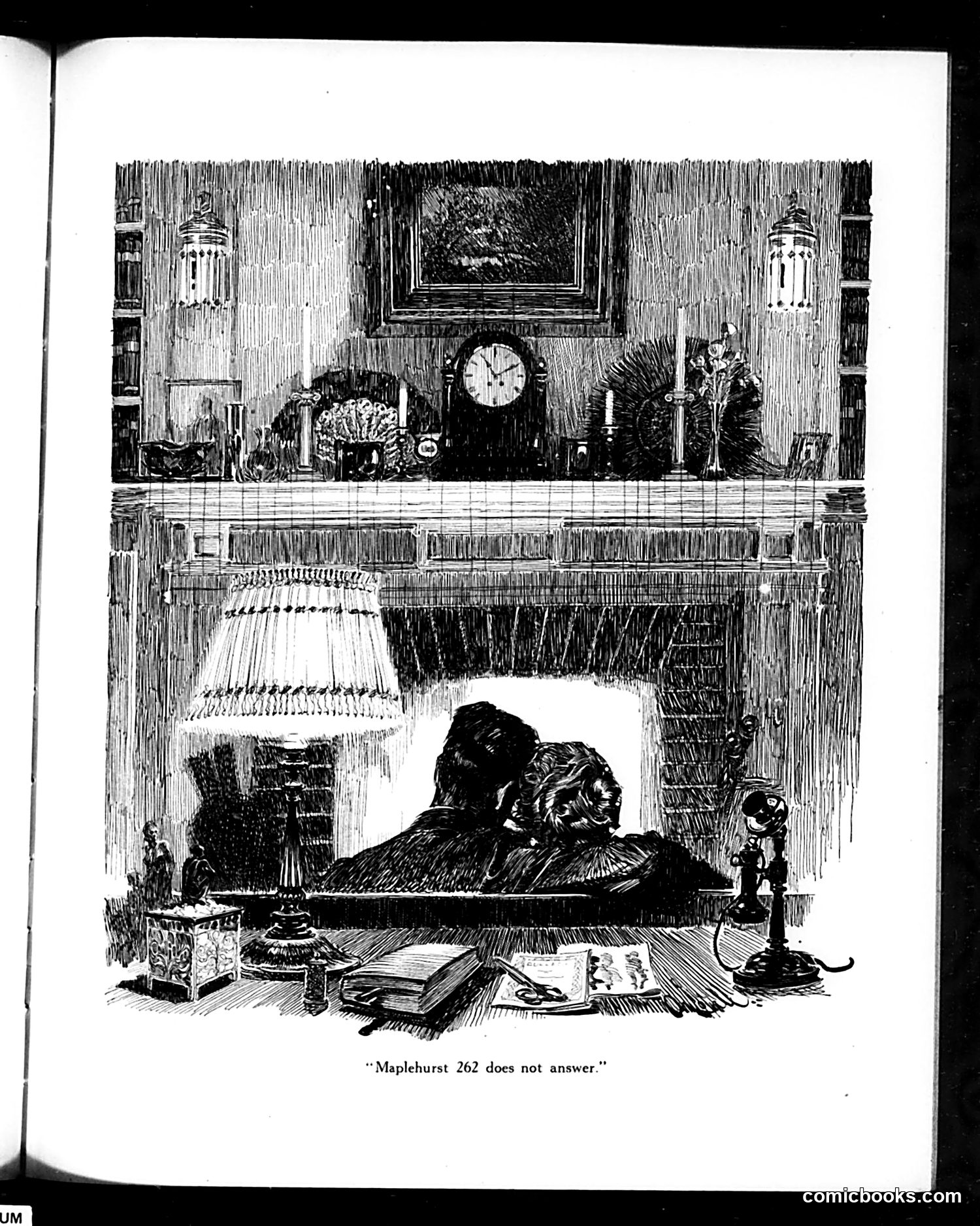
This cartoon depicts a domestic scene where a man and woman recline together on a bed in what appears to be an elegant bedroom. The caption references a telephone number ("Maplehurst 262") that doesn't answer. The satire likely comments on marital neglect or infidelity—the couple's intimate moment suggests they're ignoring outside calls or responsibilities. The ornate mantelpiece above with its clock and decorative objects emphasizes domestic comfort, contrasting with the idea that someone is trying unsuccessfully to reach them. Without additional context about 1920s-era references, the precise target remains unclear, but the joke appears to satirize either moral lapses or couples prioritizing private moments over social obligations.
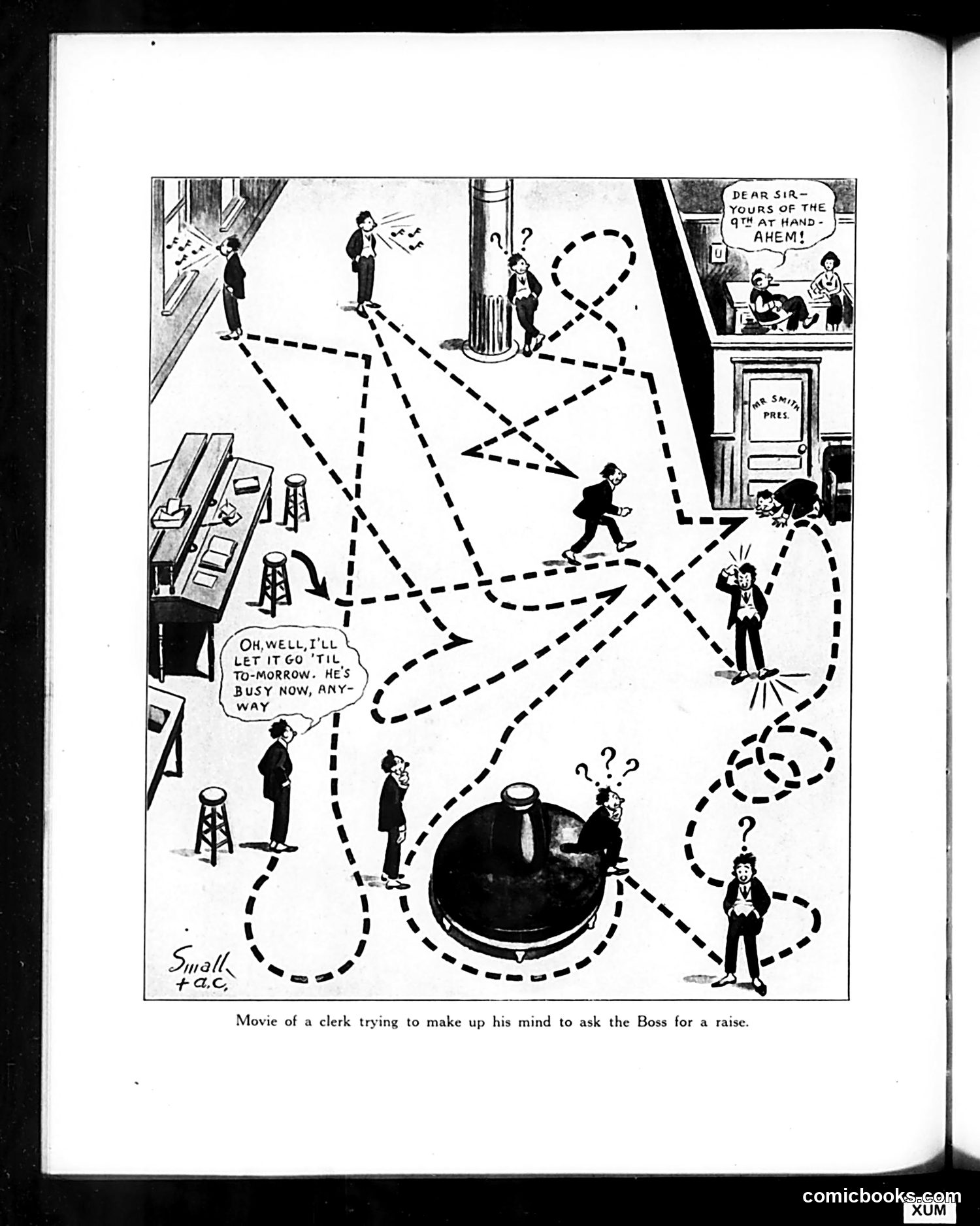
This single-panel cartoon satirizes the anxiety of asking one's boss for a raise. The clerk (shown repeatedly via dashed lines tracing his movements) nervously circles through an office building, repeatedly psyching himself up and backing down from entering the boss's office. Speech bubbles show his internal debate: he receives a letter dated the 9th spurring him to ask, but then postpones ("I'll let it go 'til to-morrow"). The cartoon depicts his boss visible in an upper office window. The humor targets the common workplace fear and procrastination around salary negotiations—the clerk's indecision and endless circling visualize his mental hesitation. This reflects early 20th-century office culture anxieties about hierarchy and the difficulty of directly confronting authority figures about compensation.
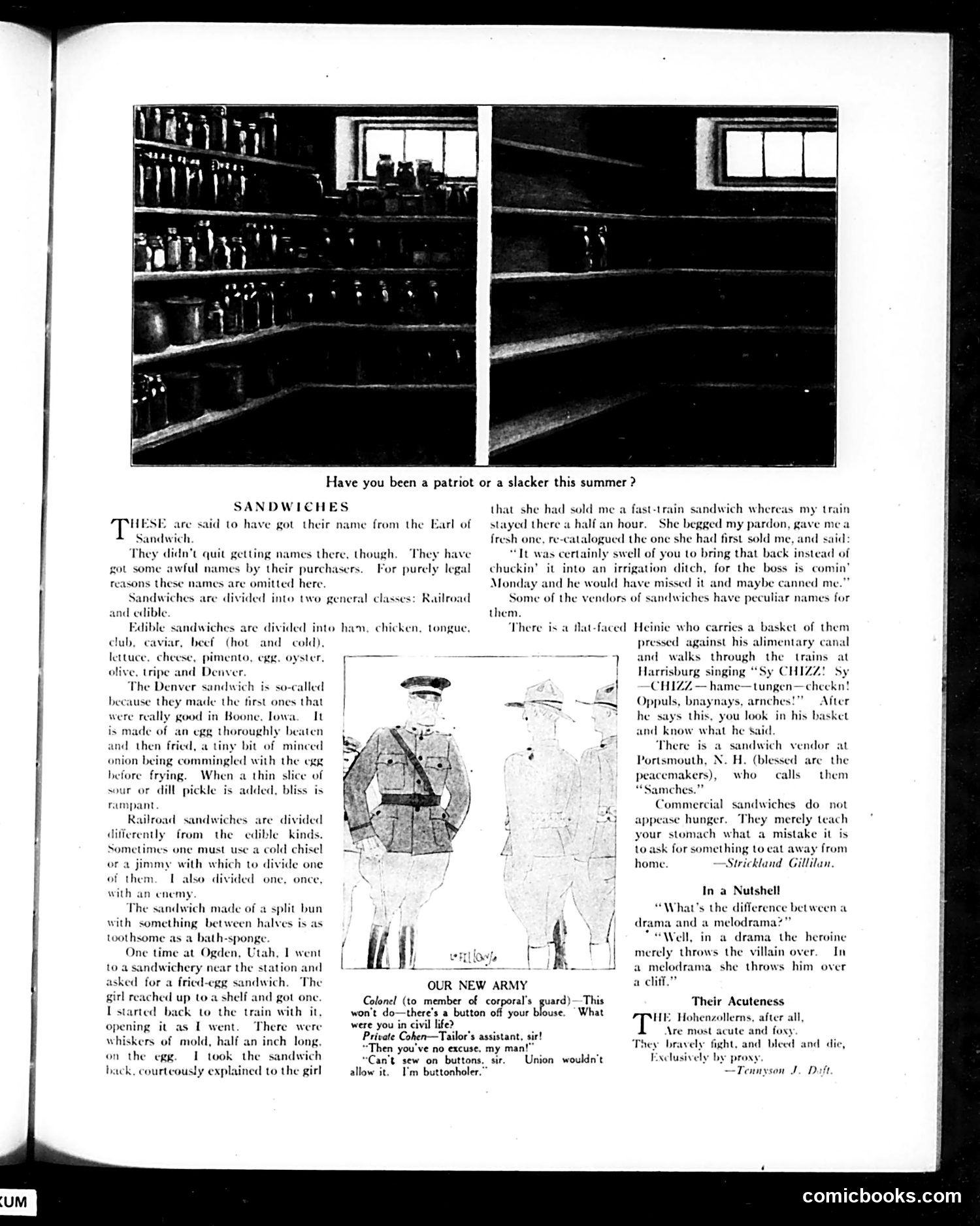
This page combines humor about WWI-era American life with social commentary. The main "Sandwiches" article is a humorous essay mocking both the poor quality of railroad food and ethnic stereotypes—specifically German immigrants ("Heinie") selling sandwiches on trains while singing gibberish. The piece satirizes commercial food vendors as offering inedible products. The "Our New Army" cartoon at bottom criticizes military inefficiency: a Colonel reprimands a soldier for a missing button, but learns the soldier (a Jewish tailor's assistant named Cohen) cannot sew because his union prohibits it—absurdly preventing him from performing basic duties. The closing verses mock the Hohenzollerns (Germany's ruling family) for directing WWI from safety while soldiers die, a common American criticism of distant leadership during the Great War. The header question—"Have you been a patriot or a slacker this summer?"—reflects 1917-18 patriotic pressure on civilians.
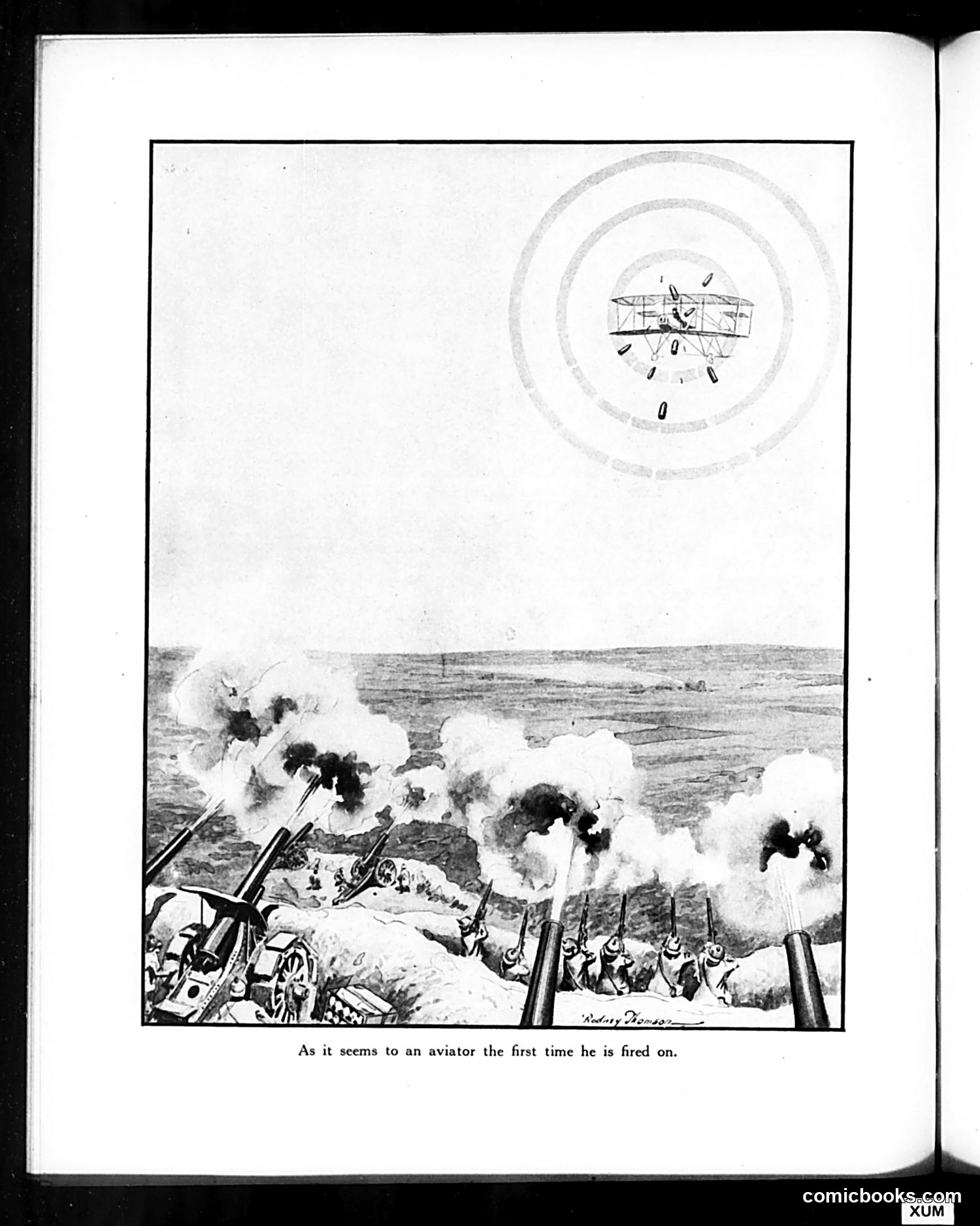
This illustration depicts a World War I scene from the perspective of an aviator under enemy fire for the first time. The image shows: **Visual Elements:** - Artillery cannons firing from a trench position below - Multiple explosions creating white smoke clouds across the landscape - An aircraft diagram in the upper right with concentric circles, suggesting the aviator's viewpoint **The Satire:** The cartoon humorously exaggerates how chaotic and overwhelming artillery fire appears to a novice pilot experiencing combat for the first time. The centered aircraft diagram emphasizes the aviator's disorienting perception—everything seems to be exploding directly around them. This satirizes the sensory shock of combat while also reflecting contemporary fascination with aerial warfare, a relatively new phenomenon during WWI when aviation was still emerging as a military force.
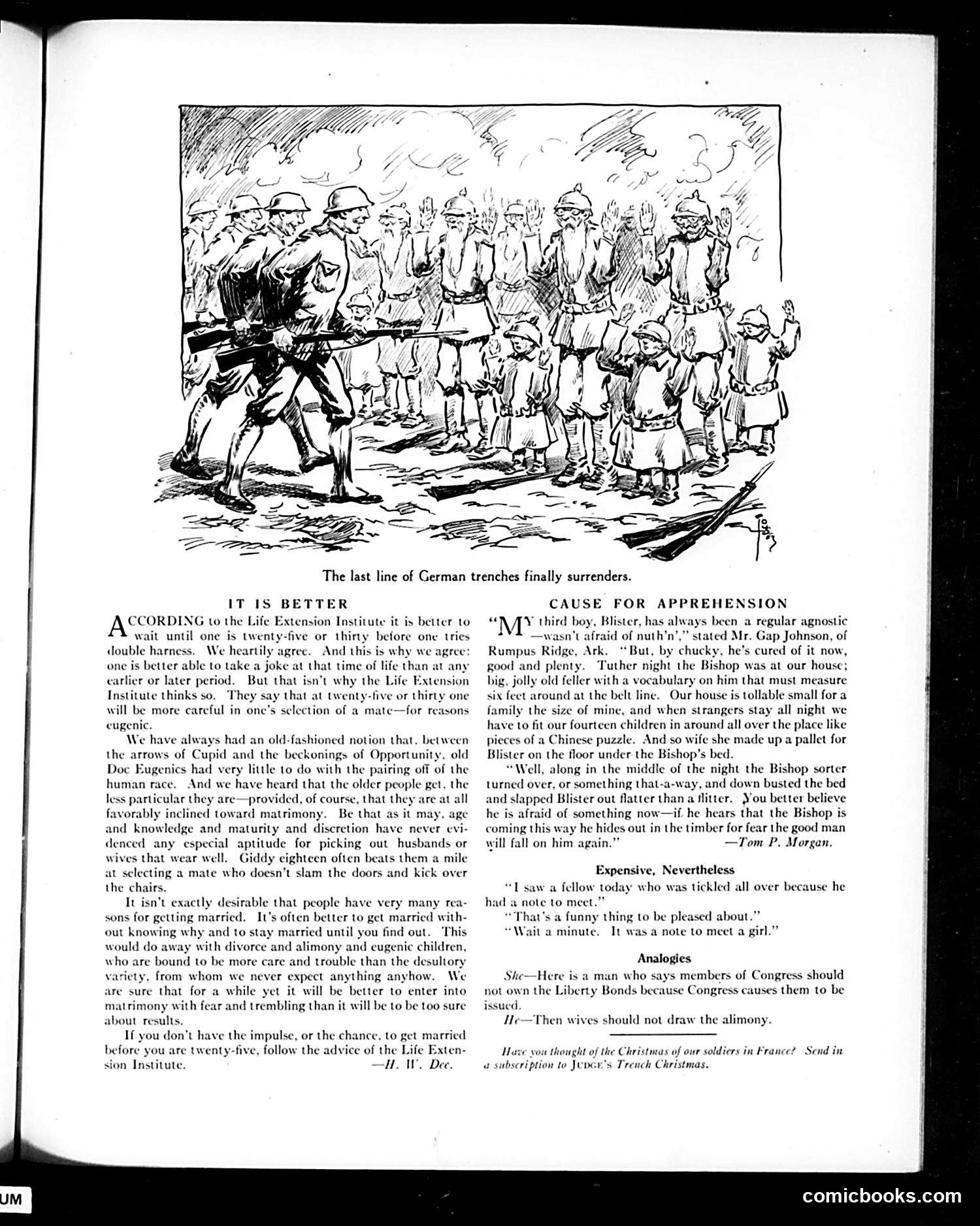
**Top Cartoon:** "The last line of German trenches finally surrenders" depicts armed soldiers accepting the surrender of German troops during World War I. This references the armistice of November 1918, celebrating Allied victory and the end of trench warfare. **"It Is Better"** article mocks the Life Extension Institute's advice that people wait until 25-30 to marry for "eugenic" reasons (selective breeding for "better" offspring). The author satirizes this pseudo-scientific claim, arguing that younger people actually make better romantic choices through impulse rather than calculated reasoning, and that overthinking marriage backfires. **"Cause for Apprehension"** humorously depicts a rural Arkansas family's atheist son becoming suddenly religious after a large visiting Bishop accidentally crushes him by falling from bed—fear replacing skepticism. The remaining brief items are light humor pieces and a pitch for subscriptions to *Judge's* "Trench Christmas" charitable campaign for soldiers in France. The page reflects 1918-era concerns: WWI victory, eugenic pseudoscience, and support for troops.
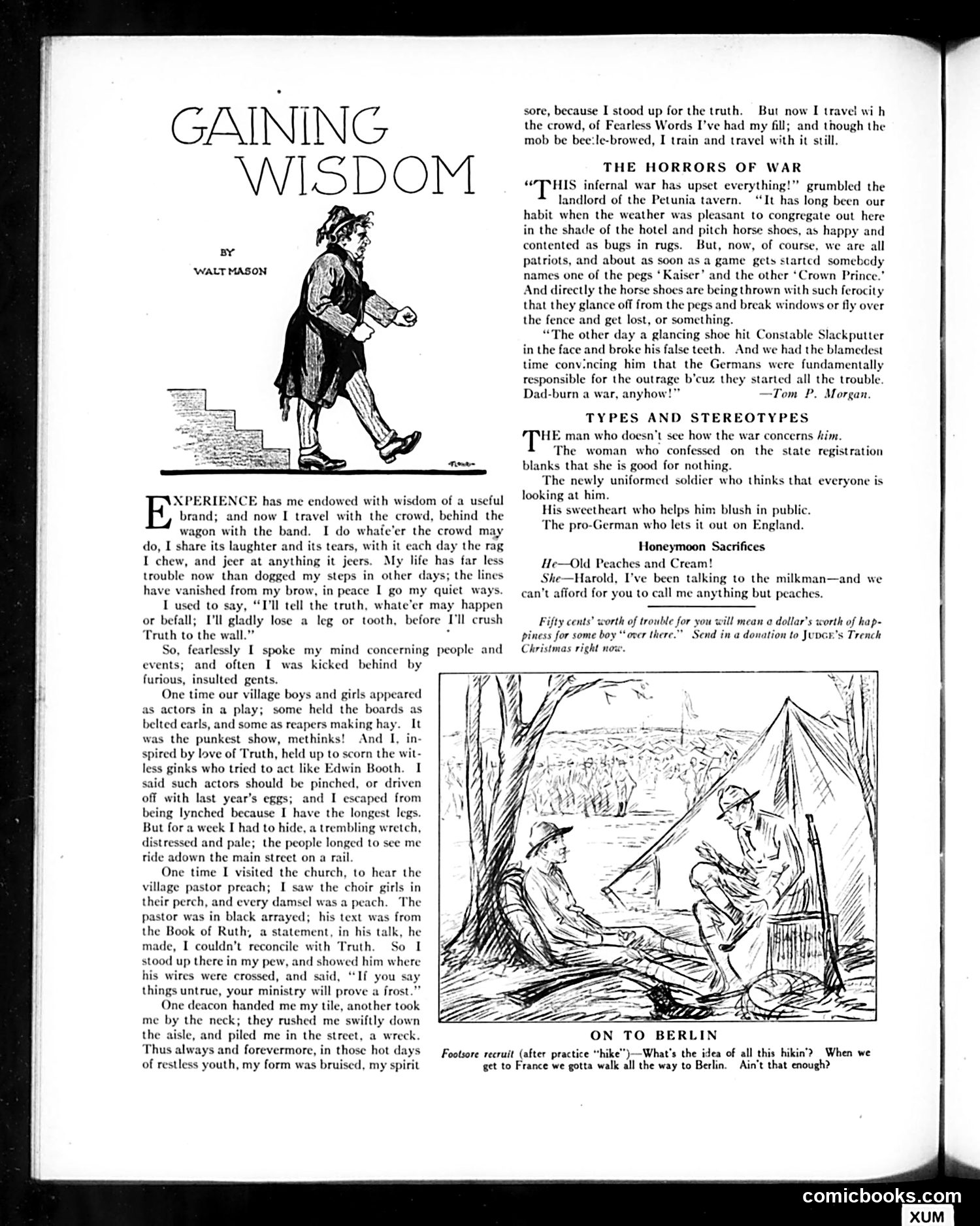
This page contains **"Gaining Wisdom" by Walt Mason**, a humorous essay-poem about the author's idealistic youth versus pragmatic adulthood. Mason describes his younger self as a fearless truth-teller who challenged injustice and fraud—and got beaten for it. Now older, he's learned to travel "with the crowd" and avoid confrontation, having abandoned his principles for peace. The accompanying satirical pieces mock WWI-era American attitudes. "The Horrors of War" jokes that patriotic fervor has ruined small-town leisure—even horseshoe games become violent when pegs are named after the Kaiser and Crown Prince. "Types and Stereotypes" catalogs war-obsessed social types. The cartoon (lower right) shows soldiers, likely illustrating wartime themes. **Context for modern readers**: This reflects American ambivalence about WWI involvement and how national fervor disrupted ordinary life. Mason's tale satirizes how people compromise ideals for social acceptance.
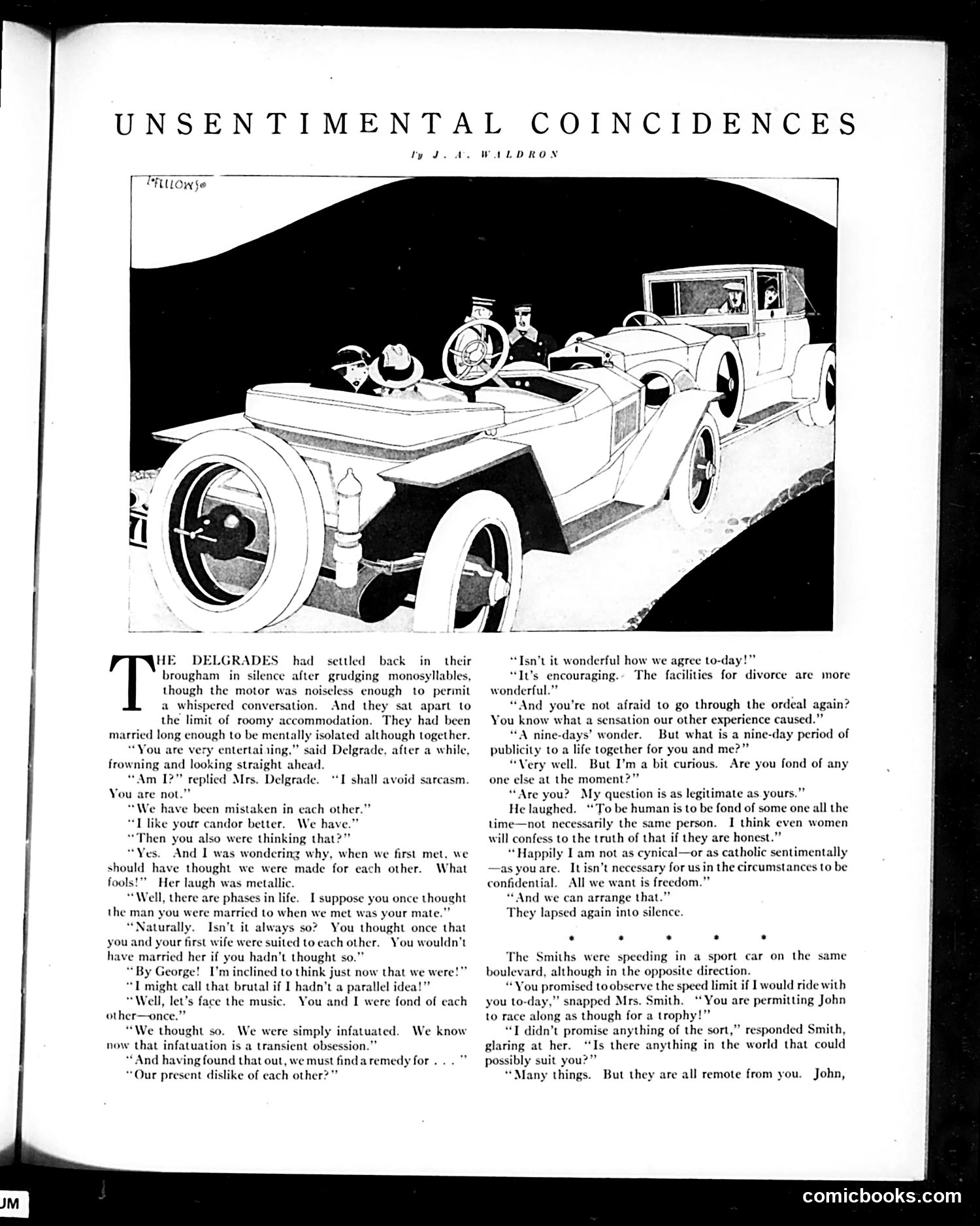
This story satirizes the casual attitudes toward marriage and divorce emerging in early 20th-century American society. The Delgrades, a married couple, acknowledge their marriage was based on infatuation rather than genuine compatibility. They discuss divorce with striking indifference, joking about "facilities for divorce" being "wonderful" and dismissing the scandal of their previous divorce as merely a "nine-days' wonder." The satire's point: modern divorce has become so normalized and emotionally detached that married people can discuss separation as pragmatically as discussing the weather. The parallel scene with the Smiths—quarreling over speeding—reinforces the theme: relationships are transactional and unsentimental, lacking deeper commitment. The title captures the irony: these unhappy marriages are "coincidences" rather than genuine matches, yet people treat such profound life changes with remarkable coldness.
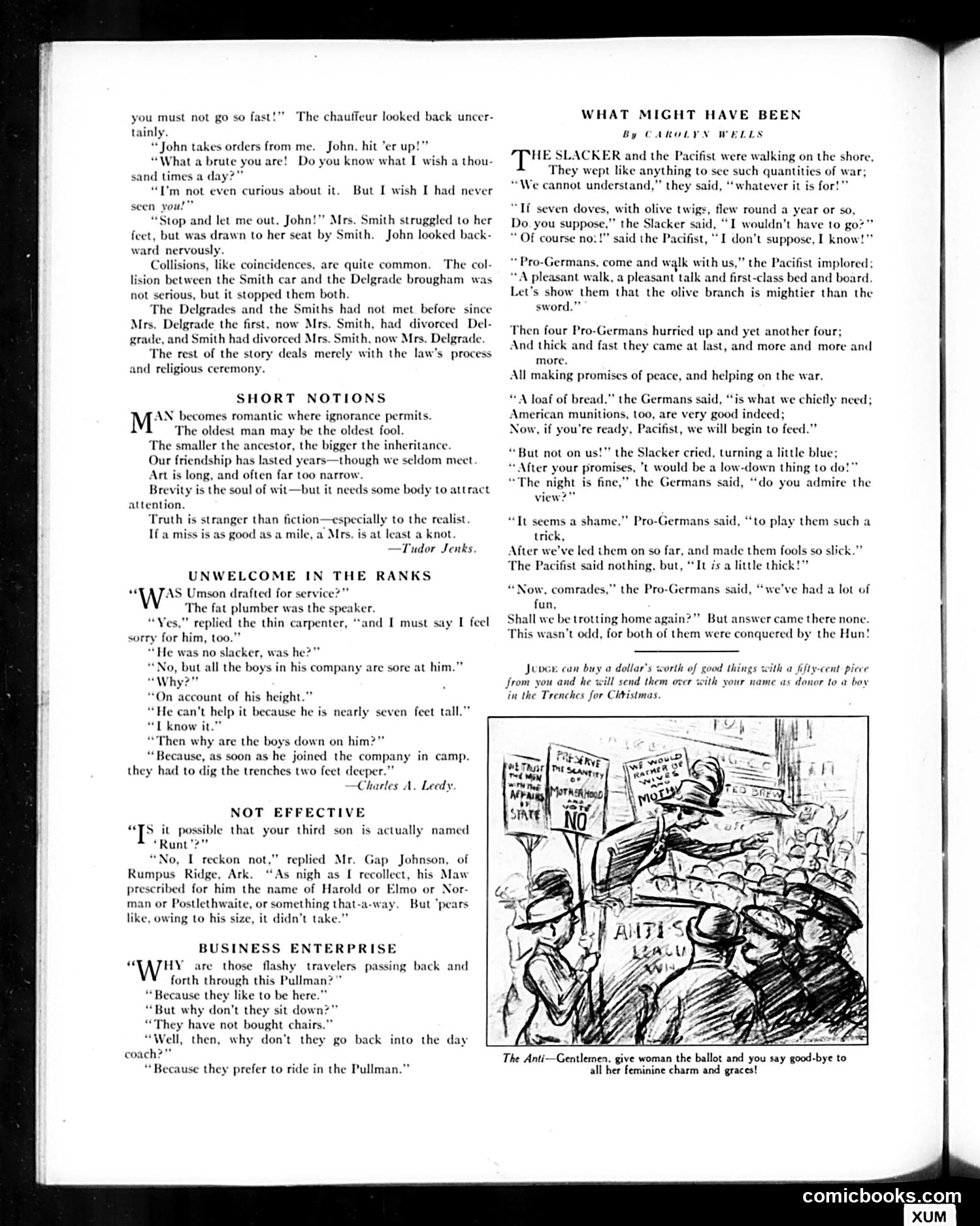
This page contains satirical content about World War I-era American society. The main cartoon depicts **anti-war activists ("the Slacker and the Pacifist")** being duped by **Pro-Germans** who pose as peaceful advocates. The Germans initially promise peace while secretly requesting American munitions and food supplies, revealing their true military agenda. The satire targets **pacifists and anti-war activists**, portraying them as naive and easily manipulated by German interests. The cartoon suggests that pacifism and opposition to the war actually aid the enemy's war effort. The page also includes brief humorous sketches about military life, including a tall soldier who must dig deeper trenches (mocking his unwilling contribution) and social commentary on class divisions (the Pullman car anecdote). The underlying message reflects wartime propaganda: those opposing American war involvement are either foolish or complicit with enemy objectives.
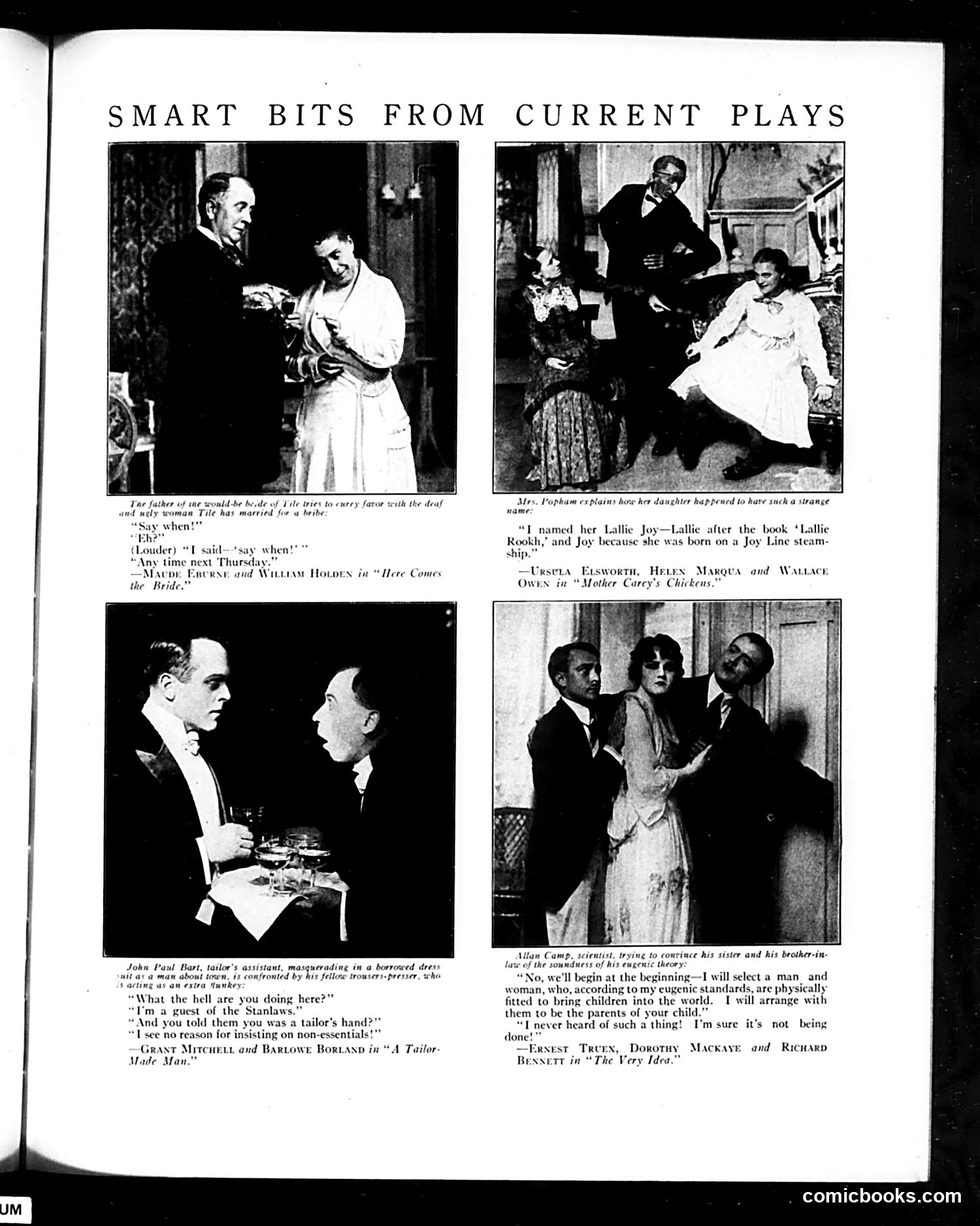
This page presents humorous dialogue excerpts from Broadway plays of the era (likely 1910s-1920s). The four scenes illustrate comedic moments: 1. **Top left**: A man jokes about naming his wife "Lallie Joy"—combining a book title with "Joy Line" (a steamship company), a pun on her arbitrary naming. 2. **Top right**: A character explains a daughter's unusual name origins through circumstance rather than intention. 3. **Bottom left**: A tailor's assistant cross-dresses to masquerade as a gentleman, creating confusion when discovered by a coworker—a common theatrical farce device. 4. **Bottom right**: A scientist advocates "eugenic standards" for selective breeding—promoting the then-fashionable pseudoscience of eugenics as a comedic concept, with family members shocked by his proposal to arrange parenthood. The page showcases popular theatrical humor of the day, mixing wordplay, mistaken identity, and social satire around contemporary trends like eugenic theory.
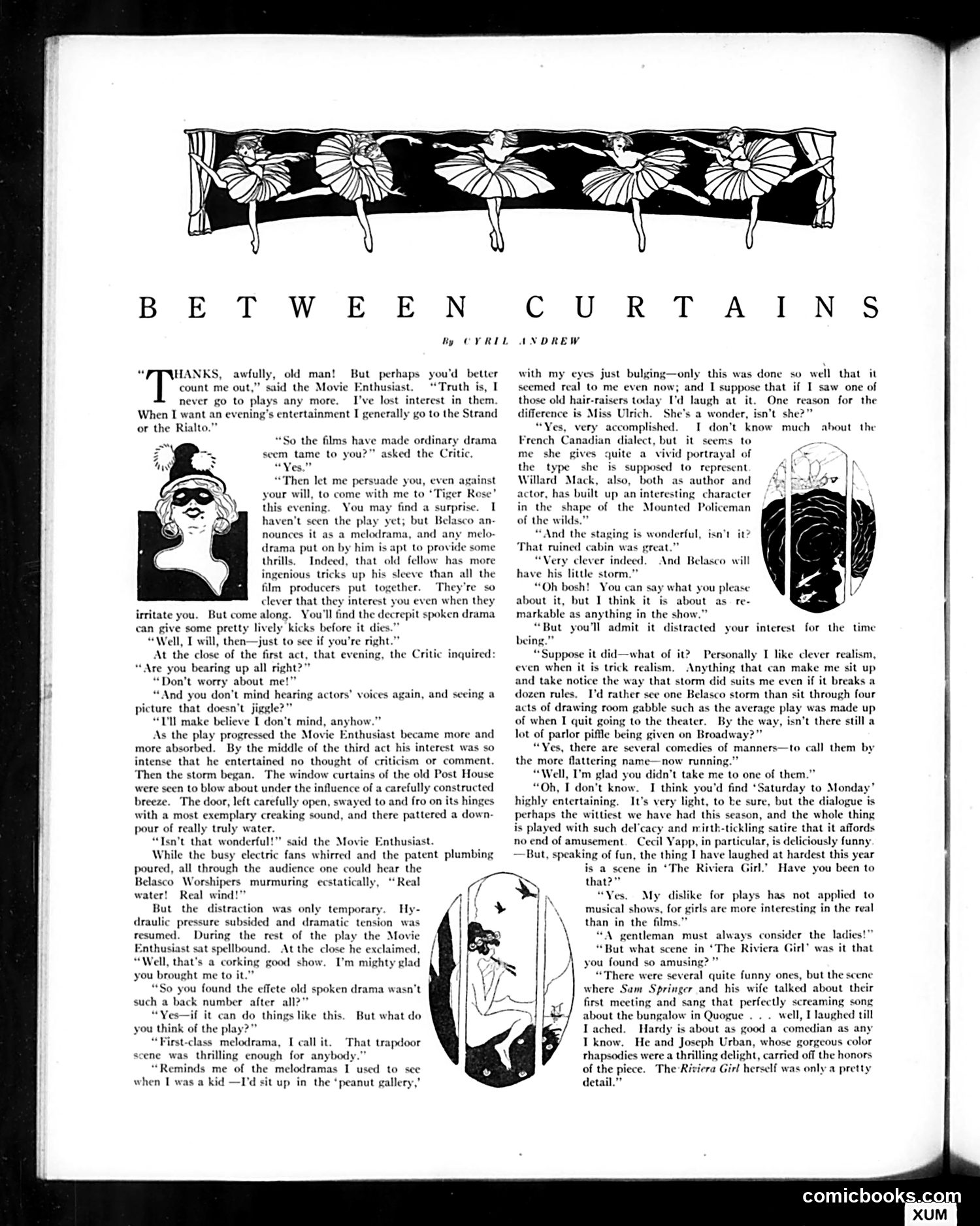
This satirical piece contrasts live theater with cinema, which was then relatively new and increasingly popular. A "Movie Enthusiast" claims films have made stage plays boring, but his skeptical friend (the Critic) persuades him to see David Belasco's production of *Tiger Rose*. The satire targets the Movie Enthusiast's snobbery about "talkies" and live performance. During the play, Belasco's famous technical wizardry—realistic wind machines, actual water effects, and elaborate staging—captivates him. By the end, the Enthusiast admits live theater can match film's appeal. The joke: the Critic proves that skilled stagecraft and acting (mentioning performers like Willard Mack and Miss Ulrich) can provide thrills equal to cinema. The piece defends theater against film's encroaching popularity, celebrating Belasco's reputation for elaborate mechanical effects that created genuine theatrical spectacle.
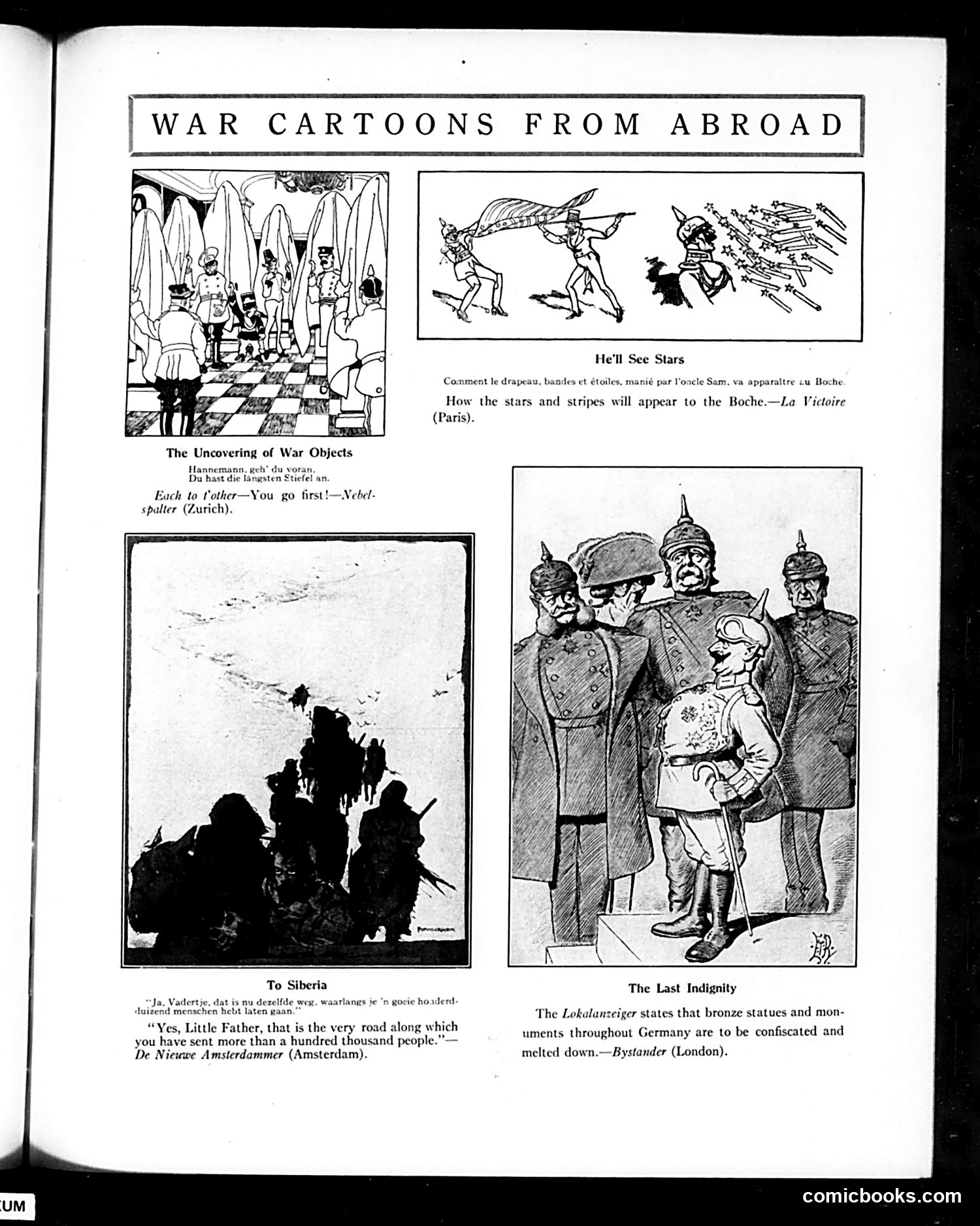
This page collects anti-German satirical cartoons from Allied nations during World War I. "He'll See Stars" (French) depicts a German soldier seeing stars from the American flag—suggesting American military power will literally daze the enemy ("the Boche"). "The Uncovering of War Objects" (Swiss) shows soldiers reluctantly going to battle. "To Siberia" (Dutch) references sending soldiers to the brutal Eastern Front, with a father telling his son he's following the same deadly road thousands have already traveled. "The Last Indignity" (British) mocks Germany melting down bronze monuments—suggesting German desperation and cultural degradation. The cartoons collectively portray Germany as losing, doomed, and resorting to increasingly desperate measures while Allied nations mock their inevitable defeat.
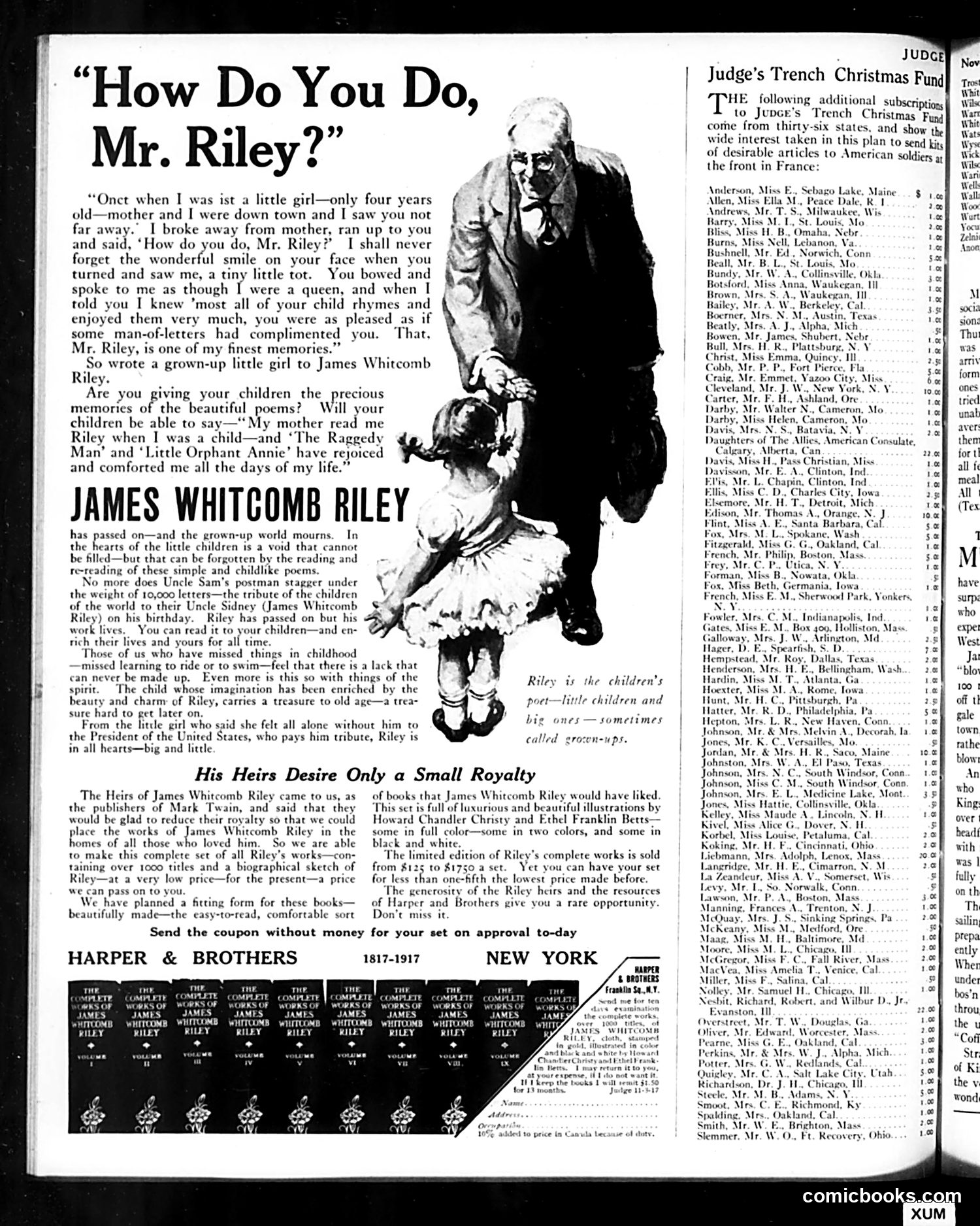
This is a **memorial advertisement** for James Whitcomb Riley, an American poet who had recently died. Riley was famous for writing sentimental children's poetry ("The Raggedy Man," "Little Orphant Annie"). The page uses **emotional nostalgia** to sell his complete works. The opening anecdote—a woman recalling how Riley kindly greeted her as a child—establishes him as a beloved cultural figure whose work shaped childhoods. The text claims his death leaves a void in children's lives that can only be filled by reading his poems. **The sales pitch**: Harper & Brothers is offering Riley's complete works at an unusually low price because his heirs voluntarily reduced royalties. This is presented as an act of generosity, not just commerce. The right column lists names and donations to "Judge's Trench Christmas Fund"—likely a WWI relief effort, situating this 1917 advertisement during wartime when such charitable appeals were common. The cartoon itself appears illustrative rather than satirical—simply depicting Riley as a gentle, grandfatherly figure interacting with children, reinforcing the sentimental sales message.
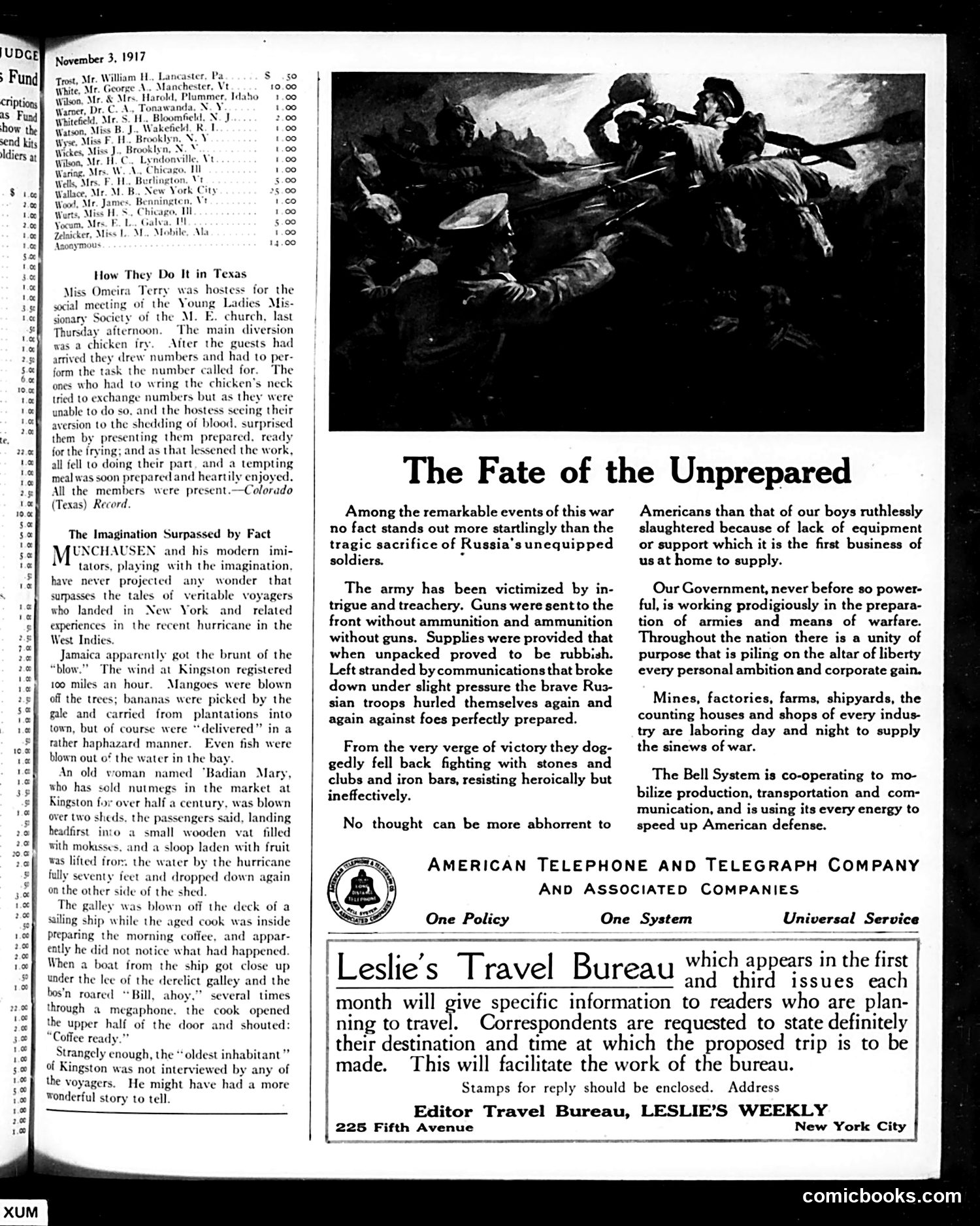
This page contains a dramatic editorial illustration and accompanying text criticizing Russia's military unpreparedness during World War I. The large image depicts Russian soldiers in desperate combat, fighting with primitive weapons against better-equipped forces. The accompanying article details Russia's catastrophic supply failures: troops sent to the front without ammunition, broken communications, and soldiers forced to resist "heroically but ineffectively" with stones and iron bars. The text emphasizes the tragic waste of brave soldiers sacrificed due to incompetence and logistical collapse. The editorial then pivots to reassure American readers that the U.S. government, "never before so powerful," is ensuring American soldiers will be properly equipped and supported. This represents American patriotic confidence in 1917, shortly after U.S. entry into the war, contrasting American preparedness with Russia's documented failures. The underlying message: America will not repeat Russia's mistakes.
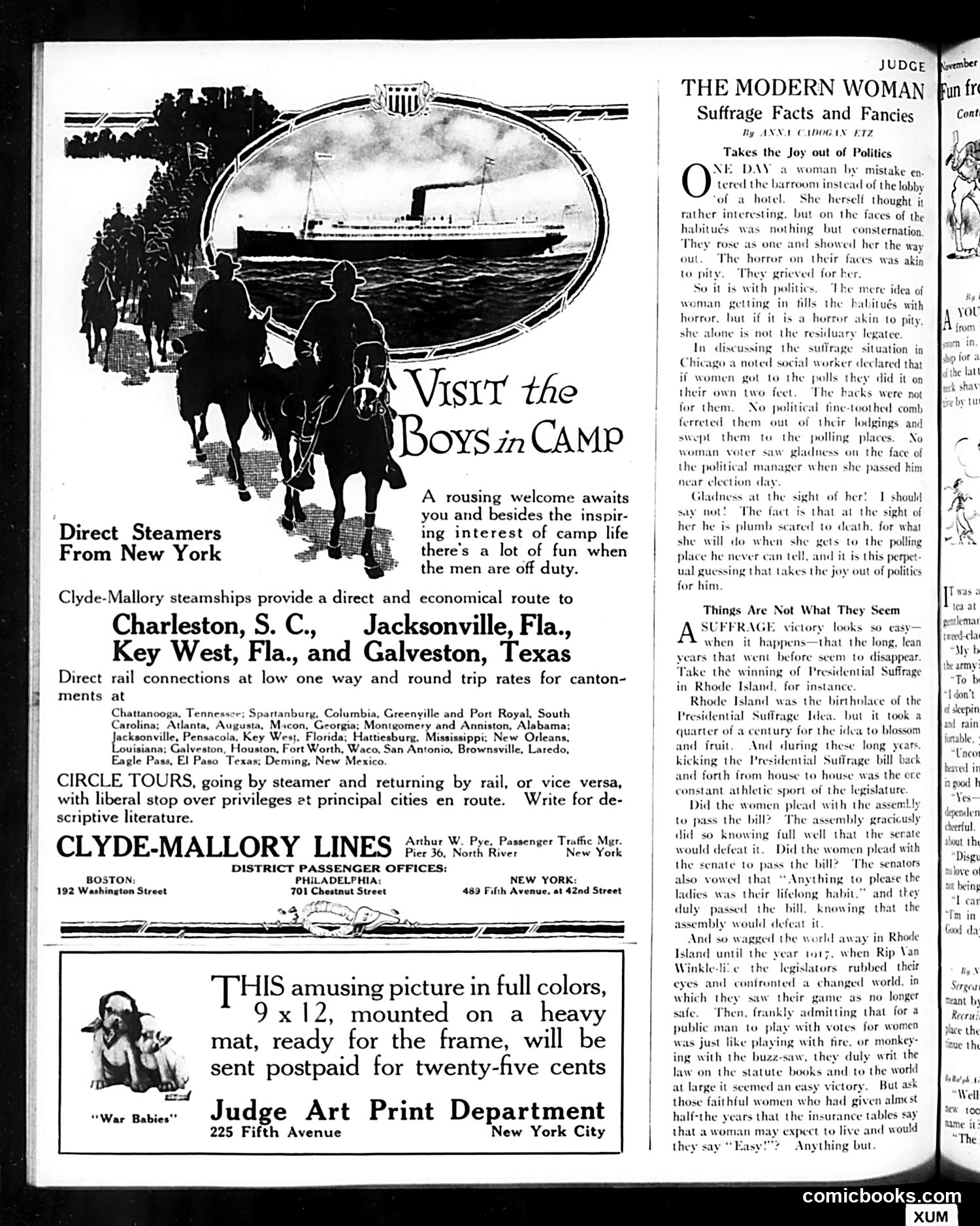
This page contains mostly **advertisements and filler content**, not political cartoons requiring interpretation. The left side features a **Clyde-Mallory steamship advertisement** promoting travel to Southern ports, contextually relevant to WWI (note references to military "cantonments"). The bottom advertises an art print from Judge's print department. The right side contains **"The Modern Woman: Suffrage Facts and Fancies"** by Anna Cadogan Ertz—a satirical column mocking women's suffrage. The humor relies on traditional gender stereotypes: women voters terrify political managers because they're "unpredictable," and the author sarcastically describes women's decades-long struggle for Rhode Island presidential suffrage as effortless. The tone is dismissive and patronizing toward women's political participation, typical of anti-suffrage sentiment in this era. The column appears designed to entertain male readers through ridicule of feminist ambitions.
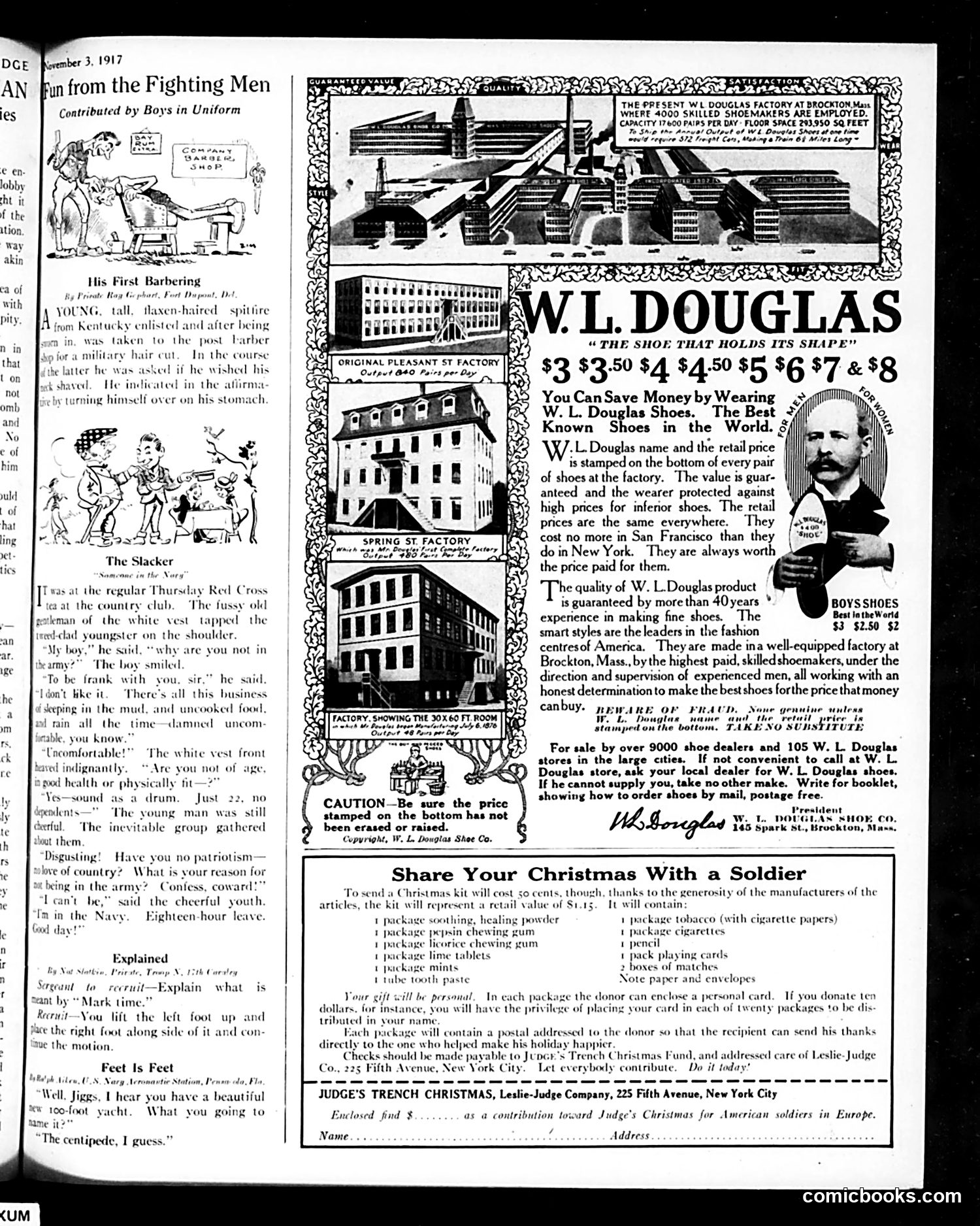
This page mixes humor with wartime messaging. The left side contains three comedic sketches about military life: **"His First Barbering"** depicts a Kentucky recruit unfamiliar with military procedures, establishing a "country rube" character type. **"The Slacker"** satirizes a young man avoiding military service by claiming discomfort with army conditions—mud, uncooked food—while admitting he's healthy and of age. His claim to be in the Navy on leave undercuts his excuses, mocking those who evaded WWI service. **"Feet Is Feet"** appears to be wordplay about military drill. The right side is dominated by W.L. Douglas shoe advertising, with a patriotic appeal below promoting "Judge's Trench Christmas"—a fund to send care packages (tobacco, gum, playing cards) to American soldiers in Europe. **Context**: This is December 1917, months after U.S. entry into WWI. The slacker joke reflects contemporary anxiety about draft resistance; the Christmas appeal validates military sacrifice as worthy of civilian support.
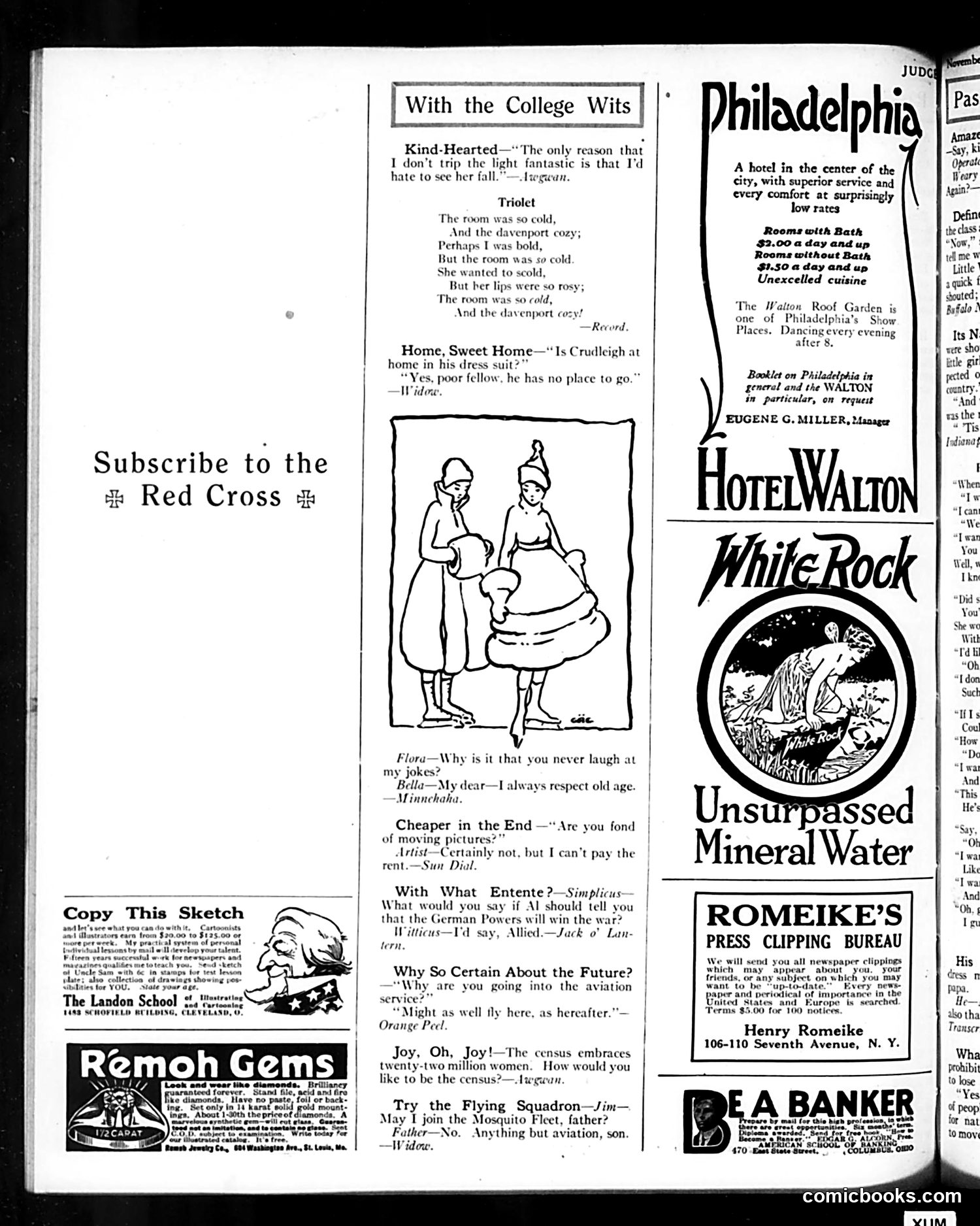
This page from *Judge* magazine features light collegiate humor and advertisements. The "College Wits" section contains short, witty jokes and poems from various college publications, typical of early 20th-century student humor. These are genteel observations about romance (a cold room making a couple cozy), social awkwardness, and courtship—reflecting period attitudes about gender and propriety. The scattered jokes reference World War I ("German Powers will win the war"), aviation as a new, dangerous pursuit, and the 1910 U.S. Census ("twenty-two million women"). The humor is mild and nostalgic ("Home, Sweet Home"). The advertisements—for Hotel Walton (Philadelphia), White Rock mineral water, and Romeike's Press Clipping Bureau—reflect contemporary consumer and business services. There's no sharp political satire here; rather, this is mainstream magazine filler combining collegiate wit with commercial promotion typical of the era.
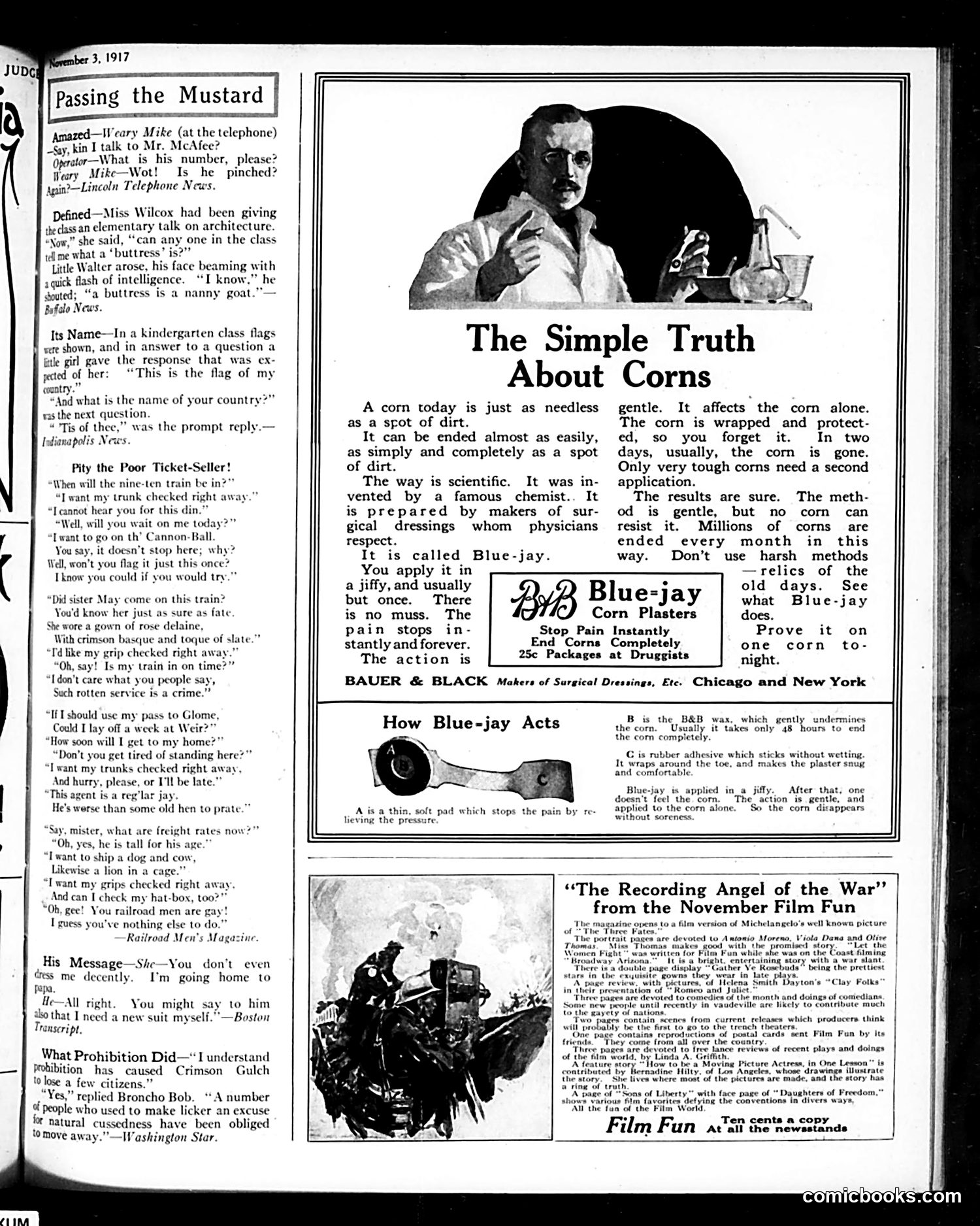
This page from *Judge* (November 3, 1917) consists primarily of **humorous anecdotes** in the "Passing the Mustard" section—brief jokes about everyday situations, not political cartoons. Topics include a telephone mix-up, a child's definition of architecture, and a ticket-seller pestered by impatient travelers. The page is **dominated by advertising**: a full-page Blue-Jay Corn Plaster advertisement claiming scientific superiority over old remedies. This reflects 1917's marketing emphasis on "modern" medical solutions. One small anecdote references **Prohibition**, suggesting some citizens moved away when alcohol bans eliminated their excuse for "natural cussedness"—a mild joke about hypocrisy among drinkers. The page contains **no major political satire** visible. It reflects typical early-20th-century magazine content: light humor, advertisements positioned as informative articles, and references to contemporary conveniences (telephones, railroads).
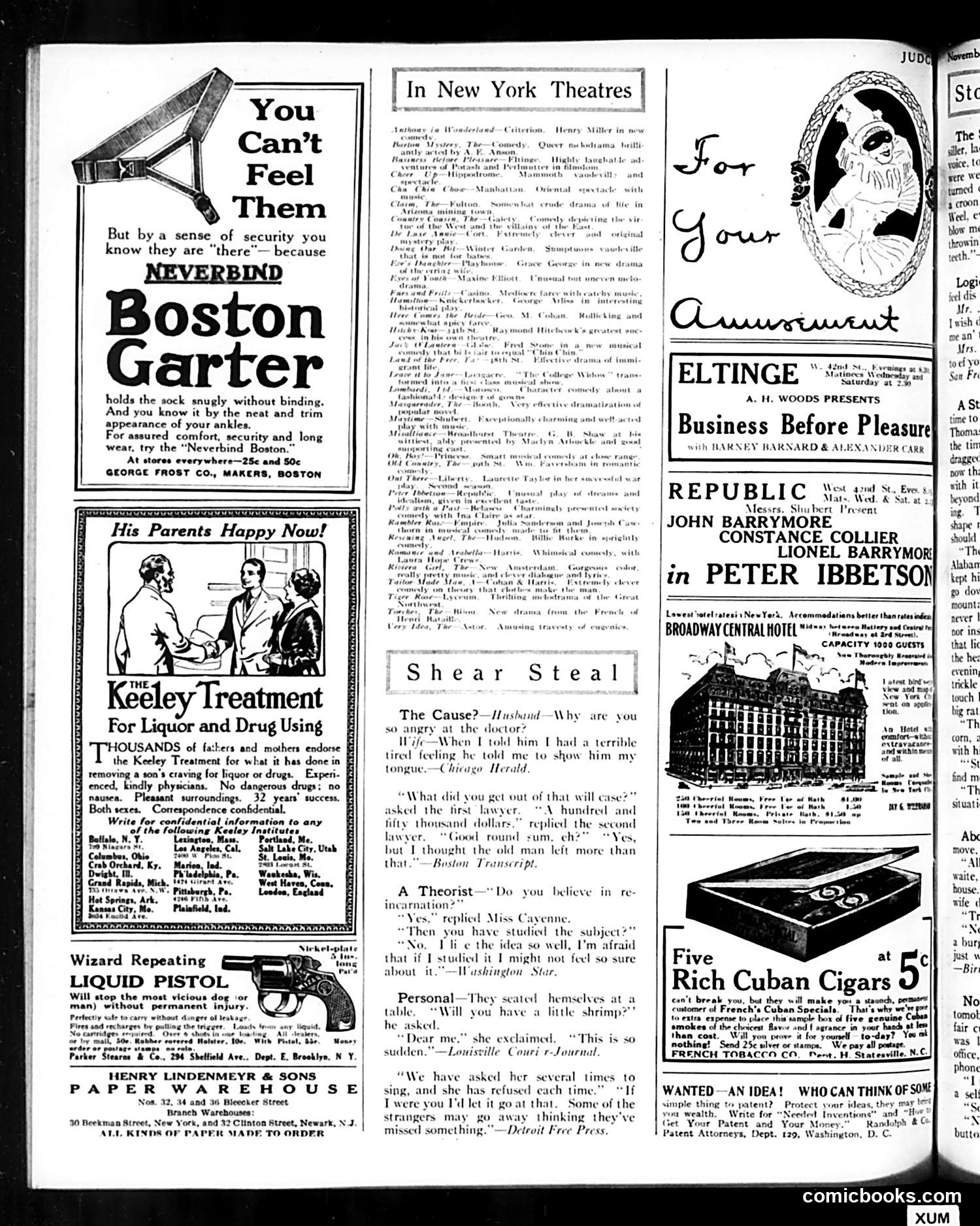
This page is primarily **advertising**, with small joke fillers scattered throughout. The main satirical content is minimal. The notable elements: **"Shear Steal"** section contains brief jokes mocking lawyers and doctors—typical early-20th-century professional ridicule. One joke portrays a doctor as dismissively asking a patient to "show him her tongue," implying medical incompetence or condescension. The bulk of the page advertises consumer products (Boston Garter socks, Keeley Treatment for alcoholism/drug addiction, "Liquid Pistol" dog repellent) and New York theater productions. The **Keeley Treatment ad** is historically notable: it reflects period concerns about substance abuse and promoted a real sanitarium claiming 32 years of success treating addiction—a common pitch in early-1900s publications. **Theater listings** promote contemporary Broadway shows with actors like John Barrymore. Overall, this appears to be a **commercial section** rather than satirical editorial content, showing how Judge magazine balanced humor with revenue-generating advertising.
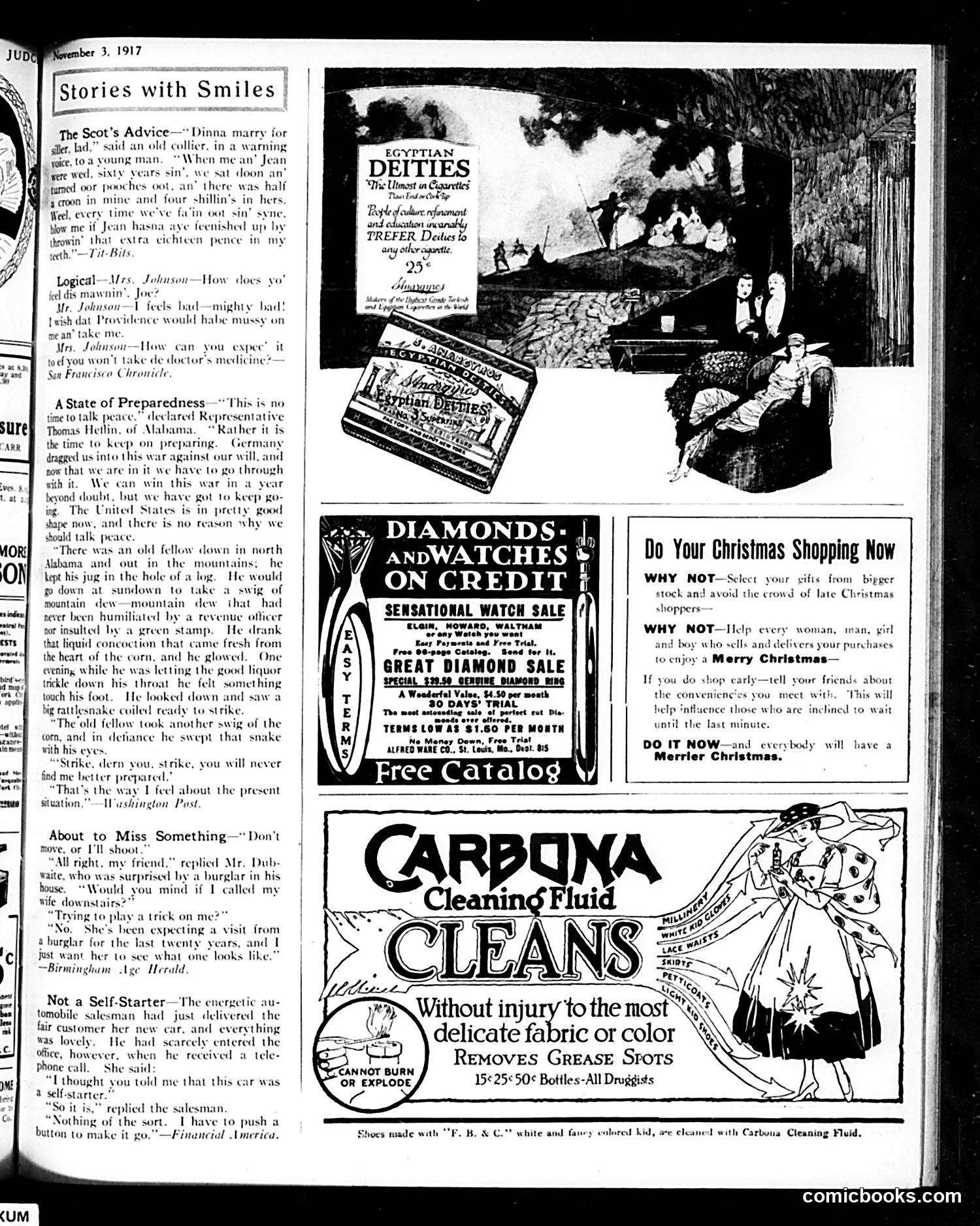
This page is primarily **humorous short stories and advertisements**, not political cartoons. The "Stories with Smiles" section contains four brief joke pieces: 1. **Scottish collier's marriage advice** — a dialect humor piece about financial arguments in a 60-year marriage 2. **Logical dialogue** — a sick man and his wife's unsympathetic response 3. **"State of Preparedness"** — a Representative's WWI speech arguing against peace talks, followed by a mountain-man anecdote about defiance (the rattlesnake story appears to be a metaphorical response to the war debate) 4. **Burglar humor** — a husband wants his wife to see a burglar because she's "been expecting" one The page includes period **advertisements for Egyptian Deities cigarettes, diamond watches, and Carbona cleaning fluid**. The content reflects **1917 wartime American attitudes**: the preparedness speech shows support for continuing WWI effort, while the lighter stories offer escapist humor. There are no identifiable caricatures or specific political figures beyond the unnamed Representative Hellin.
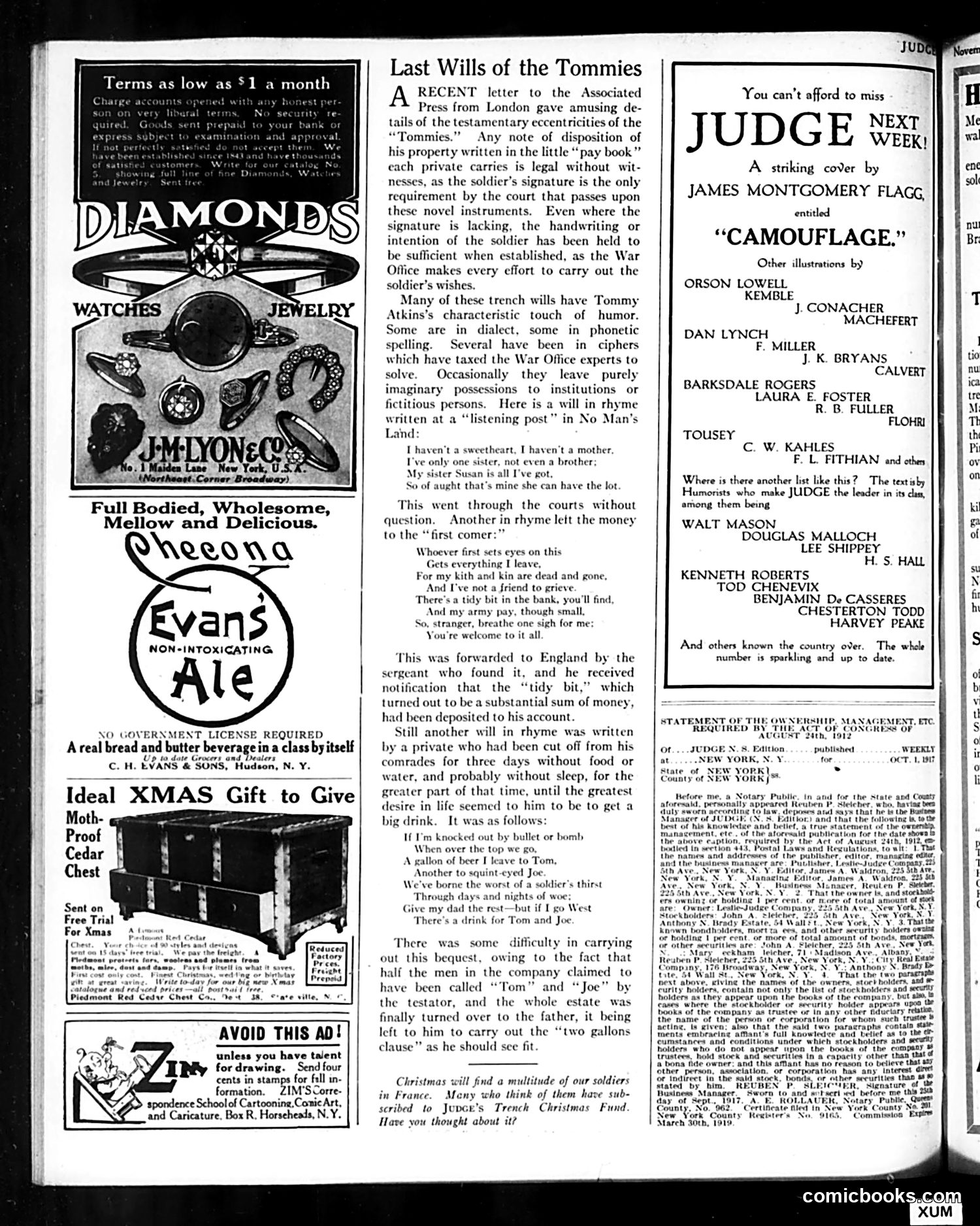
This article documents the real practice of British soldiers (called "Tommies") writing wills in their pay books during World War I. The humor lies in the soldiers' irreverent attitudes toward death—they draft these documents with dark comedy and whimsy rather than solemnity. The examples shown use rhyming verse and casual language. One soldier bequeaths his meager possessions to whoever finds the will first; another—apparently delirious from hunger and sleep deprivation in the trenches—leaves beer to comrades named Tom and Joe. A third instructs his father to distribute "two gallons" as best he sees fit. The satire's point: these wills reveal soldiers' grim humor and camaraderie in facing death, while also exposing the poverty and deprivation of trench warfare. British courts actually honored these informal documents, treating soldiers' intentions seriously despite their lighthearted tone—a poignant contrast between the documents' levity and their fatal purpose.
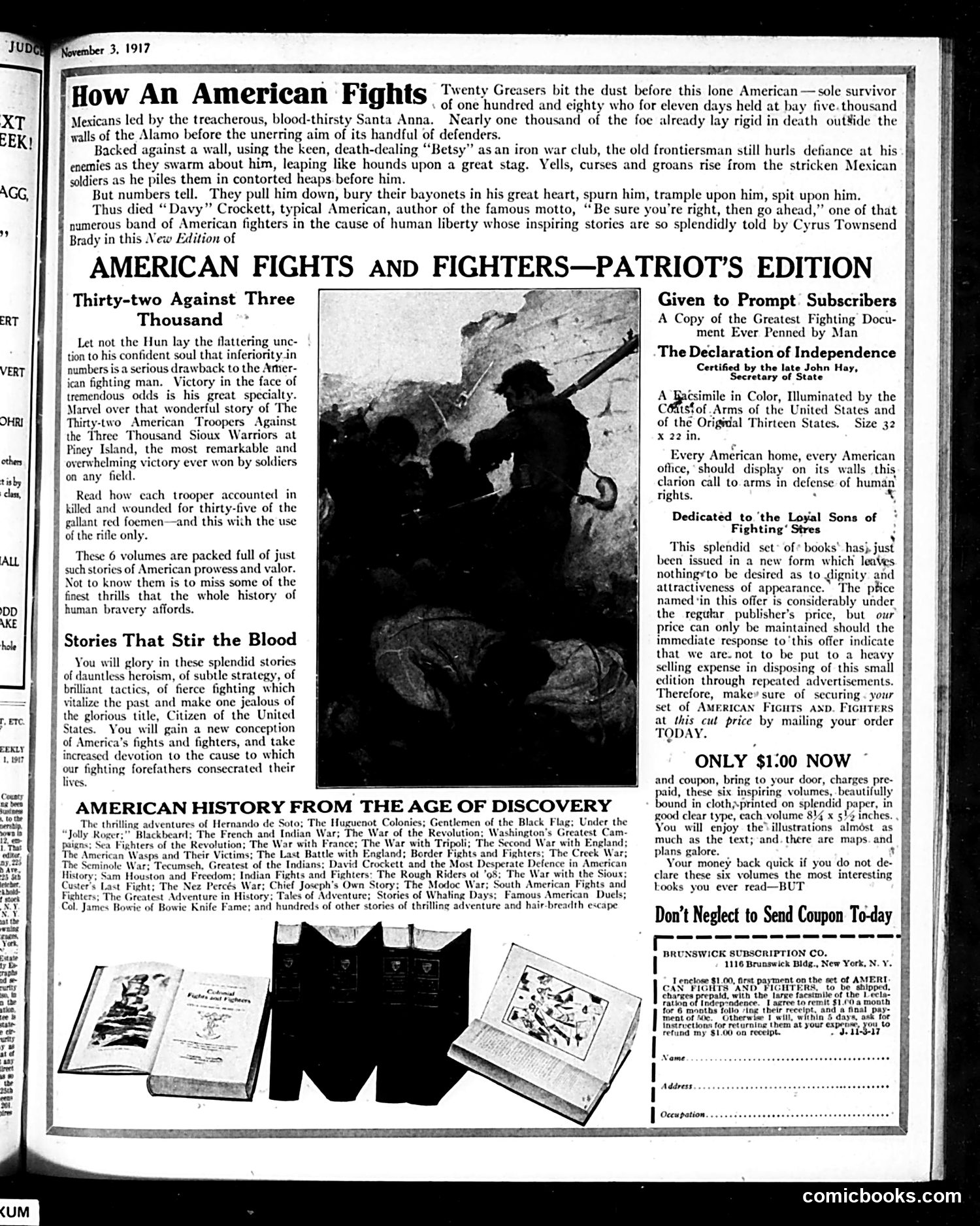
This page advertises "American Fights and Fighters," a six-volume patriotic book series by Cyrus Townsend Brady, published during World War I. The advertisement uses heroic narratives of American military history to stir nationalist fervor. The text celebrates two historical episodes: Davy Crockett at the Alamo fighting Mexican forces (described using the racial slur "Greasers"), and thirty-two American cavalry troops defeating three thousand Sioux warriors at Piney Island. These stories frame American military superiority despite numerical disadvantage—a rhetorical move aimed at 1917 readers as America entered WWI against Germany (referenced as "the Hun"). The advertisement pairs these historical narratives with a facsimile Declaration of Independence to link past American "liberty" fights with present patriotic duty. The $1.00 price point and subscription coupon indicate a mass-market appeal designed to spread nationalist ideology during wartime. The page conflates westward expansion and Indian warfare with defending "human rights."
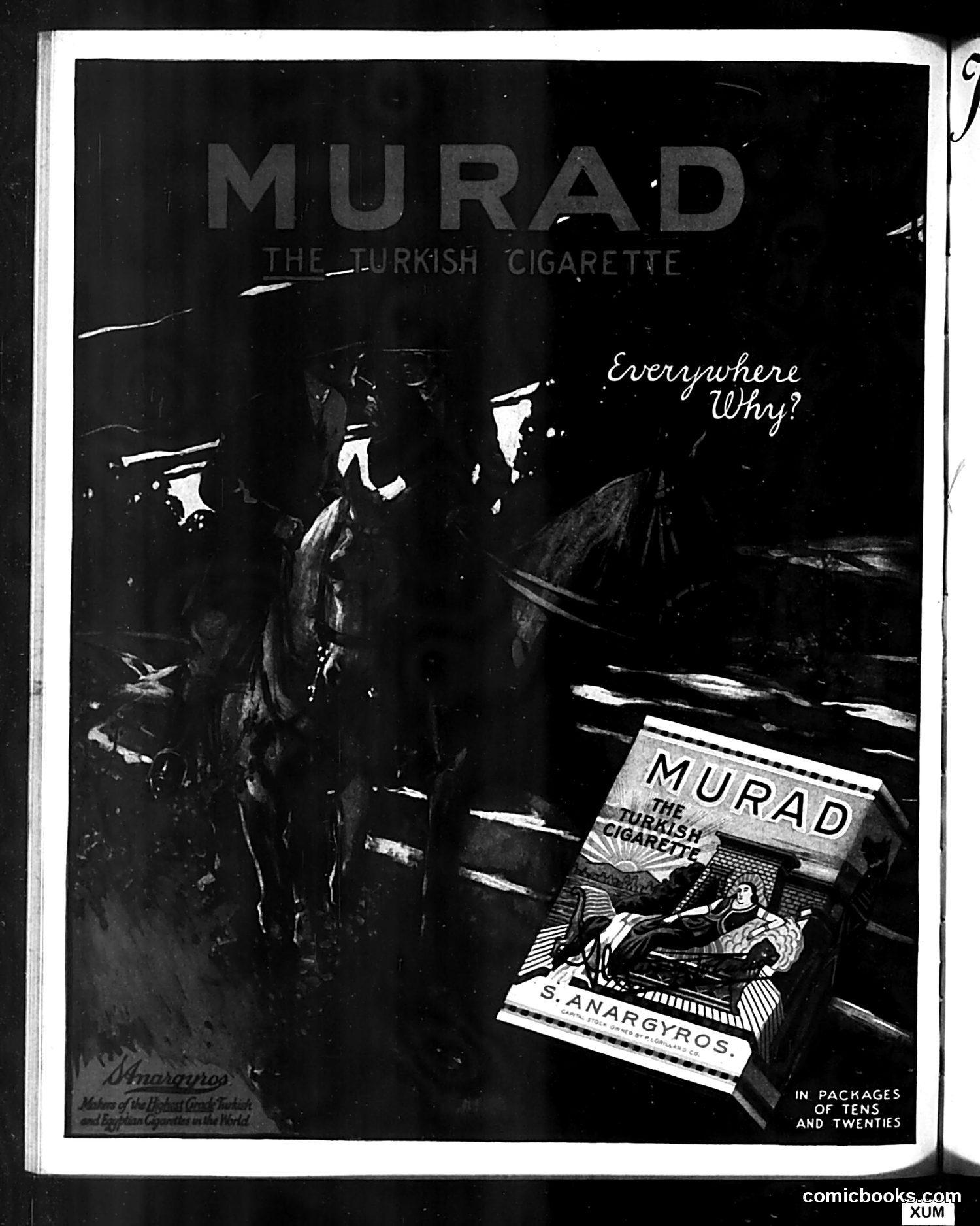
This is a **cigarette advertisement** for Murad, "the Turkish Cigarette," rather than political satire. The ad features silhouetted figures in what appears to be a Middle Eastern or exotic setting, with the tagline "Everywhere Why?" suggesting the cigarettes' widespread popularity. The lower right shows a Murad cigarette package alongside what appears to be S. Anargyros branding (likely the distributor). Text indicates packaging comes in "tens and twenties." The small print at bottom left credits "Anargyros" as "Makers of the Highest Grade Turkish Cigarettes in the World." This reflects early 20th-century advertising that marketed "Turkish" cigarettes as exotic luxury products, playing on orientalist imagery popular in that era.