
Judge, 1917-11-03 · page 14 of 28
Judge — November 3, 1917 — page 14: what you’re looking at
What you’re looking at
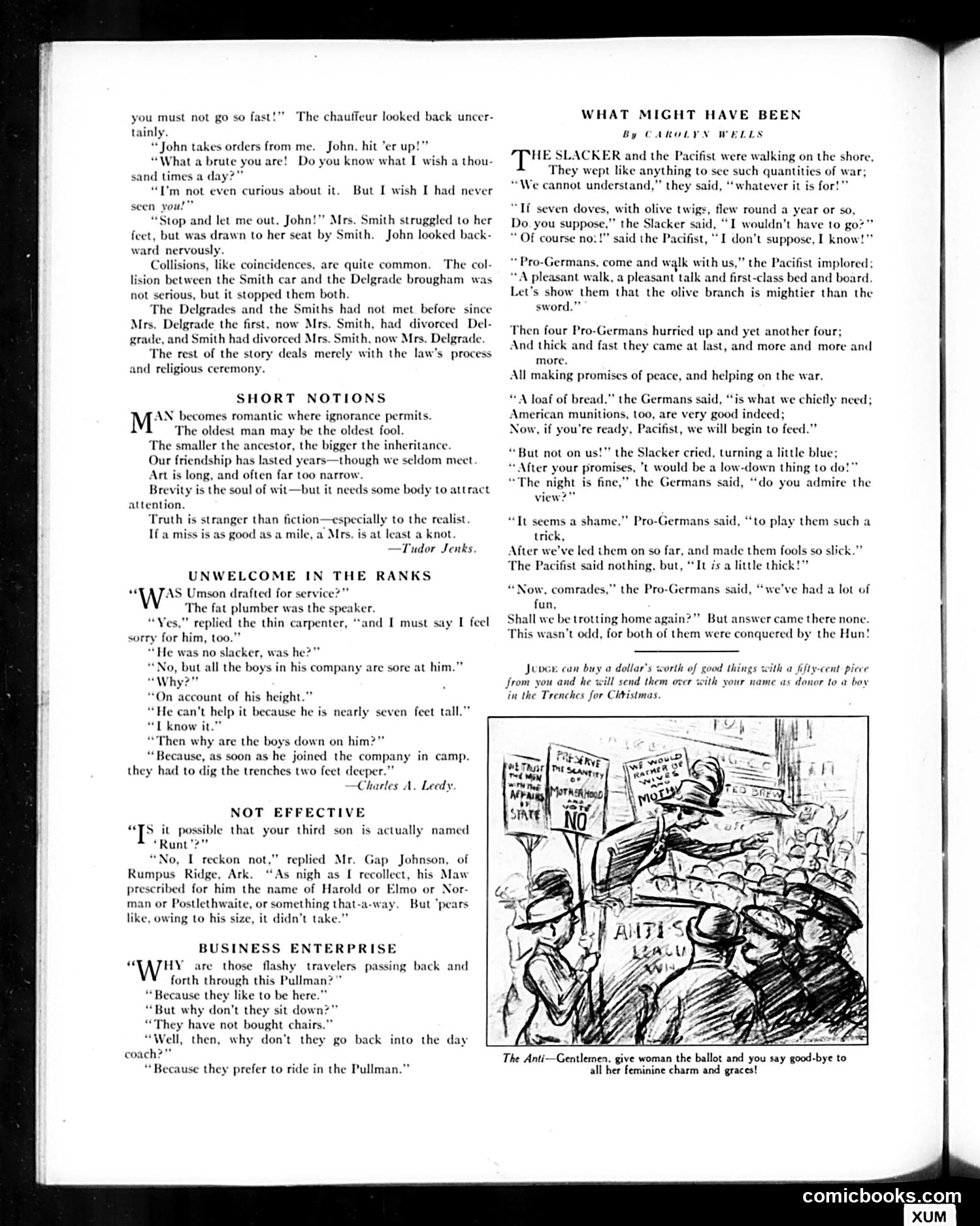
This page contains satirical content about World War I-era American society. The main cartoon depicts **anti-war activists ("the Slacker and the Pacifist")** being duped by **Pro-Germans** who pose as peaceful advocates. The Germans initially promise peace while secretly requesting American munitions and food supplies, revealing their true military agenda. The satire targets **pacifists and anti-war activists**, portraying them as naive and easily manipulated by German interests. The cartoon suggests that pacifism and opposition to the war actually aid the enemy's war effort. The page also includes brief humorous sketches about military life, including a tall soldier who must dig deeper trenches (mocking his unwilling contribution) and social commentary on class divisions (the Pullman car anecdote). The underlying message reflects wartime propaganda: those opposing American war involvement are either foolish or complicit with enemy objectives.
📄 Transcribed text from this page (OCR, searchable)
Machine-transcribed from the original scan — historical spelling and the odd misread are preserved.
you must not go so fast!” The chauffeur looked back uncer- tainly. “John takes orders from me. “What a brute you are! sand times a day? “I'm not even curious about it John, hit ‘er up!” Do you know what I wish a thou- But I wish I had never and let me out, John!” Mrs. Smith struggled to her s drawn to her seat by Smith. John looked back- ward nervous! Collisions, like coincidences, are quite common, lision between the Smith car and the Delgrade brougham was not serious, but it stopped them both. The Delgrades and the Smiths had not met before since Mrs. Delgrade the first, now Mrs. Smith, had divorced Del- grade, and Smith had divorced Mrs. Smith, now Mrs. Delgrade. The rest of the story deals merely with the law’s process and religious ceremony. The col- SHORT OTION M*s becomes romantic where ignorance permits. The oldest man may be the oldest fool. The smaller the ancestor, the bigger the inheritance. Our friendship has lasted years—though we seldom meet Art is long, and often far too narrow. Brevity is the soul of wit—but it needs some body to attract attention. Truth is stranger than fiction—especially to the realist If a miss is as good as a mile, a Mrs. is at least a knot. udor Jenks. UNWELCOME IN THE RANKS AS Umson drafted for service?” The fat plumber was the speaker. “y replied the thin carpenter, “and I must say I fi sorry for him, too.” He was no slacker, was he?” “No, but all the boys in his company are sore at him.” “Why?” “On account of his height.” “He can’t help it because he is nearly seven feet tall.” I know it.” “Then why are the boys down on him?” “ Because, as soon as he joined the company in camp. they had to dig the trenches two feet deeper. Charles A. Leedy. NOT EFFECTIVE “TS it possible that your third son is actually named “Runt’?” No, I reckon not,” replied Mr. Gap Johnson, of Rumpus Ridge, Ark. “As nigh I recollect, his Maw prescribed for him the name of Harold or Elmo or Nor- man or Postlethwaite, or something that-a-way. But ‘pears like, owing to his size, it didn’t tak BUSINES ENTERPRISE HY are those flashy travelers passing back and forth through this Pullman?” “Because they like to be here.” But why don’t they sit down? “They have not bought chairs.” “Well, then, why don’t they go back into the day coach? “Because they prefer to ride in the Pullman.” WHAT MIGHT HAVE BEEN By CAKOLYN WELLS HE SLACKER and the Pacifist were walking on the shore, hey wept like anything to see such quantities of war; “We cannot understand,” they said, “whatever it is for! “Tf seven doves, with olive twigs, flew round a year or so, Do. you suppose,” the Slacker said, “I wouldn’t have to g * Of course no:!" said the Pacifist, “I don’t suppose, I know! * Pro-Germans, come and walk with us,” the Pacifist implored; \ pleasant walk, a pleasant talk and first-class bed and board. Let’s show them that the olive branch is mightier than the sword.” jermans hurried up and yet another four; t they came at last, and more and more and ‘Then four Pro- And thick and mor All making promises of peace, and helping on the war. “A loaf of bread,” the Germans said, “is what we chiefly need; American munitions, too, are very good indeed; Now, if you're ready, Pacifist, we will begin to feed.” “But not on us!” the “After your promise “The night is fine, view?” Slacker cried, turning a little blue; . 't would be a low-down thing to do!” the Germans said, “do you admire the “Tt seems a shame,” Pro-Germans said, “to play them such a trick, After we've led them on so far, and made them fools so slick.”” The Pacifist said nothing, but, “ little thick!” “Now, comrades,” the Pro-Germans said, “we've had a lot of fun, Shall we be trotting home again?” But answer came there none. This wasn’t odd, for both of them were conquered by the Hun! Jevce can buy a dollar's worth of good things with a fifty-cent piece from you and he will send them over with your name as donor to a boy in the Trenches for Cltistmas A RW The Anti—Gentlemen. give woman the ballot and you say good-bye to all her feminine charm and graces! comicbooks.com