
A complete issue · 28 pages · 1917
Judge — February 10, 1917
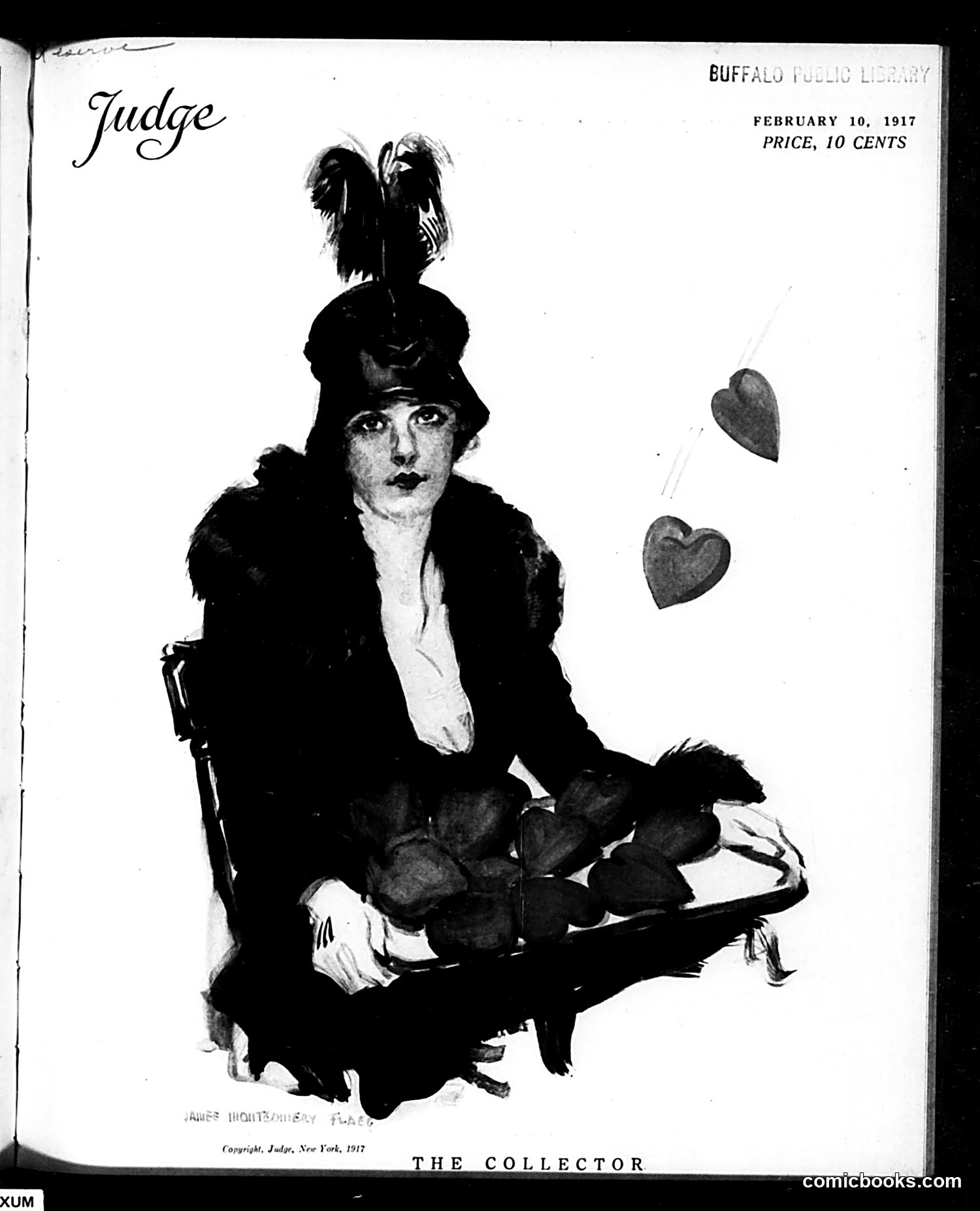
This satirical illustration depicts a fashionably dressed woman with an elaborate feathered hat, holding a tray of chocolate candies shaped like hearts. Two floating hearts appear above her. The cartoon is titled "The Collector," suggesting commentary on Valentine's Day gift-giving or romantic pursuits. The woman's sophisticated clothing and deliberate pose imply she is collecting romantic attentions or affections—the "hearts" being metaphorical representations of suitors' devotion. The satire likely mocks the commercialization of Valentine's Day or critiques women's strategic pursuit of romantic admirers during this period. The elegant presentation and her composed expression suggest ironic commentary on courtship rituals and gender dynamics in early 20th-century society.
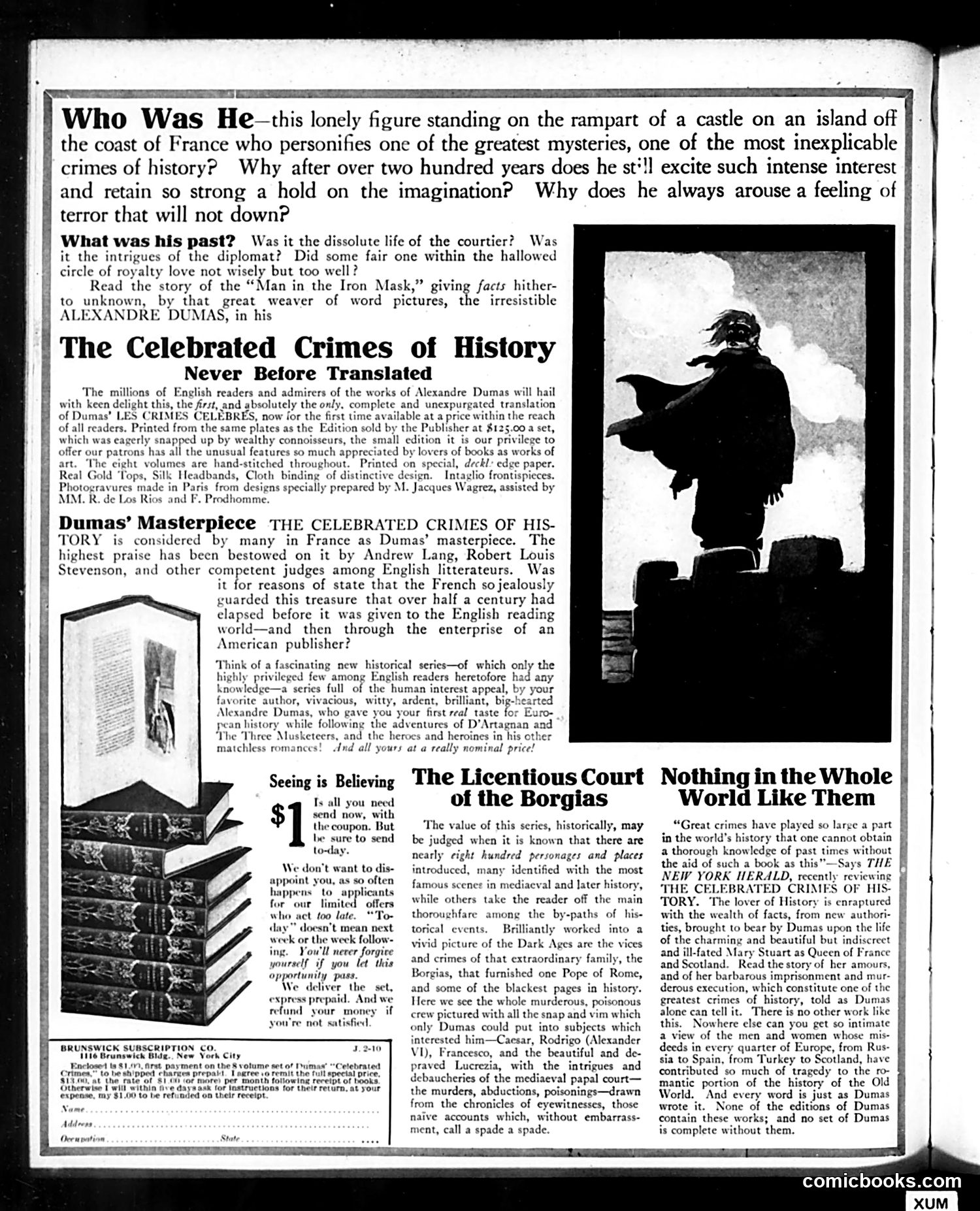
This page is primarily **advertising**, not satire or political commentary. It promotes a new English translation of Alexandre Dumas's *The Celebrated Crimes of History*, a multi-volume historical series. The advertisement emphasizes that this is the first complete English translation, previously unavailable to English readers despite Dumas's fame. The silhouetted figure on the right appears to be a dramatic illustration—likely depicting one of history's notorious criminals discussed in the work, given the "Man in the Iron Mask" reference in the opening text. The ad highlights the books' quality (hand-stitched, special paper, Paris photogravures) and appeals to Dumas enthusiasts and history lovers. The tone is promotional, not satirical.
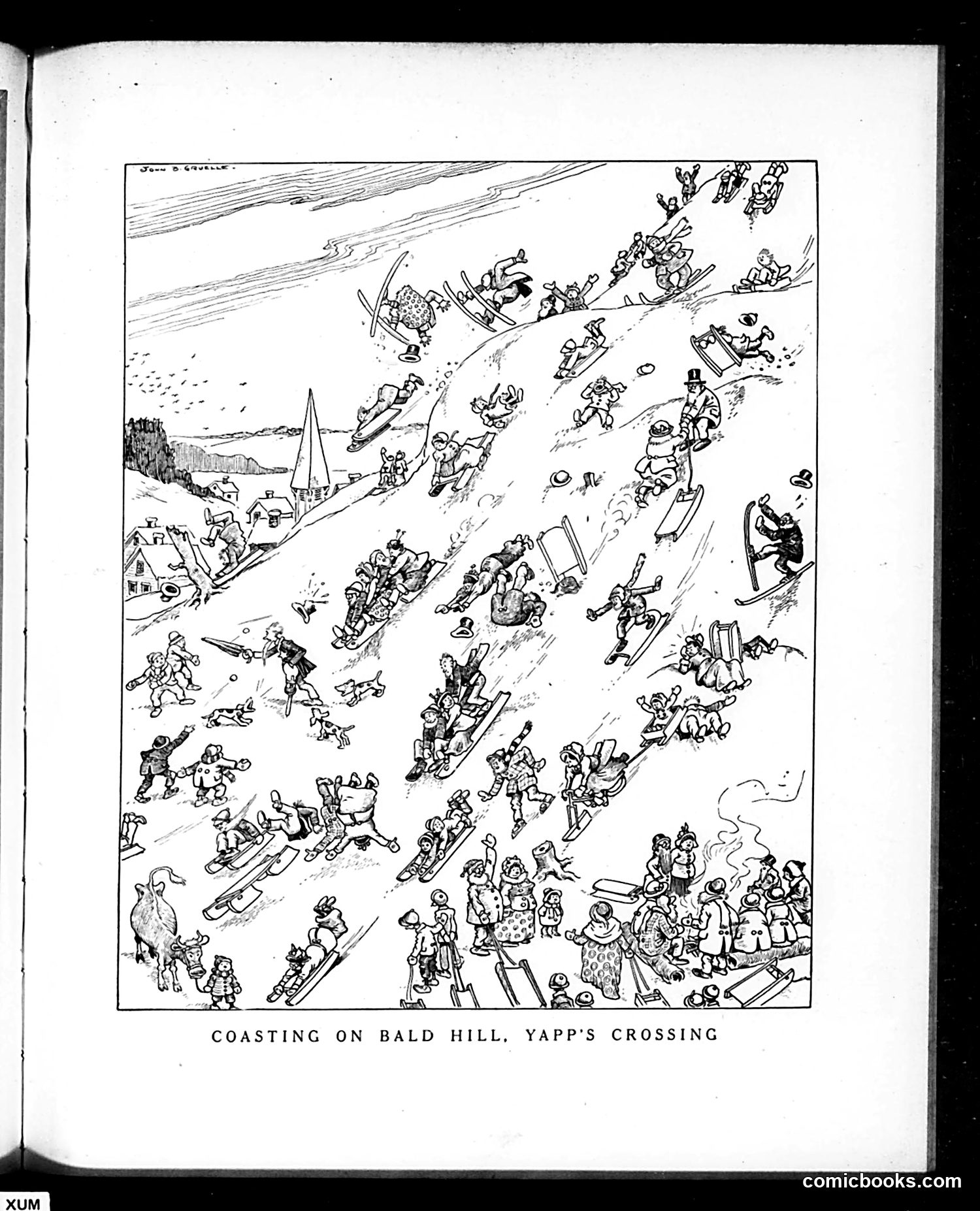
This illustration depicts a winter recreational scene of sledding/coasting down a snowy slope. The caption references "Bald Hill" at "Yapp's Crossing," suggesting a specific popular sledding location known to Judge's readers. The cartoon satirizes winter leisure culture by crowding the hillside with dozens of figures engaged in various sledding activities—some on sleds, others tumbling or playing. The scene captures both the joy and chaos of recreational coasting, with people of different ages and social classes mingling on the slopes. A small building (likely a warming house or tavern) appears at the base. The humor derives from the bustling, almost chaotic energy of the crowded slope and the varied mishaps and comedic poses of the sledders, reflecting contemporary winter entertainment and social mixing at popular recreational sites.
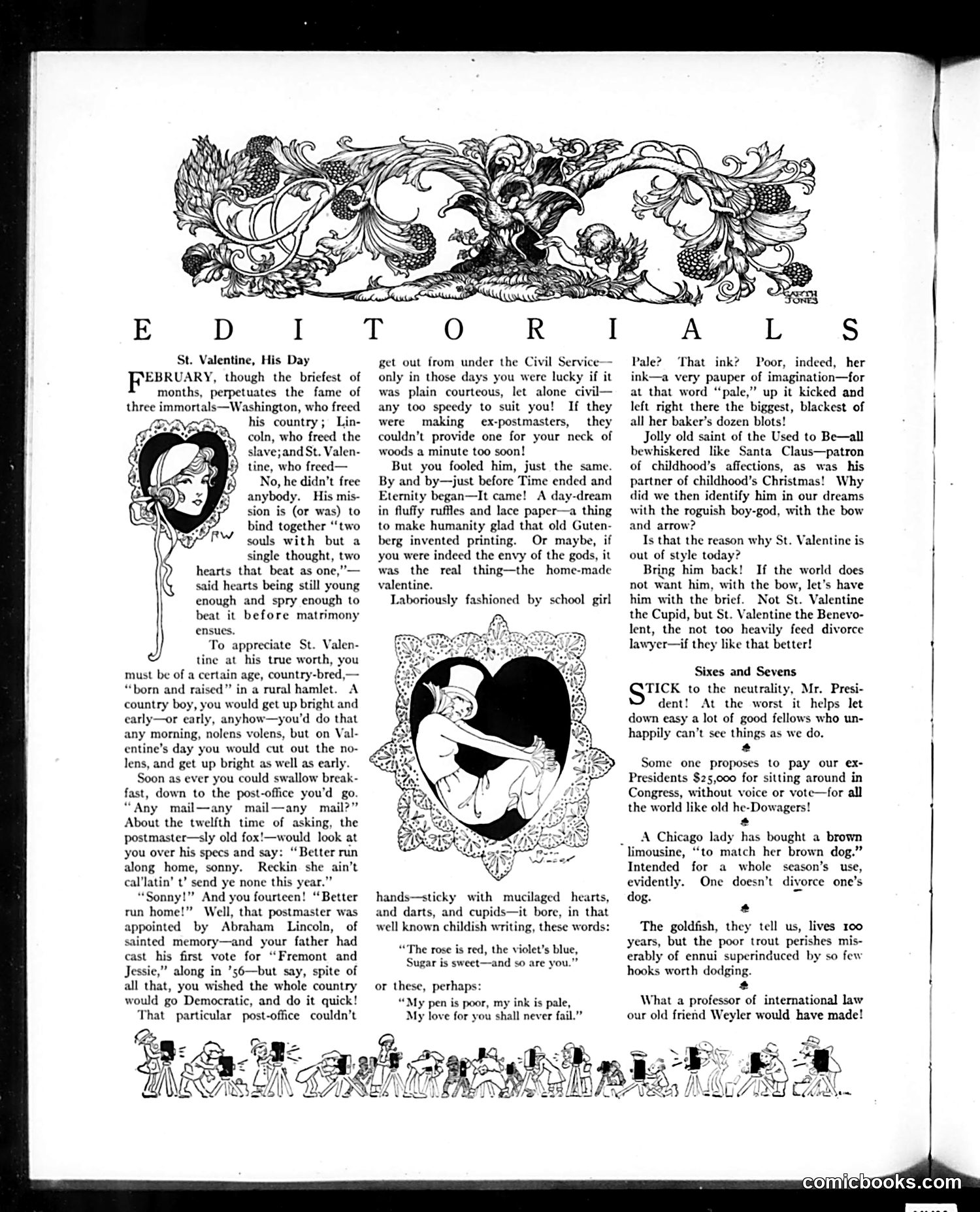
This page contains a satirical essay about St. Valentine's Day traditions, not political cartoons. The main illustration shows a cherub or cupid figure within a decorative heart frame. The text mocks various aspects of Valentine's customs: the tradition of anonymous love letters, the commercialization of the holiday, and outdated postal service practices. It references Abraham Lincoln casting a vote for "Fremont and Jessie" (likely the 1856 presidential election), using this as a humorous analogy about old postal workers. The piece also contains brief satirical items about executive salaries and a Chicago lady divorcing her dog—typical light social commentary. The decorative border at the page bottom shows stylized figures. This appears to be general-interest satire rather than hard political critique.
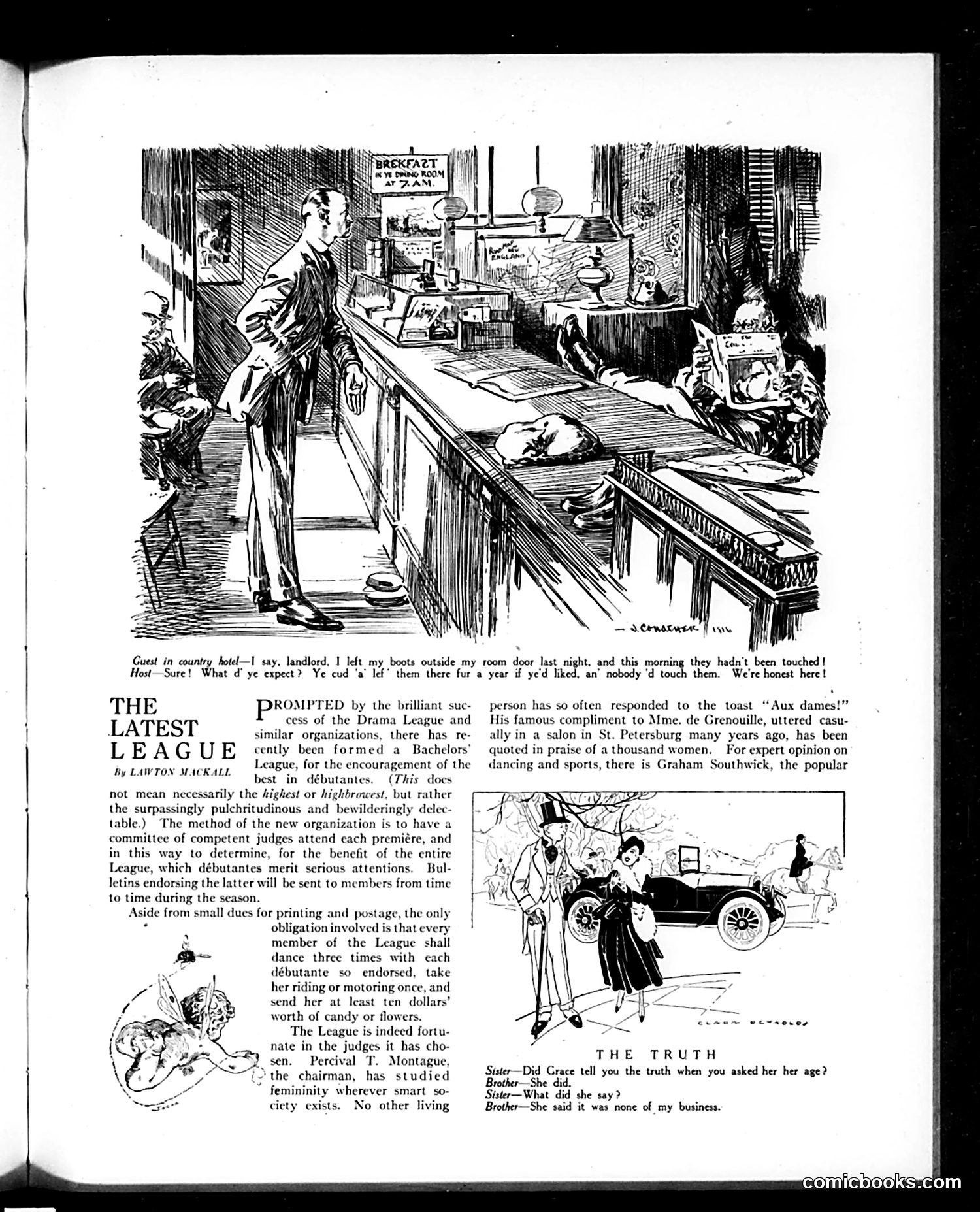
The page contains two distinct cartoons with social commentary: **Top cartoon ("Breakfast Room"):** A guest at a country hotel complains his boots disappeared overnight. The host defensively claims honesty, suggesting the guest left them where "nobody'd touch them" for a year. The satire mocks rural hospitality and implies theft despite protestations of virtue—a jab at rustic establishments' reliability. **"The Latest League":** Text describes a new "Bachelors' League" for encouraging theatrical performances. The article praises its judges, particularly Percival T. Montague, for his refined taste in femininity. **Bottom cartoon ("The Truth"):** A brother questions his sister about whether she told the truth regarding her age. She admits she lied, claiming it was "none of my business." The joke satirizes women's secretiveness about age—a period commentary on feminine vanity.
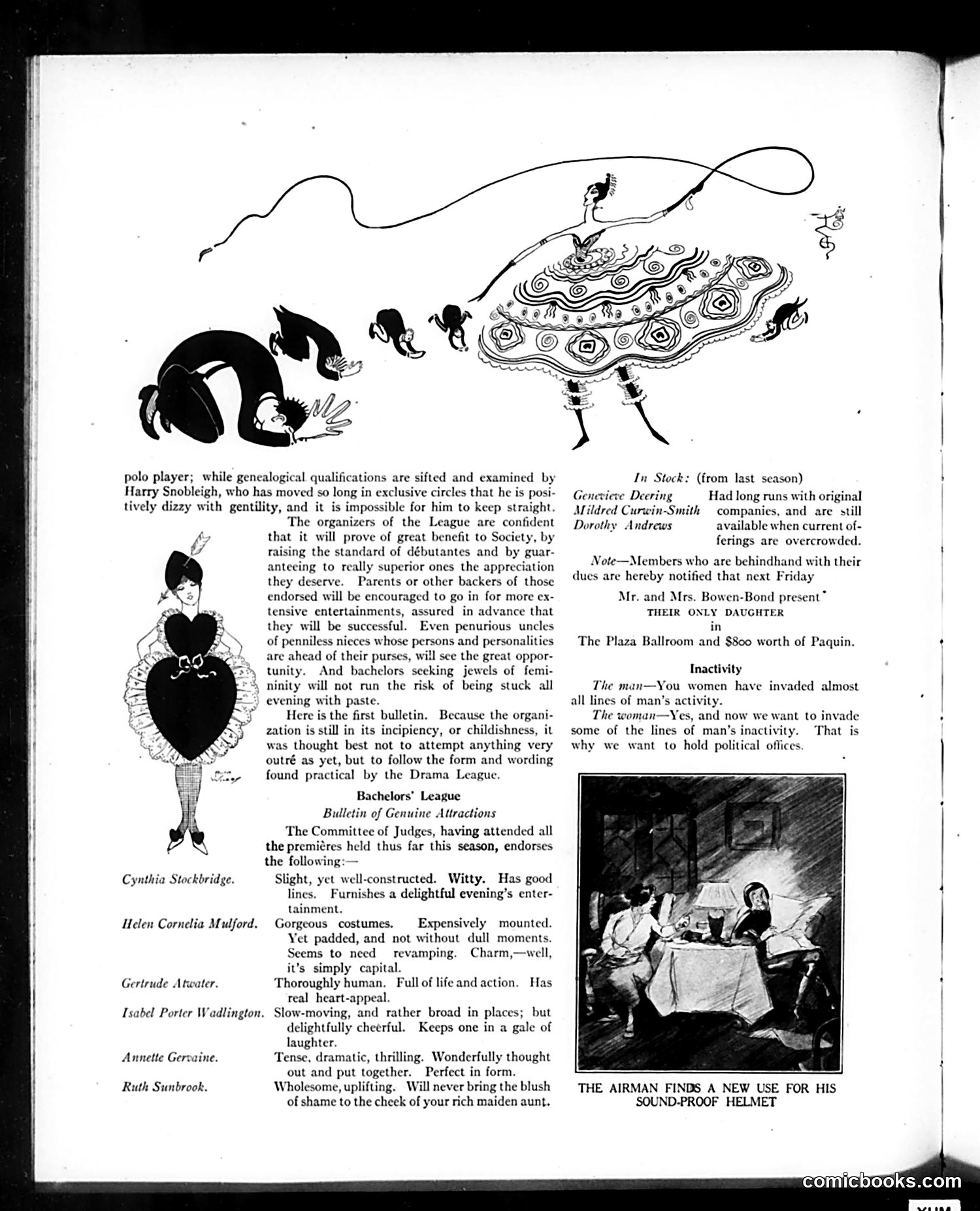
This page mixes theatrical reviews with satirical commentary. The top cartoon depicts a large figure (possibly representing a theatrical production or trend) being chased by smaller figures—likely satirizing the popularity or invasive nature of some entertainment phenomenon. The "Bachelors' League" section reviews actresses' stage performances with pointed critiques. The text below titled "Inactivity" presents a dialogue between "The man" and "The woman" discussing women invading "lines of man's activity" and the desire to "hold political offices." This is social satire on early women's suffrage and workplace participation movements. The photograph caption references "The Airman" finding "a new use for his sound-proof helmet"—likely a joke about aviation technology, though the specific reference remains unclear without additional context.
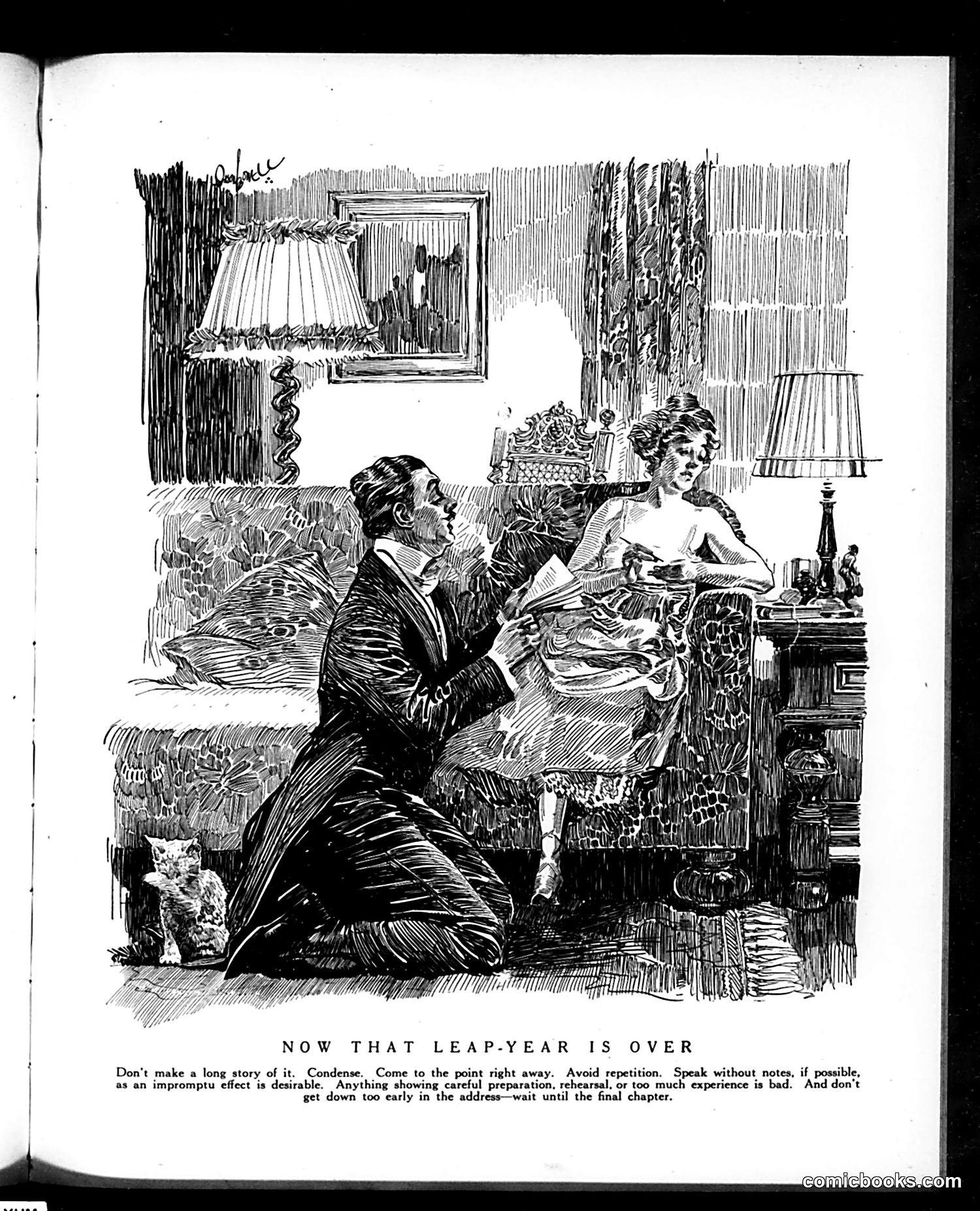
This satirical piece references the tradition that during leap years, women could propose to men—reversing normal gender roles. The cartoon shows a man kneeling before a woman in a domestic interior, apparently having been proposed to during the leap year. The text below offers comedic "advice" for men accepting such proposals, instructing them to be brief, avoid preparation, and sound spontaneous. The satire mocks both: 1. **Women's boldness during leap year**, treating female romantic initiative as shocking enough to require special coaching 2. **Male anxiety about proposal etiquette**, humorously suggesting men should disguise their acceptance as casual rather than deliberate The humor relies on Victorian-era gender expectations where male proposal-giving was standard. Judge magazine's readership would recognize leap-year proposal traditions as a comedic inversion of social norms.
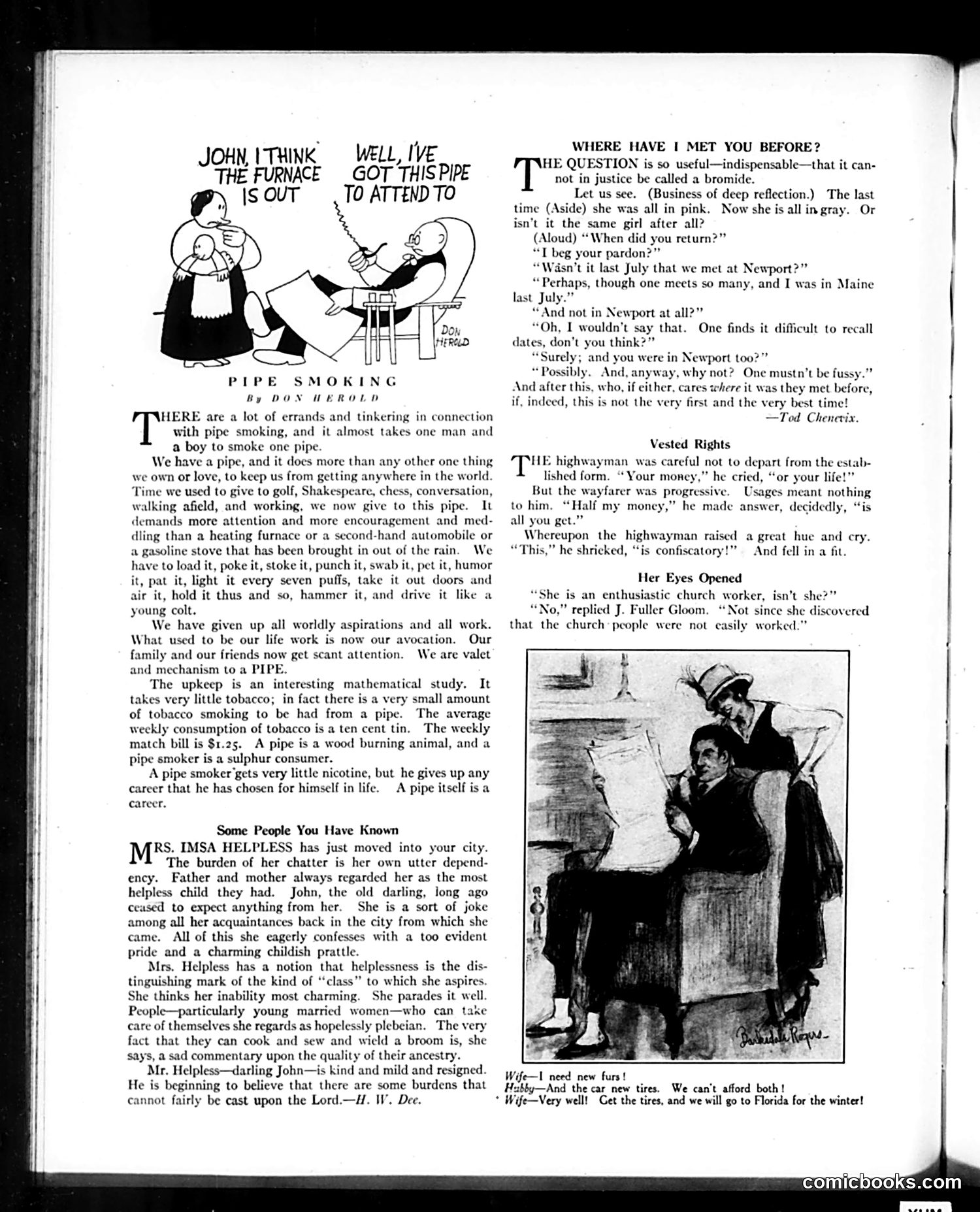
This page contains three distinct pieces of satirical content: **"Pipe Smoking" (by Don Herold):** A humorous essay mocking pipe smokers' obsession with maintaining their pipes. The accompanying cartoon shows a man abandoning his wife and child to tend to a pipe, satirizing how pipe smoking consumes a man's attention and life priorities—more demanding than furnaces or automobiles. The piece calculates the absurd economics: minimal tobacco consumption but high match costs, suggesting pipe smoking is actually a "career" that displaces real work. **"Some People You Have Known":** Character sketch satirizing Mrs. Imsa Helpless, a woman who ostentatiously displays her helplessness as a marker of upper-class status. The satire critiques wealthy women who view domestic competence (cooking, sewing) as beneath their social standing, contrasting with self-sufficient women. **"Where Have I Met You Before?" and "Vested Rights":** Short satirical pieces on social awkwardness and highway robbery respectively—the latter mocking how criminals modernize their demands. The page represents typical Judge content: gentle social satire targeting bourgeois pretension and absurd human behavior.
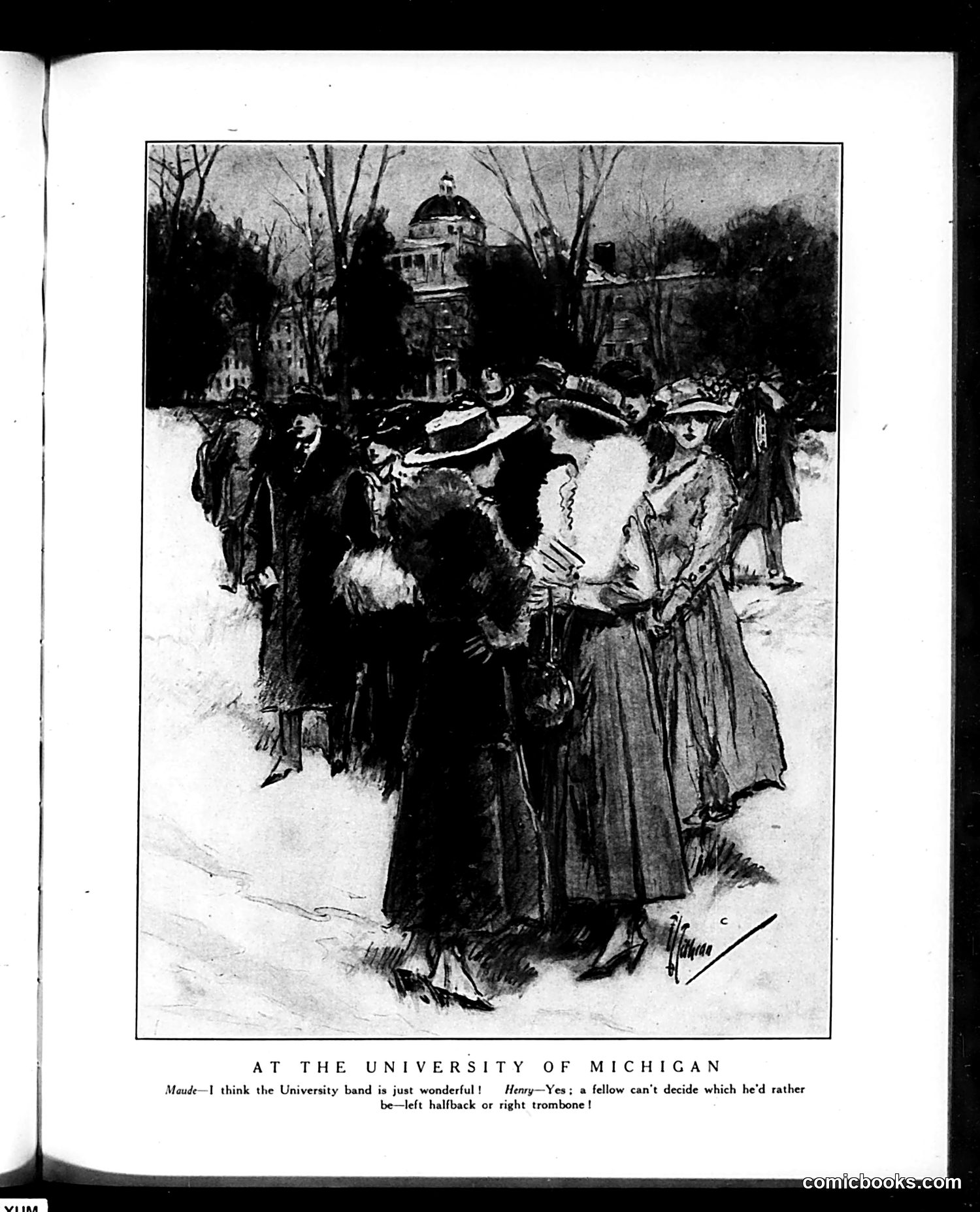
This is a single-panel cartoon depicting a winter scene on a college campus. Two figures, Maude and Henry, watch a university band perform in the snow, with a domed building (likely a university landmark) visible in the background. The joke plays on the ambiguity of "positions" in two different contexts. Henry's response conflates football terminology ("left halfback") with band instrumentation ("right trombone"), treating musical instrument assignments as equivalent to athletic positions. The humor derives from this absurd comparison—suggesting that joining the band or playing an instrument carries the same prestige or appeal as being a football player, a major status symbol at American universities during this era (likely early 1900s). The satire gently mocks college culture's obsession with both athletics and social status.
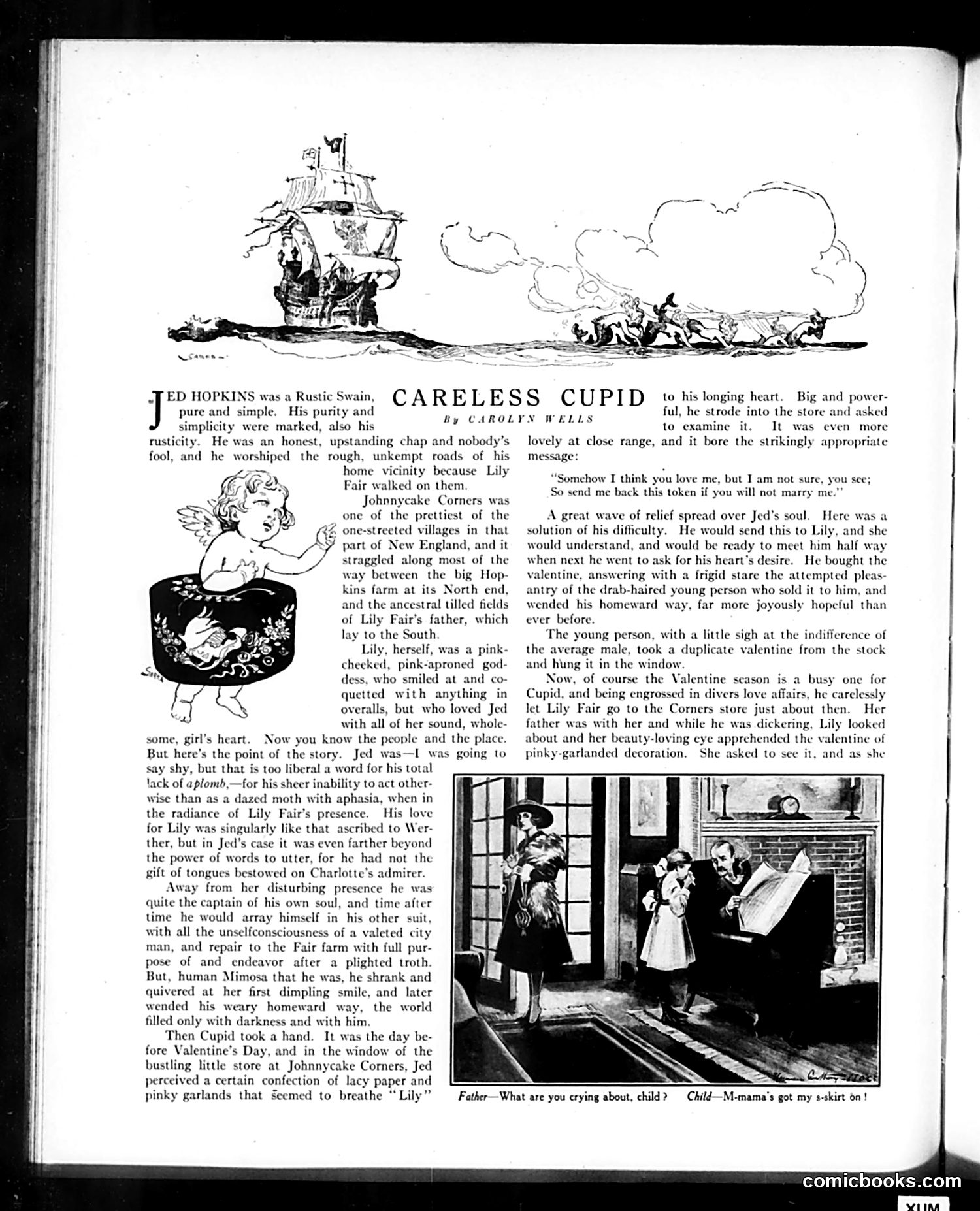
This is a romantic short story, not political satire. Set in rural New England ("Johnnycake Corners"), it tells of Jed Hopkins, a shy farm boy hopelessly in love with Lily Fair. The joke is that Jed is so tongue-tied around her that he cannot propose directly—he's compared to Goethe's Werther, a literary reference to tragic, speechless romantic longing. The "careless Cupid" (the winged cherub illustration) becomes the plot device: a Valentine's Day card with the message "send me back this token if you will not marry me" offers Jed a solution to his shyness. However, the setup suggests dramatic irony—the "careless" Cupid will likely bungle the plan, as both Jed and Lily separately discover identical valentines in the store window, creating comedic confusion about who is meant to receive whose declaration.
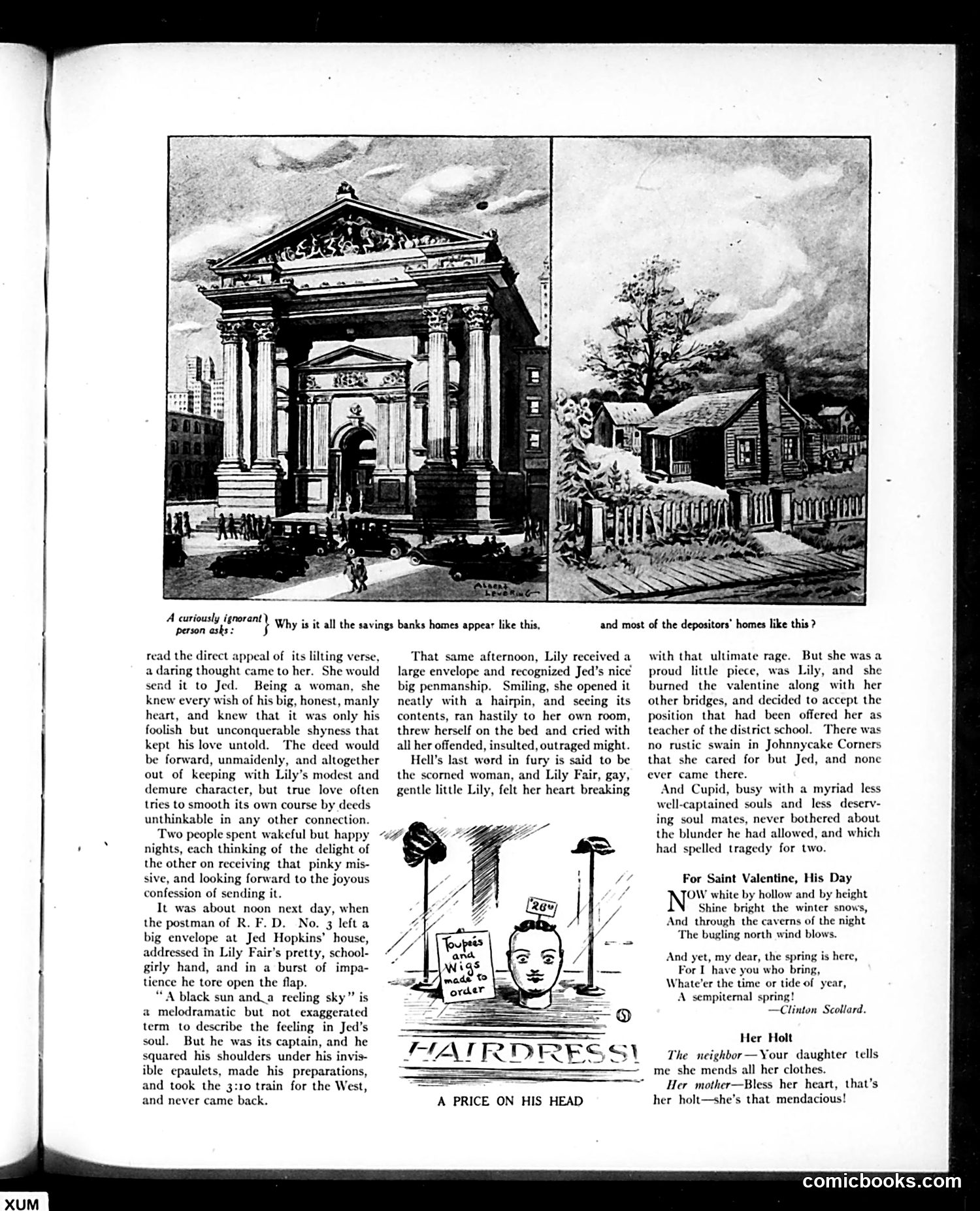
This page contains a romantic short story about Jed Hopkins and Lily Fair, set in rural America (apparently early 20th century). The narrative follows a Valentine's Day tragedy: Lily sends Jed a love poem; Jed responds but apparently with a rejection letter; both are heartbroken and separate. The top cartoon asks sarcastically why savings banks look like grand classical temples while depositors' homes are humble cottages—a visual metaphor for economic inequality and the power imbalance between financial institutions and ordinary people. The "Hairdress" sketch appears to be a separate comic about a woman with an elaborate coiffure, captioned "A Price on His Head," likely a pun about her expensive styling. The page concludes with a Valentine's poem by Clinton Scollard and a brief joke about a girl who "mends" (lies about) her clothes—"holt" being an old term for a characteristic trait. The overall theme emphasizes the contrast between romantic idealism and harsh economic reality in Gilded Age America.
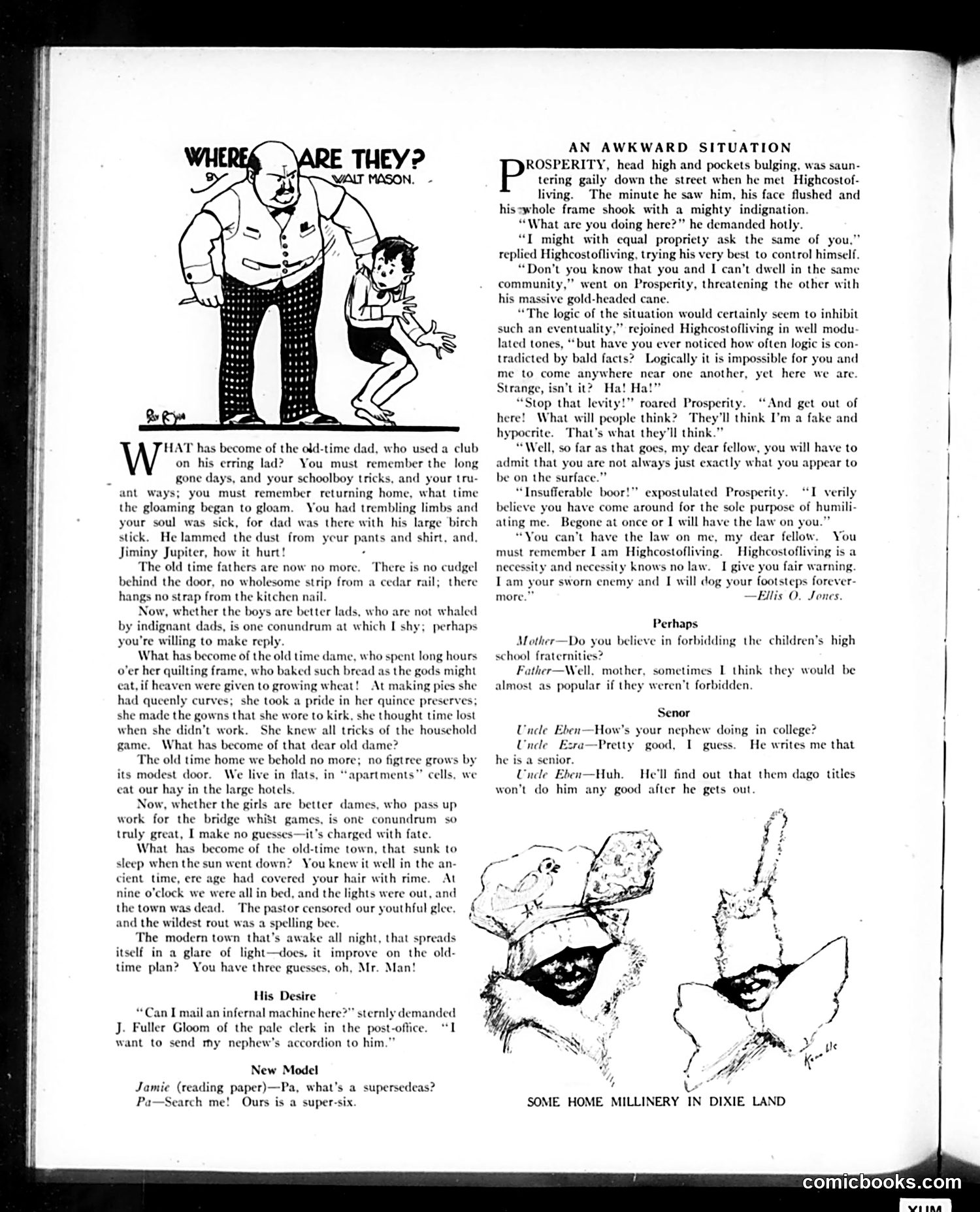
**Top Cartoon ("Where Are They?"):** A nostalgic critique of changing American life. The large figure represents "Walt Mason" (likely the magazine's contributor), reminiscing about "old-time dads" who disciplined children with physical punishment—a practice Judge's readership knew firsthand. The text laments the disappearance of strict fathers, hardworking mothers, modest homes, and quiet small towns, replaced by apartment living, card games, and electric-lit nightlife. The satire is ambiguous: it mocks both traditional discipline and modern leisure, capturing period anxiety about social change. **Bottom Cartoon ("An Awkward Situation"):** An allegorical debate between "Prosperity" and "High Cost of Living"—personified as gentlemen. Prosperity demands the other leave town, claiming they cannot coexist. High Cost of Living counters with logic: their incompatibility contradicts observable reality—they're standing together. The joke critiques wealthy people's denial of inflation's real economic impact during a period of rising costs.
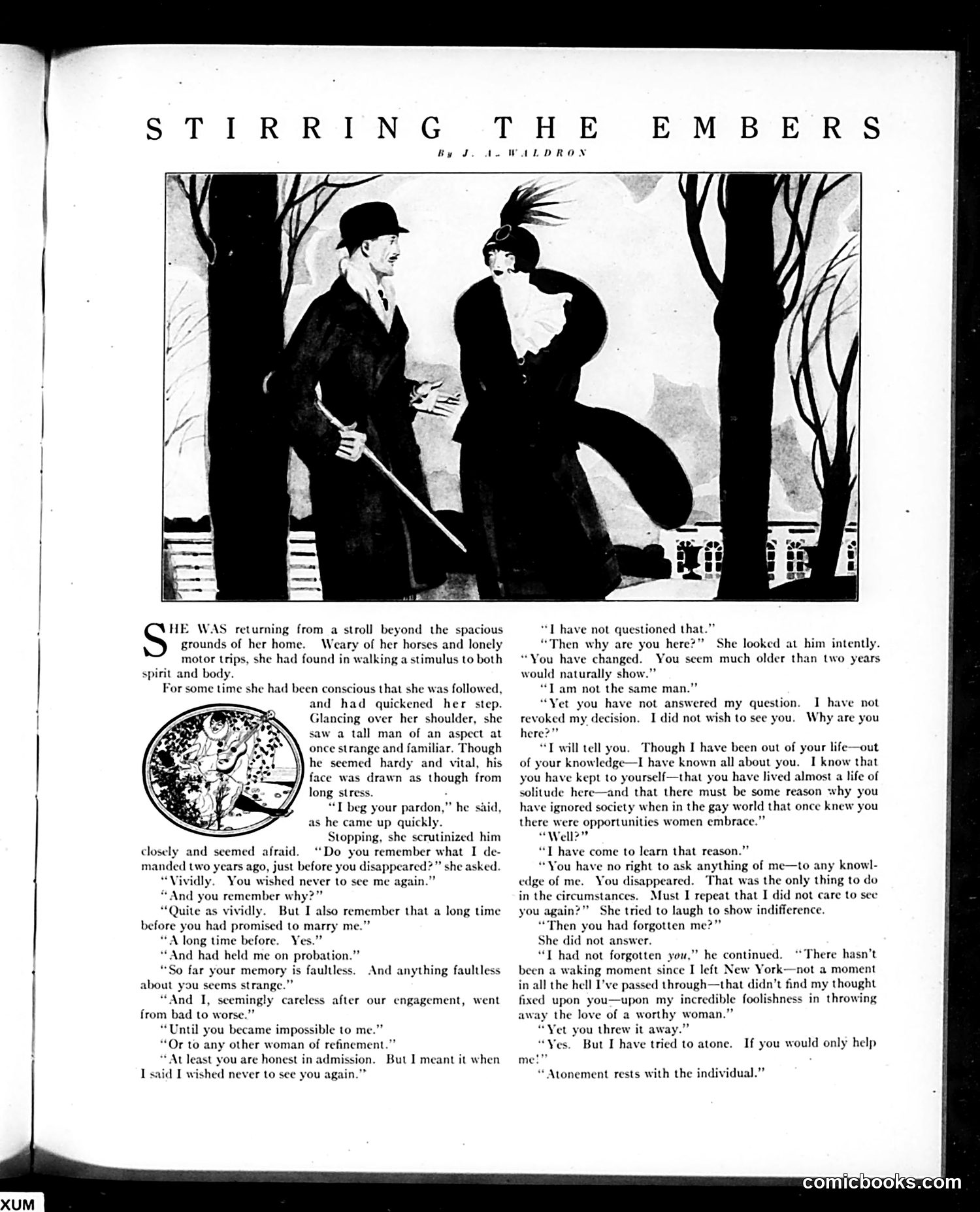
This illustration and accompanying story depict a romantic melodrama typical of early 20th-century Judge magazine. A woman of apparent wealth—indicated by her spacious home and leisured lifestyle—encounters a man from her past who disappeared two years prior after she refused to marry him due to his moral failings (he "went from bad to worse"). The man has since reformed and seeks her forgiveness, claiming he's thought of her constantly and wishes to atone. She remains unmoved, having lived in solitude, and rebuffs his appeals by stating "atonement rests with the individual"—suggesting personal redemption cannot be achieved through another's forgiveness. The "embers" referenced in the title likely represent the rekindled emotions between them. The satire appears to mock both sentimental Victorian romance conventions and the earnest moral reformism popular in the era, presenting the woman as principled but cold, and the man as self-pitying despite his claimed transformation.
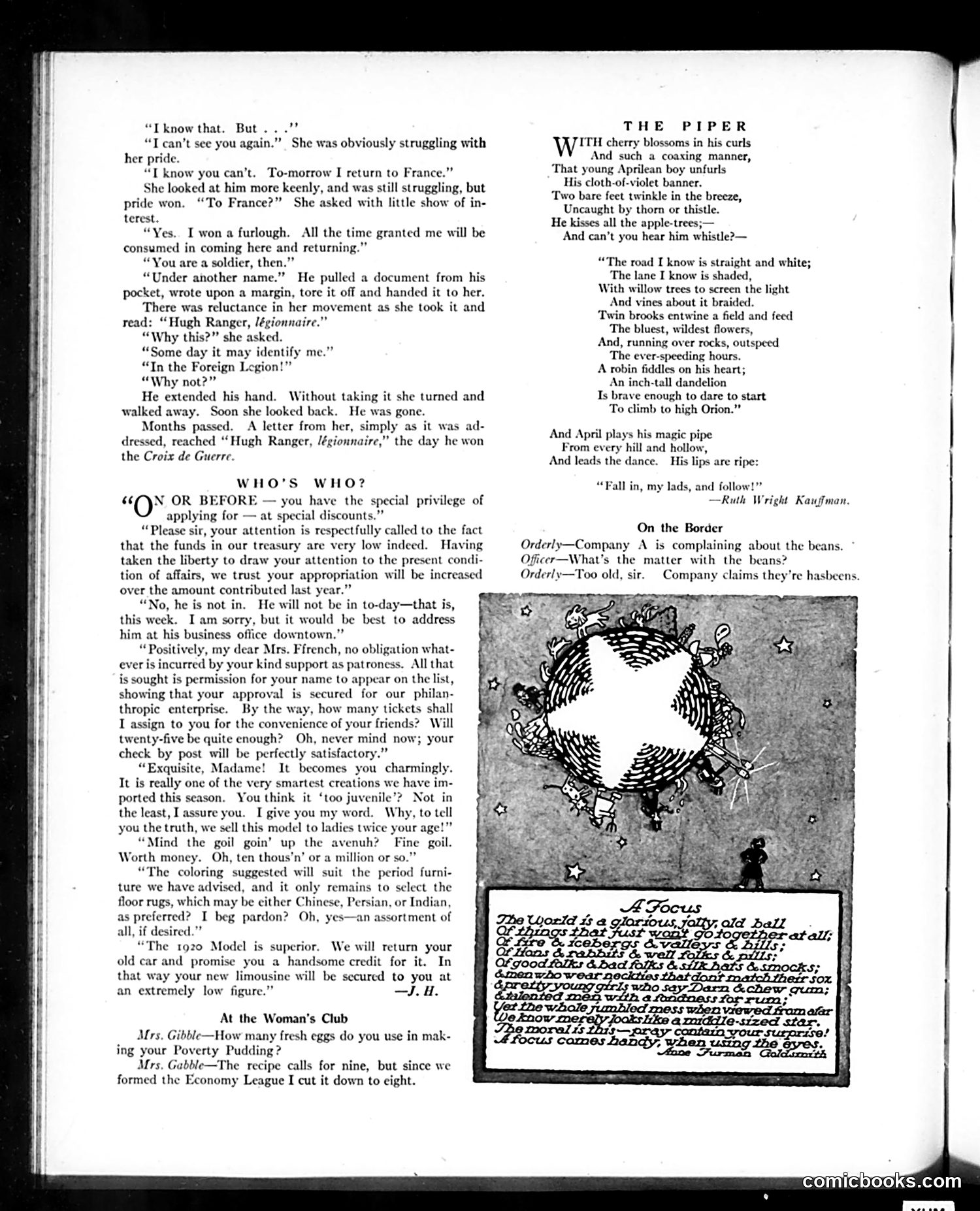
This page contains a romantic narrative ("The Piper") paired with social satire vignettes typical of Judge magazine's style. **The main narrative** depicts a wartime romance between a soldier (enlisted under the assumed name "Hugh Ranger") serving in the French Foreign Legion and a woman he must leave. The story ends with him receiving the Croix de Guerre (French military decoration), suggesting he survived and achieved recognition—a sentimental conclusion. **The satirical vignettes** mock upper-class social hypocrisy: 1. **"Who's Who?"** — A fundraiser solicitor flatters a wealthy donor while extracting money, promising her name on a philanthropic list while pressuring her for contributions. 2. **"At the Woman's Club"** — Brief domestic humor about economizing (reducing recipe eggs due to an "Economy League"). 3. **"On the Border"** — A joke about soldier complaints: beans are so old the company calls them "has-beens" (pun on outdated supplies). The page satirizes class pretension, fake charity appeals, and military absurdity—typical Judge fare mocking American society's affectations.
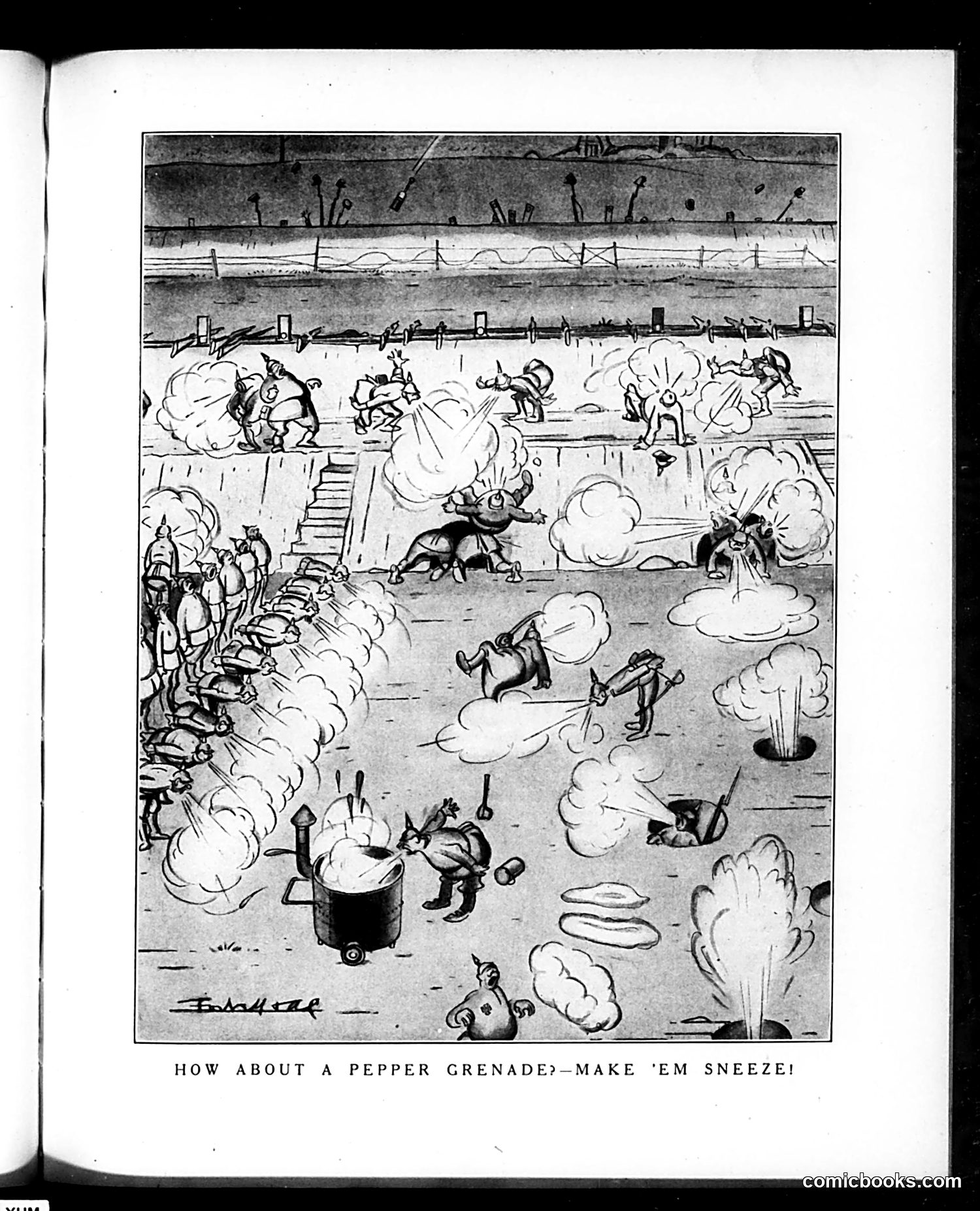
The OCR text is too corrupted to read. However, the cartoon itself is clear: it depicts a military battle scene with soldiers, explosions (shown as large cloud bursts), cavalry, artillery, and chaos across a battlefield viewed from above. The caption reads: "HOW ABOUT A PEPPER GRENADE?—MAKE 'EM SNEEZE!" This is wartime satire, likely from World War I or II era *Judge* magazine. The joke proposes using "pepper grenades" as a humorous alternative weapon—the pun being that pepper makes people sneeze rather than causing serious harm. It's a lighthearted commentary on warfare, using absurdist humor to mock the brutality and chaos of combat by suggesting an ineffectual, almost comical weapon instead.
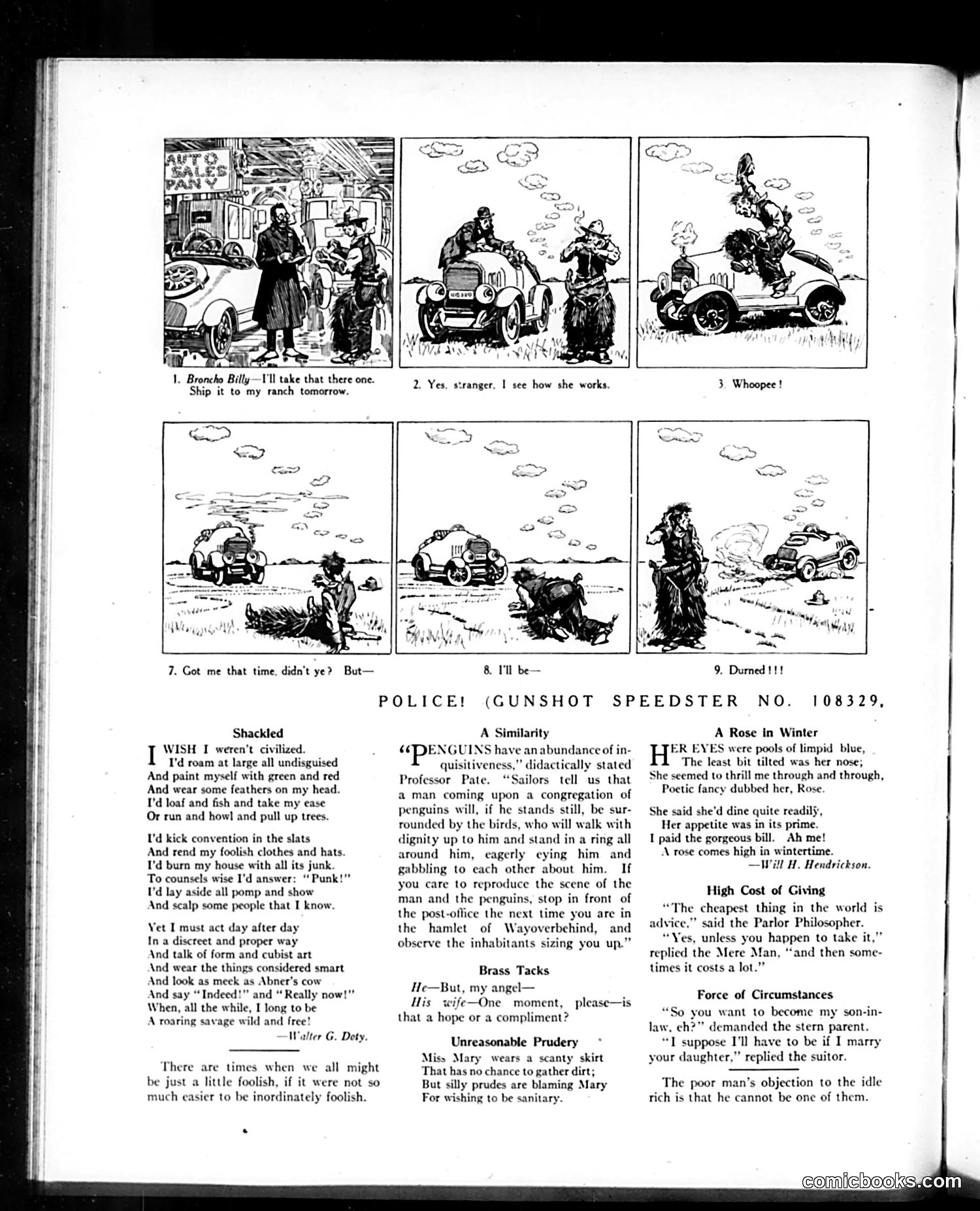
This page satirizes early automotive culture and the outlaw mythology surrounding it. The comic strip features "Broncho Billy," likely referencing the popular Western film character, purchasing a racecar he intends to ship to his ranch. The subsequent panels show him joyride recklessly across the countryside, culminating in police pursuit—the "Whoopee!" and "Durned!!!" captions capturing the thrill-seeking and lawlessness of early motorists. The surrounding humor pieces reflect Jazz Age anxieties: the poem "Shackled" expresses frustration with civilized restraints; "A Similarity" compares curious townspeople to nosy penguins; "High Cost of Giving" and other shorts mock dating expenses and social pretension. Together, the page captures 1920s concerns about automobile-fueled recklessness, urbanization's social constraints, and the era's shifting class and gender norms—women's "scanty skirts," expensive dining, and matrimonial negotiations all featuring prominently.
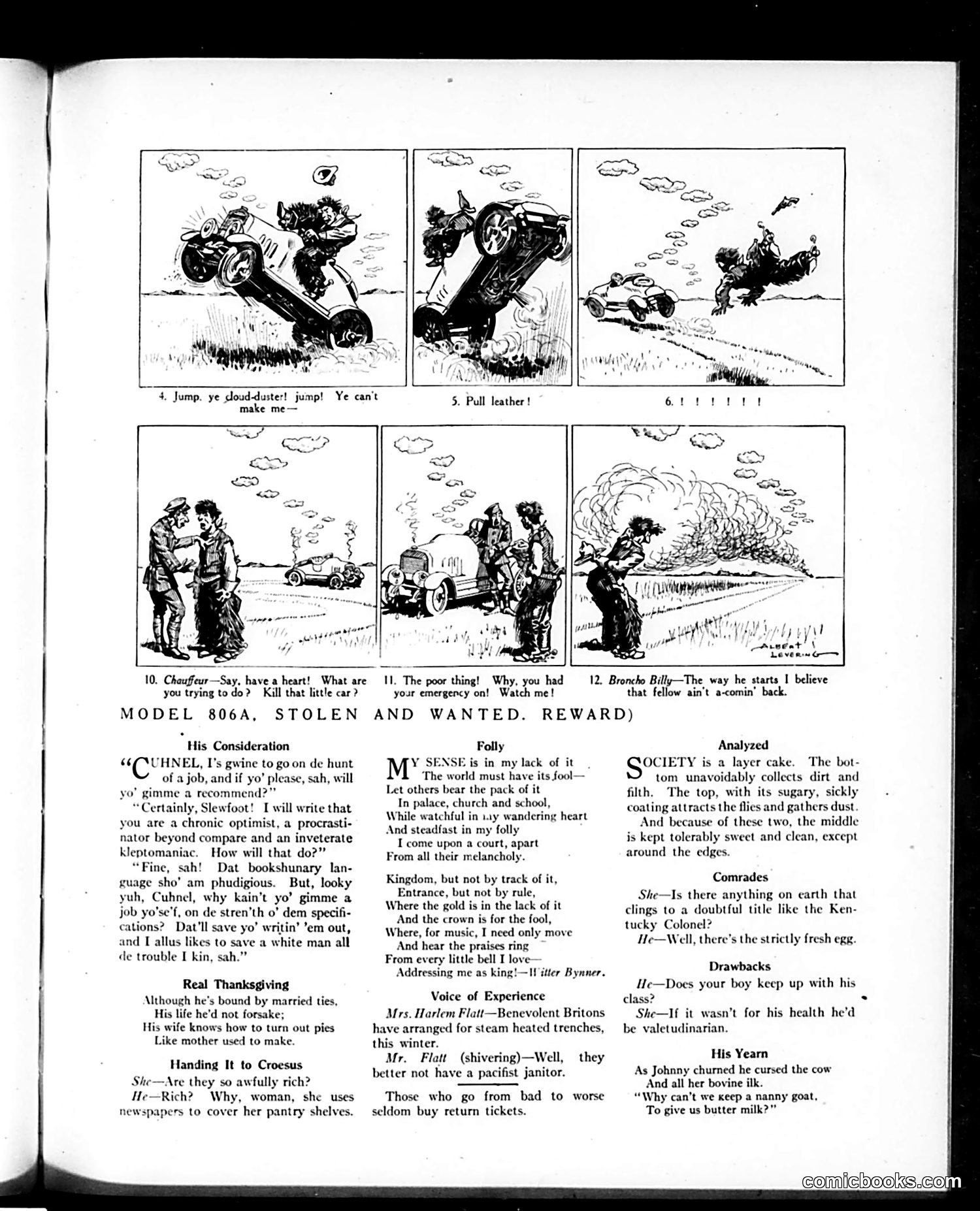
This page contains several short humor pieces typical of Judge's satirical content. The top shows a comic strip about a car chase or reckless driving accident, with captions suggesting someone is being urged to jump from a vehicle ("Jump, ye cloud-duster!") and a chauffeur being criticized for dangerous driving. The lower section features brief comedic dialogues and observations: - **"His Consideration"** mocks a Black servant (depicted in period dialect) seeking a job recommendation by asking his employer to list unflattering traits—treating negative character descriptions as qualifications, satirizing both the absurdity of recommendations and racial stereotypes of the era. - **"Handing It to Croesus"** jokes about extreme wealth, suggesting someone is so rich they use newspapers for pantry shelf-lining. - **"Folly"** includes a poem about embracing foolishness and social outsider status. - Small humor items about marriage, wartime conditions ("steam heated trenches"), and social climbing ("Kentucky Colonel") round out the page—typical light satirical fare for an early 20th-century humor magazine.
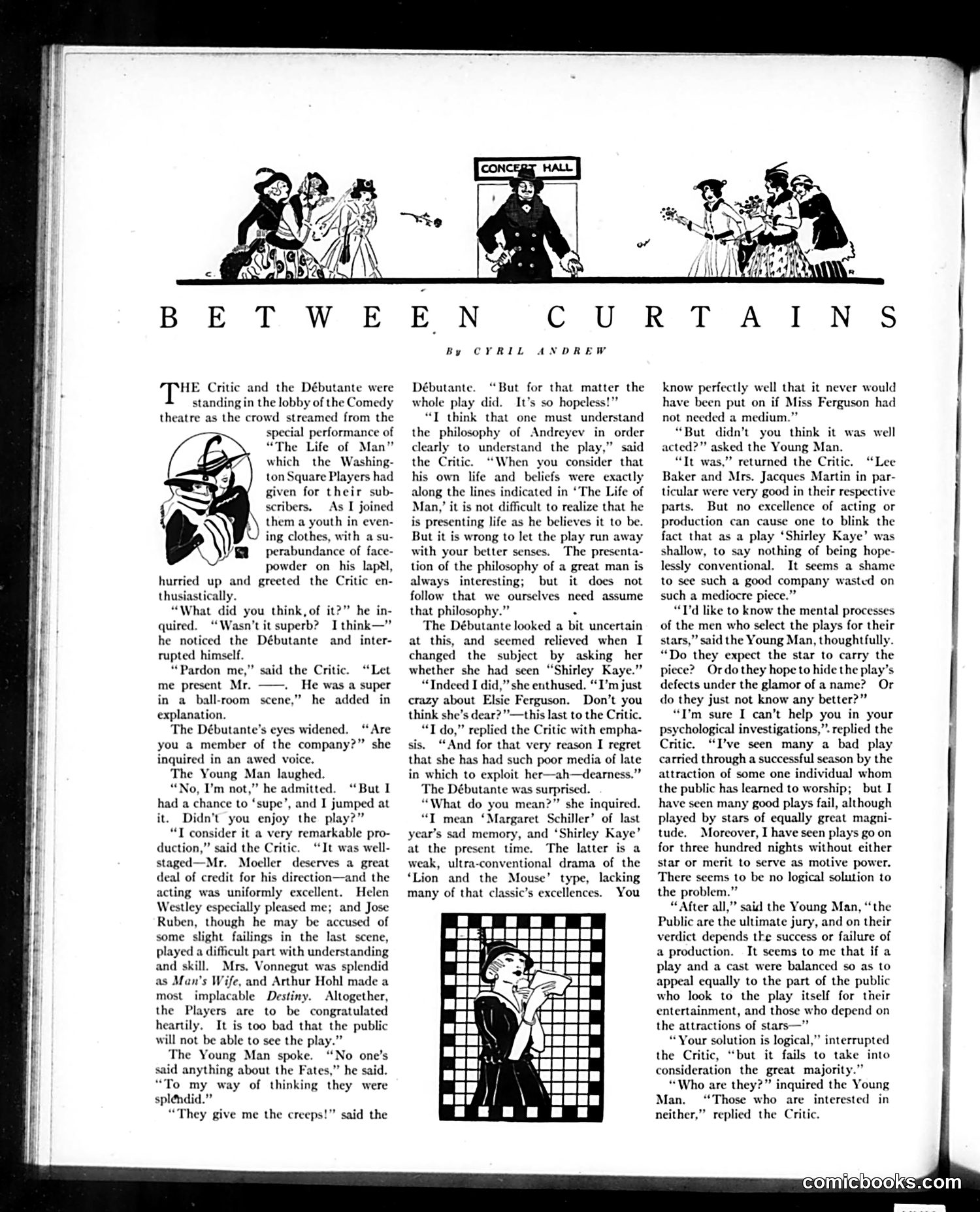
This satirical piece mocks theatrical pretension and the star system in early 20th-century Broadway. Three characters discuss a production of Andreyev's "The Life of Man" at the Washington Square Players: **The figures:** A Critic (an authority on theater), a Débutante (a young society woman), and an unnamed Young Man who served as an extra ("super") in a ball-room scene. **The satire:** The Critic dismisses the play's philosophy while praising individual actors' performances, then criticizes that Elsie Ferguson's recent vehicles ("Margaret Schiller" and "Shirley Kaye") are mediocre plays chosen merely because she needs *something* to perform in—excellent acting cannot redeem weak material. **The point:** The piece exposes how star power drives theatrical production choices regardless of dramatic merit, and how even sophisticated critics compromise artistic standards by praising performances in fundamentally shallow plays. The Young Man's casual participation suggests Broadway's accessibility to the privileged but dilettantish.
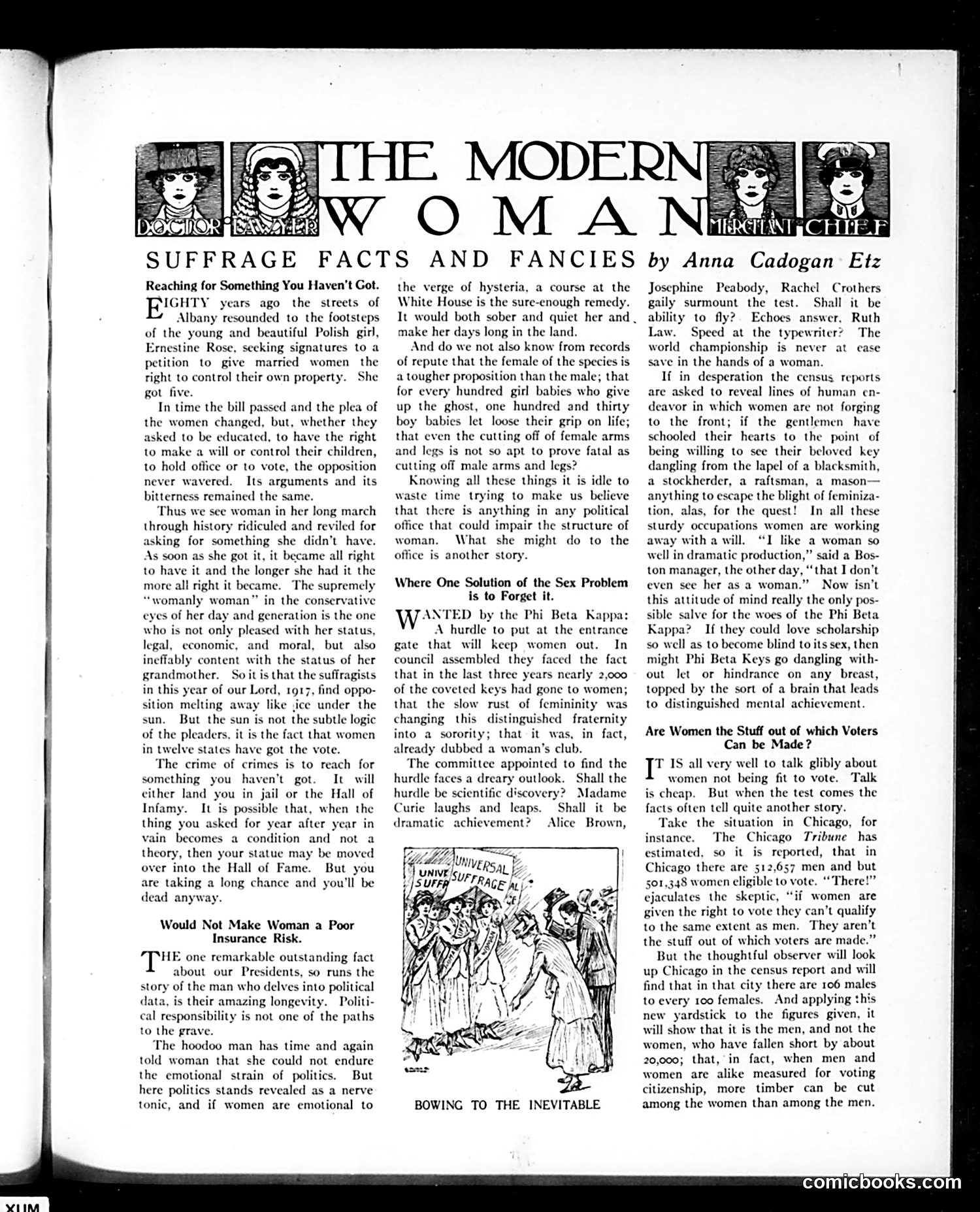
This 1917 satirical article by Anna Cadogan Etz argues **for women's suffrage and equality** by attacking the logic of opponents. The main cartoon ("Bowing to the Inevitable") depicts women being admitted to what appears to be an exclusive male institution, likely referencing the Phi Beta Kappa fraternity discussed in the text. **Key arguments made:** 1. **Historical hypocrisy**: Women were mocked for *asking* for rights (property control, voting) but accepted once gained. Only achieving what you "haven't got" is considered criminal. 2. **Women's fitness**: The article dismantles anti-suffrage claims that politics would harm women's health, noting women actually live longer than men and endure physical hardship better. 3. **Institutional resistance**: Phi Beta Kappa seeks to exclude women despite nearly 2,000 female members receiving keys in three years, turning the "distinguished fraternity" into a "woman's club." The satire mocks male resistance as inevitable but ultimately futile—women will achieve equality regardless. The tone is sardonic about society's double standards regarding female ambition.
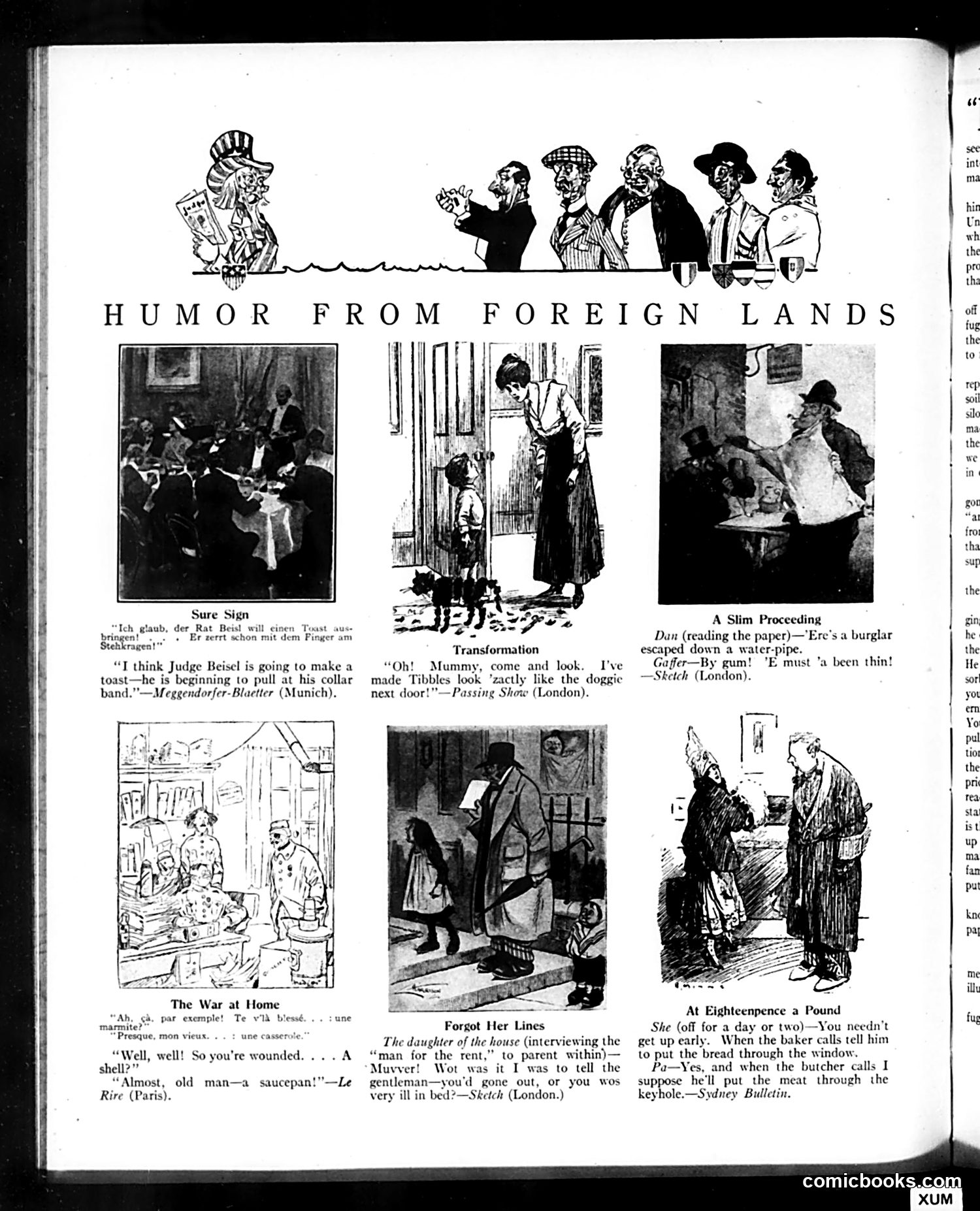
This page collects brief humorous anecdotes and cartoons sourced from European and Australian publications, translated for American readers. Each piece uses simple, domestic situations for comic effect: **Key content includes:** - A German joke about a judge pulling his collar—a visual tell that he's about to give a toast - French humor about wartime domestic life and housekeeping mishaps - A British piece about a child making their cat resemble a neighbor's dog - Working-class British humor about thin burglars and servants' wages - Australian jokes about household deliveries and domestic economy The satire is gentle and apolitical, focused on universal middle and working-class situations: servants, domestic animals, rationing, and social awkwardness. The page demonstrates how Judge used foreign sources to entertain American audiences with relatable, cross-cultural humor. The varied sourcing (Munich, Paris, London, Sydney) shows the magazine's cosmopolitan reach during this period.
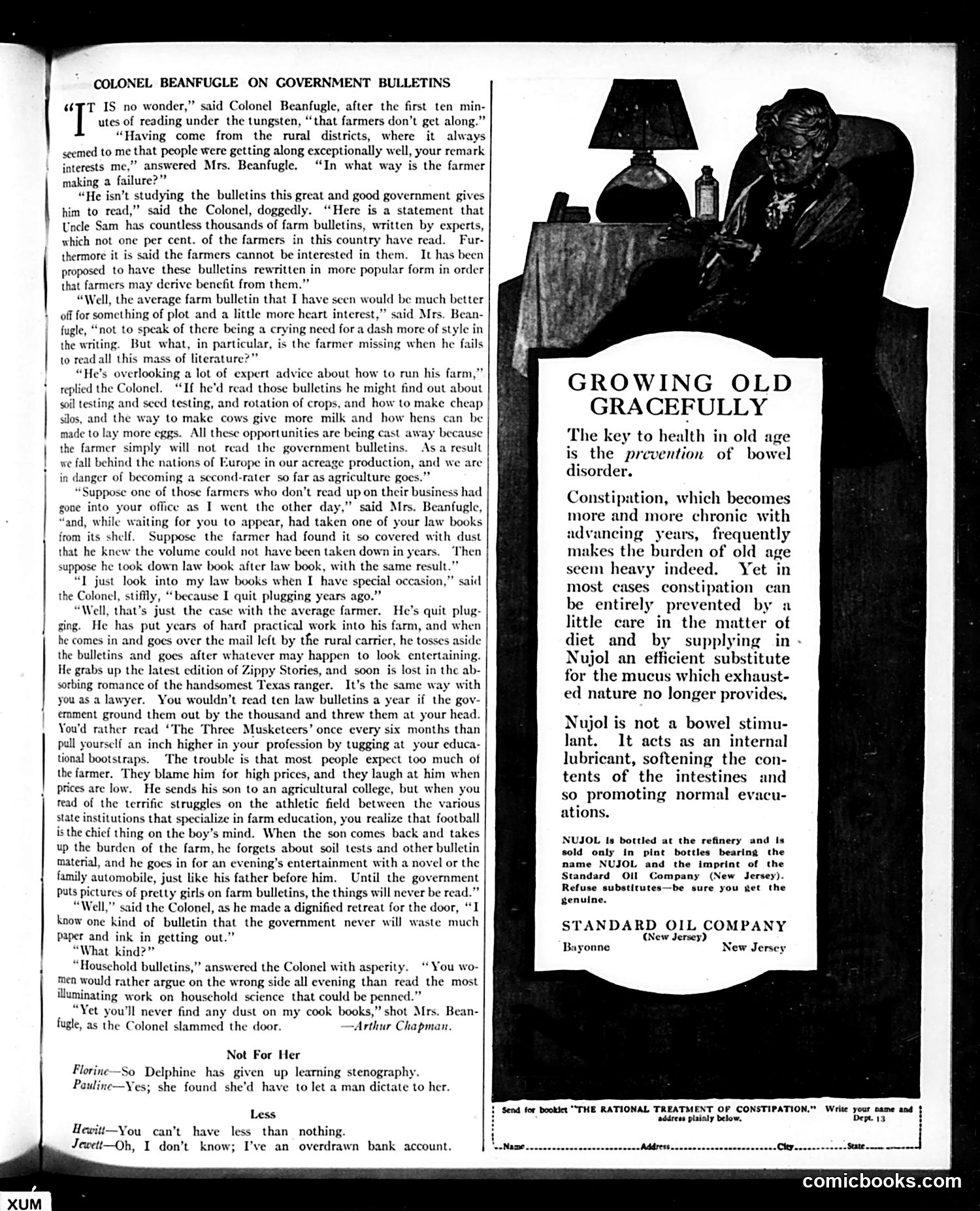
This satirical piece mocks the government's assumption that farmers will read expert agricultural bulletins. Colonel Beanfugle initially blames farmers for ignoring these publications, claiming this causes agricultural failure. However, Mrs. Beanfugle deflates his argument with a clever analogy: she points out that the Colonel himself—a lawyer—wouldn't regularly read government law bulletins either, preferring entertainment like *The Three Musketeers*. She exposes the hypocrisy of expecting farmers to diligently study dry technical literature when educated professionals won't do the same. The satire targets both bureaucratic overconfidence in printed materials and class condescension toward rural people. It suggests the real problem isn't farmer laziness but unrealistic expectations about human nature and reading habits across all social classes.
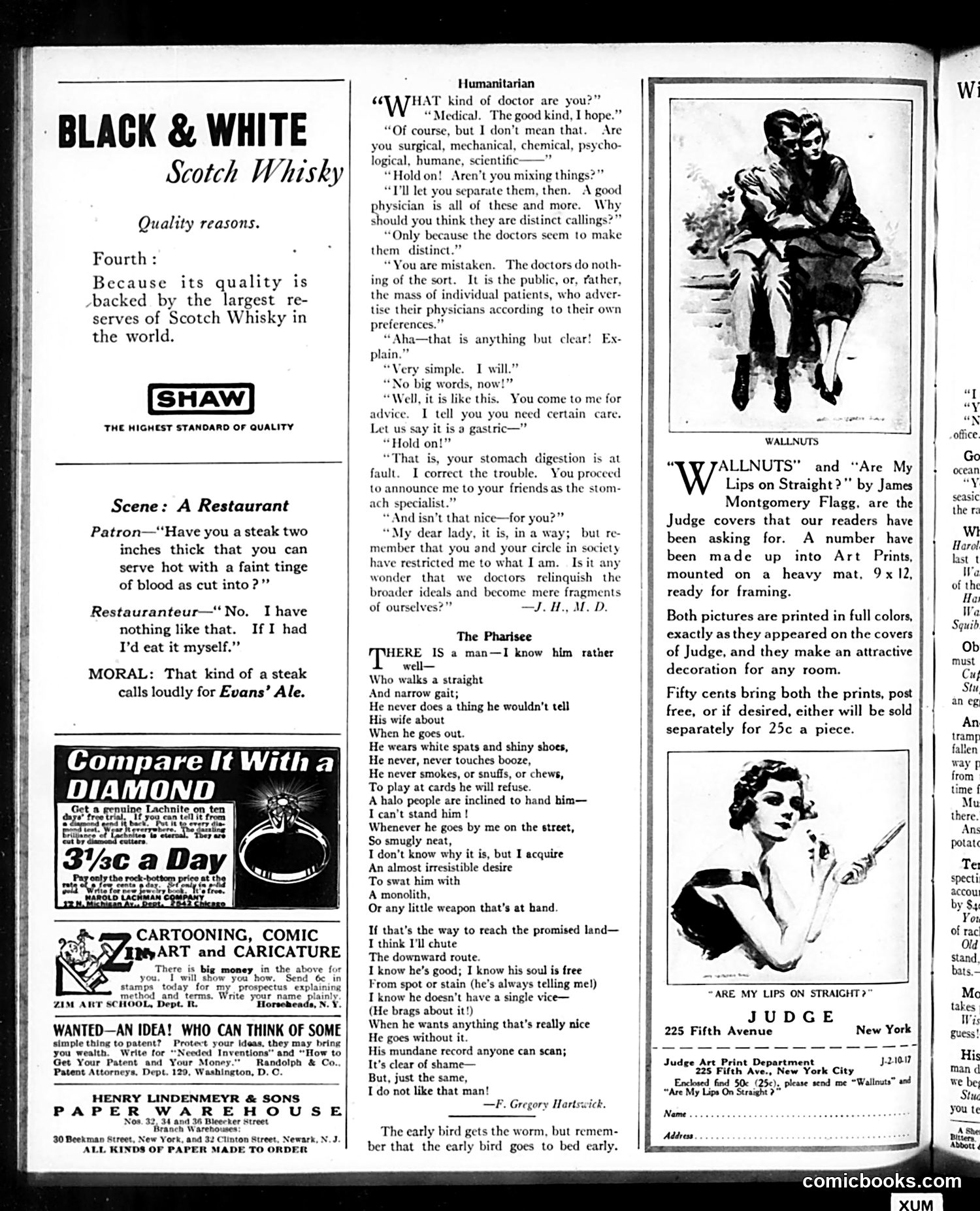
This page mixes advertisements with satirical content typical of early 20th-century Judge magazine. **Main Cartoons:** The "Humanitarian" dialogue satirizes medical specialization. A doctor argues that physicians shouldn't be artificially divided into specialists (surgical, mechanical, chemical, etc.)—rather, patients themselves create these categories by advertising doctors based on narrow treatments they receive. The satire critiques both medical fragmentation and public perception. **"The Pharisee" poem** mocks self-righteous moralism. It describes a man of impeccable virtue—straight-laced, abstinent, honest—whom the narrator finds unbearably smug and irritating. The satire targets not hypocrisy but rather ostentatious piety and moral superiority, suggesting that excessive virtue displayed without humility is itself off-putting. **Visual Elements:** Two James Montgomery Flagg illustrations advertise art prints available for purchase—typical Judge content marketing its own brand. **Context:** These pieces reflect early 1900s American anxieties about professionalization and middle-class moral pretension.
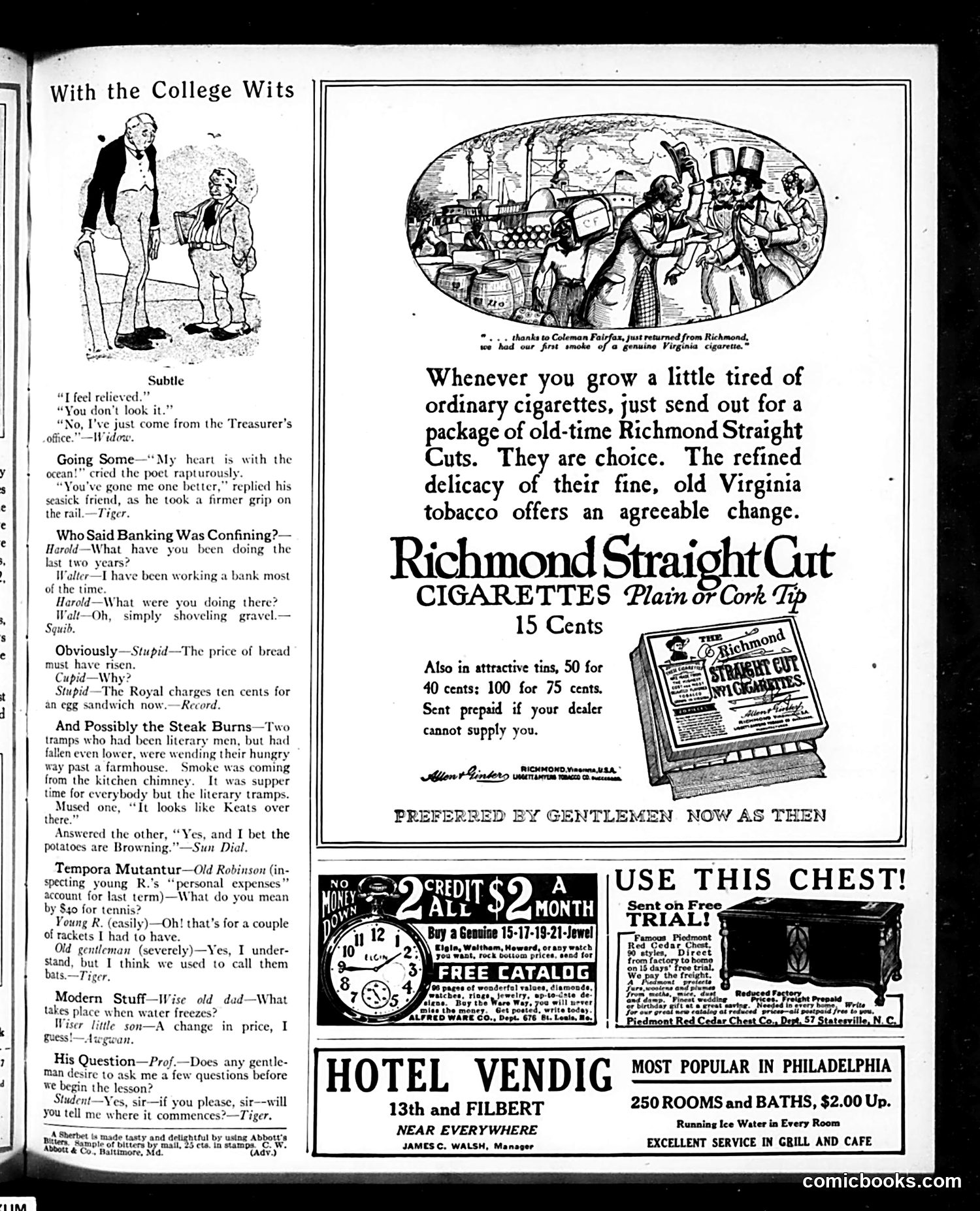
This page contains **brief humor columns** aimed at educated readers, primarily centered on wordplay and social observation rather than political satire. The jokes target **college students and young professional men**: a Treasurer's office visit provides relief (likely from financial anxiety), a banker literally shovels gravel, literary tramps make puns about poets' names ("Keats," "Browning") while hungry, and a student asks a professor where a lesson "commences"—implying he doesn't know where to begin. The humor relies on **double meanings and class commentary**. Rising bread and egg prices reflect post-WWI inflation. A young man's "$40 for tennis" expense is questioned—suggesting either frivolous spending or euphemism. The page is **predominantly advertising**: Richmond Straight Cut cigarettes dominate the right side, marketing Virginia tobacco as refined and gentlemanly. Additional ads promote a mail-order watch, chest furniture, and Hotel Vendig in Philadelphia. The "college wits" content reflects Judge's educated, urban male readership circa the 1920s.
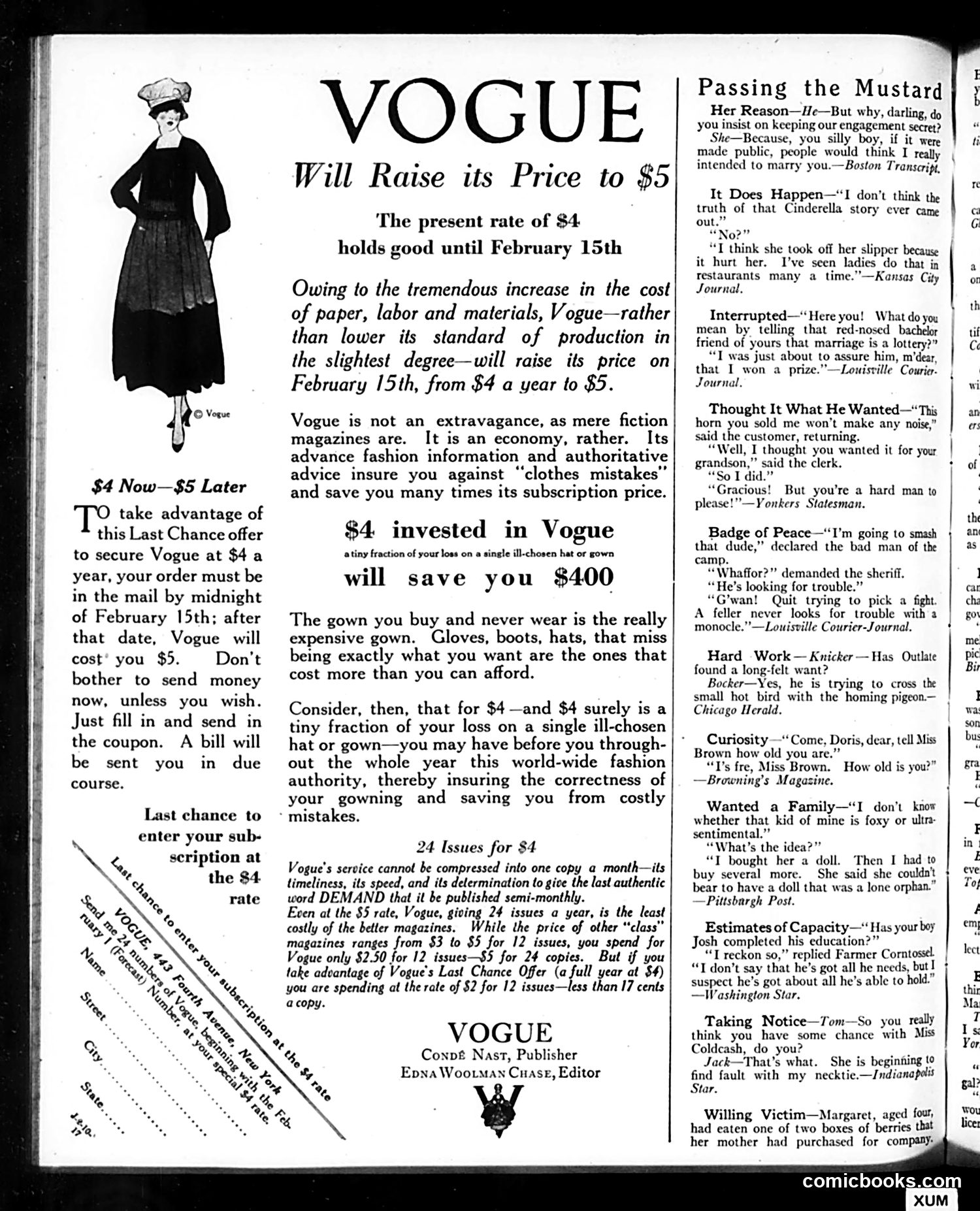
This page is primarily **Vogue magazine advertising**, not political satire. The left side announces a price increase from $4 to $5 per year, effective February 15th. The magazine justifies this by arguing that Vogue is an "economy"—claiming subscribers save $400 annually by avoiding fashion mistakes. The pitch emphasizes getting 24 semi-monthly issues cheaply compared to competitors. The right side contains **humorous short jokes** typical of Judge magazine's filler content—unrelated to the main advertisement. These are mild domestic humor: a woman hiding her engagement to avoid appearing marriage-minded; references to false teeth and faulty car horns; marriage portrayed as a gamble. **No political figures or caricatures appear.** This is essentially a period advertising document showing how luxury magazines marketed themselves and promoted urgency through limited-time pricing offers. The humor reflects early 20th-century attitudes about courtship, class consumption, and married life.
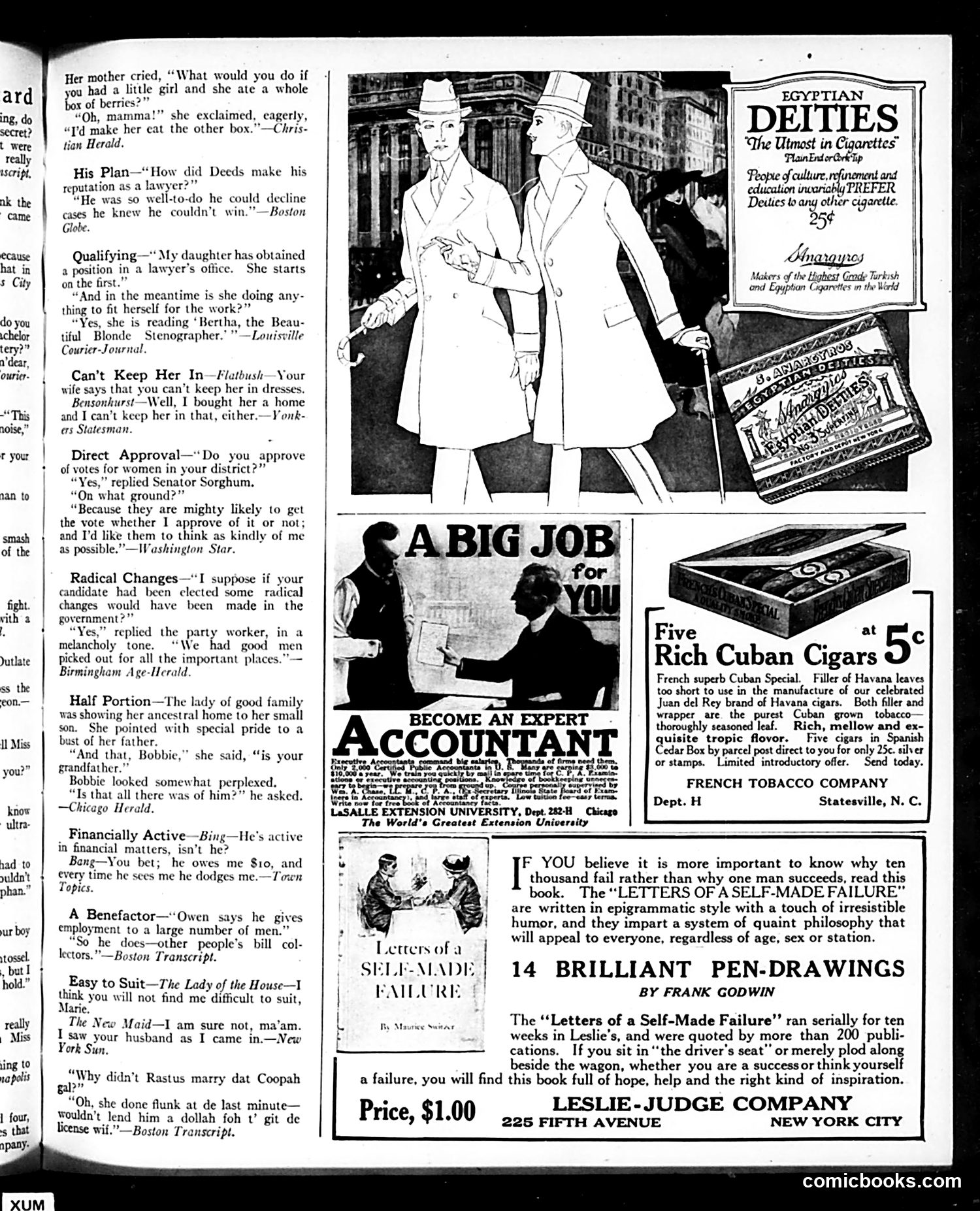
This page is primarily **humorous short jokes and advertisements** rather than political cartoons. The jokes target early 20th-century American social attitudes: **Key jokes include:** - A wife's stubbornness about berries (domestic humor) - Women's suffrage: Senator Sorghum supports women voting only because they'll get it anyway and he wants their goodwill—satirizing insincere political support - A lawyer's reputation built on losing unwinnable cases - A woman's "unfitness" for work despite getting hired **Advertisements feature:** - Egyptian Deities cigarettes (25¢) - Five Rich Cuban Cigars (5¢) - "Letters of a Self-Made Failure" book with Frank Godwin illustrations The suffrage joke is the most politically pointed: it mocks politicians who cynically endorse women's rights not from principle but from self-interest—a jab at opportunistic politics during the suffrage movement era.
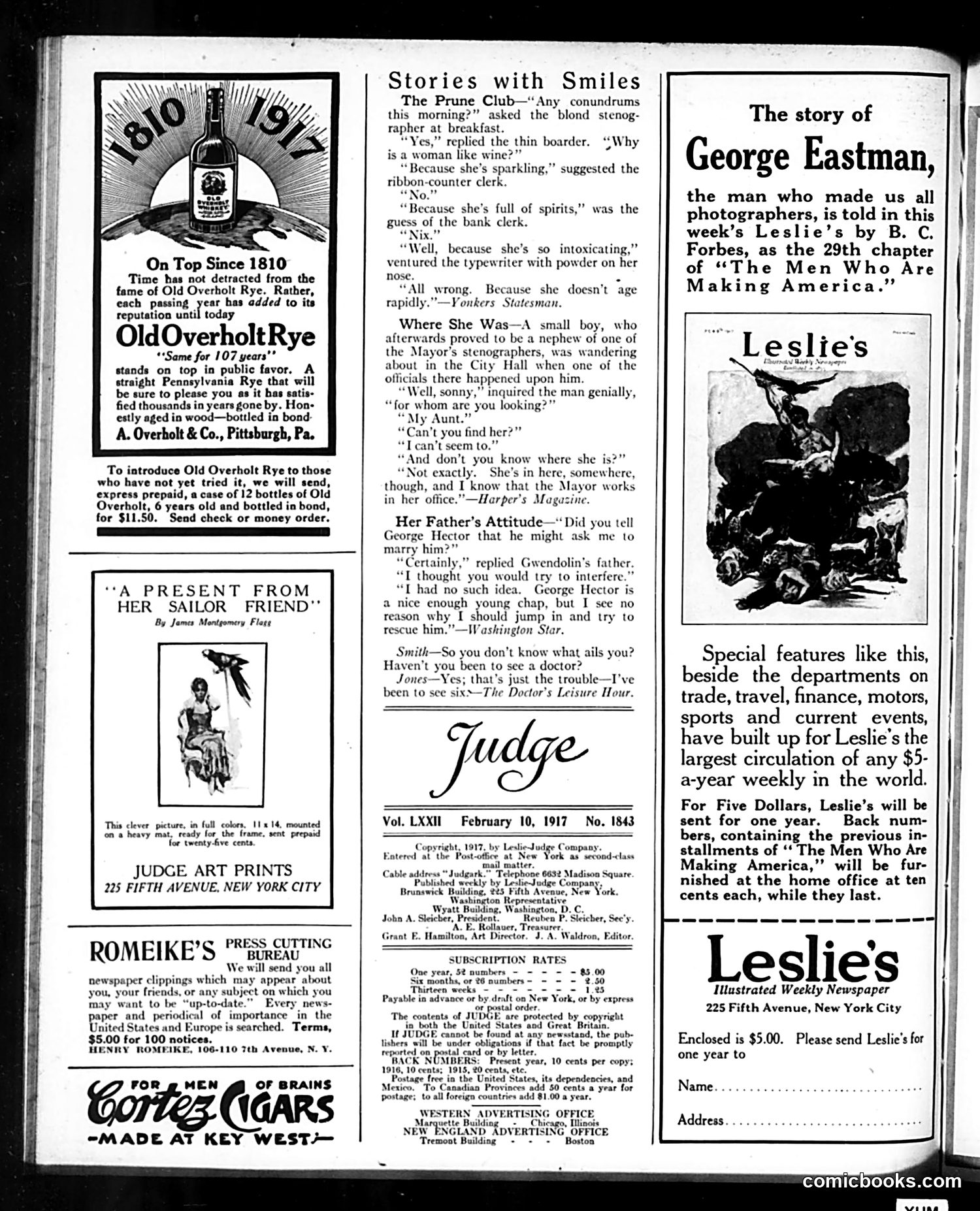
This page is primarily advertisements and magazine masthead information, with some light humor content. The main satirical elements are brief jokes in the "Stories with Smiles" section—wordplay pieces typical of 1910s magazines. One joke plays on "woman like wine" comparisons (she gets better with age, she's intoxicating, full of spirits). Another depicts a young boy lost in City Hall, unable to find his aunt who works there—gentle humor about bureaucratic spaces. A third joke involves a father's surprisingly indifferent attitude toward his daughter's suitor, refusing to interfere. The advertisements showcase period concerns: whiskey promotion (Old Overholt Rye, bottled-in-bond), art prints, and a press-clipping bureau service. The overall tone is genteel humor for middle-class readers rather than sharp political satire.
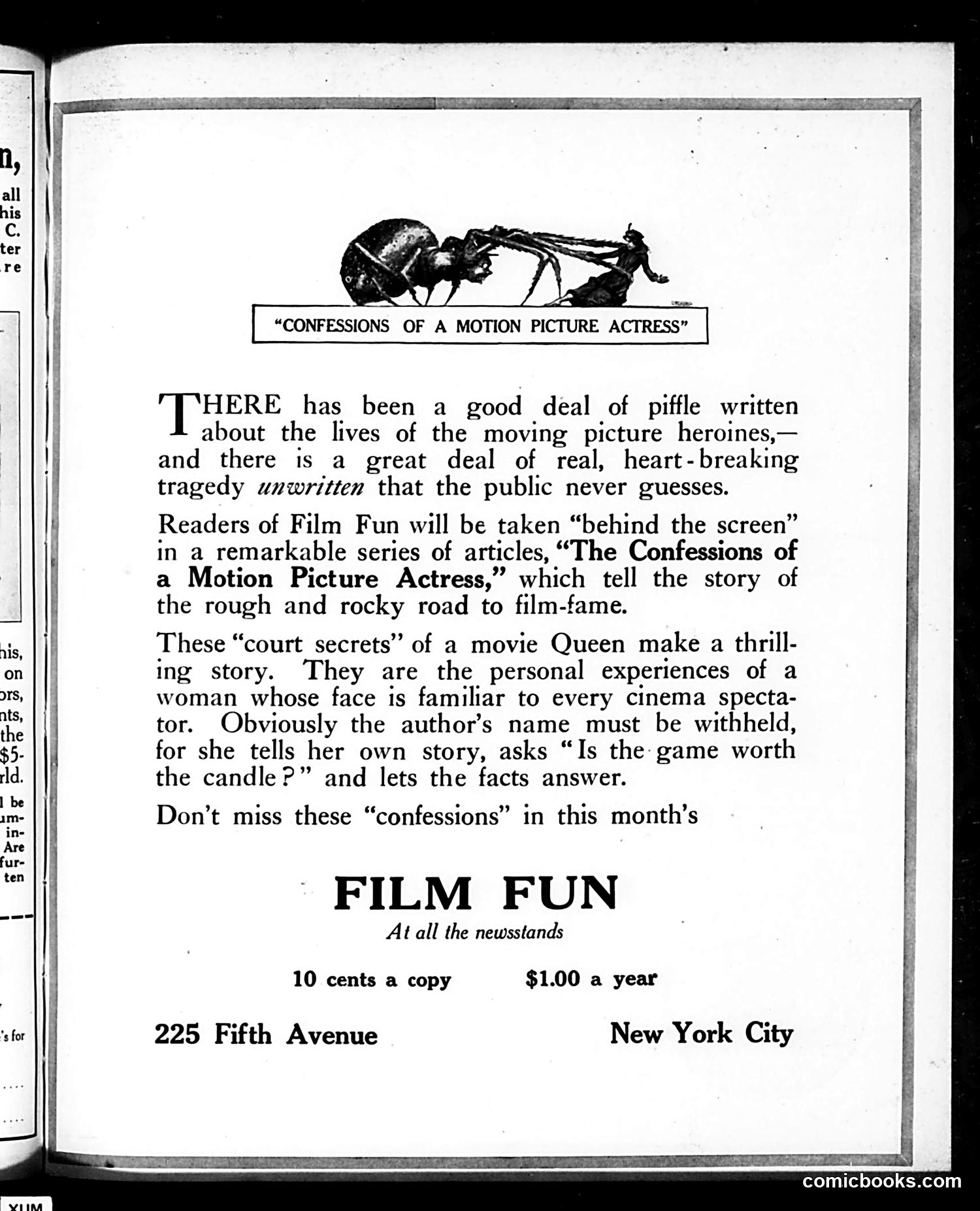
This is primarily a **magazine advertisement**, not political satire. It promotes *Film Fun*, a publication featuring a serialized article titled "Confessions of a Motion Picture Actress." **The Appeal:** The ad promises readers exclusive "behind-the-scenes" revelations from an anonymous famous film actress discussing the harsh realities of achieving stardom—positioning this as scandalous insider testimony ("court secrets") that the public wouldn't otherwise know. The rhetorical question "Is the game worth the candle?" suggests the article will reveal whether film fame's costs outweigh its rewards. **Historical Context:** This reflects 1920s fascination with Hollywood's glamorous but supposedly tragic underbelly. The anonymous authorship adds mystique—readers are invited to guess the actress's identity while enjoying what's framed as authentic personal confession rather than mere gossip. **No political cartoon** appears on this page. The illustration shows a theatrical figure, likely decorative rather than satirical.
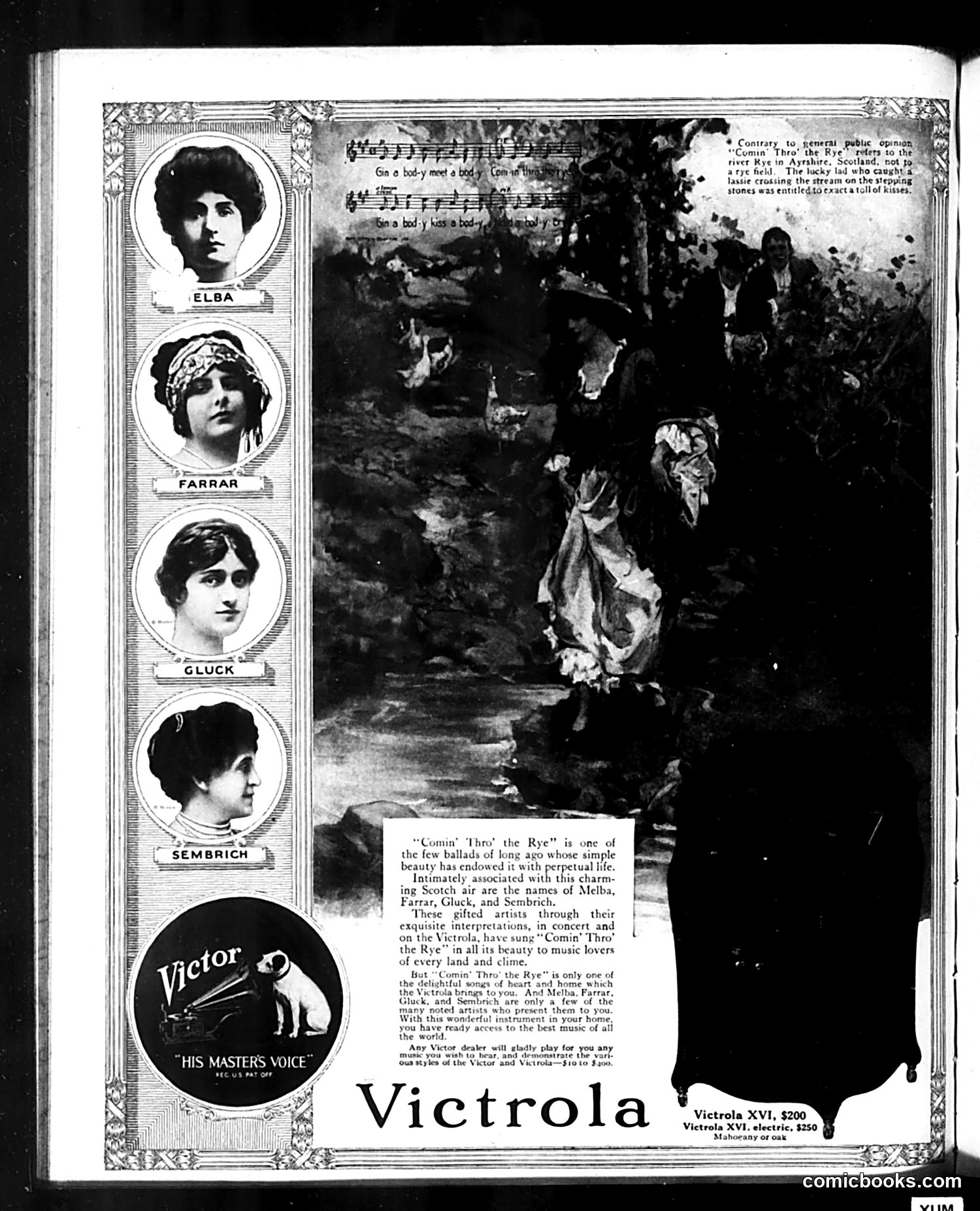
This is primarily a **Victrola phonograph advertisement**, not a political cartoon. The page features portraits of four famous opera singers—Elba, Farrar, Gluck, and Sembrich—who performed "Comin' Thro' the Rye" on Victor records. The ad explains the song's Scottish origins (a stream in Ayrshire where young couples would kiss on stepping stones). The advertisement emphasizes that these "gifted artists" have made this traditional ballad available to home listeners through the Victrola, positioning the phonograph as bringing world-class musical entertainment into ordinary households. Prices for different Victrola models ($200 and $250) are listed at bottom. This reflects early 20th-century marketing strategy: using celebrity endorsements and cultural prestige to sell consumer technology.