
Judge, 1917-02-10 · page 19 of 28
Judge — February 10, 1917 — page 19: what you’re looking at
What you’re looking at
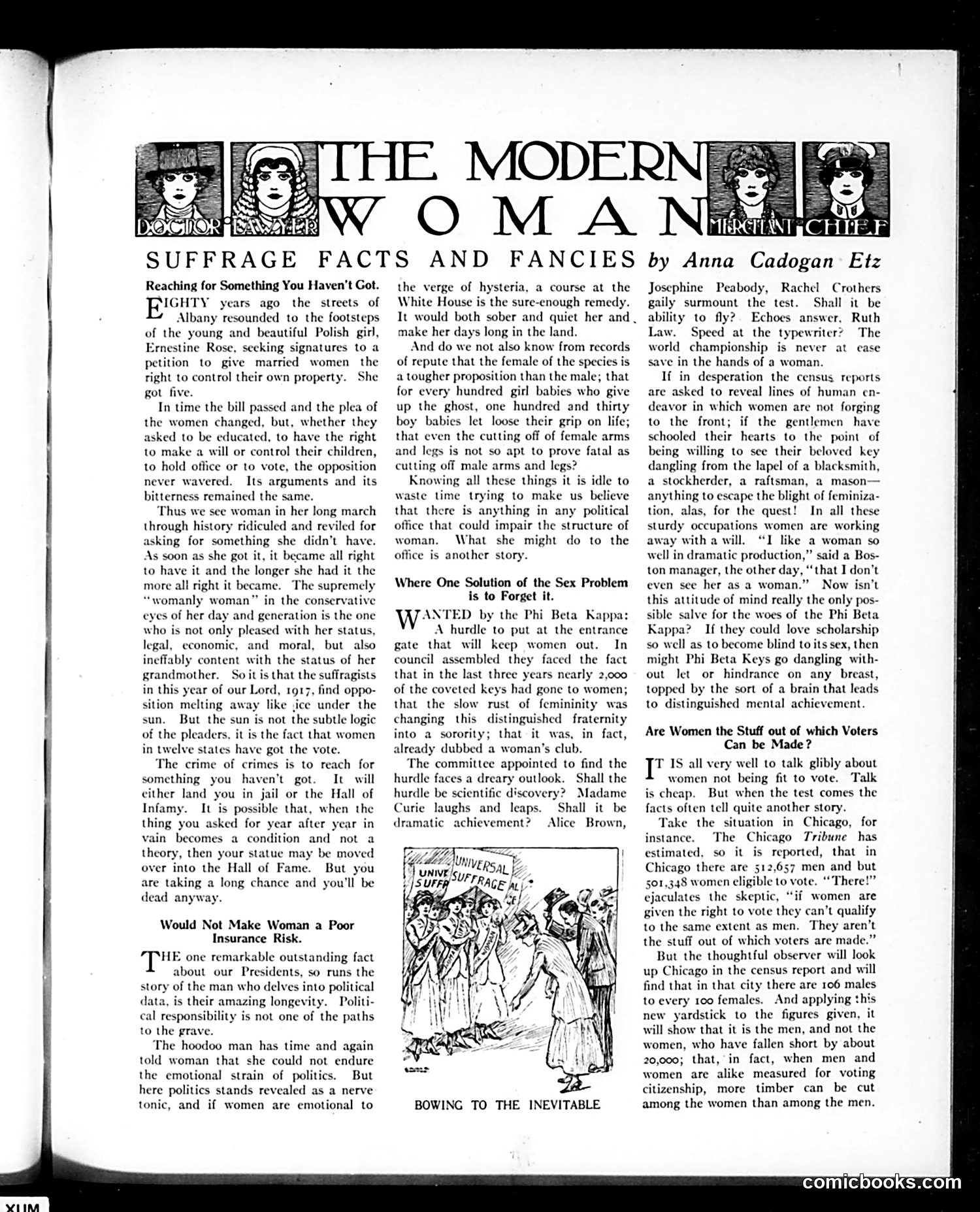
This 1917 satirical article by Anna Cadogan Etz argues **for women's suffrage and equality** by attacking the logic of opponents. The main cartoon ("Bowing to the Inevitable") depicts women being admitted to what appears to be an exclusive male institution, likely referencing the Phi Beta Kappa fraternity discussed in the text. **Key arguments made:** 1. **Historical hypocrisy**: Women were mocked for *asking* for rights (property control, voting) but accepted once gained. Only achieving what you "haven't got" is considered criminal. 2. **Women's fitness**: The article dismantles anti-suffrage claims that politics would harm women's health, noting women actually live longer than men and endure physical hardship better. 3. **Institutional resistance**: Phi Beta Kappa seeks to exclude women despite nearly 2,000 female members receiving keys in three years, turning the "distinguished fraternity" into a "woman's club." The satire mocks male resistance as inevitable but ultimately futile—women will achieve equality regardless. The tone is sardonic about society's double standards regarding female ambition.
📄 Transcribed text from this page (OCR, searchable)
Machine-transcribed from the original scan — historical spelling and the odd misread are preserved.
Reaching for Something You Haven't Got. IGHTY Ss ago the streets of Albany resounded to the footsteps of the young and beautiful Polish gir, Ernestine Rose, secking signatures to a petition to give married women the right to control their own property. She got five. In time the bill passed and the plea of the women changed, but, whether they asked to be educated, to have the right to make a will or control their children, to hold office or to vote, the opposition never wavered. Its arguments and its bitterness remained the same. Thus w woman in her long march through history ridiculed and reviled for asking for something she didn’t have. As soon as she got it, it became all right to have it and the longer she had it the more all right it became. The supremely “womanly woman” in the conservative of her day and generation is the one who is not only pleased with her status, legal, economic, and moral, but also ineffably content with the status of her grandmother. So it is that the suffragists in this year of our Lord, 1917, find oppo- sition melting away like ,ice under the sun. But the sun is not the subtle logic of the pleaders, it is the fact that women in twelve states have got the vote. The crime of crimes is to reach for something you haven't got. It will cither land you in jail or the Hall of Infamy. It is possible that, when the thing you asked for year after year in vain becomes a condition and not a theory, then your statue may be moved over into the Hall of Fame. But you are taking a long chance and you'll be dead anyway. € Would Not Make Woman a Poor Insurance Risk. HE one remarkable outstanding fact about our Presidents, so runs the story of the man who delves into political data, is their amazing longevity. Poli cal responsibility is not one of the paths to the grave. The hoodoo man has time and again told woman that she could not endure the emotional strain of politics. But here politics stands revealed as a nerve tonic, and if women are emotional to FACTS AND FANCIES the verge of hysteria, a course at the White House is the sure-enough remedy. It would both sober and quiet her and , make her days long in the land. And do we not also know from records of repute that the female of the species is a tougher proposition than the male; that for every hundred girl babies who give up the ghost, one hundred and thirty boy babies let loose their grip on life; that even the cutting off of female arms and legs is not so apt to prove fatal as cutting off male arms and legs? Knowing all these things it is idle to waste time trying to make us believe that there is anything in any political office that could impair the structure of woman. What she might do to the office is another story. Where One Solution of the Sex Problem is to Forget it. ANTED by the Phi Beta Kapp: A hurdle to put at the entrance gate that will keep women out. In council assembled they faced the fact that in the last three years nearly 2,000 of the coveted keys had gone to women; that the slow rust of femininity was changing this distinguished fraternity into a sorority; that it was, in fact, already dubbed a woman’s club. The committee appointed to find the hurdle faces a dreary outlook. Shall the hurdle be scientific discove: Madame Curie laughs and leaps. Shall it be dramatic achievement? Alice Brown, BOWING TO THE INEVITABLE by Anna Cadogan Etz Josephine Peabody, Rachel Crothers gaily surmount the test. Shall it be ability to fly? Echoes answer, Ruth Law. Speed at the typewriter? The world championship is never at ease save in the hands of a woman. If in desperation the census reports are asked to reveal lines of human en- deavor in which women are not forging to the front; if the gentlemen have schooled their hearts to the point of being willing to sce their beloved key dangling from the lapel of a blacksmith, a stockherder, a raftsman, a mason— anything to escape the blight of feminiza- tion, alas, for the quest! In all these sturdy occupations women are working away with a will. “I like a woman so well in dramatic production,” said a Bos- ton manager, the other day, “that I don’t even see her as a woman.” Now isn’t this attitude of mind really the only pos- sible salve for the woes of the Phi Beta Kappa? If they could love scholarship so well as to become blind to its sex, then might Phi Beta Keys go dangling with- out Iet or hindrance on any breast, topped by the sort of a brain that leads to distinguished mental achievement. Are Women the Stuff out of which Voters Can be Made? T IS all very well to talk glibly about women not being fit to vote. Talk is cheap. But when the test comes the facts often tell quite another story. Take the situation in Chicago, for instance. The Chicago Tribune has estimated, so it is reported, that in Chicago there are 512,657 men and but 501,348 women eligible to vote. “There!” ejaculates the skeptic, “if women are given the right to vote they can’t qualify to the same extent as men. They aren’t the stuff out of which voters are made.” But the thoughtful observer will look up Chicago in the census report and will find that in that city there are 106 males to every 100 females, And applying this new yardstick to the figures given, it will show that it is the men, and not the women, who have fallen short by about 20,000; that, in fact, when men and women are alike measured for voting citizenship, more timber can be cut among the women than among the men.