
Judge, 1917-02-10 · page 13 of 28
Judge — February 10, 1917 — page 13: what you’re looking at
What you’re looking at
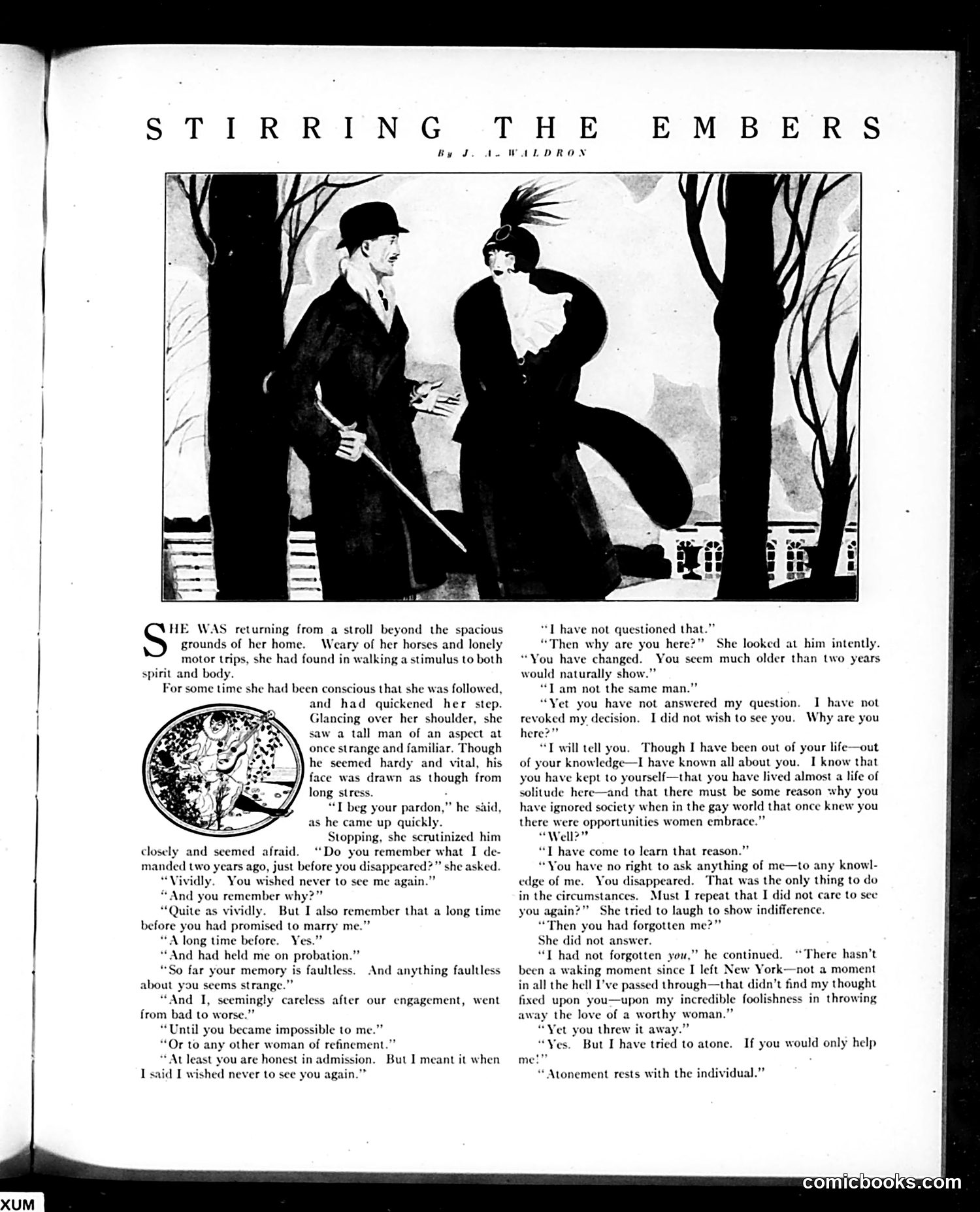
This illustration and accompanying story depict a romantic melodrama typical of early 20th-century Judge magazine. A woman of apparent wealth—indicated by her spacious home and leisured lifestyle—encounters a man from her past who disappeared two years prior after she refused to marry him due to his moral failings (he "went from bad to worse"). The man has since reformed and seeks her forgiveness, claiming he's thought of her constantly and wishes to atone. She remains unmoved, having lived in solitude, and rebuffs his appeals by stating "atonement rests with the individual"—suggesting personal redemption cannot be achieved through another's forgiveness. The "embers" referenced in the title likely represent the rekindled emotions between them. The satire appears to mock both sentimental Victorian romance conventions and the earnest moral reformism popular in the era, presenting the woman as principled but cold, and the man as self-pitying despite his claimed transformation.
📄 Transcribed text from this page (OCR, searchable)
Machine-transcribed from the original scan — historical spelling and the odd misread are preserved.
STIRRING By Jo An HE WAS returning from a stroll beyond the spacious grounds of her home. Weary of her horses and lonely motor trips, she had found in walking a stimulus to both spirit and body. For some time she had been conscious that she was followed, and had quickened her step. Glancing over her shoulder, she saw a tall man of aspect at once strange and familiar. Though he seemed hardy and vital, his face was drawn as though from long stress. : “I beg your pardon,” he said, as he came up quickly. Stopping, she scrutinized him id. “Do you remember what I de- hed. closely and seemed af manded two years ago, just before you disappeared?” sh “Vividly. You wished never to see me again.” “ And you remember why?” “Quite as vividly. But I also remember that a long time before you had promised to marry me.” A long time before. Yes.” “And had held me on probation.” “So far your memory is faultless. about you seems strange. “And I, seemingly careless after our engagement, went from bad to worse “Until you became impossible to me.” “Or to any other woman of refinement.” At least you are honest in admission. But I meant it when I said I wished never to see you again.” And anything faultless THE EMBERS tLDRON I have not questioned that.” “Then why are you here?” She looked at him intently. “You have changed. You seem much older than two years would naturally show. “Tam not the same man.” “Yet you have not answered my question. I have not revoked my decision. I did not wish to see you. Why are you her “T will tell you. Though I have been out of your life—out of your knowledge—I have known all about you. I know that you have kept to yourself—that you have lived almost a life of solitude here—and that there must be some reason why you have ignored society when in the gay world that once knew you there were opportunities women embrace.” “Well?” “T have come to learn that reason.” You have no right to ask anything of me—to any knowl- edge of me. You disappeared. That was the only thing to do in the circumstances. Must I repeat that I did not care to see you again?” She tried to laugh to show indifference. hen you had forgotten me?” She did not answer. “T had not forgotten you,” he continued. ‘There hasn’t been a waking moment since I left New York—not a moment in all the hell I’ve passed through—that didn’t find my thought fixed upon you—upon my incredible foolishness in throwing away the love of a worthy woman.” “Yet you threw it away.” “Yes. But I have tried to atone. If you would only help “Atonement rests with the individual.”