
Judge, 1917-02-10 · page 21 of 28
Judge — February 10, 1917 — page 21: what you’re looking at
What you’re looking at
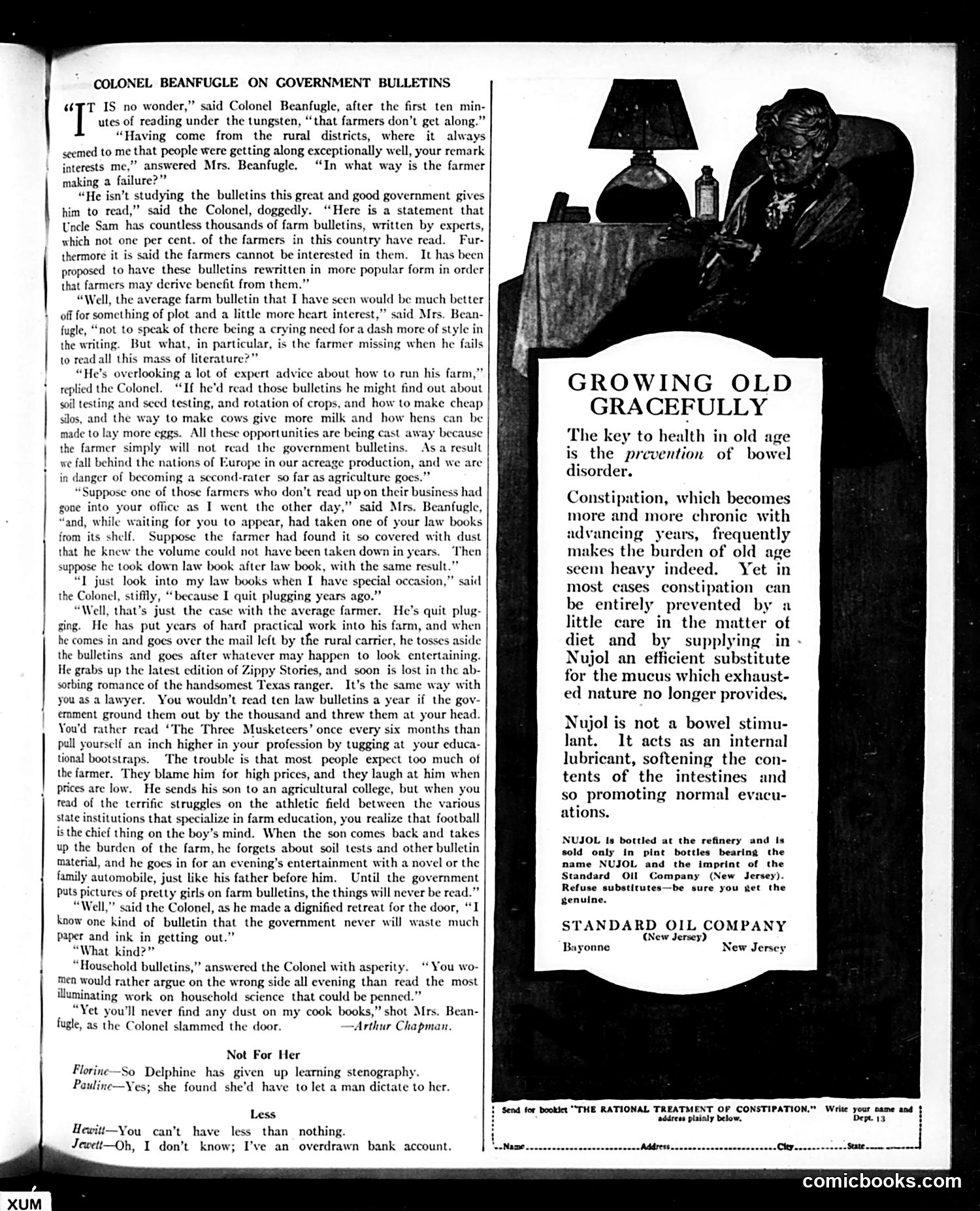
This satirical piece mocks the government's assumption that farmers will read expert agricultural bulletins. Colonel Beanfugle initially blames farmers for ignoring these publications, claiming this causes agricultural failure. However, Mrs. Beanfugle deflates his argument with a clever analogy: she points out that the Colonel himself—a lawyer—wouldn't regularly read government law bulletins either, preferring entertainment like *The Three Musketeers*. She exposes the hypocrisy of expecting farmers to diligently study dry technical literature when educated professionals won't do the same. The satire targets both bureaucratic overconfidence in printed materials and class condescension toward rural people. It suggests the real problem isn't farmer laziness but unrealistic expectations about human nature and reading habits across all social classes.
📄 Transcribed text from this page (OCR, searchable)
Machine-transcribed from the original scan — historical spelling and the odd misread are preserved.
COLONEL BEANFUGLE ON GOVERNMENT BULLETINS séJT IS no wonder,” said Colonel Beanfugle, after the first ten min- I utes of reading under the tungsten, “that farmers don’t get along.” “Having come from the rural districts, where it always seemed to me that people were getting along exceptionally well, your remark interests me,” answered Mrs. Beanfugle. “In what way is the farmer making a failure?” “He isn’t studying the bulletins this great and good government gives him to read,” said the Colonel, doggedly. “Here is a statement that Uncle Sam has countless thousands of farm bulletins, written by experts, which not one per cent. of the farmers in this country have read. Fur- thermore it is said the farmers cannot be interested in them. It has been proposed to have these bulletins rewritten in more popular form in order that farmers may derive benefit from them.” “Well, the average farm bulletin that I have seen would be much better off for something of plot and a little more heart interest,” said Mrs. Bean- fugle, ‘not to speak of there being a crying need for a dash more of style in the writing. But what, in particular, is the farmer missing when he fails to read all this mass of literature?” “He's overlooking a lot of expert advice about how to run his farm,” + replied the Colonel. “If he’d read those bulletins he might find out about soi silos, and the way to make cows made to lay more eggs. All these opportunities are being cast away because the farmer simply will not read the government bulletins. As a result Il behind the nations of Europe in our acreage production, and we are nger of becoming a sccond-rater so far as agriculture goes.” Suppose one of those farmers who don’t read up on their business had gone into your office as I went the other day,” said Mrs. Beanfugle, “and, while waiting for you to appear, had taken one of your law books from its shelf, Suppose the farmer had found it so covered with dust that he knew the volume could not have been taken down in years. Then suppose he took down law book after law book, with the same result.” “I just look into my law books when I have special occasion, the Colonel, stiffly, “because I quit plugging y: “Well, that’s just the case with the average farmer. He’s quit plug- ging. He has put years of hard practical work into his farm, and when he comes in and goes over the mail left by the rural carrier, he tosses aside the bulletins and goes after whatever may happen to look entertaining. He grabs up the latest edition of Zippy Stories, and soon is lost in the ab- sorbing romance of the handsomest Texas ranger. It’s the same with you as a lawyer. You wouldn’t read ten law bulletins a year if the gov- emment ground them out by the thousand and threw them at your head. You'd rather read ‘The Three Musketeers’ once every six months than pull yourself an inch higher in your profession by tugging at your educa- tional bootstraps. The trouble is that most people expect too much of the farmer. They blame him for high prices, and they laugh at him when Prices are low. He sends his son to an agricultural college, but when you read of the terrific struggles on the athletic field between the various state institutions that sp lize in farm education, you realize that football is the chief thing on the boy’s mind. When the son comes back and takes up the burden of the farm, he forgets about soil tests and other bulletin material, and he goes in for an evening’s entertainment with a novel or the family automobile, just like his father before him. Until the government Puts pictures of pretty girls on farm bulletins, the things will never be read.” “Well,” said the Colonel, as he made a dignified retreat for the door, “I Know one kind of bulletin that the government never will waste much Paper and ink in getting out.” “What kind?” “Houschold bulletins,” answered the Colonel with asperity. ‘You wo- men would rather argue on the wrong side all evening than read the most illuminating work on houschold science that could be penned.” “Yet you'll never find any dust on my cook books,” shot Mrs. Bean- fugle, as the Colonel slammed the door. -Arthur Chapman. give more milk and how hens can be said Not For Her Florine—So Delphine has given up learning stenography. Pauline—Yes; she found she'd have to let a man dictate to her. Less Hewitt—You can’t have less than nothing. Jewett—Oh, I don’t know; I’ve an overdrawn bank account. XUM | testing and seed testing, and rotation of crops, and how to make cheap | GROWING OLD GRACEFULLY The key to health in old age is the prevention of bowel disorder. Constipation, which becomes more and more chronic with advancing years, frequently makes the burden of old age seem heavy indeed. Yet in most cases constipation can be entirely prevented by a little care in the matter of diet and by supplying in - Nujol an efficient substitute for the mucus which exhaust- ed nature no longer provides, Nujol is not a bowel stimu- lant. It acts as an internal lubricant, softening the con- tents of the intestines and so promoting normal evacu- ations. NUJOL Is bottled at the refinery and is sold only in pint bottles bearing the name NUJOL and the imprint of the Standard Oil Company (New Jersey). Refuse substitutes—be sure you get the genuine. STANDARD OIL (New Jersey) COMPANY New Jersey Bayonne {Send for booklet “THE RATIONAL TREATMENT OF CONSTIPATION.” Write your same and { address plainly below. Dep. 13, H Chey. State -—- --—-—- comicbooks.com