
Judge, 1917-02-10 · page 8 of 28
Judge — February 10, 1917 — page 8: what you’re looking at
What you’re looking at
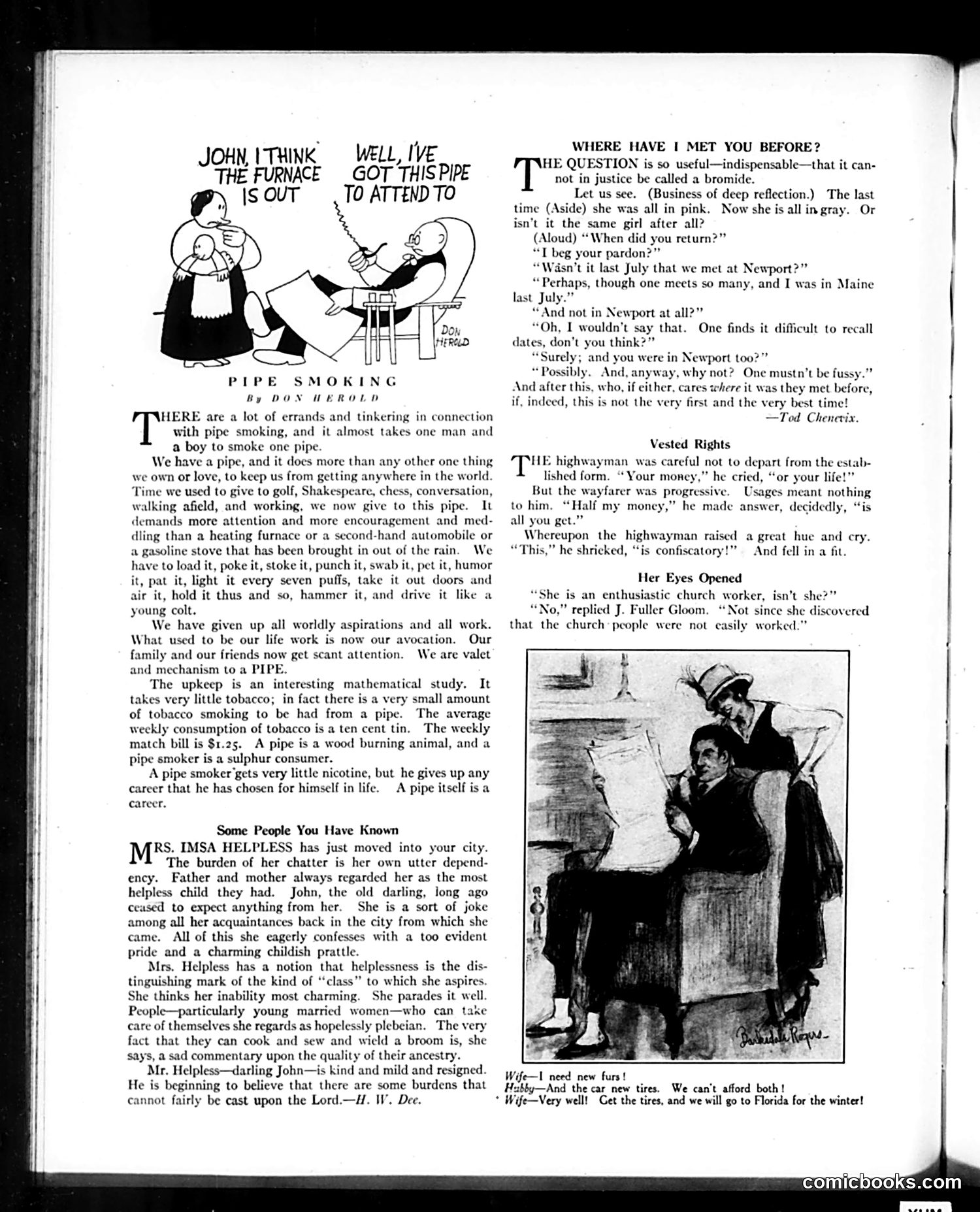
This page contains three distinct pieces of satirical content: **"Pipe Smoking" (by Don Herold):** A humorous essay mocking pipe smokers' obsession with maintaining their pipes. The accompanying cartoon shows a man abandoning his wife and child to tend to a pipe, satirizing how pipe smoking consumes a man's attention and life priorities—more demanding than furnaces or automobiles. The piece calculates the absurd economics: minimal tobacco consumption but high match costs, suggesting pipe smoking is actually a "career" that displaces real work. **"Some People You Have Known":** Character sketch satirizing Mrs. Imsa Helpless, a woman who ostentatiously displays her helplessness as a marker of upper-class status. The satire critiques wealthy women who view domestic competence (cooking, sewing) as beneath their social standing, contrasting with self-sufficient women. **"Where Have I Met You Before?" and "Vested Rights":** Short satirical pieces on social awkwardness and highway robbery respectively—the latter mocking how criminals modernize their demands. The page represents typical Judge content: gentle social satire targeting bourgeois pretension and absurd human behavior.
📄 Transcribed text from this page (OCR, searchable)
Machine-transcribed from the original scan — historical spelling and the odd misread are preserved.
WELL, IVE GOT THIS PIPE TO ATTEND To JOHN, UTHINK: THE FURNACE > |S OUT PIPE SMOKING By DON HEROLD HERE are a lot of errands and tinkering in connection T with pipe smoking, and it almost takes one man and a boy to smoke one pipe. We have a pipe, and it does more than any other one thing we own or love, to keep us from getting anywhere in the world. Time we used to give to golf, Shakespeare, chess, conversation, walking afield, and working, we now give to this pipe. It mands more attention and more encouragement and med- dling than a heating furnace or a second-hand automobile or a gasoline stove that has been brought in out of the rain. We have to load it, poke it, stoke it, punch it, swab it, pet it, humor it, pat it, light it every seven puffs, take it out doors and air it, hold it thus and so, hammer it, and drive it like a young colt. We have given up all worldly aspirations and all work. What used to be our life work is now our avocation. Our family and our friends now get scant attention. We are valet and mechanism to a PIPE. The upkeep is an interesting mathematical study. It takes very little tobacco; in fact there is a very small amount of tobacco smoking to be had from a pipe. The average weekly consumption of tobacco is a ten cent tin, The weekly match bill is $1.25. A pipe is a wood burning animal, and a pipe smoker is a sulphur consumer. A pipe smoker gets very little nicotine, but he gives up any career that he has chosen for himself in life. A pipe itself is a career. Some People You Have Known RS. IMSA HELPLESS has just moved into your city. The burden of her chatter is her own utter depend- ency. Father and mother always regarded her as the most helpless child they had. John, the old darling, long ago ceased to expect anything from her. She is a sort of joke among all her acquaintances back in the city from which she came. All of this she eagerly confesses with a too evident pride and a charming childish prattle. Mrs. Helpless has a notion that helplessness is the dis- tinguishing mark of the kind of “class” to which she aspires. She thinks her inability most charming. She parades it well. People—particularly young married women—who can take care of themselves she regards as hopelessly plebeian. The very fact that they can cook and sew and wield a broom is, she says, a sad commentary upon the quality of their ancestry. Mr. Helpless—darling John—is kind and mild and resigned. He is beginning to believe that there are some burdens that cannot fairly be cast upon the Lord.—H. IW’, Dee. WHERE HAVE | MET YOU BEFORE? T": QUESTION is so useful—indispensable—that it can- not in justice be called a bromide. Let us see. (Business of deep reflection.) The last time (Aside) she was all in pink. Now she is all in gray. Or isn’t it the same girl after all? (Aloud) “When did you return?” “T beg your pardon?” “Wasn't it last July that we met at Newport?” Perhaps, though one meets so many, and I was in Maine last July.” “And not in Newport at all?” “Oh, I wouldn't say that. One finds it difficult to recall don’t you think? Surely; and you were in Newport too?” “Possibly. And, anyway, why not? One mustn’t be fu And after this, who, if eithes s if, indeed, this is not the very first and the v best time! —Tod Chenevix. Vested Rights HE highwayman was careful not to depart from the estab- lished form. “ Your money,” he cried, “or your life! But the w Ss progressive. Usages mi to him. “Half my money,” he made answer, de all you get.” . Whereupon the highwayman 1: “This,” he shricked, “is confiscatory 1 a great hue and cry. * And fell in a fit. Her Eyes Opened “She is an enthusiastic church worker, isn’t she?” No,” replied J. Fuller Gloom. “Not since she discovered that the church people were not easily worked.” Wife—I need new furs! Hubby—And the car new tires. We can't afford both ! * Wife—Very well! Get the tires, and we will go to Florida for the winter! icbooks.com