
Judge, 1917-02-10 · page 18 of 28
Judge — February 10, 1917 — page 18: what you’re looking at
What you’re looking at
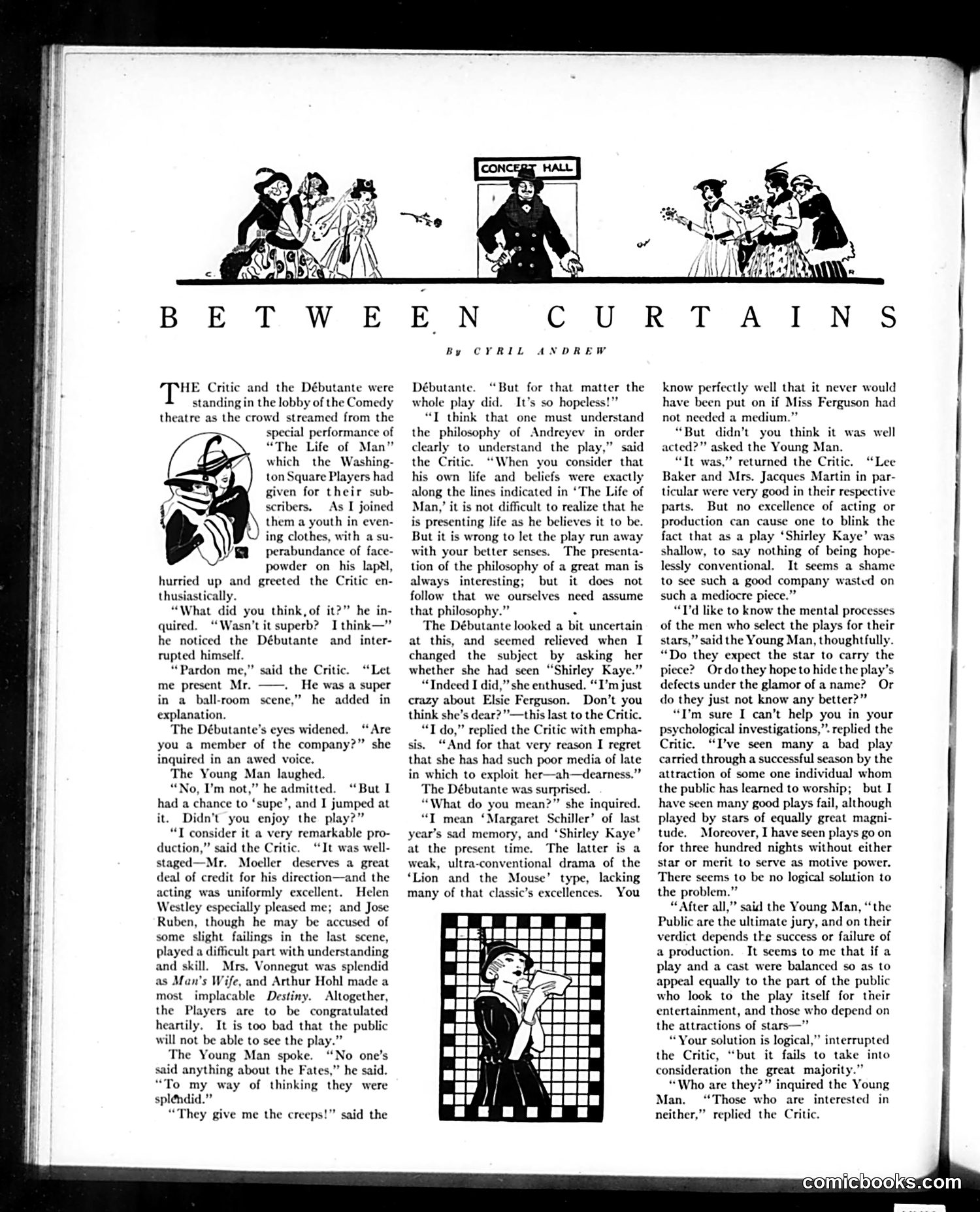
This satirical piece mocks theatrical pretension and the star system in early 20th-century Broadway. Three characters discuss a production of Andreyev's "The Life of Man" at the Washington Square Players: **The figures:** A Critic (an authority on theater), a Débutante (a young society woman), and an unnamed Young Man who served as an extra ("super") in a ball-room scene. **The satire:** The Critic dismisses the play's philosophy while praising individual actors' performances, then criticizes that Elsie Ferguson's recent vehicles ("Margaret Schiller" and "Shirley Kaye") are mediocre plays chosen merely because she needs *something* to perform in—excellent acting cannot redeem weak material. **The point:** The piece exposes how star power drives theatrical production choices regardless of dramatic merit, and how even sophisticated critics compromise artistic standards by praising performances in fundamentally shallow plays. The Young Man's casual participation suggests Broadway's accessibility to the privileged but dilettantish.
📄 Transcribed text from this page (OCR, searchable)
Machine-transcribed from the original scan — historical spelling and the odd misread are preserved.
HE Critic and the Débutante were standing in the lobby of the Comedy theatre as the crowd streamed from the special performance of “The Life of Man” which the Washing- quare Players had n for their sub- scribers. As I joined them a youth in even- ing clothes, with a su- perabundance of face- powder on his lapti, hurried up and greeted the Critic en- thusiastically. “What did you think, of it?” he in- quired. “Wasn't it superb? I think—” he noticed the Débutante and inter- rupted himself. “Pardon me,” said the Critic. “Let me present Mr. ——. He was a super in a ball-room scene,” he added in explanation. The Débutante’s eyes widened. “Are you a member of the company?” she inquired in an awed voice. The Young Man laughed. “No, I’m not,” he admitted. “But I had a chance to ‘supe’, and I jumped at it. Didn't you enjoy the play?” “I consider it a very remarkable pro- duction,” said the Critic. “It was well- staged—Mr. Moeller deserves a great deal of credit for his direction—and the acting was uniformly excellent. Helen Westley especially pleased me; and Jose Ruben, though he may be accused of some slight failings in the last scene, played a difficult part with understanding and skill. Mrs. Vonnegut was splendid as Man's Wife, and Arthur Hohl made a most implacable Destiny. Altogether, the Players are to be congratulated heartily. It is too bad that the public will not be able to see the play.” The Young Man spoke. “No one’s said anything about the Fates,” he said. “To my way of thinking they were splendid.” “They give me the creeps!” said the By CYRIL ANDREW Débutante. “But for that matter the whole play did. It’s so hopeless!” “T think that one must understand the philosophy of Andreyev in order to understand the play,” said “When you consider that his own life and beliefs were exactly along the lines indicated in ‘The Life of Man,’ it is not difficult to realize that he is presenting life as he believes it to be. But it is wrong to let the play run away with your better senses. The presenta- tion of the philosophy of a great man is always interesting; but it does not follow that we ourselves need assume that philosophy.” . The Débutante looked a bit uncertain at this, and seemed relieved when I changed the subject by asking her whether she had seen “Shirley Kaye.” “Indeed I did,” she enthused. “I’m just crazy about Elsie Ferguson. Don’t you think she’s dear? ””—this last to the Critic. replied the Critic with empha- sis. “And for that very reason I regret that she has had such poor media of late in which to exploit her—ah—dearness.” The Débutante was surprised. “What do you mean?” she inquired. “IT mean ‘Margaret Schiller’ of last year’s sad memory, and ‘Shirley Kaye’ at the present time. The latter is a weak, ultra-conventional drama of the ‘Lion and the Mouse’ type, lacking many of that classic’s excellences. You know perfectly well that it never would have been put on if Miss Ferguson had not needed a medium.” “But didn’t you think it was well acted?” asked the Young Man. “Tt was,” returned the Critic. “Lee Baker and Mrs. Jacques Martin in par- were very good in their respective But no excellence of acting or production can cause one to blink the fact that as a play ‘Shirley Kaye’ was shallow, to say nothing of being hope- lessly conventional. It seems a shame to see such a good company wasted on such a mediocre piece.” “T'd like to know the mental processes of the men who select the plays for their stars,” said the Young Man, thoughtfully. “Do they expect the star to carry the piece? Ordo they hope to hide the play’s defects under the glamor of aname? Or do they just not know any better?” “I'm sure I can’t help you in your psychological investigations,”. replied the Critic. “I’ve seen many a bad play carried through a successful season by the attraction of some one individual whom the public has learned to worship; but I have seen many good plays fail, although played by stars of equally great magni- tude. Moreover, I have seen plays go on for three hundred nights without either star or merit to serve as motive power. There seems to be no logical solution to the problem.” “ After all,” said the Young Man, “the Public are the ultimate jury, and on their verdict depends tke success or failure of a production. It seems to me that if a play and a cast were balanced so as to appeal equally to the part of the public who look to the play itself for their entertainment, and those who depend on the attractions of stars—" “Your solution is logical,” interrupted the Critic, “but it fails to take into consideration the great majority.” “Who are they?” inquired the Young Man. “Those who are interested in neither,” replied the Critic. | | |