
Judge, 1917-02-10 · page 24 of 28
Judge — February 10, 1917 — page 24: what you’re looking at
What you’re looking at
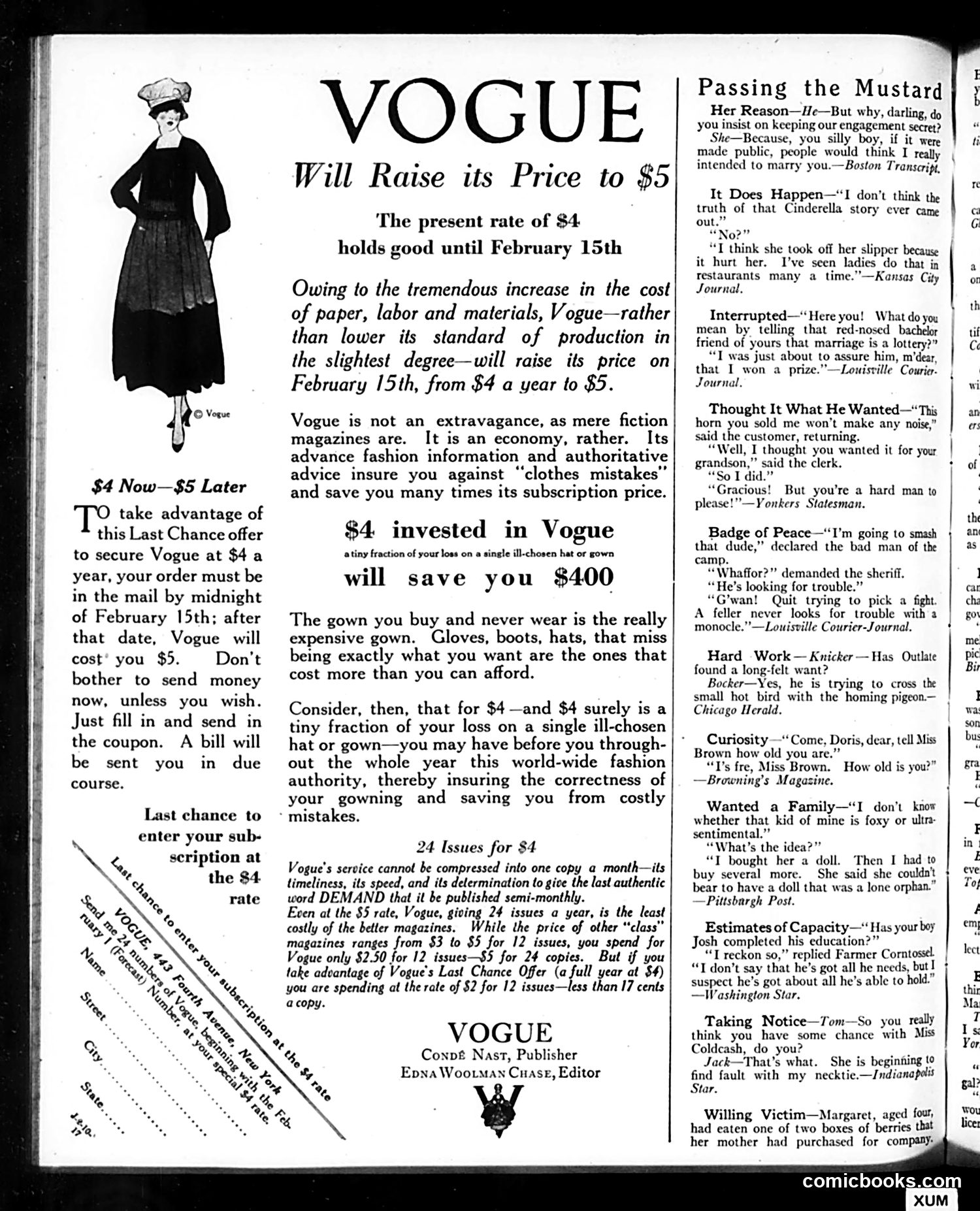
This page is primarily **Vogue magazine advertising**, not political satire. The left side announces a price increase from $4 to $5 per year, effective February 15th. The magazine justifies this by arguing that Vogue is an "economy"—claiming subscribers save $400 annually by avoiding fashion mistakes. The pitch emphasizes getting 24 semi-monthly issues cheaply compared to competitors. The right side contains **humorous short jokes** typical of Judge magazine's filler content—unrelated to the main advertisement. These are mild domestic humor: a woman hiding her engagement to avoid appearing marriage-minded; references to false teeth and faulty car horns; marriage portrayed as a gamble. **No political figures or caricatures appear.** This is essentially a period advertising document showing how luxury magazines marketed themselves and promoted urgency through limited-time pricing offers. The humor reflects early 20th-century attitudes about courtship, class consumption, and married life.
📄 Transcribed text from this page (OCR, searchable)
Machine-transcribed from the original scan — historical spelling and the odd misread are preserved.
i $4 Now—$5 Later take advantage of i Te Last Chance offer to secure Vogue at $4 a / year, your order must be in the mail by midnight of February 15th; after that date, Vogue will cost’ you $5. Don't bother to send money now, unless you wish. Just fill in and send in the coupon. A bill will be sent you in due course. Last chance to enter your sub- scription at the $4 rate VOGUE Will Raise its Price to $5 The present rate of $4 holds good until February 15th Owing to the tremendous increase in the cost of paper, labor and materials, Vogue—rather than lower its standard of production in the slightest degree—will raise its price on February 15th, from $4 a year to $5. Vogue is not an extravagance, as mere fiction magazines are. It is an economy, rather. Its advance fashion information and authoritative advice insure you against ‘‘clothes mistakes” and save you many times its subscription price. $4. invested in Vogue atiny fraction of your loss on a single ill-chosen hat or gown will save you $400 The gown you buy and never wear is the really expensive gown. Gloves, boots, hats, that miss being exactly what you want are the ones that cost more than you can afford. Consider, then, that for $4—and $4 surely is a tiny fraction of your loss on a single ill-chosen hat or gown—you may have before you through- out the whole year this world-wide fashion authority, thereby insuring the correctness of your gowning and saving you from costly * mistakes. 24 Issues for $4 Vogue's service cannot be compressed into one copy a month—its timeliness, ils speed, and its determination to give the last authentic word DEMAND that it be published semi-monthly. Even at the $5 rate, Vogue, giving 24 issues a year, is the least costly of the better magazines. While the price of other “class” magazines ranges from $3 to $5 for 12 issues, you spend for Vogue only $2.50 for 12 issues—$5 for 24 copies. But if you take advantage of Vogue's Last Chance Offer (a full year at $4) you are spending at the rate of $2 for 12 issues—less than 17 cents Conpf Nast, Publisher Epna Wootman Cuase, Editor Passing the Mustard Her Reason—He—But why, darling, do you insist on keeping our engagement secret? She—Because, you silly boy, if it were made public, people would think I really , intended to marry you.—Boston Transcript, It Does Happen—“I don’t think the truth of that Cinderella story ever came out.” “T think she took off her slipper because it hurt her. I’ve seen ladies do that in restaurants many a time.”’—Kansas City Journal. Interrupted—‘‘Here you! What do you mean by telling that red-nosed bachelor friend of yours that marriage is a lottery?” “T was just about to assure him, m’dear, that I won a prize.”—Louisville Courier. Journal. Thought It What He Wanted—“ This horn you sold me won't make any noise,” said the customer, returning. “Well, I thought you wanted it for your grandson,” said the clerk. “So I did.” “Gracious! But you’re a hard man to please!” —Yonkers Statesman. Badge of Peace—‘I’m going to smash that dude,” declared the bad man of the camp. “Whaffor?” demanded the sheriff. “He’s looking for trouble.” “G’wan! Quit trying to pick a fight. A feller never looks for trouble with a monocle.”"—Louisville Courier-Journal. Hard Work — Knicker —Has Outlate found a long-felt want? Bocker—Yes, he is trying to cross the small hot bird with the homing pigeon— | Chicago Herald. Curiosity —‘‘ Come, Doris, dear, tell Miss Brown how old you are.” “T's fre, Miss Brown. How old is you?” —Browning’s Magazine. Wanted a Family—“I don’t know whether that kid of mine is foxy or ultr- sentimental.” “What's the idea?” “I bought her a doll. Then I had to buy several more. She said she couldn't bear to have a doll that was a lone orphan.” —Pittsbargh Post. Estimates of Capacity—‘‘ Has your boy Josh completed his education?” “T reckon so,” replied Farmer Corntoss¢l. “T don’t say that he’s got all he needs, but! suspect he’s got about all he’s able to hold.’ —Washington Star. Taking Notice—Tom—So you really think you have some chance with Miss Coldcash, do you? Jack—That’s what. She is beginning (0 find fault with my necktie. —/ndianapolis Star. Willing Victim—Margaret, aged four, had eaten one of two boxes of berries her mother had purchased for company. comicbooks.com