
A complete issue · 28 pages · 1916
Judge — January 8, 1916
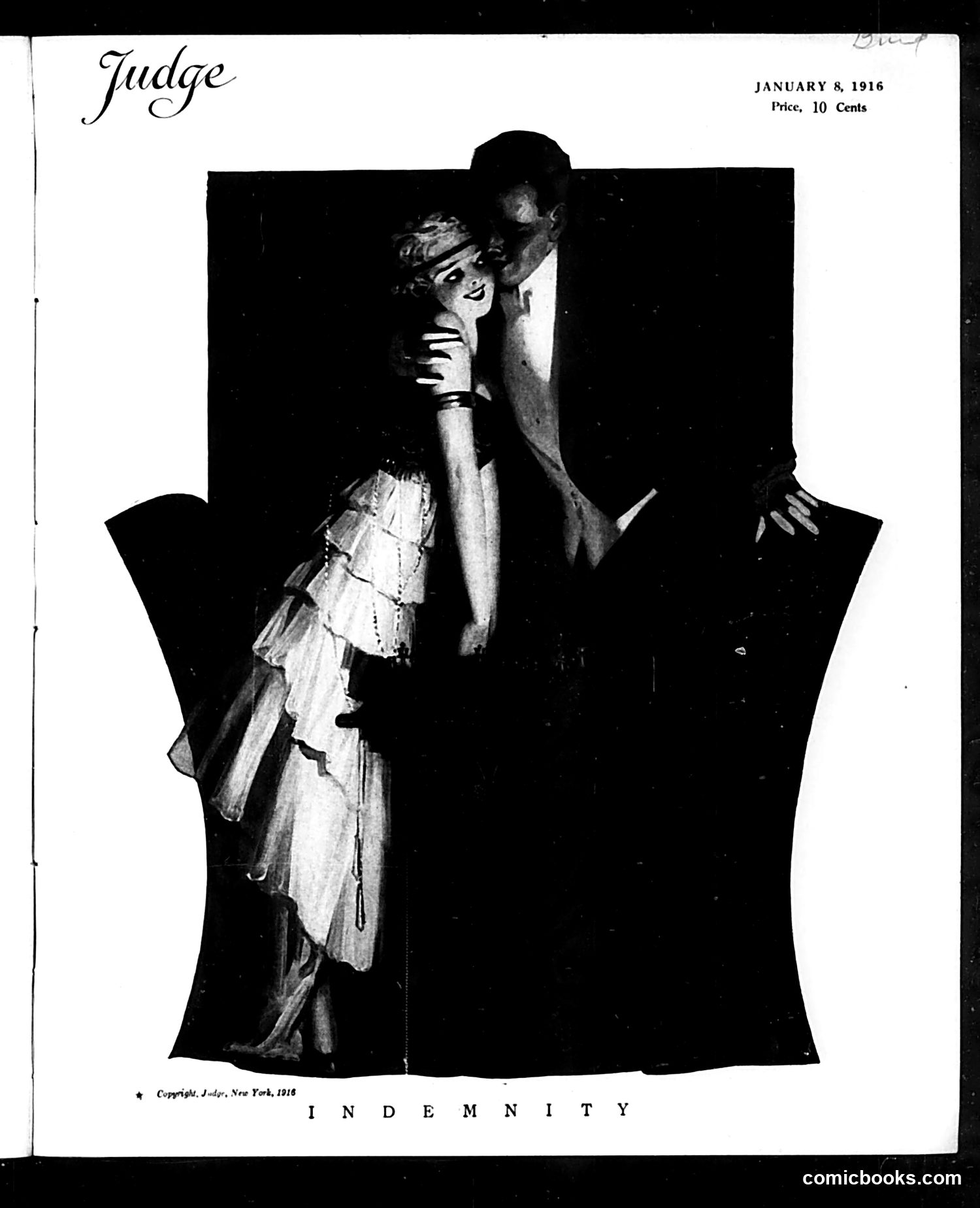
This cartoon illustrates a romantic scene between a man and woman, captioned "INDEMNITY" at the bottom. The image appears to be satirizing relationship dynamics around financial compensation or settlement—likely commentary on breach of promise suits or divorce settlements that were common legal issues in the early 20th century. The woman wears a fashionable hat and appears flirtatious, while the man in formal attire seems to be the one being "indemnified" or compensated. The satire likely mocks either the commercialization of romance or men's financial vulnerability in legal disputes involving women. The specific social context—whether referencing a particular scandal or general courtship practices—remains unclear from the image alone.
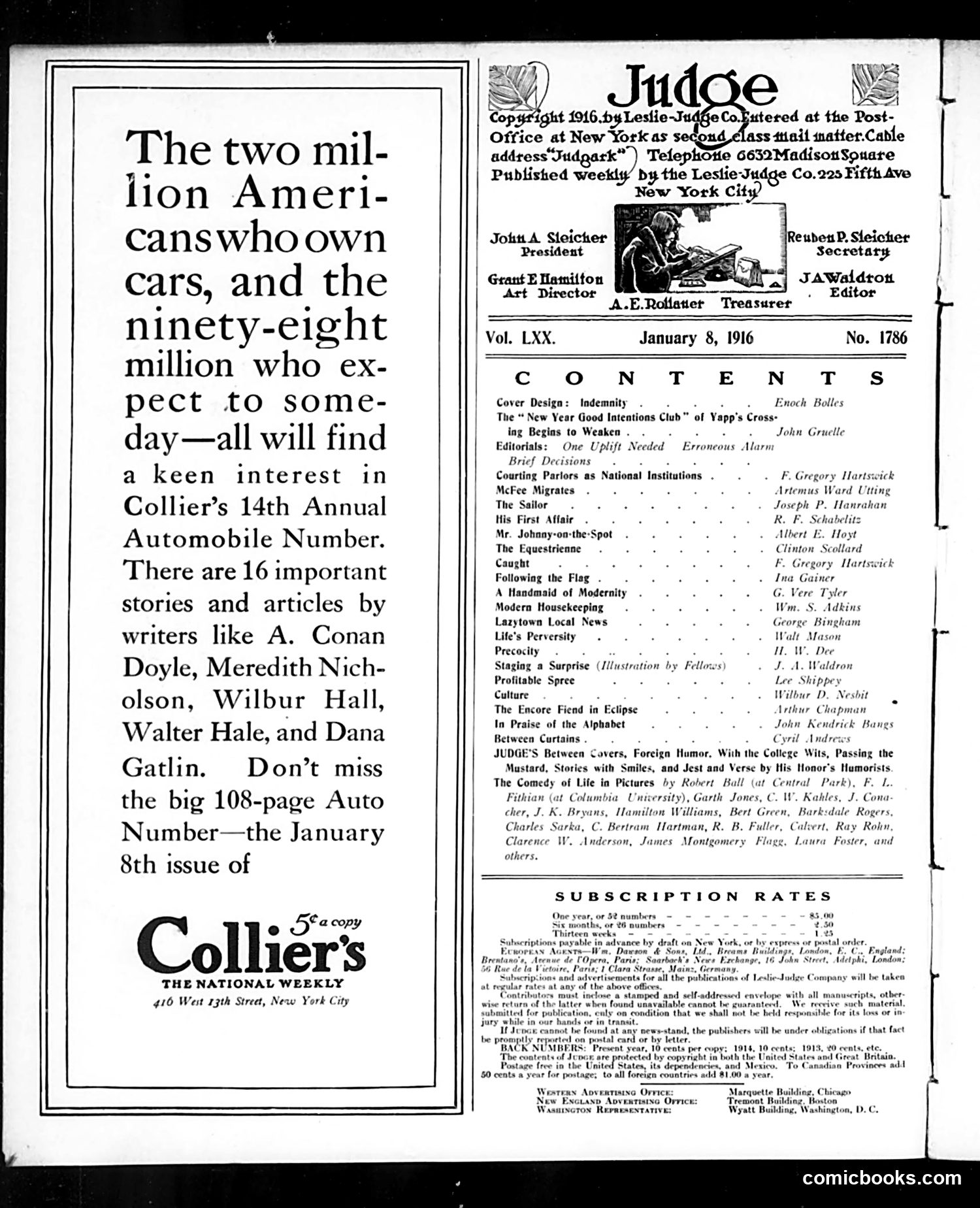
This page is primarily **advertising for Collier's magazine**, promoting their 14th Annual Automobile Number (108 pages). The ad highlights 16 stories and articles by prominent writers including A. Conan Doyle, Meredith Nicholson, and Wilbur Hall. The left side features a large advertisement emphasizing that both car owners and prospective buyers will find keen interest in the automobile-focused issue. The right side shows the Judge masthead and table of contents for this particular issue. The **content listed** includes satirical pieces typical of Judge's style—editorials on "An Uplift Needed" and "Erroneous Alarms," plus humor columns about courtship, migration, and social observations. This reflects Judge's role as a general-interest satirical weekly covering American life and current events.
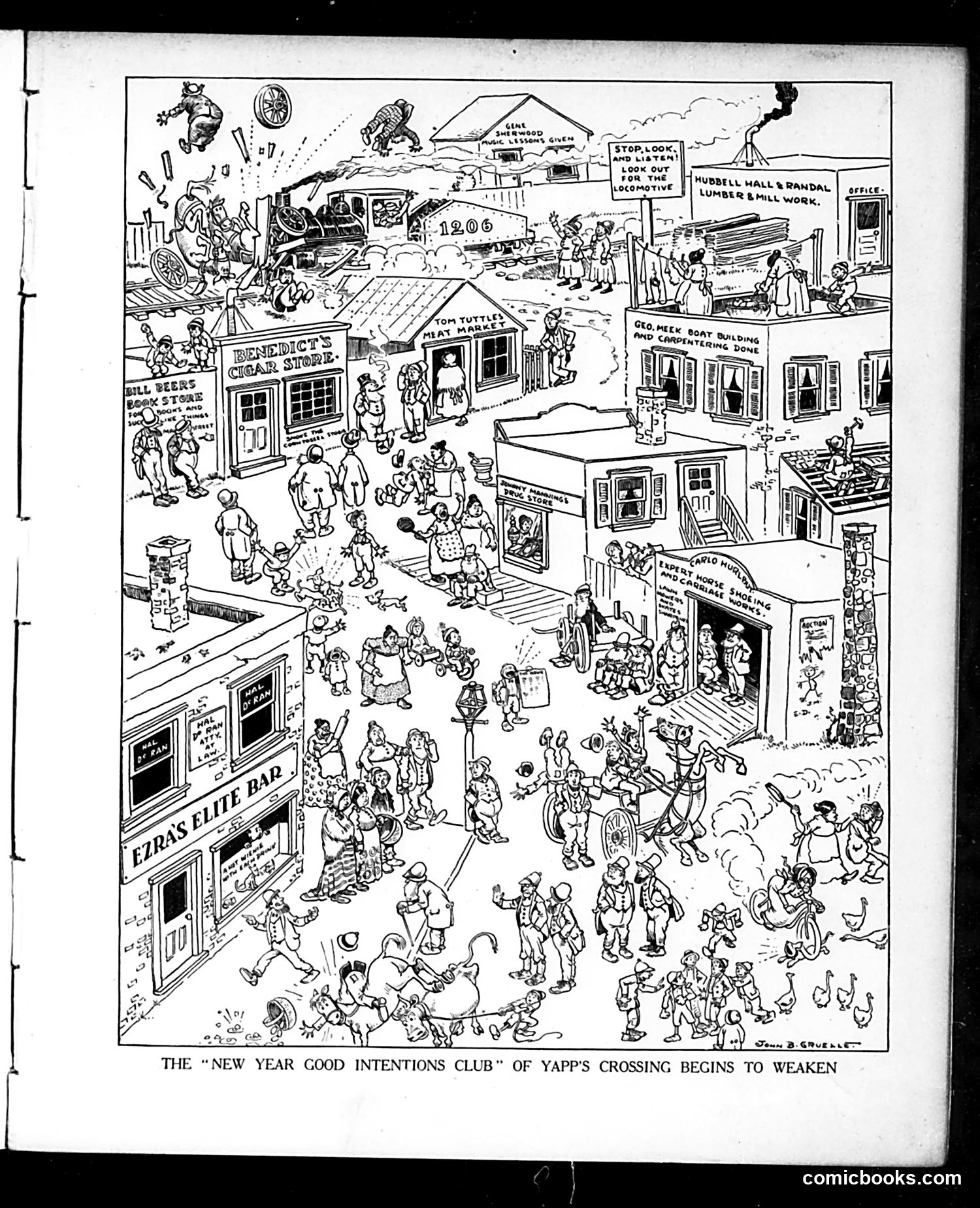
The cartoon depicts "Yapp's Crossing," apparently a town or neighborhood, with the caption "The 'New Year Good Intentions Club' of Yapp's Crossing Begins to Weaken." The scene shows a bustling street filled with people engaged in various activities—playing, fighting, and socializing—suggesting disorder and chaos. Visible businesses include "Ezra's Elite Bar," "Benedict's Cigar Store," and "Tom Tuttle's Market," alongside industrial operations like "Hubbell Hall & Randal Lumber & Mill Work." The satire mocks the common New Year's resolution tradition, humorously suggesting that residents' good intentions for self-improvement have already crumbled just days into January. The crowded street scene of drinking, brawling, and general mayhem visually reinforces this message about human weakness and the failure to maintain moral discipline.
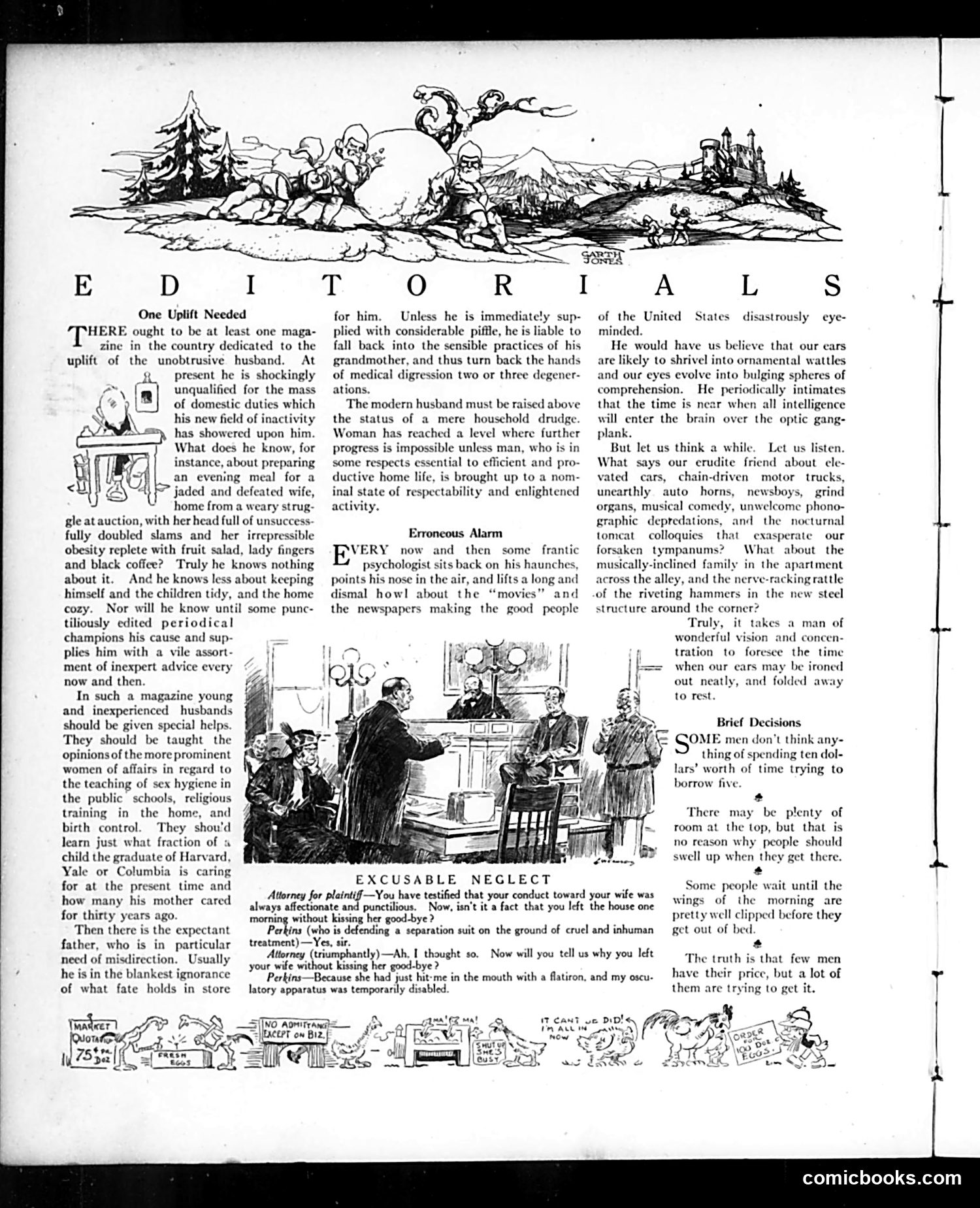
This page contains several satirical pieces about domestic life and gender relations, typical of early 20th-century American humor magazines. **"One Uplift Needed"** argues that husbands need better education about housekeeping and childcare. The satire targets men's ignorance of domestic duties and suggests they should receive formal training—a critique of masculine incompetence in the home. **"Erroneous Alarm"** mocks psychologists and newspaper moral guardians who worry about movies corrupting families, portraying such concerns as overblown. **"Excusable Neglect"** depicts a marital dispute where a husband defends neglecting his wife by claiming he forgot her birthday because she "had just let me in the mouth with a flirtatious, and my occultary apparatus was temporarily disabled"—crude humor about domestic conflict. The page satirizes gender dynamics, parenting expectations, and contemporary social anxieties.
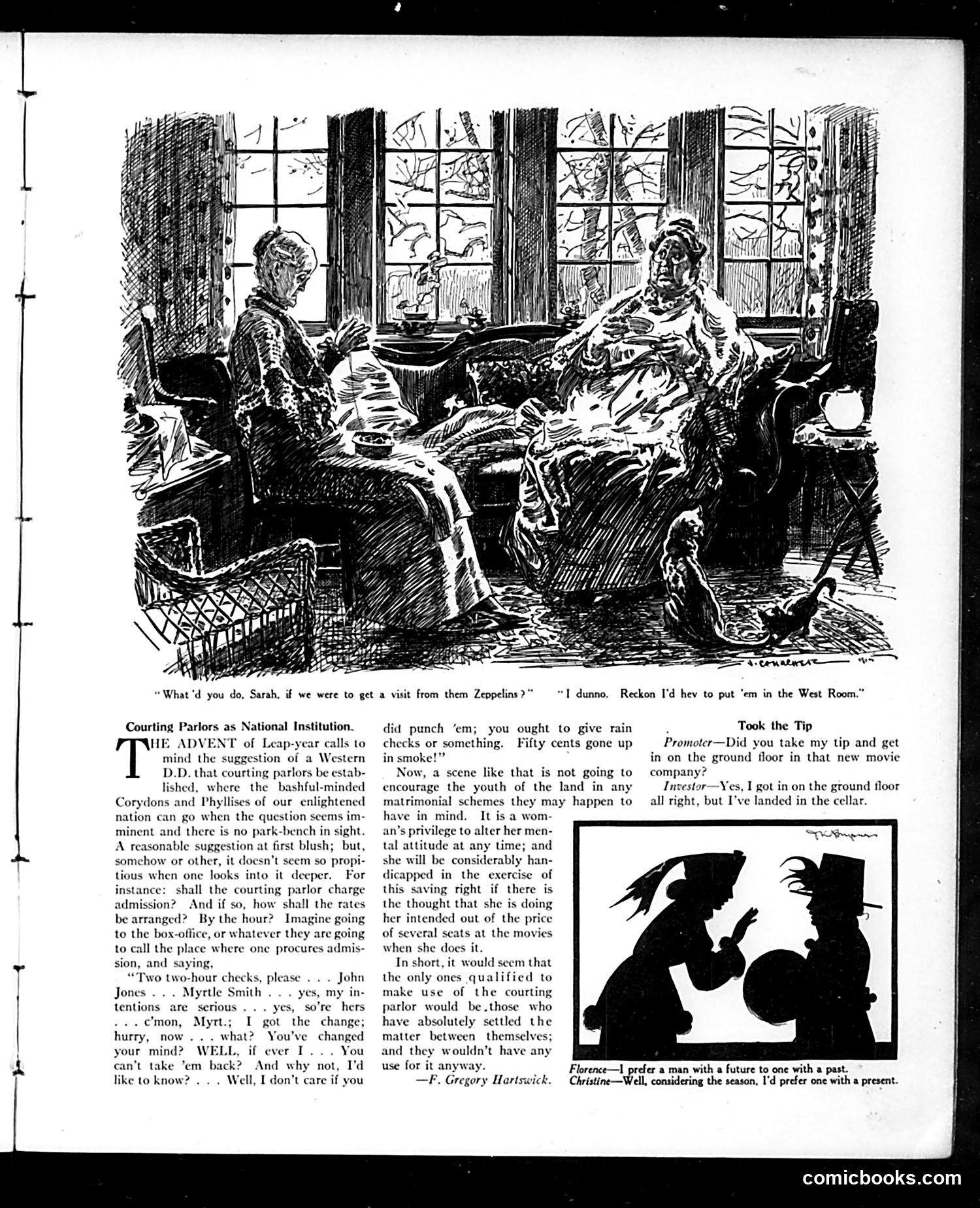
The main cartoon illustrates "Courting Parlors as National Institution," critiquing a Western YMCA's proposal to establish chaperoned courting spaces. The satirist argues this represents government overreach into intimate matters—questioning who decides admission rates, location, and rules. The dialogue mocks the absurdity: characters debate practical logistics ("Two two-hour checks, please") while the underlying point is that young people settling romantic matters themselves requires no institutional mediation or expense. The smaller silhouette cartoons at right ("Took the Tip," "Florence," "Christine") appear to be separate joke vignettes, unrelated to the main satire. **Context**: This reflects early 20th-century anxieties about institutional control over private life and generational independence—a progressive-era debate about paternalism.
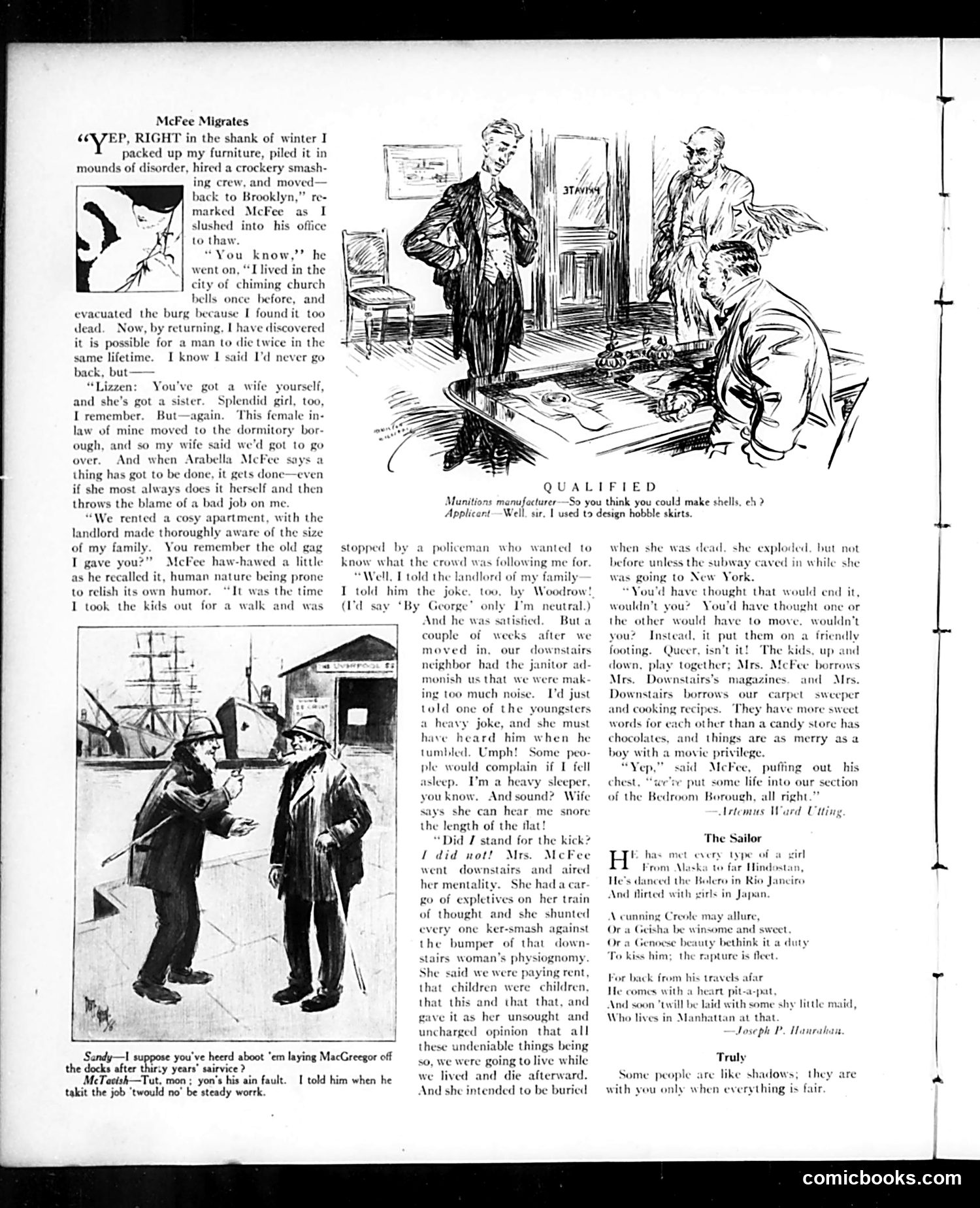
This Judge magazine page contains three distinct items: **"McFee Migrates"** (main story): A humorous narrative where McFee recounts moving back to Brooklyn despite having left years earlier, forced by his domineering wife. The joke centers on domestic comedy—noisy children, complaining neighbors, and marital dynamics. A secondary cartoon shows two dock workers discussing a fired employee, playing on working-class humor about job security. **"Qualified"** (small cartoon): A munitions manufacturer interviews a woman applicant. The satire mocks her stated qualification—designing "hobble skirts" (restrictive women's fashion from the 1910s-20s era)—as absurdly unrelated to armaments manufacturing. This likely references WWI-era industrial mobilization and gender in the workforce. **"The Sailor"** (poem): Light verse celebrating a sailor's romantic conquests across various ports and ethnicities, reflecting casual early-20th-century attitudes toward international flirtation. The overall page emphasizes domestic and workplace humor typical of American satirical magazines of this era.
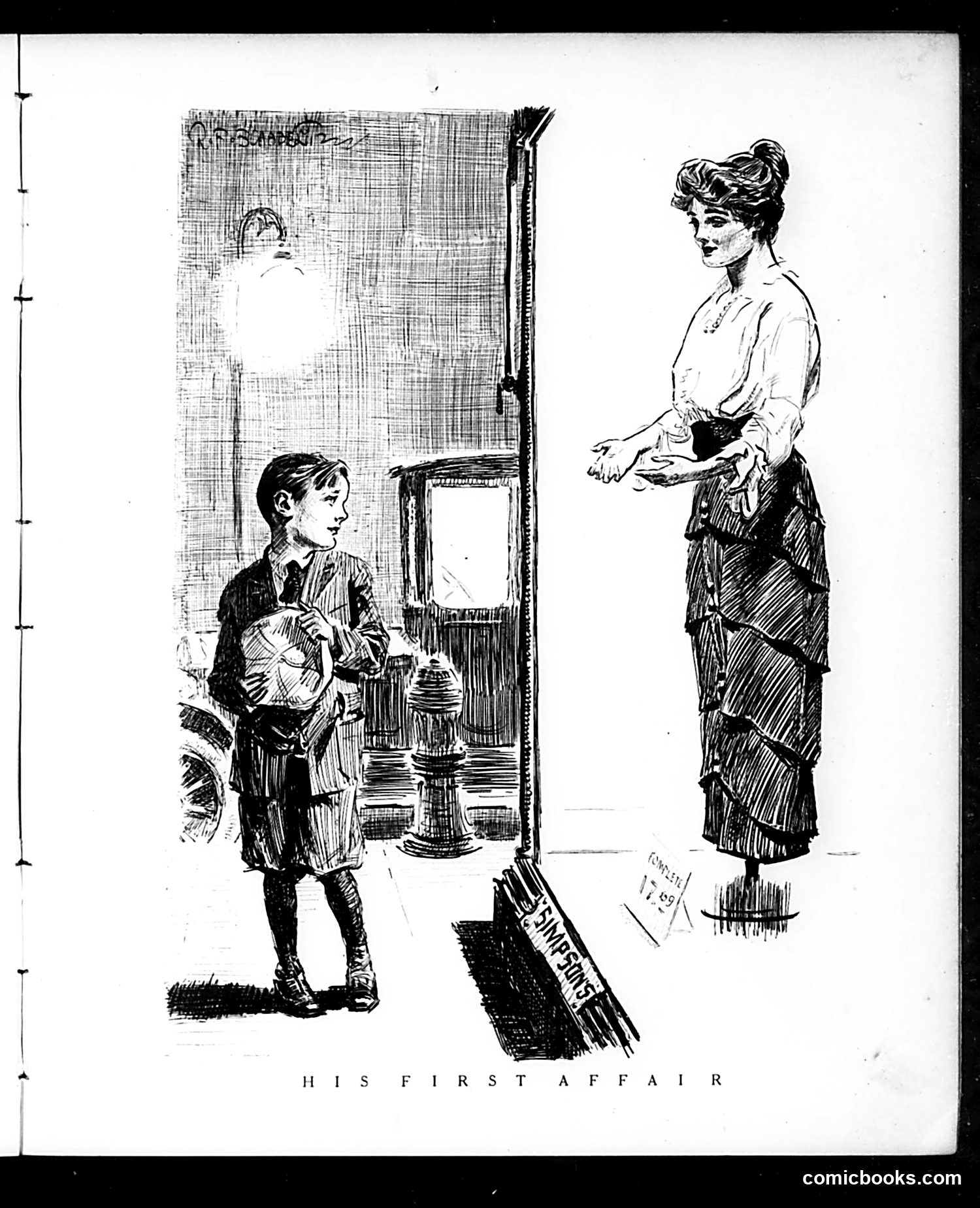
This illustration depicts a young boy presenting flowers to an adult woman, captioned "His First Affair." The humor relies on the double meaning of "affair"—what appears to be an innocent childhood gesture of admiration is framed as romantic/sexual ("affair"), creating comedic irony through incongruity. The woman's amused expression and the boy's earnest presentation suggest this is satirizing either: the precocious behavior of children imitating adult courtship rituals, or possibly mocking overwrought sentimentality about childhood innocence. The domestic setting (interior doorway visible) emphasizes the mundane, everyday nature of the interaction, heightening the absurdist humor of labeling a child's innocent gesture with adult terminology.
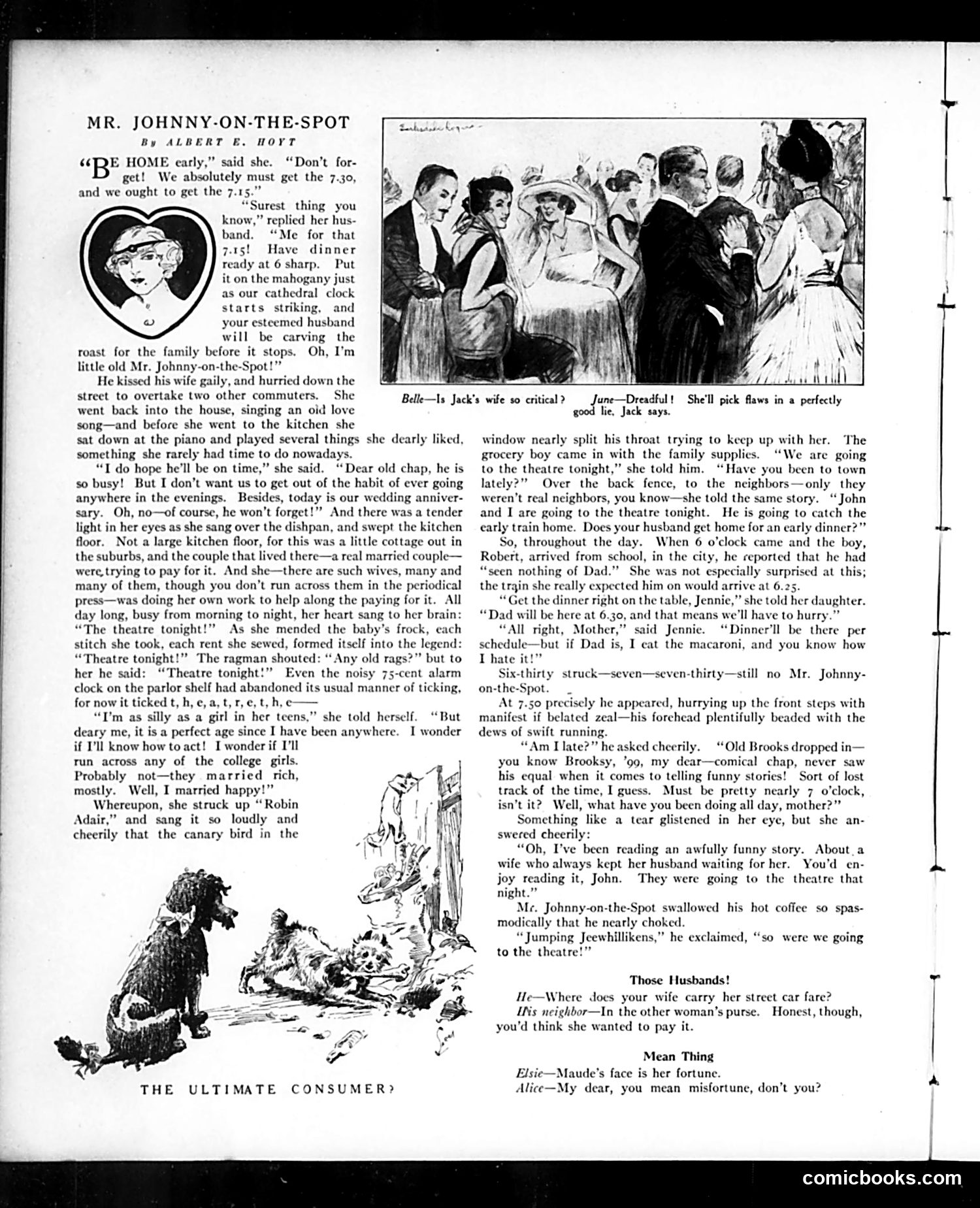
This story satirizes the gap between husbands' grand promises and reality. The protagonist boasts he'll be punctual ("Johnny-on-the-Spot"), ensuring dinner at 6 sharp and making their wedding anniversary theatre trip. His wife—a working-class housewife managing a cottage, doing her own labor—spends the day joyfully anticipating the evening. However, Mr. Johnny-on-the-Spot repeatedly fails to appear. He arrives at 7:50, vastly late, after his wife and children have waited through dinner. The satire targets husbands who make elaborate commitments yet neglect their wives' emotional needs, leaving them disappointed despite their careful preparation and hope. The accompanying jokes ("Those Husbands!") reinforce the theme: wives manage household finances and sacrifice while husbands absent themselves. The illustration labeled "The Ultimate Consumer?" shows a dog, implying men consume resources without reciprocating care or reliability.
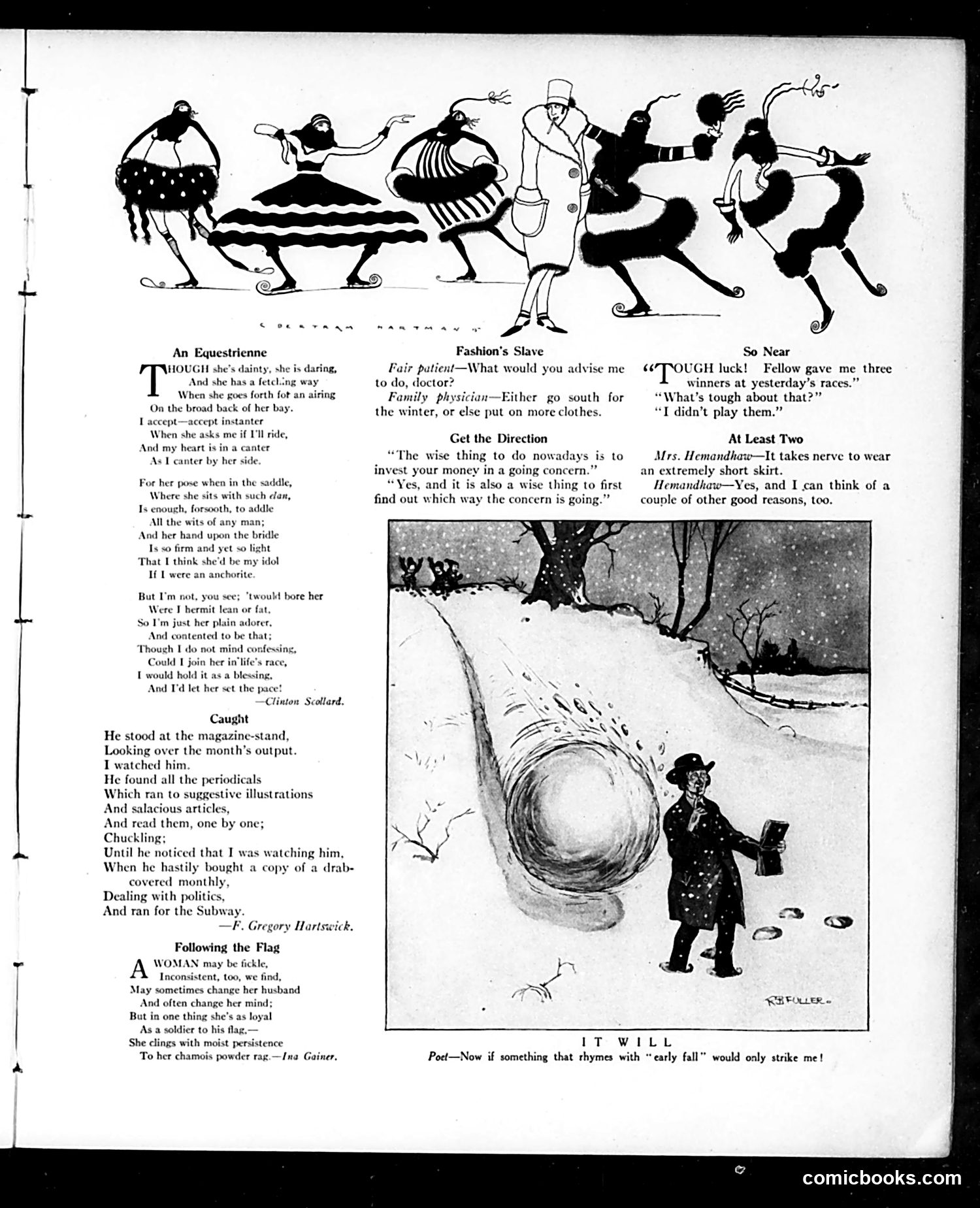
This page contains light satirical humor typical of early 20th-century American magazines. The top illustration depicts fashionable women dancing or parading—likely satirizing exaggerated fashion trends of the era (the bobbed hair and loose clothing suggest 1920s styles). The text pieces mock contemporary social attitudes: - **"An Equestrienne"**: A romantic poem about a woman on horseback, poking gentle fun at male admiration of fashionable women. - **"Caught"**: Satirizes hypocrisy—a man eagerly reads "salacious" magazines until he realizes he's being watched, then hastily buys a respectable political publication to appear proper. - **"Following the Flag"**: A joke about women's loyalty to cosmetics (powder compacts), comparing it mockingly to patriotic devotion. The remaining jokes address gender relations, fashion choices, and dating customs. The illustration shows a man in winter with a large log—captioned "It Will," suggesting romantic inevitability. Overall, this reflects Jazz Age social commentary—poking fun at changing gender roles, consumerism, and evolving fashion without serious political intent.
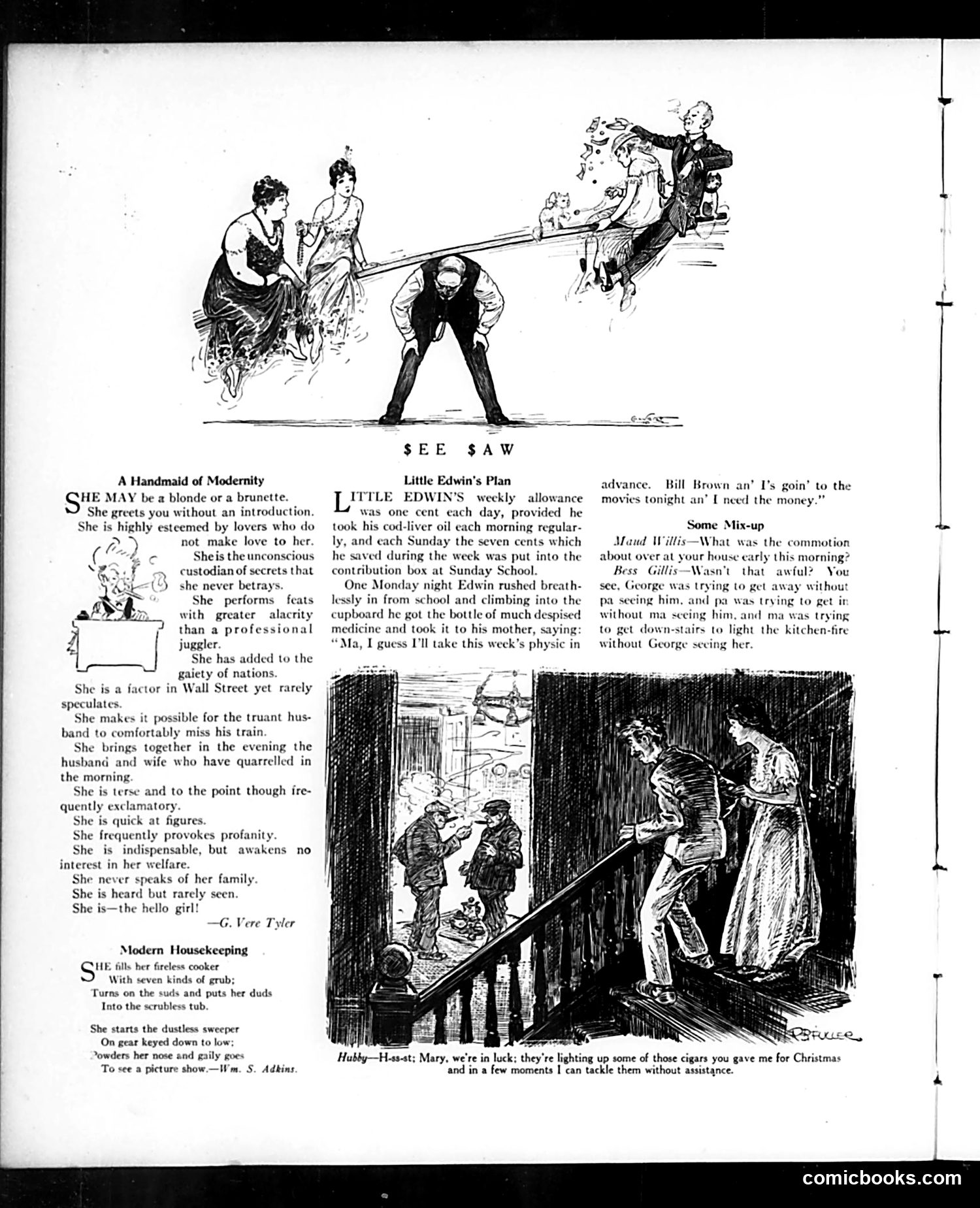
This page from the satirical magazine **Judge** contains three distinct pieces satirizing early 20th-century American life: **"A Handmaid of Modernity"** celebrates the telephone operator (the "hello girl")—a modern female worker essential to society yet invisible and underappreciated, treated as a utility rather than a person. **"Modern Housekeeping"** mocks labor-saving devices marketed to women. Despite "fireless cookers," "scrubless tubs," and "dustless sweepers" promising to free women from drudgery, the housewife simply rushes to the movies instead—satirizing how modernity promised liberation but didn't fundamentally change women's workload or social position. **"Little Edwin's Plan"** is a children's humor piece where a boy takes his weekly medicine in advance to skip doses and spend his savings on movies—gentle satire on childhood reasoning and parental authority. The page's bottom illustration depicts a domestic scene of marital tension, accompanying a joke about infidelity and deception between spouses. These pieces reflect Judge's satirical commentary on modern life, technology, gender roles, and social change in the early 1900s.
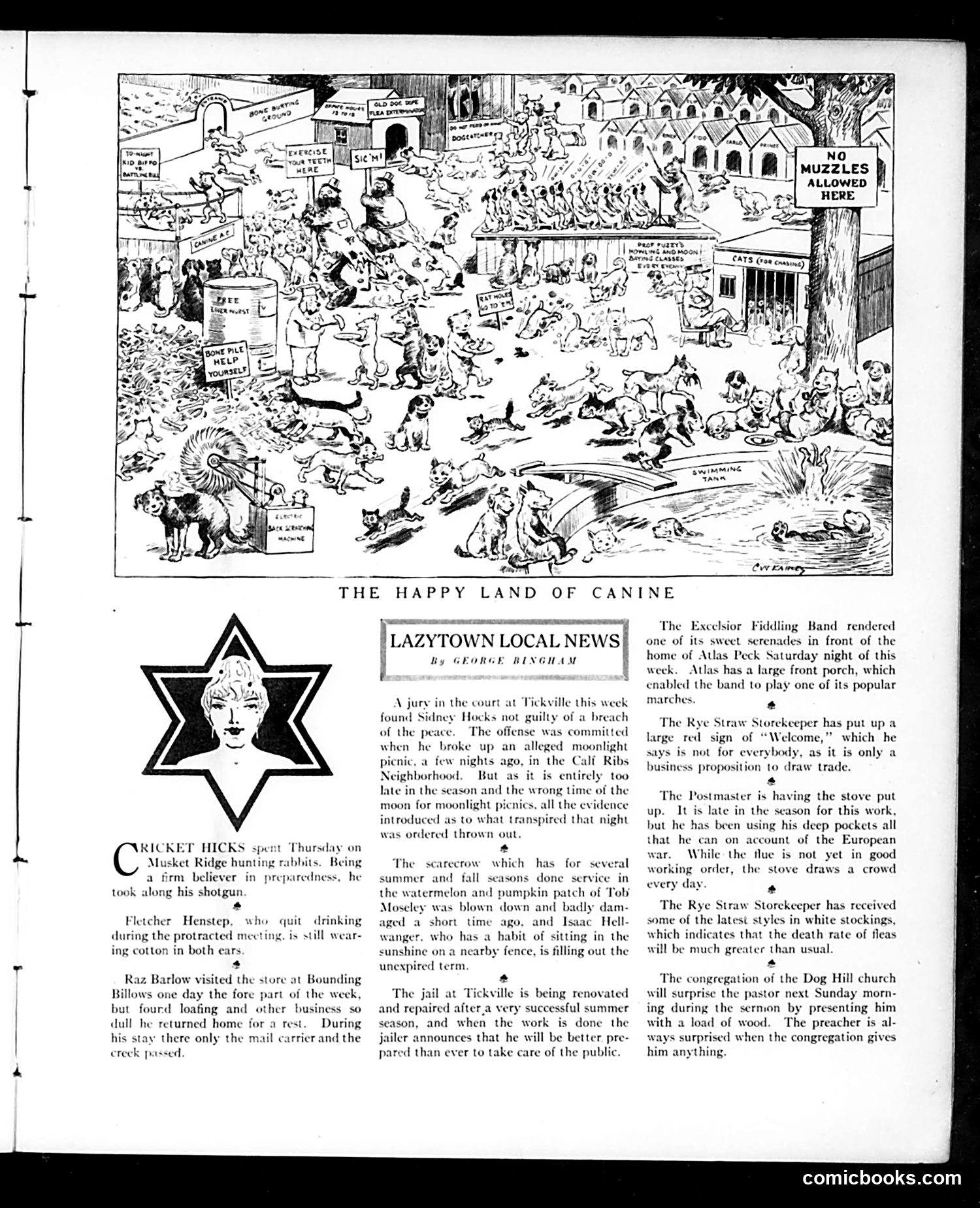
**Main Cartoon:** A densely packed, whimsical illustration depicting an idealized dog community—dogs engaging in human activities (exercising, swimming, visiting shops, playing). Signs read "No Muzzles Allowed Here" and reference dog-related services. This appears to be a humorous fantasy of a dog utopia, contrasting with real-world restrictions on dogs. **"Lazytown Local News":** A satirical gossip column mocking small-town life through absurdist humor. Examples: a man acquitted of disturbing a picnic because it's "the wrong time of moon for moonlight picnics"; a scarecrow replaced by a man sitting on a fence; a jail jailer announcing he'll better "take care of the public"—circular, pointless logic. The humor targets rural America's perceived backwardness, inefficiency, and peculiar social dynamics. These aren't real events but exaggerated parodies of small-town news columns and rustic character types popular in early 20th-century American humor.
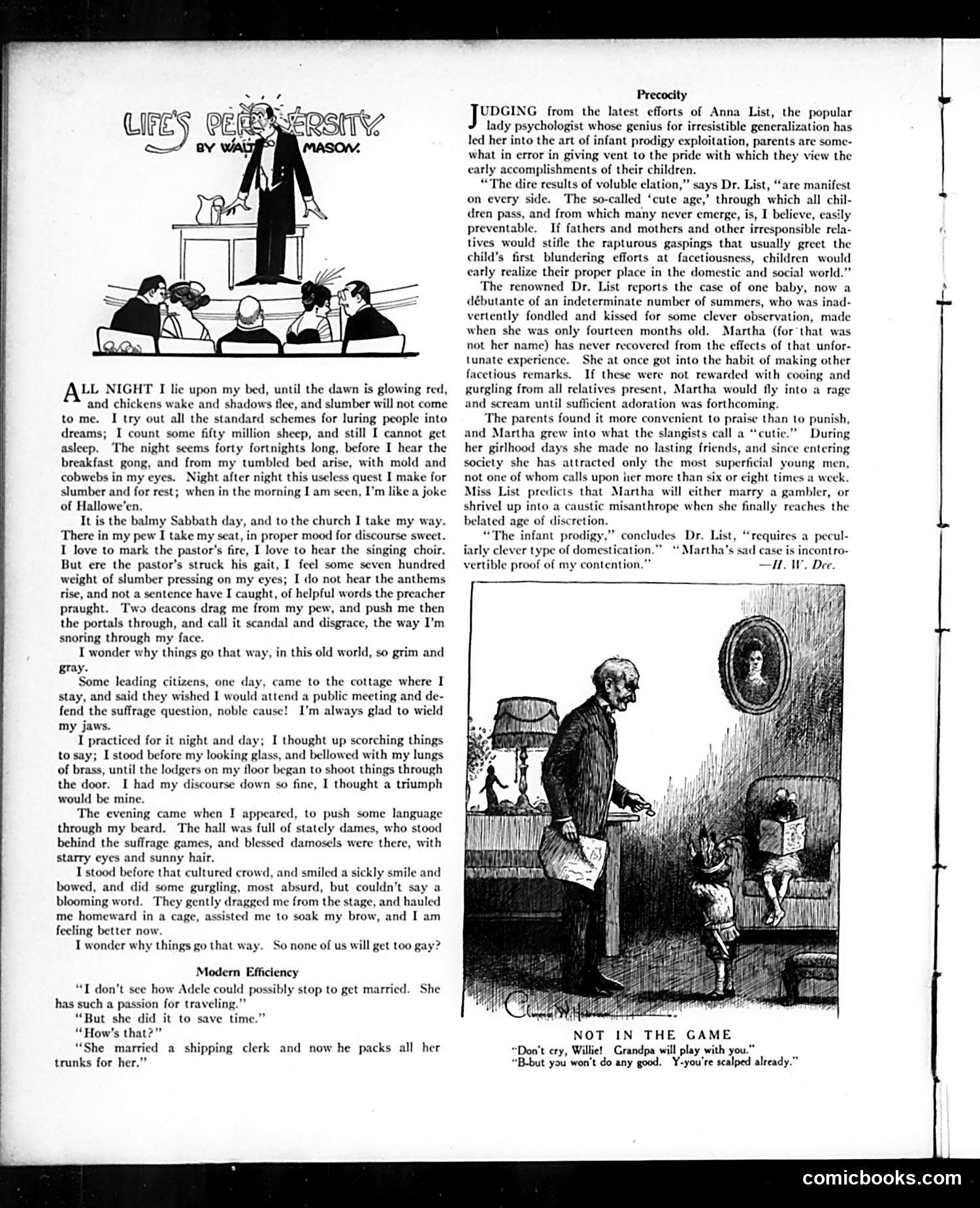
This page contains three distinct pieces: 1. **"Life's Perversity" by Walt Mason** — A humorous column where the narrator complains about life's ironies: insomnia, church discomfort, and social embarrassment at a suffrage meeting where he attempted to argue against women's voting rights but was silenced and mocked by the crowd. 2. **"Precocity"** — An article by Dr. List criticizing parents who boast about their young children's accomplishments. It warns that premature praise can harm children's development and self-awareness, using the cautionary example of "Martha," a girl whose early flattery led to lasting social difficulties. 3. **"Modern Efficiency"** — A brief joke about a woman who married a shipping clerk to save time packing her trunks. 4. **"Not in the Game"** — A cartoon showing a child being excluded from play.
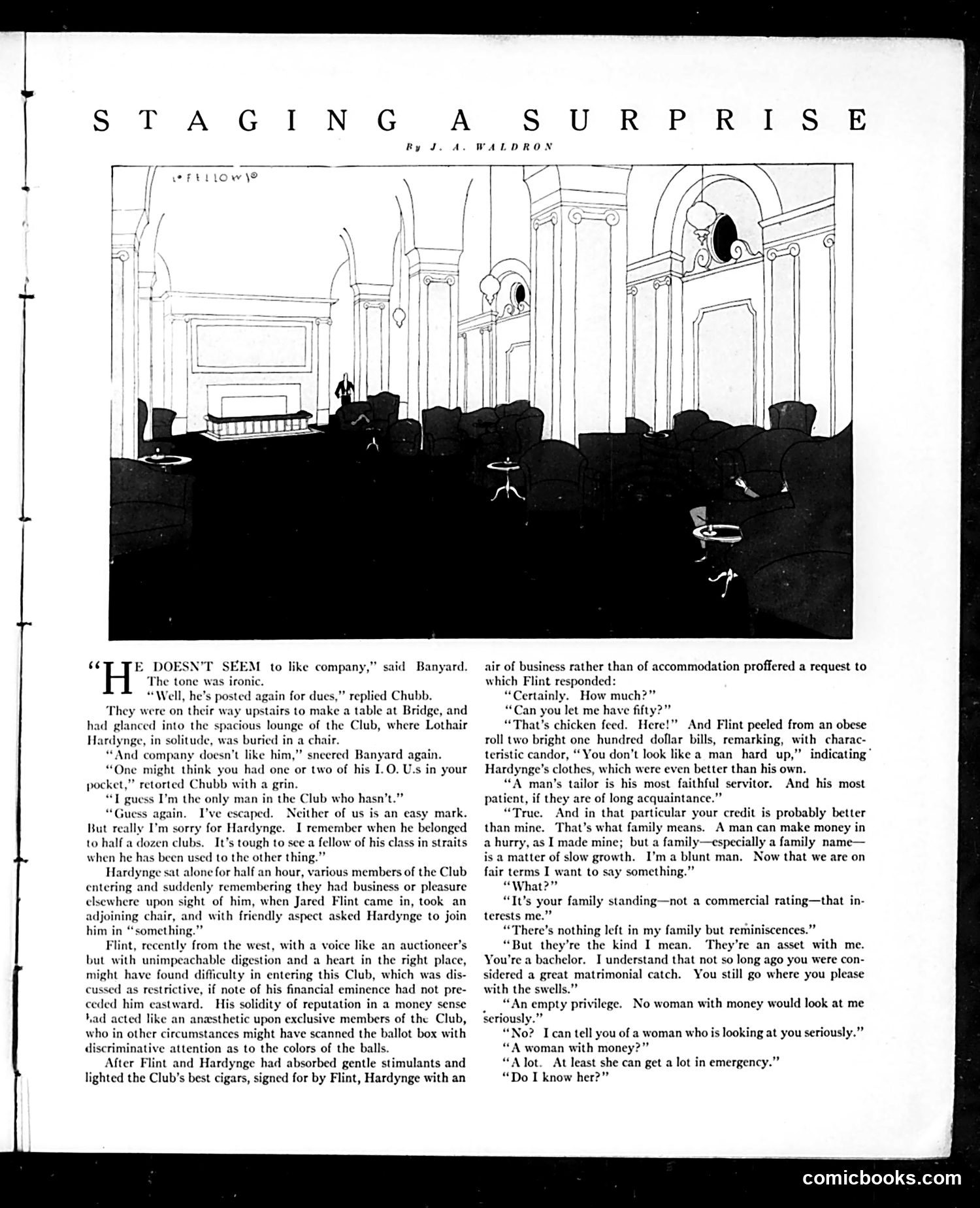
This story illustration satirizes the rigid class hierarchies of exclusive gentlemen's clubs and marriage markets in early 20th-century America. **The setup:** Lothair Hardynge, a fallen aristocrat, is socially shunned at his club despite his refined background—he's been "posted for dues" (publicly marked as delinquent). Club members avoid him, viewing financial embarrassment as disreputable. **The satire:** Jared Flint, a newly wealthy but socially crude "self-made man" from the West, befriends Hardynge and loans him money. Flint reveals he values Hardynge's *family name* over his current financial status—suggesting that old-money pedigree remains marketable even when broke. **The joke:** The story implies Flint is positioning Hardynge for marriage to a wealthy woman, trading Hardynge's social credentials for her money. The irony mocks both the pretension of aristocratic "family standing" and the transactional nature of upper-class courtship, where lineage and wealth are negotiable commodities.
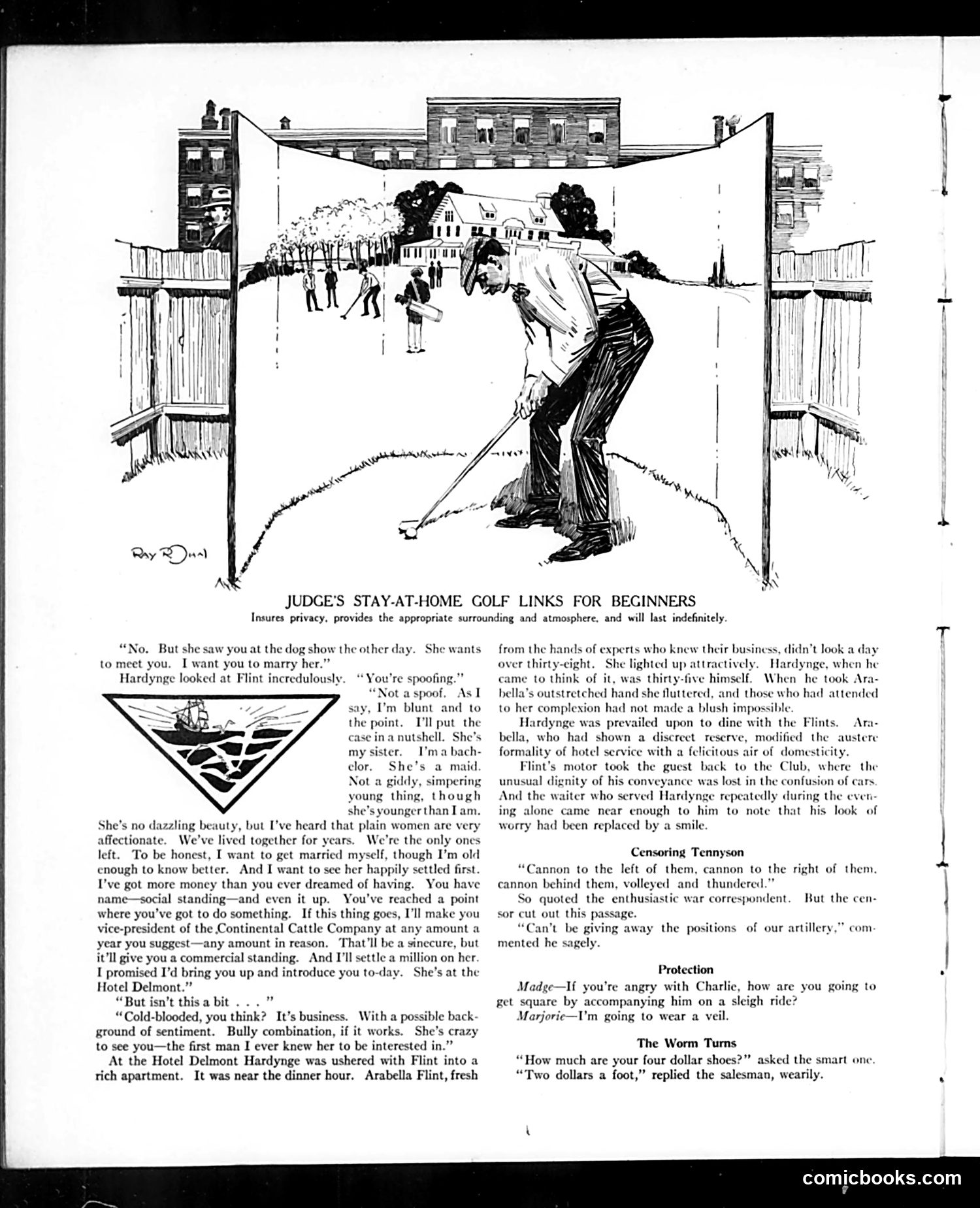
**Top Cartoon: "Judge's Stay-at-Home Golf Links for Beginners"** This is a humorous illustration showing a man golfing indoors within his home, visible through open doors. The caption satirizes the golf craze of the early 20th century by suggesting that wealthy urbanites could avoid public golf courses entirely by playing at home—ensuring privacy and eliminating the need to interact with other golfers. It's a gentle mockery of both golf obsession and the desire for exclusive leisure among the well-to-do. **Story Below ("Cold-blooded, you think?")** A comedic narrative about a straightforward business proposition: a bachelor arranges a marriage between his wealthy but unmarried friend and his sister, sweetening the deal with a vice-presidency and a million-dollar dowry. The satire targets the transactional nature of upper-class marriage arrangements, presented here as frank "business" rather than romance. **Brief Humor Items** Minor satirical quips: "Censoring Tennyson" mocks wartime censorship of poetry; "Protection" and "The Worm Turns" are light social jokes about courtship and commerce.
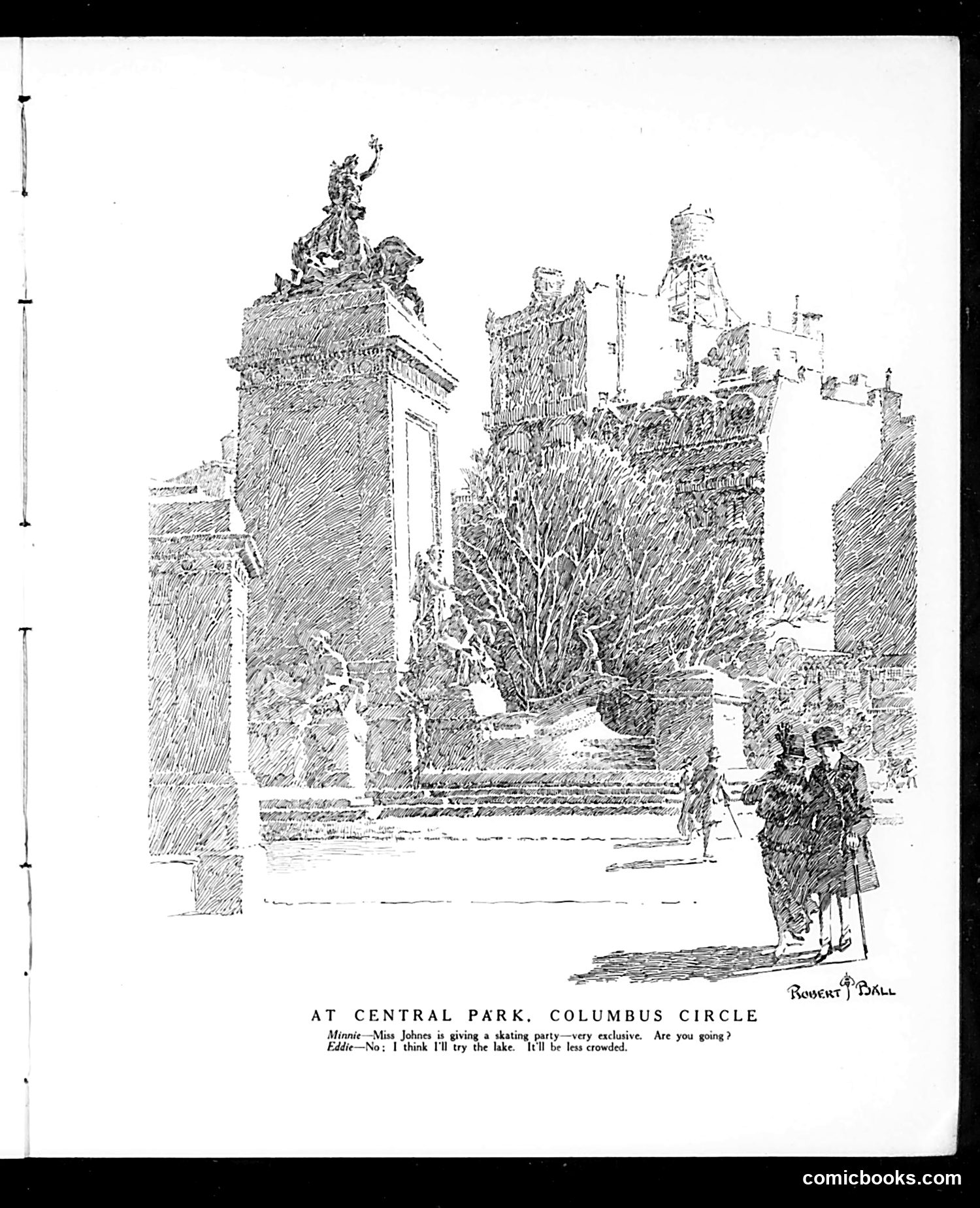
This cartoon by Robert Ball satirizes exclusive social events and class divisions in early 20th-century New York. The scene depicts Central Park at Columbus Circle, where "Miss Johnes" is hosting an exclusive ice-skating party. The humor rests on Eddie's response: rather than attend the exclusive gathering, he'll skate on the lake because it will be "less crowded"—a witty inversion suggesting that a public venue will paradoxically be more pleasant than a supposedly elite private event. The cartoon mocks the pretension of exclusive social gatherings while implicitly critiquing class-based segregation in public spaces. The architectural towers in the background emphasize the urban wealth context. The satire works because Eddie's preference for the "common" lake humorously undermines the status-seeking of exclusive society events.
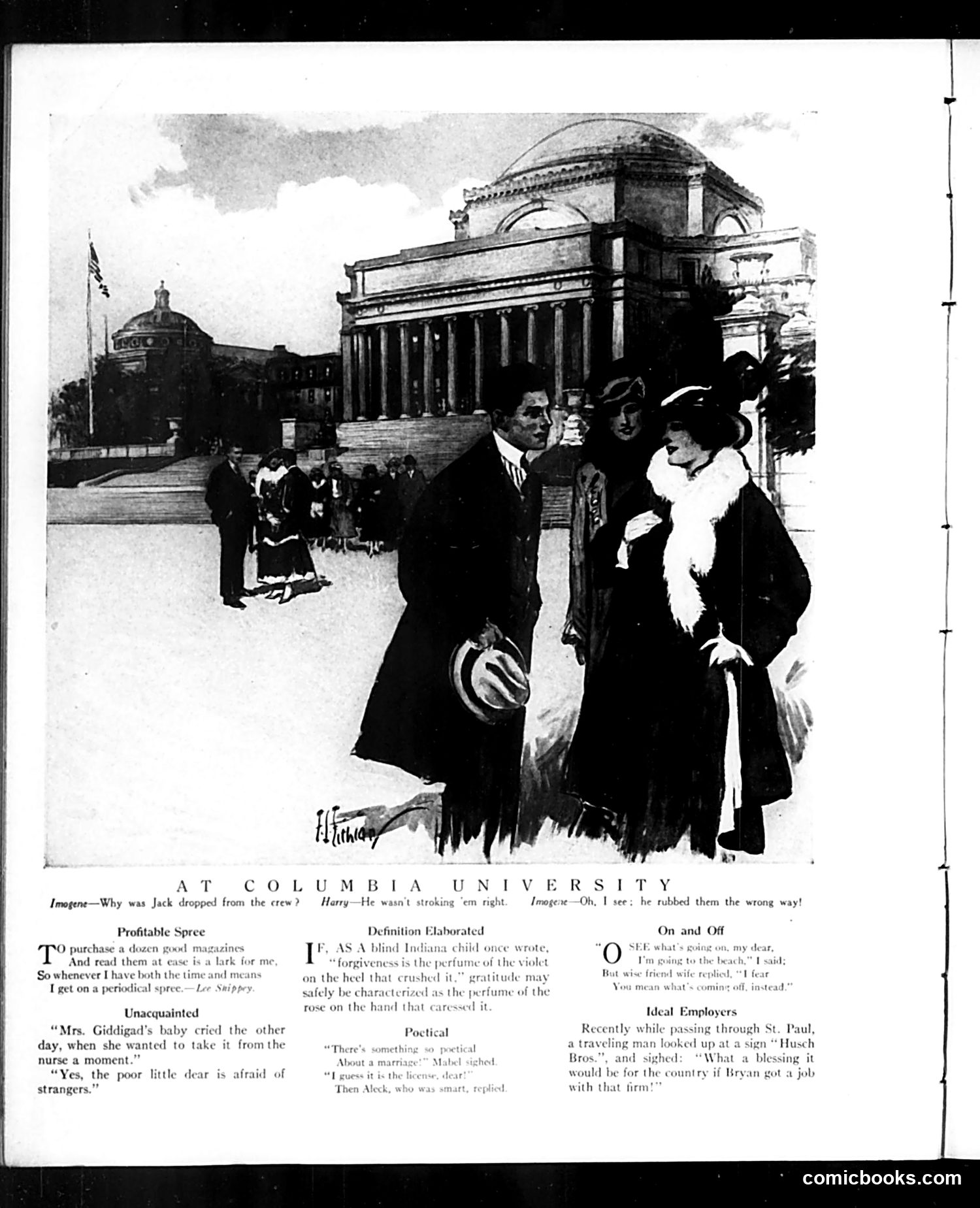
This page from the satirical magazine **Judge** contains several brief humorous sketches set at Columbia University, presented as social commentary on early 20th-century American life. The main cartoon depicts well-dressed visitors at the university. The three vignettes mock social pretension and misunderstanding: 1. **"Profitable Spree"** - Jokes about reading magazines as leisure 2. **"Unacquainted"** - Satirizes upper-class anxiety about servants and social propriety (Mrs. Giddigad fears her baby is "afraid of strangers") 3. **"Ideal Employers"** - The final joke references **William Jennings Bryan**, a prominent political figure, suggesting humorously that Bryan getting a job with a firm ("Husch Bros.") would benefit the country—implying Bryan was better suited to employment than his actual political role The humor targets Victorian-era class consciousness, social awkwardness, and political figures. The reference to Bryan suggests this predates his political decline, making him still a recognized public figure worth satirizing.
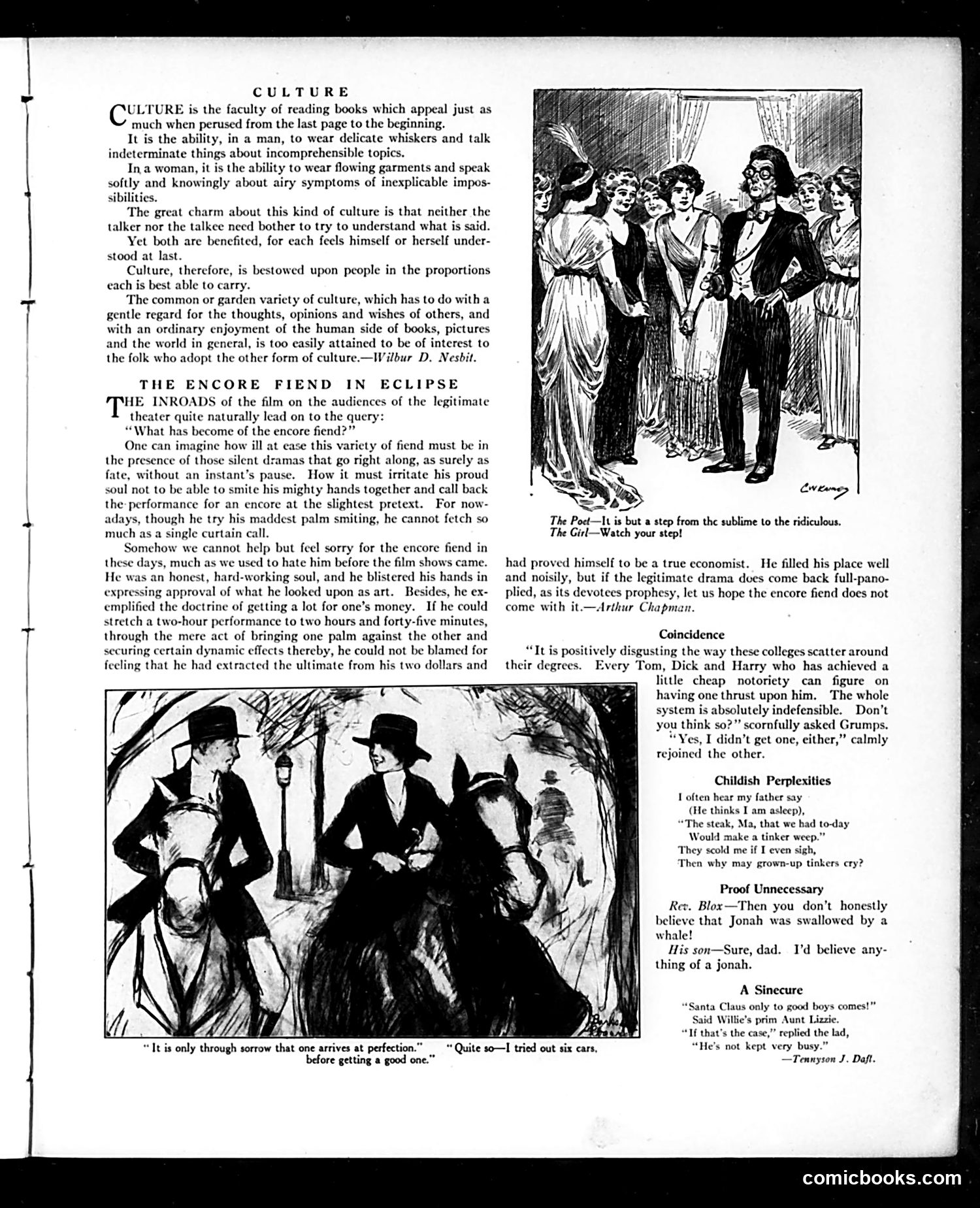
This page satirizes **pretentious "culture"** and laments the decline of the **"encore fiend"** due to cinema's rise. The opening essay mocks shallow intellectualism—defining "culture" as the ability to wear fine clothes, speak vaguely about incomprehensible topics, and impress others without actual understanding. The satire cuts both ways: neither speaker nor listener needs to grasp anything; both feel sophisticated anyway. "The Encore Fiend in Eclipse" nostalgia-humor addresses how silent films have eliminated live theater audiences' ability to demand encores by applauding. The writer expresses unexpected sympathy for this formerly-despised figure—the aggressive applauder who extended performances through sheer hand-clapping. He was "honest" and "hard-working," extracting maximum value from his ticket. Silent film's non-interactive nature has eliminated his role entirely. The cartoon illustrations show genteel social scenes; the shorter humor pieces offer mild domestic and clerical jokes typical of period magazines. The overall tone is gently satirical about American social pretense and changing entertainment culture.
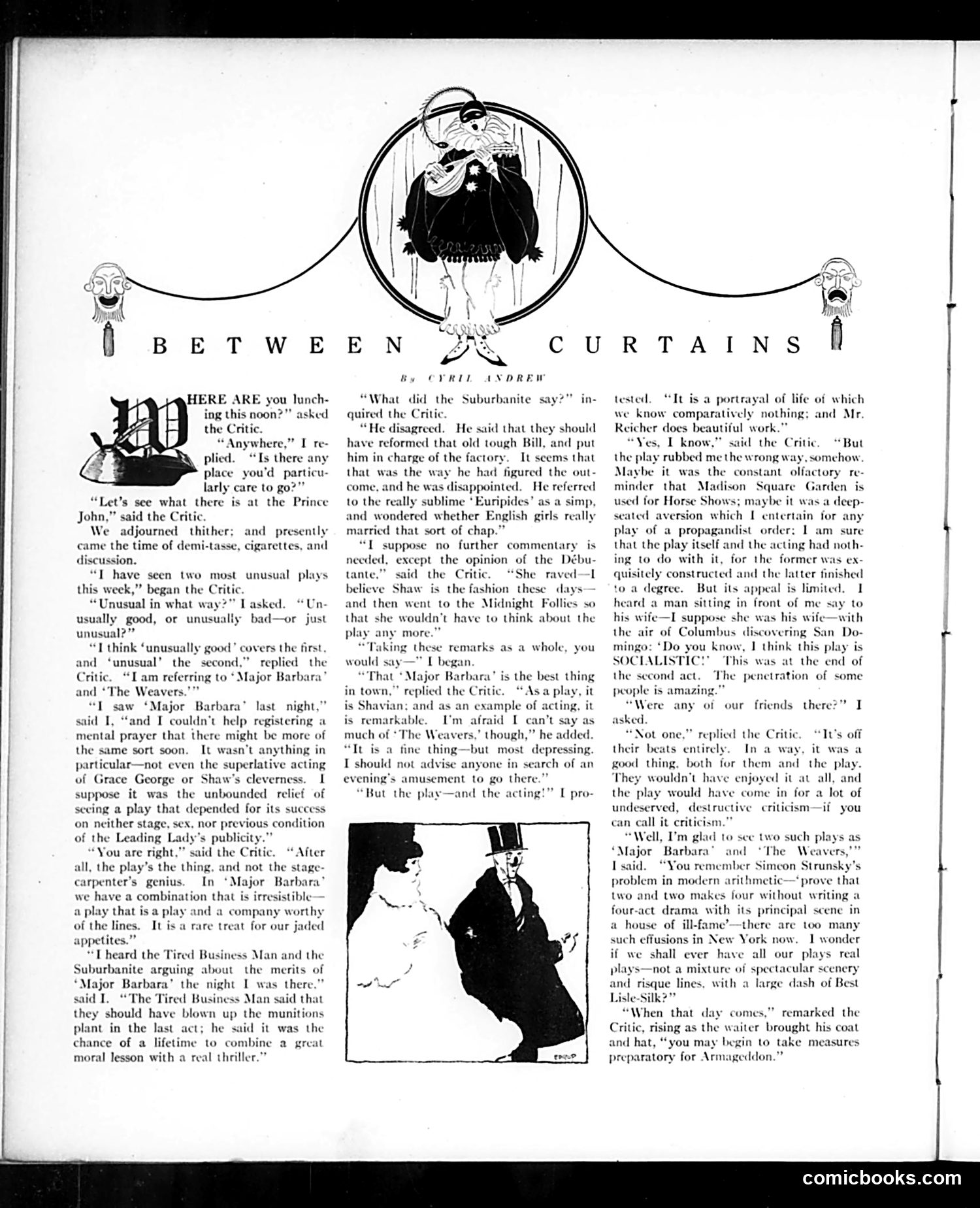
This page presents a theatrical critique disguised as lunch conversation between a Critic and unnamed narrator. They discuss two plays: Shaw's *Major Barbara* and *The Weavers*. The satire mocks different audience responses to theater. A "Tired Business Man" wanted explosions and thrills; a "Suburbanite" expected moral redemption through reform; a "Debutante" followed fashion by praising Shaw without engagement; and an ordinary patron discovered the play was "SOCIALISTIC"—implying the audience member had little cultural awareness. The Critic ultimately praises *Major Barbara* as superior drama despite Shaw's reputation, while dismissing *The Weavers* as depressing propaganda, though technically excellent. The joke targets how audiences project their own values and prejudices onto theater rather than appreciating plays on their artistic merits.
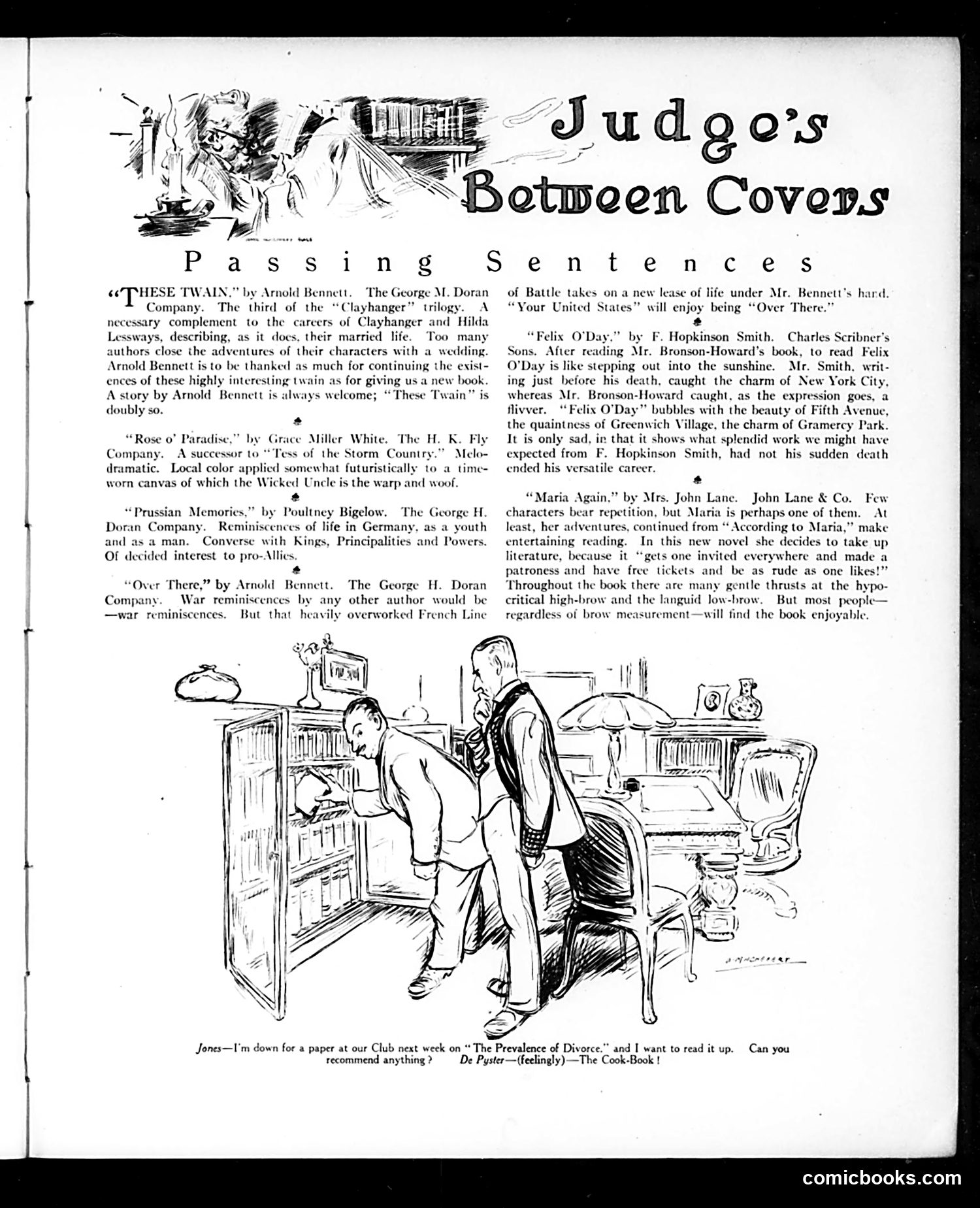
This is a literary review section titled "Judge's Between Covers," featuring brief critiques of contemporary novels, primarily by Arnold Bennett and other popular authors of the era. The cartoon at the bottom contains the sole humor: Two men discuss an upcoming club paper on divorce. When asked for a reading recommendation, one man sardonically suggests "The Cook-Book," implying that marital discord stems from poor cooking—a common early-20th-century joke stereotype about women's domestic failures causing divorce. The reviews themselves are straightforward literary criticism, praising Bennett's novels and other works for their quality and emotional depth. No political content is evident. This appears to be standard entertainment/culture journalism from Judge magazine, mixing serious book commentary with gentle domestic humor reflecting period gender attitudes.
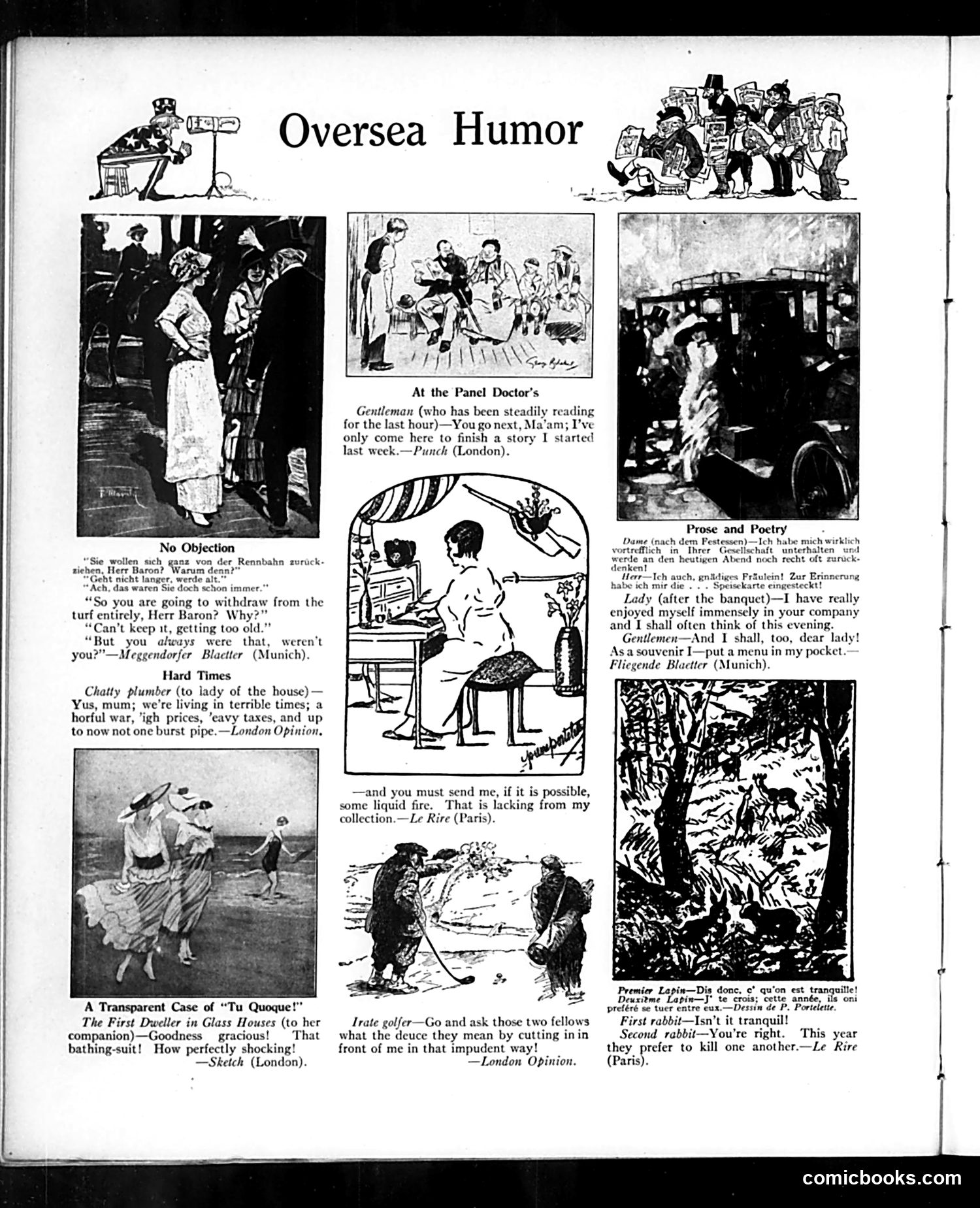
This page collects humorous cartoons and anecdotes from international publications (Punch, London Opinion, Le Rire Paris, Munich's Meggendorfer Blätter, and Sketch), showcasing overseas wit for American readers. The jokes reflect early 20th-century concerns: a doctor's patient monopolizing his time with an unfinished story; a retired baron unable to quit horse-racing despite age; wartime hardships ("Hard Times") affecting civilians; a woman hypocritically criticizing another's bathing suit; and two rabbits preferring to kill each other rather than live in peace—likely a WWI reference to human conflict. One cartoon shows a collector requesting "liquid fire" (possibly explosives or incendiary devices), hinting at wartime preoccupations. The "Tu Quoque" piece (meaning "you also") mocks hypocrisy—criticizing others' behavior while doing the same. These are lighthearted social observations about human nature, class, aging, and the absurdities of wartime life, presented for American audiences' entertainment.
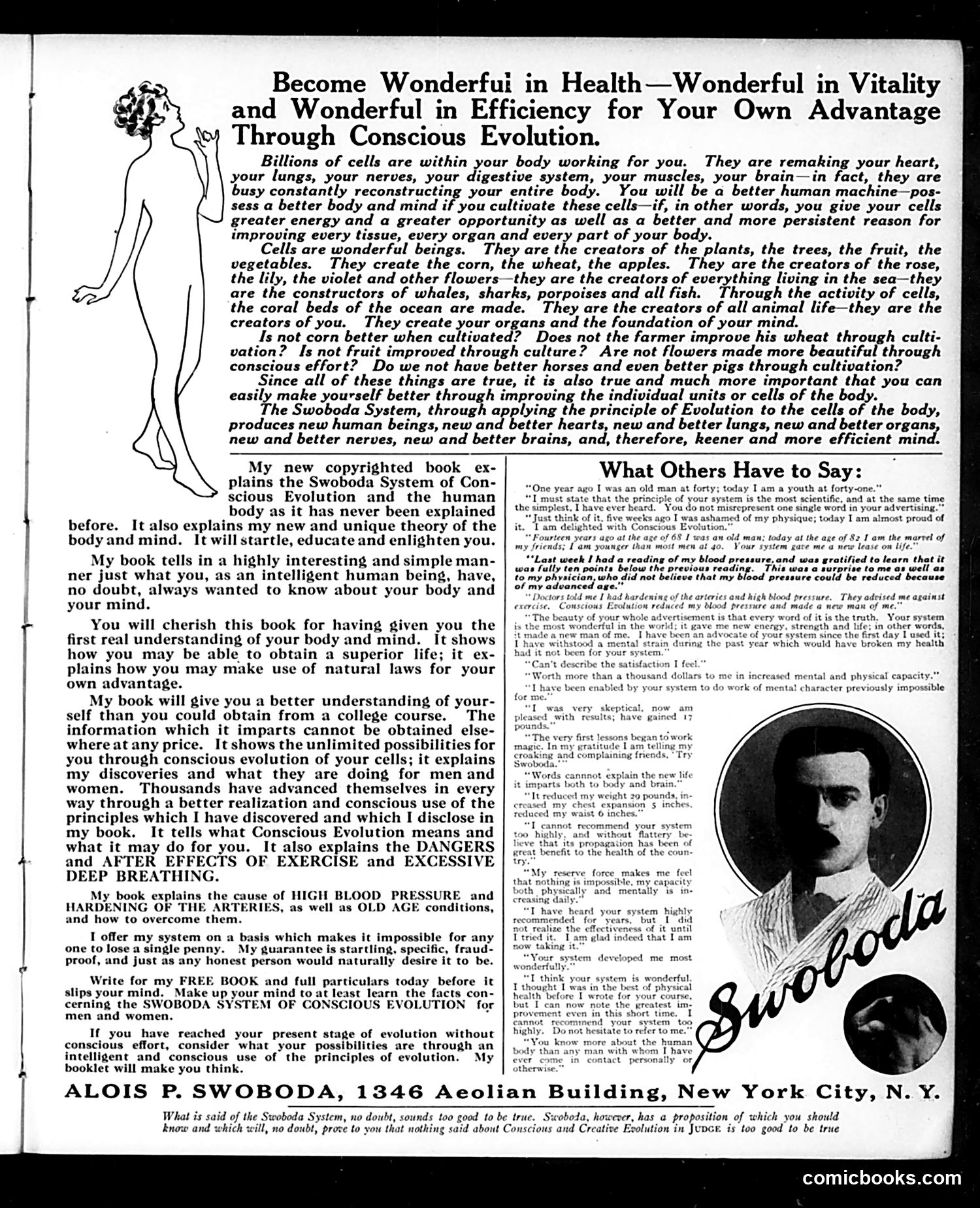
This is **primarily a full-page advertisement**, not a satirical cartoon. It promotes Alois P. Swoboda's self-help system claiming cells can be "evolved" to improve health, vitality, and mental capacity. **The pitch:** Swoboda argues that just as farmers cultivate crops and breeders improve animals, humans can deliberately "cultivate" their body's cells through conscious effort to become healthier, stronger, and more intelligent versions of themselves. **Historical context:** This represents early 20th-century pseudoscience blending crude Darwinian evolution with New Thought self-improvement ideology—a popular genre in magazines like *Judge*. The testimonials (right side) feature supposed real people claiming cured blood pressure, improved mental capacity, and rejuvenation. **Why it appears in Judge:** Satirical magazines often published ads for dubious health schemes, which modern readers might recognize as quackery, though contemporary audiences would have found such claims more plausible given limited medical knowledge.
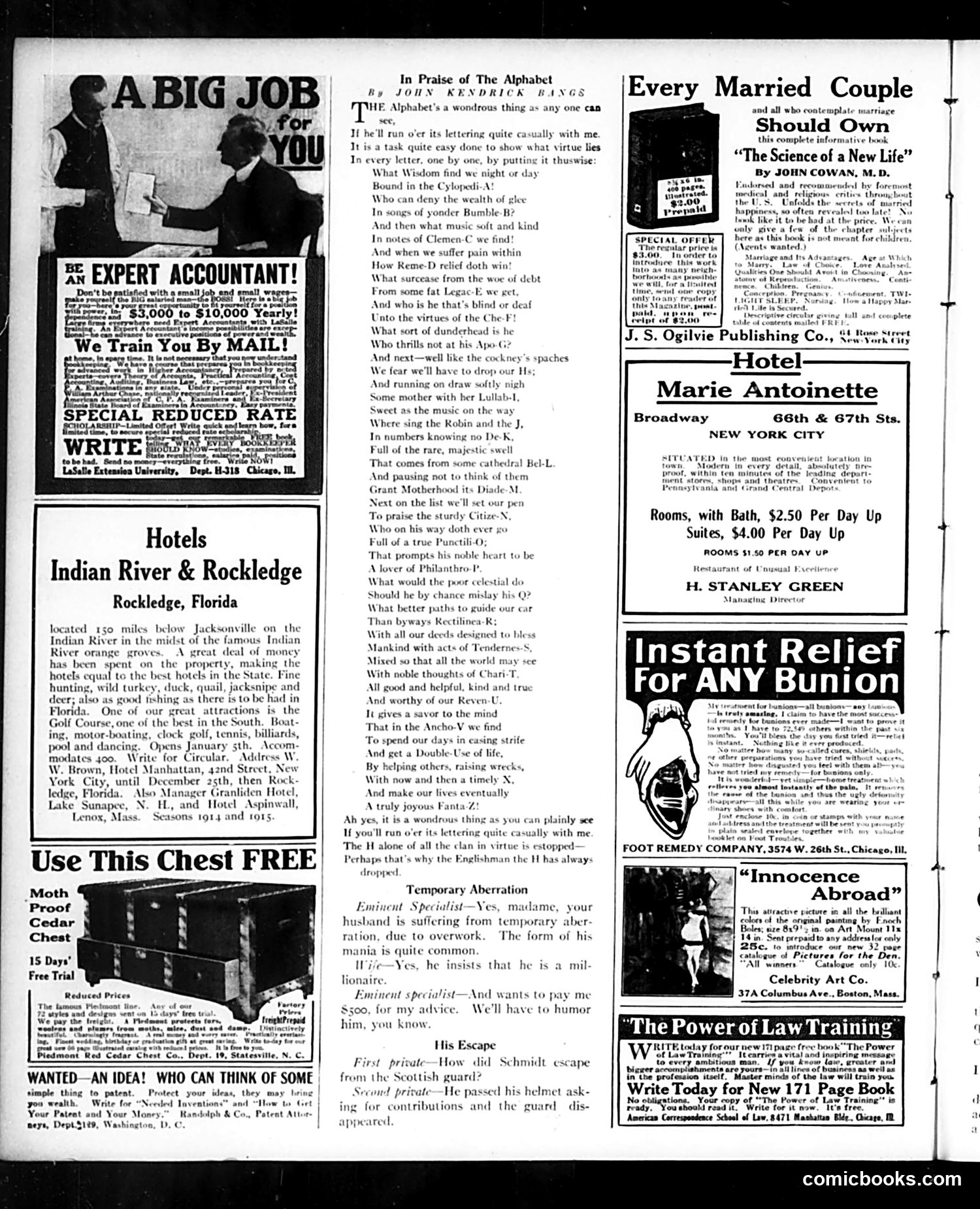
This page is primarily **advertising and light humor content**, not political satire. The dominant feature is a full-page ad for accountant training by mail (promising $5,000-$10,000 yearly), alongside hotel and product advertisements typical of early 1910s publications. The text content includes: **"In Praise of The Alphabet"** by John Kendrick Bangs — a lengthy comic poem playing with wordplay by inserting letter names into words (e.g., "Rem-E-dy" for remedy, "Citi-Z-en" for citizen). It's a light linguistic joke with no deeper political meaning. **"Temporary Aberration"** — a brief joke about a husband who believes he's a millionaire due to "overwork mania," with a doctor suggesting humorous treatment. **"His Escape"** — the fragment shown appears to be the start of another brief joke about soldiers. The page reflects early 20th-century Judge magazine's shift toward lifestyle advertising and general humor rather than sharp political commentary. The jokes are gentle wordplay and domestic humor rather than satirical commentary on current events.
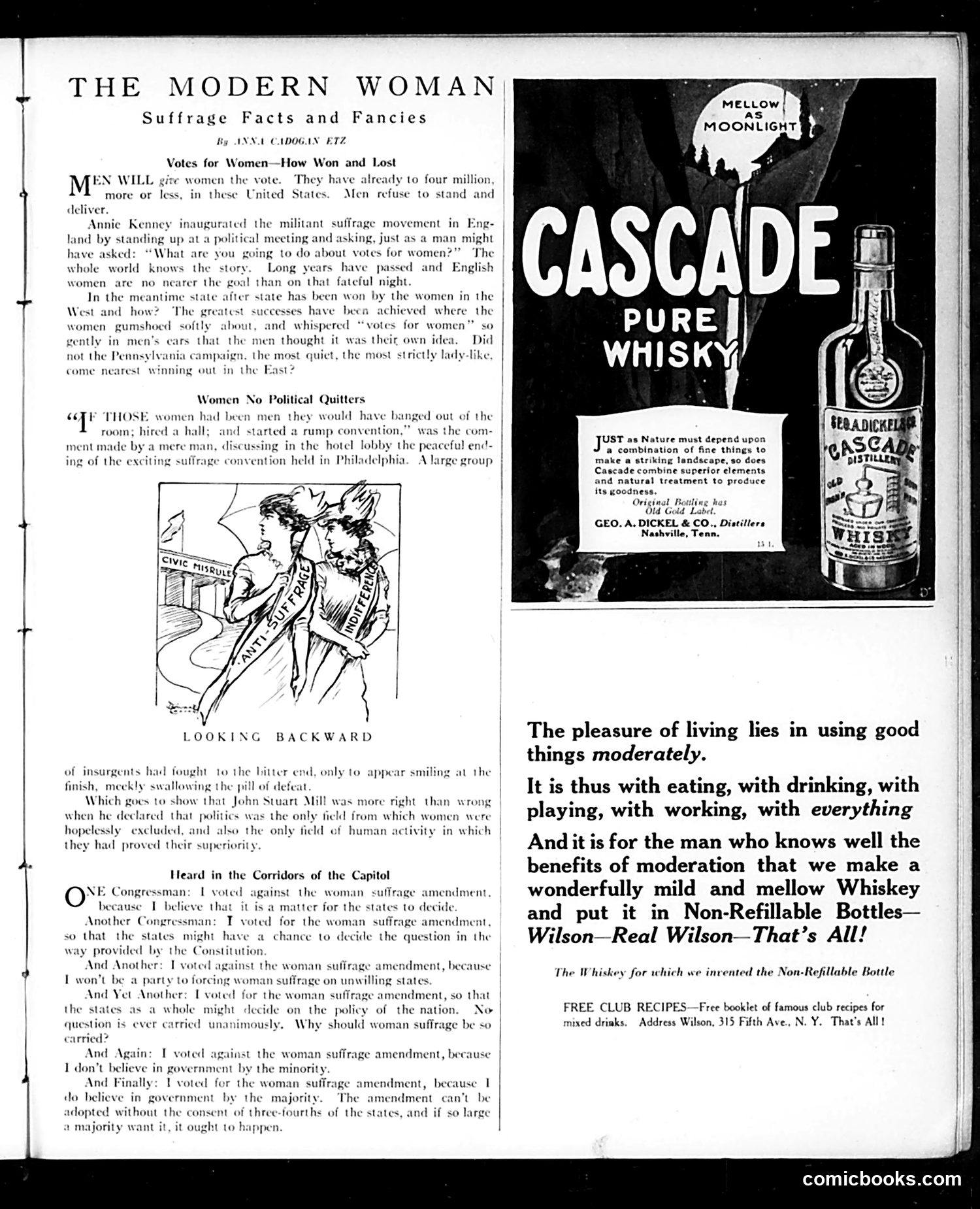
This page satirizes the women's suffrage movement and political hypocrisy. The article by Anna Cadogan Etz discusses how Western states granted women voting rights through quiet persuasion—women "whispered 'votes for women' so gently in men's ears that the men thought it was their own idea"—contrasting with the more militant, confrontational British approach that achieved less. The cartoon "Looking Backward" depicts suffragists outside a "Civic Museum," likely mocking how suffragists' efforts would become historical relics rather than current victories. The "Heard in the Corridors of the Capitol" section satirizes congressional hypocrisy: multiple congressmen justify opposite votes on suffrage using contradictory logic about states' rights, majority rule, and government principle—exposing how politicians disguise partisan positions with convenient constitutional arguments. The Cascade Whisky advertisement is simply period product placement, unrelated to the political content.
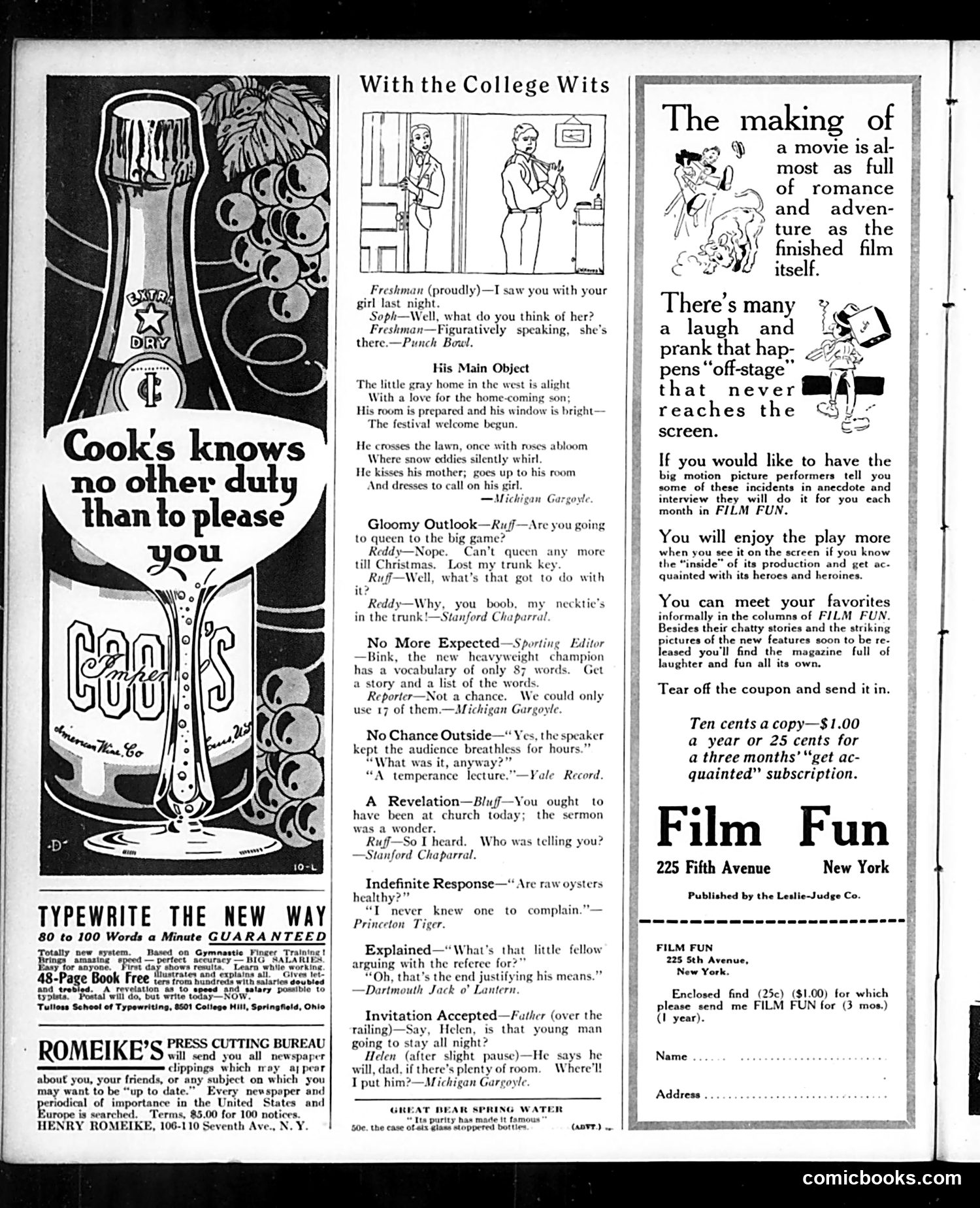
This page combines vintage advertisements with a "College Wits" humor section—typical filler content for Judge magazine. **The College Humor Section** consists of brief, witty exchanges from various college publications (Michigan Gargoyle, Yale Record, Stanford Chaparral, Dartmouth Jack o' Lantern, Princeton Tiger). These jokes reflect early-20th-century college life: romantic pursuits, sporting events, dormitory antics, and campus figures like heavyweight boxers and temperance lecturers. The humor is light, punning, and wholesome—jokes about losing trunk keys, calling on girls, and ecclesiastical sermons. **The Advertisements** include Cook's typewriters (emphasizing "typewriter the new way"), Romeike's Press Cutting Bureau (a clipping service), and Film Fun magazine (promoting behind-the-scenes Hollywood gossip). These ads target aspirational readers interested in modernized office work and celebrity culture. The page reflects Judge's role: satirical commentary mixed with accessible consumer advertising and collegiate humor that would appeal to educated, middle-class American readers of the era.
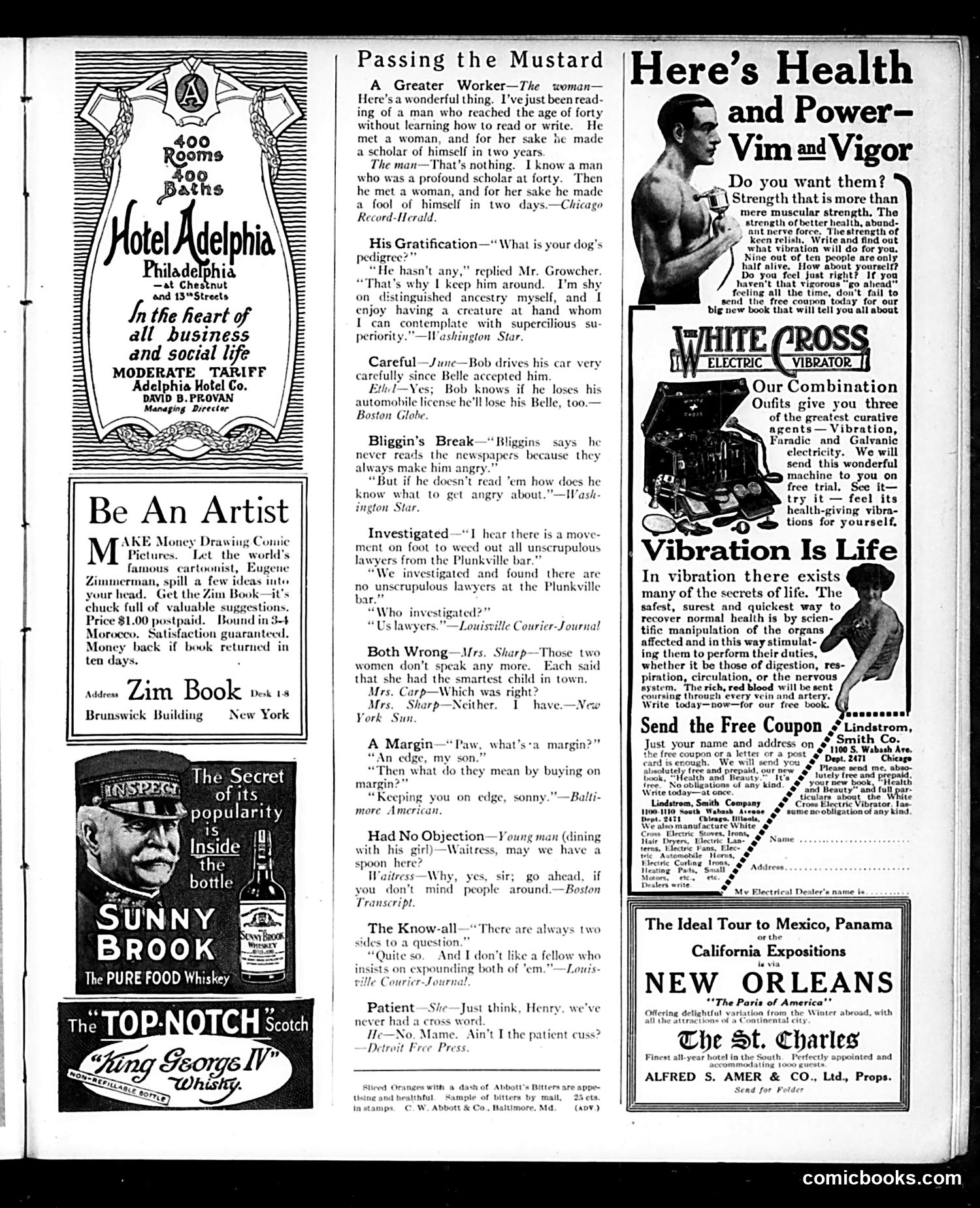
This page is primarily **advertising, not political satire**. The left side contains short humorous anecdotes ("Passing the Mustard") typical of Judge magazine's filler content—jokes about relationships, dogs, lawyers, and margins that rely on wordplay and domestic situations. The right side features a major advertisement for the **White Cross Electric Vibrator**, a pseudo-medical device marketed as cure-all for health problems. This reflects the **early 1900s medical quackery era**, when vibration machines were heavily advertised to "recover normal health" and provide "vim and vigor." The device claimed to treat digestion, respiration, and nervous system issues through electrical stimulation—claims modern medicine recognizes as unfounded. The inclusion of a shirtless man flexing muscles alongside medical claims exemplifies how these devices exploited health anxieties and were marketed with dubious legitimacy. This advertisement is historically significant as evidence of widespread medical fraud before FDA regulations, not as satire but as genuine (if false) product promotion that Judge's readers apparently encountered.
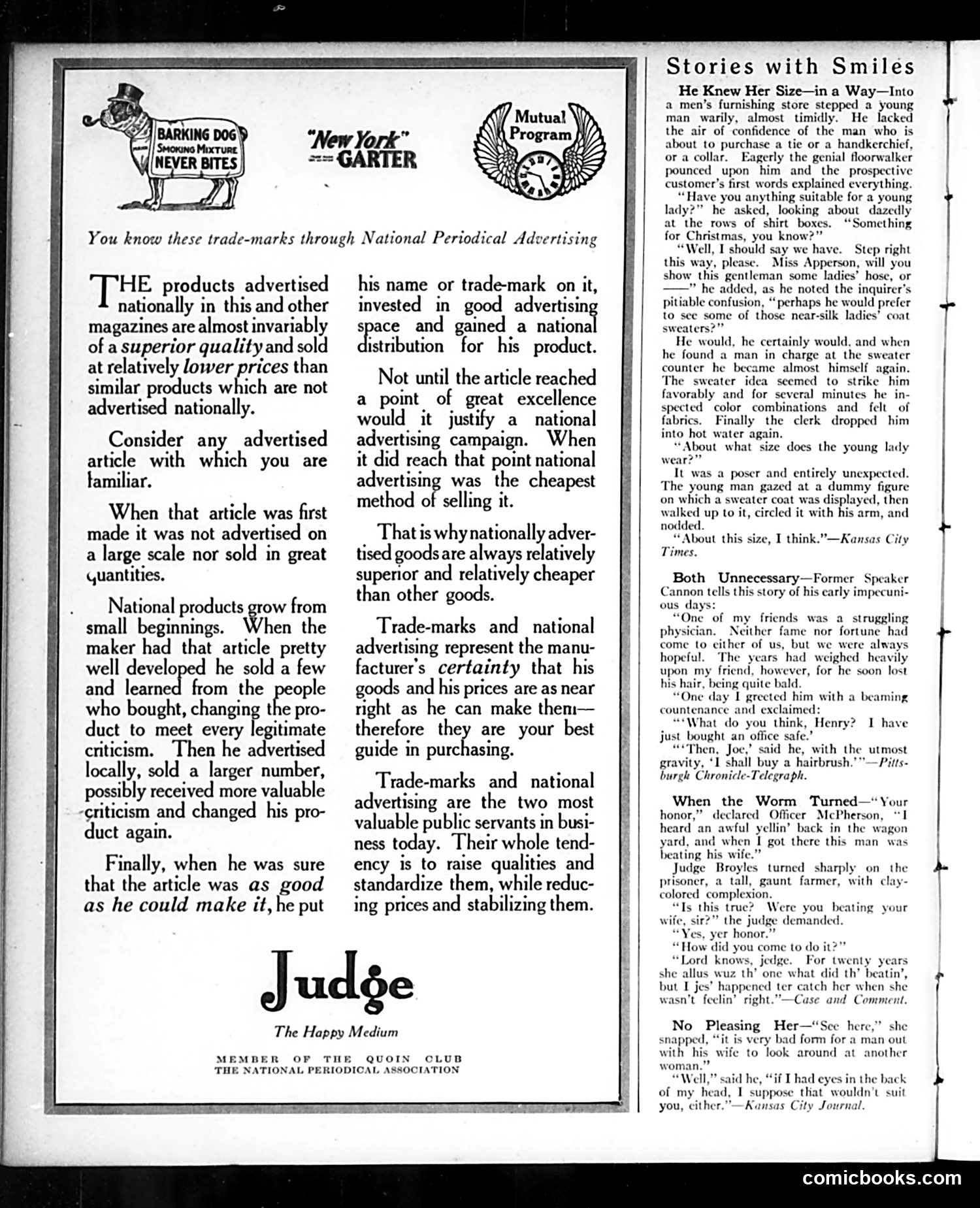
This page is primarily **advertising and editorial advocacy**, not political satire. The main content promotes the value of national advertising and trade-marks as consumer safeguards. **Central argument:** The left column argues that nationally advertised products are superior and cheaper than unadvertised goods because manufacturers only invest in national campaigns once products reach "great excellence." This serves as implicit advertising for Judge itself and the magazines carrying national ads. **Right side content:** "Stories with Smiles" contains three brief humorous anecdotes unrelated to politics: - A young man embarrassed buying ladies' clothing - Former Speaker Cannon's joke about a broke friend buying a safe instead of a hairbrush - An incomplete police officer story **Context for modern readers:** This reflects early-20th-century *trust in branded products* and *faith in advertising as quality assurance*—before modern consumer skepticism. The page essentially uses light humor to frame serious pro-advertising messaging.
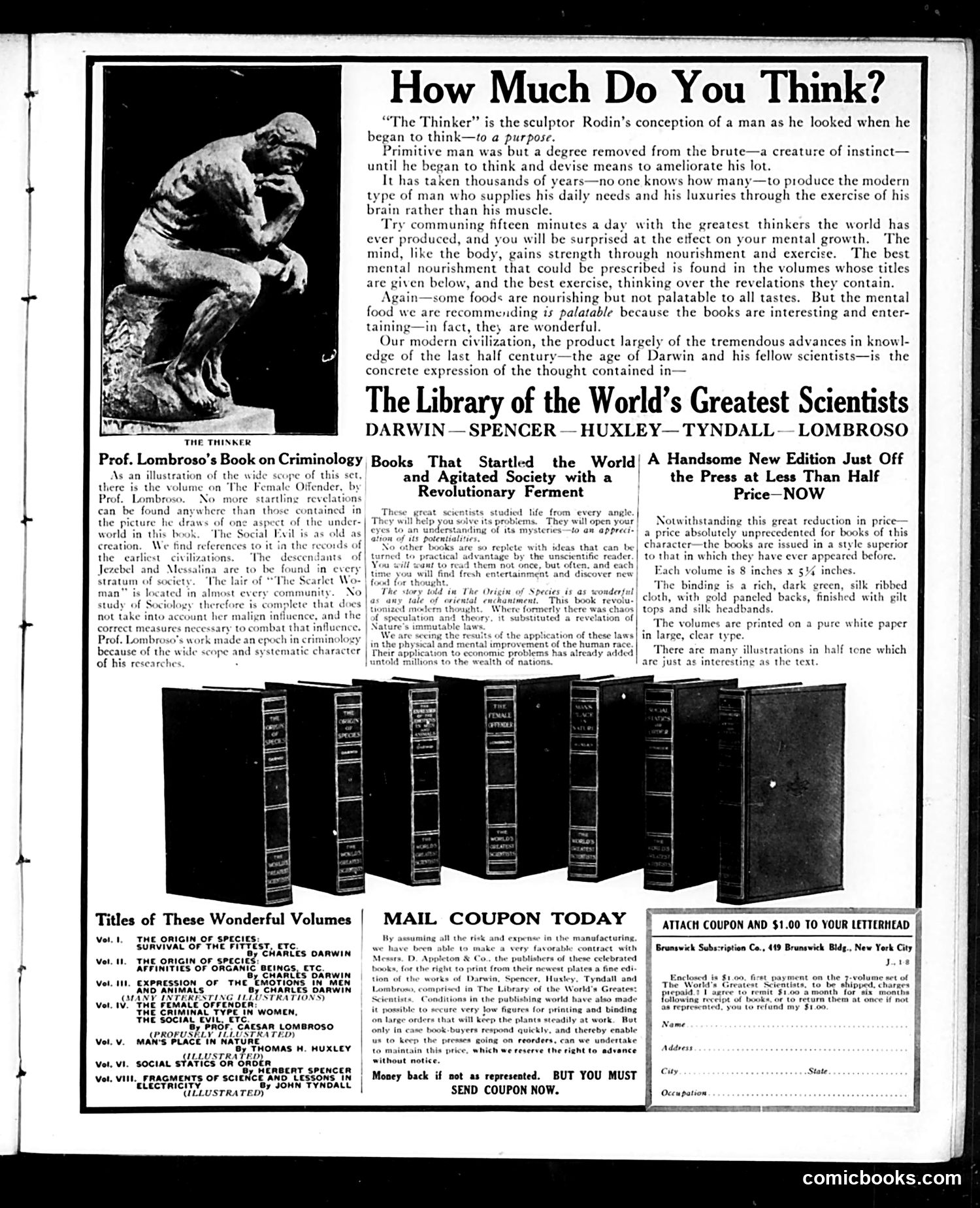
This is primarily a **mail-order advertisement**, not a political cartoon. It promotes "The Library of the World's Greatest Scientists"—a book collection featuring Darwin, Spencer, Huxley, Tyndall, and Lombroso. The page uses Rodin's famous sculpture "The Thinker" to argue that intellectual development separates humans from animals. It frames reading these scientific works as mental exercise, comparable to physical fitness. **Key context for modern readers:** The advertisement reflects early 20th-century faith in science and self-improvement through reading. Lombroso, prominently featured, was a criminologist whose theories about criminal "types" were later discredited but were then considered cutting-edge. The marketing pitch—positioning serious scientific books as both "nourishing" and "entertaining"—appeals to educated middle-class readers seeking cultural advancement. This represents a period when scientific literacy was marketed as a middle-class aspiration, and these particular scientists embodied intellectual authority.
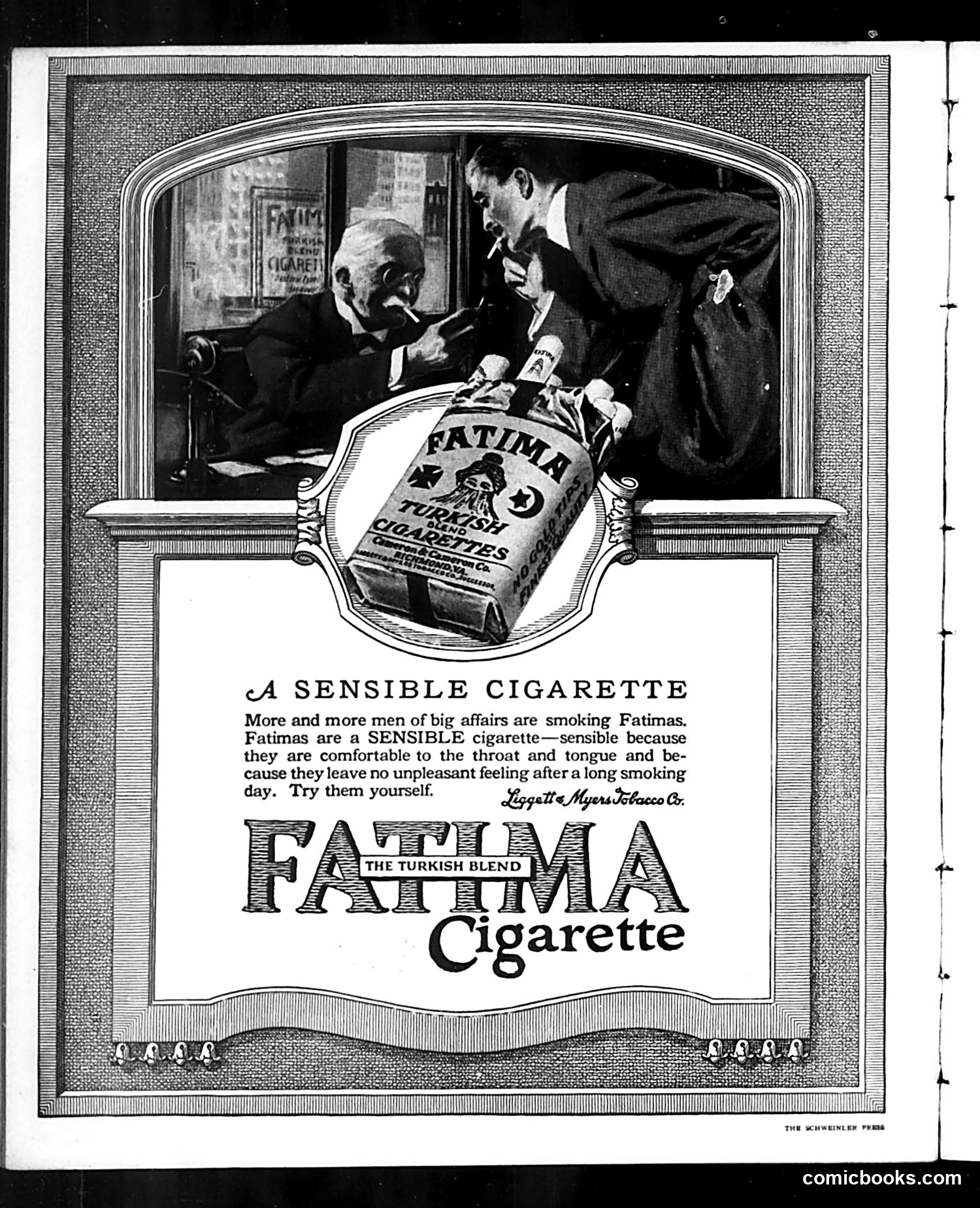
This is a **cigarette advertisement**, not satire. It promotes Fatimas, a Turkish-blend cigarette brand by Liggett & Myers Tobacco Co. The ad depicts two well-dressed businessmen in what appears to be an office or shop, examining a Fatima package. The copy targets affluent professionals ("men of big affairs"), claiming the cigarettes are "sensible" because they're allegedly gentle on the throat and leave no unpleasant aftertaste—a common early-20th-century tobacco marketing pitch before health dangers were widely acknowledged. The phrase "sensible cigarette" reflects period advertising language emphasizing product safety and comfort rather than any actual health benefit. This would run in Judge magazine to reach educated, upper-class readers who were key consumers for premium tobacco products.