
Judge, 1916-01-08 · page 26 of 28
Judge — January 8, 1916 — page 26: what you’re looking at
What you’re looking at
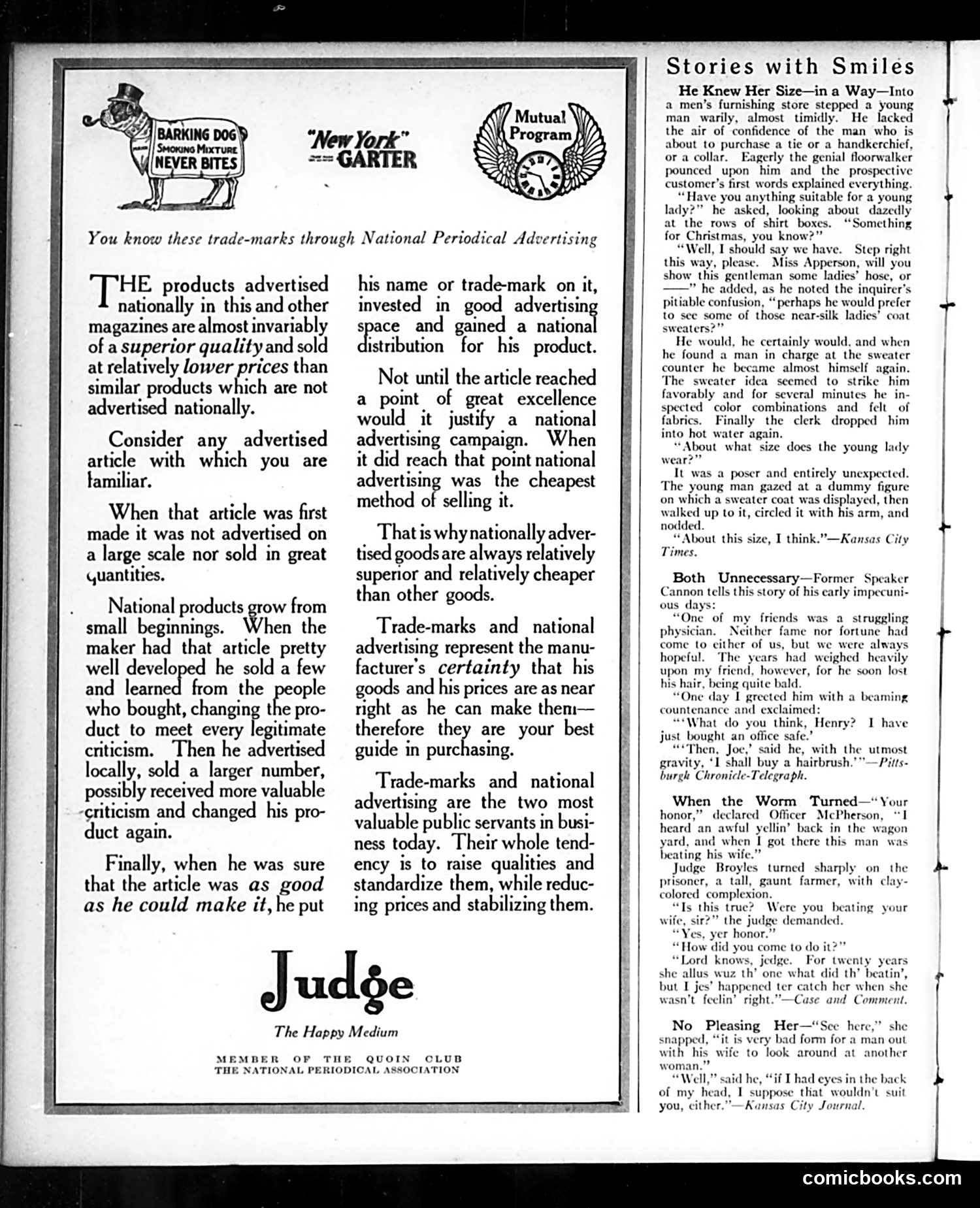
This page is primarily **advertising and editorial advocacy**, not political satire. The main content promotes the value of national advertising and trade-marks as consumer safeguards. **Central argument:** The left column argues that nationally advertised products are superior and cheaper than unadvertised goods because manufacturers only invest in national campaigns once products reach "great excellence." This serves as implicit advertising for Judge itself and the magazines carrying national ads. **Right side content:** "Stories with Smiles" contains three brief humorous anecdotes unrelated to politics: - A young man embarrassed buying ladies' clothing - Former Speaker Cannon's joke about a broke friend buying a safe instead of a hairbrush - An incomplete police officer story **Context for modern readers:** This reflects early-20th-century *trust in branded products* and *faith in advertising as quality assurance*—before modern consumer skepticism. The page essentially uses light humor to frame serious pro-advertising messaging.
📄 Transcribed text from this page (OCR, searchable)
Machine-transcribed from the original scan — historical spelling and the odd misread are preserved.
"THE products advertised nationally in this and other magazines are almost invariably of a superior quality and sold at relatively lower prices than similar products which are not advertised nationally. Consider any advertised article with which you are familiar. When that article was first made it was not advertised on a large scale nor sold in great quantities. National products grow from small beginnings. When the maker had that article pretty well developed he sold a few and learned from the people who bought, changing the pro- duct to meet every legitimate criticism. Then he advertised locally, sold a larger number, possibly received more valuable -criticism and changed his pro- duct again. Finally, when he was sure that the article was as good as he could make it, he put MEMBER OF You know these trade-marks through National Periodical Advertising J udge The Happy Medium THE THE NATIONAL PERIODICAL ASSOCIATION his name or trade-mark on it, invested in good advertisin epee and gained a matical istribution for his product. Not until the article reached a point of great excellence would it justify a national advertising campaign. When it did reach that point national advertising was the cheapest method ofealling it. _ Thatis whynationally adver- tised goods are always relatively superior and relatively cheaper than other goods. Trade-marks and _ national advertising represent the manu- facturer's certainty that his goods and his prices are as near night as he can make them— therefore they are your best guide in purchasing. Trade-marks and_ national advertising are the two most valuable public servants in busi- ness today. Their whole tend- ency is to raise qualities and standardize them, while reduc- ing prices and stabilizing them. QUOIN CLUB Stories with Smiles He Knew Her Size—in a Way—Into a men’s furnishing store stepped a young man warily, almost timidly. He lacked the air of confidence of the man who is about to purchase a tie or a handkerchief, ora collar. Eagerly the genial floorwall pounced upon him and. the prospective customer’s first words explained everything. “Have you anything suitable for a young lady?” he asked, looking about dazedly at the rows of shirt boxes. “Something for Christmas, you know “Well, I should say Mis: is gentle he added, a: pitiable confusion, “perhaps he would p to s me of those near-silk ladies’ He would, he certainly would, and when he found a man in charge at the sweate counter he became almost himself aga The sweater idea seemed to strike hi favorably and for several minutes he in- spected color combinations and felt of fabrics. Finally the clerk dropped him into hot water again. “About what size does the young lady wear?” It was a poser and entirely unexpected. The young man gazed at a dummy figure on which a sweater coat was displayed, then walked up to it, circled it with his arm, and nodded. “About this size, I think.”—Kansas City Times, Both Unnecessary— Cannon tells this story of hi ous days: “One of my friends was a struggling physician. Neither fame nor fortune had come to cither of us, but we were always hopeful. The years had weighed heavily upon my friend, however, for he soon lost his haii i mer Speaker arly impecuni- at do you think, Henry? I have ght an office safe.’ Joe,’ said he, with the utmost 1 shall buy a hairbrush.’ —Pitts- burgh Chronicle-Telegraph. When the Worm Turned—* Your honor,” declared Officer McPherson, “I heard an awful yellin’ back in the wagon yard, and when I got there this man was beating his wife.” Judge Broyles turned sharply. on the prisoner, a tall, gaunt farmer, with clay- colored complexion. “Is this true? Were you beating your sir?” the judge demanded. es, yer honor.” “How did you come to do it?” “Lord knows, jedge. For twenty years she allus wuz th’ one what did th’ beatin’, but I jes’ happened ter catch her when she wasn't feelin’ right.”—Case and Comment. No Pleasing Her—‘Sce here,” she snapped, “it is very bad form for a man out with his wife to look around at another said he, “if I had eyes in the back r id, I suppose that wouldn't suit you, cither.”"—Kansas City Journal. | | r | f comicbooks.com