
Judge, 1916-01-08 · page 8 of 28
Judge — January 8, 1916 — page 8: what you’re looking at
What you’re looking at
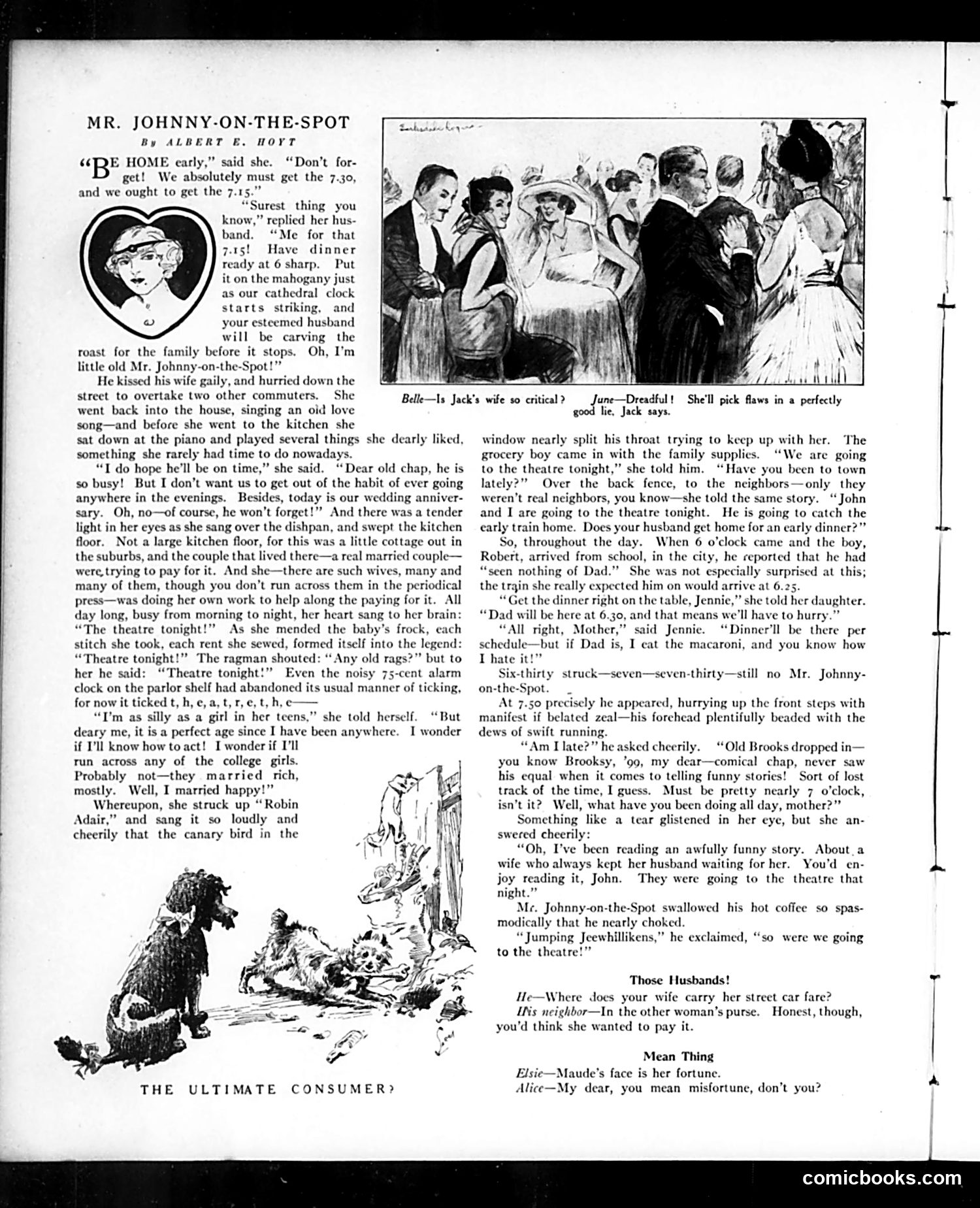
This story satirizes the gap between husbands' grand promises and reality. The protagonist boasts he'll be punctual ("Johnny-on-the-Spot"), ensuring dinner at 6 sharp and making their wedding anniversary theatre trip. His wife—a working-class housewife managing a cottage, doing her own labor—spends the day joyfully anticipating the evening. However, Mr. Johnny-on-the-Spot repeatedly fails to appear. He arrives at 7:50, vastly late, after his wife and children have waited through dinner. The satire targets husbands who make elaborate commitments yet neglect their wives' emotional needs, leaving them disappointed despite their careful preparation and hope. The accompanying jokes ("Those Husbands!") reinforce the theme: wives manage household finances and sacrifice while husbands absent themselves. The illustration labeled "The Ultimate Consumer?" shows a dog, implying men consume resources without reciprocating care or reliability.
📄 Transcribed text from this page (OCR, searchable)
Machine-transcribed from the original scan — historical spelling and the odd misread are preserved.
MR. JOHNNY-ON-THE-SPOT By ALBERT BE, HOYT “B = HOME early,” said she. “Don’t for- get! We absolutely must get the 7.30, and we ought to get the 7.15.” urest thing you know,” replied her hus- band. ‘Me for that Have dinner ready at 6 sharp. Put it on the mahogany just as our cathedral clock starts striking, and your esteemed husband will be carving the roast for the family before it stops. Oh, I’m little old Mr. Johnny-on-the-Spo' _—y He kissed his wife gaily, and hurried down the street to overtake two other commuters. She went back into the house, singing an oid love song—and before she went to the kitchen she sat down at the piano and played several things she dearly liked, something she rarely had time to do nowadays. “I do hope he'll be on time,” she said. “Dear old chap, he is so busy! But I don’t want us to get out of the habit of ever going anywhere in the evenings. Besides, today is our wedding anniver- sary. Oh, no—of course, he won't forget!” And there was a tender light in her eyes as she sang over the dishpan, and swept the kitchen floor. Not a large kitchen floor, for this a little cottage out in the suburbs, and the couple that lived there—a real married couple— were, trying to pay for it. And she—there are such wives, many and many of them, though you don’t run across them in the periodical press—was doing her own work to help along the paying for it. All day long, busy from morning to night, her heart sang to her brai “The theatre tonight!” As she mended the baby’s frock, each stitch she took, e: ent she sewed, formed itself into the legend: “Theatre tonigh The ragman shouted: “Any old rags?” but to her he said: “Theatre tonight!” Even the noisy 75-cent alarm clock on the parlor shelf had abandoned its usual manner of ticking, for now it ticked t, h, ¢, a, t, r,¢, t, he “I’m as silly as a girl in her teens,” she told herself. “But deary me, it is a perfect age since I have been anywhere. I wonder if I'll know how to act! I wonder if I'll run across any of the college girls. Probably not—they married rich, mostly. Well, I married happy!” Whereupon, she struck up “Robin Adair,” and sang it so loudly and cheerily that the canary bird in the THE ULTIMATE CONSUMER? Belle—Is Jack's wife so c June—Dreadful ! She'll pick flaws in a perfectly good lie, Jack says. window nearly split his throat trying to keep up with her. The grocery boy came in with the family supplies. “We are going to the theatre tonight,” she told him. ‘Have you been to town lately? Over the back fence, to the neighbors—only they weren't real neighbors, you know—she told the same story. “John and I are going to the theatre tonight. He is going to catch the early train home. Does your husband get home for an early dinner?” So, throughout the day. When 6 o'clock came and the boy, Robert, arrived from school, in the city, he reported that he had “seen nothing of Dad.” She was not especially surprised at this; the trqin she really expected him on would arrive at 6.25 “Get the dinner right on the table, Jennie,” she told her daughter. “Dad will be here at 6.30, and that means we'll have to hurry.” “All right, Mother,” said Jennie. ‘Dinner’ll be there per schedule—but if Dad is, I cat the macaroni, and you know how I hate Six-thirty struck—seven—seven-thirty—still no Mr. Johnny- on-the-Spot. At 7.50 precisely he appeared, hurrying up the front steps with manifest if belated zeal—his forehead plentifully beaded with the dews of swift running. “Am I late?” he asked cheerily. “Old Brooks dropped in— you know Brooksy, ’99, my dear—comical chap, never saw his equal when it comes to telling funny stories! Sort of lost track of the time, I gue: Must be pretty nearly 7 o'clock, isn’t it? Well, what have you been doing all day, mother?” Something like a tear glistened her eye, but she an- swered cheerily: “Oh, I’ve been reading an awfully funny story. About_a wife who always kept her husband waiting for her. You'd en- joy reading it, John. They were going to the theatre that night.” Mc. Johnny-on-the-Spot swallowed his hot coffee so spas- modically that he nearly choked. “Jumping Jeewhillikens,” he exclaimed, “so were we going to the theatre!” Those Husbands! He—Where does your wife carry her street car fare? is neighbor—In the other woman’s purse. Honest, though, you'd think she wanted to pay it. Mean Thing —Maude’s face is her fortune. Alice—My dear, you mean misfortune, don’t you? comicbooks.com