
Judge, 1916-01-08 · page 19 of 28
Judge — January 8, 1916 — page 19: what you’re looking at
What you’re looking at
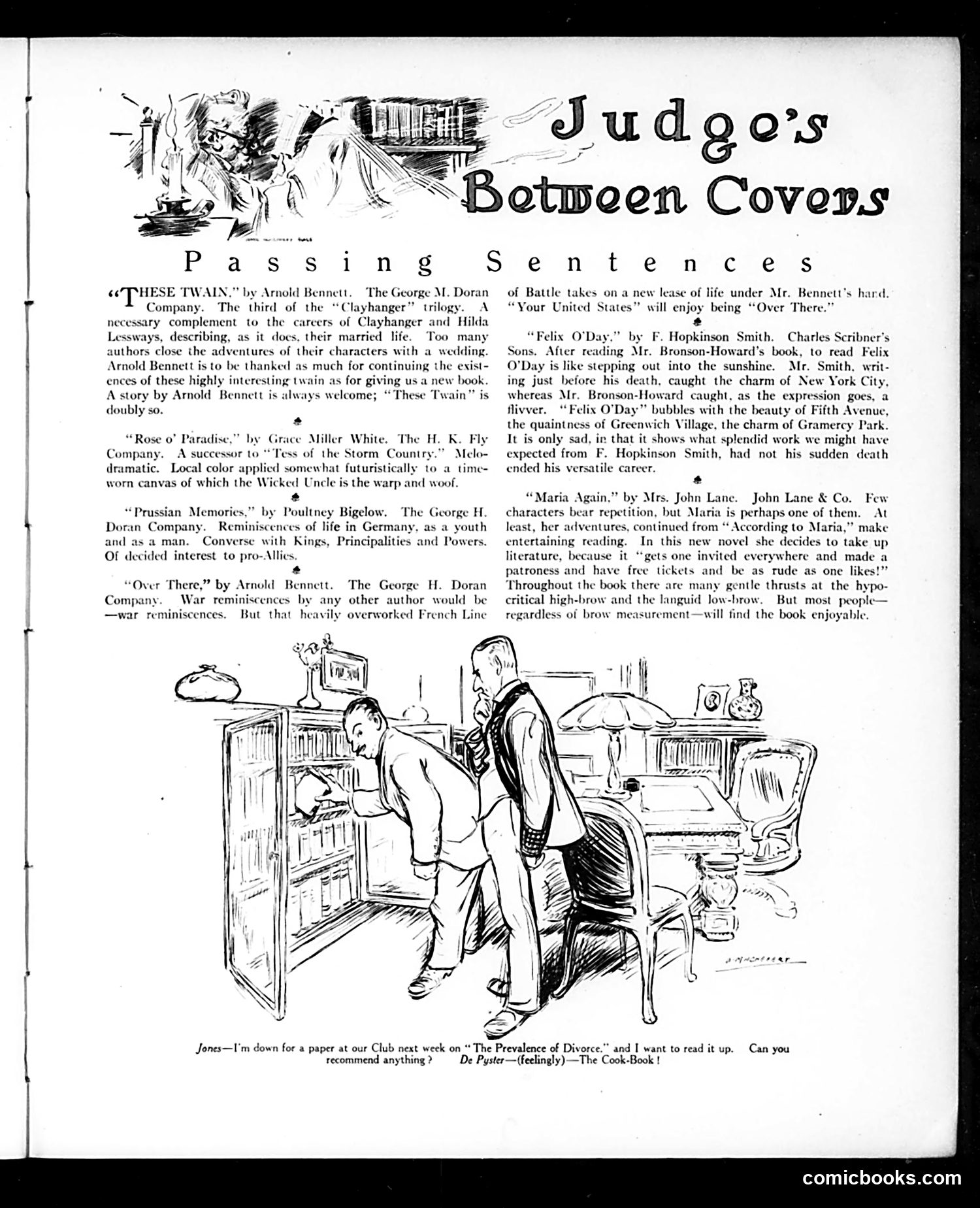
This is a literary review section titled "Judge's Between Covers," featuring brief critiques of contemporary novels, primarily by Arnold Bennett and other popular authors of the era. The cartoon at the bottom contains the sole humor: Two men discuss an upcoming club paper on divorce. When asked for a reading recommendation, one man sardonically suggests "The Cook-Book," implying that marital discord stems from poor cooking—a common early-20th-century joke stereotype about women's domestic failures causing divorce. The reviews themselves are straightforward literary criticism, praising Bennett's novels and other works for their quality and emotional depth. No political content is evident. This appears to be standard entertainment/culture journalism from Judge magazine, mixing serious book commentary with gentle domestic humor reflecting period gender attitudes.
📄 Transcribed text from this page (OCR, searchable)
Machine-transcribed from the original scan — historical spelling and the odd misread are preserved.
>———— oe ——y —— ing rs ESE TWAIN,” by Arnold Bennett. The George M. Doran Company. The third of the “Clayhanger” trilogy. A necessary complement to the careers of Clayhanger and Hilda Lessways, describing, as it docs, their married life. Too many authors close the adventures of their characters with a wedding. Arnold Bennett is to be thanked as much for continuing the exist- ences of these highly interesting twain as for giving us a new book. A story by Arnold Bennett is always welcome; “These Twain” is doubly so. ¢ “Rose 0° Paradise,” by Grace Miller White. The H. K. Fly Company. A successor to “Tess of the Storm Count Melo- dramatic. Local color applied somewhat futuristically to a time- worn canvas of which the Wicked Uncle is the warp and woof. e “Prussian Memories,” by Poultney Bigelow. The George H. Doran Company. Reminiscences of life in Germany, as a youth and asa man. Converse with Kings, Principalities and Powers. Of decided interest to pro-AMllics. * “Over There,” by Arnold Bennett. The George H. Doran Company. War reminiscences by any other author would be —war reminiscences. But that heavily overworked French Line S enteon JSudgo's “Between Covers ¢ es of Battle takes on a new lease of life under Mr. Bennett's hard. “Your United States” will enjoy being “Over There.” * “Felix O'Day.” by F. Hopkinson Smith. Charles Scribner's After reading Mr. Bronson-Howard’s book, to read Felix s like stepping out into the sunshine. Mr. Smith, writ- before his death, caught the charm of New York C whereas Mr. Bronson-Howard caught, as the expression goes, a flivver. ‘Felix O'Day” bubbles with the beauty of Fifth Avenue, the quaintness of Greenwich ge, the charm of Gramercy P. It is only sad, ir that it shows what splendid work we might have expected from F. Hopkinson Smith, had not his sudden death ended his versatile career. 2 “Maria Again,” by Mrs. John L; John Lane & Co. Few characters bear repetition, but Maria is perhaps one of them. At least, her adventures, continued from “ According to Mari make entertaining reading. In this new novel she decides to take up literature, because it cts one invited everywhere and made patroness and have free tickets and be tude as one li Throughout the book there are many gentle thrusts at the hypo- critical high-brow and the languid low-brow. But most people— regardless of brow measurement —will find the book enjoyable. Jones—I'm down for a paper at our Club next week on * The Prevalence of Divorce.” and I want to read it up. Can you recommend anything > De Pyster—(feelingly)—The Cook-Book ! comicbooks.com