
A complete issue · 28 pages · 1915
Judge — August 21, 1915
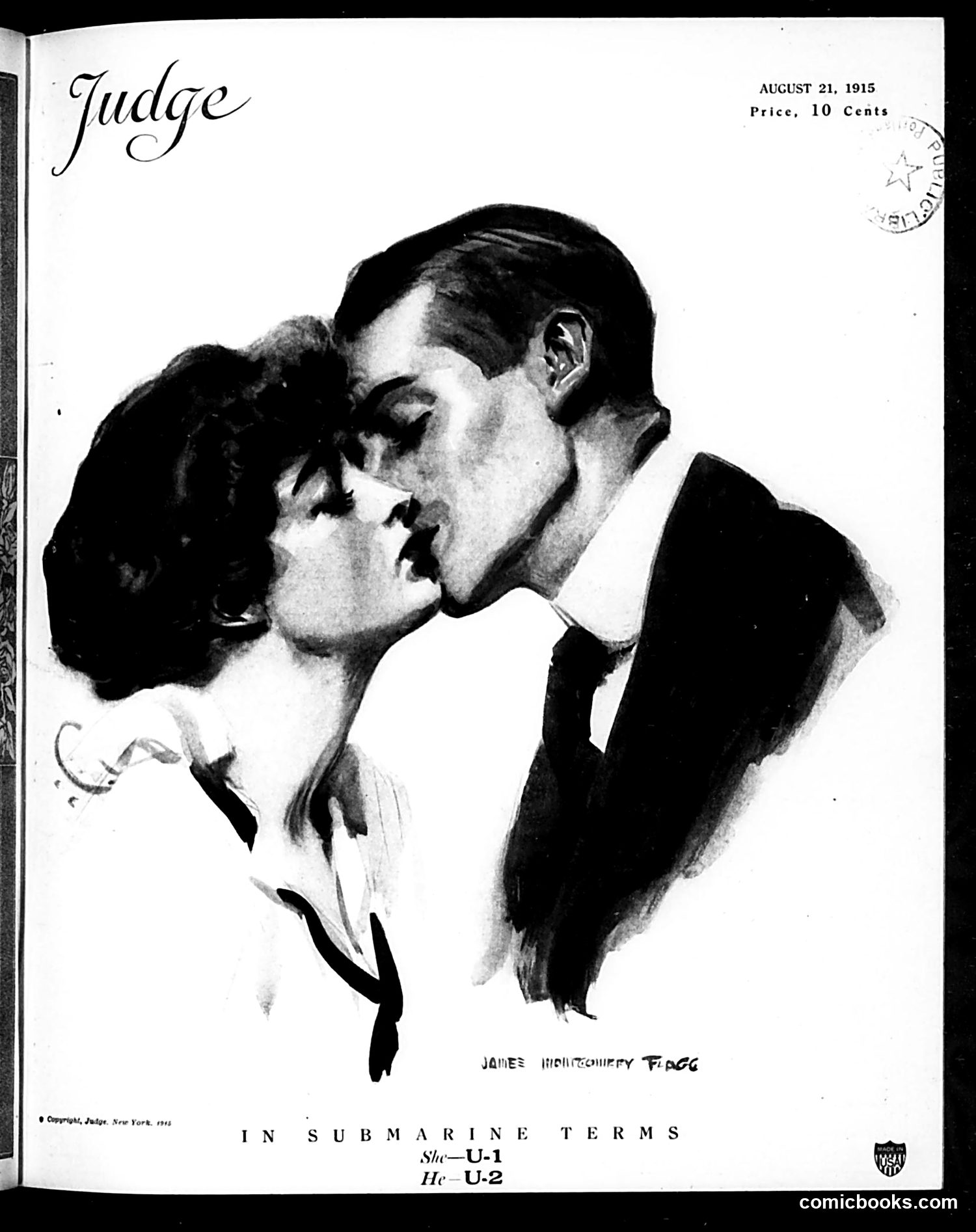
This romantic illustration by James Montgomery Flagg satirizes World War I submarine warfare through a coded double entendre. The kissing couple represents nations or combatants, labeled with submarine terminology: "She—U-1" and "He—U-2" (German U-boats were designated with "U-" numbers). The cartoon likely comments on neutral nations' anxious relationships with belligerents during the war, particularly America's tension with Germany over unrestricted submarine warfare. The romantic framing contrasts sharply with the deadly reality of submarine attacks on merchant vessels—including American ships and citizens—that were escalating in 1915. The satire suggests how dangerous or destructive relationships were being romanticized or rationalized during wartime.
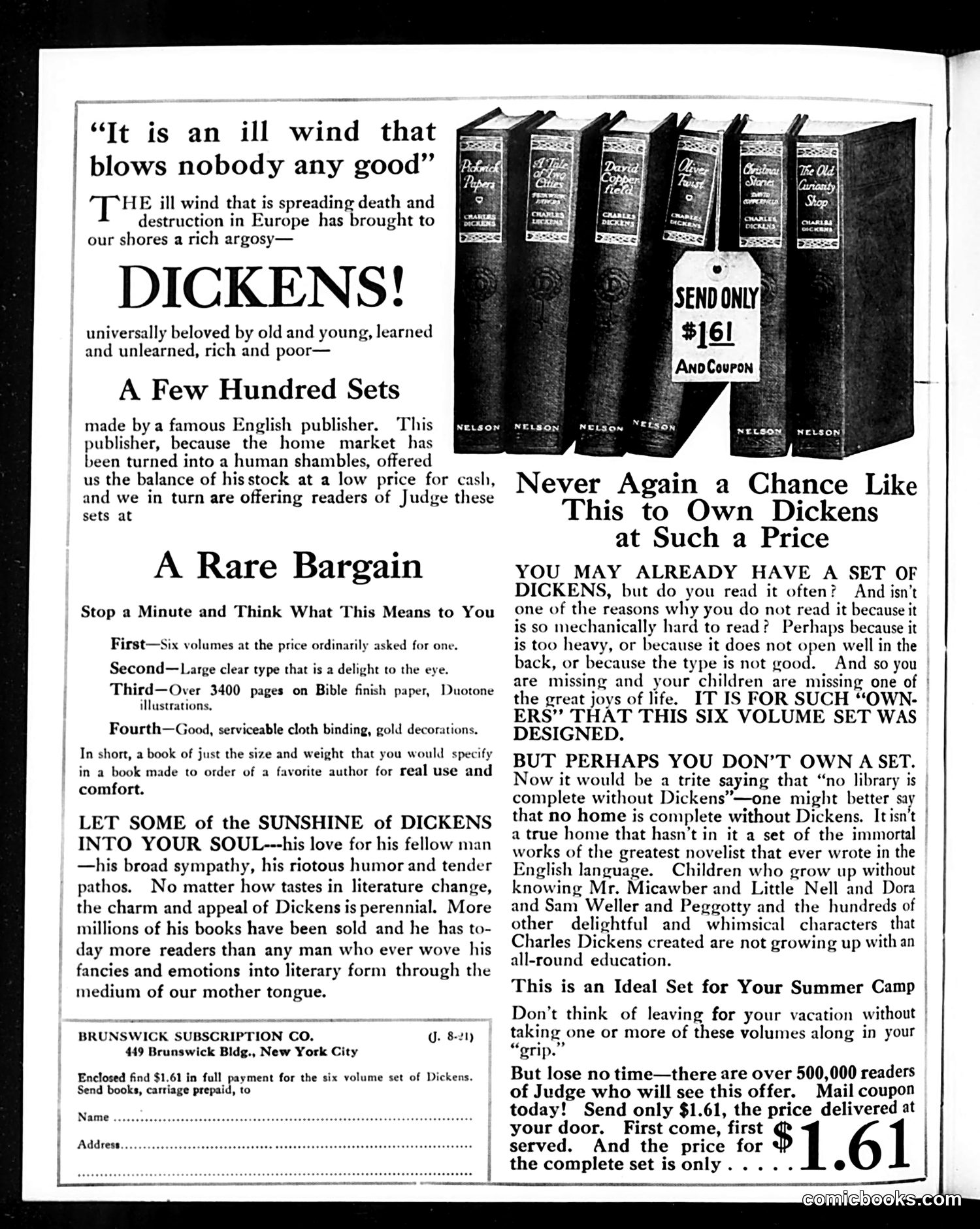
This page is primarily a **book advertisement**, not a political cartoon. It promotes a six-volume set of Charles Dickens novels for $1.61, distributed by the Brunswick Subscription Co. The ad opens with a topical reference: "It is an ill wind that blows nobody any good"—apparently referencing European conflict (likely WWI-era, given the mention of "death and destruction in Europe"). The copywriter uses this to frame the offer: war-displaced goods have reached America cheaply. The sales pitch emphasizes Dickens's moral value and accessibility, appealing to family literacy and summer reading. The ad targets middle-class consumers through Judge magazine, positioning classic literature as both affordable and morally beneficial—a common Progressive-era marketing strategy linking culture to social improvement.
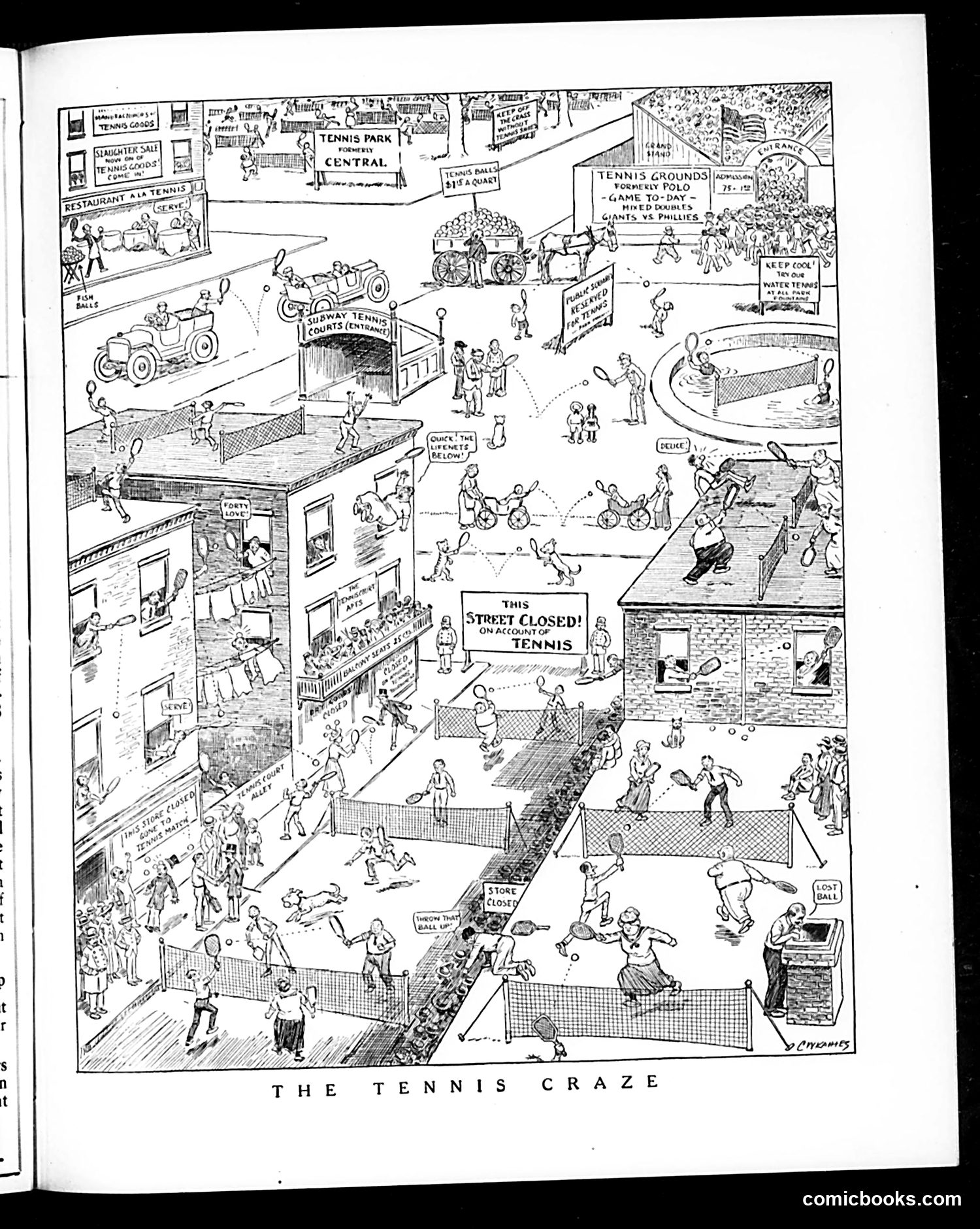
This satirical illustration depicts the overwhelming popularity of tennis during what appears to be the early 20th century. The cartoon shows a city street entirely consumed by tennis activity—courts occupy the street itself, restaurants and shops display tennis-related signage, and crowds of people play or watch tennis everywhere, even on rooftops and in windows. The central sign reading "THIS STREET CLOSED! ON ACCOUNT OF TENNIS" anchors the joke: tennis mania has literally shut down normal urban life. The satire mocks how a sporting fad can dominate society to absurd proportions, disrupting commerce, transportation, and everyday activities. It's a commentary on mass enthusiasms and how leisure trends can overwhelm practical civic concerns.
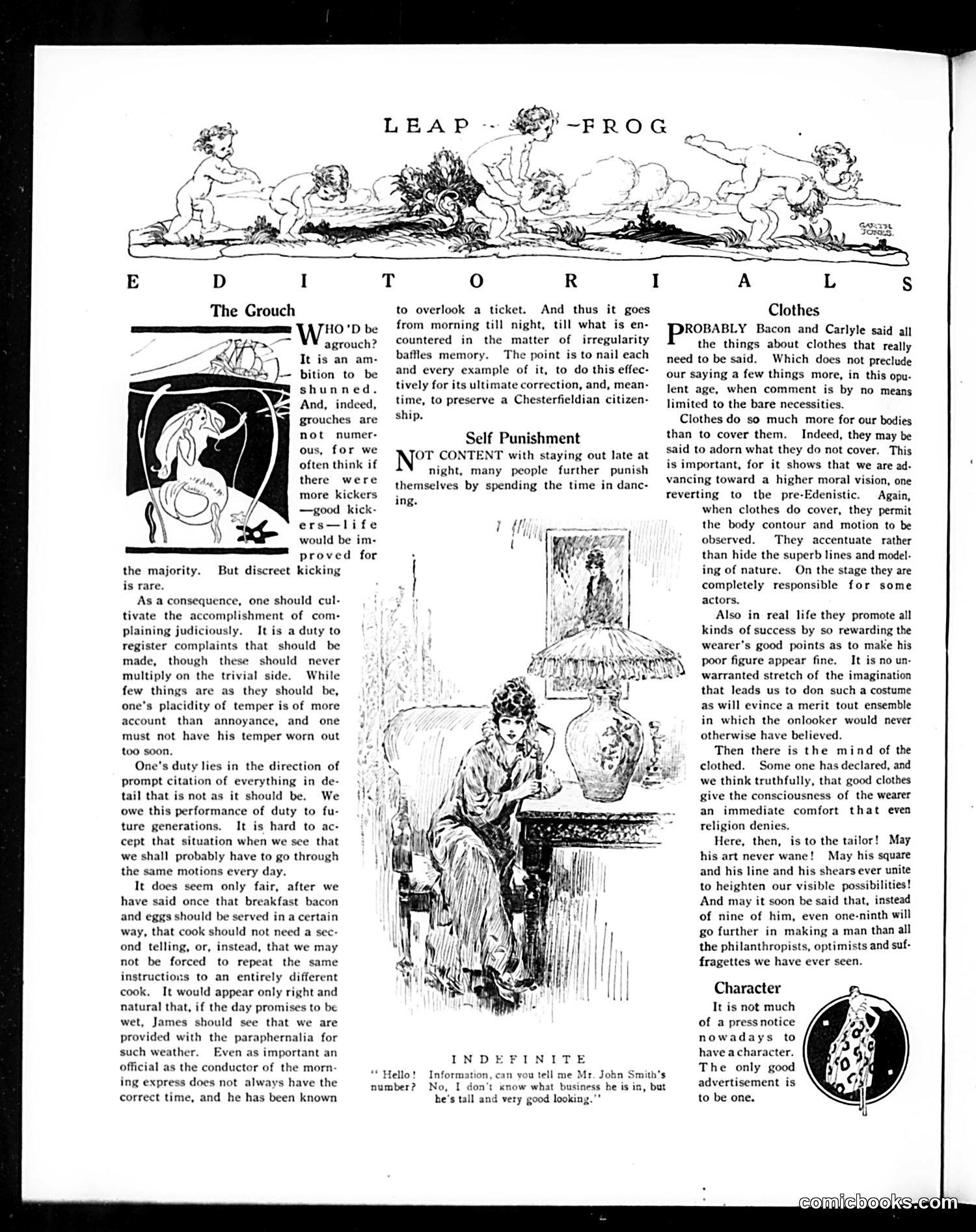
This page from *Judge* magazine uses satirical commentary on social etiquette and morality. The "Leap-Frog" header with cherubs suggests frivolous jumping between topics. The main editorials address: 1. **"The Grouch"** - Criticizes people who complain excessively about minor infractions (like overlooked theater tickets), arguing such nitpicking reveals poor character. 2. **"Self Punishment"** - Mocks those who stay out late dancing as self-inflicted suffering, arguing one should plan activities judiciously. 3. **"Clothes"** - Argues proper dress reveals character and moral development, suggesting clothes do more than cover bodies—they reflect refinement and success. 4. **"Character"** - Notes that having good character is the only worthwhile advertisement. The overall tone satirizes Victorian-era moralizing about respectability, suggesting these editorials represent excessive preaching about proper behavior.
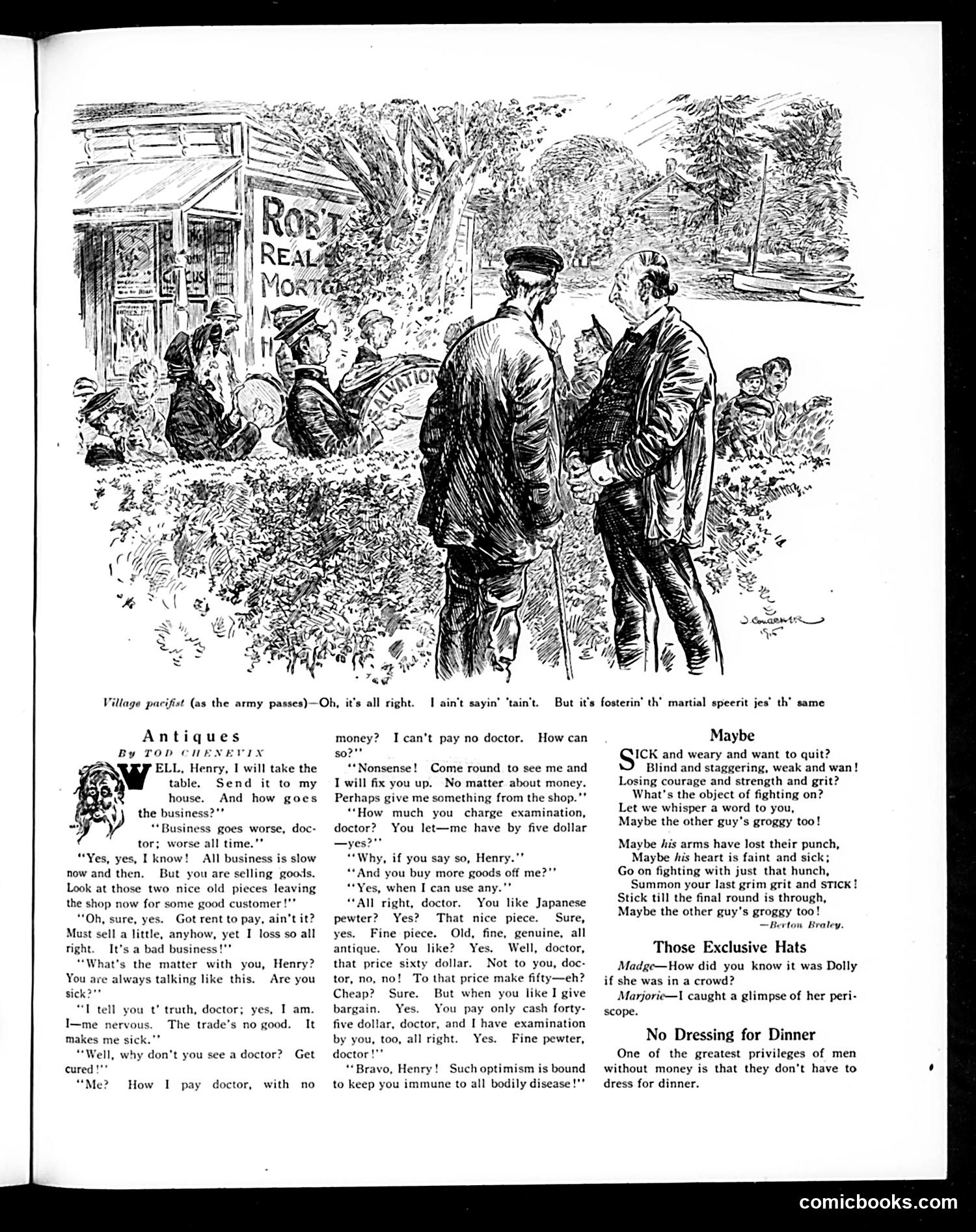
This page satirizes a doctor's unethical business practices. The sketch shows a medical professional charging poor patients exorbitant fees while selling them dubious "antique" goods from his shop—mixing legitimate medical practice with commercialism. The dialogue reveals the satire: the doctor claims he can't afford to treat patients without payment, yet offers expensive "genuine antique" items at inflated prices. The humor targets physicians who exploited vulnerable patients by bundling medical services with retail sales of questionable merchandise. The accompanying poetry sections mock romantic notions of war and poverty's "privileges" (no need to dress for dinner without money). The cartoon likely reflects early-20th-century concerns about medical fraud and commercialization of healthcare, common satirical targets in *Judge* magazine.
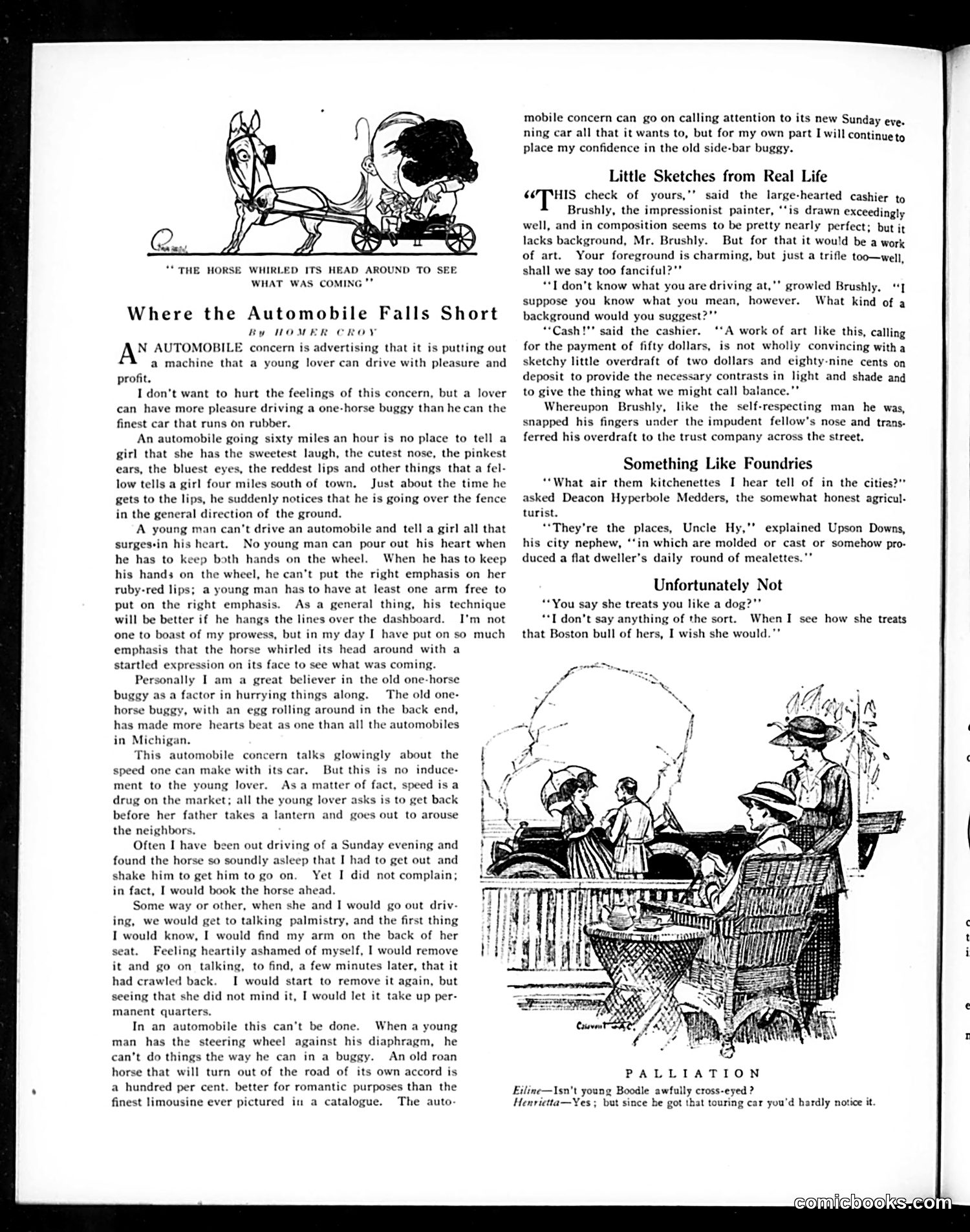
This page contains two satirical pieces from *Judge* magazine critiquing early 20th-century American life. **"Where the Automobile Falls Short"** by Homer Croy humorously argues that automobiles are inferior to horse-drawn buggies for romantic courtship. The satire mocks automobile advertising by claiming that cars' speed and sophistication actually *hinder* romance. A young man needs one hand free to gesture expressively while complimenting a girl, and he needs the horse to move slowly enough that he doesn't crash while distracted by romance. The author nostalgically praises the old buggy, where a horse's natural slowness and predictability allowed young men to shift focus from driving to courtship—even permitting a strategically "accidental" arm placement on the seat back. The piece satirizes both modern technology's disruption of tradition and automotive advertising's overstated claims about appeal to romance. The accompanying sketches appear to illustrate related domestic humor, though specifics are unclear in reproduction.
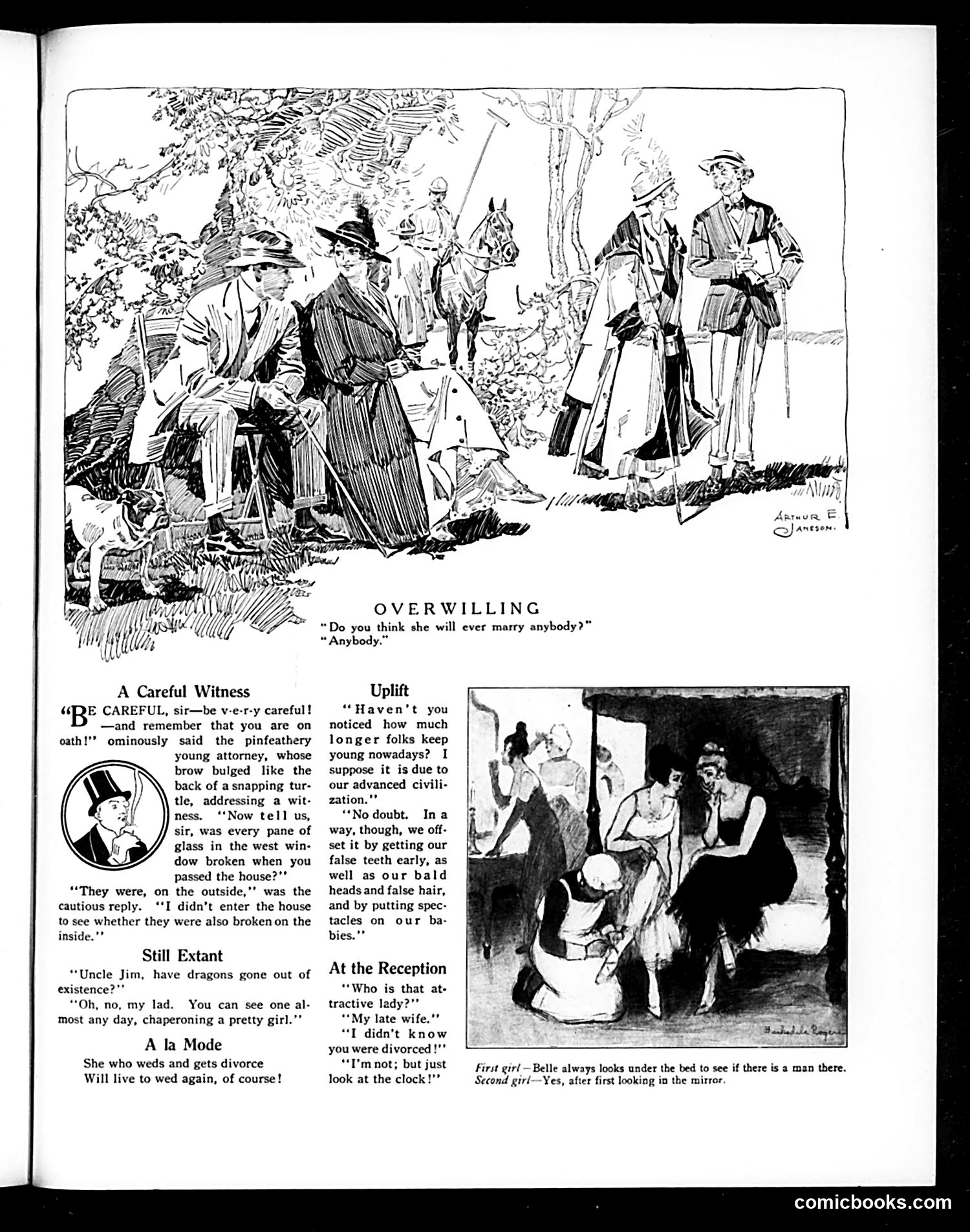
This page from Judge presents several short satirical humor pieces typical of early 20th-century American comic magazines: **"A Careful Witness"** mocks overly cautious legal testimony—a lawyer aggressively interrogates a witness who carefully qualifies his answers, suggesting the absurdity of pedantic courtroom procedure. **"Still Extant"** uses "dragons" as a metaphor for domineering women (chaperones), joking that controlling females persist despite modernity. **"A la Mode"** sarcastically comments on divorce's increasing prevalence and acceptability among the upper classes. **"Overwilling"** satirizes modern vanity—people claim extended youthfulness yet compensate with false teeth, hair, and spectacles on babies, contradicting claims of natural vitality. **"At the Reception"** plays on a widow remarrying quickly, with dark humor about a "late wife" (dead wife) who's still alive due to remarriage timing. The bottom illustration jokes about women's vanity and deception regarding romance, suggesting women primp extensively to attract men.
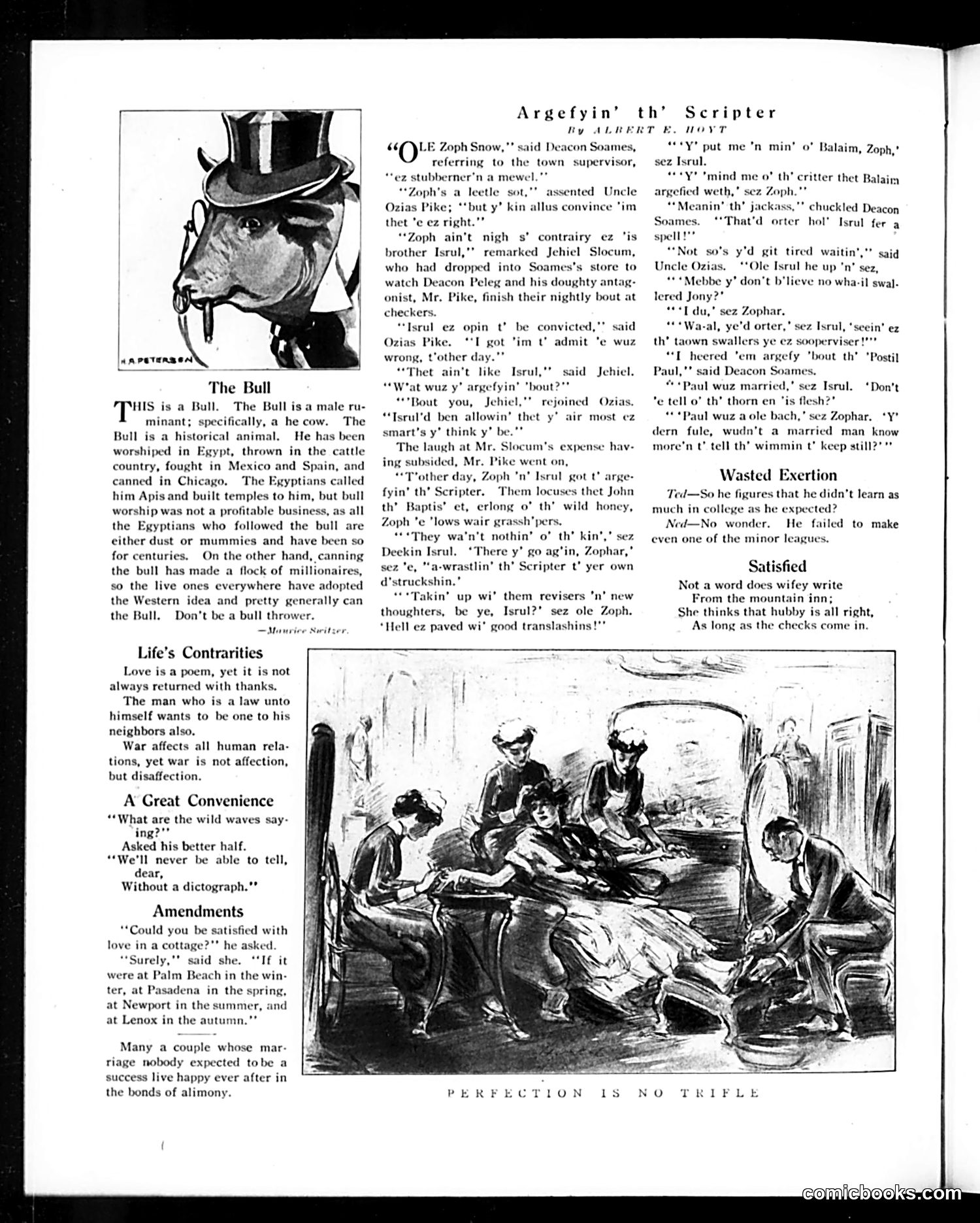
This piece satirizes rural American religious debate through exaggerated dialectal humor. The setting appears to be a country store where men argue about biblical interpretation—specifically whether John the Baptist ate locusts or grasshoppers, and whether Balaam's ass was real. The satire targets two things: (1) **uneducated men confidently disputing scripture** they barely understand, and (2) **resistance to modern Bible translations** ("them revisers"). The characters' thick dialect and malapropisms ("argefyin'" for "arguing") mock rural ignorance while suggesting that textual accuracy matters less than stubbornness. The accompanying short pieces ("Life's Contrarities," "Amendments") offer cynical observations on marriage and modern life, typical Judge magazine fare—particularly the final item mocking wives who only care about husbands' paychecks. The overall tone is gentle mockery of rural types, common in early-20th-century urban magazines.
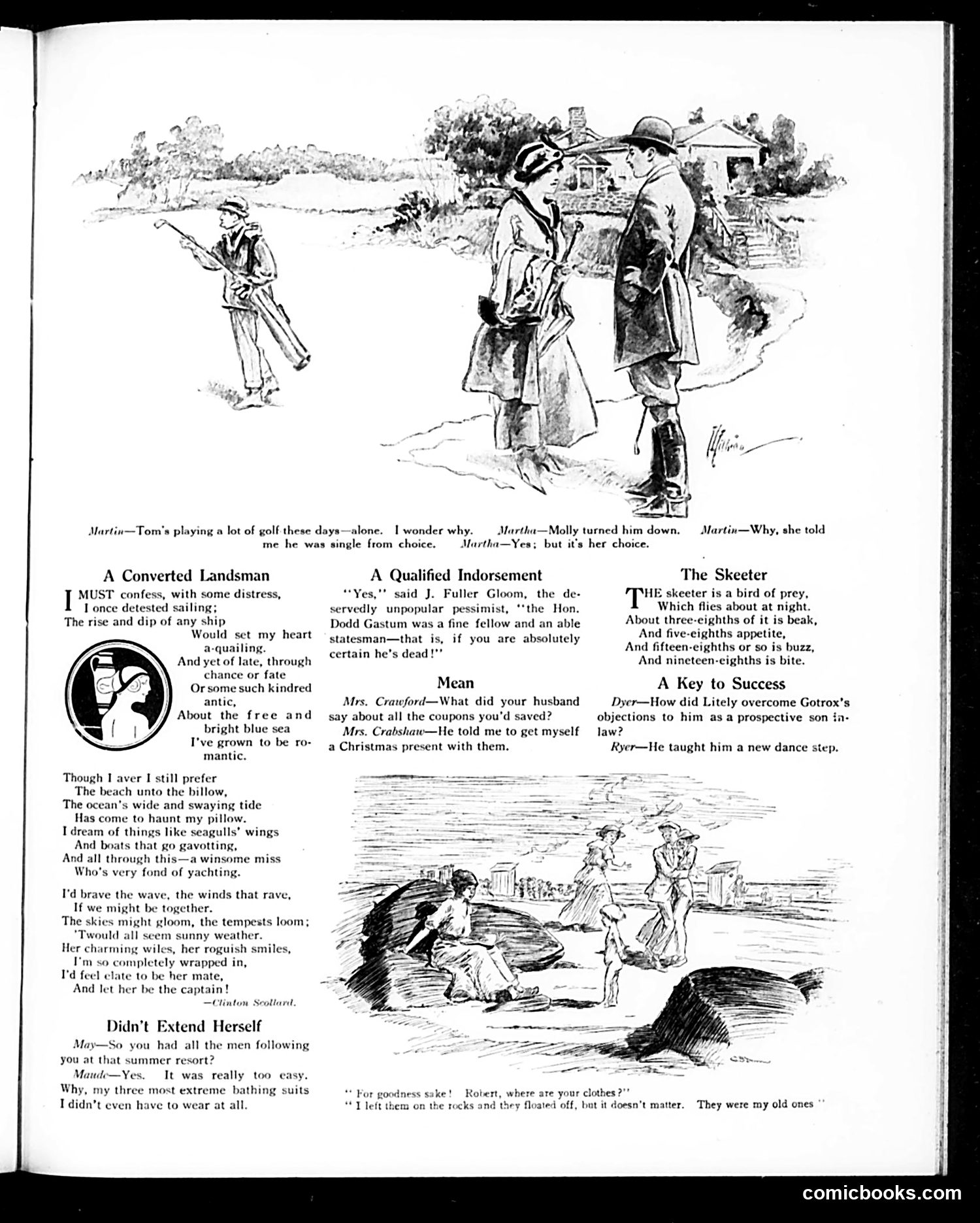
This page from *Judge* magazine contains **humorous short pieces and poems** typical of early 20th-century American satirical magazines—not political cartoons, but social commentary through wit. **Key pieces:** 1. **"A Converted Landsman"** — A romantic poem where a man, previously seasick, has fallen in love with a yachting enthusiast and now romanticizes sailing. The joke: love makes him overlook his actual discomfort. 2. **"Didn't Extend Herself"** — A woman claims she had men "following" her at a resort without effort, implying her attractiveness. The humor relies on the era's dating culture and women's fashion/appearance. 3. **"A Qualified Indorsement"** — A pessimist gives backhanded praise: a man was "fine" *if* he's definitely dead. Dark humor about an unpopular person. 4. **"A Key to Success"** — A young man wins over his prospective father-in-law simply by teaching him a new dance step—trivializing courtship/approval. These pieces satirize **romantic relationships, gender dynamics, and social climbing** through light, often cynical humor characteristic of the era.
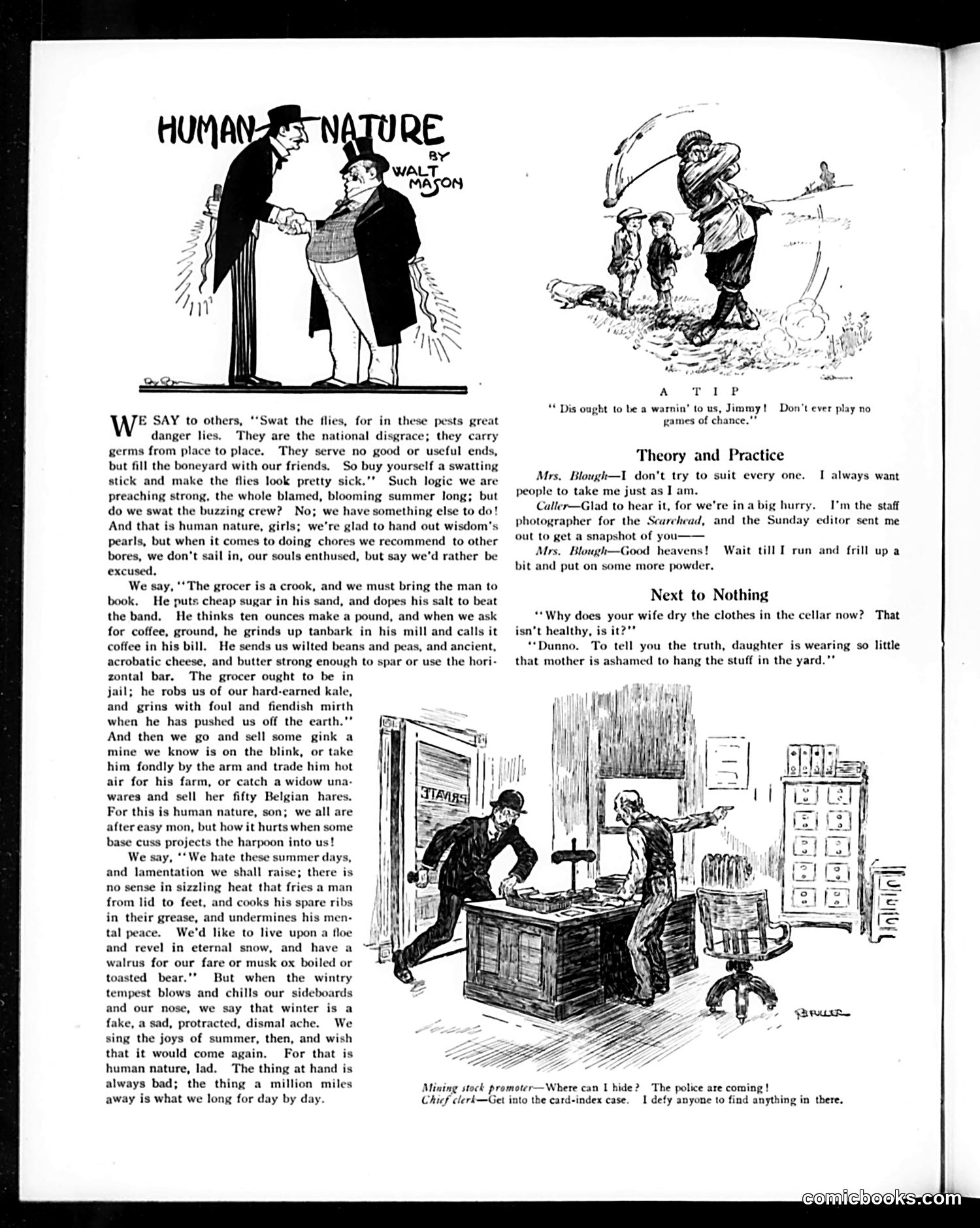
This page satirizes human hypocrisy and double standards. The main essay attacks people who publicly condemn others' faults while committing similar wrongs themselves: they lecture about swatting flies and denounce grocer fraud, yet sell defective mines and trade hot air for farms. They complain about summer heat and winter cold, always wanting what they lack. The satirical point: humans are fundamentally self-serving and hypocritical. The accompanying cartoons reinforce this theme. "Theory and Practice" mocks a woman who claims to take people as they are, then frantically prepares her appearance for a photograph. "Next to Nothing" jokes about economic hardship—a daughter wears so little that hanging laundry outside would embarrass the family. The "Missing stock promoter" cartoon depicts financial fraud, with a clerk suggesting hiding in a card-index case. The overall message criticizes human nature's inconsistency between professed principles and actual behavior.
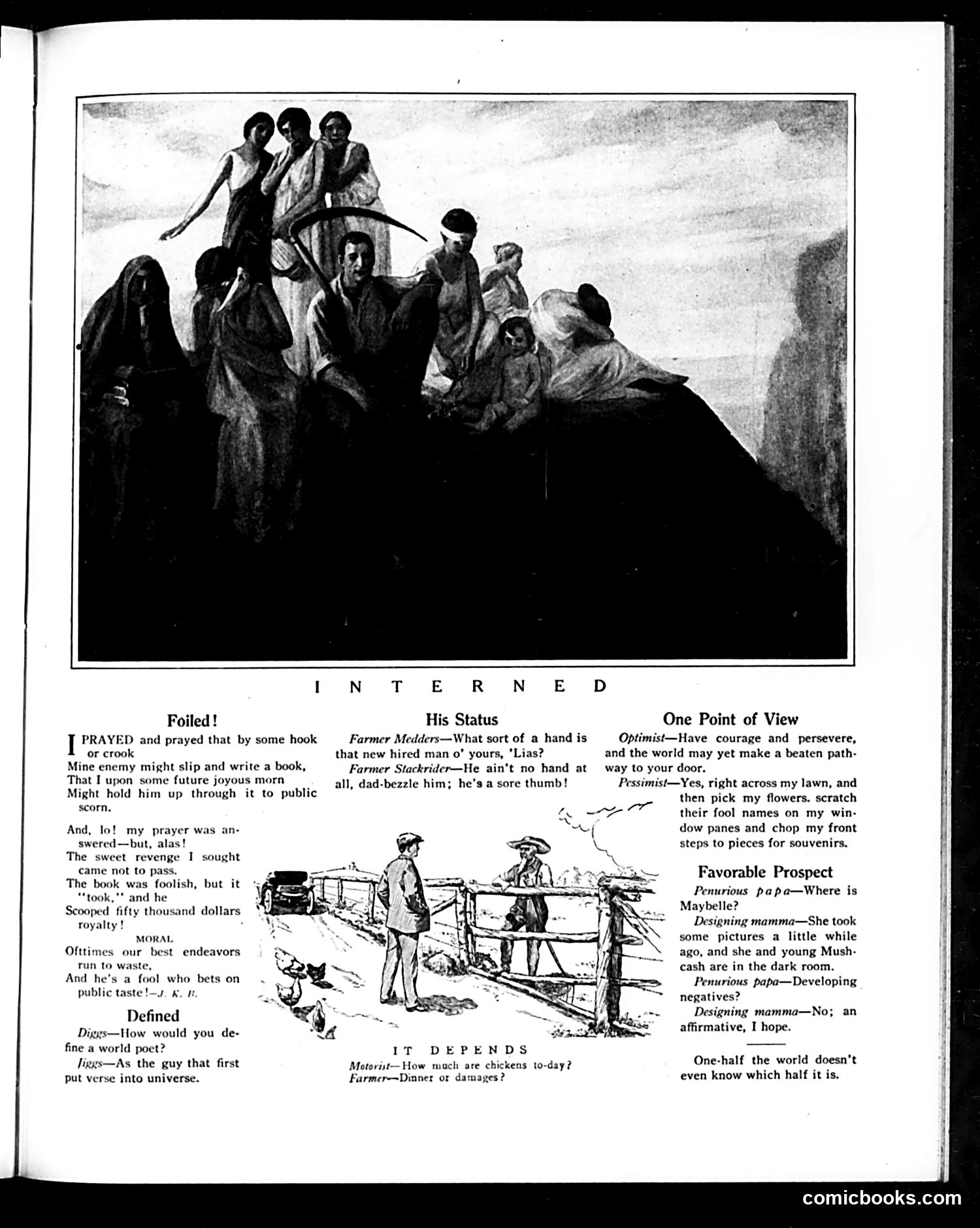
This page from Judge contains several satirical vignettes targeting early 20th-century American life: **"Foiled!"** mocks a man who prayed his enemy's hired hand would embarrass himself publicly through a book—but the book succeeded commercially instead, earning fifty thousand dollars. The moral: betting on public taste backfires. **"It Depends"** is a quick joke where a motorist asks a farmer chicken prices; the farmer asks whether he means for dinner or damages (implying motorists hit farm animals). **"His Status" and related sections** contain social commentary on rural labor, incompetent farmhands, and class dynamics. **"Favorable Prospect"** presents wordplay about a young woman and man in a darkroom—the pessimistic father fears romance ("affirmative"), while the designing mother hopes for it. The satirical tone targets rural simplicity, commercial phoniness, and romantic/social pretensions of the era. The page reflects Judge's style: quick jokes, social observation, and gentle mockery of American aspirations and mishaps.
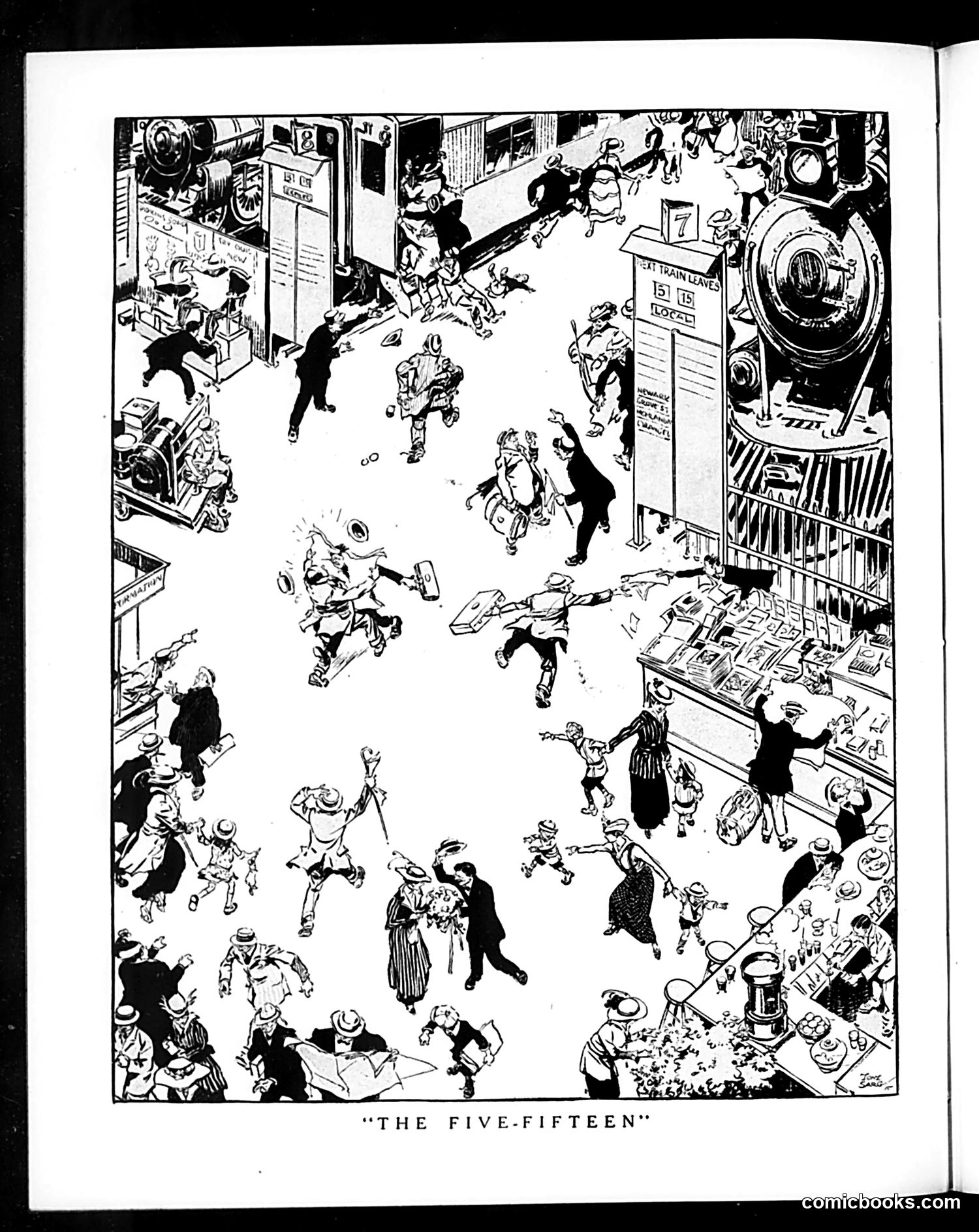
This is a bird's-eye view illustration of what appears to be a busy train station or railway platform during rush hour. The title "The Five-Fifteen" likely refers to a 5:15 PM departure time—a common commute hour. The cartoon satirizes the chaos of modern urban commuting through densely packed crowds, luggage, and scrambling passengers. The scene captures the frenzy and disorder of mass transportation, with figures climbing over one another, abandoning belongings, and creating general pandemonium. Large mechanical elements (likely locomotives or train cars) frame the scene. This reflects early 20th-century anxieties about industrialization, urbanization, and the dehumanizing effects of modern transportation systems. The satire mocks both the indignity passengers endure and society's acceptance of this daily chaos as normal.
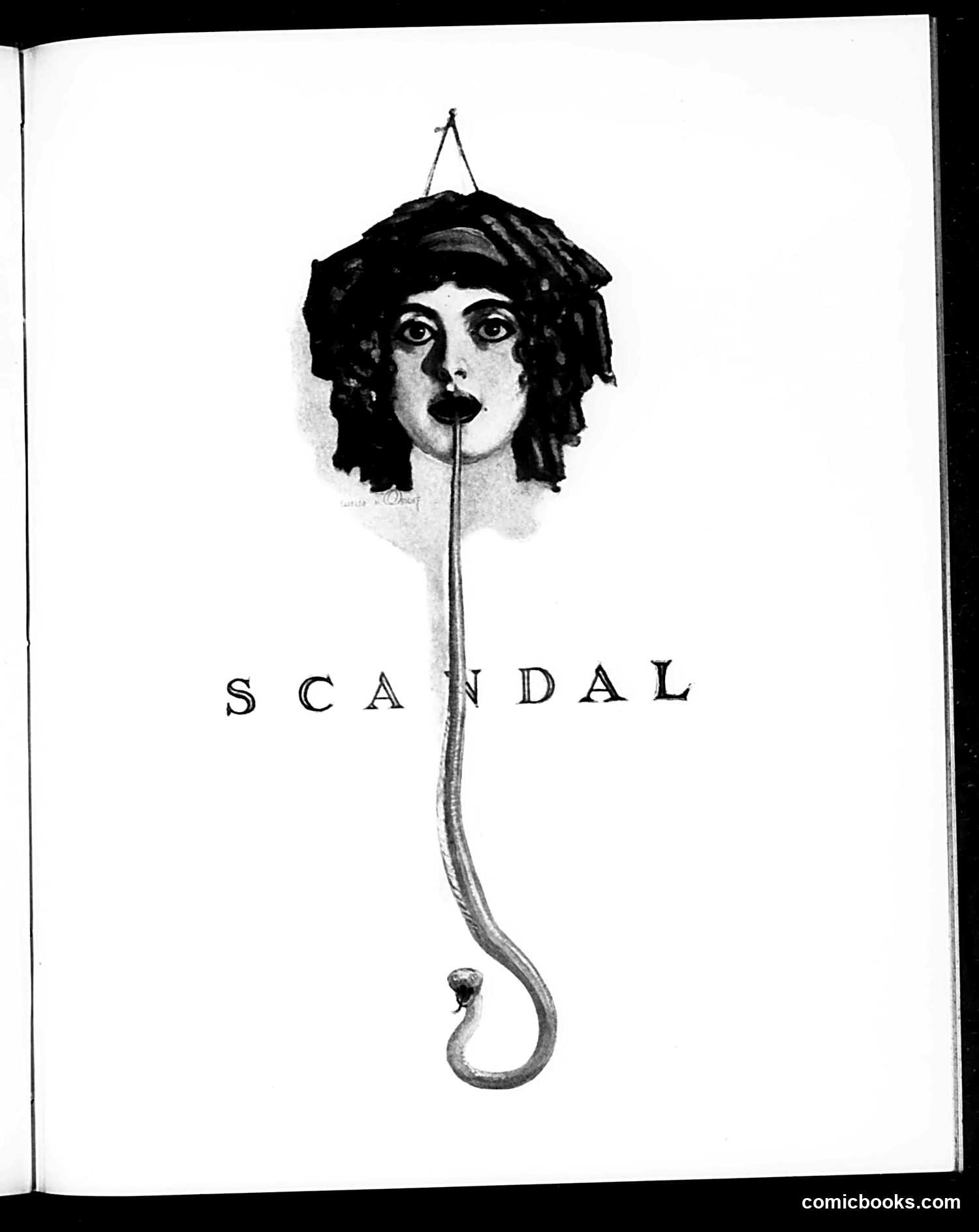
This appears to be a title page or section header from *Judge* magazine featuring a disturbing image: a stylized female head with an expression of shock or distress, suspended by a noose-like cord with a hook at the bottom. The single word "SCANDAL" appears alongside the illustration. The artistic style and execution suggest this is early 20th-century satirical commentary, likely referencing public scandals or sensationalism of the era. Without additional context from surrounding pages or publication date, the specific scandal being referenced remains unclear. The imagery critiques how scandals—particularly involving women—were sensationalized and treated as objects of public fascination and harm by media and society. The disturbing nature of the image itself underscores the satire's point about scandal's corrosive effects.
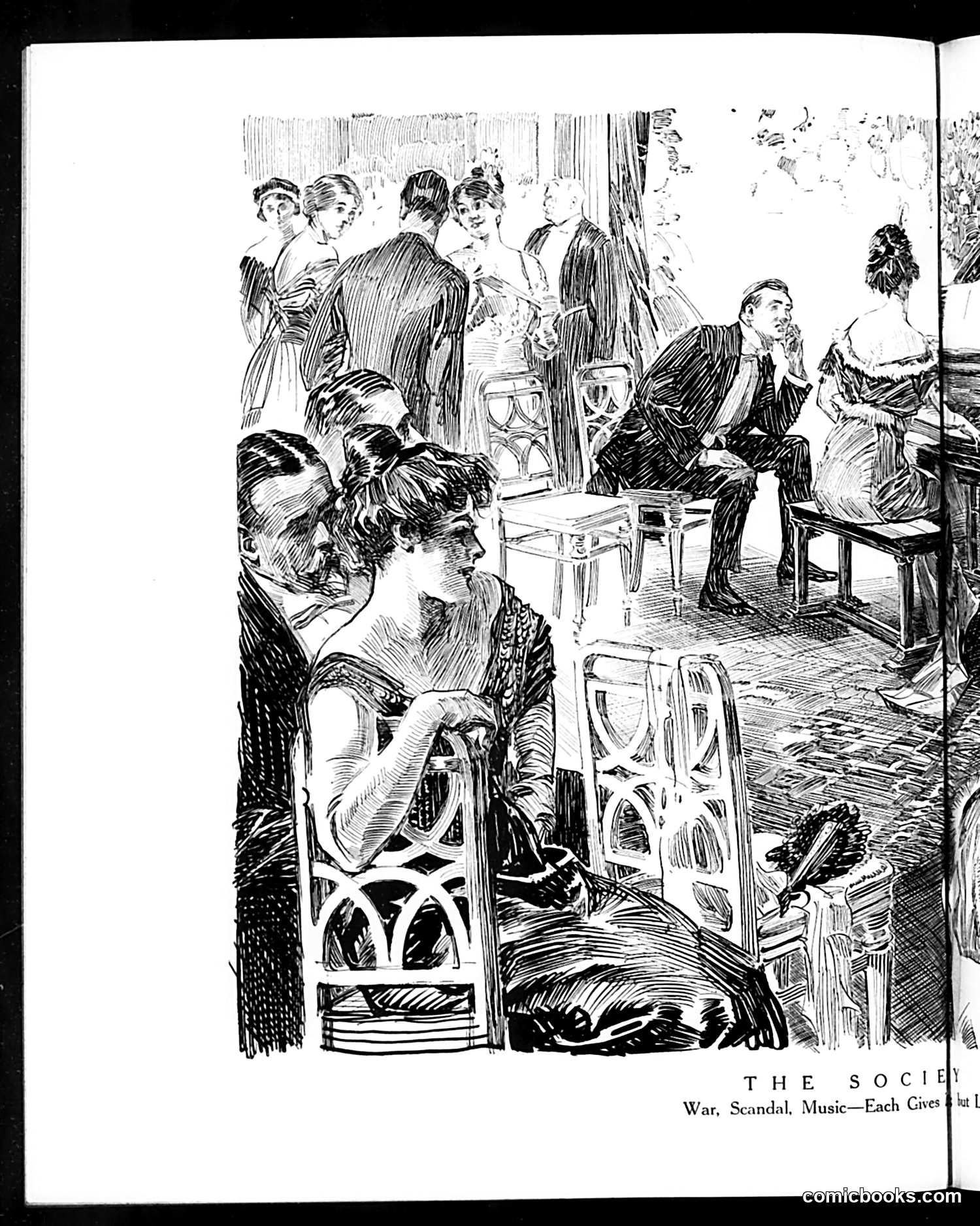
This is a black and white ink illustration depicting an elegant social gathering or salon scene. The visible text reads "THE SOCIETY" with partial text below mentioning "War, Scandal, Music—Each Gives" (the sentence appears cut off). The cartoon shows well-dressed men and women in formal attire socializing in what appears to be an upper-class interior. The composition suggests this is satirizing high-society gatherings of the era, likely commenting on how the wealthy elite entertain themselves with gossip about serious matters—war, scandal, and music serving as mere social entertainment and conversation topics for the privileged class. The OCR text is largely corrupted, making it difficult to identify specific individuals or provide precise historical context. However, Judge magazine's typical approach was mocking the pretensions and shallow concerns of the wealthy and fashionable classes.
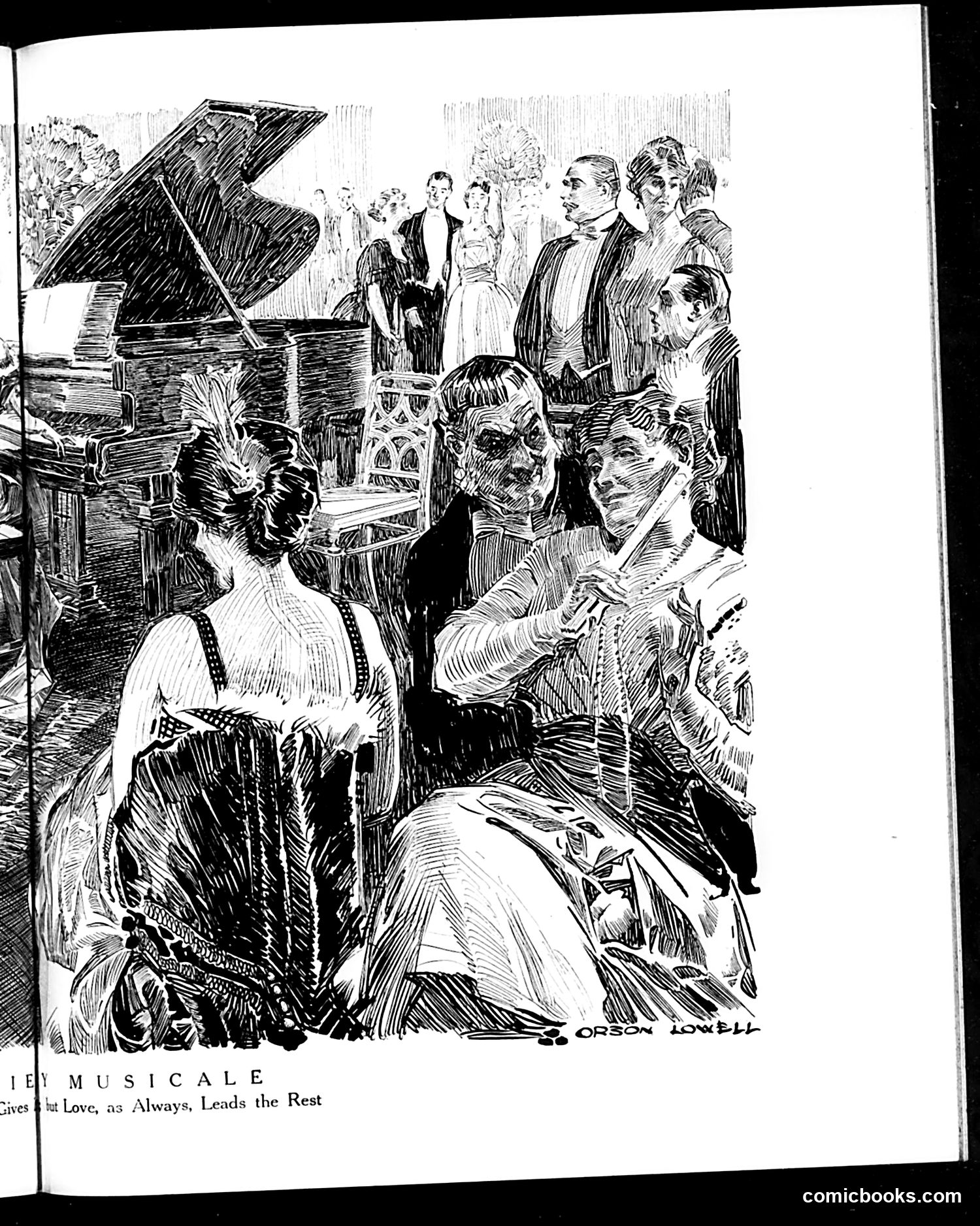
This illustration by Orson Lowell depicts a high-society musical performance or salon. The caption reads "Love, as Always, Leads the Rest," suggesting the drawing satirizes romantic or sentimental themes within elite cultural gatherings. The scene shows well-dressed attendees at what appears to be a piano recital. The composition emphasizes the contrast between the performers and audience members, with particular focus on the seated women in the foreground wearing elaborate clothing typical of early 20th-century haute couture. The satire likely mocks the pretensions of wealthy society attending classical music events—perhaps critiquing artificial sophistication, romantic posturing, or the social rituals surrounding elite cultural consumption. However, without additional context about specific individuals or events referenced, the precise satirical target remains unclear.
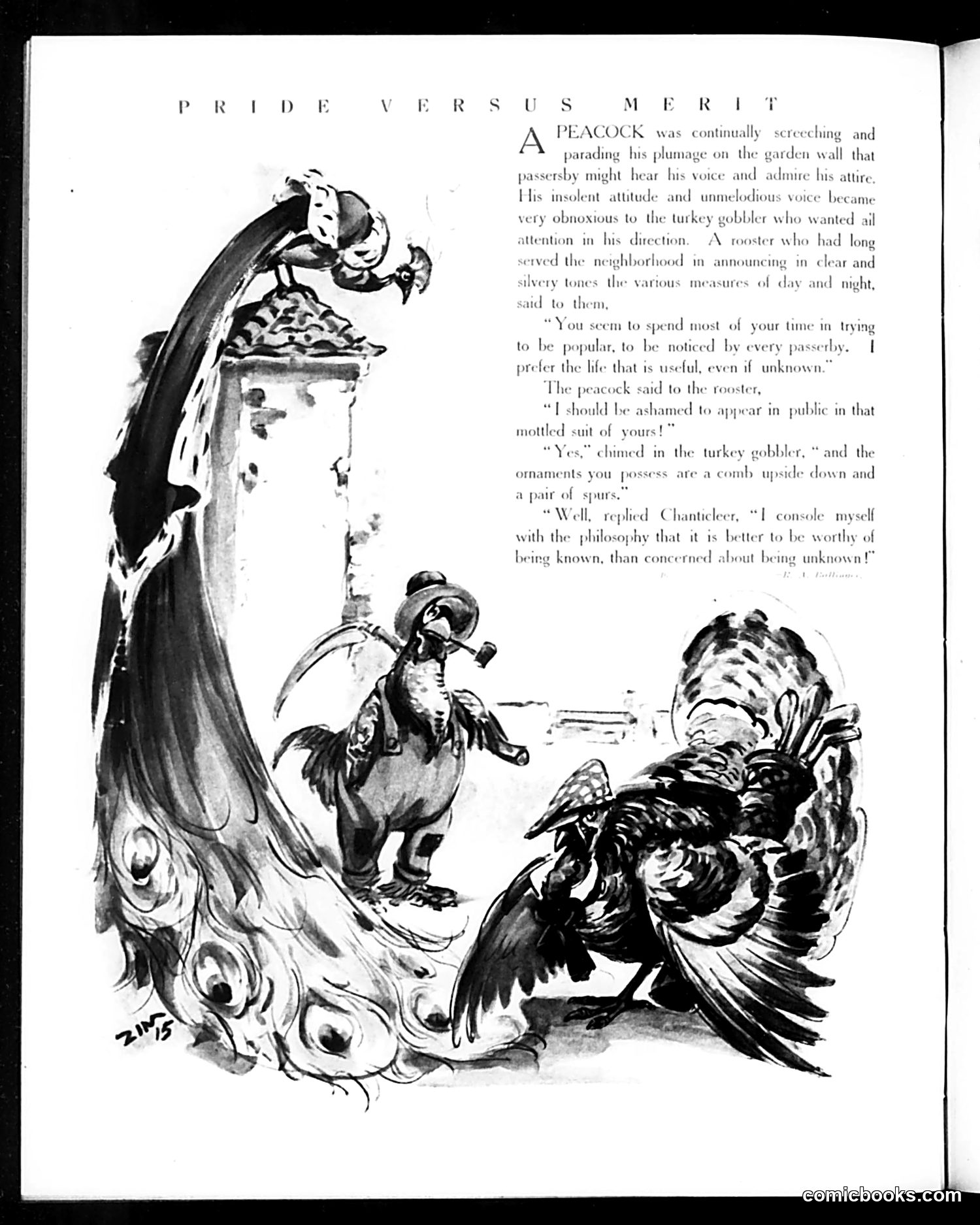
This is a fable illustration accompanying the moral lesson "Pride Versus Merit." Three farmyard birds debate the value of appearance versus usefulness: - **The Peacock** represents vanity and self-promotion—constantly displaying his plumage to attract attention, caring only about being admired by passersby. - **The Turkey Gobbler** is his vain ally, mocking the rooster's plain appearance. - **Chanticleer the Rooster** (a traditional name for roosters in fables) represents humble utility and genuine worth. He performs a necessary function—announcing the hours—without seeking recognition. The satire critiques those who prioritize appearance and popularity over substantive contribution to society. Chanticleer's final retort—that it's better to be worthy of being known than obsessed with being noticed—articulates the moral: true merit lies in useful service, not ostentatious display. This reflects Gilded Age anxieties about materialism versus traditional virtue.
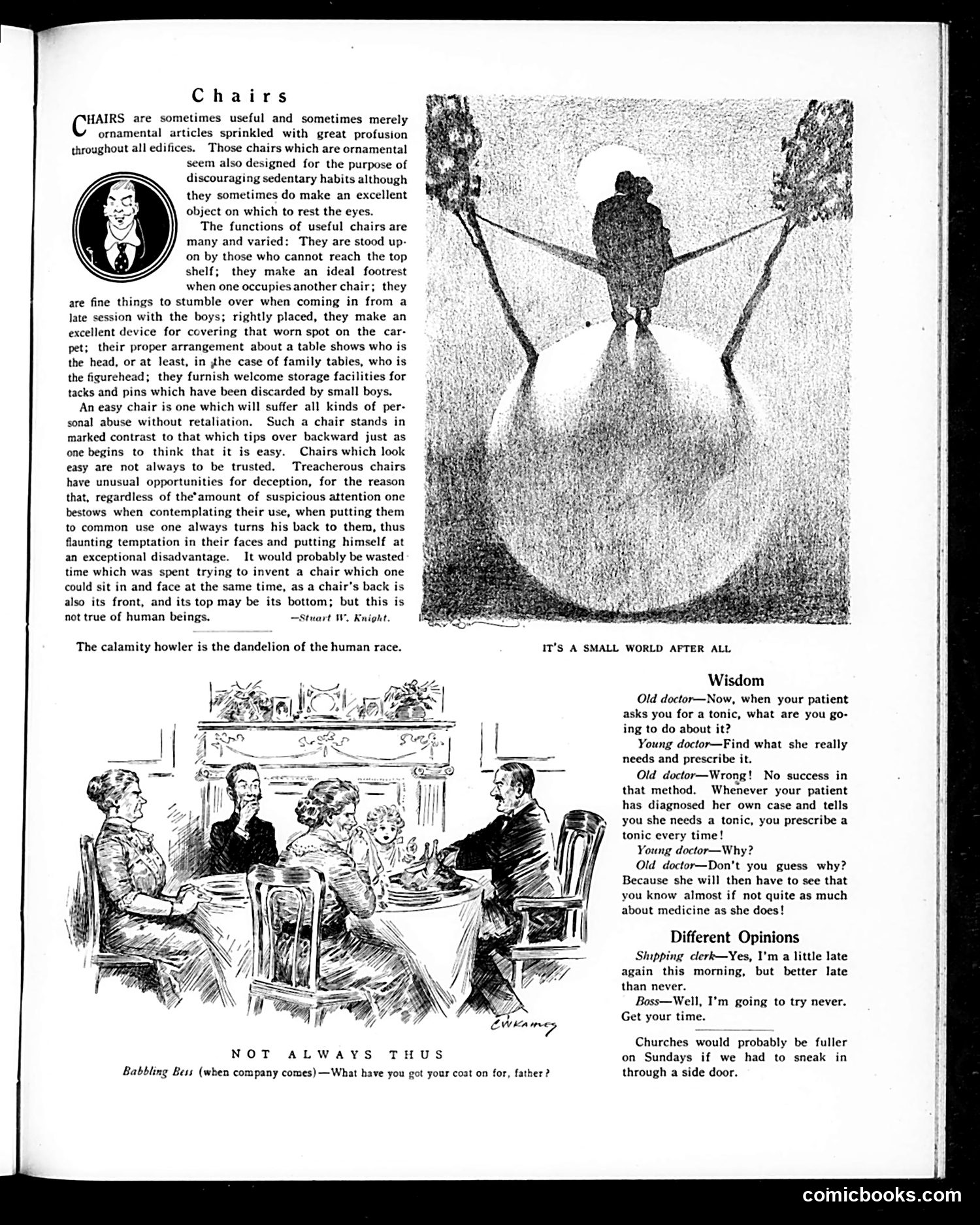
This page contains three distinct satirical pieces reflecting early 20th-century American humor: **"Chairs"** — A lengthy humorous essay by Stuart W. Knight that treats chairs with mock-serious analysis, cataloging their absurd practical uses (footrests, stepladders, carpet concealment, storage). The satire mocks over-elaborate essays on mundane objects by treating trivial functions with elaborate philosophical weight. **"Wisdom"** — A dialogue between an old and young doctor satirizing medical practice. The older doctor cynically advises prescribing what patients *think* they need (tonics) rather than what they actually need, since patients equate prescriber ignorance with their own knowledge. It mocks both patient self-diagnosis and doctors' willingness to exploit it. **"Different Opinions" and "Not Always Thus"** — Brief workplace and domestic jokes about tardiness, employee management, and church attendance. These mock conventional social excuses and hypocrisy. The cartoon illustrates the "Wisdom" dialogue, showing a domestic dinner scene. The page's overall tone is light social satire aimed at professional incompetence, patient behavior, and workplace dynamics.
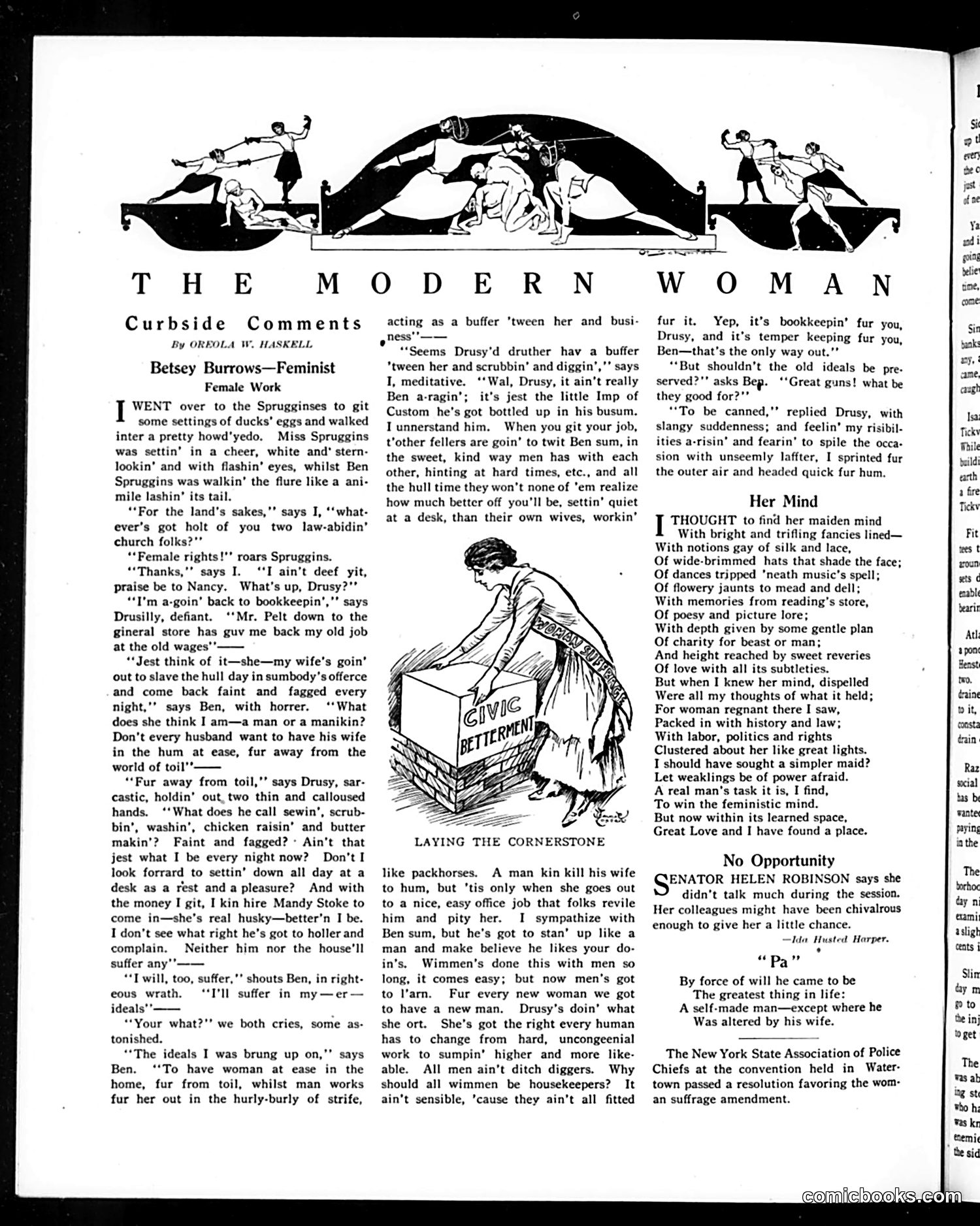
This page satirizes the emerging feminist movement of the early 20th century through a rural dialogue between neighbors about a wife, "Drusy," who wants to return to office work as a bookkeeper. **The Setup:** Ben Spruggins opposes his wife working, claiming it violates his "ideals" about women's proper domestic role. He sees her office job as emasculating—he'd rather she remain at home, exhausted from housework and child-rearing. **The Satire's Target:** The humor mocks Ben's contradictory reasoning: he romanticizes women's "ease at home" while ignoring their actual grueling labor (washing, cooking, sewing). The narrator points out the absurdity—men accept wives working themselves to exhaustion at home but pity them for office work. **The Point:** The piece argues for women's right to choose meaningful work, suggesting that "ideals" about gender roles are outdated customs ("the little Imp of Custom") that must adapt as society changes. The illustration shows a woman literally laying the "cornerstone" of civic improvement. This reflects real Progressive-Era debates about women's suffrage and workforce participation.
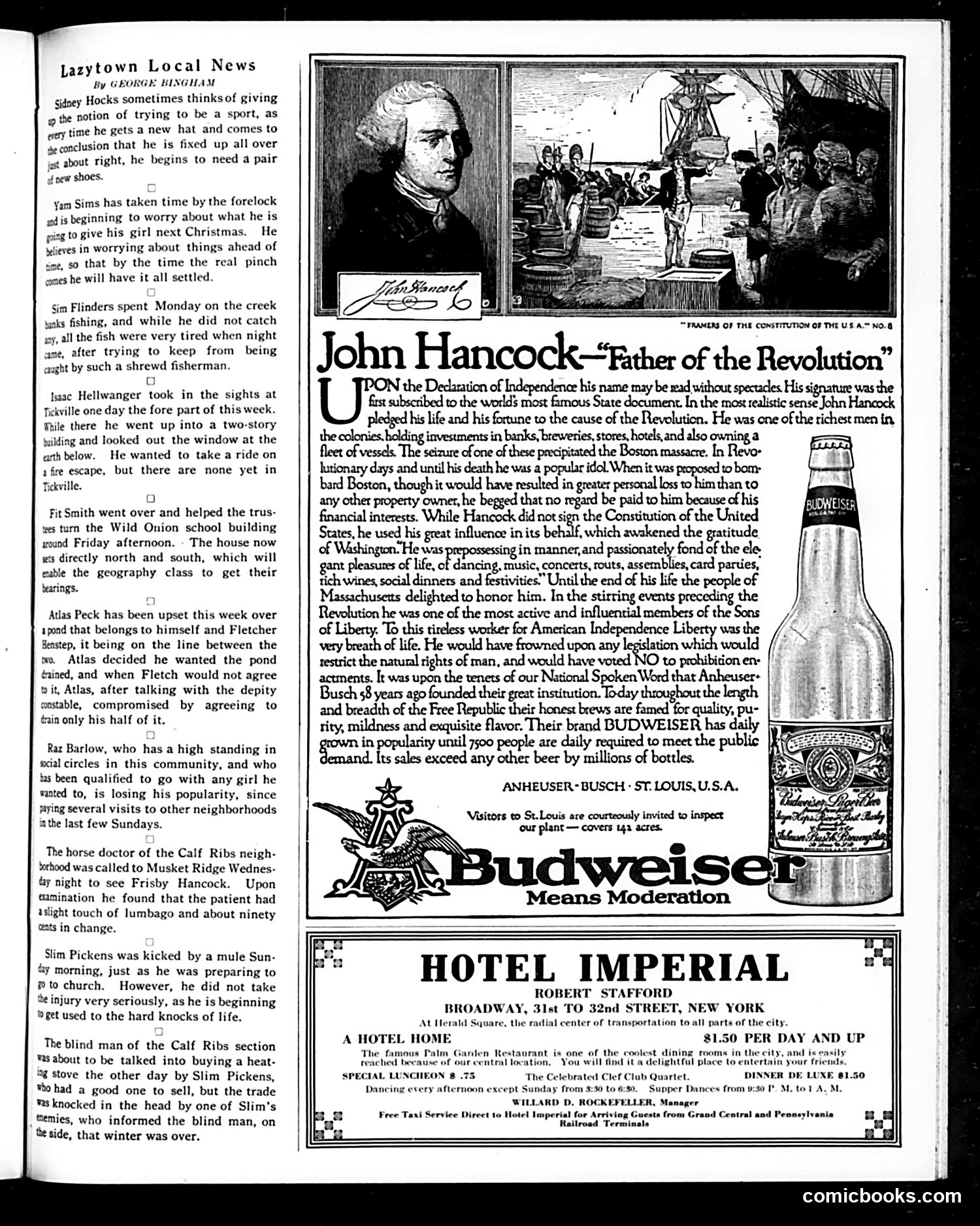
This page consists primarily of two elements: a humorous local-news column and a substantial historical advertisement. **"Lazytown Local News"** is a folksy humor column recounting trivial small-town incidents—men worrying about Christmas gifts, failed fishing trips, a mule-kicking mishap. The humor derives from exaggerated rural simplicity and human foibles. **The major content** is a Budweiser beer advertisement masquerading as historical education. It features John Hancock as "Father of the Revolution," highlighting his wealth, patriotic sacrifice, and social refinement (dancing, concerts, card parties). The advertisement then pivots to praising Budweiser beer's "quality, purity, mildness and exquisite flavor," claiming it's grown in popularity until "1,700 people are daily impelled to meet the public demand." The satire is subtle: by associating Hancock's gentlemanly pleasures with beer consumption, and by framing commercial success in Revolutionary terms, the ad ironically equates beer-drinking with patriotic virtue—a common advertising strategy of the Prohibition-era Judge magazine.
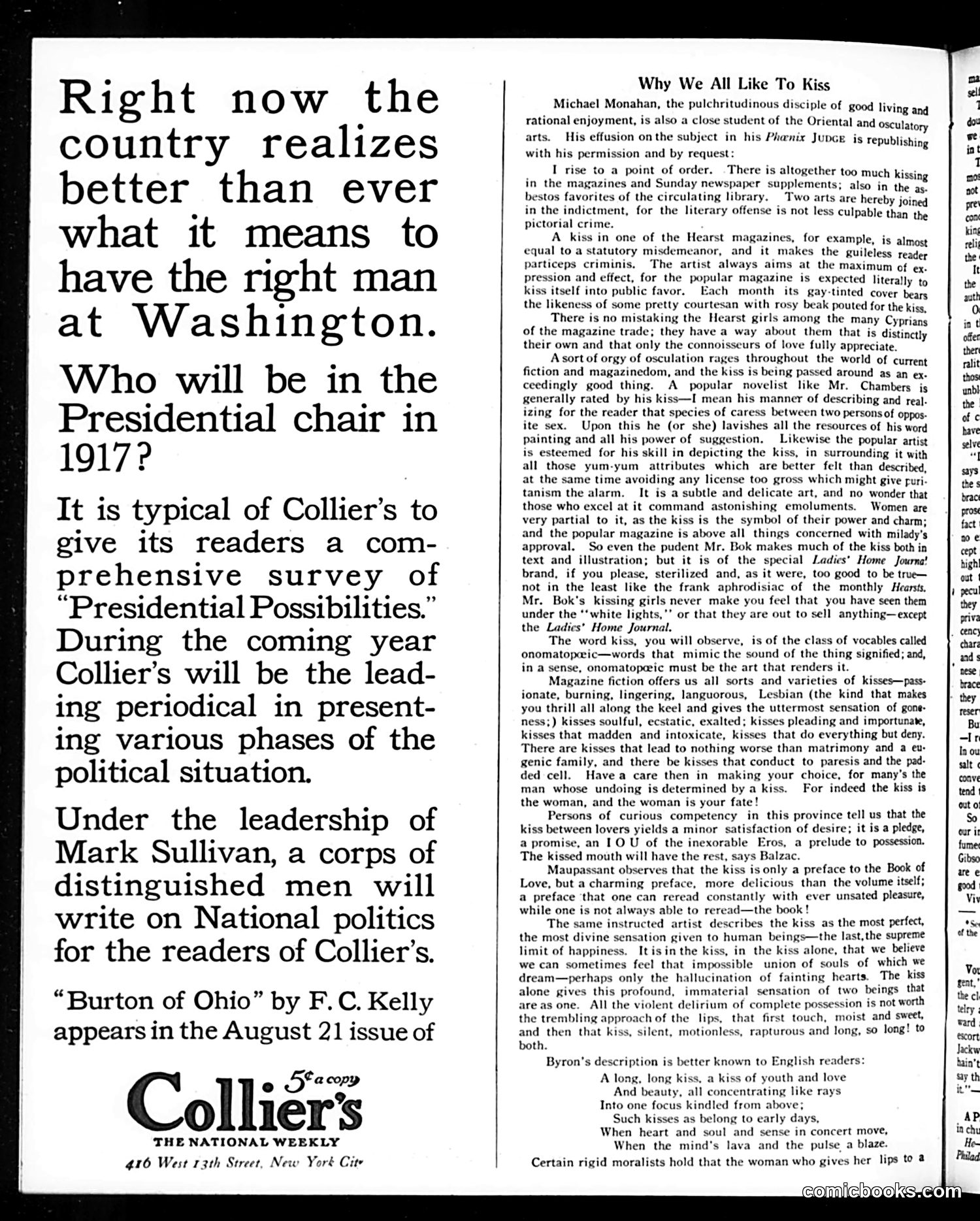
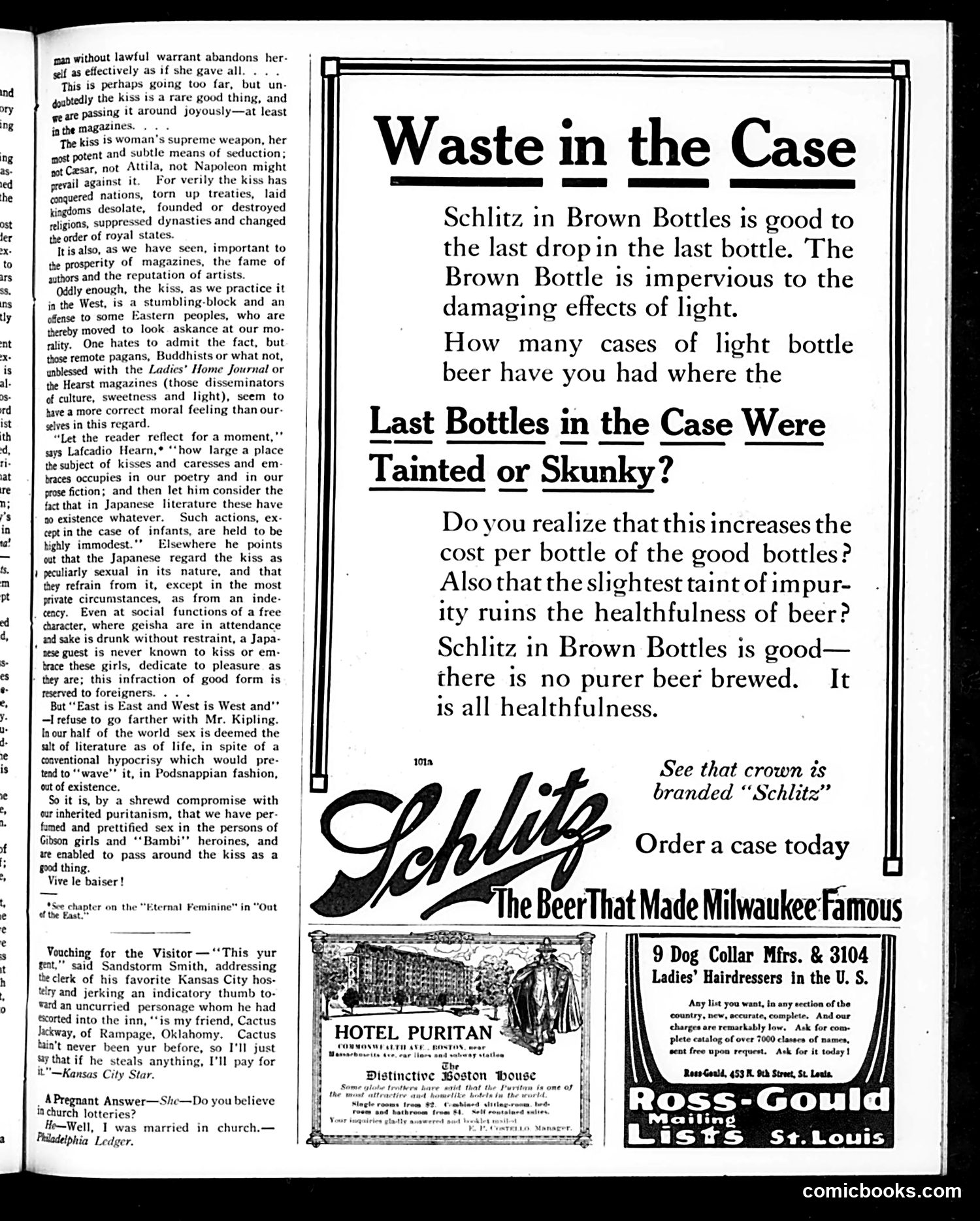
This page combines satirical editorial content with advertisements. The main article (left) discusses the cultural significance of kissing, drawing on Lafcadio Hearn's observations about Eastern restraint versus Western promiscuity in literature and social behavior. The author argues that Western magazines have sexualized the kiss, while Japanese culture treats it as an immodest act reserved for privacy. The prominent advertisement (center/right) is for **Schlitz beer in brown bottles**, using a rhetorical appeal: it asks readers how many cases of light-bottled beer they've purchased where the last bottles were "tainted or skunky," arguing that brown glass protects beer from light damage and ensures quality throughout the case. Below are smaller ads for a Boston hotel and a St. Louis mailing list service. The page reflects early 20th-century concerns: cultural attitudes toward propriety and sexuality, and commercial competition in the brewing industry (where packaging innovation was a genuine selling point).
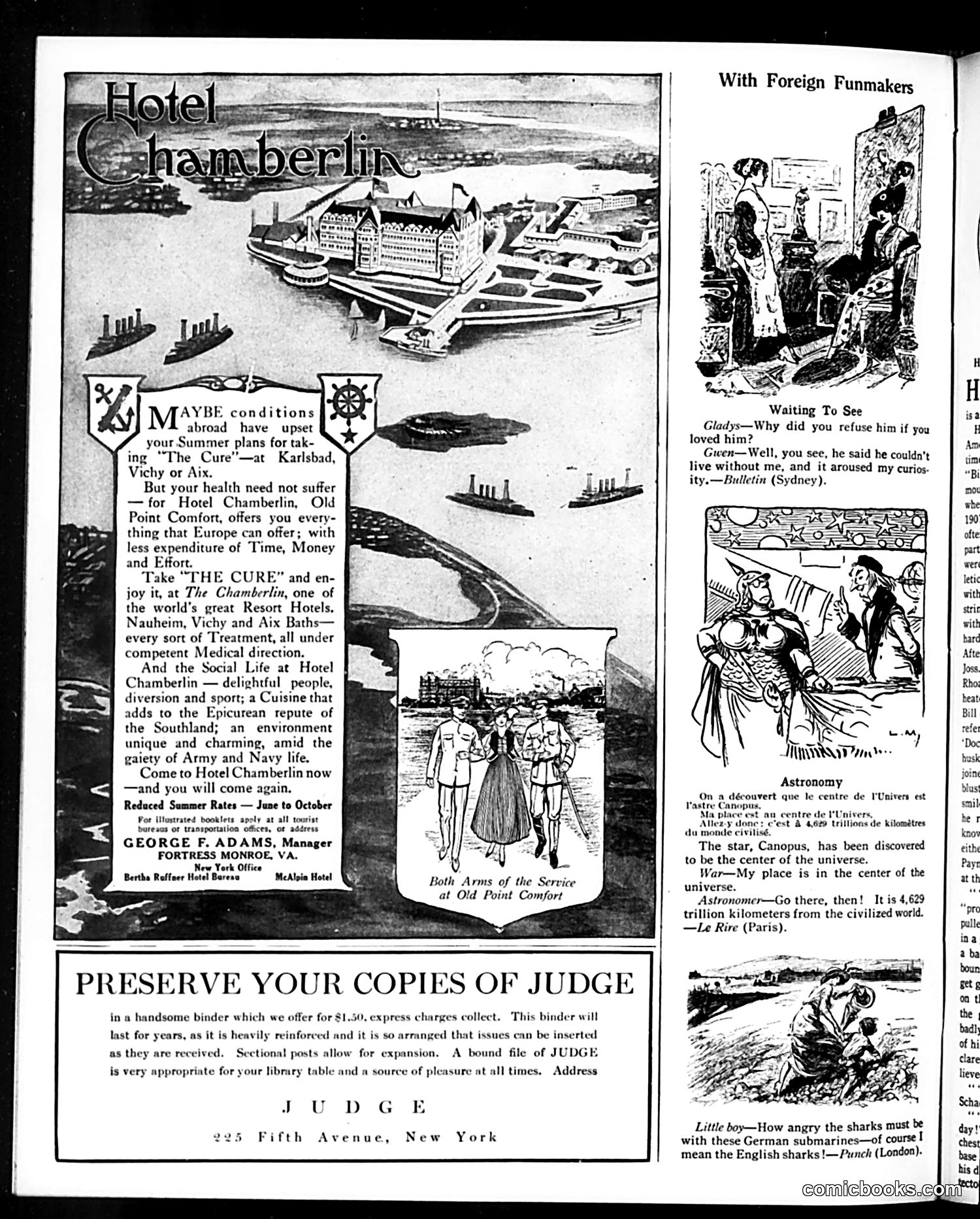
This page is primarily **advertising and filler content**, not political satire. The main advertisement promotes **Hotel Chamberlin** at Old Point Comfort, Virginia, as a domestic alternative to European spa resorts (Karlsbad, Vichy, Aix) for health treatments—likely referencing WWI disruptions to European travel. It emphasizes American luxury and proximity to military installations. The right column contains brief **humor snippets** reprinted from other publications: - A joke about refusing a suitor - A astronomy gag (translated from French publication *Le Rire*) playing on cosmic insignificance - A children's joke about German submarines and English sharks, implying confusion or dark wartime humor The page's scattered cartoons illustrate the hotel's amenities and the submarine joke. There's no coherent political statement—it's typical magazine filler mixing advertisements with lightweight international humor, common in early-20th-century publications.
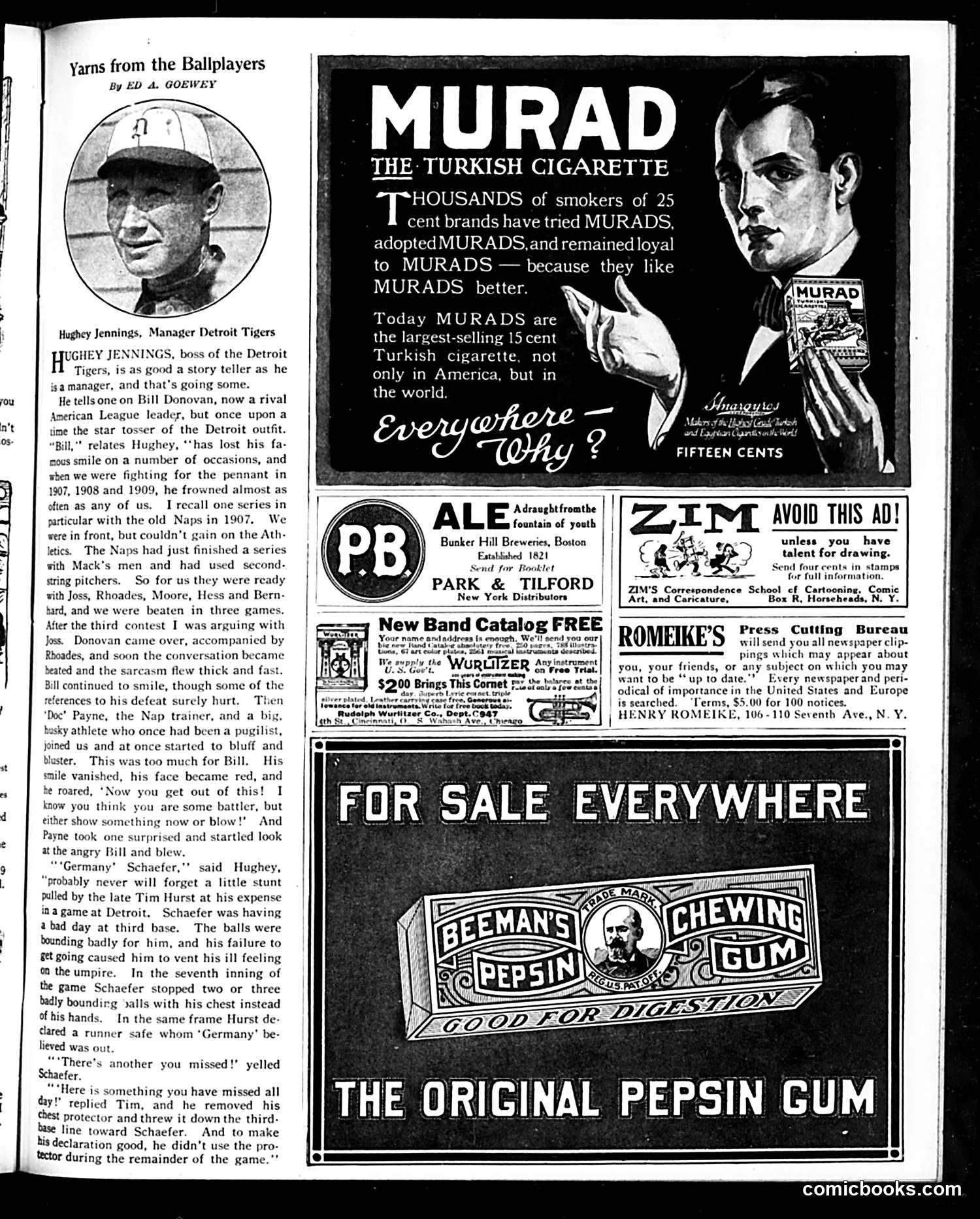
This page is primarily a **sports feature with advertisements**. The main content is "Yarns from the Ballplayers" by Ed A. Goewey, featuring anecdotes from **Hughey Jennings, manager of the Detroit Tigers**, recounting baseball stories from the early 1900s (circa 1907-1909). The stories concern rival players—**Bill Donovan** and **"Germany" Schaefer**—and incidents involving losing games and heated confrontations. One anecdote describes umpire **Tim Hurst** sarcastically removing his chest protector to mock Schaefer's poor fielding performance. **The satire is gentle**: the humor lies in the colorful personalities and dramatic overreactions of competitive ballplayers rather than political commentary. For modern readers, this reflects early baseball's rough-and-tumble culture and the sport's prominence in American popular magazines. The page also contains period **advertisements** (Murad cigarettes, PB Ale, Beeman's gum, Wurlitzer cornet), typical of Judge magazine's revenue model.
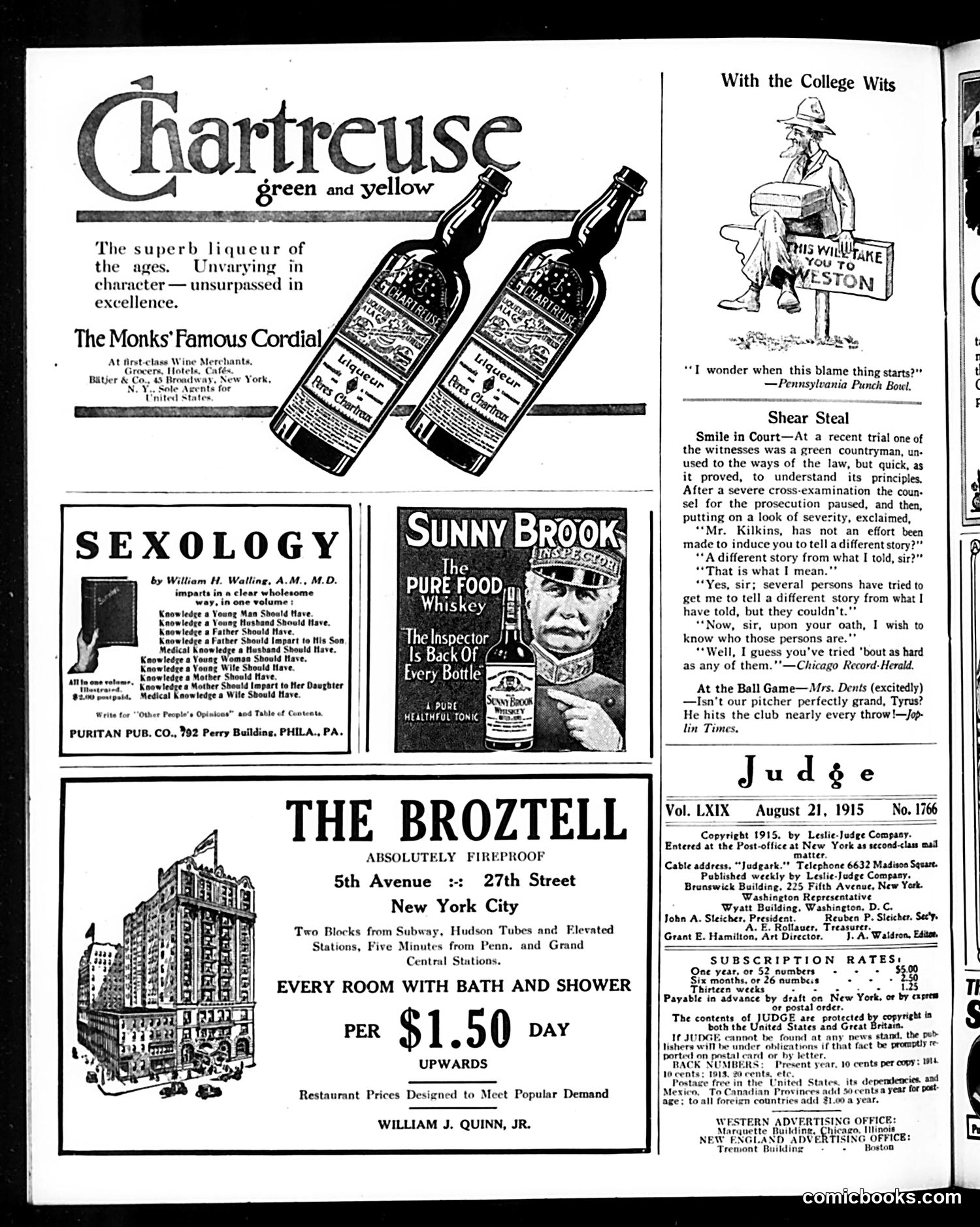
This page is primarily **advertisements and magazine infrastructure**, not political satire. The main content includes: **Advertisements:** Chartreuse liqueur, a book on sexology, Sunny Brook whiskey, and the Broztell Hotel on 5th Avenue (advertised at $1.50/day—notably cheap even for 1915). **"With the College Wits" section:** This features brief humor pieces. The titled cartoon shows a young man with a suitcase labeled "This will take you to Boston," wondering when something "starts"—likely a train or coach. The jokes below involve courtroom testimony and baseball commentary, representing typical contemporary collegiate humor of mild, conventional types. **Bottom half:** Standard magazine masthead information for Judge's August 21, 1915 issue, including subscription rates and editorial staff. **No significant political satire appears on this page**—it's routine magazine filler and advertising typical of this era's publications.
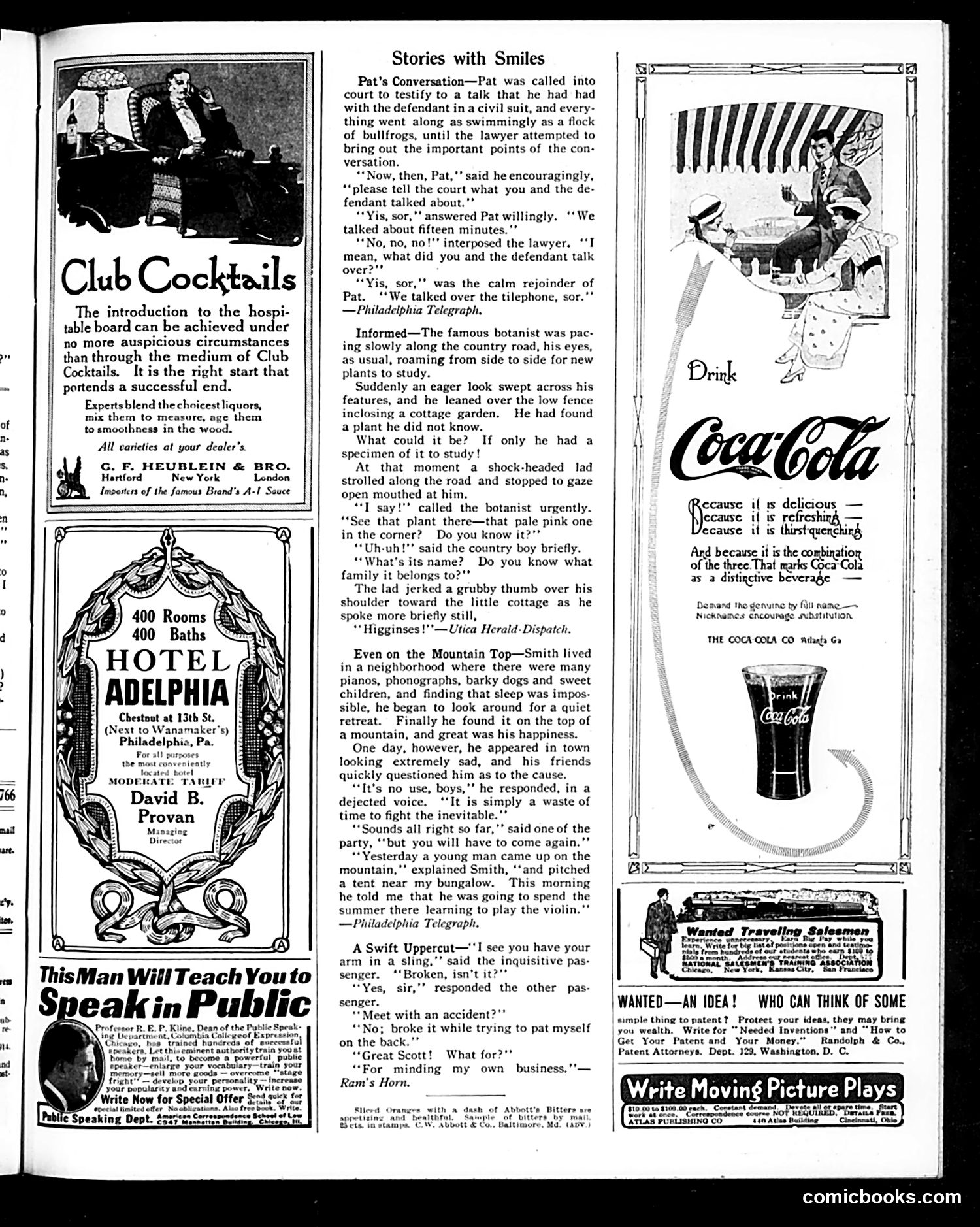
This page from *Judge* contains several brief humorous anecdotes rather than political cartoons. The jokes rely on wordplay and misunderstanding: **"Pat's Conversation"**: An Irish immigrant (identified by dialect as "Pat") testifies in court but misunderstands the lawyer's question about what he discussed with a defendant. He literally answers "fifteen minutes" of conversation occurred, then reveals they talked "over the telephone"—missing the point entirely. The humor derives from Irish stereotype humor popular in early 20th-century American magazines. **"Informed"**: A botanist cannot identify a pale pink flower and asks a country boy. The boy's answer—"Higginses!"—reveals the plant is actually in the yard of people named Higgins, not a botanical specimen. The joke plays on literal versus expected interpretation. The remaining anecdotes follow similar patterns of miscommunication or anticlimactic reveals. These are gentle, populist humor pieces typical of *Judge*'s lighter content, interspersed with period advertisements for cocktails, hotels, and Coca-Cola.
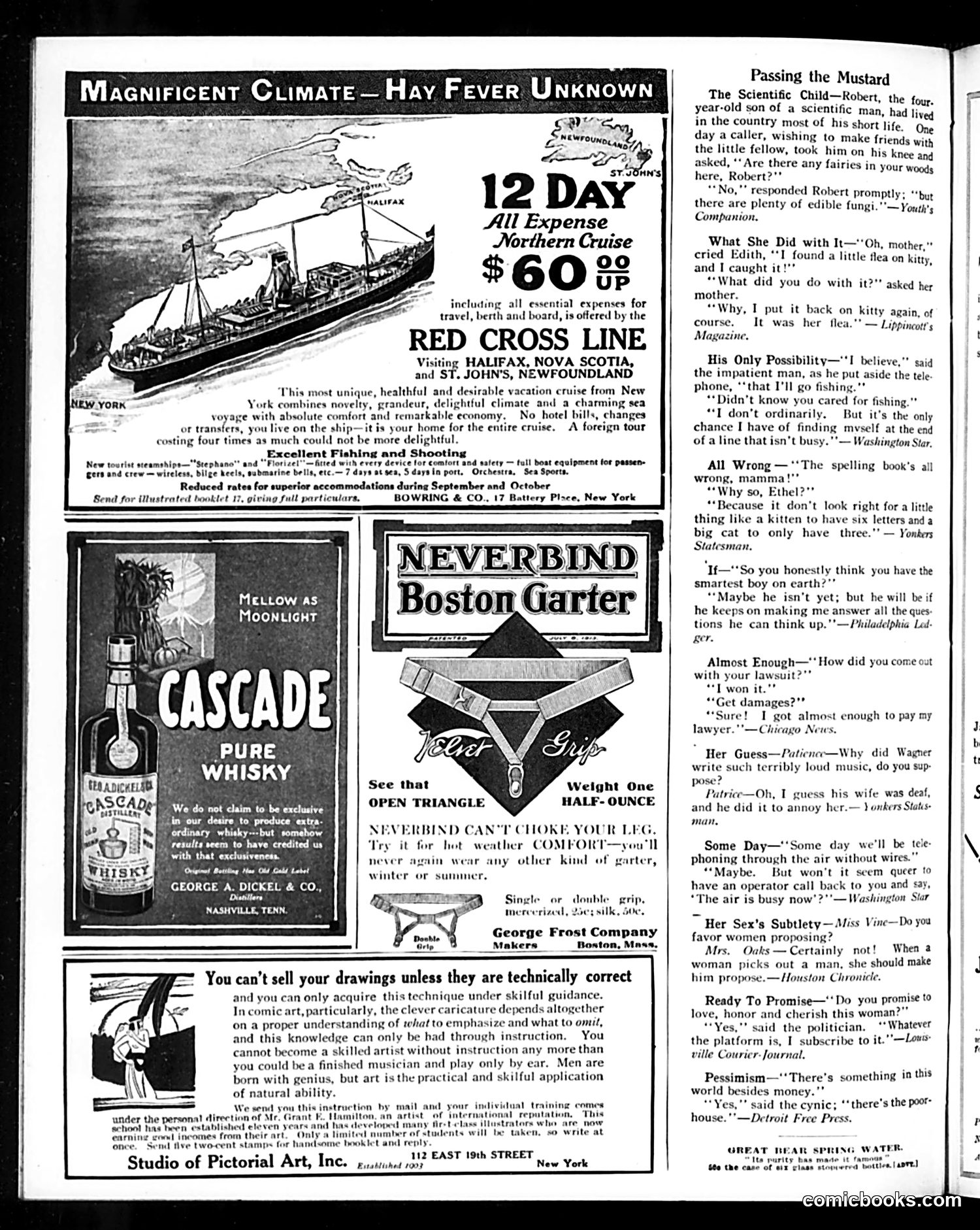
This page is primarily **advertising** for travel, whiskey, garters, and art instruction, interspersed with brief humor items typical of Judge's "comic shorts" format. The main content includes: **Top**: Red Cross Line cruise advertisement promoting a 12-day Northern Cruise ($60) to Halifax and Newfoundland, emphasizing comfort and novelty for tourists seeking escape from hay fever (a common complaint among wealthy Americans). **Left side**: Cascade Whiskey and Neverbind Boston Garter ads (men's undergarments). **Center-bottom**: Studio of Pictorial Art instruction advertisement, discussing proper technique for comic art and caricature. **Right column**: Brief humorous anecdotes with titles like "The Scientific Child," "What She Did with It," and "His Only Possibility"—light domestic humor involving children's innocent misunderstandings and wordplay, typical of early-20th-century family magazine fare. The overall page reflects Judge's mixed editorial-advertising model and period preoccupations: leisure travel, masculine comfort products, and genteel domestic comedy.
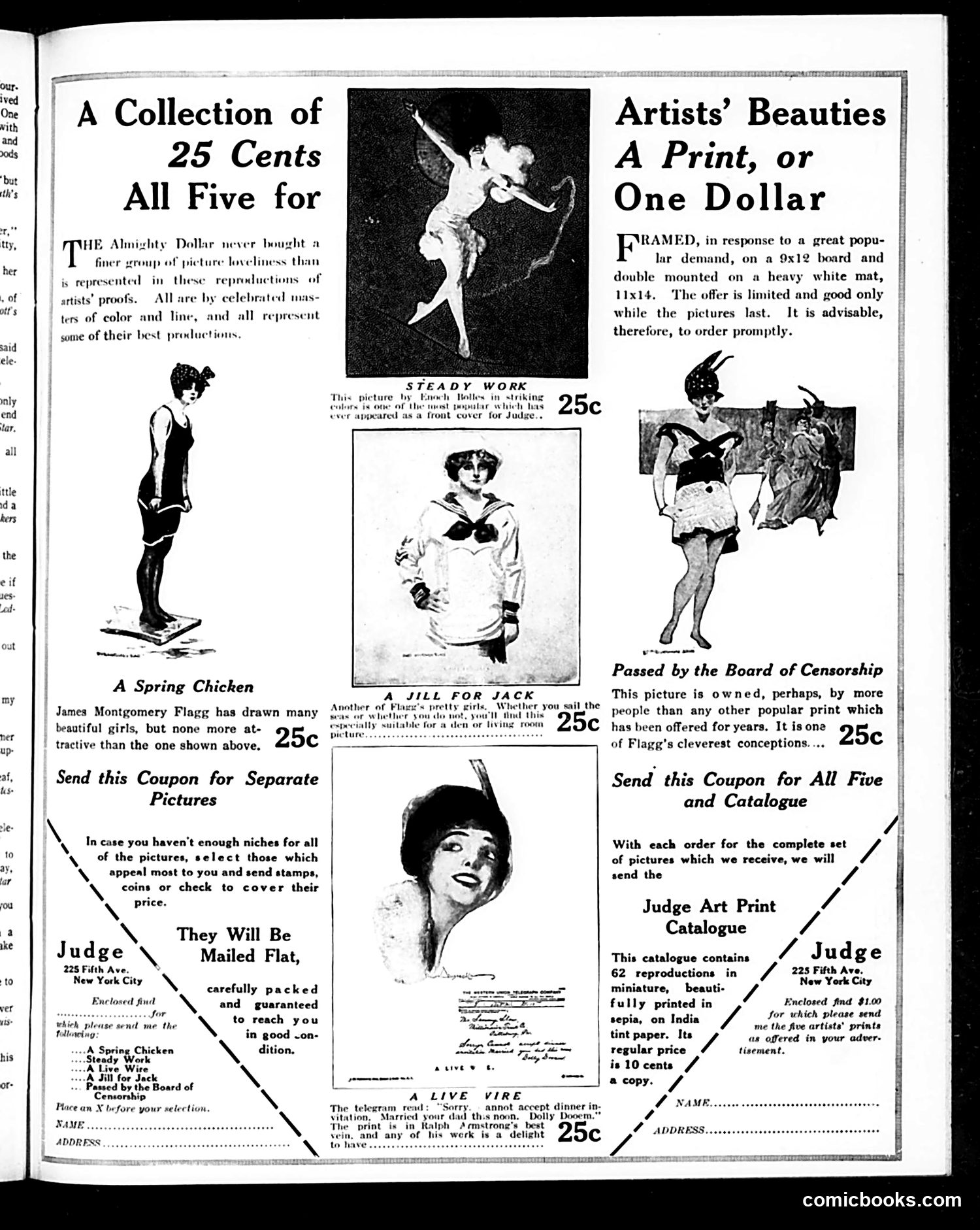
This page is primarily **advertising**, not satire. It promotes a collection of five artistic prints by celebrated illustrators, available individually for 25 cents or as a complete set for one dollar. The featured artists include **James Montgomery Flagg**, a prominent illustrator known for depicting attractive young women. The prints shown—"A Spring Chicken," "Steady Work," "Jill for Jack," and "A Live Wire"—feature idealized female figures in various poses and contexts, typical of early 20th-century commercial art. One image is notably marked **"Passed by the Board of Censorship,"** suggesting it was previously controversial or risqué enough to warrant approval. This hints at the era's moral anxieties around depictions of women's bodies and sexuality. The advertisement emphasizes quality and affordability, positioning these reproductions as accessible art for ordinary Americans. The coupon-based ordering system reflects common direct-mail marketing practices of the period.
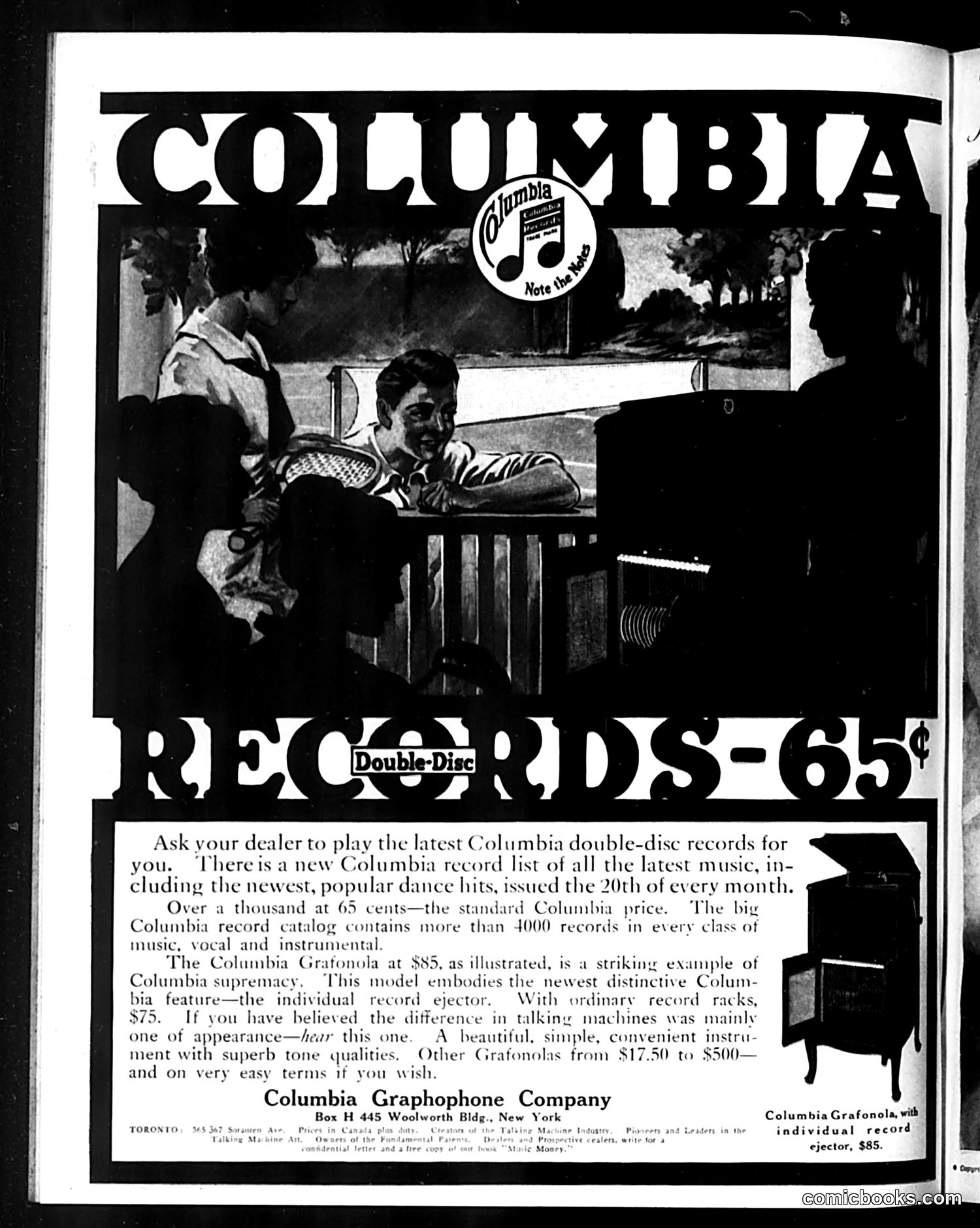
This page is **primarily a Columbia Records advertisement**, not a political cartoon. It promotes Columbia's "Grafonola" (phonograph) and double-disc records. The image shows a domestic scene: a man relaxing indoors while listening to music on a Columbia Grafonola phonograph. The advertisement emphasizes the machine's superior features—particularly its "individual record ejector," a new innovation—and its tone quality compared to competitors. The sales pitch targets middle-class consumers: over 4,000 records available at 65 cents each, machines priced from $17.50 to $500, and flexible payment terms. The ad claims Columbia's dominance in the emerging recorded music market. There is **no political satire or cartoon commentary** on this page. Judge magazine sometimes carried advertisements alongside editorial content; this appears to be a commercial placement rather than satirical content.