
Judge, 1915-08-21 · page 4 of 28
Judge — August 21, 1915 — page 4: what you’re looking at
What you’re looking at
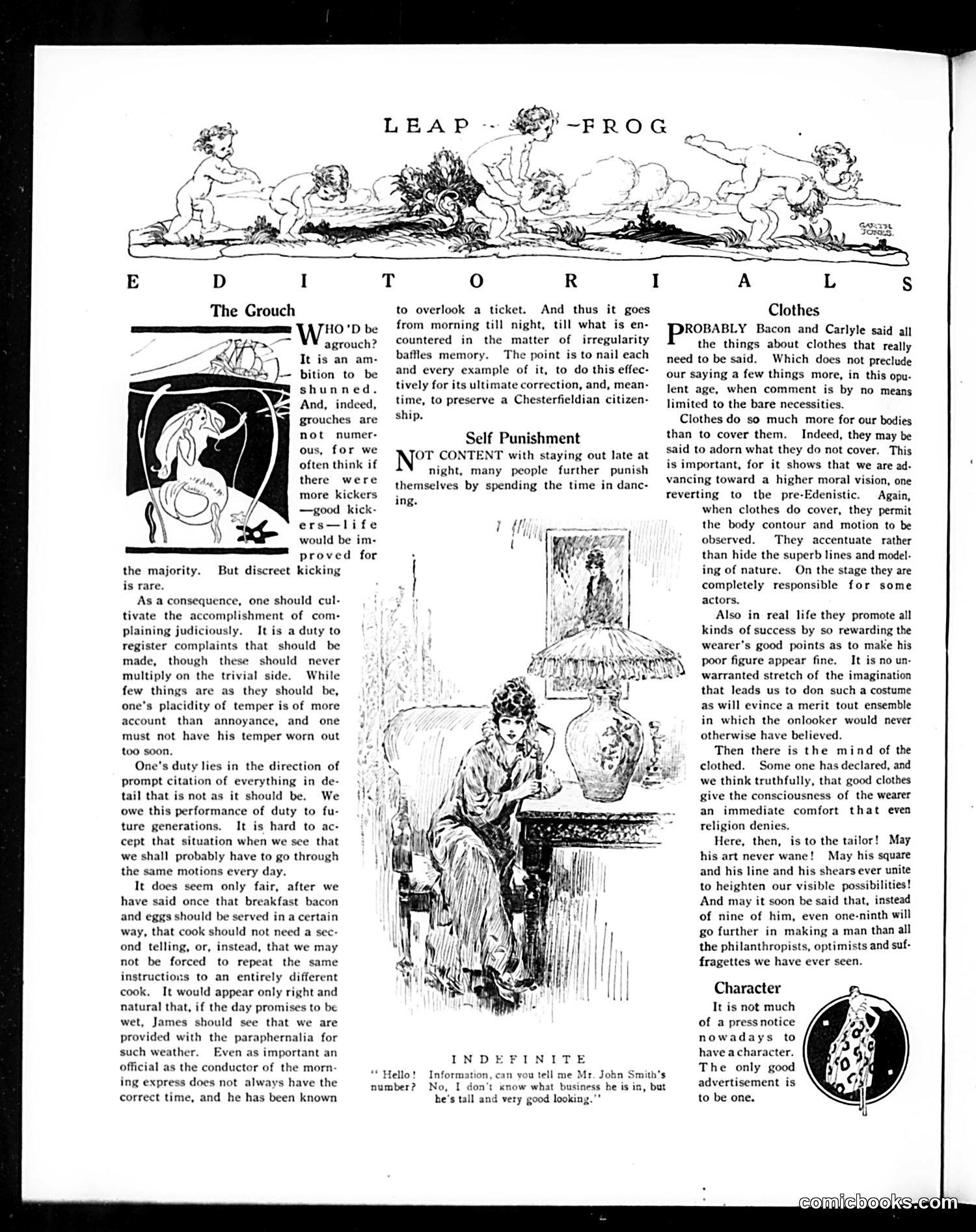
This page from *Judge* magazine uses satirical commentary on social etiquette and morality. The "Leap-Frog" header with cherubs suggests frivolous jumping between topics. The main editorials address: 1. **"The Grouch"** - Criticizes people who complain excessively about minor infractions (like overlooked theater tickets), arguing such nitpicking reveals poor character. 2. **"Self Punishment"** - Mocks those who stay out late dancing as self-inflicted suffering, arguing one should plan activities judiciously. 3. **"Clothes"** - Argues proper dress reveals character and moral development, suggesting clothes do more than cover bodies—they reflect refinement and success. 4. **"Character"** - Notes that having good character is the only worthwhile advertisement. The overall tone satirizes Victorian-era moralizing about respectability, suggesting these editorials represent excessive preaching about proper behavior.
📄 Transcribed text from this page (OCR, searchable)
Machine-transcribed from the original scan — historical spelling and the odd misread are preserved.
HO'D be agrouch? It is an am- bition to be shunned, And, indeed, grouches are not numer- ous, for we often think if were more kickers there to overlook a ticket. And thus it goes from morning till night, till what is en- countered in the matter of irregularity baffles memory. The point is to nail each and every example of it, to do this effec- tively for its ultimate correction, and, mean- time, to preserve a Chesterfieldian citizen- ship. Self Punishment ‘OT CONTENT with staying out late at night, many people further punish themselves by spending the time in danc- ing. —good kick- ers—life would be im- proved for the majority. But discreet kicking is rare, As a consequence, one should cul- tivate the accomplishment of com- plaining judiciously. It is a duty to register complaints that should be made, though th should never multiply on the trivial side. While few things are as they should be, one’s placidity of temper is of more account than annoyance, and one must not have his temper worn out too soon. One's duty lies in the direction of prompt citation of everything in de- tail that is not as it should be. We owe this performance of duty to fu- ture generations. It is hard to ac- cept that situation when we see that we shall probably have to go through the same motions every day. It does seem only fair, after we have said once that breakfast bacon and eggs should be served ina certain way, that cook should not need a sec- ond telling, or, instead, that we may not be forced to repeat the same instructions to an entirely different cook, It would appear only right and natural that, if the day promises to be wet, James should see that we are provided with the paraphernalia for such weather. Even as important an official as the conductor of the morn- ing express does not always have the correct time, and he has been known HHS DAA INDEFINITE “ Hello! Information, can you tell me Mr. John Smith's number? No, I don’t know what business he is in, but he's tall and very good looking.”” Clothes ROBABLY Bacon and Carlyle said all the things about clothes that really need to be said. Which does not preclude our saying a few things more, in this opu- lent age, when comment limited to the bare necessities. Clothes do so much more for our bodies than to cover them. Indeed, they may be said to adorn what they do not cover. This is important, for it shows that we are ad- vancing toward a higher moral vision, one reverting to the pre-Edenistic. Again, by no means when clothes do cover, they permit the body contour and motion to be observed. They accentuate rather than hide the superb lines and model- ing of nature. On the stage they are completely responsible for some actors. Also in real life they promote all kinds of success by so rewarding the wearer's good points as to make his poor figure appear fine. It is no un- warranted stretch of the imagination that leads us to don such a costume as will evince a merit tout ensemble in which the onlooker would never otherwise have believed. Then there is the mind of the clothed. Some one has declared, and we think truthfully, that good clothes give the consciousness of the wearer an immediate comfort that even religion denies. Here, then, is to the tailor! May his art never wane! May his square and his line and his shears ever unite to heighten our visible possibilities! And may it soon be said that, instead of nine of him, even one-ninth will go further in making a man than all the philanthropists, optimists and suf- fragettes we have ever seen. Character Tt is not much of a pressnotice nowadays to have a character. The only good advertisement is to be one.