
Judge, 1915-08-21 · page 20 of 28
Judge — August 21, 1915 — page 20: what you’re looking at
A restored page from Judge, 1915-08-21. Page through the whole issue in the reader above.
📄 Transcribed text from this page (OCR, searchable)
Machine-transcribed from the original scan — historical spelling and the odd misread are preserved.
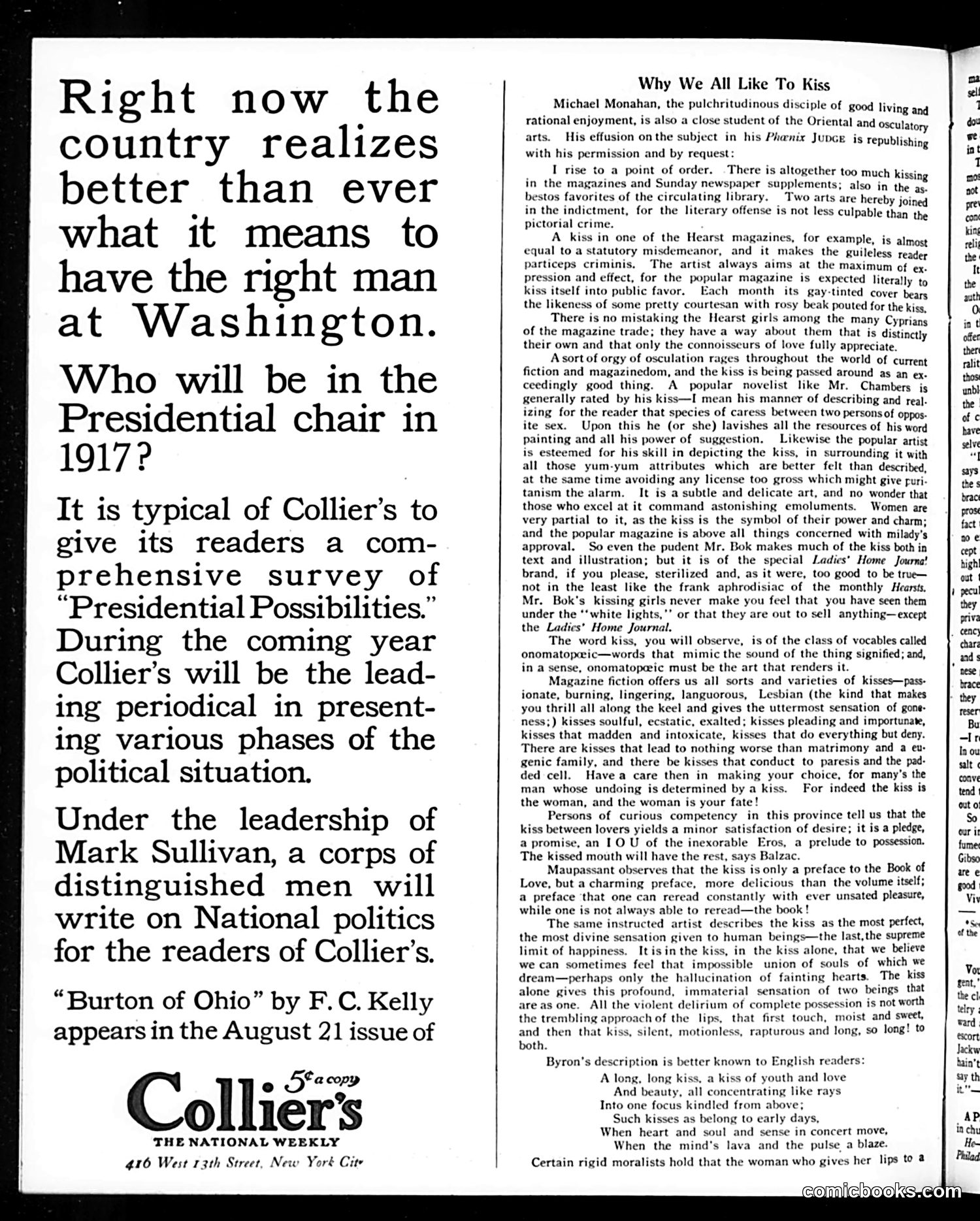
Right now the country realizes better than ever what it means to have the right man at Washington. Who will be in the Presidential chair in 1917? It is typical of Collier’s to give its readers a com- prehensive survey of “Presidential Possibilities.” During the coming year Collier’s will be the lead- ing periodical in present- ing various phases of the political situation. Under the leadership of Mark Sullivan, a corps of distinguished men will write on National politics for the readers of Collier’s. “Burton of Ohio” by F.C. Kelly appears in the August 21 issue of Colliers THE NATIONAL WEEKLY 416 West 13th Street, New York Cite Why We All Like To Kiss Michael Monahan, the pulchritudinous disciple of good living and rational enjoyment, is also a close student of the Oriental and osculatory arts. His effusion onthe subject in his Phanix Jupce is Tepublishing with his permission and by request: I rise to a point of order. There is altogether too much kissin, in the magazines and Sunday newspaper supplements; also in the ae, bestos favorites of the circulating library. Two arts are hereby joined in the indictment, for the literary offense is not less culpable than the pictorial crime. A kiss in one of the Hearst magazines, for example, is almost equal to a statutory misdemeanor, d it makes the guileless reader particeps criminis, The artist always aims at the maximum of ex. pression and effect, for the popular magazine is expected literally to kiss itself into public favor. Each month its gay-tinted cover bears the likeness of some pretty courtesan with rosy beak pouted for the kiss, There is no mistaking the Hearst girls among the many Cypriang of the magazine trade; they have a way about them that is distinctly their own and that only the connoisseurs of love fully appreciate. Asort of orgy of osculation rages throughout the world of current fiction and magazinedom, and the kiss is being passed around as an ex. ceedingly good thing. A popular novelist like Mr. Chambers is generally rated by his kiss—I mean his manner of describing and real- izing for the reader that species of caress between two persons of oppos- ite sex. Upon this he (or she) lavi all the resources of his word painting and all his power of suggestion, Likewise the popular artist is esteemed for his skill in depicting the kiss, in surrounding it with all those yum-yum attributes which are better felt than described, at the same time avoiding any license too gross which might give puri- tanism the alarm. It is a subtle and delicate art, and no wonder that those who excel at it command astonishing emoluments. Women are very partial to it, as the kiss is the symbol of their power and charm; and the popular magazine is above all things concerned with milady's approval. So even the pudent Mr. Bok makes much of the kiss both in text and illustration; but it is of the special Ladies’ Home Journa! brand, if you please, sterilized and, as it were, too good to be true— not in the least like the frank aphrodisiac of the monthly Hearsts, Mr. Bok's kissing gir! ver make you feel that you have seen them under the *‘white lights,’’ or that they are out to sell anything—except the Ladies’ Home Journal. The word kiss, you will observe, is of the class of vocables called onomatopawic—words that mimic the sound of the thing signified; and, onomatoperic must be the art that renders it. ne fiction offers us all sorts and varieties of kisses—pass- ionate, burning, lingering, languorous, Lesbian (the kind that makes you thrill all along the keel and gives the uttermost sensation of gone- ness;) kisses soulful, ecstatic, exalted; kisses pleading and importunate, kisses that madden and intoxicate, kisses that do everything but deny. There are kisses that lead to nothing worse than matrimony and a eu- genic family, and there be kisses that conduct to paresis and the pad- ded cell. Have a care then in making your choice, for many's the man whose undoing is determined by a kiss. For indeed the kiss is the woman, and the woman is your fate! Persons of curious competency in this province tell us that the kiss between lovers yields a minor satisfaction of desire; it is a pledge, a promise, an IO U of the inexorable Eros, a prelude to possession. The kissed mouth will have the rest, says Balzac. Maupassant observes that the nly a preface to the Book of Love, but a charming preface, more delicious than the volume itself; a preface that one can reread constantly with ever unsated pleasure, while one is not always able to reread—the book! The same instructed artist describes the kiss as the most perfect, the most divine sensation given to human beings—the last,the supreme limit of happiness. It isin the kiss, in the kiss alone, that we believe we can sometimes feel that impossible union of souls of which we dream—perhaps only the hallucination of fainting hearts. The kiss alone gives this profound, immaterial sensation of two beings that are as one. All the violent delirium of complete possession is not worth the trembling approach of the lips, that first touch, moist and sweet, and then that kiss, silent, motionless, rapturous and long, so long! to both. Byron’s description is better known to English readers: A long, long kiss, a kiss of youth and love And beauty, all concentrating like rays Into one focus kindled from above; Such kisses as belong to early days, When heart and soul and sense in concert move, When the mind's la and the pulse a blaze. Certain rigid moralists hold that the woman who gives her lips to @ Ba sel J oo we int 1 m0 not pre com king reli the I