
Judge, 1915-08-21 · page 6 of 28
Judge — August 21, 1915 — page 6: what you’re looking at
What you’re looking at
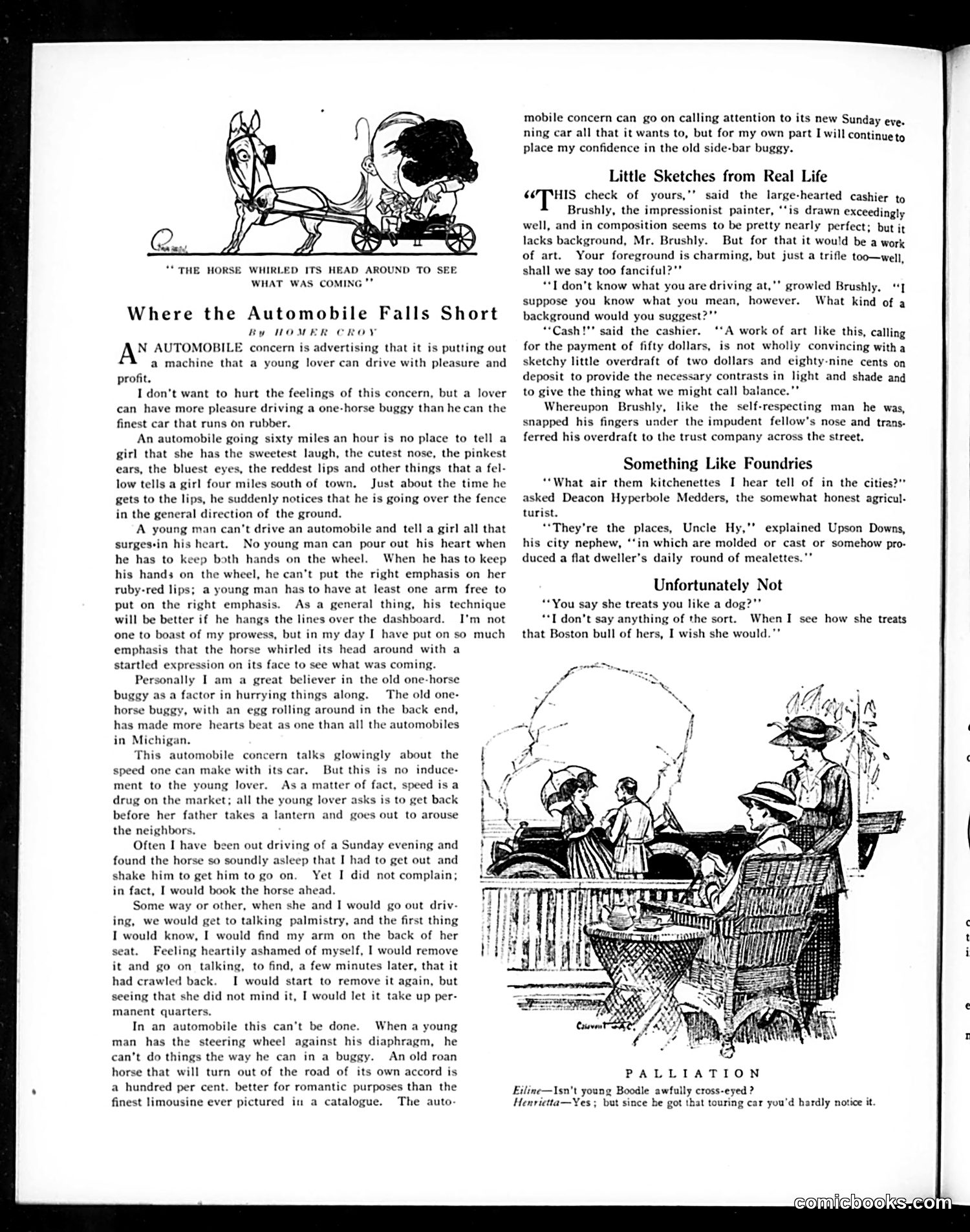
This page contains two satirical pieces from *Judge* magazine critiquing early 20th-century American life. **"Where the Automobile Falls Short"** by Homer Croy humorously argues that automobiles are inferior to horse-drawn buggies for romantic courtship. The satire mocks automobile advertising by claiming that cars' speed and sophistication actually *hinder* romance. A young man needs one hand free to gesture expressively while complimenting a girl, and he needs the horse to move slowly enough that he doesn't crash while distracted by romance. The author nostalgically praises the old buggy, where a horse's natural slowness and predictability allowed young men to shift focus from driving to courtship—even permitting a strategically "accidental" arm placement on the seat back. The piece satirizes both modern technology's disruption of tradition and automotive advertising's overstated claims about appeal to romance. The accompanying sketches appear to illustrate related domestic humor, though specifics are unclear in reproduction.
📄 Transcribed text from this page (OCR, searchable)
Machine-transcribed from the original scan — historical spelling and the odd misread are preserved.
‘* THE HORSE WHIRLED ITS HEAD AROUND TO SEE WHAT WAS COMIN Where the Automobile Falls Short By HOMER CROY N AUTOMOBILE concern is advertising that it is putting out a machine that a young lover can drive with pleasure and profit. I don’t want to hurt the feelings of this concern, but a lover can have more pleasure driving a one-horse buggy than he can the finest car that runs on rubber. An automobile going ty miles an hour is no place to tell a girl that she has the sweetest laugh, the cutest nose, the pinkest ears, the bluest eyes, the reddest lips and other things that a fel- low tells a girl four miles south of town, Just about the time he gets to the lips, he suddenly notices that he is going over the fence in the general direction of the ground. A young man can’t drive an automobile and tell a girl all that surgessin his heart. No young man can pour out his heart when he has to keep both hands on the wheel. When he has to keep his hands on the wheel, he can't put the right emphasis on her ruby-red lips; a young man has to have at least one arm free to put on the right emphasis. As a general thing, his technique will be better if he hangs the lines over the dashboard. I'm not one to boast of my prowess, but in my day I have put on so much emphasis that the horse whirled its head around with a startled expression on its face to see what was coming. Personally I am a great believer in the old one-horse buggy as a factor in hurrying things along. The old one- horse buggy, with an egg rolling around in the back end, has made more hearts beat as one than all the automobiles in Michigan. This automobile concern talks glowingly about the speed one can make with its car. But this is no induce- ment to the young lover. Asa matter of fact, speed is drug on the market; all the young lover asks is to get back before her father takes a lantern and goes out to arouse the neighbors, Often I have been out driving of a Sunday evening and found the horse so soundly asleep that I had to get out and shake him to get him to go on. Yet I did not complain; in fact, I would book the horse ahead. Some way or other, when she and I would go out driv- ing, we would get to talking palmistry, and the first thing I would know, I would find my arm on the back of her seat. Feeling heartily ashamed of myself, | would remove it and go on talking, to find, a few minutes later, that it had crawled back. I would start to remove it again, but seeing that she did not mind it, I would let it take up per- manent quarters. In an automobile this can’t be done. When a young man has the steering wheel against his diaphragm, he can’t do things the way he can in a buggy. An old roan horse that will turn out of the road of its own accord is a hundred per cent. better for romantic purposes than the finest limousine ever pictured in a catalogue. The auto- mobile concern can go on calling attention to its new Sunday eve. ning car all that it wants to, but for my own part I will continueto place my confidence in the old side-bar buggy. Little Sketches from Real Life 60 TPHIS check of yours,’’ said the large-hearted cashier to Brushly, the impressionist painter, ‘tis drawn exceedingly id in composition seems to be pretty nearly perfect; but it But for that it would be a work charming, but just a trifle too—well, lacks background, Mr. Brus of art. Your foreground i shall we say too fanciful?’’ **T don’t know what you are driving at,’ growled Brushly, “1 suppose you know what you mean, however. What kind of a background would you suggest?” “Cash!"" said the cashier. ‘‘A work of art like this, calling for the payment of fifty dollars, is not wholly convincing with a sketchy little overdraft of two dollars and eighty-nine cents on deposit to provide the necessary contrasts in light and shade and to give the thing what we might call balance."" Whereupon Brushly, like the self-respecting man he was, snapped his fingers under the impudent fellow's nose and trans. ferred his overdraft to the trust company across the street. Something Like Foundries ‘What air them kitchenettes I hear tell of in the cities?” asked Deacon Hyperbole Medders, the somewhat honest agricul- turist. ‘*They’re the places, Uncle Hy,’’ explained Upson Downs, his city nephew, ‘‘in which are molded or cast or somehow pro- duced a flat dweller’s daily round of mealettes."" Unfortunately Not **You say she treats you like a dog?"’ **I don’t say anything of th rt. WhenI see that Boston bull of hers, I wish she would."* how she treats PALLIATION Eiline—Isn't young Boodle awfully cross-eyed ? Henrictta—Yes ; but since be got that touring car you'd hardly notice it.