
A complete issue · 24 pages · 1915
Judge — May 29, 1915
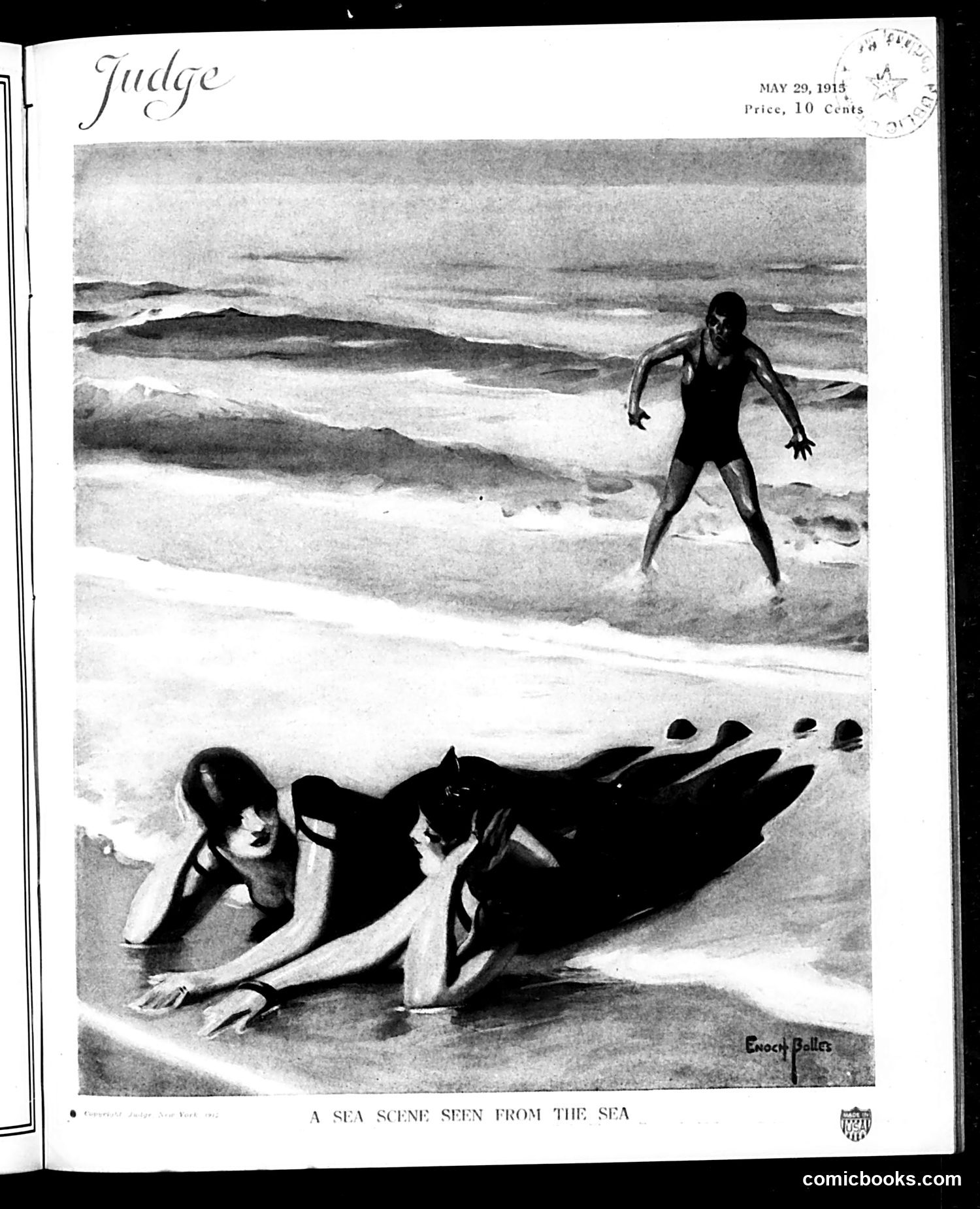
This Judge magazine page from May 29, 1914 shows a beach scene with two figures: one wading in the ocean (top) and another in shallow water (bottom). The illustration is credited to Enoch Bolles, a prominent Judge illustrator known for depicting fashionable women. The caption "A Sea Scene Seen from the Sea" appears to be a humorous observation about beach bathing culture. Without additional context from accompanying text, the specific satirical point is unclear. It likely comments on contemporary bathing costume styles or beach social conventions of the 1910s era, though the exact target of the satire remains ambiguous from the image alone.
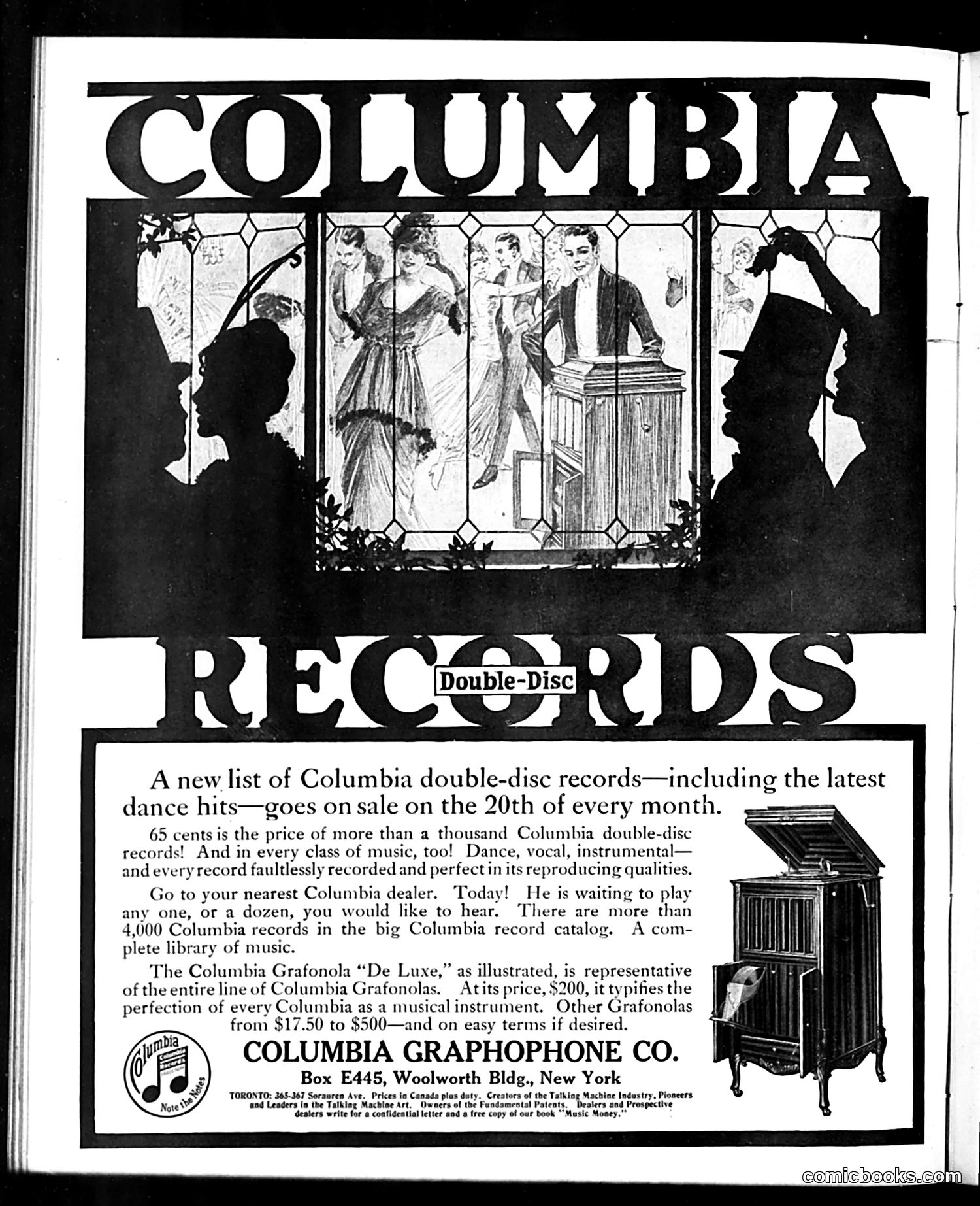
This page is **primarily an advertisement**, not satirical content. It promotes Columbia Records' double-disc records and their Grafonola "De Luxe" phonograph player. The visual shows silhouettes of two people (likely a couple) viewing an illustrated scene of well-dressed dancers and musicians through a window display—suggesting the appeal and allure of Columbia's musical offerings. The ad emphasizes that Columbia records cost only 65 cents (more than a thousand titles available), with new lists released monthly featuring dance hits and other genres. The Grafonola "De Luxe" model, priced at $200, is presented as the premium option in Columbia's product line ($17.50–$500 range available). The company's address in New York and Toronto is provided for interested buyers to visit dealers.
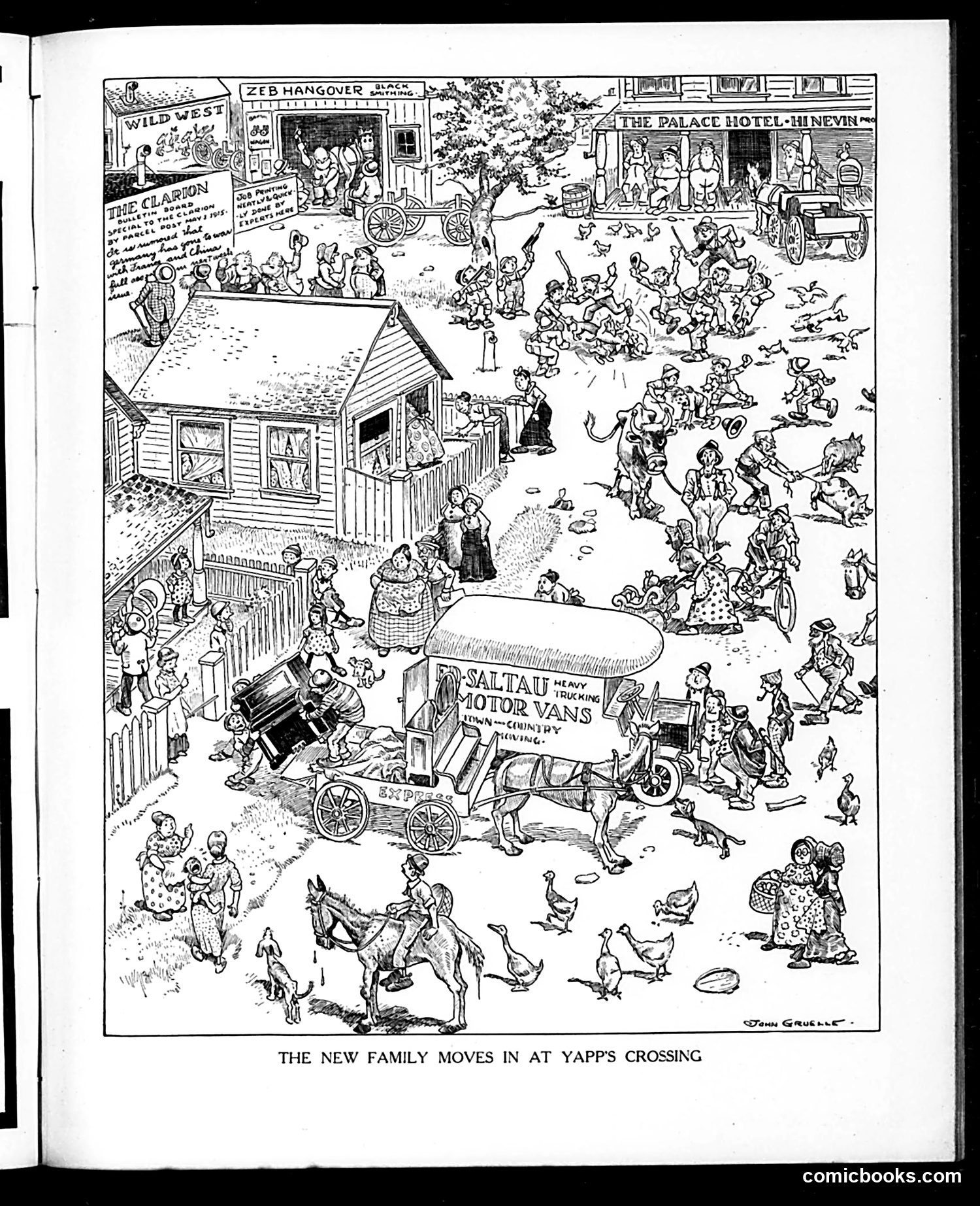
This is a satirical illustration depicting a chaotic moving day scene in what appears to be a small town or village. The cartoon shows a family arriving with a "Saltau Heavy Motor Vans" truck, surrounded by numerous onlookers and various animals (dogs, geese, chickens). The humor targets small-town life and the spectacle of newcomers arriving—a common social observation. The businesses visible (Wild West attraction, The Clarion newspaper, The Palace Hotel) suggest this is meant to parody rural or frontier community dynamics, where a family's arrival generates considerable public interest and commotion. The overall satire mocks the disruption and curiosity such events provoke in close-knit communities.
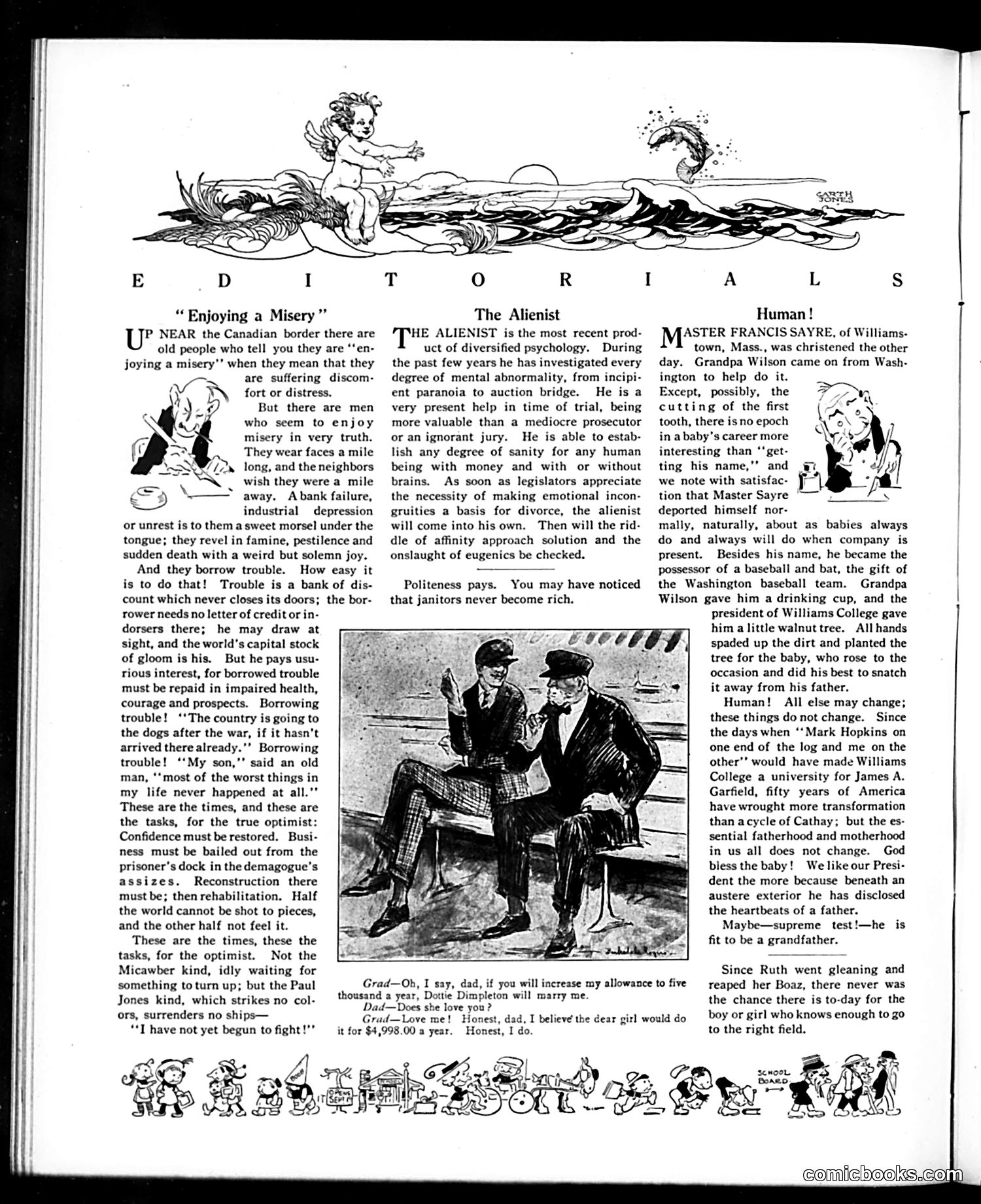
This page contains three distinct editorial pieces satirizing early 20th-century American social issues: **"Enjoying a Misery"** critiques people who romanticize poverty and hardship, arguing that while some take pride in suffering through economic depression, true optimism requires practical reconstruction—not glorification of struggle. **"The Alienist"** discusses a psychologist's expertise in diagnosing mental abnormalities and determining sanity in legal cases, suggesting legislators should use such expertise for divorce proceedings rather than relying solely on emotional testimony. **"Human!"** celebrates a baby's christening at Williams College, arguing that despite social changes, fundamental human values—represented by baseball, gifts, and family traditions—remain constant across generations. The decorative header and footer illustrations are typical Judge magazine ornamental design elements.
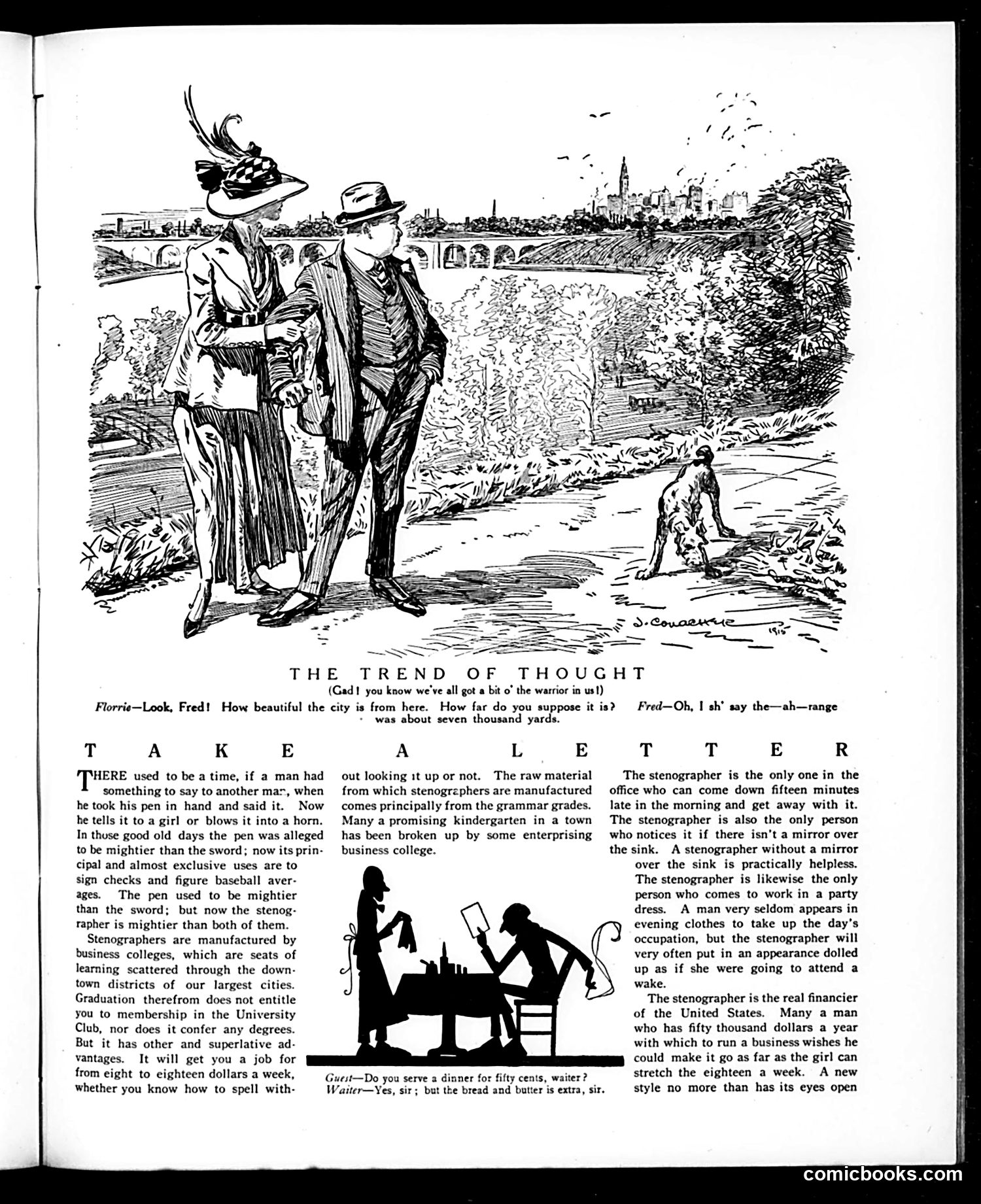
The cartoon satirizes the declining prestige of traditional professions. Two well-dressed figures admire a distant city, discussing its beauty—establishing an aspirational tone that's then undercut by the accompanying text. "Take a Letter" pivots to mock stenographers. The text celebrates stenography as a lucrative profession, claiming stenographers earn $8-18 weekly and can eventually run businesses. However, it simultaneously ridicules stenographers through pointed observations: they're the only office workers who arrive late, dress poorly for evening events, and lack mirrors (suggesting poor self-awareness). The satire targets the growing white-collar workforce and economic mobility myths of the era, implying that while stenography promised advancement, the reality was undignified labor with modest rewards.
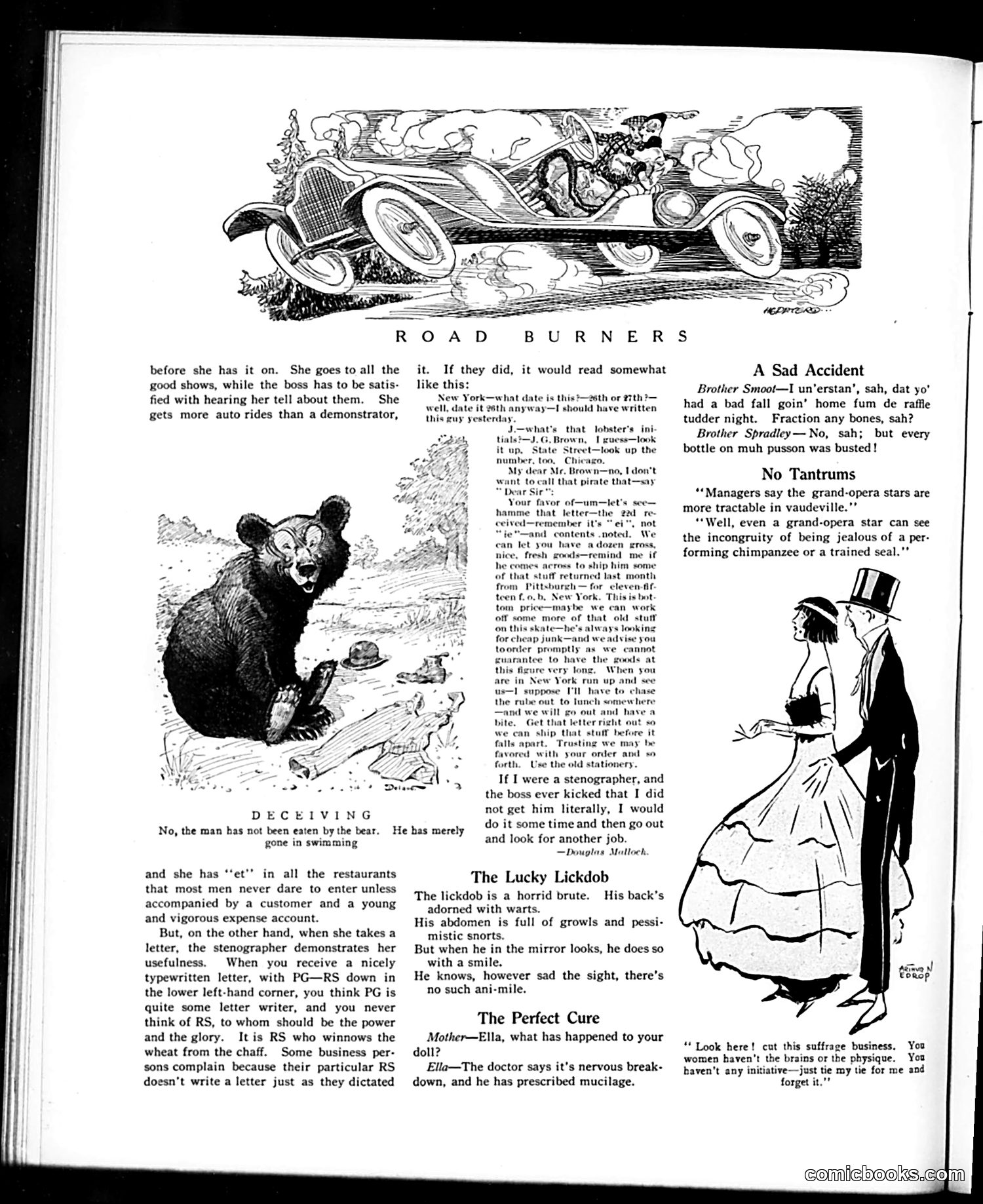
This page contains multiple short humor pieces typical of early 20th-century satirical magazines: **"Road Burners"** (top): A cartoon showing an early automobile with wealthy passengers, satirizing the nouveaux riches and their ostentatious driving habits. **"Deceiving"**: A joke about a bear that hasn't eaten a man because the man went swimming—a play on the phrase "eaten by the bear." **"A Sad Accident"**: African American dialect humor (common in period magazines, now considered offensive) about someone injured at a raffle. **"No Tantrums"**: Social commentary noting that even opera singers behave better in vaudeville than legitimate theater—suggesting grand opera attracts temperamental performers. **"The Lucky Lickdob"** and **"The Perfect Cure"**: Whimsical short jokes with illustrations. **"Suffrage" cartoon** (bottom right): Satirizes the women's suffrage movement by depicting a man dismissively telling a woman to stop discussing politics and instead perform domestic tasks—reflecting anti-suffrage sentiment of the era. The page reflects early 1900s attitudes: casual racism, anti-feminist views, and class-based humor.
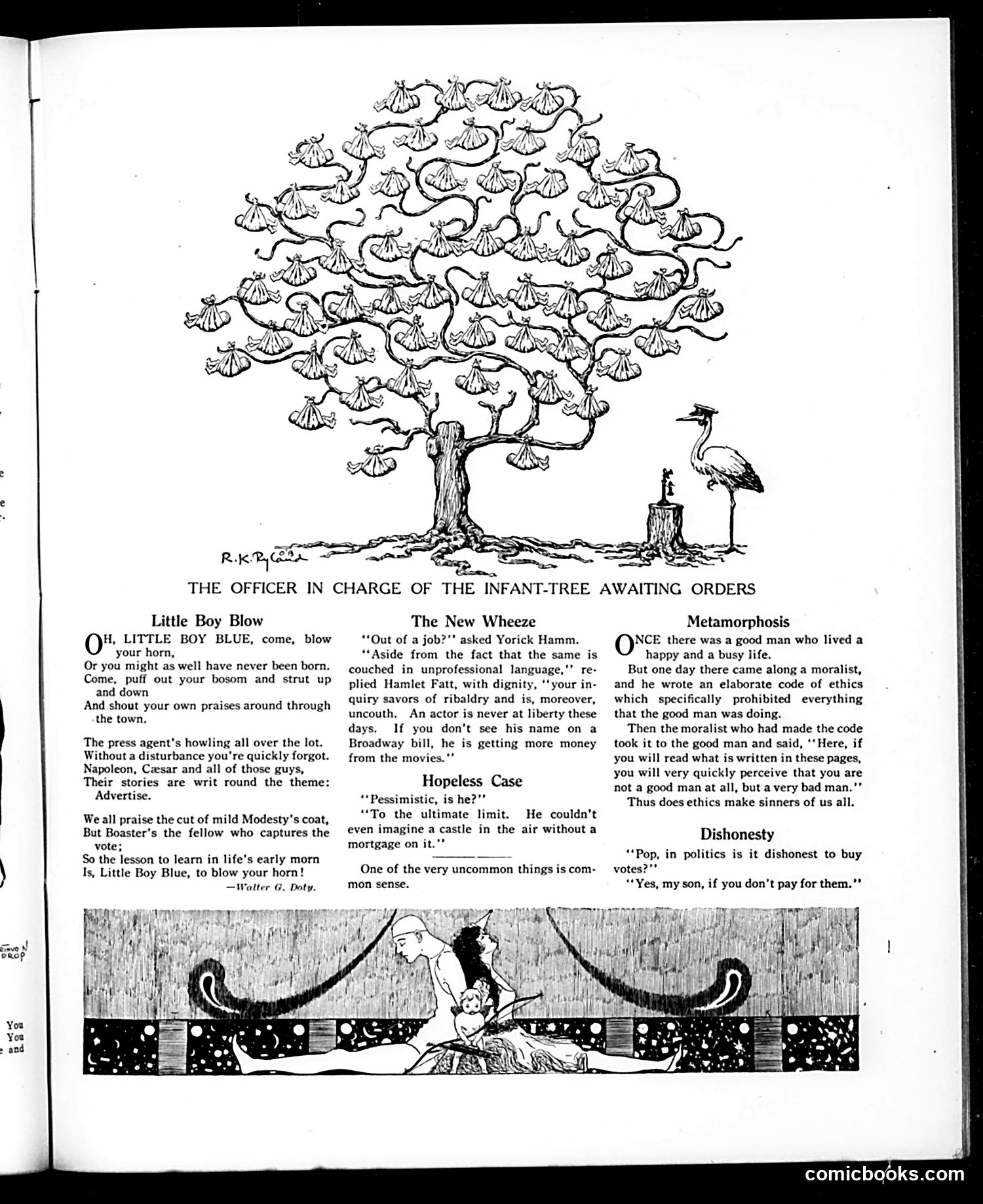
This page collects satirical commentary on early 20th-century American society through poetry and humor columns. **"Little Boy Blow"** mocks American self-promotion culture, arguing that modesty loses elections while boasting succeeds—a critique of press agents and celebrity marketing dominating public discourse. **"The New Wheeze"** ridicules unemployed actors who deny joblessness by claiming movie work, satirizing the entertainment industry's pretension and actors' defensive pride during economic hardship. **"Hopeless Case"** jokes about pervasive pessimism, depicting a man so defeatist he can't even fantasize without imagining debt—commentary on financial anxiety and depression-era gloom. **"Metamorphosis"** cynically argues that moralists' arbitrary ethical codes transform ordinary people into "sinners," suggesting rigid moralizing creates guilt rather than virtue. **"Dishonesty"** uses parent-child dialogue to mock political corruption: the joke's dark humor suggests vote-buying is acceptable if properly compensated—satire of normalized political bribery. The **top illustration** of an infant tree with a waiting crane likely represents political succession or patronage systems awaiting direction.
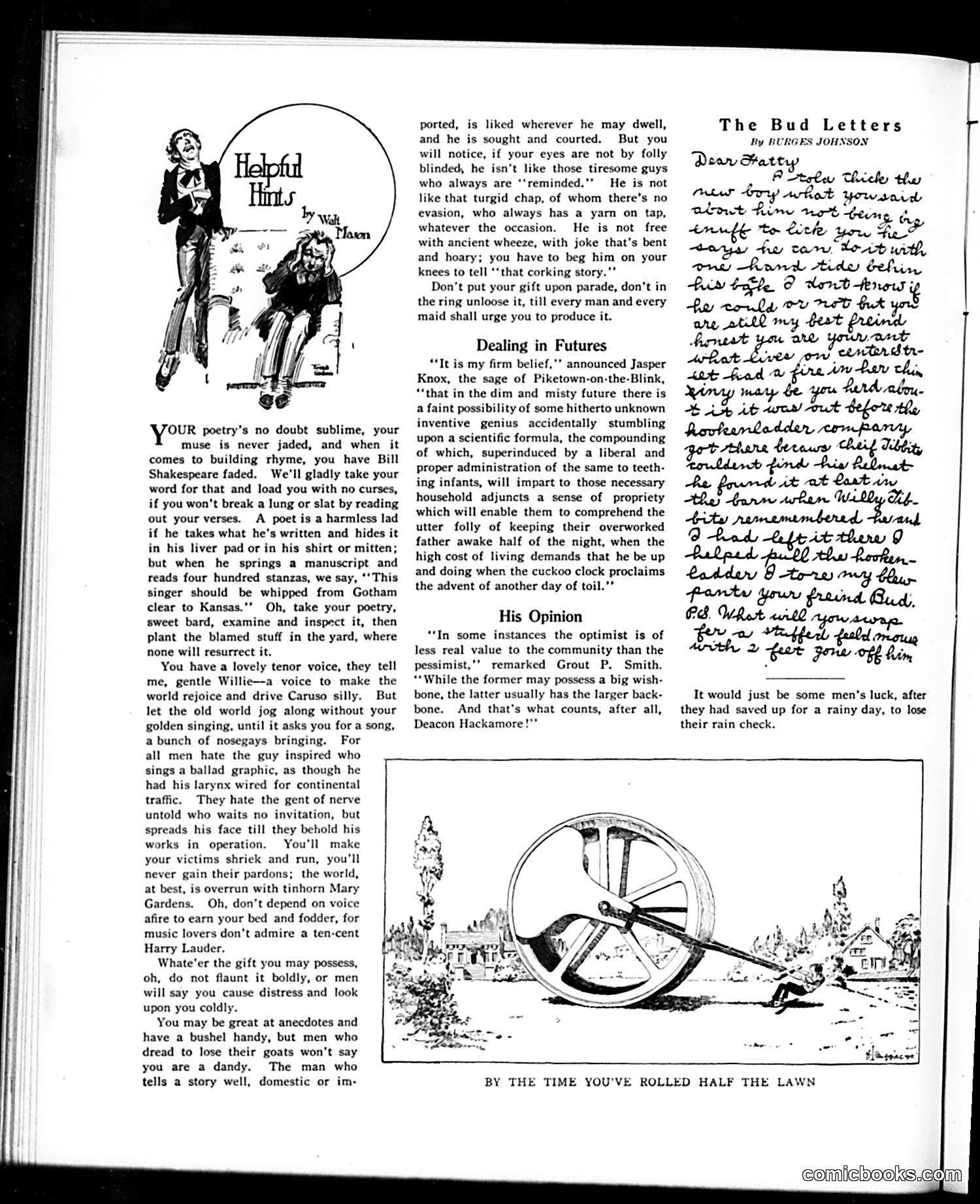
This page contains satirical advice columns targeting self-aggrandizing behavior. The "Helpful Hints" section mocks poets and singers who inflict their talents on unwilling audiences—those who recite lengthy verses or perform uninvited. The satire suggests these performers are oblivious to how tiresome they are, comparing them unfavorably to genuinely talented figures like Shakespeare and Caruso. The three anecdotes below ridicule different character types: Jasper Knox proposes an absurd future invention to make babies behave (mocking pseudo-intellectual speculation), while Grout P. Smith argues pessimists have more "backbone" than optimists (a cynical observation on practical virtue). The bottom cartoon shows a man trapped under a rolling lawn roller—illustrating the consequences of procrastination or poor planning, likely the punchline "by the time you've rolled half the lawn" suggests exhaustion or disaster. The page's overall theme: **don't loudly broadcast your talents uninvited; humility and restraint are virtues**.
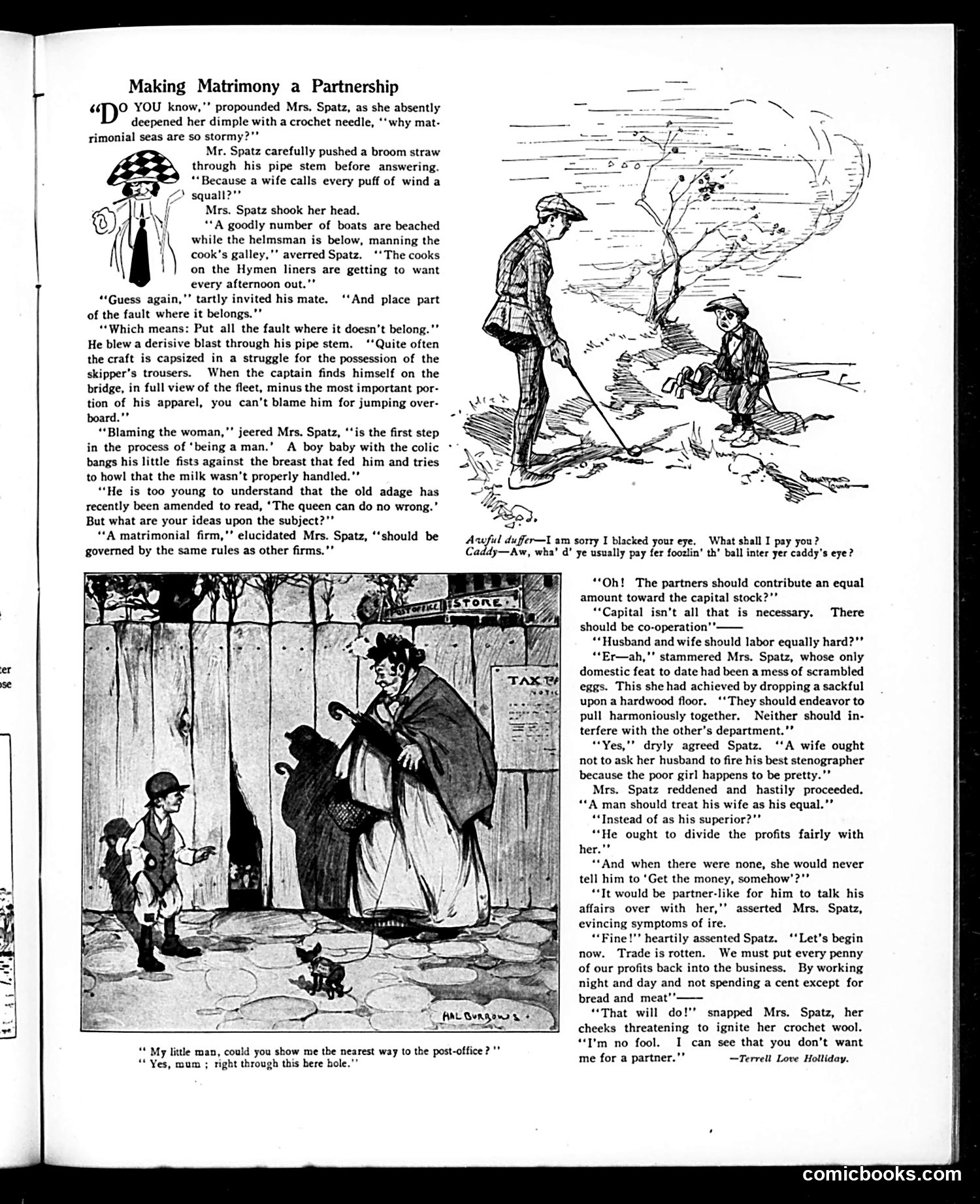
This satirical piece critiques the emerging "companionate marriage" ideal of early 20th-century feminism. Mrs. Spatz proposes that marriage should operate like a business partnership with equal contribution, shared labor, and transparent communication between husband and wife. Mr. Spatz agrees—initially. But when Mrs. Spatz actually describes what equal partnership means (shared decision-making, dividing profits fairly, discussing finances), he immediately pivots to pointing out practical obstacles: business losses, the need for austerity, his wife's lack of domestic competence (the scrambled eggs joke). The satire cuts both ways: it mocks both husbands resisting women's equality and wives seeking partnership while avoiding actual work. The final panel shows Mrs. Spatz abandoning the idea once she realizes "partnership" means genuine sacrifice, not just demanding rights. The piece reflects contemporary anxiety about changing gender roles and marriage structures during the women's rights movement.
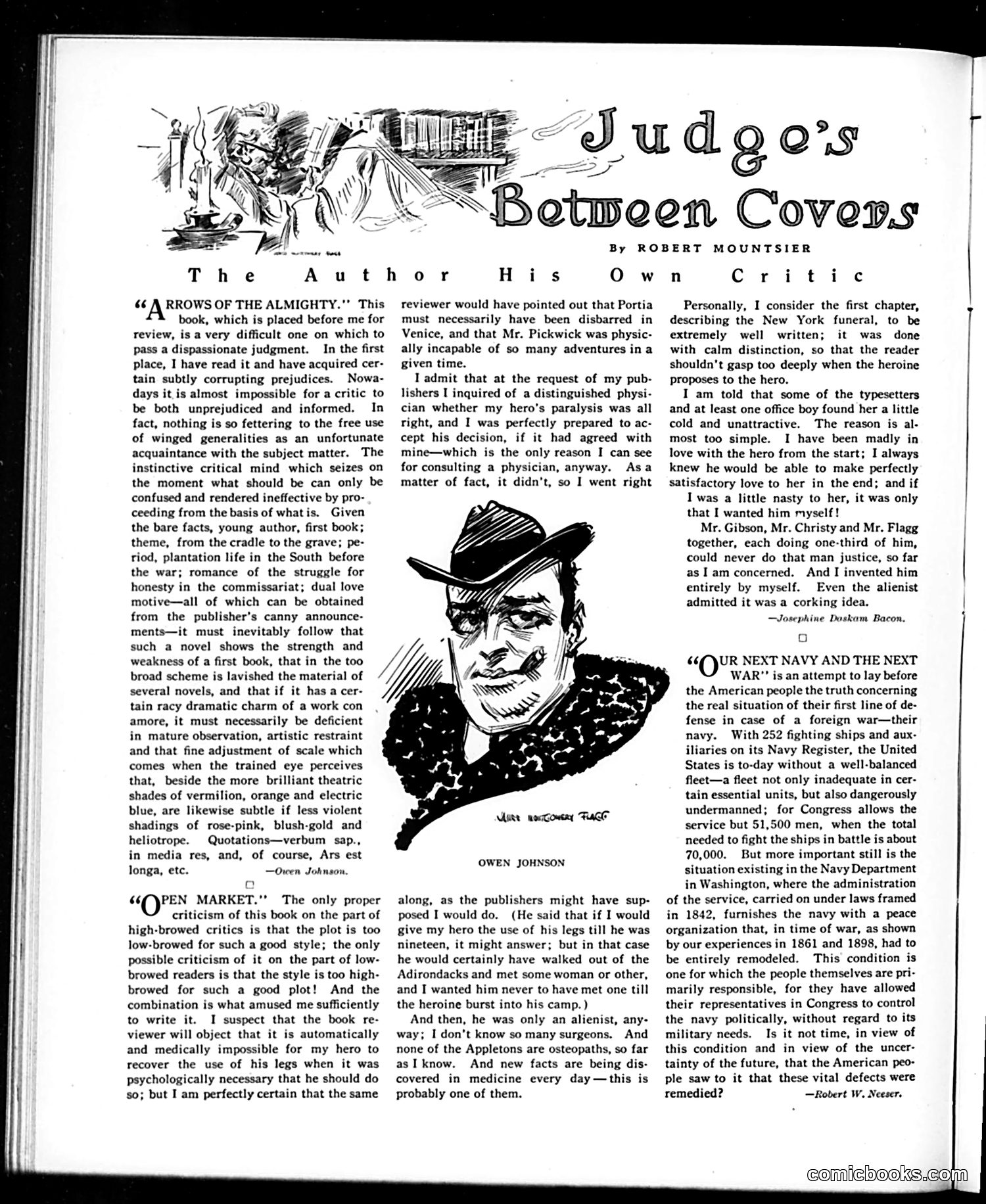
This *Judge* magazine page features literary reviews by Robert Mountsier critiquing novels by Owen Johnson. The content satirizes both pretentious literary criticism and defensive authors. **The satire:** Mountsier mocks high-minded critics who use ornate language ("verbum sap., in media res") and obscure references while claiming detachment from actual facts. He ridicules the impossible standard of being "both unprejudiced and informed." The reviews of Johnson's works playfully expose authorial defensiveness—Johnson justifies his hero's paralysis recovery by pointing out literary absurdities in canonical works (Portia practicing law in Venice, Pickwick's physical impossibilities). Johnson admits consulting a physician only to ignore his advice when it conflicted with his plot needs. **The humor** lies in the mutual skewering: pretentious critics vs. self-aware but stubborn authors, both exposed as unreliable narrators of literary merit. A portrait of Owen Johnson appears on the page.
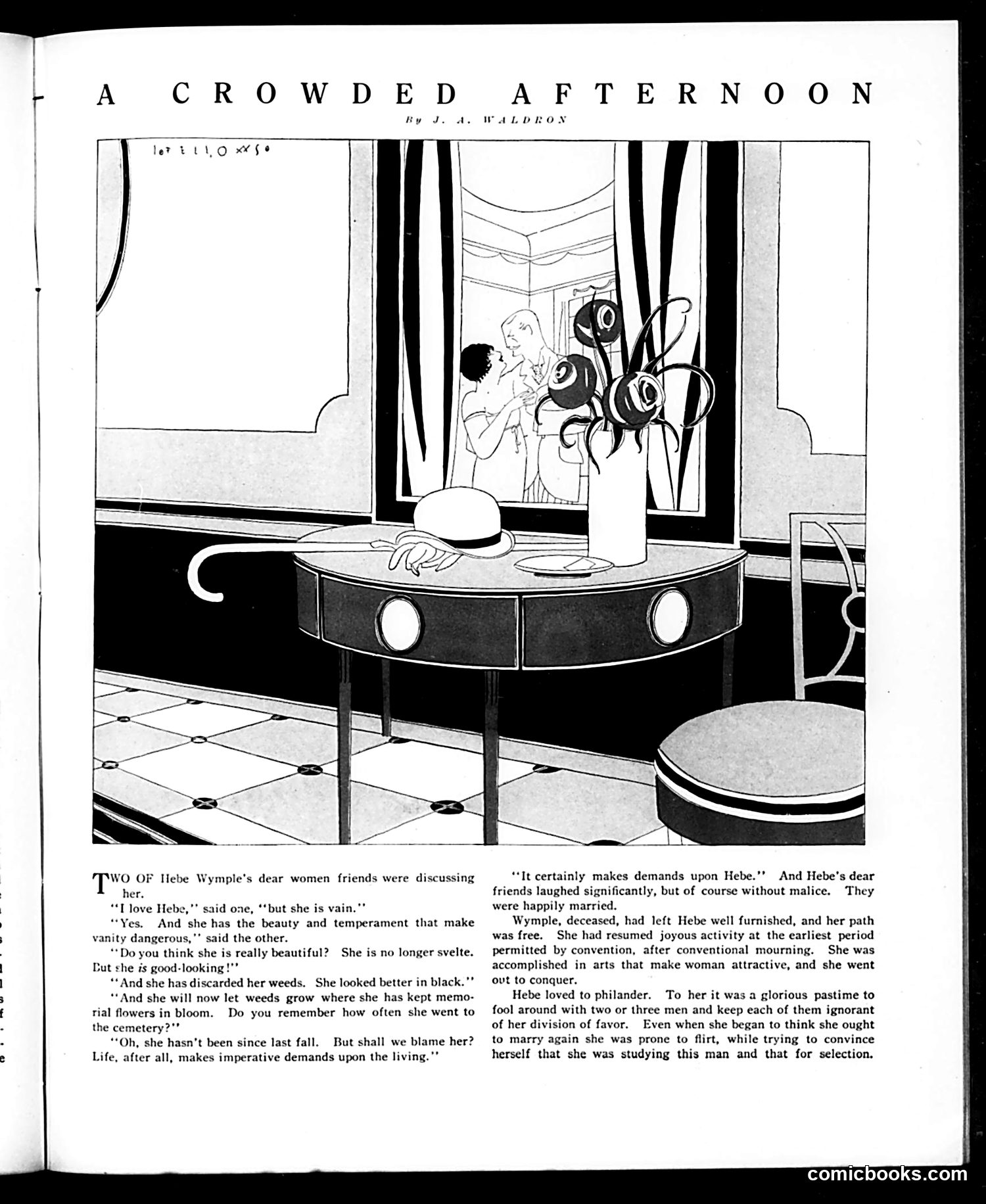
This is a society satire about **Hebe Wymple**, a wealthy widow whose behavior scandalizes her social circle. The cartoon depicts two of her female friends gossiping about her in an elegant interior. **The Social Critique:** The story mocks Hebe for abandoning widow's mourning conventions (the black "weeds") too quickly and resuming an active social life. More pointedly, it satirizes her for simultaneously flirting with multiple men while claiming to "study" them for remarriage selection—transparently using courtship as a pastime rather than sincere mate-seeking. **The Satire's Target:** The piece ridicules both Hebe's behavior and her friends' hypocritical judgment: they claim to love her while cataloging her faults (no longer "svelte," vain, neglecting her husband's grave). The final line suggests life's demands justify her conduct, yet the text implies her real motivation is pleasure-seeking disguised as matrimonial consideration. **Historical Context:** This reflects 1920s anxieties about post-war women's independence and changing sexual mores—particularly widows' newfound freedom and the "flapper" generation's rejection of Victorian propriety.
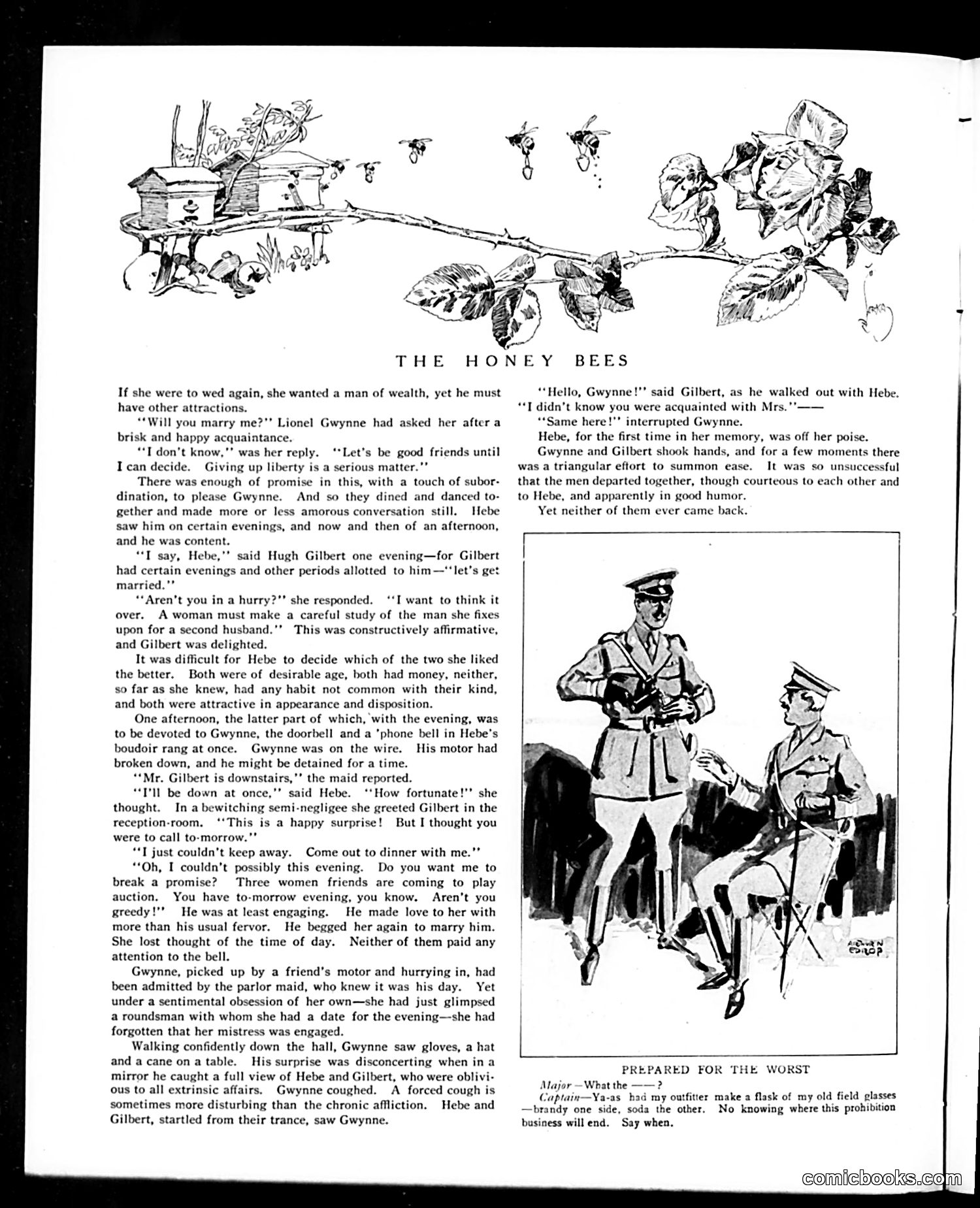
This story satirizes the marriage market and female romantic opportunism of the era. Hebe, a widow, juggles two wealthy suitors—Lionel Gwynne and Hugh Gilbert—each believing he has designated "evenings" with her. She delays committing to either, claiming she must "carefully study" her choice, while enjoying the attention and courtship from both men simultaneously. The satire's point: when both men unexpectedly arrive together and discover the deception, they calmly shake hands and depart—neither returning. The implication is biting: Hebe's calculated, mercenary approach to remarriage (prioritizing wealth and leisure over genuine affection) backfires completely. By treating marriage as a transaction to be "studied" rather than a sincere commitment, she loses both prospects. The accompanying cartoon "Prepared for the Worst" shows a military officer with a flask disguised as binoculars, joking about Prohibition—a separate contemporary reference to alcohol restrictions.
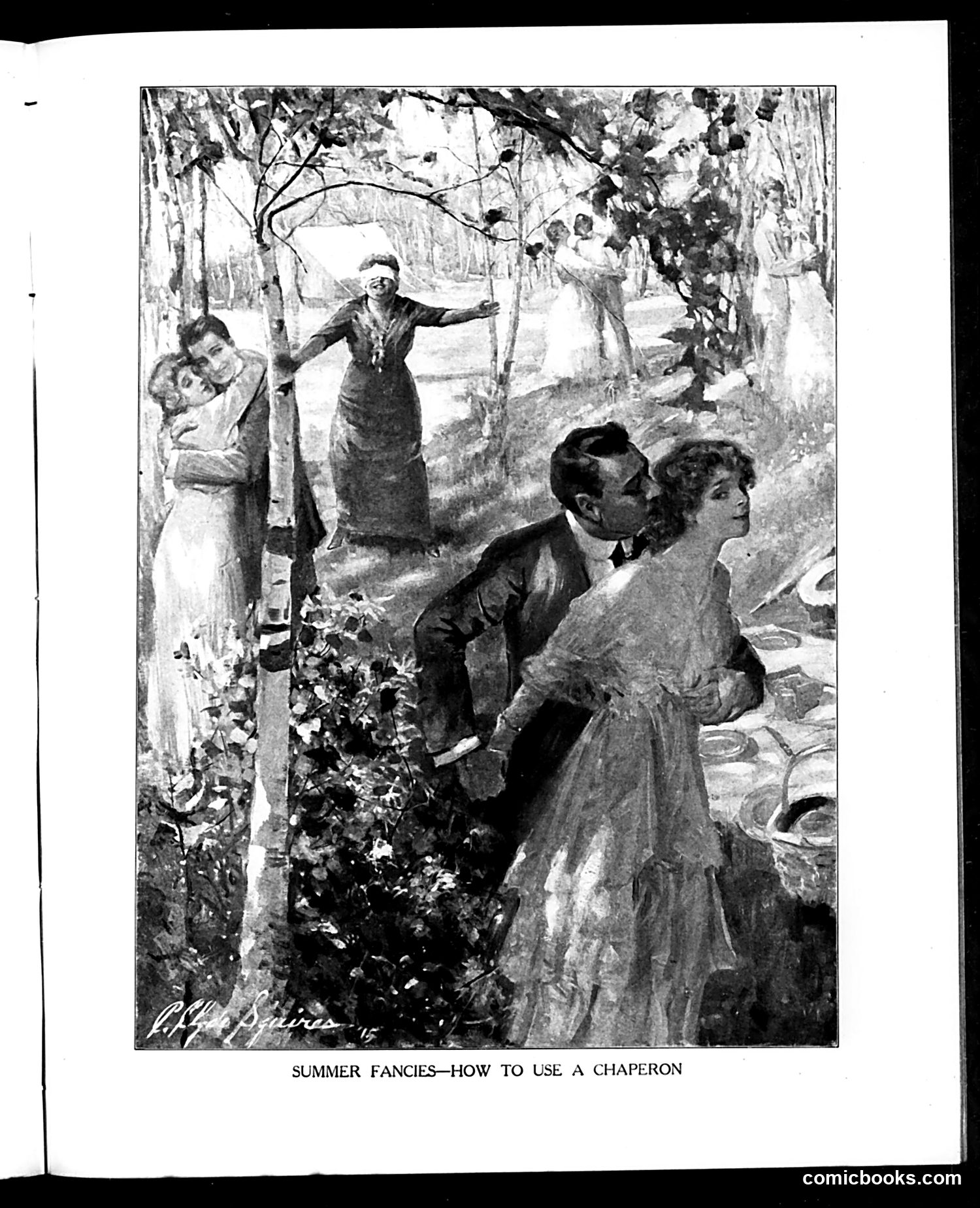
This satirical illustration depicts early 20th-century courtship customs. The image shows a young couple in an outdoor garden setting, apparently attempting romantic interaction while a female chaperon (an older woman responsible for supervising unmarried women) stands nearby. The satire centers on the contradiction between propriety and desire: the chaperon's presence is meant to prevent impropriety, yet the couple appears to be finding ways around her supervision. The man and woman are positioned closely together while the chaperon, positioned upstage with raised arms, seems either oblivious or deliberately distracted. The joke mocks the often-ineffective nature of the chaperon system—young people's ingenuity at circumventing strict Victorian/Edwardian social conventions designed to protect female virtue.
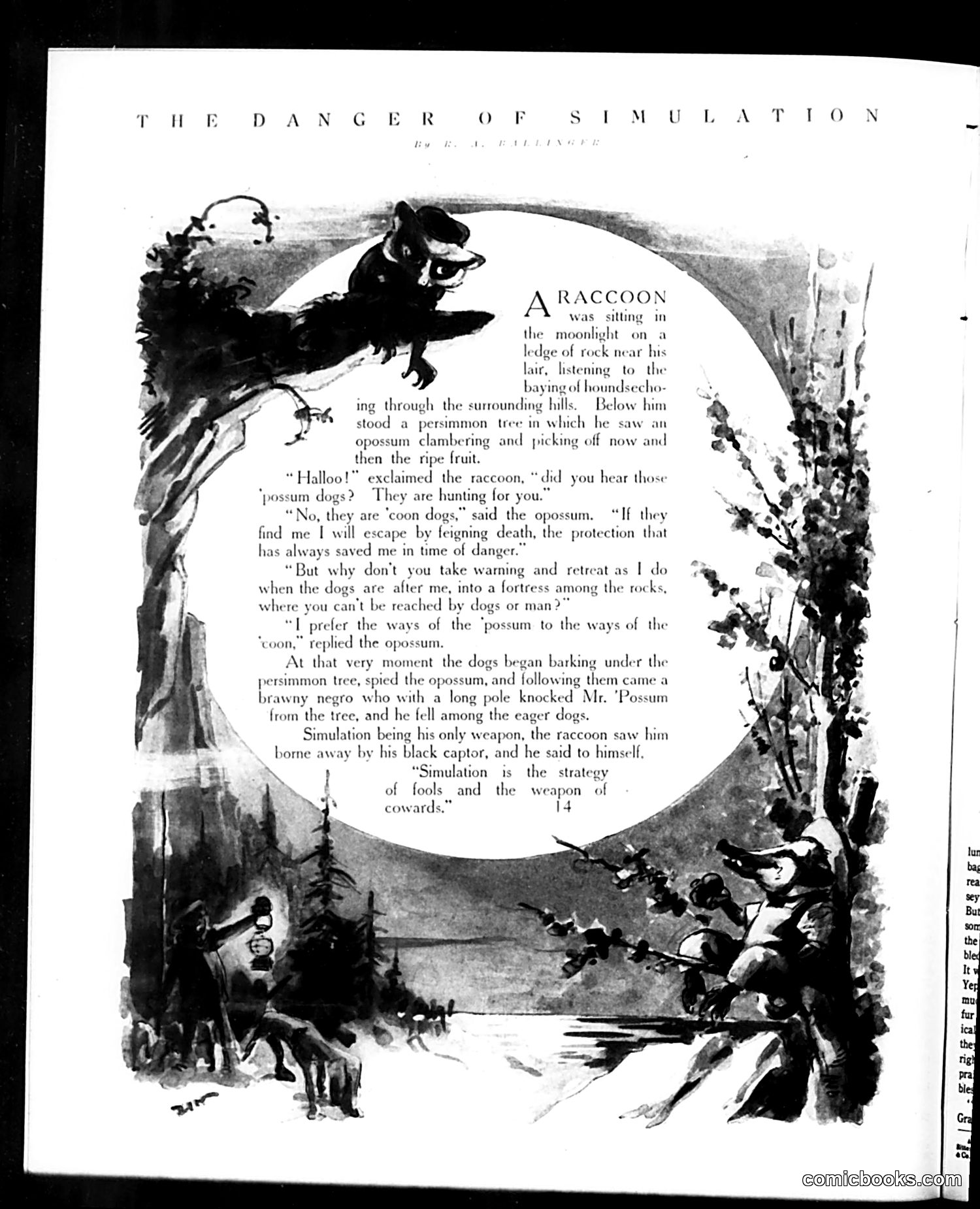
This is a fable-style story disguised as animal fiction, but the text reveals it as political allegory about race and survival strategies in the Jim Crow South. The "opossum" represents Black Americans who rely on passive resistance—"feigning death" and submission—as survival tactics. The "raccoon" represents those advocating more aggressive self-protection and resistance. The "brawny negro" hunter and his dogs represent white violence and control. The moral—that "simulation is the strategy of fools and cowards"—argues *against* passive accommodation, instead endorsing active resistance and retreat to defensible positions ("fortress among the rocks"). **The satire's target is unclear**: Judge was generally conservative. This could mock either passive accommodation *or* the raccoon's prideful rejection of it. Without knowing the publication date and author, the exact political intent—whether this supports or mocks Black resistance strategies—cannot be determined.
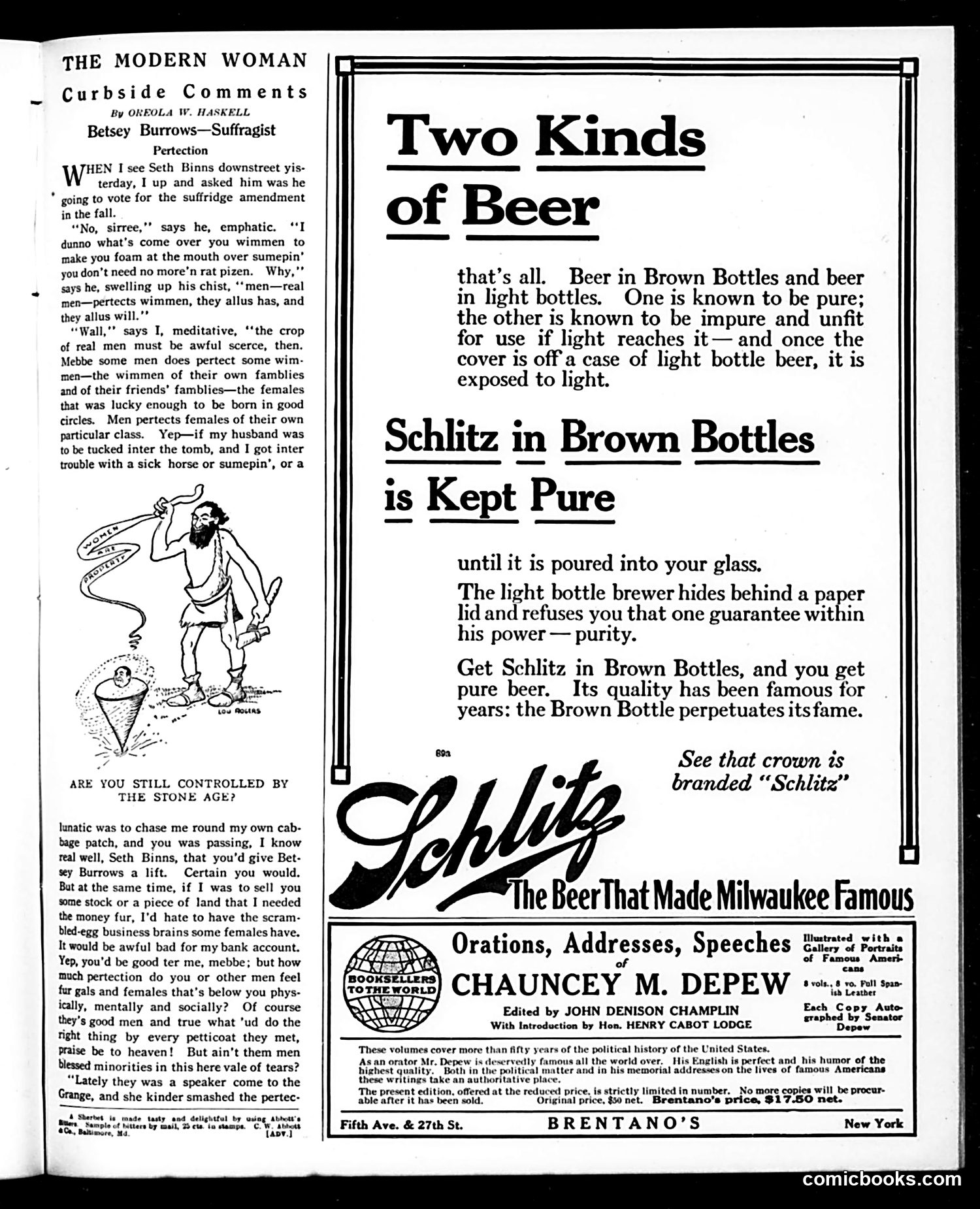
**The "Modern Woman" Column:** This satirical piece features "Betsey Burrows," a rural suffragist, debating voter Seth Binns about women's suffrage. Binns claims men "protect" women and they need no more rights than "rat poison." Betsey counters that men only protect women of their own social class; poor or working women receive no such protection. She cites a recent female speaker at the Grange who demolished these paternalistic arguments. The cartoon questions whether men still operate under "Stone Age" thinking regarding women's equality and voting rights. **Context:** This reflects the pre-1920 suffrage debate, when opponents argued women didn't need voting power because men naturally protected them. Betsey's response exposes this logic as classist—protection extended only to socially respectable women. The page also contains a Schlitz beer advertisement and a book advertisement for Chauncey M. Depew's speeches.
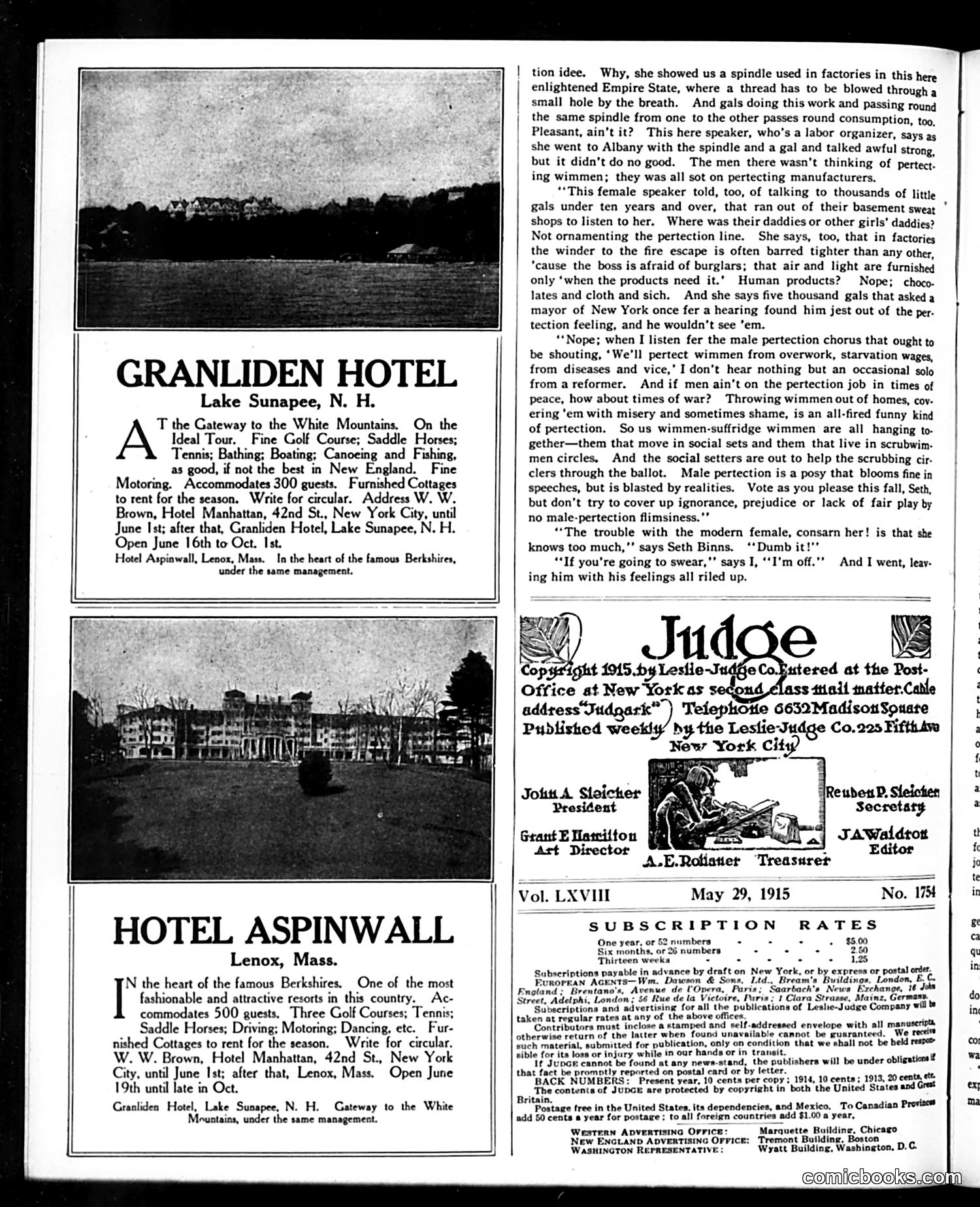
This page is primarily **advertising** for upscale resort hotels (Granliden Hotel and Hotel Aspinwall), typical of Judge magazine's commercial content. However, the text column contains a **satirical editorial** critiquing male indifference to women's labor protections. The unnamed female labor organizer speaker describes visiting factories where child workers (girls under ten) share contaminated spindles, spreading tuberculosis ("consumption"). She brought evidence to Albany legislators who dismissed her, prioritizing manufacturer "protection" over worker safety. The satire mocks male "protection" rhetoric—men claim to protect women but ignore workplace dangers, deny them hearing from officials, and provide no support. Yet when wars occur, these same men send women into poverty and shame. The piece advocates **women's suffrage** as the solution, arguing only voting power will secure real protections. The closing dialogue (Seth Binns dismissing educated women as troublesome) reinforces the satire: male resistance to female empowerment stems from discomfort with informed women demanding justice. This reflects **Progressive Era** labor reform debates circa 1915.
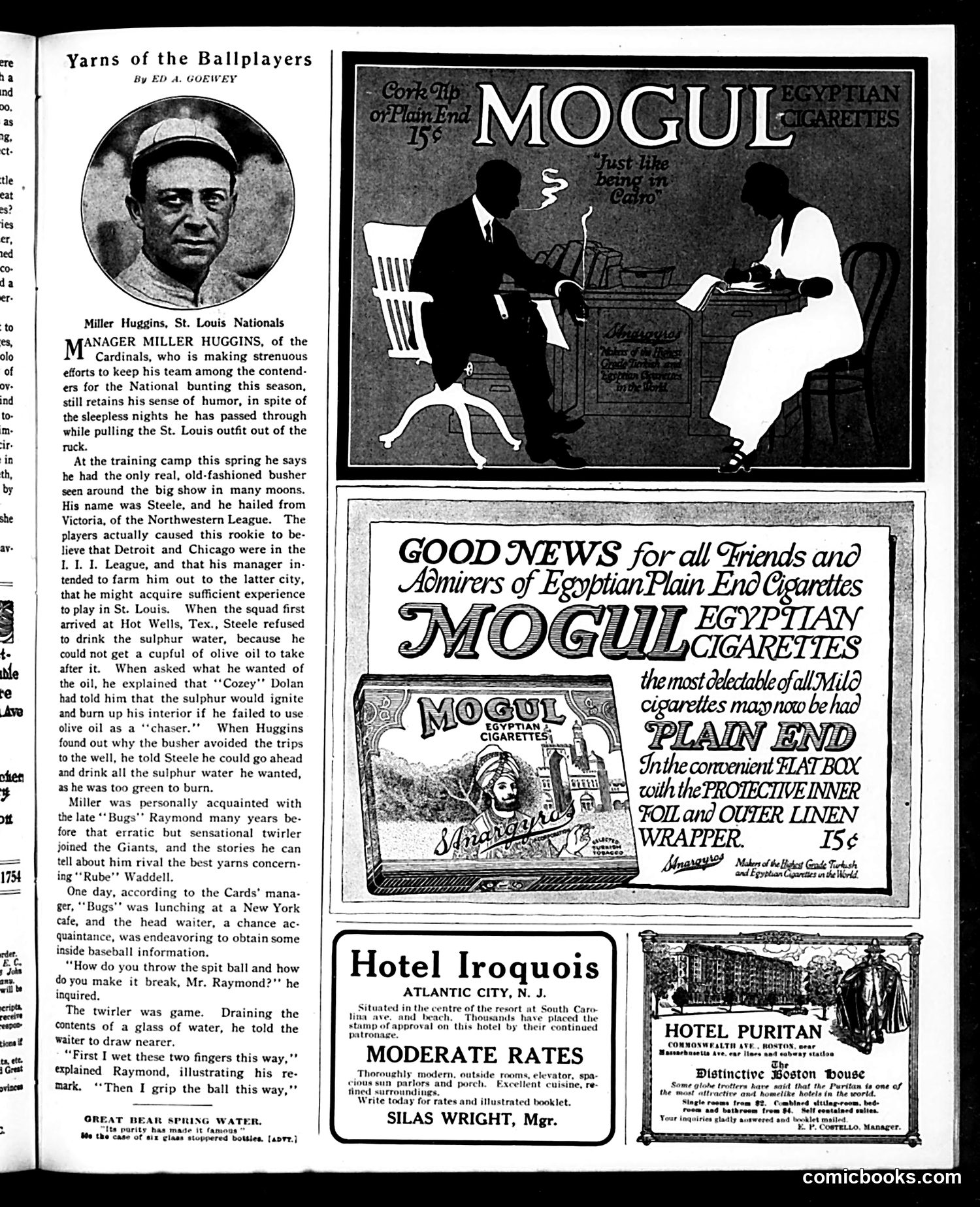
This page features a humorous article about Manager Miller Huggins of the St. Louis Cardinals, written by Ed A. Goewey. The main content is **not a political cartoon** but rather anecdotal sports humor from the early 20th century. The article recounts amusing baseball stories: a naive rookie named Steele who believes fictional teams exist and refuses to drink sulfur water without olive oil "chaser," and an anecdote about pitcher "Bugs" Raymond teaching a waiter how to throw a spitball by demonstrating with a water glass. The satire targets the gullibility of newcomers to professional baseball and the colorful personalities of eccentric pitchers. References to "Cozey" Dolan and "Rube" Waddell invoke well-known baseball figures from the era. The remainder of the page consists of period advertisements for Mogul Egyptian Cigarettes, Hotel Iroquois, and Hotel Puritan—typical magazine advertising rather than editorial content.
This page is primarily **advertising with accompanying editorial content**, not political cartoons. The main advertisement promotes **Beeman's Pepsin Chewing Gum** as "good for digestion"—a common health claim of early 20th-century patent medicines and consumer products. The other advertisements feature the Hotel Empire in New York City, Glen Morris Inn in Minnesota, and a Willard-Johnson prize-fighting puzzle card game. The substantial text column titled "From a Sinner's Diary" by Lynette Freemire contains **social commentary and aphorisms** mocking human behavior—reformers, book agents, domestic friction, and self-deception. The piece satirizes contemporary manners and hypocrisy rather than specific political figures or events. There is **no discernible political cartoon** on this page. The content represents Judge's typical mix of advertising revenue and light satirical social observation aimed at genteel middle-class readers.
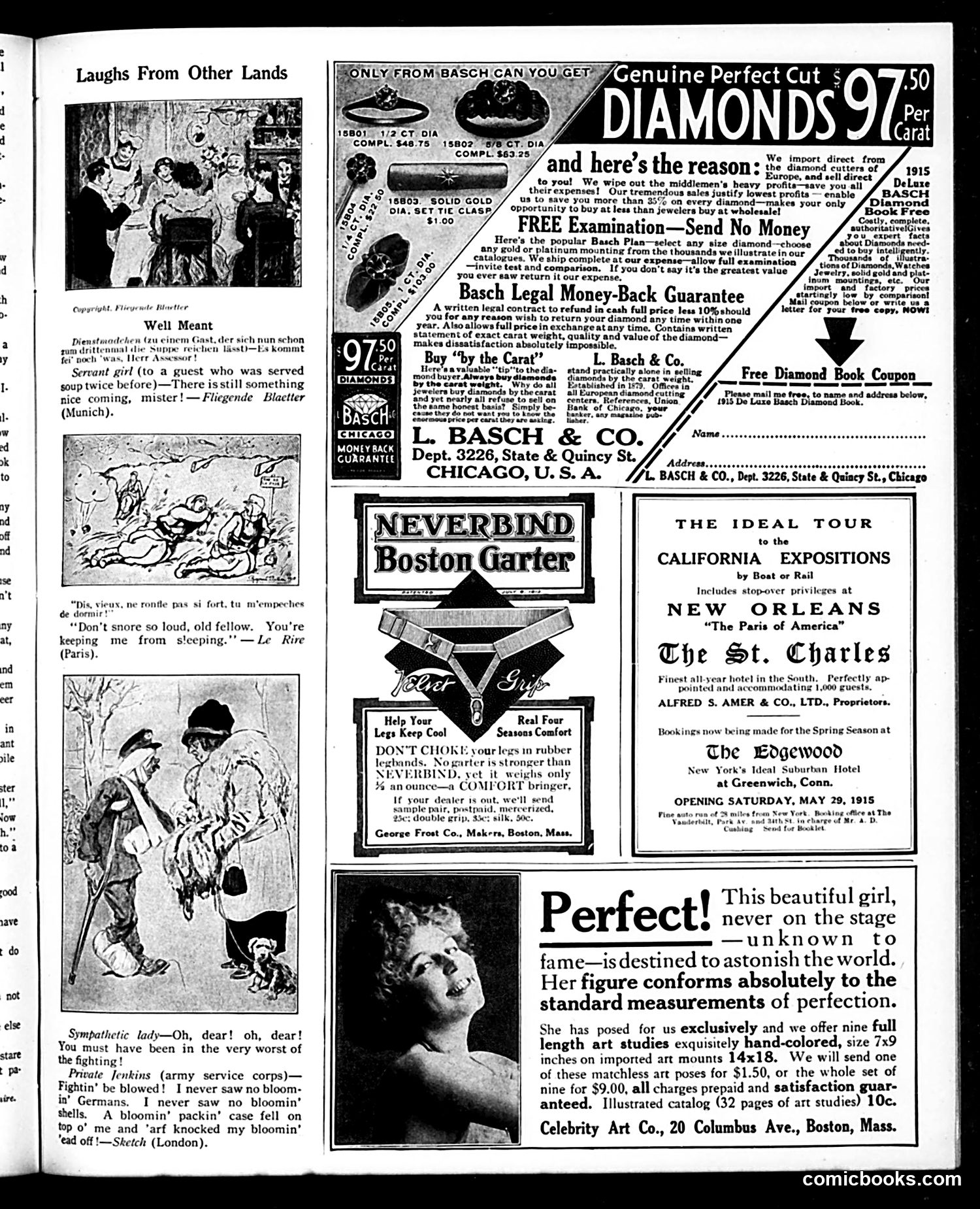
This page consists primarily of **advertisements and reprinted European humor** rather than original satire. The "Laughs From Other Lands" section features three translated comic strips from European publications (Fliegende Blätter, Le Rire, Sketch). These are gentle domestic humor pieces: a servant girl's well-meaning double soup service, Parisians complaining about snoring, and a WWI-era joke about a British soldier who never saw combat—only a falling packing crate. The advertisements dominate: L. Basch & Co. sells diamonds by mail through a "middleman-cutting" strategy; Neverbind Boston Garters promise leg comfort; hotels advertise California expositions and Connecticut retreats; and "Celebrity Art Co." offers hand-colored nude art studies of an "unknown" girl marketed as destined for fame. The page reflects **1915 consumer culture**—mail-order diamonds, ready-made tourism, and semi-risqué art—rather than political commentary.
This page from *Judge* magazine contains no political cartoons—it's primarily advertising and humorous anecdotes. The left side promotes William Maxwell's article "Champagne Corks and Cannon Balls," which addresses **World War I's escalating national debts** ($15 billion combined increase predicted). Maxwell argues this financial burden will affect ordinary Americans' post-war economic lives. The right side offers satirical humor pieces, including: - A Mark Twain anecdote about overeating at dinner - A critique of commercial fiction prioritizing entertainment over truth - A child's innocent question about mortgages on a house - A neglected girl at a dinner party sarcastically asking who wants a "clean plate" These jokes reflect **early 20th-century middle-class concerns**: manners, conspicuous consumption, and the gap between polite social pretense and reality. The satire is gentle, targeting social hypocrisy rather than specific political figures.
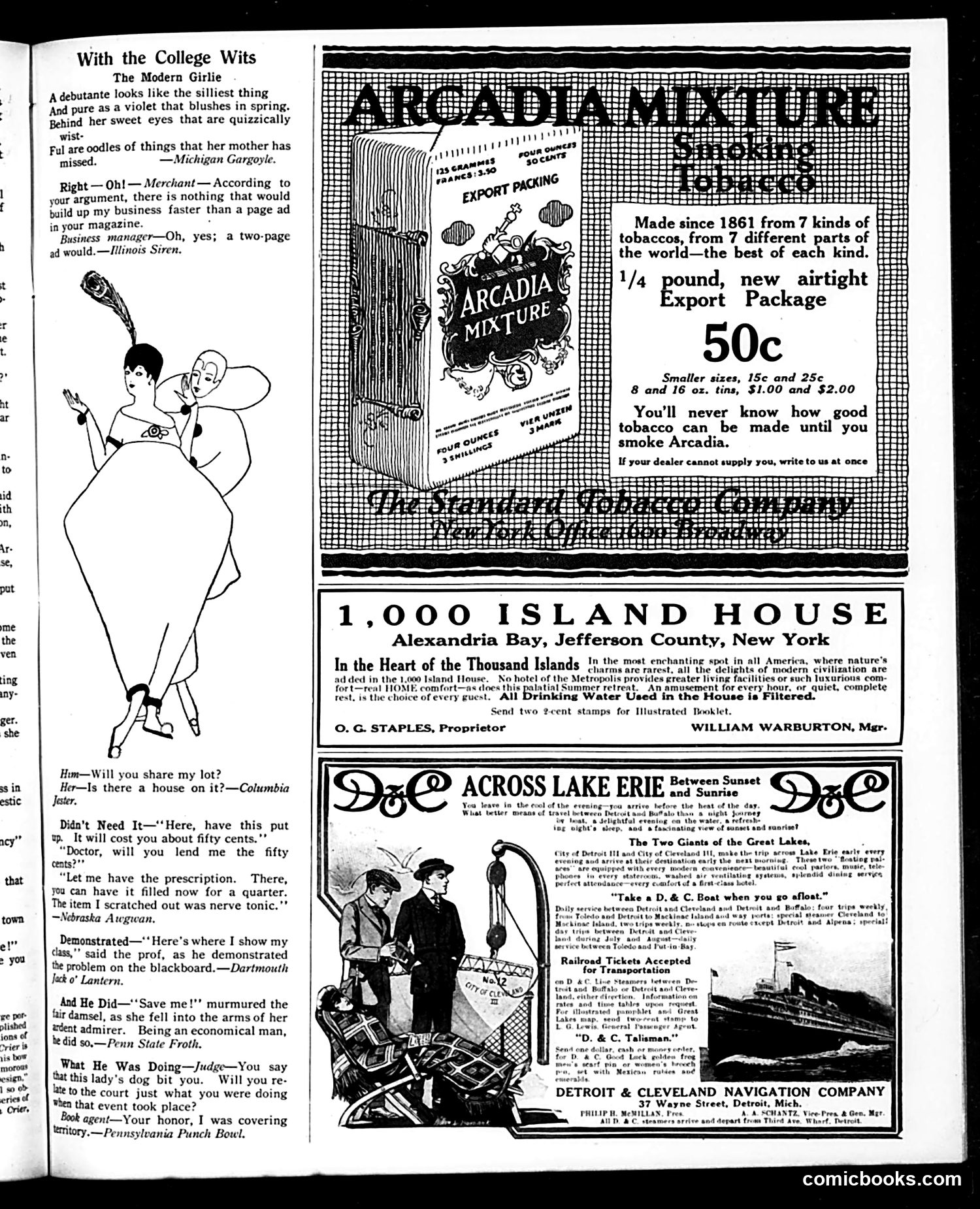
This page is primarily **advertising**, with minimal editorial content. The left column contains brief college humor jokes ("With the College Wits") sourced from various university publications—these are generic comedic quips about debutantes, business, romance, and courtroom situations. They lack specific political or social satire; they're simply lighthearted observations meant to amuse. The advertisements dominate: Arcadia Mixture tobacco (50¢), the 1,000 Island House resort in upstate New York, and D&C Navigation Company lake cruises. These ads target middle/upper-class leisure travelers and tobacco consumers. **For modern readers:** This reflects early 20th-century magazine economics—advertising subsidized content. The humor is genteel, collegiate, and apolitical, featuring typical period tropes (nervous young women, sharp businessmen, foolish judges). No identifiable political figures or events are referenced; the page serves mainly as a commercial vehicle.
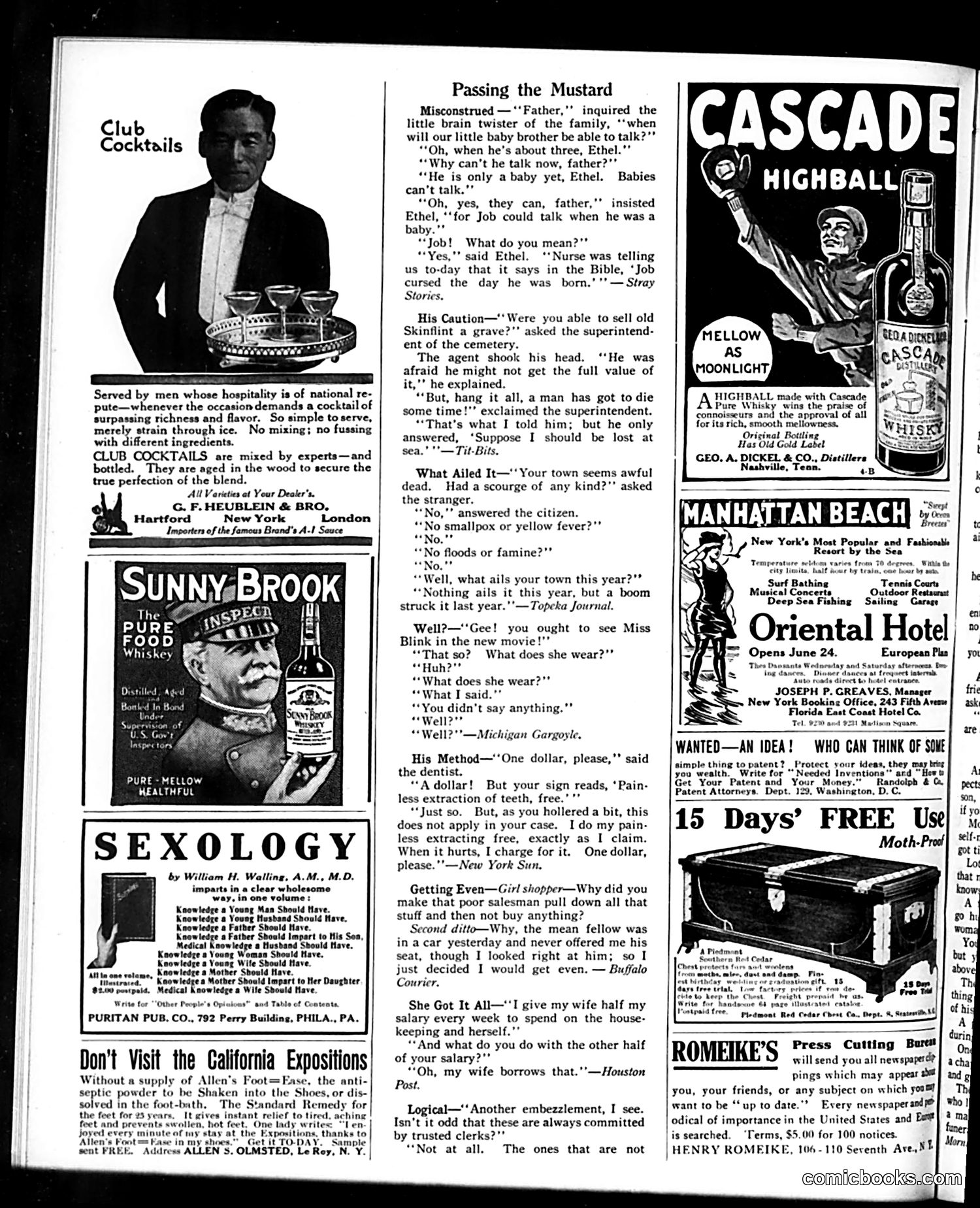
This page from *Judge* magazine consists primarily of **advertisements and humorous anecdotes** rather than political cartoons. The main content includes: **Advertisements:** Club cocktails, Sunny Brook whiskey, a book on sexology, and various products (foot powder, dental work, hotel services). **Comic Anecdotes:** Short joke pieces with titles like "Passing the Mustard," "His Caution," and "Getting Even." These are genteel, family-oriented humor typical of early 20th-century publications—featuring wordplay and mild social observations rather than sharp satire. For example, one joke mocks a cheapskate cemetery customer; another plays on a child's literal Bible interpretation. **Social Context:** The ads reveal period concerns (foot ailments, sexual education books, dental pain) while the jokes reflect middle-class anxieties about money, marriage, and propriety. The page represents *Judge*'s blend of satirical commentary with consumer advertising—the magazine funded itself through ads while maintaining its genteel humor for educated, affluent readers.
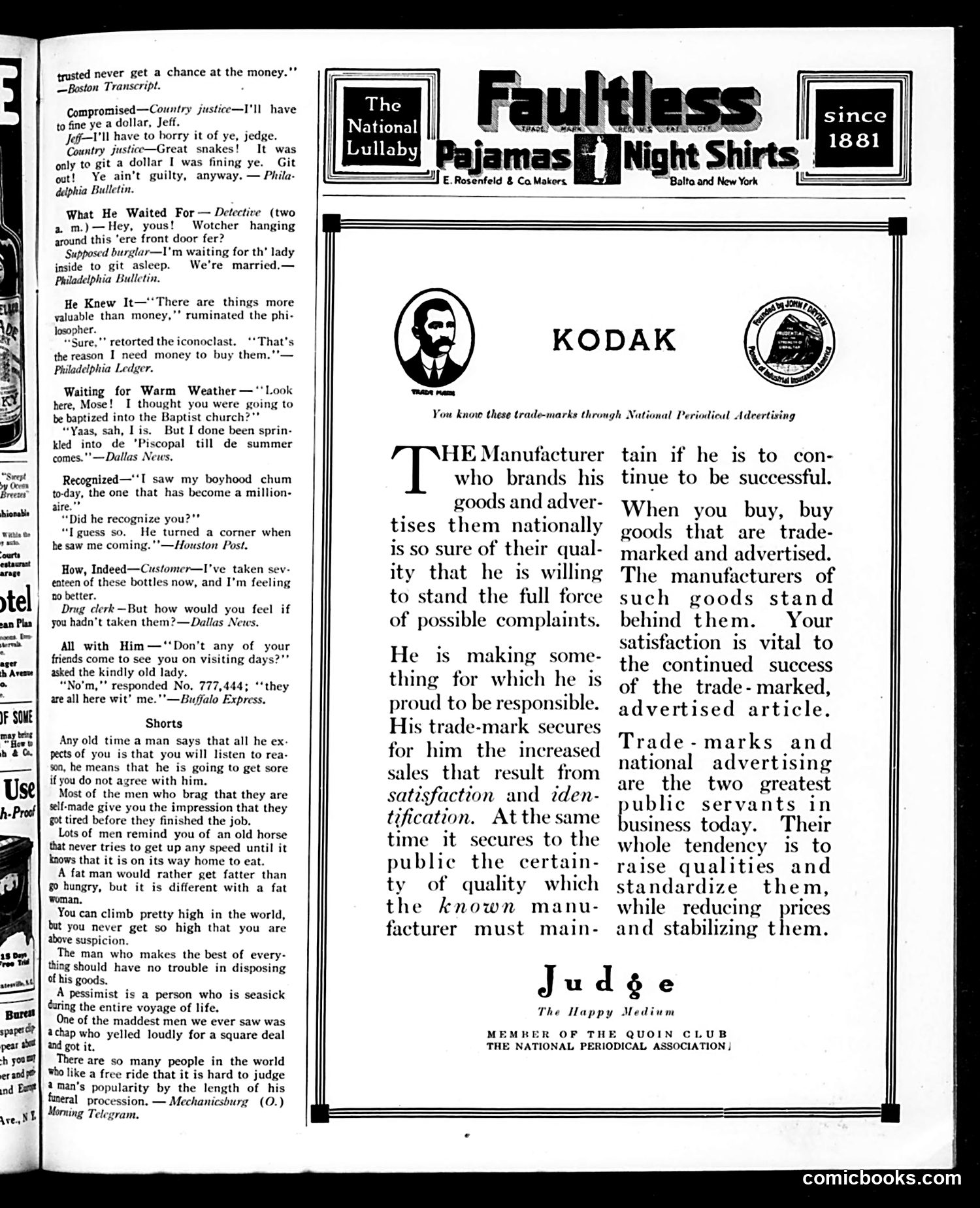
This page contains **short humor pieces and advertisements**, not political cartoons requiring historical context. The left column features brief comic anecdotes (labeled "Shorts") about everyday situations: a poor defendant who can't pay a fine, a burglar waiting for his wife to sleep, a drug customer questioning medicine's effectiveness. These rely on wordplay and situational irony rather than political satire—they're generic humor pieces likely sourced from various newspapers. The right side is **primarily advertising**: a Faultless Pajamas ad and a substantial Kodak advertisement about trade-marks and national advertising. The Kodak piece argues that branded, nationally-advertised goods benefit consumers by ensuring quality and accountability. The page reflects early 20th-century attitudes: casual racial dialect in one anecdote ("Yaas, sah"), faith in consumer branding as a guarantor of quality, and faith in national advertising as a "public servant." **No specific political figures or events are referenced.** This appears to be a typical filler page mixing light humor with advertisements.
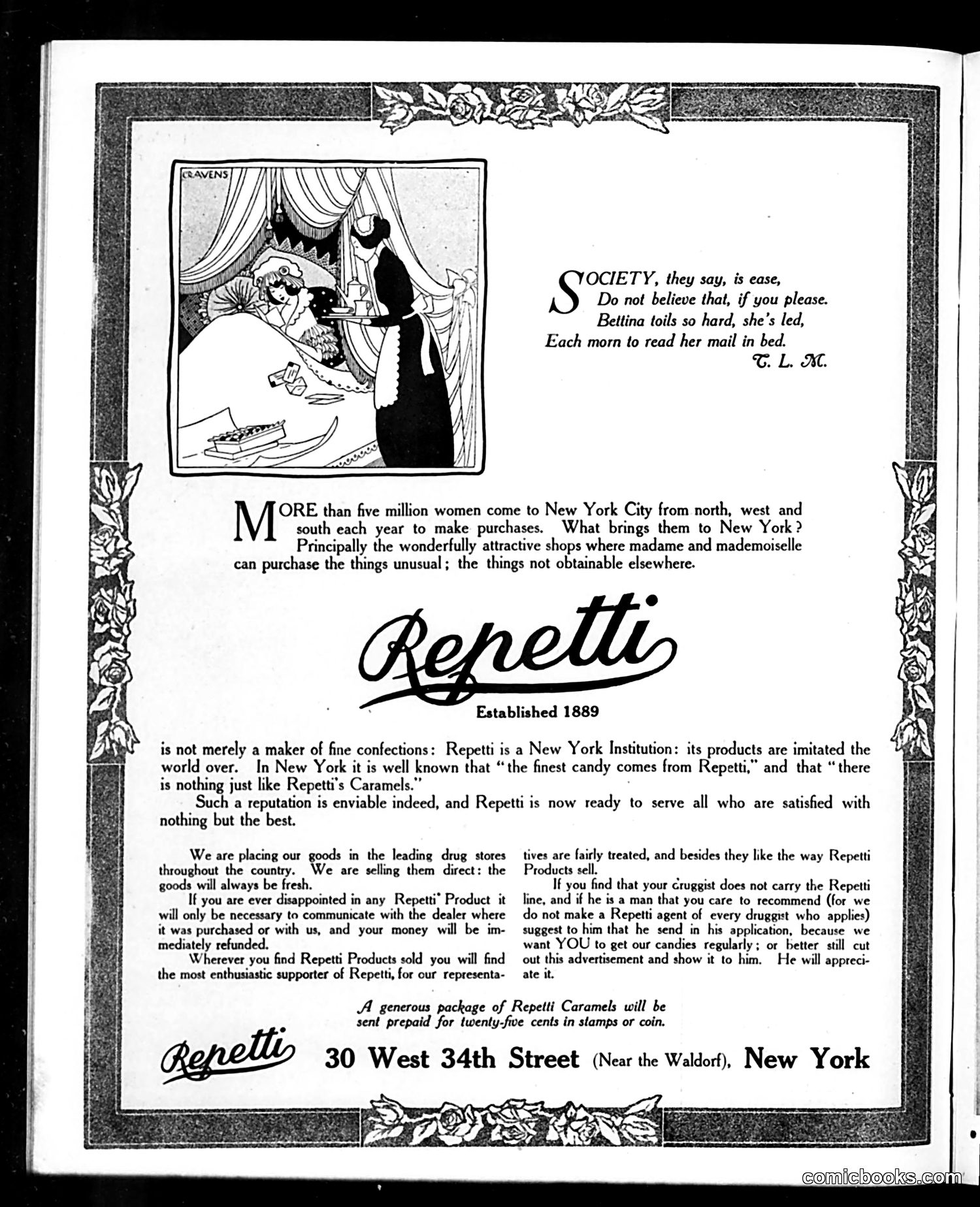
This is primarily a **Repetti candy advertisement** with a satirical cartoon header. The small cartoon depicts "Bettina," a society woman in bed reading her mail—satirizing the leisure-class lifestyle. The accompanying verse by C.L. KM. mocks high society's pretense of ease, suggesting that even wealthy women like Bettina are actually "toiling" (ironically, by merely reading correspondence in bed). The joke targets the self-important complaints of the idle rich about their supposedly demanding lives. The advertisement itself frames Repetti as a prestigious "New York Institution" (established 1889), appealing to the five million women annually visiting NYC to shop. It positions Repetti caramels as exclusive, imitated worldwide, and of uncompromising quality. The pitch emphasizes both retail availability and direct mail options, with a money-back guarantee. The page reflects early 20th-century consumer culture and class attitudes, using gentle satire to sell luxury confections to affluent women.