
Judge, 1915-05-29 · page 4 of 24
Judge — May 29, 1915 — page 4: what you’re looking at
What you’re looking at
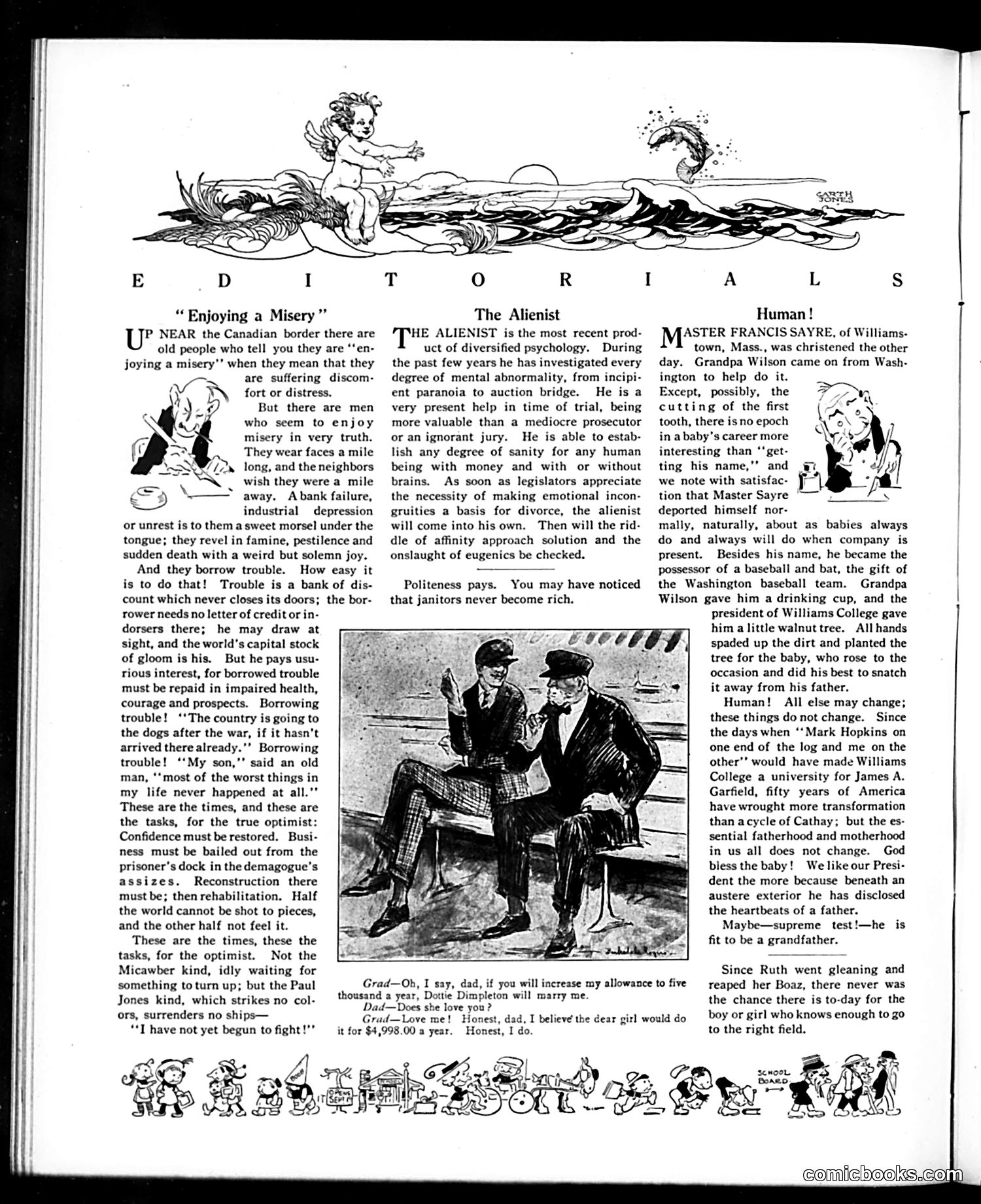
This page contains three distinct editorial pieces satirizing early 20th-century American social issues: **"Enjoying a Misery"** critiques people who romanticize poverty and hardship, arguing that while some take pride in suffering through economic depression, true optimism requires practical reconstruction—not glorification of struggle. **"The Alienist"** discusses a psychologist's expertise in diagnosing mental abnormalities and determining sanity in legal cases, suggesting legislators should use such expertise for divorce proceedings rather than relying solely on emotional testimony. **"Human!"** celebrates a baby's christening at Williams College, arguing that despite social changes, fundamental human values—represented by baseball, gifts, and family traditions—remain constant across generations. The decorative header and footer illustrations are typical Judge magazine ornamental design elements.
📄 Transcribed text from this page (OCR, searchable)
Machine-transcribed from the original scan — historical spelling and the odd misread are preserved.
“ Enjoying a Misery” P NEAR the Canadian border there are old people who tell you they are ‘‘en- joying a misery’’ when they mean that they are suffering discom- fort or distress. But there are men who seem to enjoy misery in very truth. They wear faces a mile long, and the neighbors wish they were a mile away. A bank failure, industrial depression or unrest is to them a sweet morsel under the tongue; they revel in famine, pestilence and sudden death with a weird but solemn joy. And they borrow trouble. How easy it is to do that! Trouble is a bank of dis- count which never closes its doors; the bor- rower needs no letter of credit or in- The Alienist HE ALIENIST is the most recent prod- uct of diversified psychology. During the past few years he has investigated every degree of mental abnormality, from incipi- ent paranoia to auction bridge. He is a very present help in time of trial, being more valuable than a mediocre prosecutor or an ignorant jury. He is able to estab- lish any degree of sanity for any human being with money and with or without brains. As soon as legislators appreciate the necessity of making emotional incon- gruities a basis for divorce, the alienist will come into his own. Then will the rid- dle of affinity approach solution and the onslaught of eugenics be checked. Politeness pays. You may have noticed that janitors never become rich. Human! ASTER FRANCIS SAYRE, of Williams- town, Mass., was christened the other day. Grandpa Wilson came on from Wash- ington to help do it. Except, possibly, the cutting of the first tooth, there is no epoch in a baby’s career more interesting than ‘‘get- ting his name,’’ and we note with satisfac- tion that Master Sayre deported himself nor- mally, naturally, about as babies always do and always will do when company is present. Besides his name, he became the possessor of a baseball and bat, the gift of the Washington baseball team. Grandpa Wilson gave him a drinking cup, and the president of Williams College gave him a little walnut tree. All hands dorsers there; he may draw at sight, and the world’s capital stock of gloom is his. But he pays usu- rious interest, for borrowed trouble must be repaid in impaired health, courage and prospects. Borrowing trouble! ‘‘The country is going to the dogs after the war, if it hasn't arrived there already.’’ Borrowing trouble! ‘*My son,”’ said an old man, ‘‘most of the worst things in my life never happened at all."* These are the times, and these are the tasks, for the true optimist: Confidence must be restored. Busi- ness must be bailed out from the prisoner's dock in the demagogue’s assizes. Reconstruction there must be; then rehabilitation. Half the world cannot be shot to pieces, and the other half not feel it. These are the times, these the spaded up the dirt and planted the tree for the baby, who rose to the occasion and did his best to snatch it away from his father. Human! All else may change; these things do not change. Since the days when ‘*Mark Hopkins on one end of the log and me on the other’’ would have made Williams College a university for James A. Garfield, fifty years of America have wrought more transformation than acycle of Cathay; but the es- sential fatherhood and motherhood in us all does not change. God biess the baby! We like our Presi- dent the more because beneath an austere exterior he has disclosed the heartbeats of a father. Maybe—supreme test!—he is fit to be a grandfather. tasks, for the optimist. Not the Micawber kind, idly waiting for something toturn up; but the Paul Jones kind, which strikes no col- ors, surrenders no ships— “*T have not yet begun to fight!"” Grad—Oh, I say, dad, if you will increase my allowance to five thousand a year, Dottie Dimpleton will marry me. Dad—Does she love you ? Grad—Love me! it for $4,998.00 a year. Honest, I do. Honest, dad, I believe the dear girl would do Since Ruth went gleaning and reaped her Boaz, there never was the chance there is to-day for the boy or girl who knows enough to go to the right field. comichooks.coup