
Judge, 1915-05-29 · page 10 of 24
Judge — May 29, 1915 — page 10: what you’re looking at
What you’re looking at
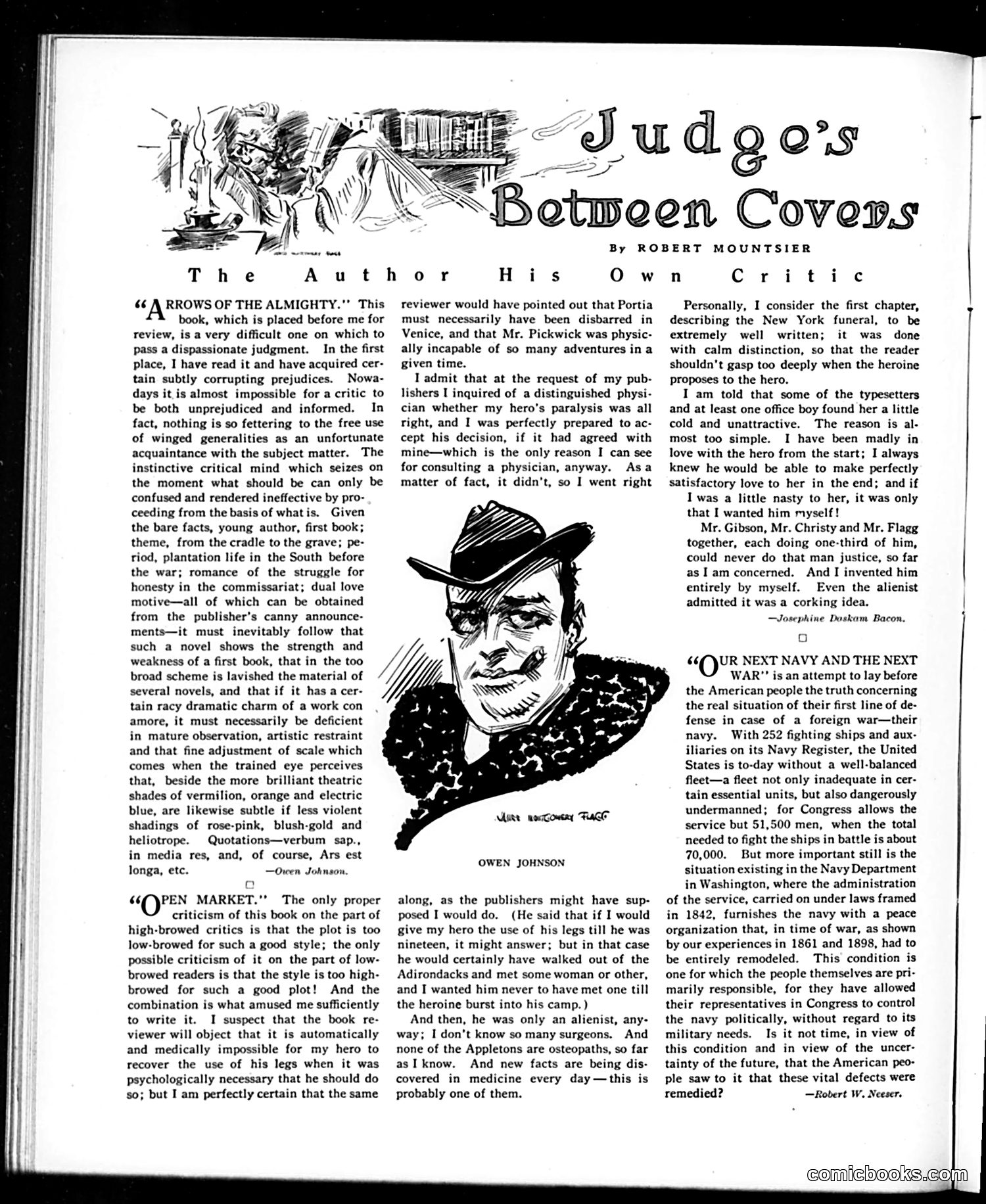
This *Judge* magazine page features literary reviews by Robert Mountsier critiquing novels by Owen Johnson. The content satirizes both pretentious literary criticism and defensive authors. **The satire:** Mountsier mocks high-minded critics who use ornate language ("verbum sap., in media res") and obscure references while claiming detachment from actual facts. He ridicules the impossible standard of being "both unprejudiced and informed." The reviews of Johnson's works playfully expose authorial defensiveness—Johnson justifies his hero's paralysis recovery by pointing out literary absurdities in canonical works (Portia practicing law in Venice, Pickwick's physical impossibilities). Johnson admits consulting a physician only to ignore his advice when it conflicted with his plot needs. **The humor** lies in the mutual skewering: pretentious critics vs. self-aware but stubborn authors, both exposed as unreliable narrators of literary merit. A portrait of Owen Johnson appears on the page.
📄 Transcribed text from this page (OCR, searchable)
Machine-transcribed from the original scan — historical spelling and the odd misread are preserved.
The 66 A RROWS OF THE ALMIGHTY.” This book, which is placed before me for review, is a very difficult one on which to pass a dispassionate judgment. In the first place, I have read it and have acquired cer- tain subtly corrupting prejudices. Nowa- days it is almost impossible for a critic to be both unprejudiced and informed. In fact, nothing is so fettering to the free use of winged generalities as an unfortunate acquaintance with the subject matter. The instinctive critical mind which seizes on the moment what should be can only be confused and rendered ineffective by pro- ceeding from the basis of whatis. Given the bare facts, young author, first book; theme, from the cradle to the grave; pe- riod, plantation life in the South before the war; romance of the struggle for honesty in the commissariat; dual love motive—all of which can be obtained from the publisher’s canny announce- ments—it must inevitably follow that such a novel shows the strength and weakness of a first book, that in the too broad scheme is lavished the material of several novels, and that if it has a cer- tain racy dramatic charm of a work con amore, it must necessarily be deficient in mature observation, artistic restraint and that fine adjustment of scale which comes when the trained eye perceives that, beside the more brilliant theatric shades of vermilion, orange and electric blue, are likewise subtle if less violent shadings of rose-pink, blush-gold and heliotrope. Quotations—verbum sap., in media res, and, of course, Ars est longa, etc. —Owen Johnson, oO 66(-)PEN MARKET."’ The only proper criticism of this book on the part of high-browed critics is that the plot is too low-browed for such a good style; the only possible criticism of it on the part of low- browed readers is that the style is too high- browed for such a good plot! And the combination is what amused me sufficiently to write it. I suspect that the book re- viewer will object that it is automatically and medically impossible for my hero to recover the use of his legs when it was psychologically necessary that he should do so; but I am perfectly certain that the same Author His Ow reviewer would have pointed out that Portia must necessarily have been disbarred in Venice, and that Mr. Pickwick was physic- ally incapable of so many adventures in a given time. l admit that at the request of my pub- lishers I inquired of a distinguished physi- cian whether my hero's paralysis was all right, and I was perfectly prepared to ac- cept his decision, if it had agreed with mine—which is the only reason I can see for consulting a physician, anyway. Asa matter of fact, it didn’t, so I went right OWEN JOHNSON along, as the publishers might have sup- posed I would do. (He said that if I would give my hero the use of his legs till he was nineteen, it might answer; but in that case he would certainly have walked out of the Adirondacks and met some woman or other, and I wanted him never to have met one till the heroine burst into his camp.) And then, he was only an alienist, any- way; I don’t know so many surgeons. And none of the Appletons are osteopaths, so far asI know. And new facts are being dis- covered in medicine every day—this is probably one of them. By ROBERT MOUNTSIER n Critic Personally, I consider the first chapter, describing the New York funeral, to be extremely well written; it was done with calm distinction, so that the reader shouldn't gasp too deeply when the heroine Proposes to the hero. I am told that some of the typesetters and at least one office boy found her a little cold and unattractive. The reason is al- most too simple. I have been madly in love with the hero from the start; I always knew he would be able to make perfectly satisfactory love to her in the end; and if I was a little nasty to her, it was only that I wanted him myself! Mr. Gibson, Mr. Christy and Mr. Flagg together, each doing one-third of him, could never do that man justice, so far as I am concerned. And I invented him entirely by myself. Even the alienist admitted it was a corking idea. —Josephine Doskam Bacon, o 66Q.)UR NEXT NAVY AND THE NEXT WAR" is an attempt to lay before the American people the truth concerning the real situation of their first line of de- fense in case of a foreign war—their navy. With 252 fighting ships and aux- iliaries on its Navy Register, the United States is to-day without a well-balanced fleet—a fleet not only inadequate in cer- tain essential units, but also dangerously undermanned; for Congress allows the service but 51,500 men, when the total needed to fight the ships in battle is about 70,000. But more important still is the situation existing in the Navy Department in Washington, where the administration of the service, carried on under laws framed in 1842, furnishes the navy with a peace organization that, in time of war, as shown by our experiences in 1861 and 1898, had to be entirely remodeled. This condition is one for which the people themselves are pri- marily responsible, for they have allowed their representatives in Congress to control the navy politically, without regard to its military needs. Is it not time, in view of this condition and in view of the uncer- tainty of the future, that the American peo- ple saw to it that these vital defects were remedied? Robert W. Neeser. comichooks.