
Judge, 1915-05-29 · page 20 of 24
Judge — May 29, 1915 — page 20: what you’re looking at
What you’re looking at
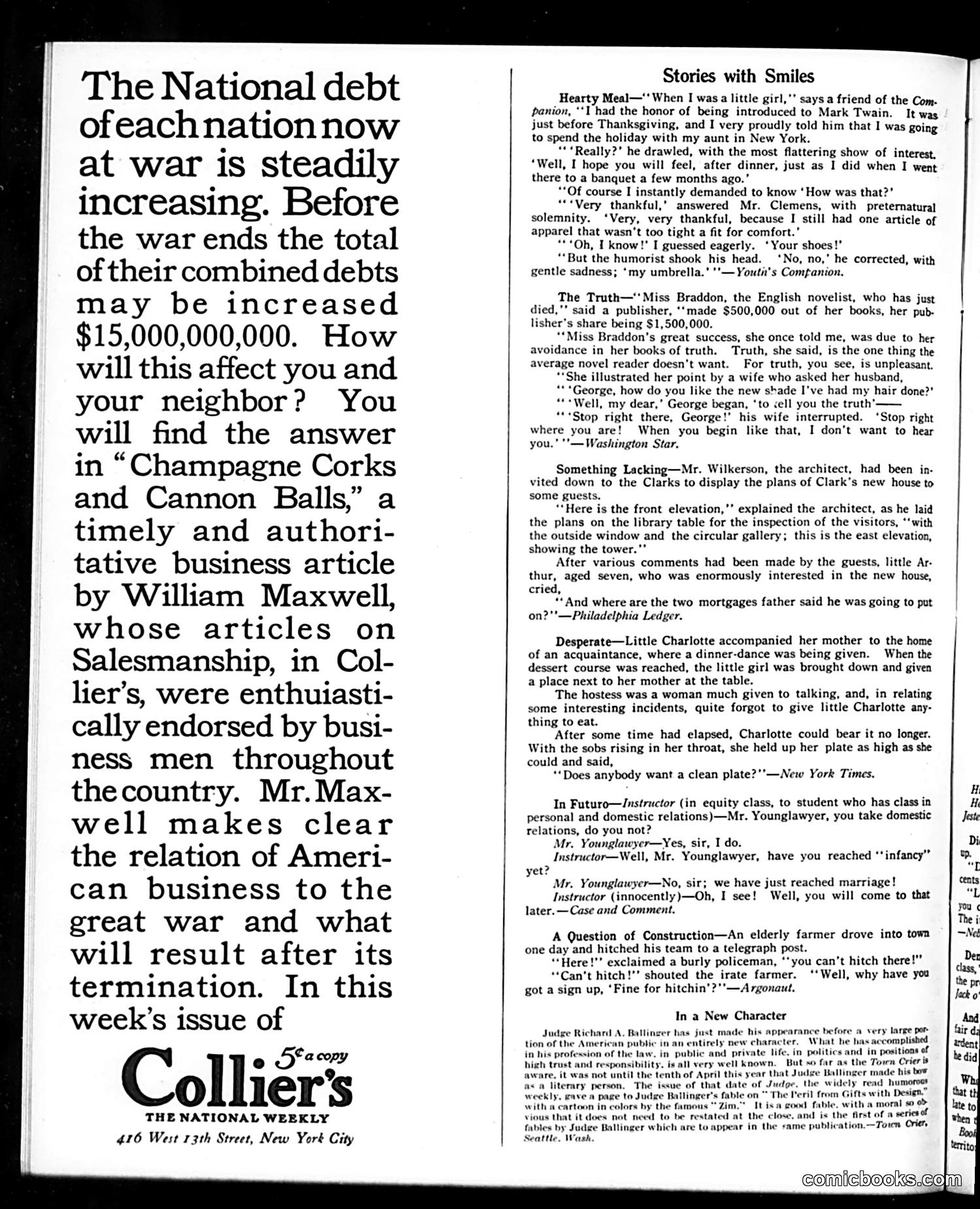
This page from *Judge* magazine contains no political cartoons—it's primarily advertising and humorous anecdotes. The left side promotes William Maxwell's article "Champagne Corks and Cannon Balls," which addresses **World War I's escalating national debts** ($15 billion combined increase predicted). Maxwell argues this financial burden will affect ordinary Americans' post-war economic lives. The right side offers satirical humor pieces, including: - A Mark Twain anecdote about overeating at dinner - A critique of commercial fiction prioritizing entertainment over truth - A child's innocent question about mortgages on a house - A neglected girl at a dinner party sarcastically asking who wants a "clean plate" These jokes reflect **early 20th-century middle-class concerns**: manners, conspicuous consumption, and the gap between polite social pretense and reality. The satire is gentle, targeting social hypocrisy rather than specific political figures.
📄 Transcribed text from this page (OCR, searchable)
Machine-transcribed from the original scan — historical spelling and the odd misread are preserved.
The National debt ofeach nation now at war is steadily increasing. Before the war ends the total of their combined debts may be increased $15,000,000,000. How will this affect you and your neighbor? You will find the answer in “Champagne Corks and Cannon Balls,” a timely and authori- tative business article by William Maxwell, whose articles on Salesmanship, in Col- lier’s, were enthuiasti- cally endorsed by busi- ness men throughout thecountry. Mr. Max- well makes clear the relation of Ameri- can business to the great war and what will result after its termination. In this week’s issue of Colliers THE NATIONAL WEEKLY 416 West 13th Street, New York City Stories with Smiles Hearty Meal—‘‘ When I wasa little girl,’’ says a friend of the Com. anion, *‘V had the honor of being introduced to Mark Twain. It was just before Thanksgiving, and I very proudly told him that I was going to spend the holiday with my aunt in New York. ‘**Really?’ he drawled, with the most flattering show of interest, ‘Well, I hope you will feel, after dinner, just as I did when I went there to a banquet a few months ago.’ “Of course I instantly demanded to know ‘How was that?’ “Very thankful,’ answered Mr. Clemens, with preternatural solemnity. ‘Very, very thankful, because I still had one article of apparel that wasn’t too tight a fit for comfort.’ “**Oh, I know!’ I guessed eagerly. ‘Your shoes!’ “But the humorist shook his head. ‘No, no,’ he corrected, with gentle sadness; ‘my umbrella.’ ''—Youti’s Companion. The Truth—''Miss Braddon, the English novelist, who has just died,’’ said a publisher, ‘‘made $500,000 out of her books, her pub- lisher’s share being $1,500,000. “*Miss Braddon’s great success, she once told me, was due to her avoidance in her books of truth. Truth, she said, is the one thing the average novel reader doesn't want. For truth, you see, is unpleasant. he illustrated her point by a wife who asked her husband, George, how do you like the new shade I've had my hair done?’ Well, my dear,’ George began, ‘to cell you the truth’. “**Stop right there, George!’ his wife interrupted. ‘Stop right where you are! When you begin like that, I don’t want to hear you.’ ''—Washington Star. Something Lacking—Mr. Wilkerson, the architect, had been in- vited down to the Clarks to display the plans of Clark’s new house to some guests. ‘*Here is the front elevation,’’ explained the architect, as he laid the plans on the library table for the inspection of the visitors, ‘‘with the outside window and the circular gallery; this is the east elevation, showing the tower."* After various comments had been made by the guests, little Ar- thur, aged seven, who was enormously interested in the new house, cried, “*And where are the two mortgages father said he was going to put on?''—Philadelphia Ledger. Desperate—Little Charlotte accompanied her mother to the home of an acquaintance, where a dinner-dance was being given. When the dessert course was reached, the little girl was brought down and given a place next to her mother at the table. The hostess was a woman much given to talking, and, in relating some interesting incidents, quite forgot to give little Charlotte any- thing to eat. After some time had elapsed, Charlotte could bear it no longer. With the sobs rising in her throat, she held up her plate as high as she could and said, ‘Does anybody want a clean plate?’"—New York Times. In Futuro—Jnstructor (in equity class, to student who has class in personal and domestic relations) —Mr. Younglawyer, you take domestic relations, do you not? Mr. Younglawyer—Yes, sir, I do. Instructor—Well, Mr. Younglawyer, have you reached ‘‘infancy”” yet? , Mr. Younglawyer—No, sit; we have just reached marriage! Instructor (innocently)—Oh, I see! Well, you will come to that later. —Case and Comment. A Question of Construction—An elderly farmer drove into town one day and hitched his team to a telegraph post. ‘Here!’ exclaimed a burly policeman, ‘‘you can't hitch there!"” ‘Can't hitch!’’ shouted the irate farmer. ‘‘Well, why have you got a sign up, ‘Fine for hitchin’?’'—Argonaut. In a New Character very large por 1s accomplished nd in positions of the Town Crier is r made his bow tion of the An |< profession week! ly, eave a page to Judge Bal 7 snot need a Ballinger which are to ap fe ne publication. —Town Crier, fables by Sud: Seattle. Wash. comichooks.com