
A complete issue · 24 pages · 1915
Judge — May 22, 1915
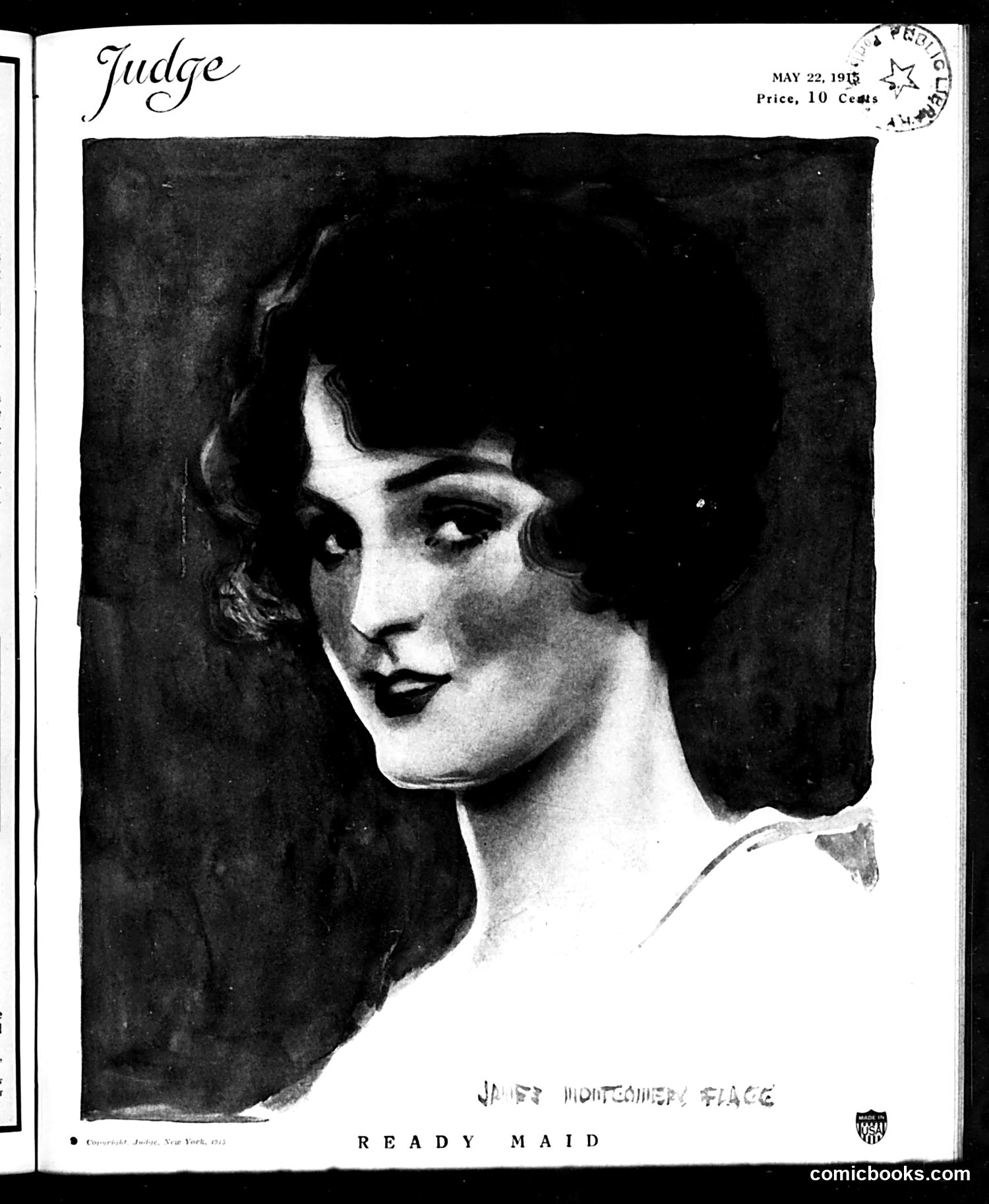
This is a **portrait photograph**, not a political cartoon. The page shows a glamorous headshot of a woman in profile from a 1915 issue of Judge magazine (price 10 cents). The caption reads "READY MAID" and there appears to be a credit line mentioning "JAMES MONTGOMERY FLAGG," the famous illustrator. This appears to be a **beauty or fashion feature** rather than satirical content. The image showcases 1920s-era styling—the bobbed hair, defined eyebrows, and dramatic makeup typical of the flapper era. Without additional context on the page, the specific subject's identity remains unclear, though the professional quality suggests she was a notable public figure of that period.
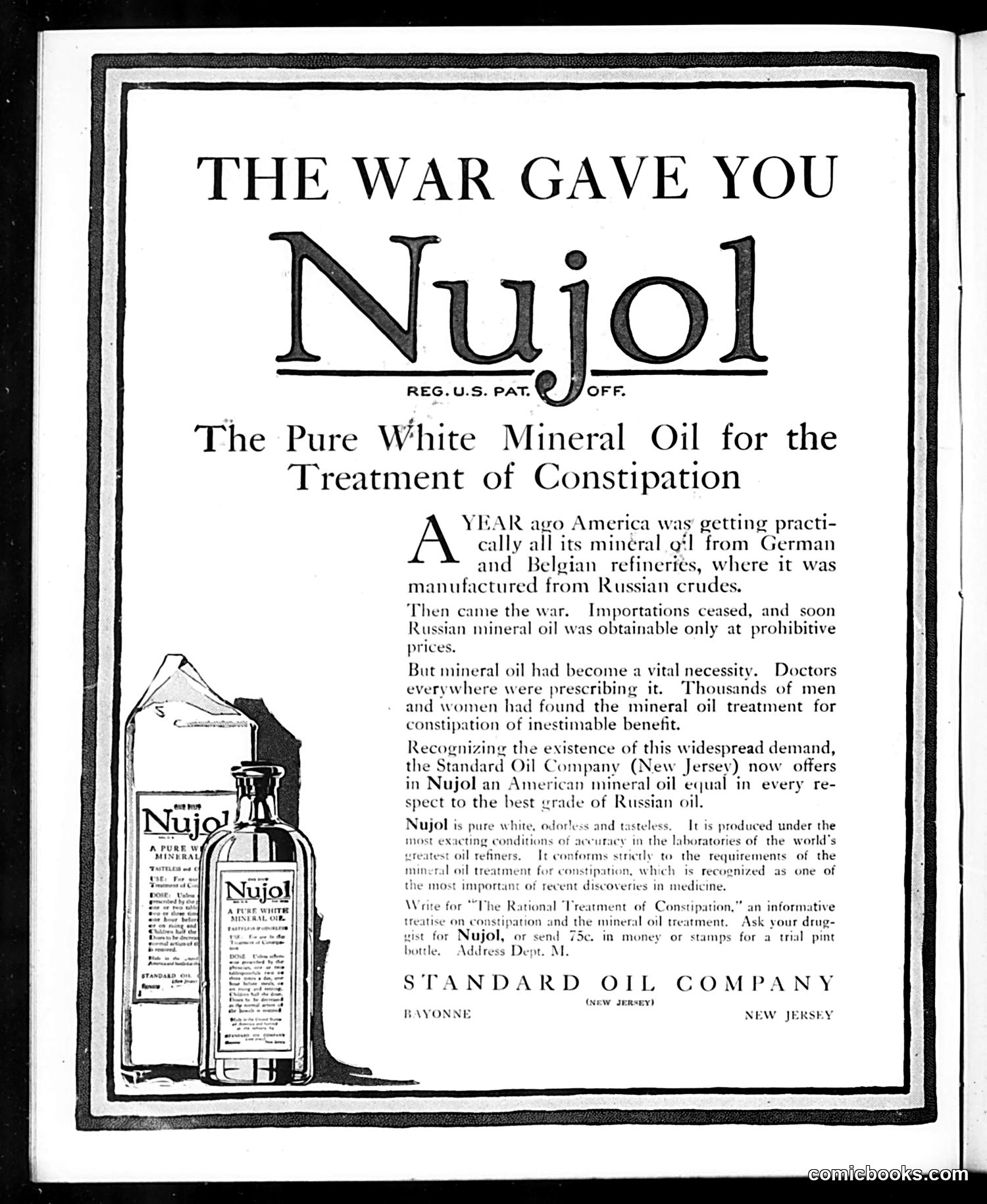
This page is primarily a **product advertisement for Nujol mineral oil**, not political satire. The Standard Oil Company (New Jersey) marketed Nujol as a constipation treatment. The ad uses **World War I as a marketing angle**, claiming that during the war, America lost access to Russian mineral oil (previously imported through German and Belgian refineries). This created a supply crisis, but doctors had discovered mineral oil's medical benefits for constipation treatment. The company positioned Nujol as solving this wartime shortage while meeting genuine medical demand. The two bottles shown are product images. There's **no cartoon or satire**—this is straightforward advertising leveraging wartime circumstances to promote a laxative product.
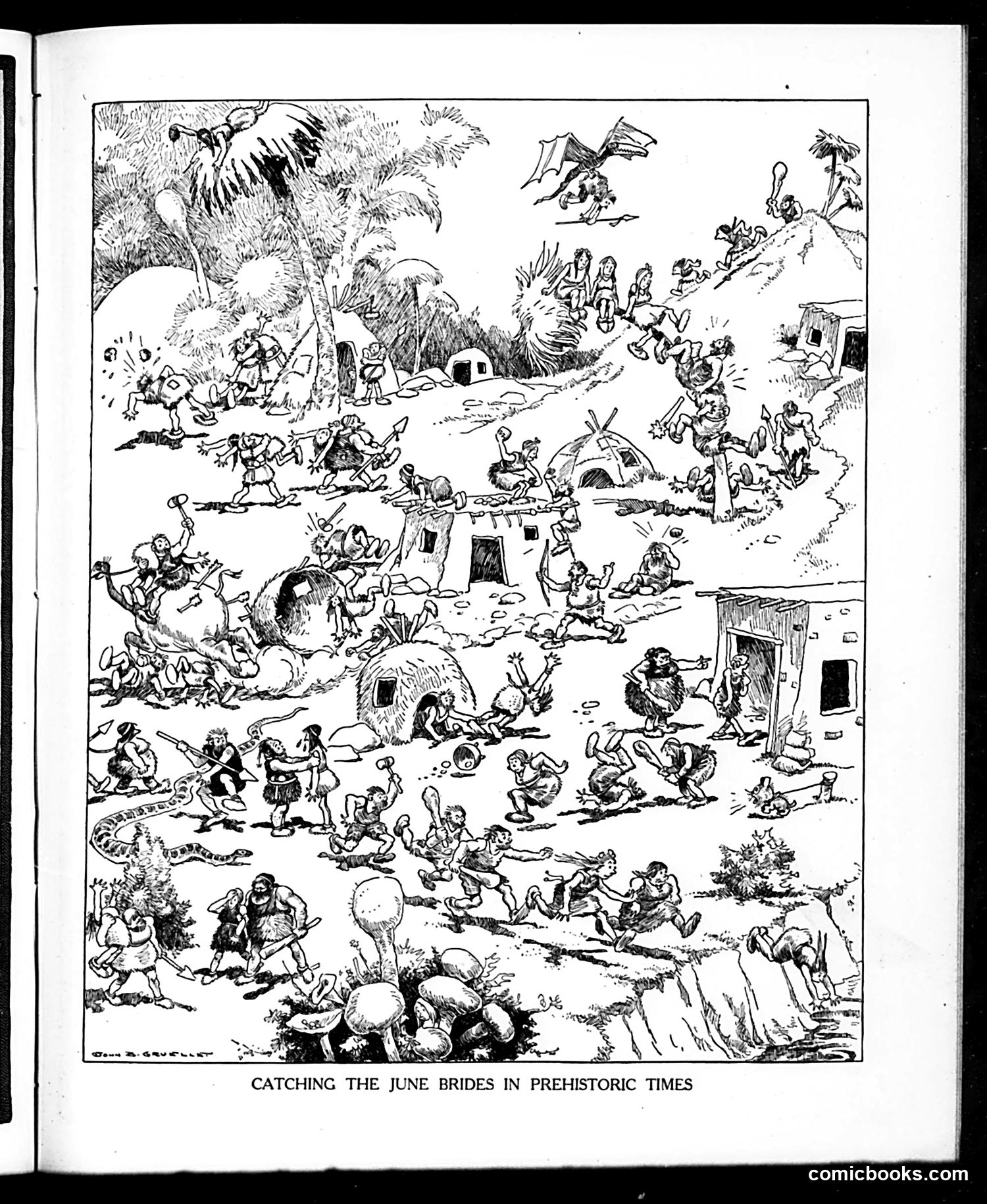
This humorous cartoon presents a satirical fantasy scenario: what if the tradition of catching June brides existed in prehistoric/caveman times? The image depicts a chaotic prehistoric settlement where numerous small figures engage in wild chasing and capturing activities among primitive dwellings, huts, and natural features like large mushrooms and palm trees. The satire plays on the contrast between civilized modern wedding customs and imagined primitive behavior. The joke suggests that the boisterous, somewhat barbaric practice of "catching" brides (a playful wedding tradition) would have fit naturally into prehistoric society. This is straightforward observational humor requiring no specific political reference—simply anachronistic comedy about human nature and courtship customs across time periods.
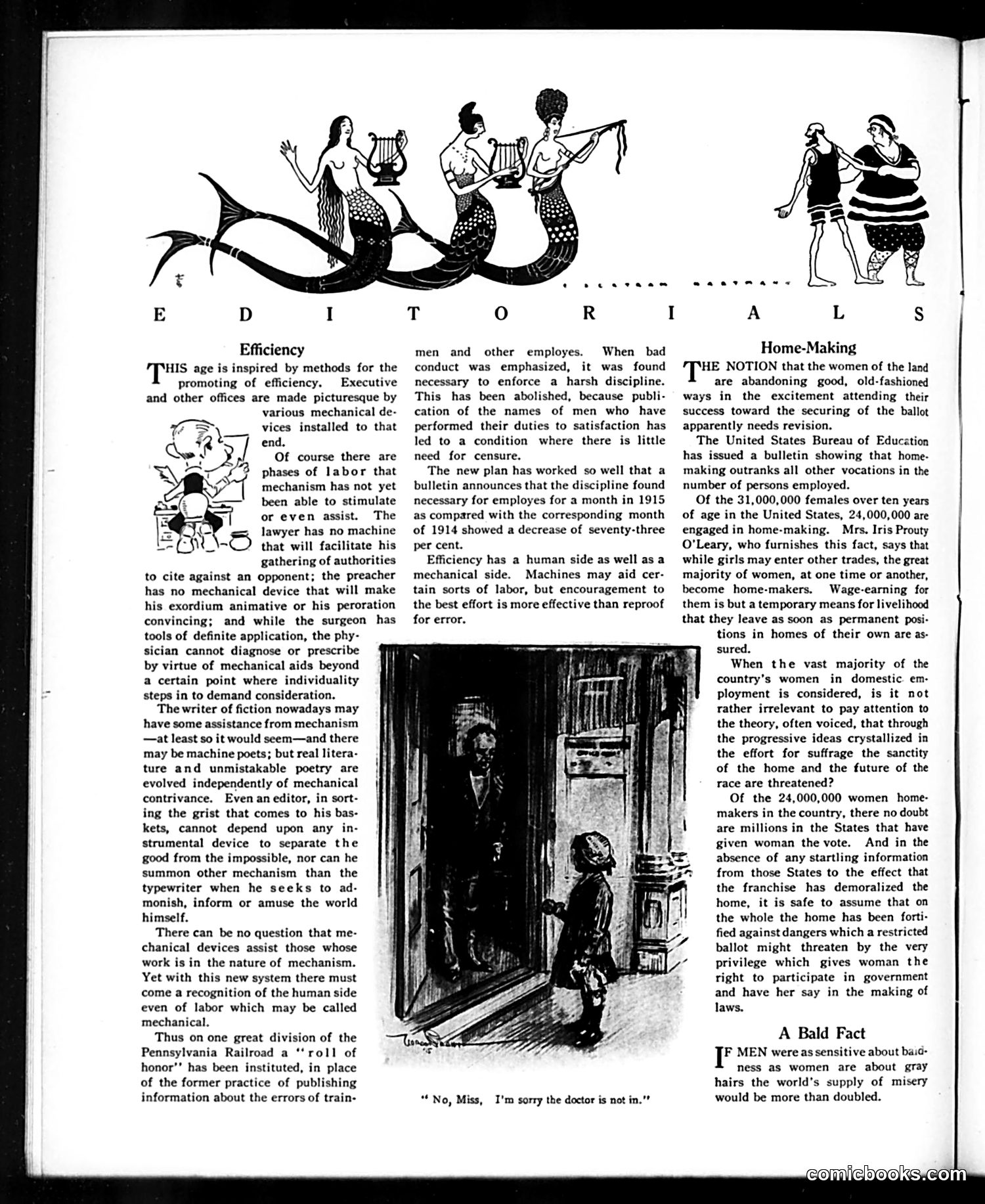
**Top Illustration ("Editorials"):** A decorative header showing mermaids with musical instruments and two figures on the right, appears to be classical/mythological imagery rather than political satire. **Main Content:** The left column discusses "Efficiency" in labor and management, advocating for mechanical/systematic approaches to workplace discipline. The right column addresses "Home-Making," arguing that women's domestic labor deserves recognition as legitimate employment. It cites U.S. Census data showing 24,000,000 women engaged in home-making, and defends homemaking against critics who view it as irrelevant to progressive movements like suffrage. **Illustration (center):** A sketch showing a patient at a doctor's door with caption "No, Miss, I'm sorry the doctor is not in," appears to be a separate humorous vignette. The page reflects early-20th-century debates about women's work, suffrage, and industrial efficiency.
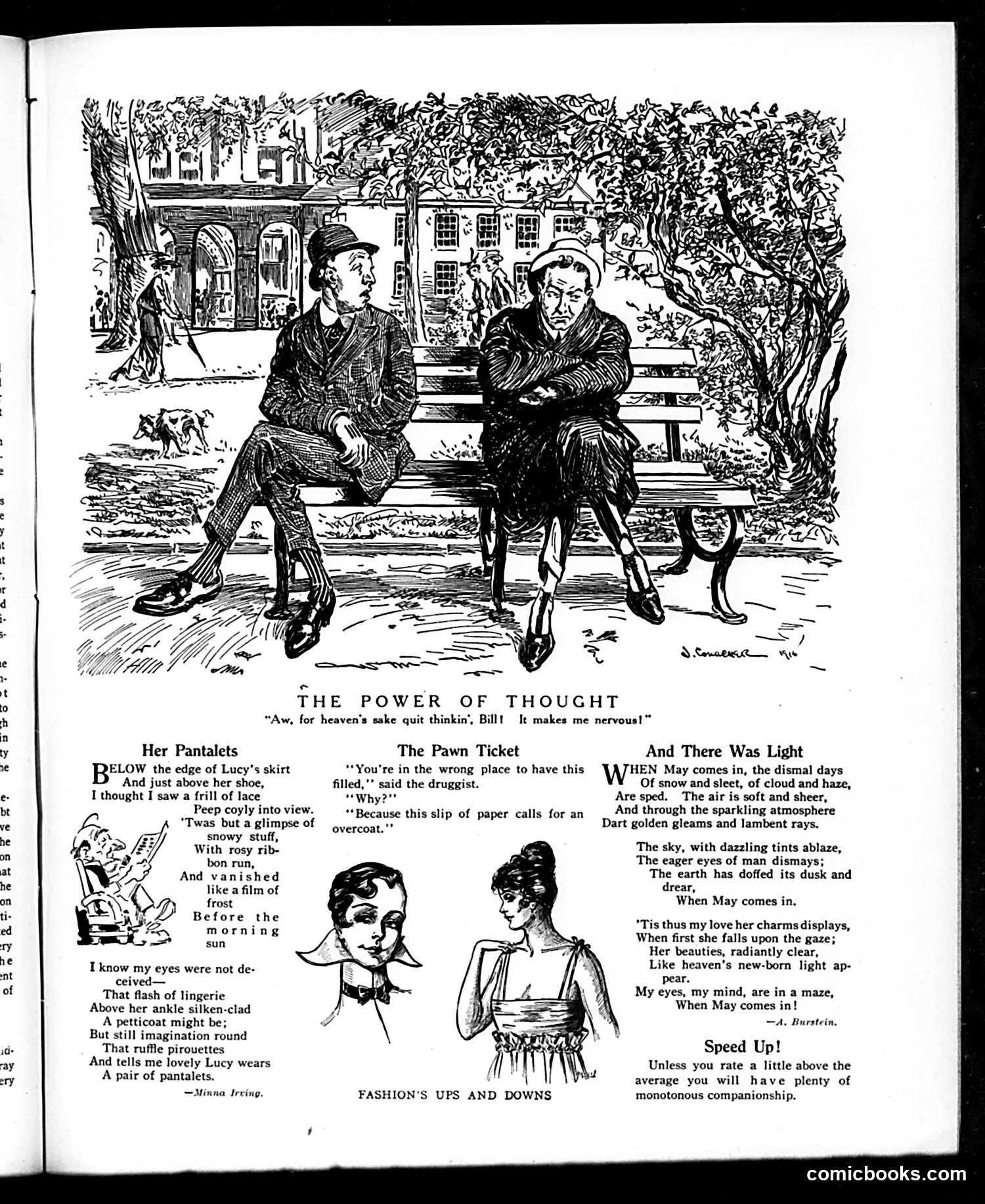
The main cartoon, "The Power of Thought," depicts two men on a bench: one appears anxious ("for heaven's sake quit thinkin', Bill! It makes me nervous!"). This satirizes overthinking or excessive contemplation as socially bothersome. Below are three unrelated pieces: **"Her Pantalets"** (by Minna Irving) is a nostalgic poem about observing a woman's underwear/stockings, reflecting Victorian-era fascinations with modest glimpses of female clothing. **"The Pawn Ticket"** presents a drugstore comedic exchange about a prescription being in the "wrong place"—likely a visual gag about misfiled paperwork. **"And There Was Light"** is a sentimental poem celebrating May's arrival and a lover's beauty. **"Fashion's Ups and Downs"** shows two fashion sketches. "Speed Up!" warns against monotonous companionship—relationship advice suggesting variety prevents boredom. The page combines humor, sentiment, and social commentary typical of Judge's content.
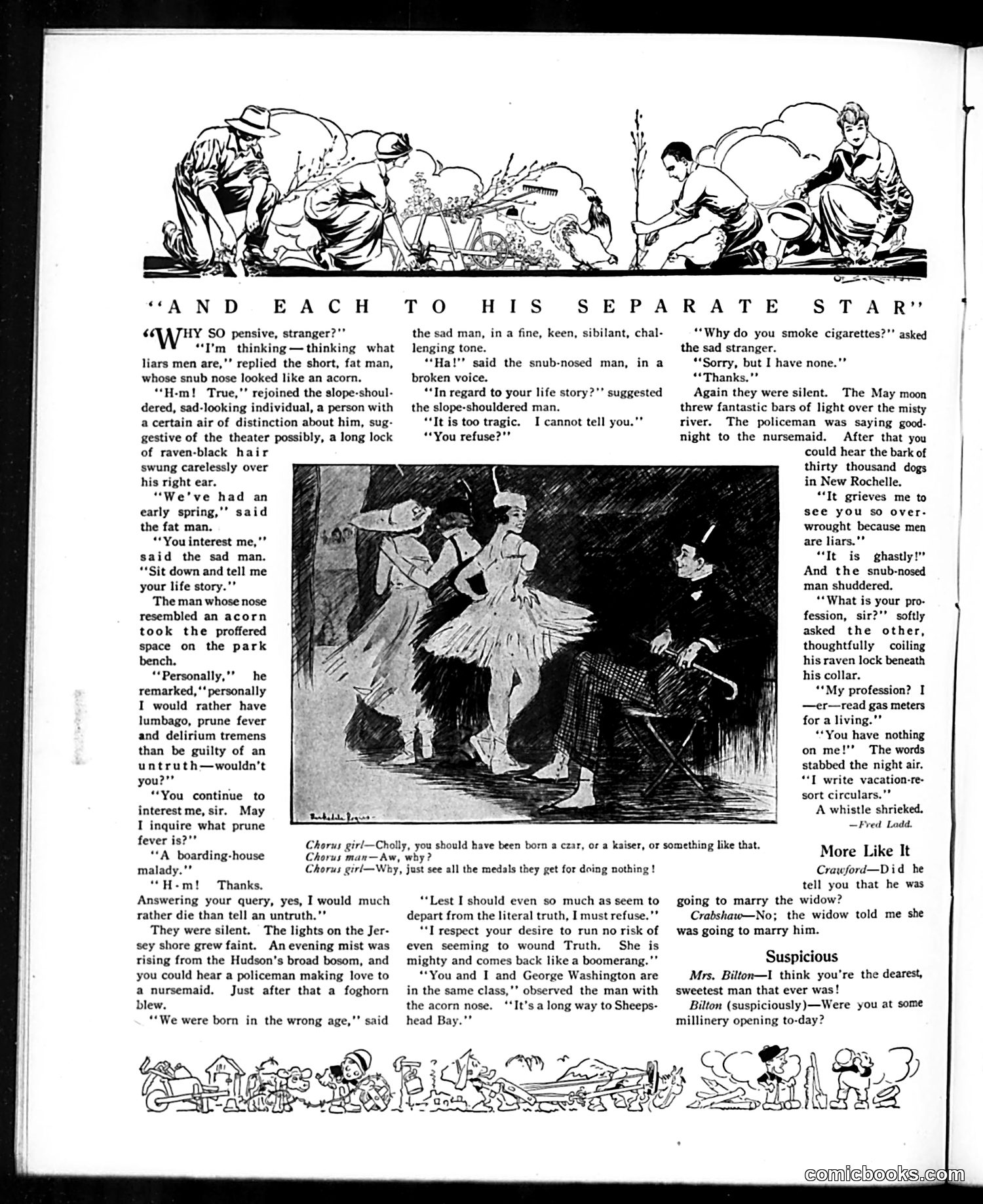
This satirical story mocks professional liars and hypocrites. Two men meet on a park bench near the Hudson River and bond over their shared claim to despise dishonesty. The fat man with an acorn-shaped nose and the theatrical-looking sad man compete to prove their absolute integrity, each claiming they'd rather suffer illness or death than lie. The joke emerges when they finally reveal their professions: one reads gas meters, the other writes vacation resort circulars—both occupations inherently requiring deception and exaggeration to customers. The story satirizes how people convince themselves of their own virtue while working in fundamentally dishonest trades. The accompanying chorus girl joke reinforces the theme: people value doing nothing (like czars receiving medals) over honest work. The piece mocks self-deception and the gap between claimed morality and actual behavior.
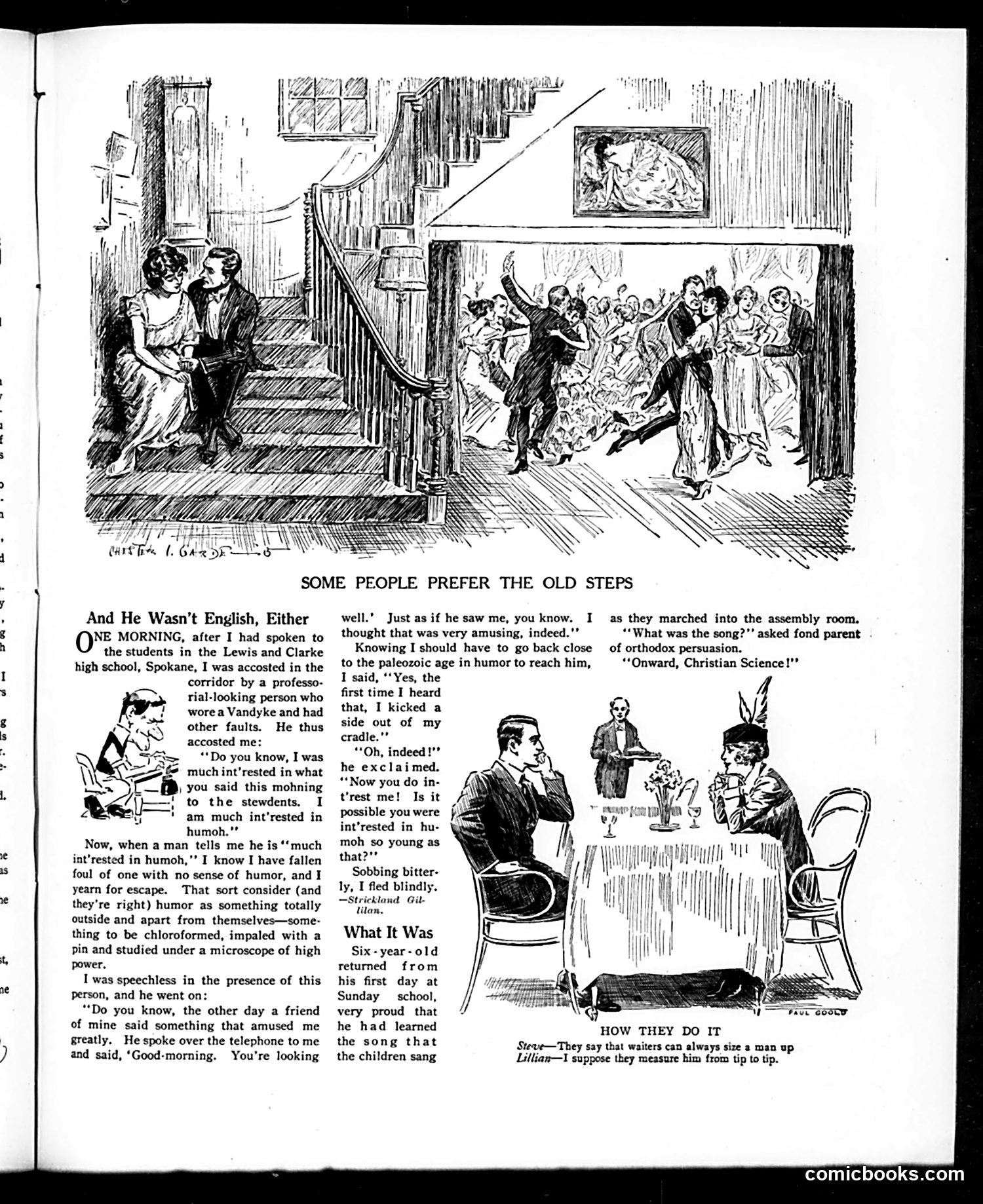
This page satirizes pretentious intellectuals who claim to appreciate humor but demonstrably lack it. The central anecdote describes a professorial man (identifiable by his Vandyke beard) who tells the narrator he is "much int'rested in humoh"—the misspelling itself mocking his affected speech. The narrator recognizes this as a red flag: people who are genuinely funny don't obsess over humor academically; they simply possess it naturally. The joke culminates when the professor's "amusing" story—about a friend greeting him over the telephone—falls completely flat, revealing his complete humorlessness. The top cartoon illustrates the contrast between lively, spontaneous social enjoyment (left) and stiff, joyless gatherings (right), reinforcing the theme that authentic humor cannot be studied or performed. The bottom anecdotes provide lighter supporting jokes about social observation and children's Sunday school behavior, maintaining the magazine's satirical tone about American social pretension.
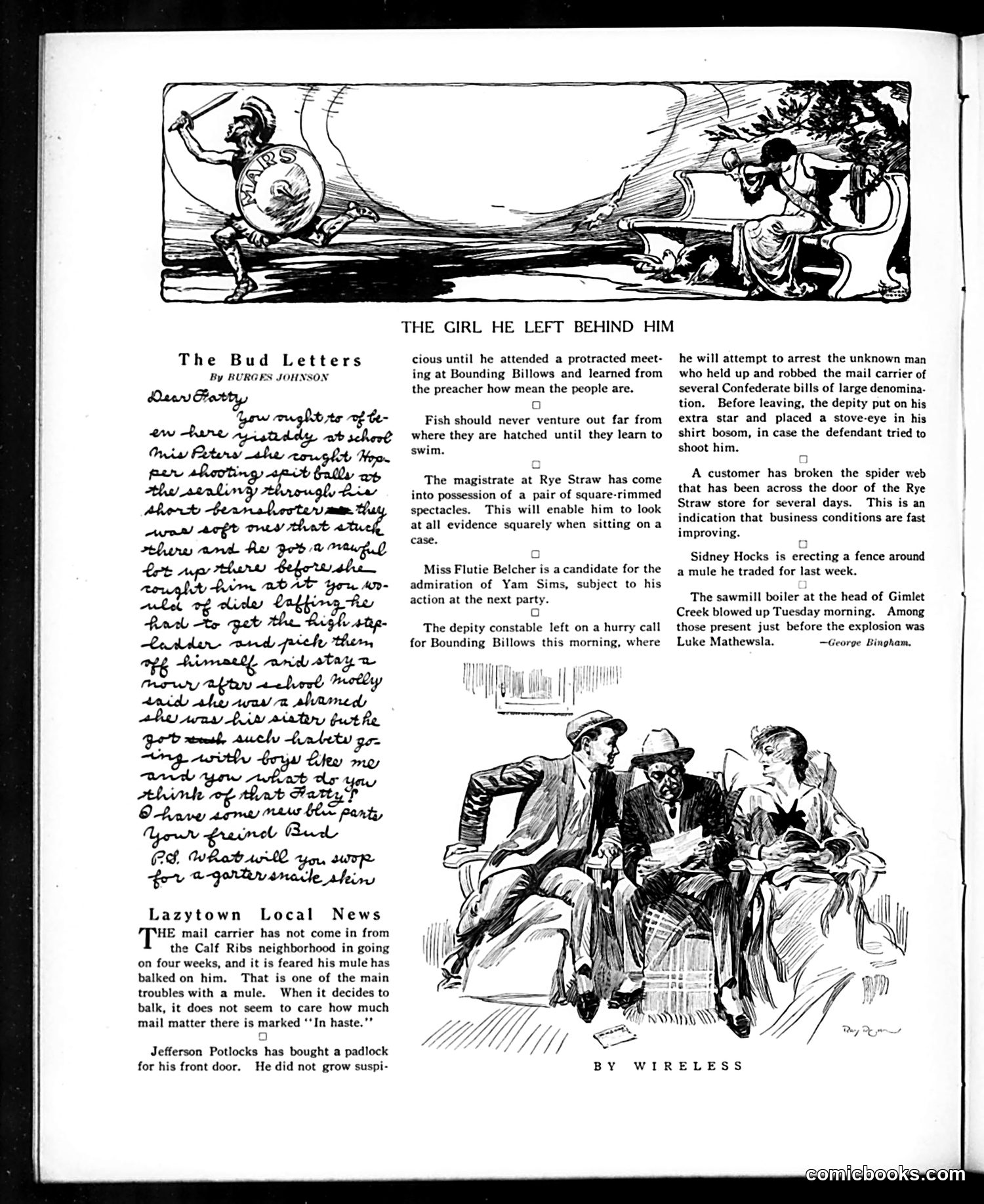
This page from *Judge* magazine presents humorous local news and gossip from fictional rural communities ("Lazytown," "Rye Straw," "Bounding Billows"). **Top illustration**: "The Girl He Left Behind Him" depicts classical/allegorical figures with a decorative border—likely illustrating a sentimental song or romantic theme common in the era. **"The Bud Letters"**: A handwritten column of personal correspondence discussing local scandals and gossip. **"Lazytown Local News"**: Mock-serious newspaper items poking fun at rural life—incompetent mail delivery, absurd local characters (magistrate with new spectacles learning to judge "squarely," a man buying a padlock after learning people are mean), and darkly comic incidents (mail carrier robbery, sawmill explosion). **"By Wireless" cartoon**: Three men sharing gossip, emphasizing how local rumors spread. The satire ridicules rustic inefficiency, superstition, and the petty drama of small-town life. It's genteel mockery of rural America for an urbane magazine readership—poking fun at farmers, mules, crude justice systems, and simple folk without malice.
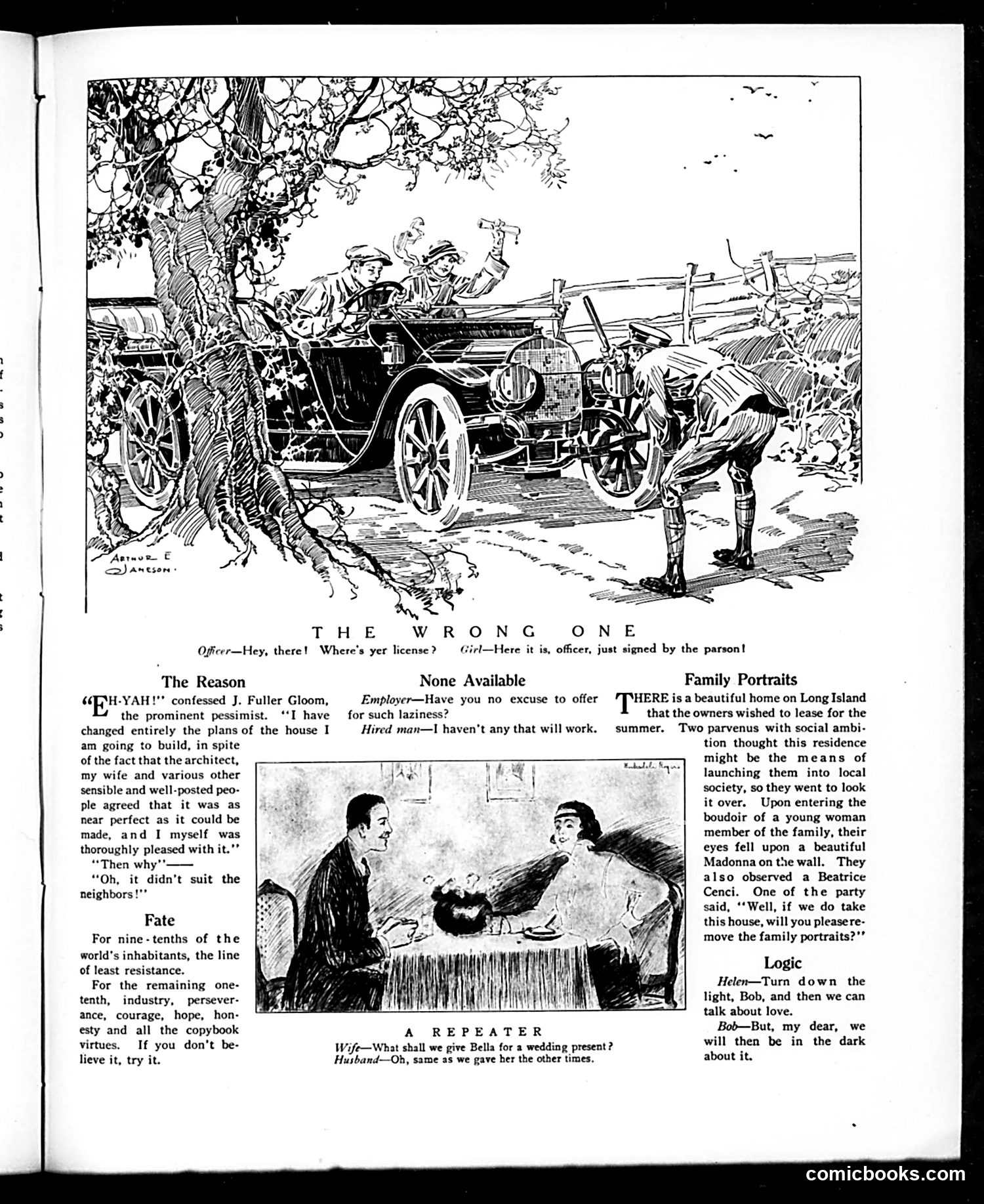
This page contains three unrelated satirical pieces typical of early 20th-century humor magazines: **"The Wrong One"** (top cartoon): A motorist is stopped by a police officer demanding a license. The joke: the woman passenger produces a marriage license instead of a driver's license—satirizing both early automobile regulations and women's legal status as essentially defined by marital status. **"The Reason"** and other text pieces: Brief humorous anecdotes mocking human nature. "The Reason" skewers social anxiety—a man abandons his perfect house design because neighbors disapproved. "A Repeater" jokes about unimaginative gift-giving to a woman being married multiple times. **"Logic"** (bottom): A flirtation joke playing on the double meaning of "in the dark"—the couple wants darkness for romance, but the man quips they need light to actually discuss love rationally. These reflect Judge's focus on domestic comedy, class commentary, and gentle social satire rather than political content. The humor assumes middle-class readers familiar with automobiles, home ownership, and courtship conventions.
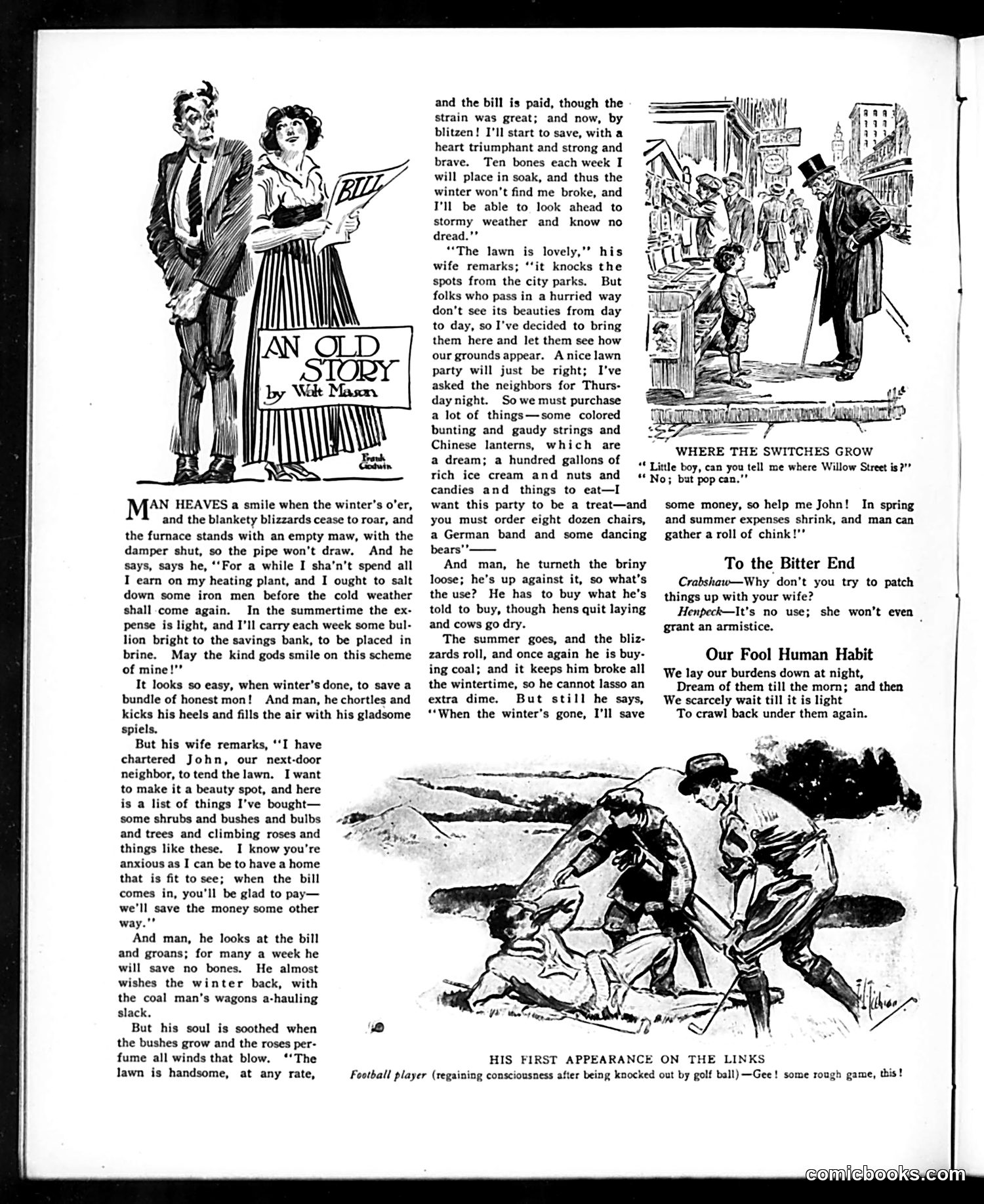
This page satirizes the working-class husband's perpetual financial struggle. The main story follows a man who, after paying winter heating bills, vows to save money by depositing "ten bones each week" in a savings account. However, his wife—having hired their neighbor John to beautify their lawn—announces plans for an expensive lawn party requiring Chinese lanterns, ice cream, chairs, and a German band. The satire captures the cyclical trap of lower-middle-class life: summer expenses (lawn care, entertainment) replace winter costs, ensuring the man never accumulates savings. His optimism about financial security is immediately undermined by his wife's spending. The accompanying cartoons ("Where the Switches Grow," "To the Bitter End," and "Our Fool Human Habit") reinforce themes of domestic expenses, marital conflict, and human weakness—all common Judge magazine humor targets depicting the struggle of ordinary Americans managing household budgets.
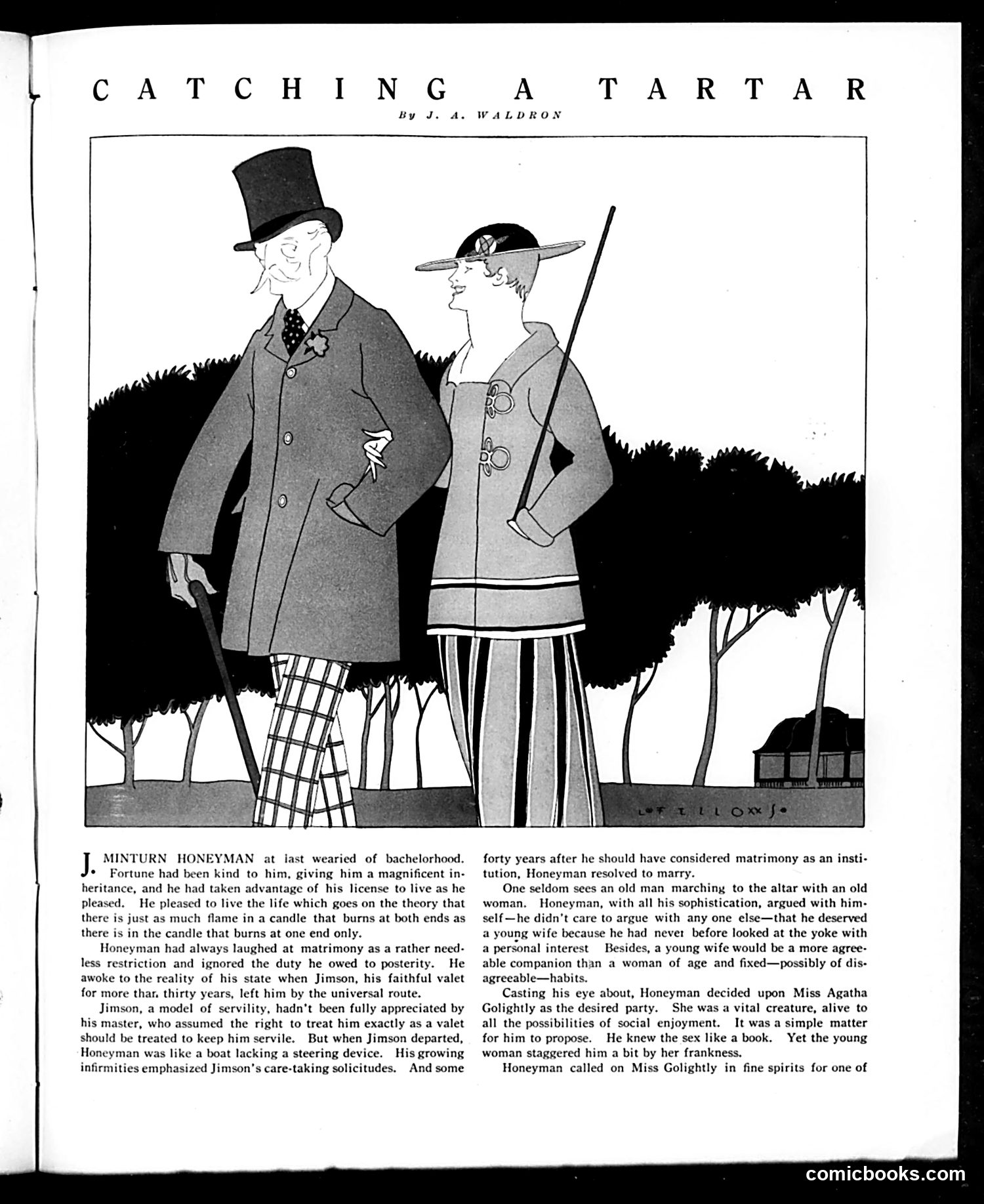
This story satirizes a wealthy bachelor's misguided courtship. Minturn Honeyman, a privileged man who's lived selfishly for forty years, finally decides to marry after his longtime valet Jimson retires, leaving him helpless. Rather than courting an age-appropriate woman, Honeyman pursues young Miss Agatha Golightly, reasoning that a young wife would be more pleasant company than an older woman. The title "Catching a Tartar" refers to the idiom meaning to encounter someone unexpectedly formidable or difficult to handle. The satire targets Honeyman's entitled assumptions: his belief he can easily manipulate "the sex" despite knowing nothing of actual women, and his self-serving logic that a younger woman should accept him based on his wealth and sophistication. Miss Golightly's unexpected "frankness" suggests she won't be the compliant, decorative wife he imagines—implying his comeuppance.
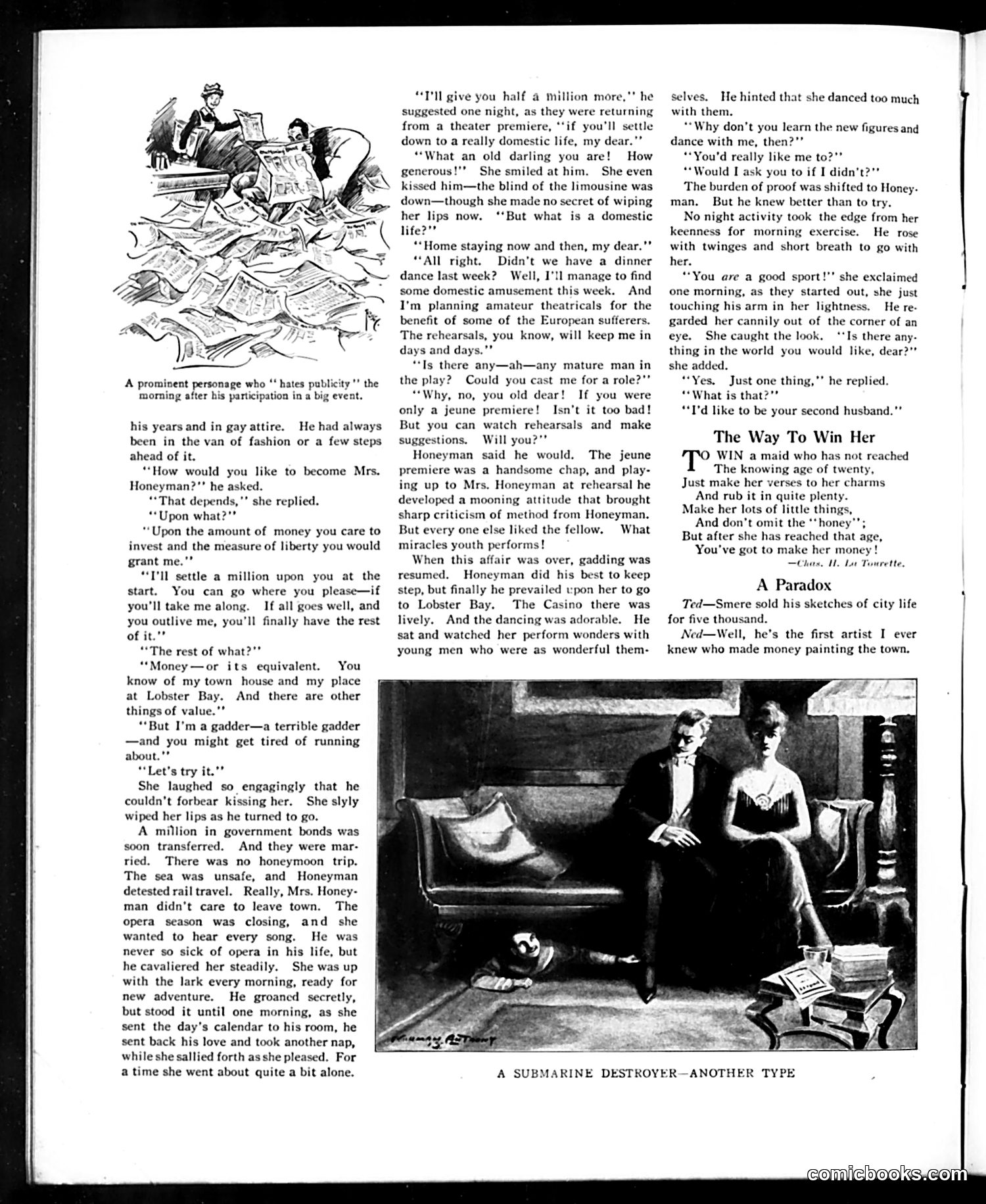
This page satirizes a wealthy man's marriage to a young, pleasure-seeking woman. The narrative follows "Honeyman," who offers a million dollars to marry a woman who admits she's a "gadder" (restless socialite). The satire's point: Despite his wealth and attempts to domesticate her through additional money ("half a million more"), she remains wholly uninterested in home life. She pursues opera, amateur theatricals, dancing, and morning exercise—anything but domesticity. When he finally joins her activities, he's exhausted while she remains energized. The cartoon at top left (captioned about someone who "hates publicity" after a big event) appears to show a disheveled man, likely commenting on wealthy men's public embarrassment from such marriages. The underlying social critique targets: wealthy older men's futile attempts to purchase young wives' compliance, and the independence of modern women who view marriage as financial transaction rather than domestic commitment. The woman's strategic lip-wiping after kisses suggests calculated manipulation. This reflects 1920s anxieties about changing gender roles and the "new woman."
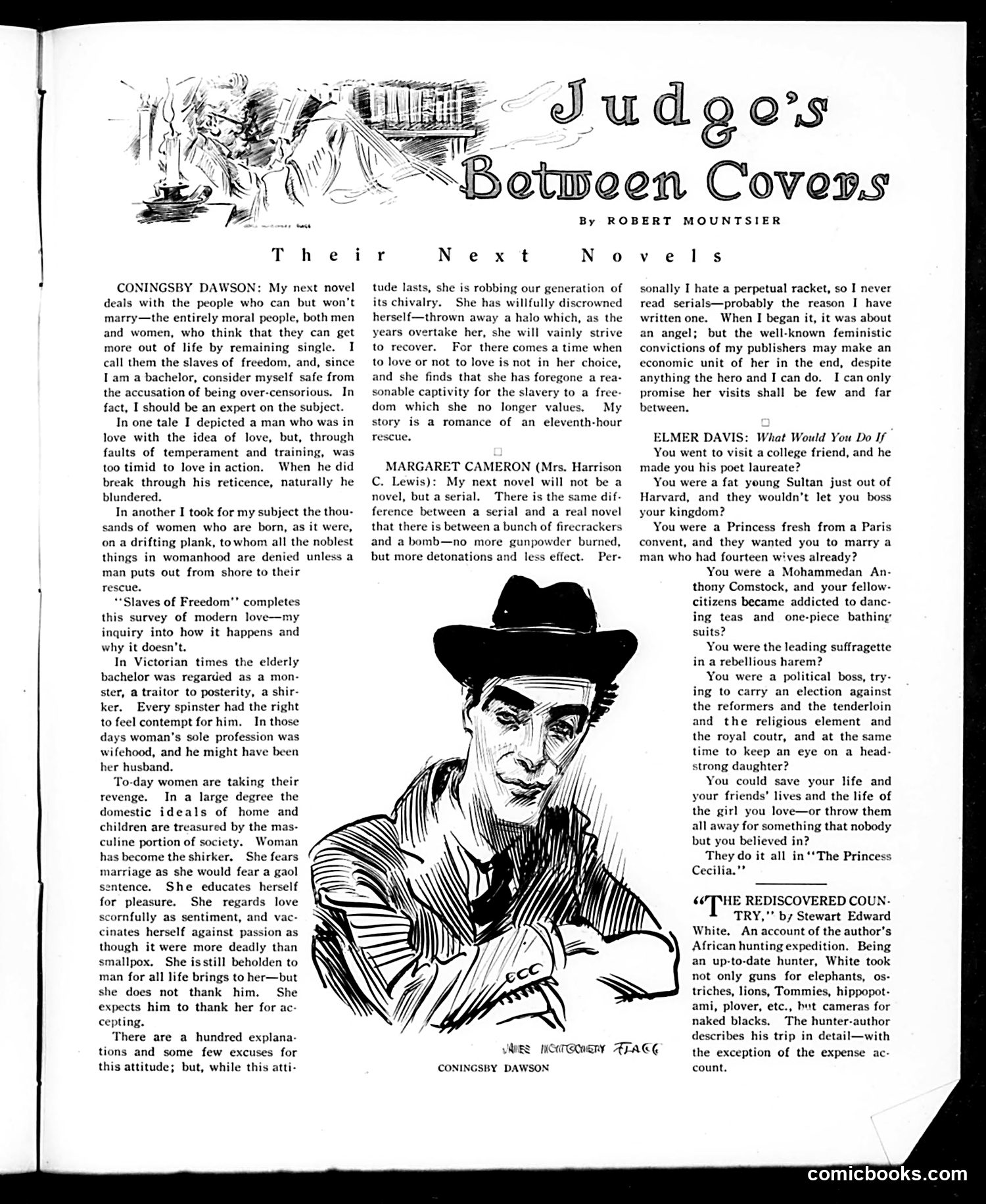
This page from *Judge* magazine features author interviews about their upcoming novels, with commentary on contemporary social attitudes toward marriage and gender roles. **The Main Satire:** The portrait shows **Coningsby Dawson**, a bachelor novelist discussing his book "Slaves of Freedom." The satire centers on modern women's rejection of marriage. Dawson presents women as having reversed Victorian social dynamics—once scorned for remaining single, women now deliberately avoid marriage, viewing it as imprisonment rather than fulfillment. He critiques this as ungrateful "revenge," arguing women abandon their "halo" of femininity and chivalry while still depending on men economically. **The Political/Social Context:** This reflects early 20th-century anxiety about women's increasing independence and the suffragette movement. The text sarcastically portrays educated women choosing careers and autonomy as selfish and emasculating, representing conservative backlash against women's liberation. **Other Authors Listed:** Margaret Cameron discusses serialized fiction, while Elmer Davis presents hypothetical scenarios (Sultan, Princess, reformer, suffragette) that appear to mock progressive causes through absurdist scenarios.
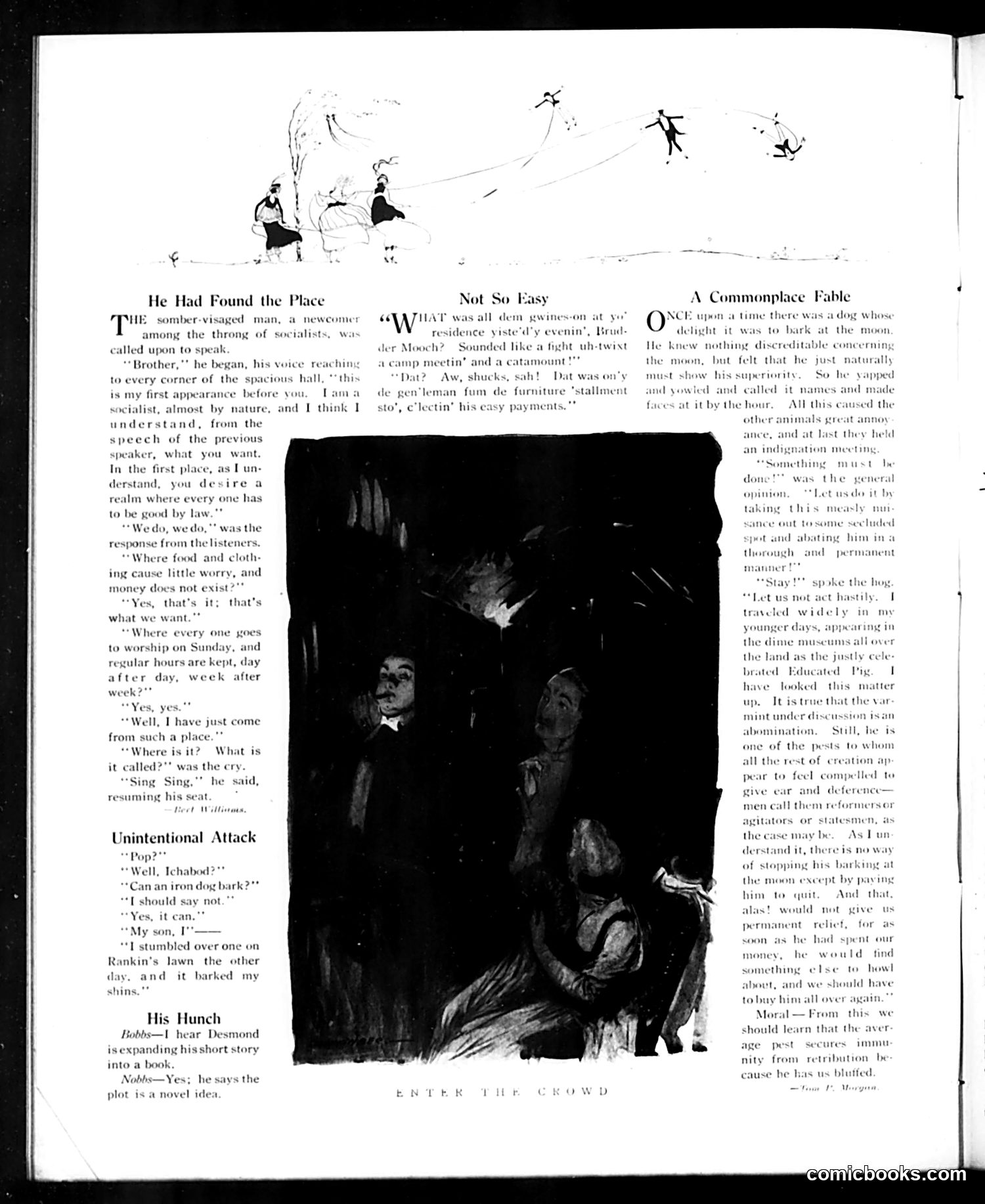
This page contains three separate satirical pieces: **"He Had Found the Place"** (left): A socialist speaker advocates for a society where "everyone has to be good by law." A heckler responds that such a place already exists—Sing Sing prison. The satire mocks socialist idealism by suggesting their utopian vision resembles forced incarceration. **"Not So Easy"** (center): A dialect-heavy piece (using affected Black vernacular common to period humor) where someone describes chaotic furniture installment payment disputes as sounding like fights or wild animals. The joke relies on period stereotypes. **"A Commonplace Fable"** (right): Animals debate whether to punish a dog that barks at the moon. One argues against action, claiming the "pest" will eventually spend their money and find "something else to howl about." The moral: troublemakers secure immunity through exhausting their critics' resources. This likely satirizes contemporary political agitators or reform movements. The cartoons above illustrate each story with period-appropriate line drawings showing people in discussion or conflict.
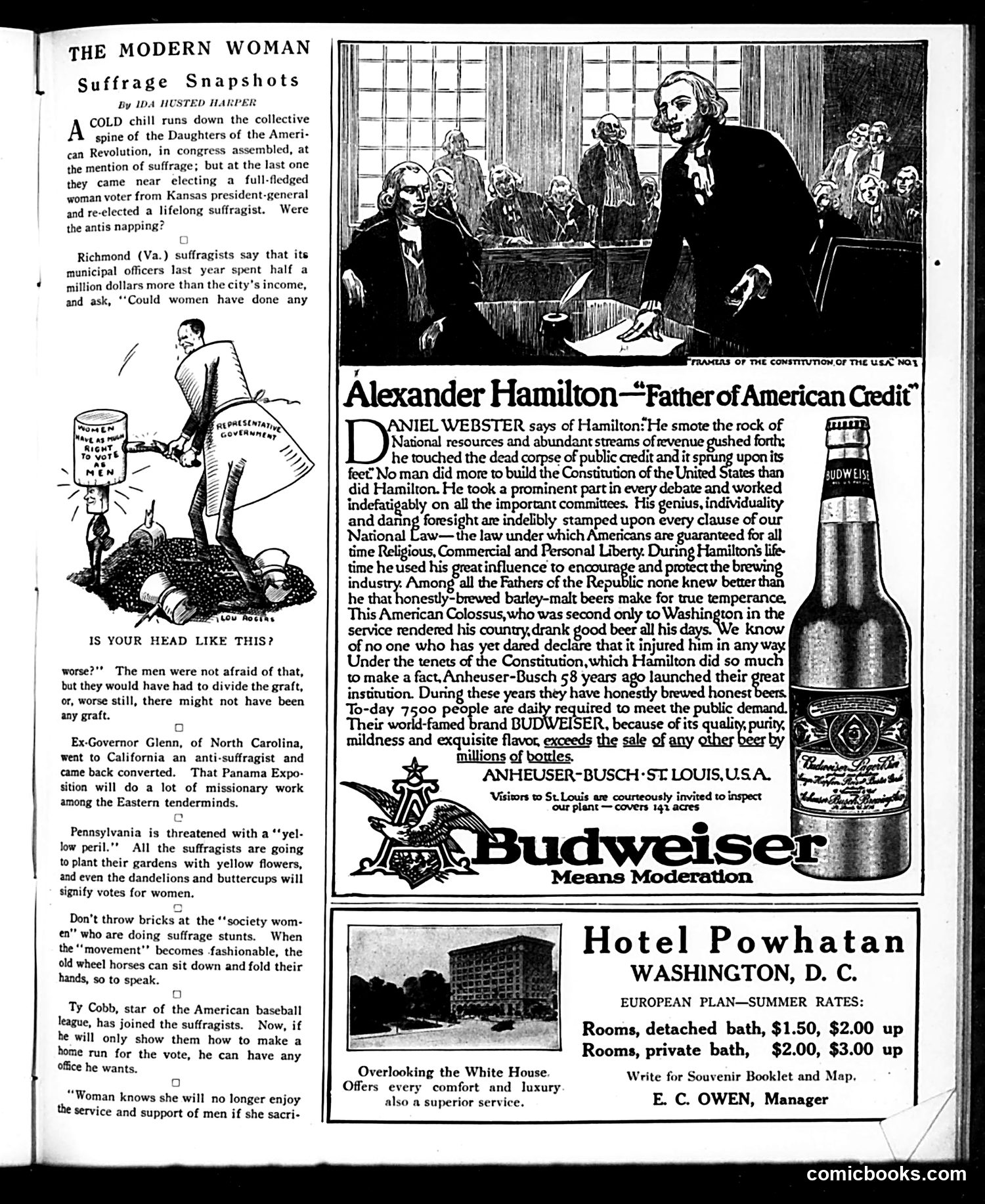
This page from *Judge* magazine contains anti-suffrage commentary disguised as news items, written by Ida Husted Harper (though Harper was actually a *pro*-suffrage activist, making the attribution unclear or possibly ironic). The satire mocks women's suffrage through mockery: Richmond suffragists are portrayed as hypocrites (questioning male corruption while being ineffectual); Pennsylvania suffragists are ridiculous (planting yellow flowers for votes); even celebrity endorsements (baseball star Ty Cobb) are presented as absurd. The opening jab at the Daughters of the American Revolution suggests even conservative women were nearly won over by suffrage arguments—presented as scandalous. The cartoons on the left reinforce the message through caricature: a woman voter depicted as incompetent ("Is your head like this?"), balancing on unstable ground labeled with women's issues. The page also contains full-page advertisements (Anheuser-Busch beer, Hotel Powhatan) that occupy significant space, making this largely a commercial publication using suffrage satire as editorial content.
This page is primarily **advertising and masthead information** rather than a political cartoon. The substantive content is "A Sorry Trick" by Orcula W. Haskell—a **satirical article about women's suffrage**. It mocks a Chamber of Commerce that arrogantly refused to let suffragists speak, claiming women shouldn't "meddle" in their affairs. The joke: when these same businessmen later needed expert advice on establishing a city market, the U.S. Department of Agriculture sent a competent female inspector, Acusah Lippincott. The men are now humiliated, learning that women are capable professionals—not mere impediments to business. The page also contains **anti-suffrage arguments** being mocked: that voting would compromise women's "charm," that women prefer staying home, and that suffrage threatens family unity. The ads (Black & White Scotch Whisky, Hotel Aspinwall) are period standard advertising. **Context**: This reflects 1915 suffrage debates, just five years before the 19th Amendment's passage.
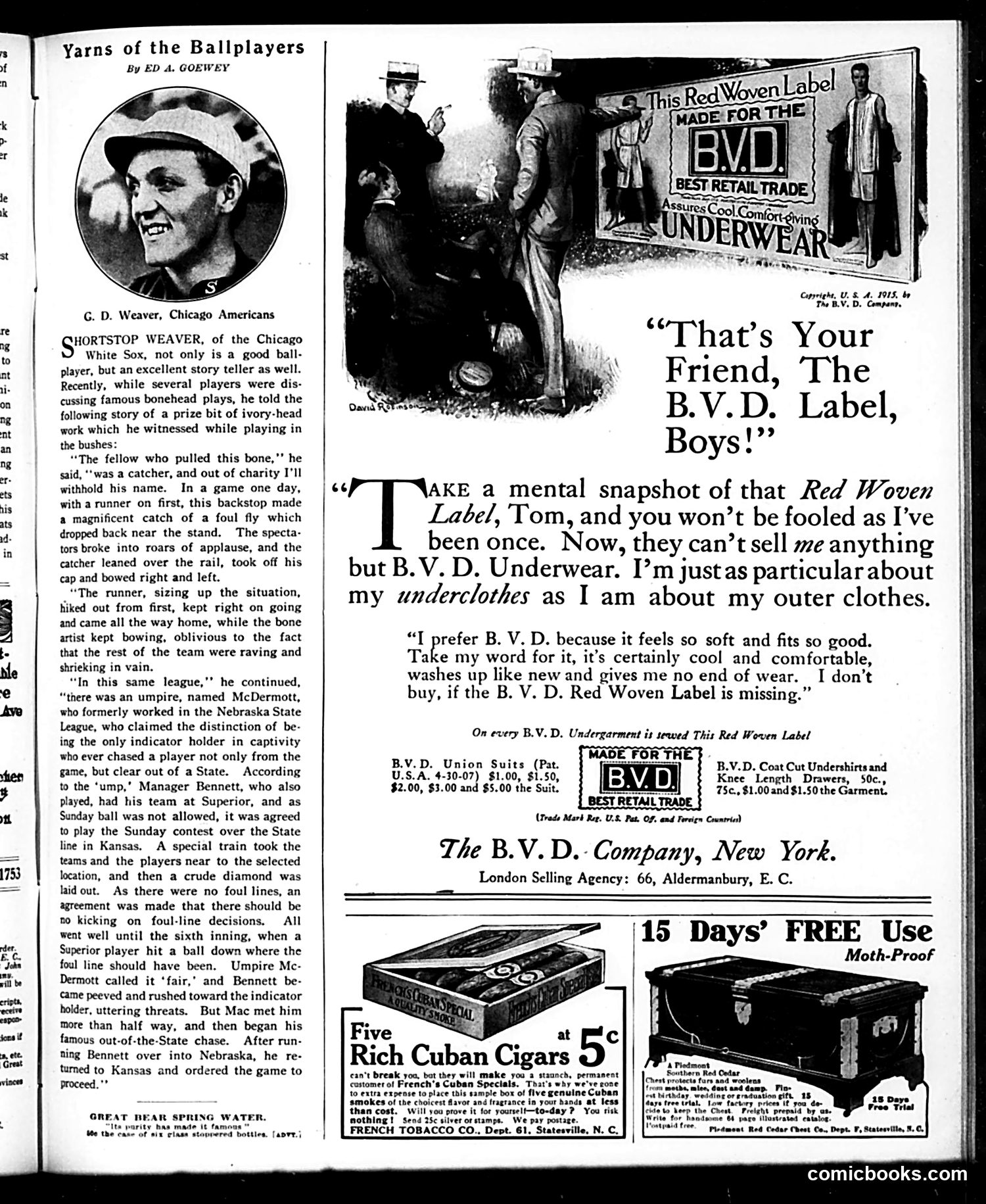
This page combines sports humor with advertising. The left column features a story by G.D. Weaver, shortstop for the Chicago White Sox, recounting "bonehead plays" from minor league baseball. The anecdotes mock incompetent players—a catcher so pleased with catching a foul ball that he bows and misses the runner scoring, and an umpire who chases a manager across state lines during a Sunday game played in Kansas to evade local laws. The dominant right side is a **B.V.D. underwear advertisement** featuring a testimonial claiming the brand's red woven label guarantees quality undergarments. The ad uses peer-pressure marketing ("That's Your Friend"), targeting male readers by associating the product with discernment and durability. Additional small ads promote Cuban cigars and a moth-proof storage trunk. The page reflects early-20th-century print culture mixing entertainment, athletics, and consumer goods marketing.
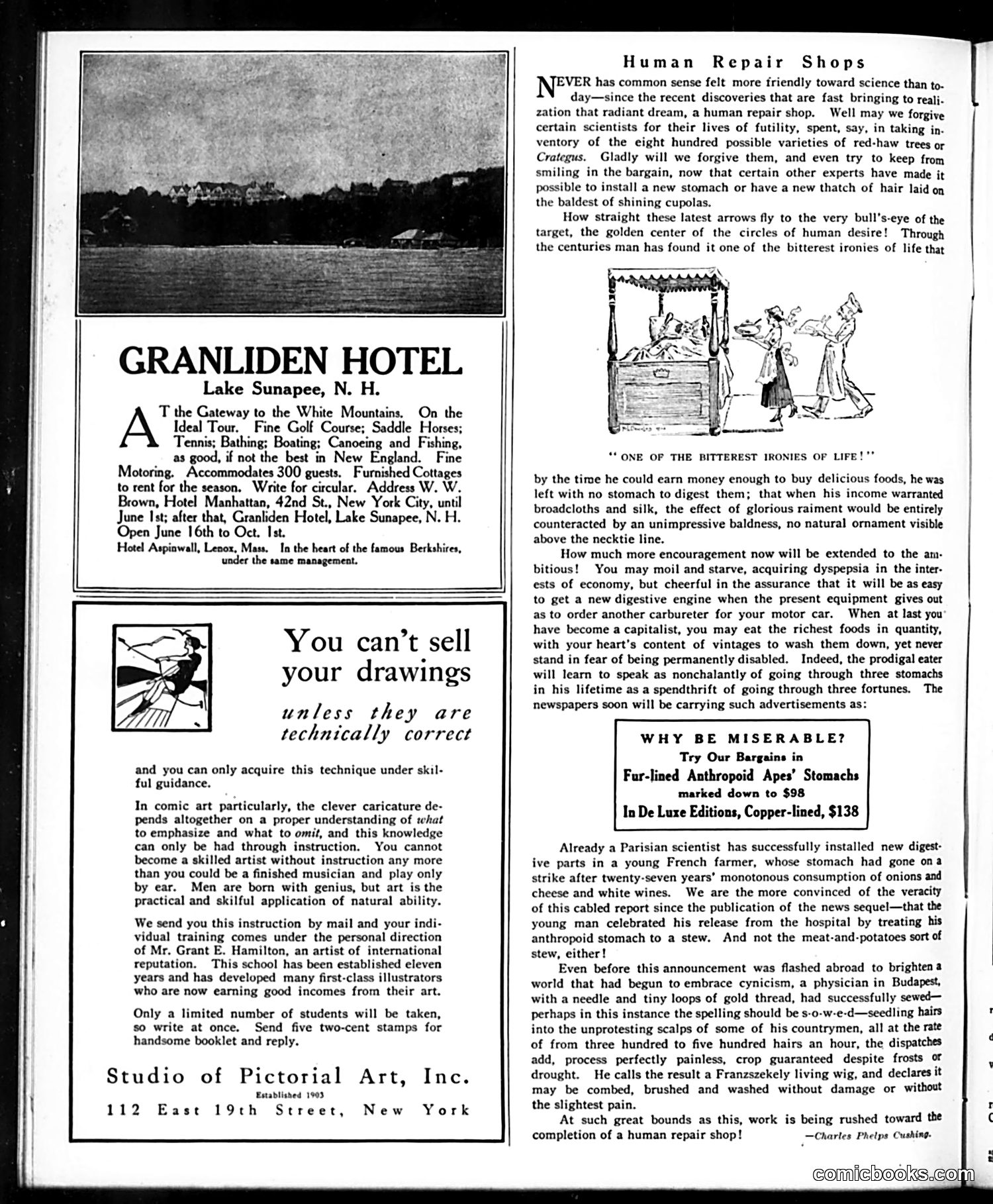
This page satirizes early 20th-century scientific optimism about medical advancement. The main article mocks the era's breathless enthusiasm for emerging surgical possibilities—organ transplants and hair restoration—as solutions to wealth's ironic problems. The satire's target: the wealthy's frustration that by the time they've earned money for fine foods, their stomachs are ruined; by the time they can afford silk clothes, they're bald. Judge ridicules this by imagining a future where organ replacement becomes casual consumer maintenance—ordering new stomachs like carburetors, wealthy gluttons casually discussing "going through three stomachs" as nonchalantly as fortunes. The piece mocks both scientific hubris and capitalist values, suggesting that even "human repair" will become just another commodity for the rich to consume excessively without consequence. The tone is darkly comic, treating medical miracles as enablers of vice rather than healers of suffering. The accompanying ads for drawing instruction and hotels are standard magazine filler.
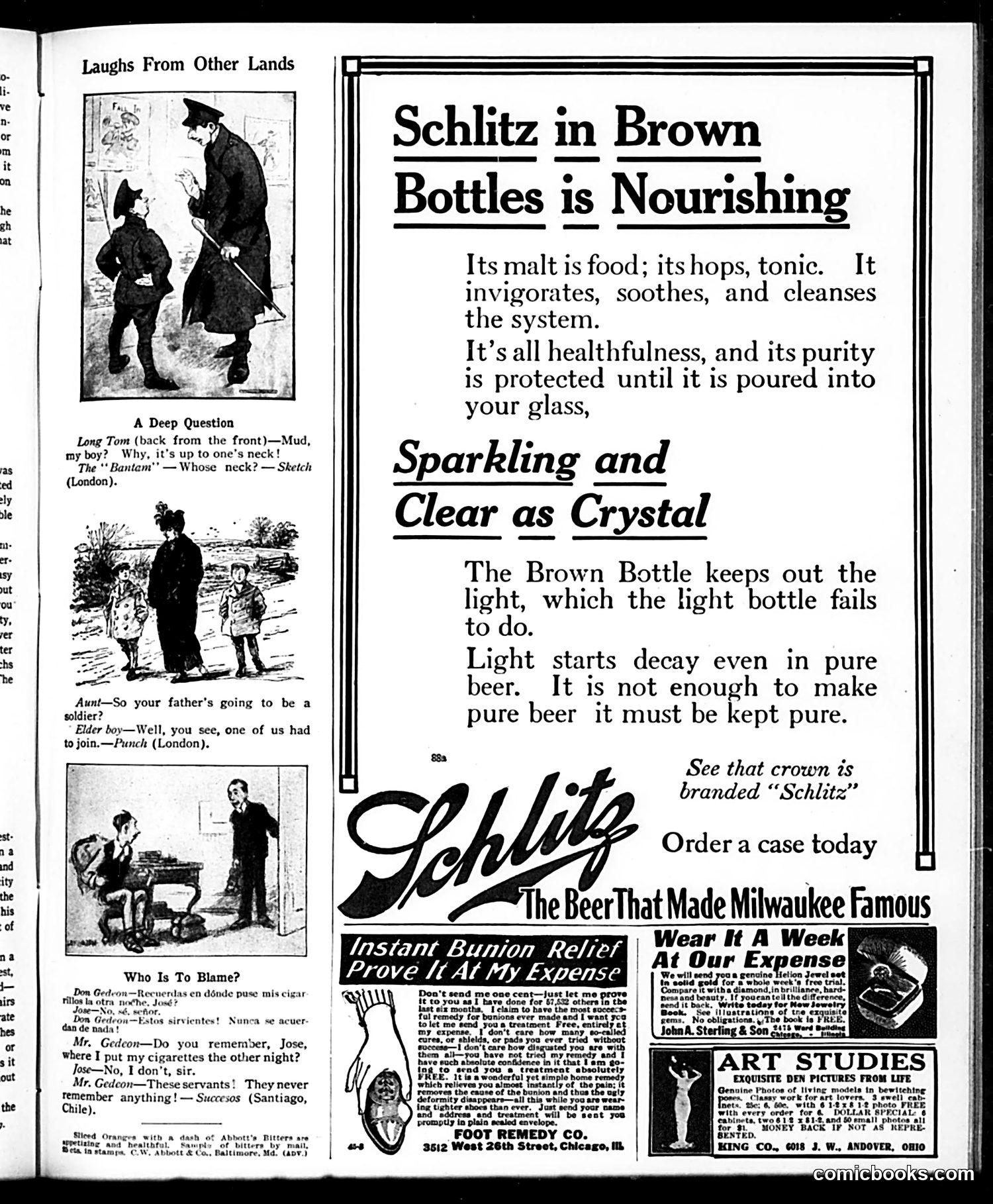
This page contains **three unrelated elements**: British and Chilean humor comics, plus advertisements. ## "Laughs From Other Lands" (Left Column) Three brief jokes from international publications: 1. **"A Deep Question"** (Sketch, London): A soldier returning from WWI trenches exchanges wordplay with a child about mud depth—a dark joke about trench warfare conditions. 2. **Aunt/Elder Boy** (Punch, London): Dark WWI humor where a boy explains his father must enlist because "one of us had to"—implying sacrifice or resignation to wartime conscription. 3. **"Who Is To Blame?"** (Succesos, Chile): A master blames his servant for forgetting where he placed cigarettes, then ironically forgets the servant's name—a class-based comedy about employers' selective memory regarding servants. ## Right Side: Advertising The bulk of the page is **Schlitz beer advertising** emphasizing brown bottles' protective properties, plus unrelated ads for foot remedies and art studies—typical period magazine content. The page demonstrates Judge's international humor reprints alongside commercial advertising.
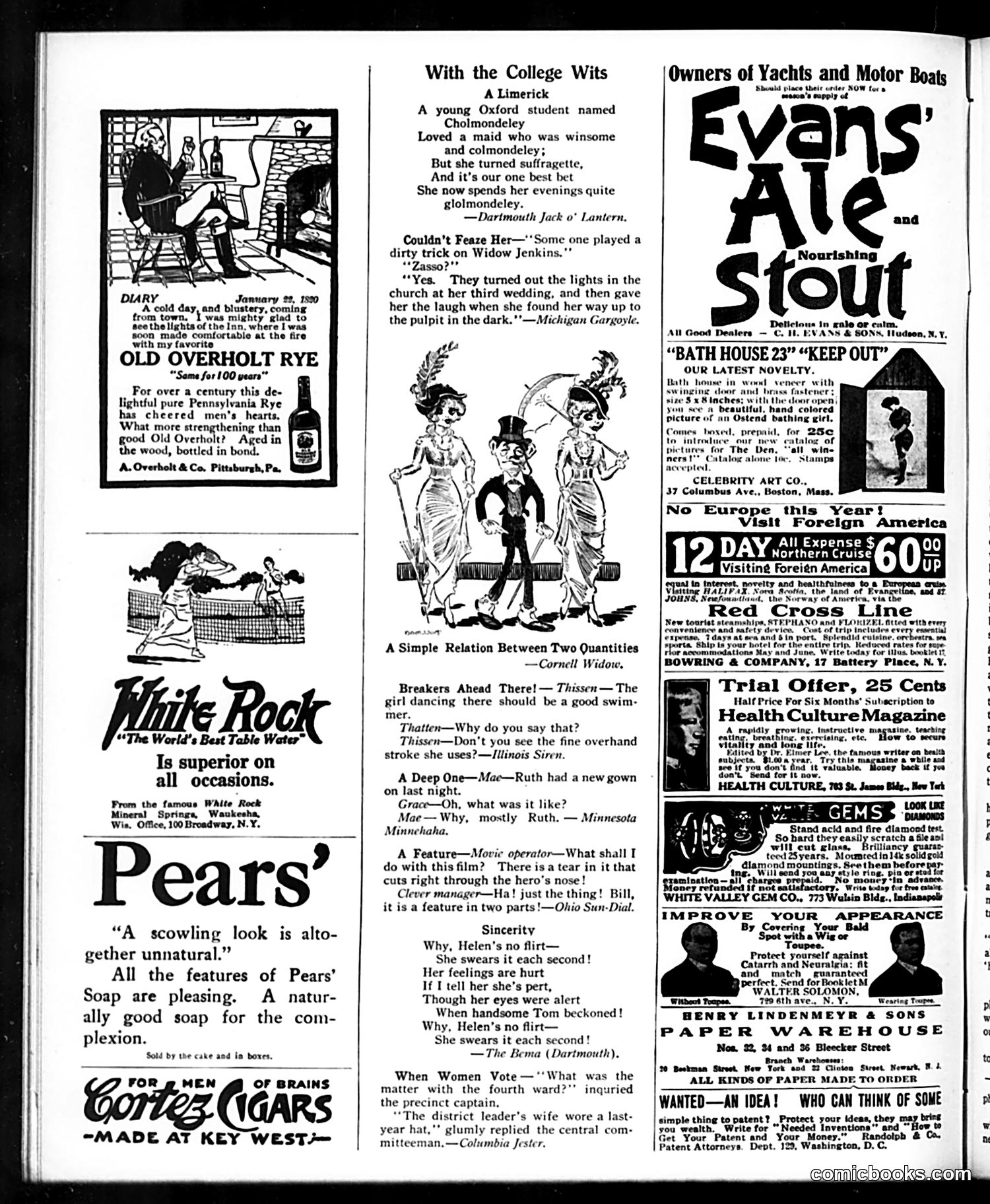
This page is primarily **advertising with humor columns**, not political satire. The advertisements dominate (whiskey, soap, cruises, novelties), interspersed with humorous college jokes. The humor pieces are light collegiate wit from university publications like *Dartmouth Jack o' Lantern* and *Cornell Widow*—witty one-liners and puns. The "Limerick" mocks a student's romantic misfortune when his beloved turns suffragette. "When Women Vote" jokes about a political machine's concern that a district leader's wife wore last year's hat, suggesting women voters aren't yet taken seriously as political actors (this predates women's suffrage). The cartoons are generic (a tennis player, dining scene)—not specific political commentary. The page reflects early 1890s concerns: suffrage emerging as a social issue, college humor culture, and consumer advertising targeting middle-class readers. This is essentially a **humor/advertising compilation**, not a vehicle for sharp political satire on this particular page.
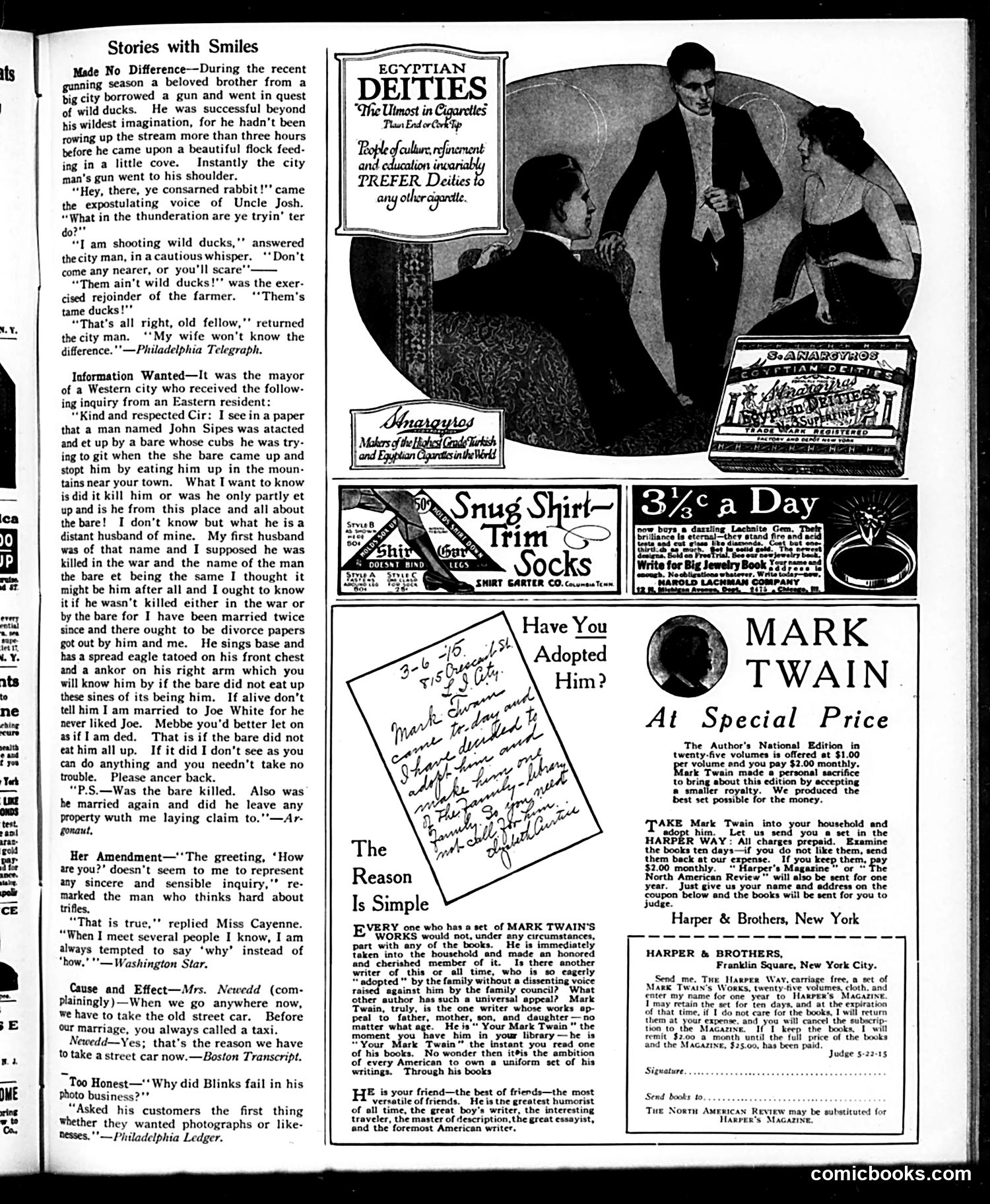
This page is primarily **humorous anecdotes and advertisements**, not political cartoons. The "Stories with Smiles" section contains three brief jokes: 1. **"Made No Difference"**: A city man shoots tame ducks instead of wild ones; when challenged, he dismisses it—his wife won't know the difference. The satire mocks urban ignorance and dishonesty. 2. **"Information Wanted"**: A woman writes seeking a man named John Sipes, eaten by a bear, uncertain if he's her first husband or a distant relative. The humor lies in her rambling, absurd inquiry and practical concerns about divorce papers and property claims. 3. **"Too Honest"**: A photographer fails because he honestly asks customers if they want photographs, suggesting his directness repels business. The ads (Egyptian Deities cigarettes, Snug Shirt Trim Socks, Mark Twain books) are period advertisements. This appears to be a **humor/entertainment page** with no significant political content—typical light fare for Judge magazine's satirical but accessible audience.
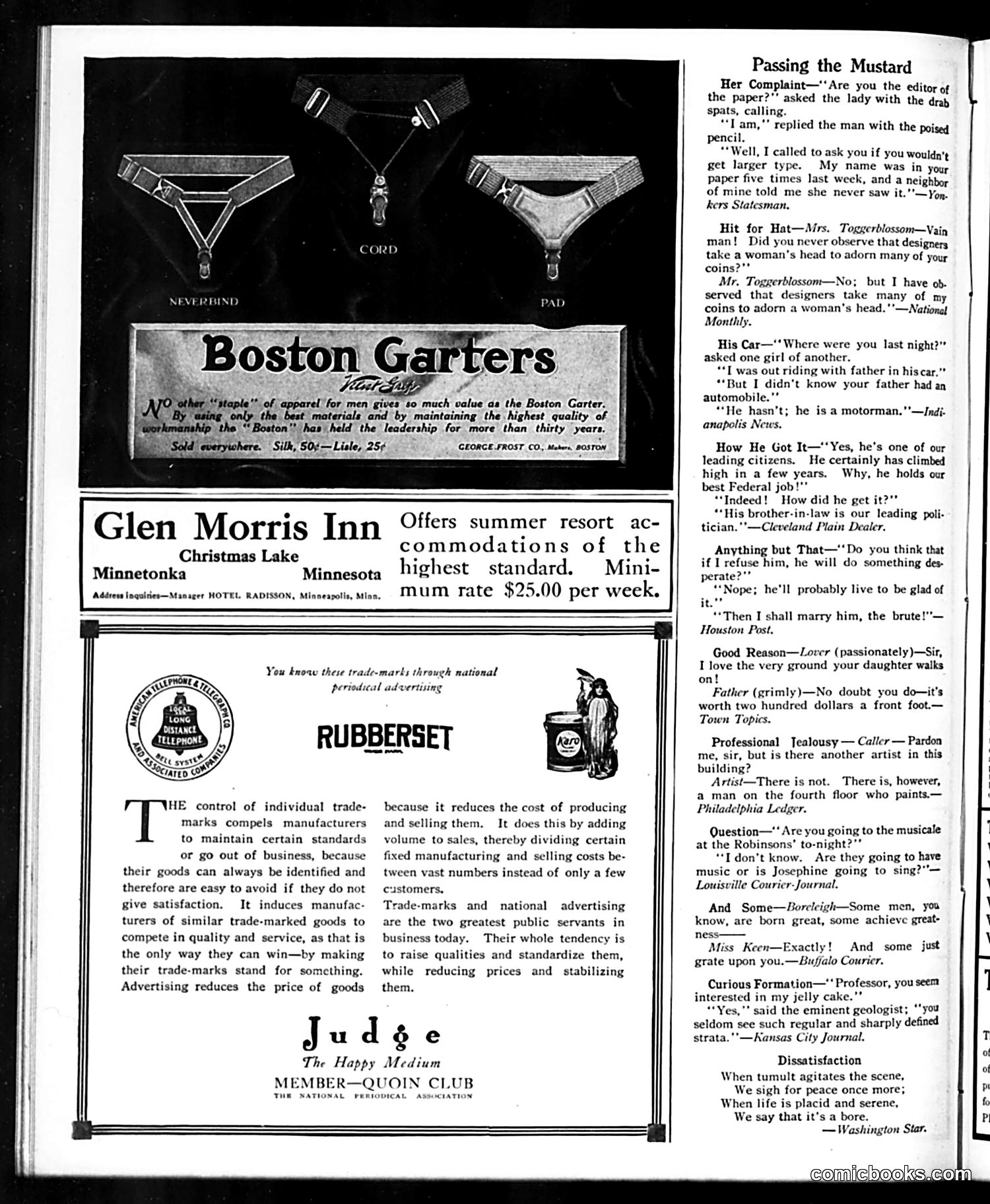
This page is primarily **advertising and humorous filler content** rather than political cartoons. The top features an advertisement for Boston Garters (men's suspenders), emphasizing product quality and brand consistency. Below are ads for Glen Morris Inn and Rubberset brushes—the latter including a lengthy explanation of how trademarks and national advertising maintain quality standards and reduce prices. The right column contains **"Passing the Mustard,"** a humor section with brief, unrelated jokes about everyday domestic and social situations: a woman complaining about small newspaper type, husband-wife banter about coins and cars, a motorman's daughter, nepotism in Federal jobs, a bride's dilemma, real estate values, professional jealousy among artists, musical preferences, and wordplay about greatness versus "grating" on people. These jokes reflect early 20th-century middle-class concerns—vanity, courtship, job-seeking, and social pretension—but contain no clear political commentary or identifiable public figures.
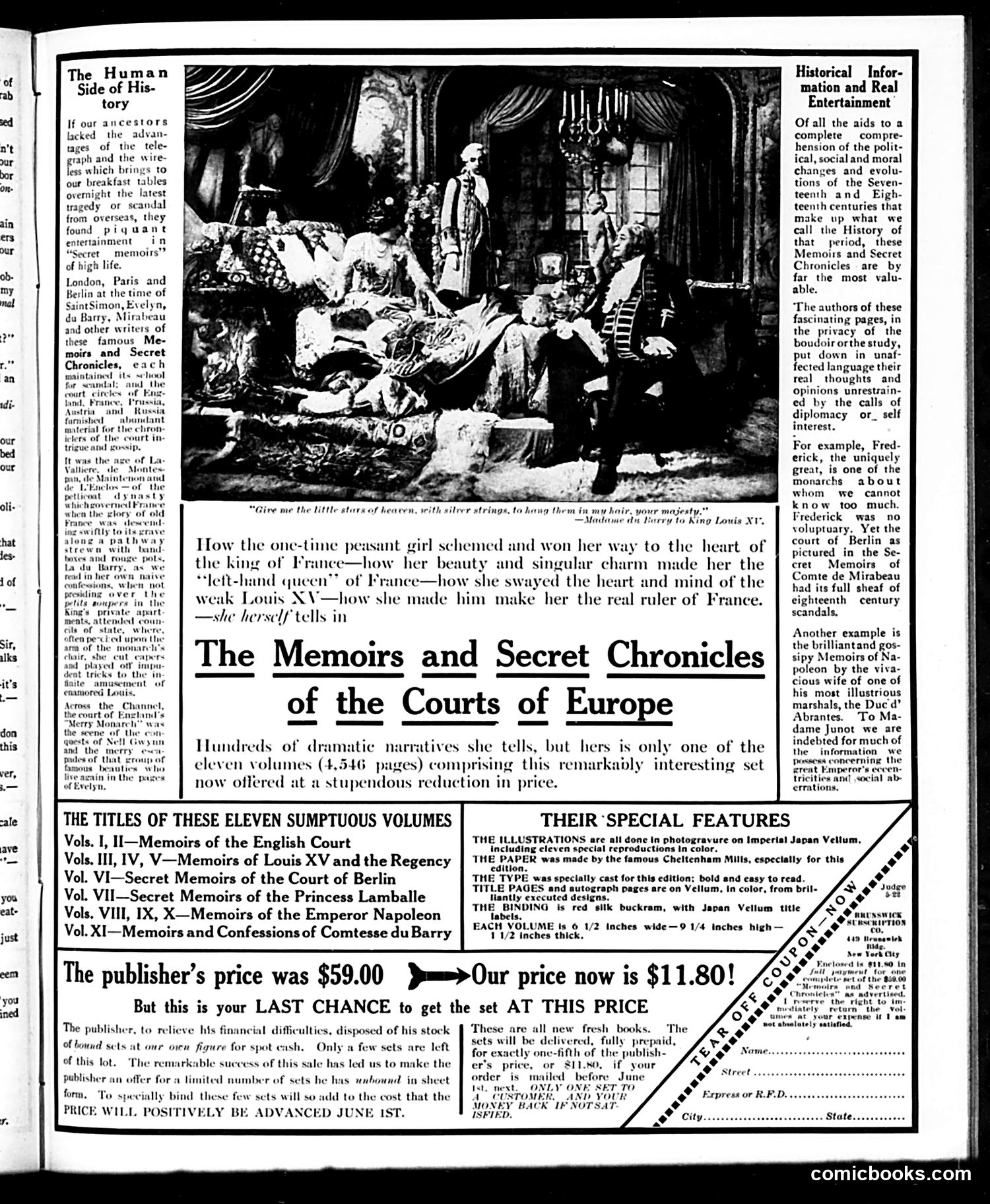
This page is primarily **advertising, not a political cartoon**. It promotes a 11-volume book set called "The Memoirs and Secret Chronicles of the Courts of Europe"—historical accounts of European royalty from the 17th-18th centuries. The accompanying engraving depicts a **court scene**, likely illustrating the books' content rather than satirizing current events. The text emphasizes these memoirs' historical value as primary sources on political and social change. The "satire" angle is subtle: Judge magazine frames these books as offering unfiltered truth ("real thoughts...unrestrained by diplomacy") from historical figures like Louis XV and Napoleon. The implicit humor is that readers could access scandalous palace gossip at a bargain price ($11.80, reduced from $59). **Key point**: This isn't mocking historical figures but rather marketing historical voyeurism—the appeal of "behind-the-scenes" accounts of famous people. The pitch emphasizes dramatic narratives and intimate revelations, a sales tactic as old as publishing itself.
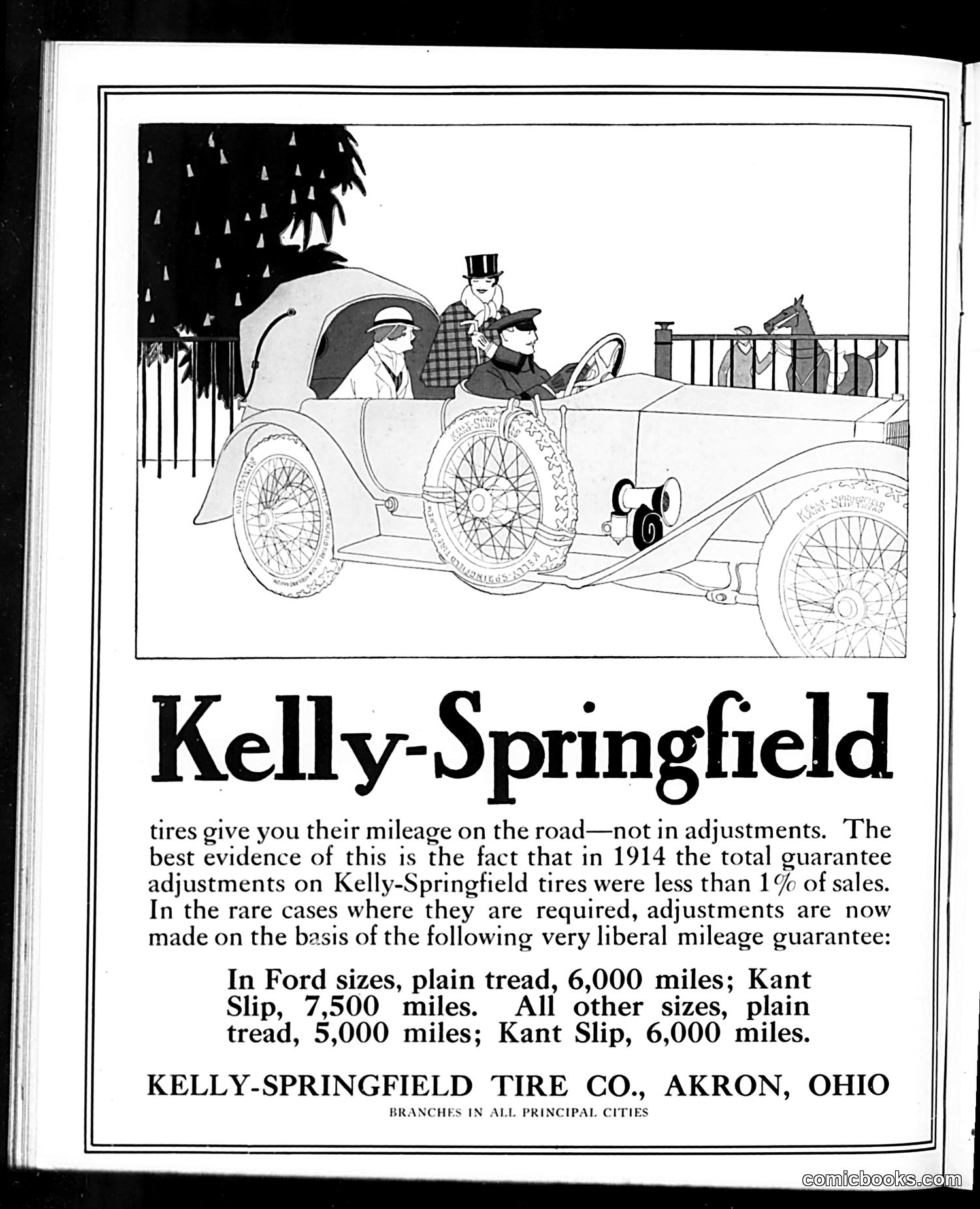
This is a **full-page advertisement**, not political satire. It promotes Kelly-Springfield tires from Akron, Ohio, featuring an illustration of an early automobile (appears to be a 1910s-era touring car) with well-dressed passengers. The ad's sales pitch emphasizes **reliability and durability**—tires deliver mileage "on the road, not in adjustments." The company boasts that in 1914, fewer than 1% of sales required warranty adjustments, positioning this as evidence of superior quality. Specific mileage guarantees are listed (5,000-7,500 miles depending on tire type), with special mention of Ford sizes, reflecting that car's market dominance. For modern readers: this speaks to an era when tire durability was genuinely uncertain, and manufacturer warranties were significant selling points for automotive products.