
Judge, 1915-05-22 · page 12 of 24
Judge — May 22, 1915 — page 12: what you’re looking at
What you’re looking at
This page satirizes a wealthy man's marriage to a young, pleasure-seeking woman. The narrative follows "Honeyman," who offers a million dollars to marry a woman who admits she's a "gadder" (restless socialite). The satire's point: Despite his wealth and attempts to domesticate her through additional money ("half a million more"), she remains wholly uninterested in home life. She pursues opera, amateur theatricals, dancing, and morning exercise—anything but domesticity. When he finally joins her activities, he's exhausted while she remains energized. The cartoon at top left (captioned about someone who "hates publicity" after a big event) appears to show a disheveled man, likely commenting on wealthy men's public embarrassment from such marriages. The underlying social critique targets: wealthy older men's futile attempts to purchase young wives' compliance, and the independence of modern women who view marriage as financial transaction rather than domestic commitment. The woman's strategic lip-wiping after kisses suggests calculated manipulation. This reflects 1920s anxieties about changing gender roles and the "new woman."
📄 Transcribed text from this page (OCR, searchable)
Machine-transcribed from the original scan — historical spelling and the odd misread are preserved.
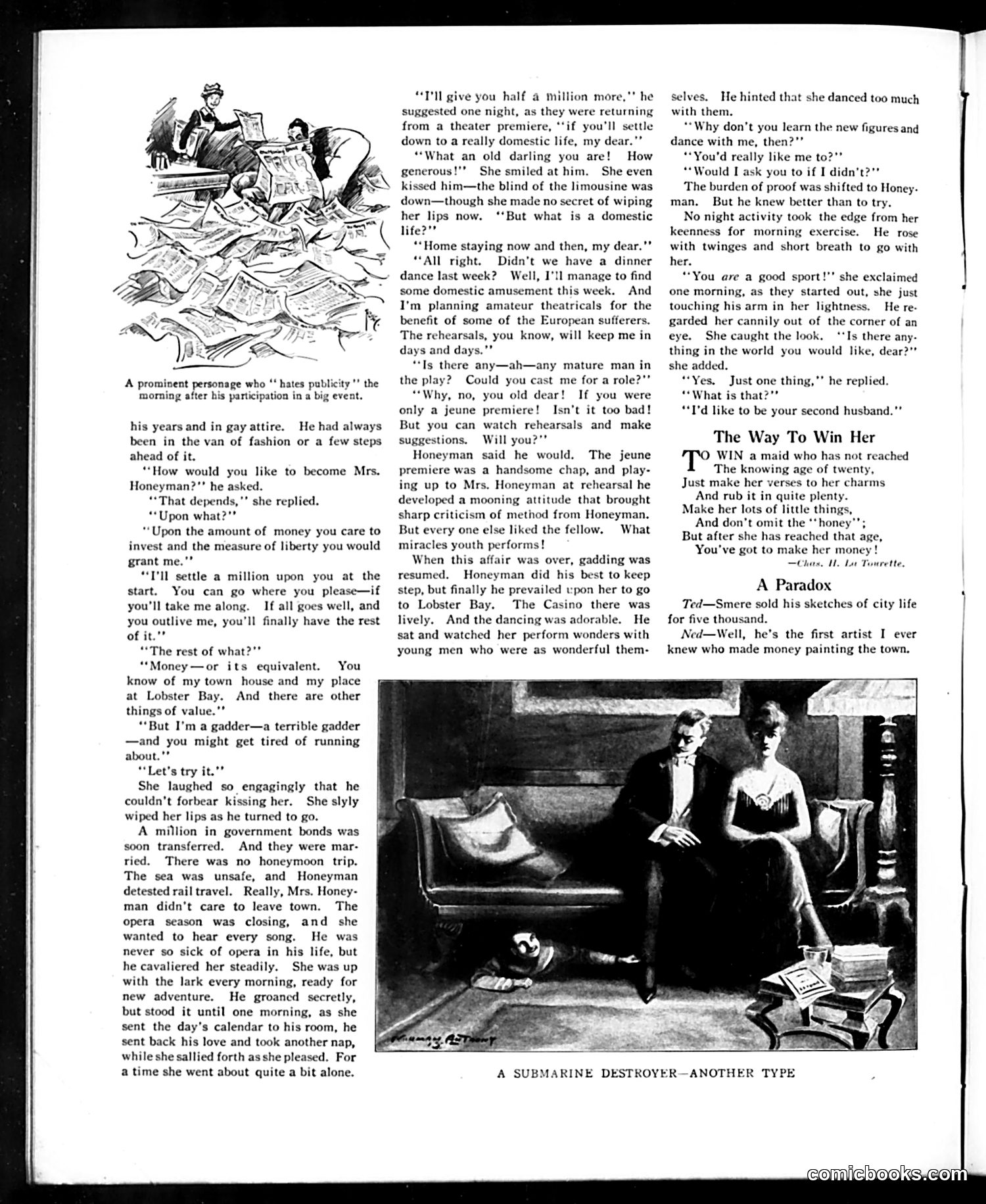
—_—_— A prominent personage who “‘ hates publicity '” the morning after his participation in a big event. his years and in gay attire. He had always been in the van of fashion or a few steps ahead of it. “How would you like to become Mrs. Honeyman?"’ he asked. “That depends,’ she replied. “*Upon what?"’ “Upon the amount of money you care to invest and the measure of liberty you would grant me."” "IL settle a million upon you at the start. You can go where you please—if you'll take me along. es well, and you outlive me, you'll finally have the rest of it.’” “The rest of what?"* “Money —or its equivalent. 2 2 You know of my town house and my place at Lobster Bay. And there are other things of value. “But I’m a gadder—a terrible gadder —and you might get tired of running about, “Let's try it.”” She laughed so engagingly that he couldn't forbear kissing her. She slyly wiped her lips as he turned to go. A million in government bonds was soon transferred. And they were mar- ried. There was no honeymoon trip. The sea was unsafe, and Honeyman detested rail travel. Really, Mrs. Honey- man didn't care to leave town. The opera season was closing, and she wanted to hear every song. He was never so sick of opera in his life, but he cavaliered her steadily. She was up with the lark every morning, ready for new adventure. He groaned secretly, but stood it until one morning, as she sent the day's calendar to his room, he sent back his love and took another nap, while she sallied forth as she pleased. For a time she went about quite a bit alone. “T'll give you half a million more,"’ he suggested one night, they were returning from a theater premie you'll settle down to a really domestic life, my dear. “What an old darling you are! How generous!"’ She smiled at him. She even kissed him—the blind of the limousine was down—though she made no secret of wiping her lips now. ‘But what is a domestic life?” Home staying now and then, my dear."” “All right. Didn't we have a dinner dance last week? Well, I'll manage to find some domestic amusement this week. And I'm planning amateur theatricals for the benefit of some of the Euro; . The rehearsals, you know, will keep me in days and day “Is there any—ah—any mature man in the play? Could you cast me for a role?” “Why, no, you old dear! If you were only a jeune premiere! Isn't it too bad! But you can watch rehearsals and make suggestions, Will yo Honeyman said he would. The jeune premiere was a handsome chap, and play- ing up to Mrs. Honeyman at rehearsal he developed a mooning attitude that brought sharp criticism of method from Honeyman. But every one else liked the fellow. What miracles youth performs! When this affair was over, gadding was resumed. Honeyman did his best to keep step, but finally he prevailed upon her to go to Lobster Bay. The Casino there was lively. And the dancing was adorable. He sat and watched her perform wonders with young men who were as wonderful them- 8. selves. He hinted that she danced too much with them, “Why don’t you learn the new figures and dance with me, then?"’ “You'd really like me to?" “Would I ask you to if I didn’t?"" The burden of proof was shifted to Honey. man. But he knew better than to try. No night activity took the edge from her keenness for morning exercise. He rose with twinges and short breath to go with her. “You are a good sport!'' she exclaimed one morning, as they started out, she just touching his arm in her lightn He re- garded her cannily out of the corner of an eye. She caught the look, ‘'Is there any- thing in the world you would like, dear?” she added, “Yes. Just one thing,’ he replied. “What is that?"" “I'd like to be your second husband."* The Way To Win Her WIN a maid who has not reached The knowing age of tw Just make her verses to her charms And rub it in quite plenty. Make her lots of little things, And don't omit the *‘honey"’; But after she has reached that age, You've got to make her money! —Ches, We La Tourette, A Paradox Ted—Smere sold his sketches of city life for five thousand. Ned—Well, he's the first artist I ever knew who made money painting the town, A SUBMARINE DESTROYER—ANOTHER TYPE