
Judge, 1915-05-22 · page 13 of 24
Judge — May 22, 1915 — page 13: what you’re looking at
What you’re looking at
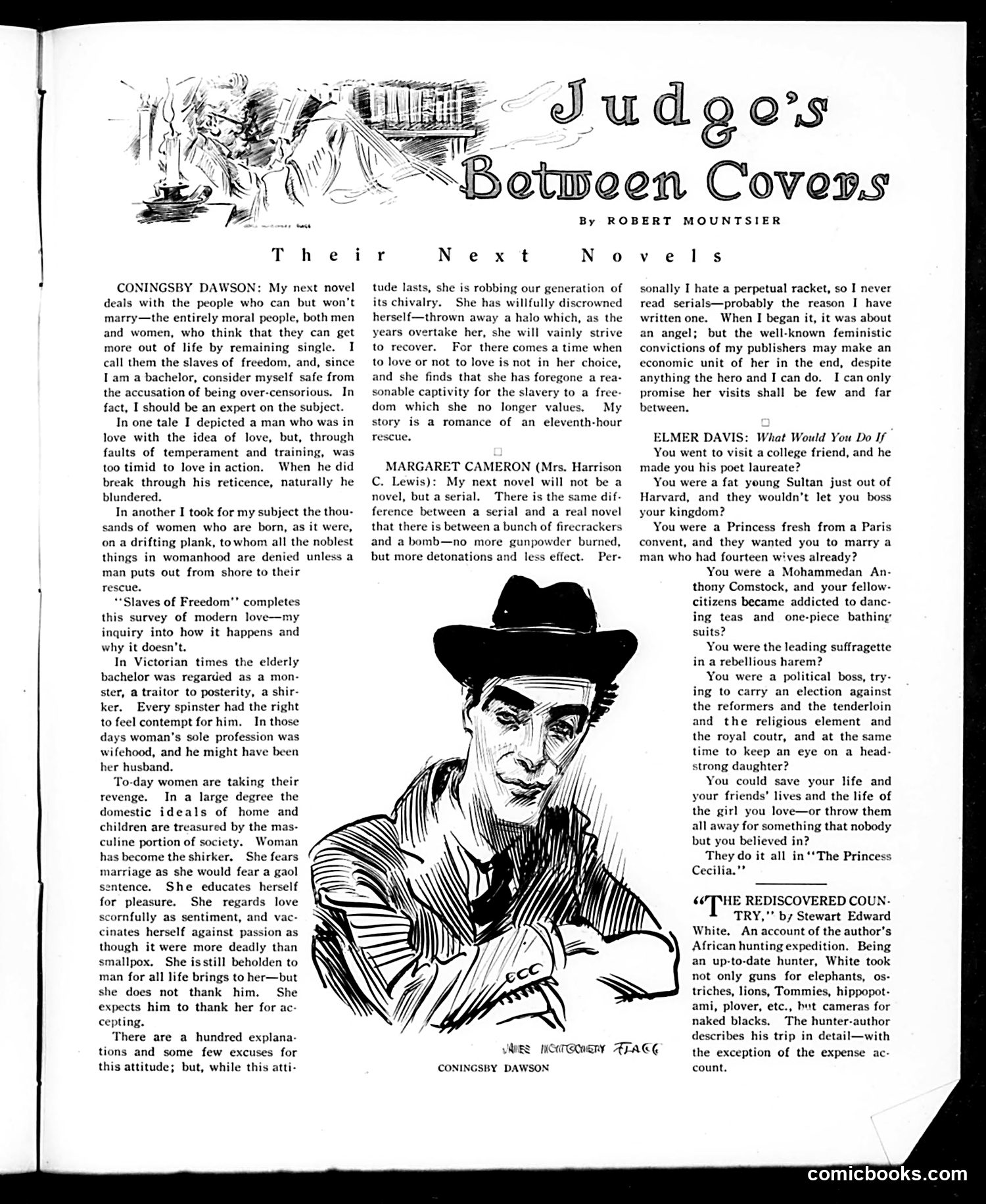
This page from *Judge* magazine features author interviews about their upcoming novels, with commentary on contemporary social attitudes toward marriage and gender roles. **The Main Satire:** The portrait shows **Coningsby Dawson**, a bachelor novelist discussing his book "Slaves of Freedom." The satire centers on modern women's rejection of marriage. Dawson presents women as having reversed Victorian social dynamics—once scorned for remaining single, women now deliberately avoid marriage, viewing it as imprisonment rather than fulfillment. He critiques this as ungrateful "revenge," arguing women abandon their "halo" of femininity and chivalry while still depending on men economically. **The Political/Social Context:** This reflects early 20th-century anxiety about women's increasing independence and the suffragette movement. The text sarcastically portrays educated women choosing careers and autonomy as selfish and emasculating, representing conservative backlash against women's liberation. **Other Authors Listed:** Margaret Cameron discusses serialized fiction, while Elmer Davis presents hypothetical scenarios (Sultan, Princess, reformer, suffragette) that appear to mock progressive causes through absurdist scenarios.
📄 Transcribed text from this page (OCR, searchable)
Machine-transcribed from the original scan — historical spelling and the odd misread are preserved.
CONINGSBY DAWSON: My next novel de: with the people who can but won't marry—the entirely moral people, both men and women, who think that they can get more out of life by remaining single. 1 call them the slaves of freedom, and, since Iam a bachelor, consider myself safe from the accusation of being over-censorious. In fact, I should be an expert on the subject. In one tale I depicted a man who was in love with the idea of love, but, through faults of temperament and training, was too timid to love in action. When he did break through his reticence, naturally he blundered. In another I took for my subject the thou- sands of women who are born, as it were, on a drifting plank, towhom all the noblest things in womanhood are denied unless a man puts out from shore to their rescue, Slaves of Freedom’ completes this survey of modern love—my inquiry into how it happens and why it doesn’t. In Victorian times the elderly bachelor was regarded as a mon- ster, a traitor to posterity, a shir- ker. Every spinster had the right to feel contempt for him. In those days woman's sole profession was wifehood, and he might have been her husband. To-day women are taking their revenge. In a large degree the domestic ideals of home and children are treasured by the mas- culine portion of society. Woman has become the shirker. She fears marriage as she would fear a gaol sentence. She educates herself for pleasure. She regards love scornfully as sentiment, and vac- cinates herself against passion as though it were more deadly than smallpox. She isstill beholden to man for all life brings to her—but she does not thank him. She expects him to thank her for ac- cepting. There are a hundred explana- tions and some few excuses for this attitude; but, while this atti- Next No tude lasts, she is robbing our generation of its chivalry, She has willfully discrowned herself—thrown away a halo which, as the years overtake her, she will vainly strive to recov For there com time when to love or not to love is not in her choice, and she finds that she has foregone a re: sonable captivity for the slavery to a free dom which she no longer values. My story is a romance of an eleventh-hour rescue. MARGARET CAMERON (Mrs. Harrison C. Lewis): My next novel will not be a novel, but a serial. There is the same dif- ference between a serial and a real nov that there is between a bunch of firecrackers and a bomb—no more gunpowder burned, but more detonations and less effect. Per- Ans NCTOCNERY ATA CE CONINGSBY DAWSON Botmeen Covep.s By ROBERT MOUNTSIER vels sonally I hate a perpetual racket, so I never read serials—probably the reason I have written one. When I began it, it was about an angel; but the well-known feministic convictions of my publishers may make an economic unit of her in the end, despite anything the hero and I can do. I can only promise her visits shall be few and far between. ELMER DAVIS: What Would You Do If You went to visit a college friend, and he made you his poet laureate? You were a fat young Sultan just out of Harvard, and they wouldn't let you boss your kingdom? You were a Princess fresh from a Paris convent, and they wanted you to marry a man who had fourteen wives already? You were a Mohammedan An- thony Comstock, and your fellow- citizens became addicted to danc- ing teas and one-piece bathing suits? You were the leading suffragette in a rebellious harem? You were a political boss, try- ing to carry an election against the reformers and the tenderloin and the religious element and the royal coutr, and at the same time to keep an eye on a head- strong daughter? You could save your life and your friends’ lives and the life of the girl you love—or throw them all away for something that nobody but you believed in? They do it all in‘*The Princess Cecilia.’* 60°. HE REDISCOVERED COUN- TRY,"’ by Stewart Edward White. An account of the author's African hunting expedition. Being an up-to-date hunter, White took not only guns for elephants, os- triches, lions, Tommies, hippopot- ami, plover, etc., hut cameras for naked blacks. The hunter-author describes his trip in detail—with the exception of the expense ac- count. comicbooks.com