
Judge, 1915-05-22 · page 4 of 24
Judge — May 22, 1915 — page 4: what you’re looking at
What you’re looking at
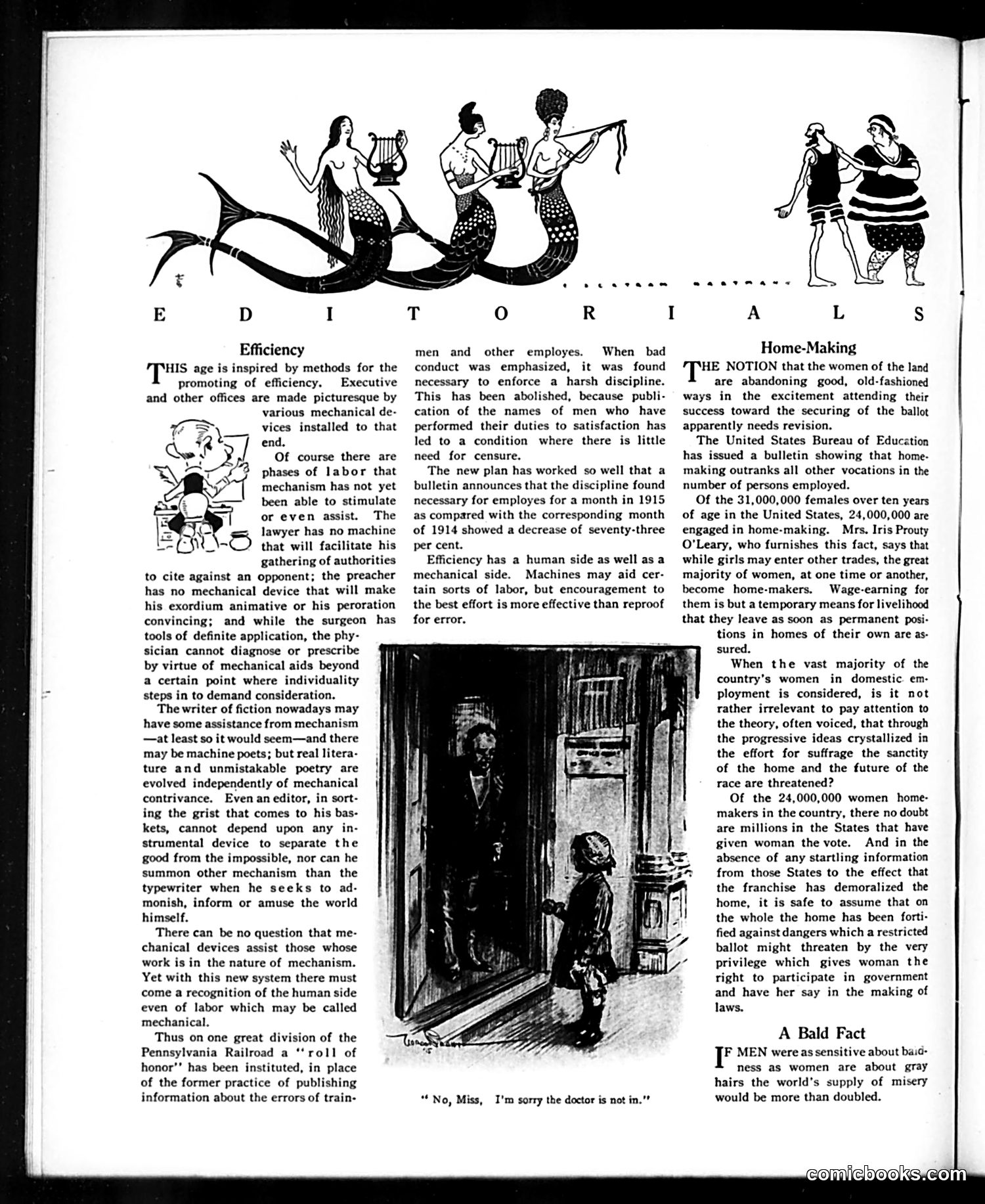
**Top Illustration ("Editorials"):** A decorative header showing mermaids with musical instruments and two figures on the right, appears to be classical/mythological imagery rather than political satire. **Main Content:** The left column discusses "Efficiency" in labor and management, advocating for mechanical/systematic approaches to workplace discipline. The right column addresses "Home-Making," arguing that women's domestic labor deserves recognition as legitimate employment. It cites U.S. Census data showing 24,000,000 women engaged in home-making, and defends homemaking against critics who view it as irrelevant to progressive movements like suffrage. **Illustration (center):** A sketch showing a patient at a doctor's door with caption "No, Miss, I'm sorry the doctor is not in," appears to be a separate humorous vignette. The page reflects early-20th-century debates about women's work, suffrage, and industrial efficiency.
📄 Transcribed text from this page (OCR, searchable)
Machine-transcribed from the original scan — historical spelling and the odd misread are preserved.
Efficiency HIS age is inspired by methods for the promoting of efficiency, Executive and other offices are made picturesque by various mechanical de- vices installed to that end. Of course there are phases of labor that mechanism has not yet been able to stimulate or even assist. The lawyer has no machine that will facilitate his gathering of authorities to cite against an opponent; the preacher has no mechanical device that will make his exordium animative or his peroration convincing; and while the surgeon has tools of definite application, the phy- sician cannot diagnose or prescribe by virtue of mechanical aids beyond a certain point where individuality steps in to demand consideration. The writer of fiction nowadays may have some assistance from mechanism —at least so it would seem—and there may be machine poets; but real litera- ture and unmistakable poetry are evolved independently of mechanical contrivance. Even an editor, in sort- ing the grist that comes to his bas- kets, cannot depend upon any in- strumental device to separate the good from the impossible, nor can he summon other mechanism than the typewriter when he seeks to ad- monish, inform or amuse the world himself. There can be no question that me- chanical devices assist those whose work is in the nature of mechanism. Yet with this new system there must come a recognition of the human side even of labor which may be called mechanical. Thus on one great division of the Pennsylvania Railroad a ‘roll of honor’’ has been instituted, in place of the former practice of publishing information about the errors of train- R men and other employes. When bad conduct was emphasized, it was found necessary to enforce a harsh discipline. This has been abolished, because publi- cation of the names of men who have performed their duties to satisfaction has led to a condition where there is little need for censure. The new plan has worked so well that a bulletin announces that the discipline found necessary for employes for a month in 1915 as compared with the corresponding month of 1914 showed a decrease of seventy-three per cent. Efficiency has a human side as well as a mechanical side. Machines may aid cer- tain sorts of labor, but encouragement to the best effort is more effective than reproof for error. I'm sorry the doctor is not in."" A Home-Making ‘HE NOTION that the women of the land are abandoning good, old-fashioned ways in the excitement attending their success toward the securing of the ballot apparently needs revision. The United States Bureau of Education has issued a bulletin showing that home- making outranks all other vocations in the number of persons employed. Of the 31,000,000 females over ten years of age in the United States, 24,000,000 are engaged in home-making. Mrs. Iris Prouty O'Leary, who furnishes this fact, says that while girls may enter other trades, the great majority of women, at one time or another, become home-makers. Wage-earning for them is but a temporary means for livelihood that they leave as soon as permanent posi- tions in homes of their own are as- sured. When the vast majority of the country’s women in domestic em- ployment is considered, is it not rather irrelevant to pay attention to the theory, often voiced, that through the progressive ideas crystallized in the effort for suffrage the sanctity of the home and the future of the race are threatened? Of the 24,000,000 women home- makers in the country, there no doubt are millions in the States that have given woman the vote. And in the absence of any startling information from those States to the effect that the franchise has demoralized the home, it is safe to assume that on the whole the home has been forti- fied against dangers which a restricted ballot might threaten by the very privilege which gives woman the right to participate in government and have her say in the making of laws. A Bald Fact F MEN were as sensitive about baid- ness as women are about gray hairs the world’s supply of misery would be more than doubled.