
A complete issue · 24 pages · 1915
Judge — February 27, 1915
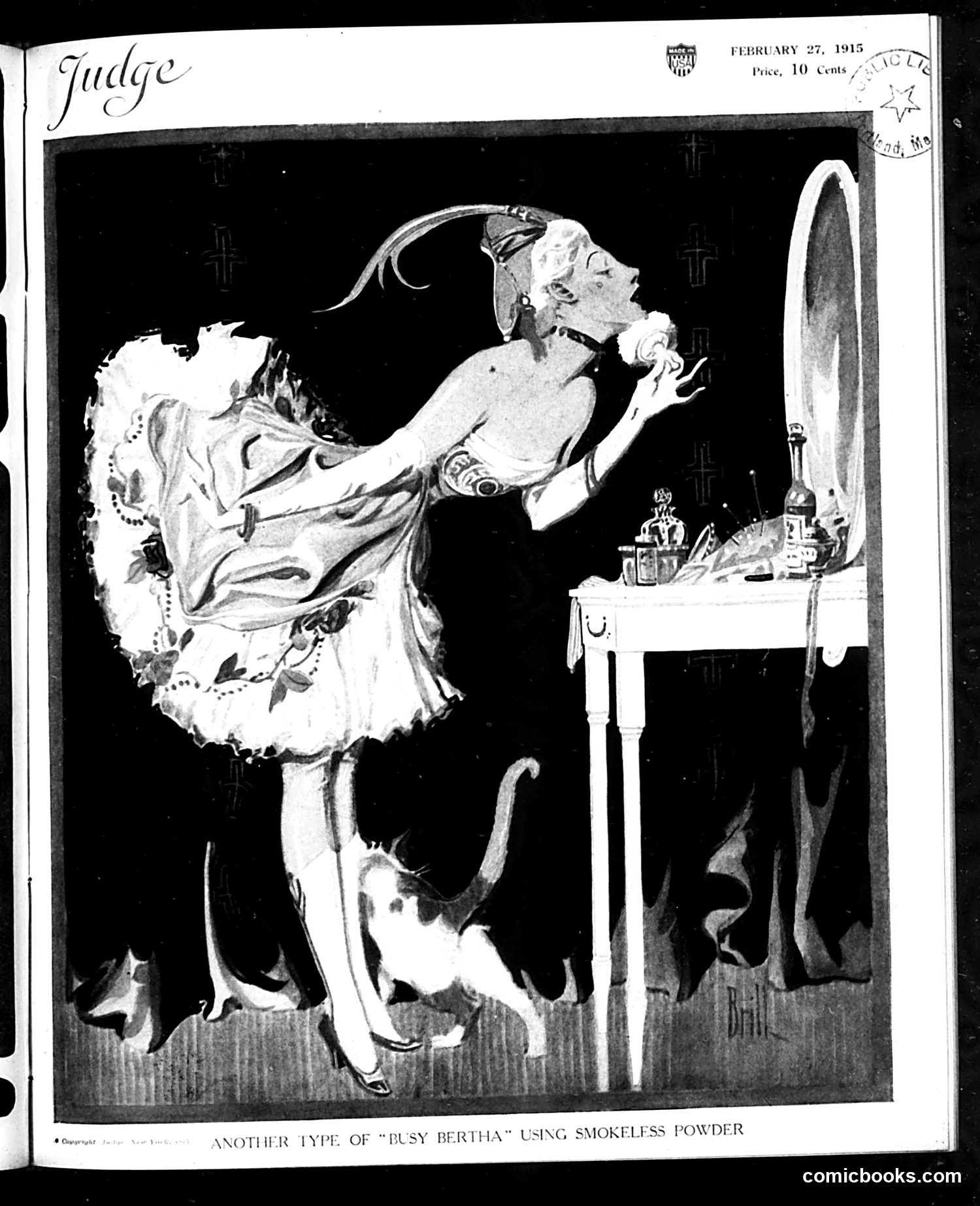
This satirical cartoon mocks a product called "Smokeless Powder," playing on the phrase "Busy Bertha"—likely referring to *Big Bertha*, the famous German artillery cannon used in World War I. The illustration shows a fashionable woman in an elaborate dress and hat, examining herself in a mirror at a vanity table with cosmetics. The caption's pun suggests the powder is so effective it leaves no visible residue, unlike traditional powders. The humor operates on multiple levels: it conflates cosmetic vanity with military weaponry, and uses a feminine domestic scene to satirize modern warfare technology. The timing—1915, during WWI—makes the reference to Bertha's destructive power darkly comedic when applied to beauty products. The image reflects period attitudes toward both consumerism and the war.
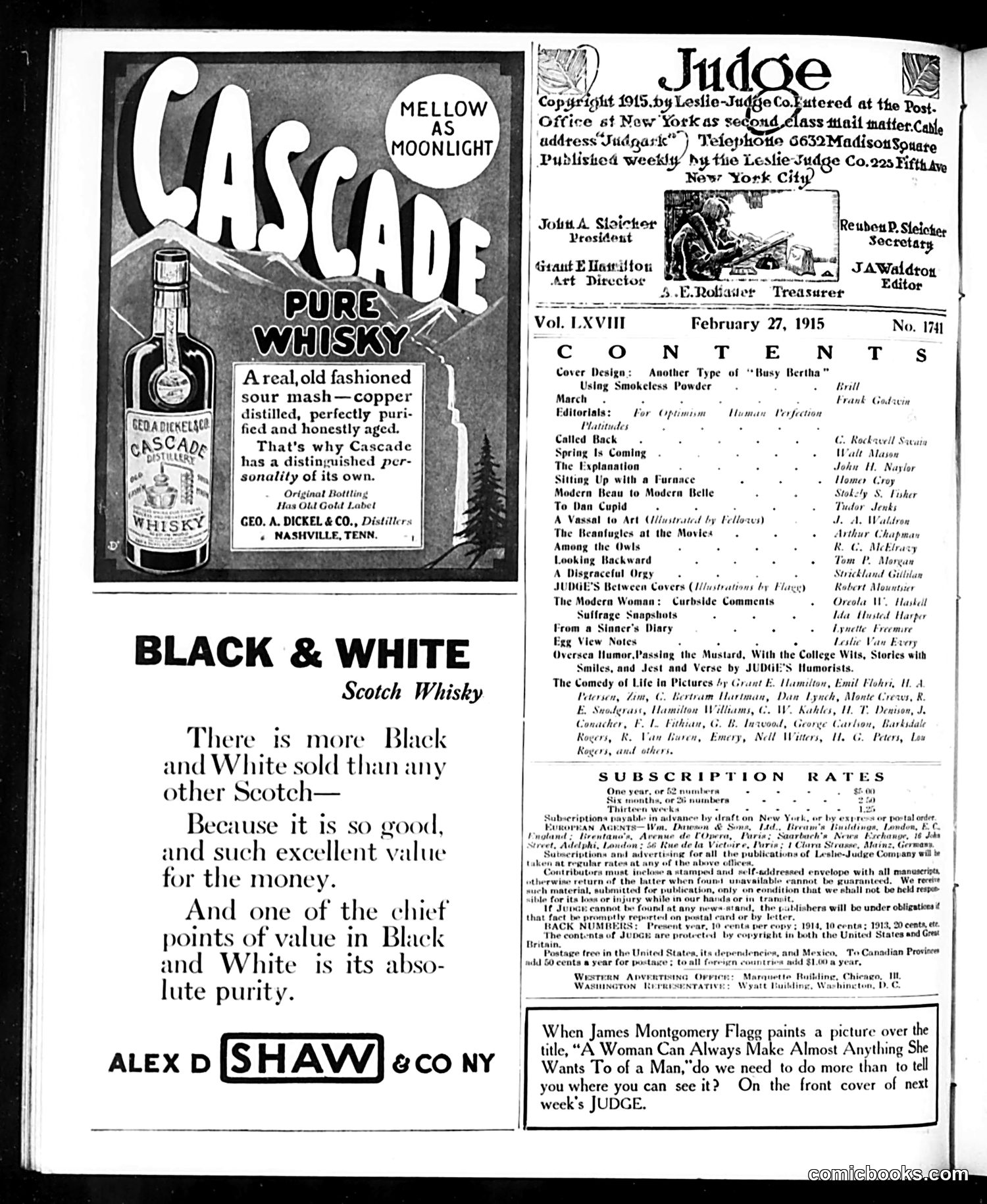
This page is primarily **advertising**, not satire or political commentary. The left side features two whisky advertisements: **Cascade Pure Whisky** (describing production methods) and **Black & White Scotch Whisky** (emphasizing its popularity and purity). These occupy the dominant visual space. The right side shows the **Judge magazine masthead and contents page** for Vol. LXVIII, February 27, 1915, listing articles, illustrations, and subscription rates. At the bottom, a small notice promotes next week's cover featuring a James Montgomery Flagg painting titled "A Woman Can Always Make Almost Anything She Wants To of a Man." The page reflects **early 20th-century magazine publishing**: heavy advertising revenue supporting editorial content, with liquor prominently featured despite Prohibition's approach (ratified that same year).
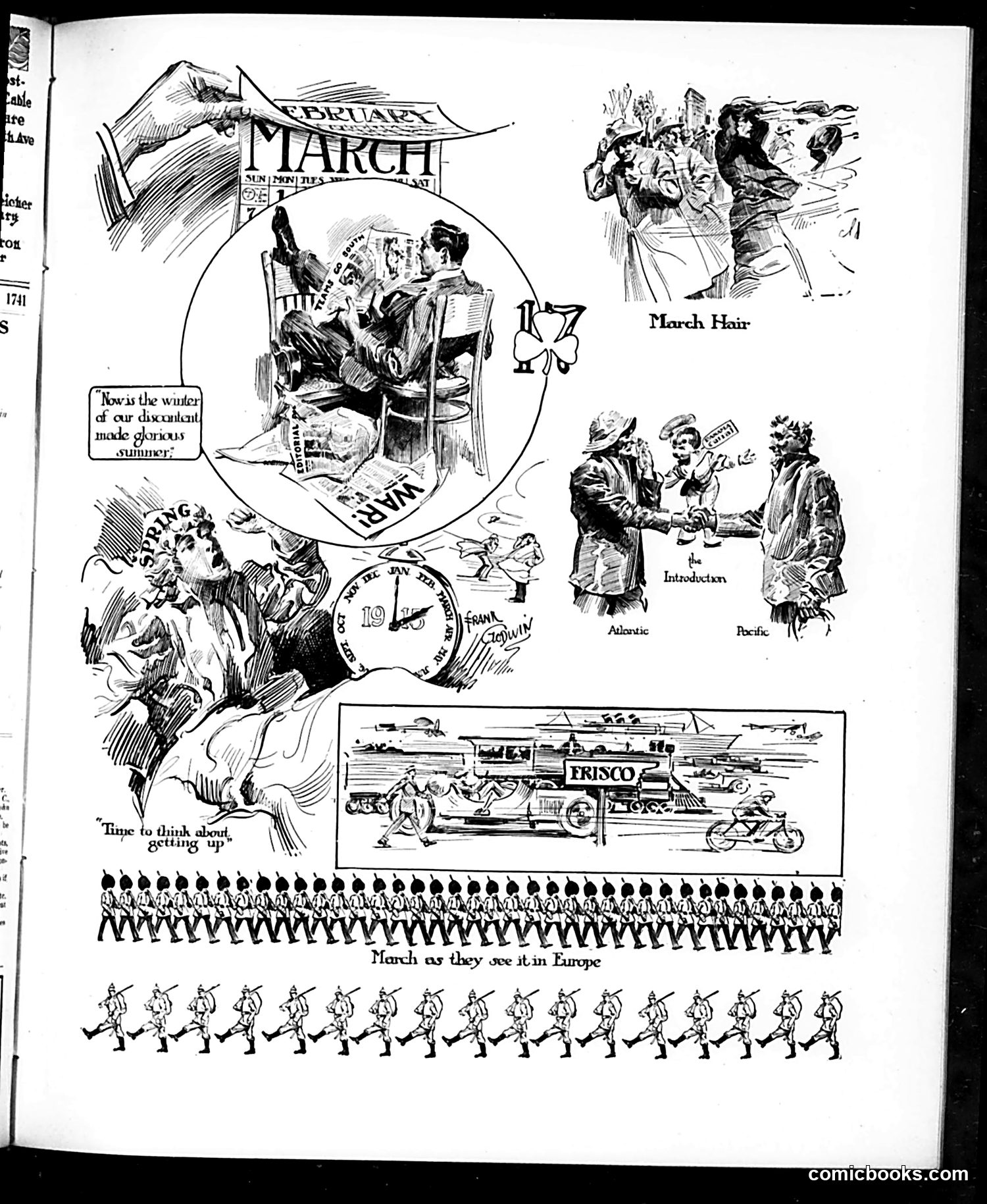
This page satirizes World War I's impact on American life in March 1915. The central figure appears to be "March" (the month personified), depicted as transitioning from winter's hardships to spring—though the dialogue "Now is the winter of our discontent made glorious summer" (inverting Shakespeare) suggests ironic commentary on wartime conditions. The vignettes labeled "March Hair," "Introduction," "Atlantic," and "Pacific" likely mock American attitudes toward the European conflict and naval tensions. The repeated soldier silhouettes at bottom emphasize military mobilization. The FRISCO transportation scene suggests civilian life continuing amid war. Overall, the page presents March 1915 as a moment when Americans grappled with whether distant European war would reach their shores, mixing anxiety with dark humor about potential American involvement.
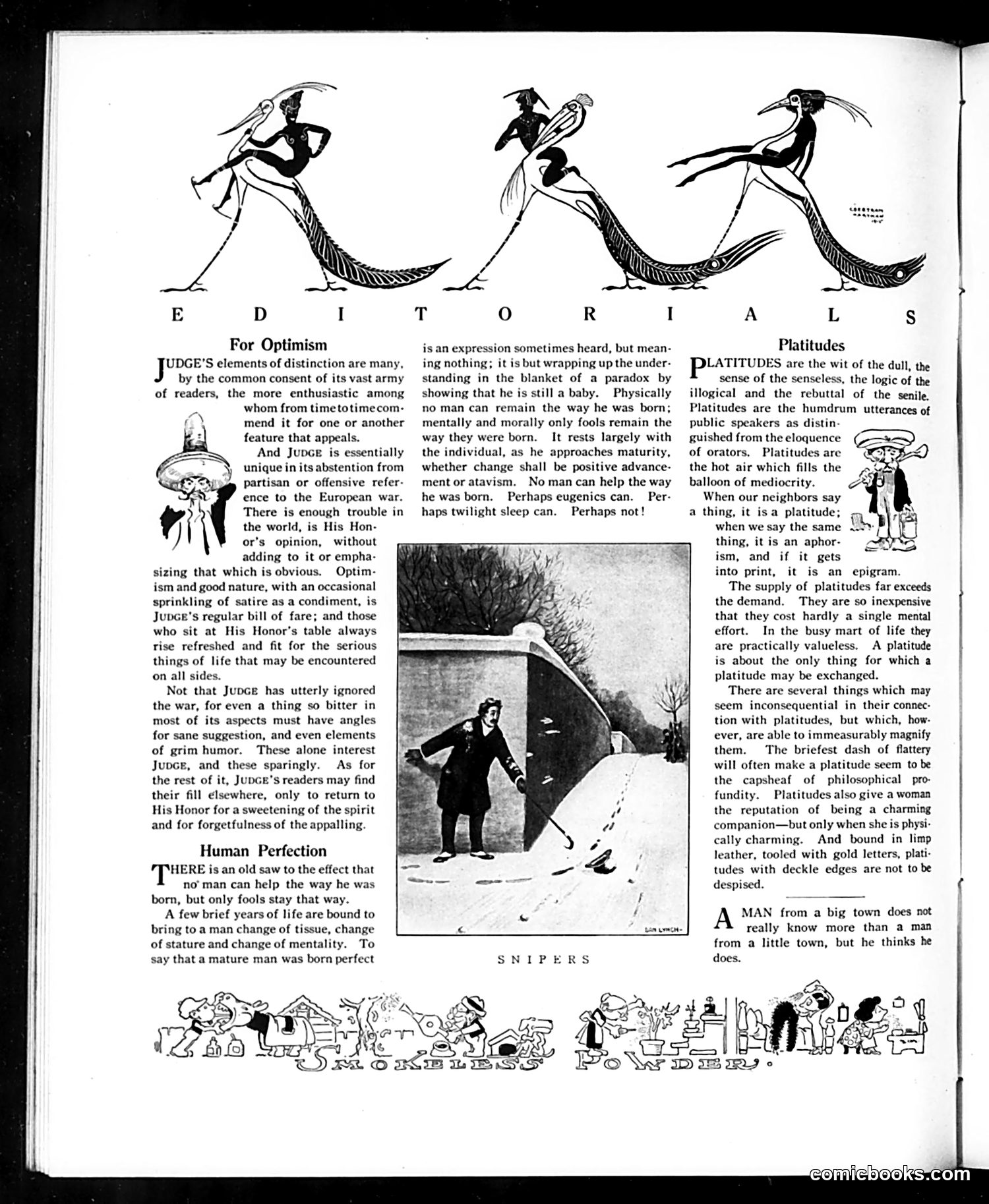
This page contains three distinct satirical pieces: **"For Optimism"** critiques judicial figures who remain enthusiastic despite wartime hardships, suggesting their optimism is naive or disconnected from reality. **"Human Perfection"** presents a philosophical argument that people are born imperfect and cannot fundamentally change, contradicting utopian ideals. **"Platitudes"** mocks the overuse of clichéd sayings and witticisms by public speakers and writers, arguing they require no mental effort and have become practically worthless. The "Snipers" illustration (center) appears to depict wartime combat, likely referencing World War I given the historical period. The page's overall tone suggests wartime cynicism about leadership's empty rhetoric and society's inability to improve through mere positive thinking.
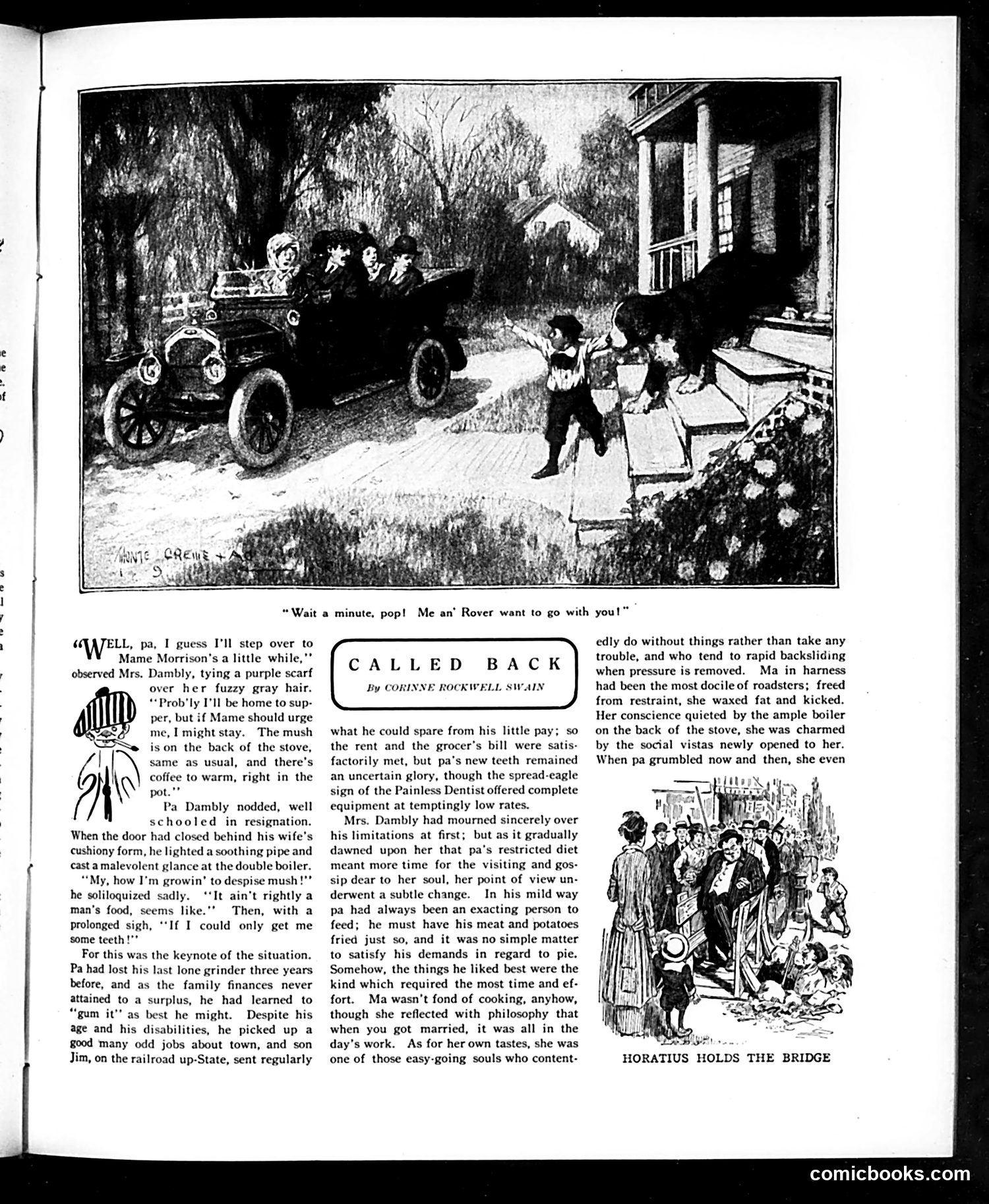
This page contains a serialized story rather than political satire. The narrative depicts domestic life centered on Pa Dambly's financial struggles and dietary restrictions due to dental problems. The top illustration shows an automobile arriving at a house where family members greet visitors—likely depicting the story's social setting. The story's humor derives from working-class domestic comedy: Pa's inability to afford new teeth, Ma's frustrations managing household expenses, and the family's modest circumstances requiring creative solutions for meals. The small illustration titled "Horatius Holds the Bridge" appears unrelated, possibly advertising another feature. This represents typical Judge magazine content mixing satirical fiction with domestic humor targeting middle-class American readers concerned with everyday financial and family concerns.
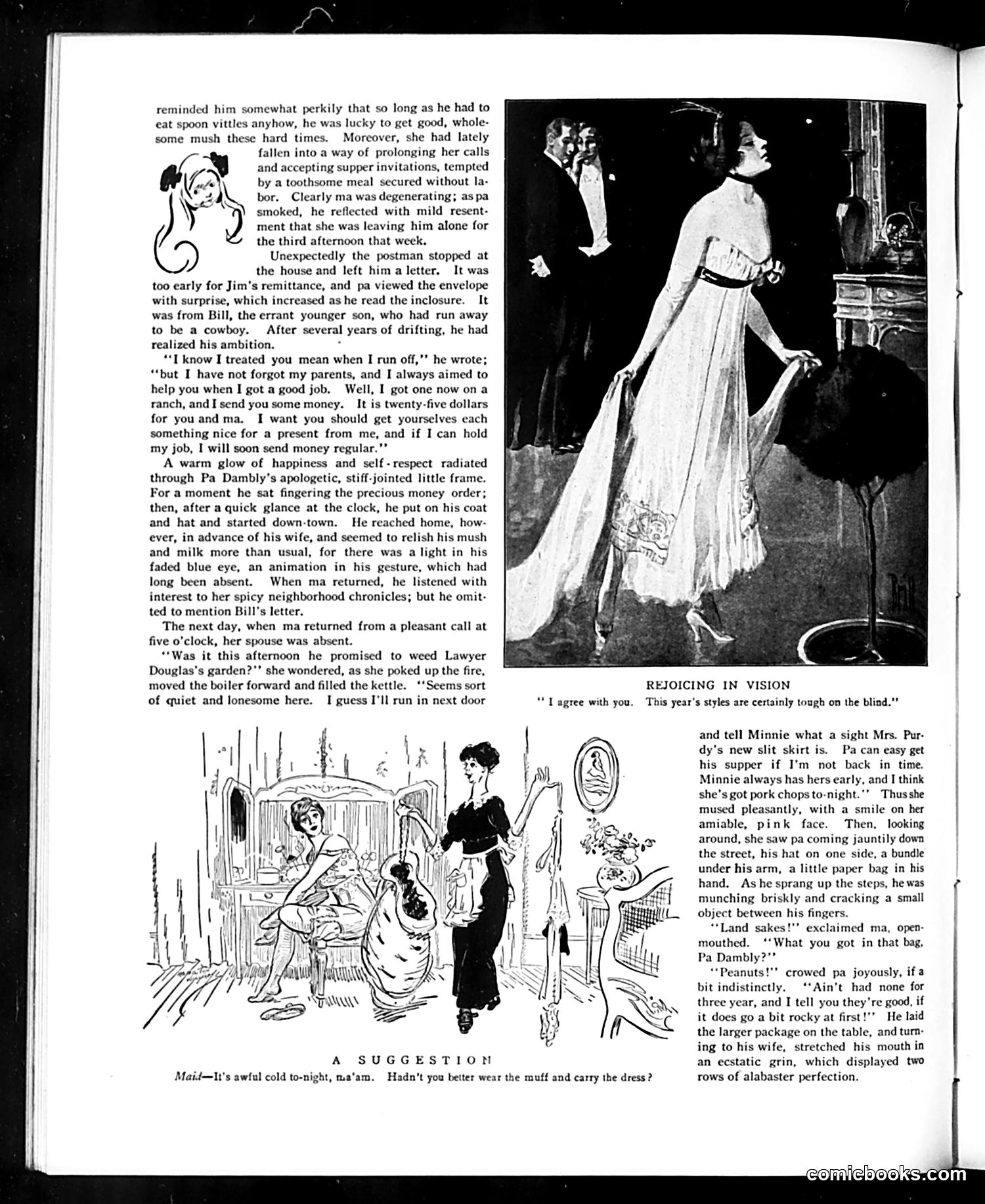
This page contains a sentimental domestic narrative rather than political satire. The story follows Pa Dambly, a poor working-class man whose runaway son Bill unexpectedly sends money from his ranch job out West. **The Plot:** Bill's letter—expressing remorse and promising regular support—lifts Pa's spirits considerably. Ma, meanwhile, has been neglecting home duties for social visits. When Pa receives the money order, he secretly buys himself peanuts (a modest luxury he's gone without for three years) and a gift for ma, arriving home energized and content. **The Satire:** Two cartoons mock fashion and gender: one depicts a maid suggesting a woman wear practical clothing in cold weather while carrying an impractical dress; the other jokes that "this year's styles are certainly tough on the blind"—likely referencing the narrow, revealing slit skirts of the era. The overall piece celebrates working-class virtue, filial redemption, and modest pleasures during economic hardship—reflecting early 1900s American values around family duty and dignity.
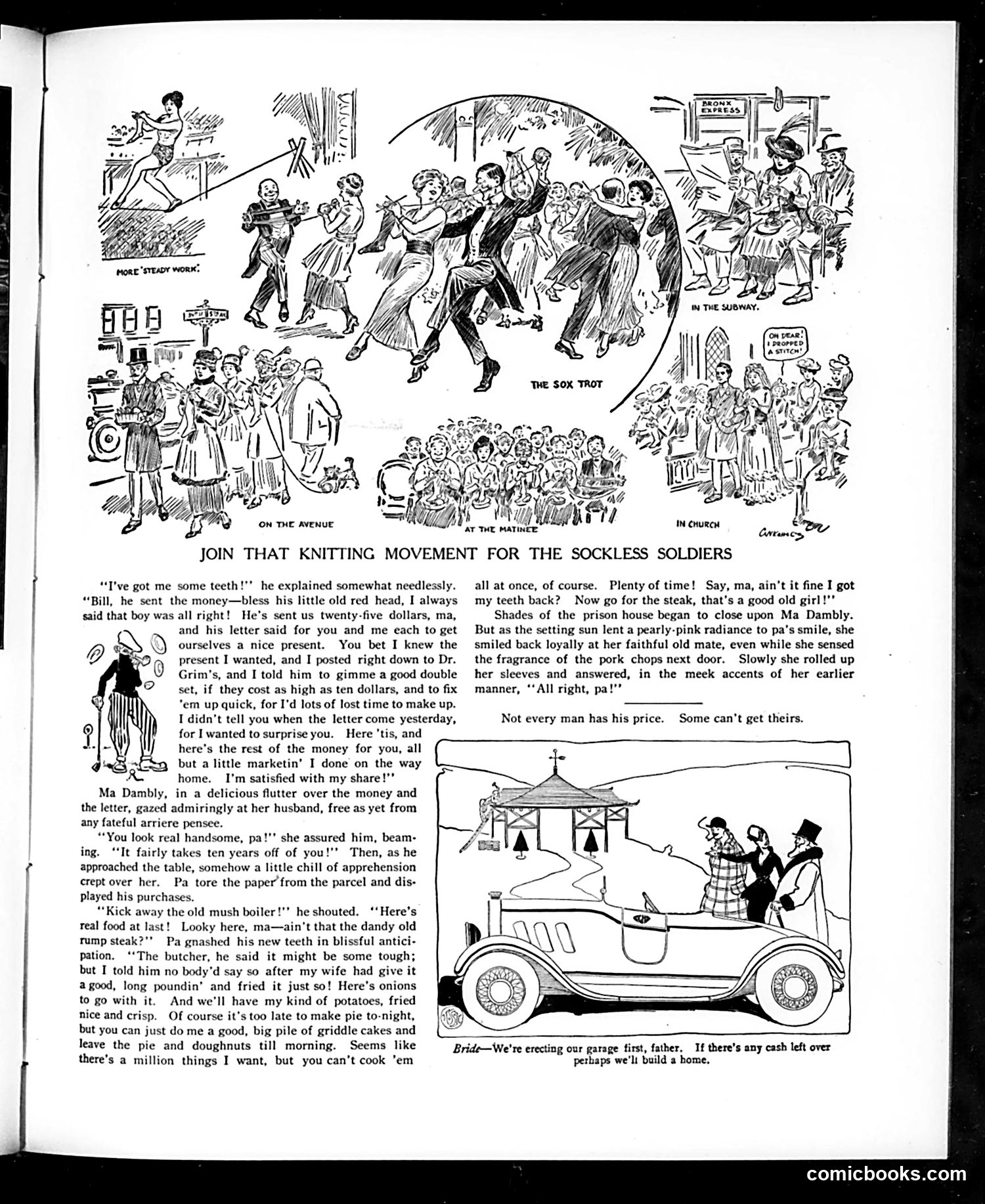
This page contains two separate satirical pieces from the WWI era: **Upper section ("Join That Knitting Movement for the Sockless Soldiers"):** A domestic comedy where a soldier son sends money home to his parents. The father uses his portion to buy false teeth and expensive meat, immediately demanding his wife cook elaborate meals. The satire mocks both masculine self-indulgence and the era's "knitting movement"—a genuine WWI charitable effort where citizens knitted socks and supplies for soldiers. The cartoon strips at top show various dance venues and social activities, contrasting civilian leisure with soldiers' needs. **Lower section (untitled automobile cartoon):** A newlywed bride announces they're building a garage before a house, with a caption suggesting they'll build a home "if there's cash left over." This satirizes the 1920s automobile craze and misplaced priorities—choosing cars over actual shelter, reflecting post-war consumer culture and changing American values. Both pieces use gentle domestic humor to critique contemporary American social behavior and values.
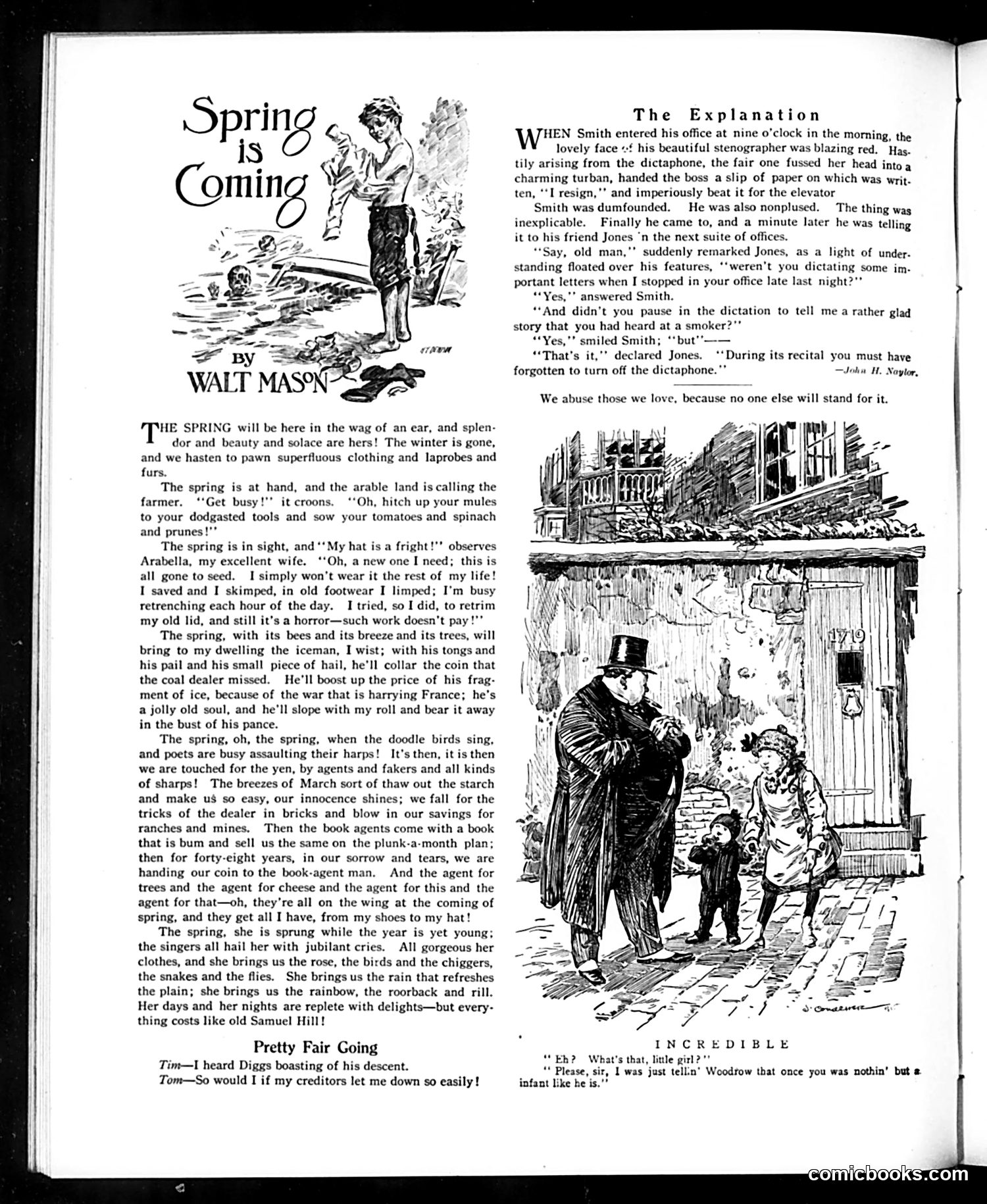
This page contains three satirical pieces from an early 20th-century American magazine: **"Spring is Coming"** (left): A humorous poem mocking springtime's financial toll on ordinary people. The satire targets how spring triggers endless expenses—farmers buying seeds, wives demanding new hats, icemen raising prices (blaming wartime France), and various traveling salesmen (book agents, tree agents, cheese agents) exploiting seasonal optimism to sell unnecessary items through installment plans. The complaint "everything costs like old Samuel Hill" suggests people are financially drained by spring's arrival. **"The Explanation"** (right): A brief comedy about a stenographer who quits after her boss tells an inappropriate "glad story" from a smoker (men's gathering) while dictating—apparently forgetting the dictaphone was recording. The humor relies on embarrassment over captured indiscretion. **"Pretty Fair Going"** (bottom): A two-line joke: one man brags about his descent/ancestry, but another notes if *his* creditors were as lenient, he'd also boast freely—implying financial irresponsibility runs in families. The cartoons reflect Depression-era anxieties about spending, debt, and workplace propriety.
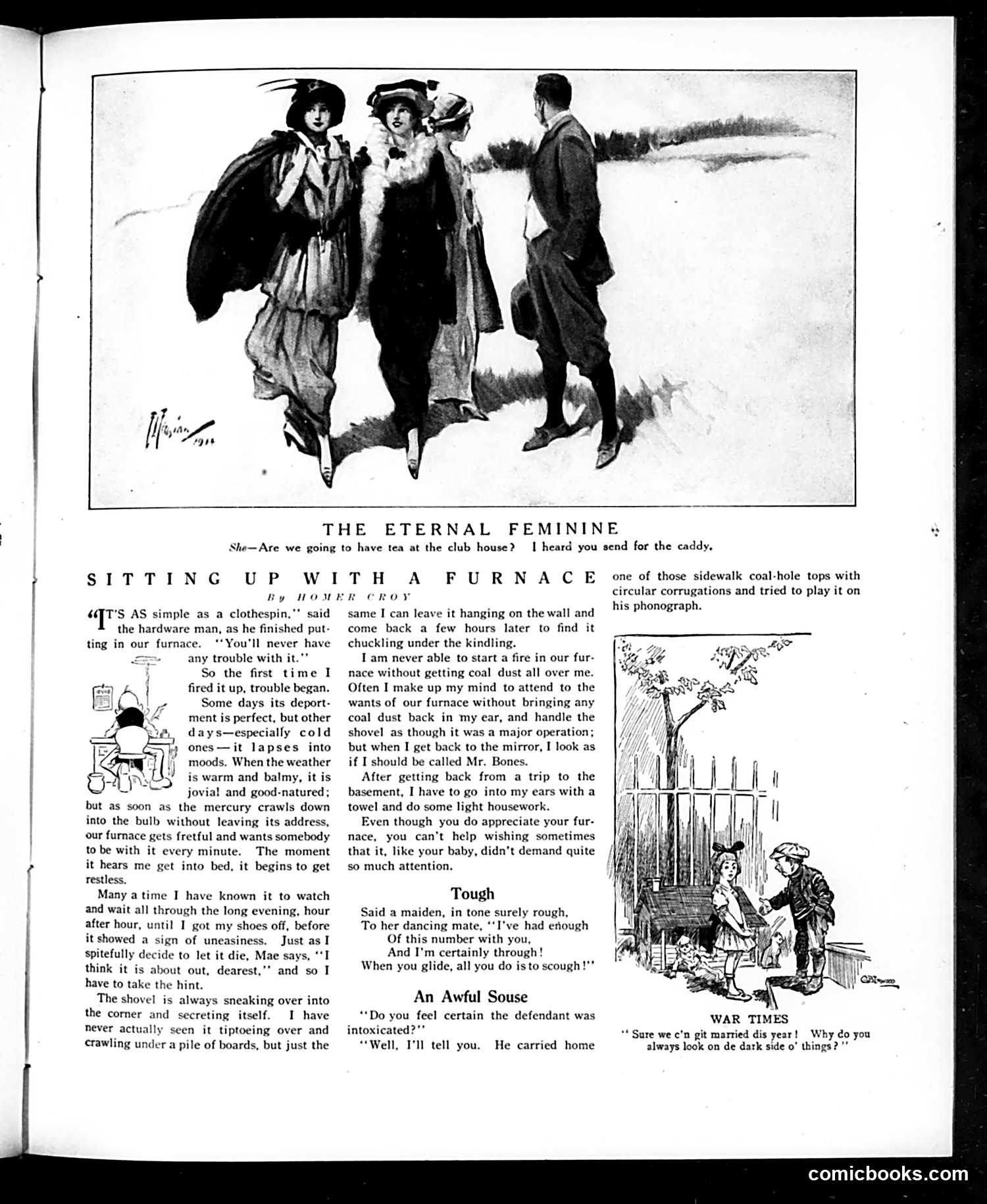
**Top Cartoon ("The Eternal Feminine"):** Shows two fashionable women in winter coats speaking to a man in a snowy landscape. The joke plays on "eternal feminine" (a philosophical concept about women's nature)—here reduced to women's preoccupation with tea and golf caddies, satirizing women's perceived shallow interests and frivolity. **Main Article ("Sitting Up with a Furnace"):** A humorous essay personifying a temperamental home furnace as demanding and moody—working perfectly in warm weather but becoming "fretful" and "restless" in cold weather, requiring constant attention. The satirical point: modern domestic technology creates as many problems as it solves, and the furnace behaves like a spoiled child or demanding spouse. **Sidebar Jokes:** Include a courtroom anecdote about an intoxicated man stealing and attempting to play a coal-hole cover as a phonograph—absurdist humor about drunkenness. The "War Times" caption references wartime rationing/hardship, likely from WWI era. **Overall:** Working-class domestic frustrations presented as comedy.
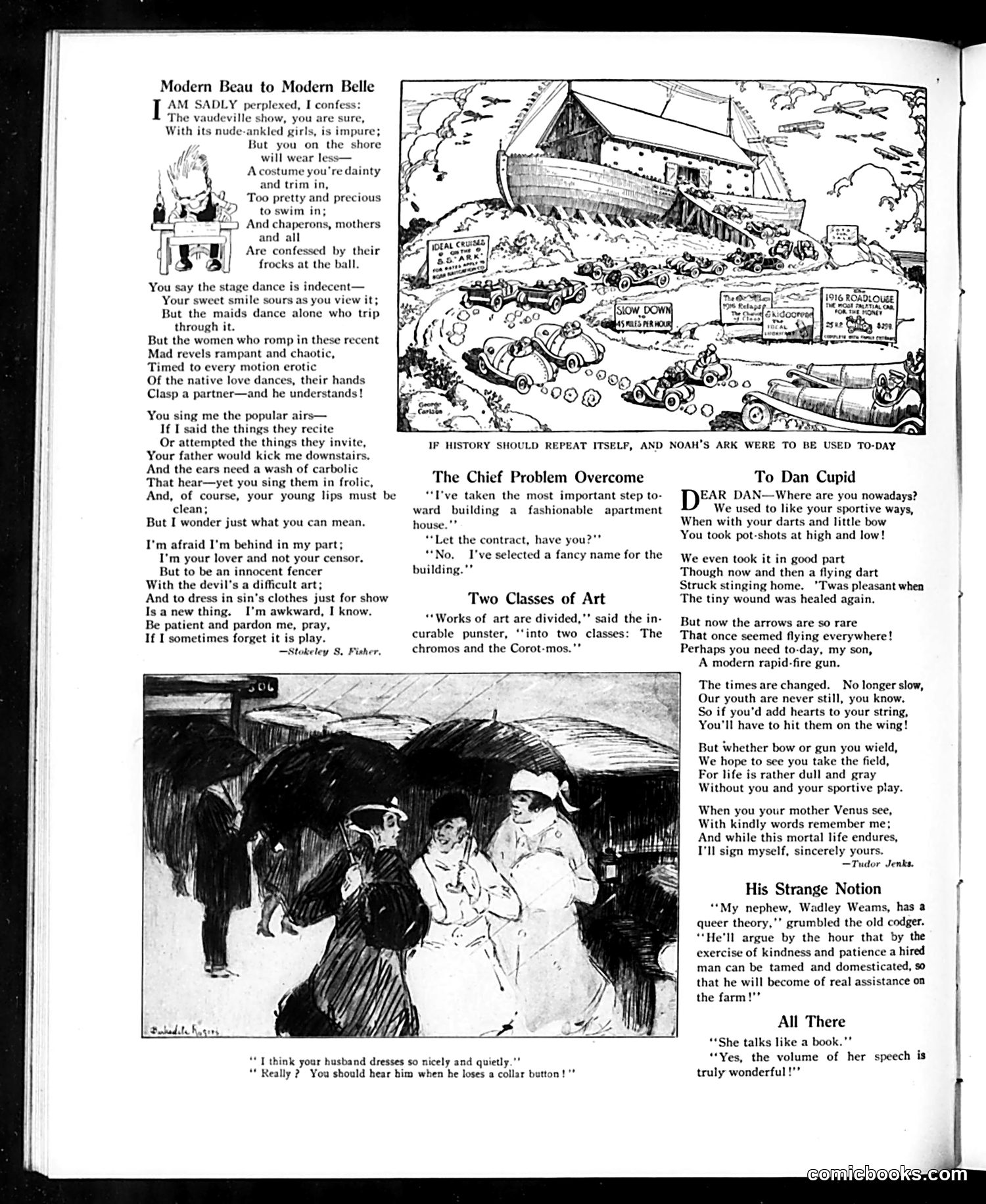
This page satirizes early 20th-century gender and social hypocrisy through multiple pieces: **"Modern Beau to Modern Belle"** (main poem by Stokeley S. Fisher): A man complains about female double standards. Women condemn vaudeville dancers' bare ankles as immoral, yet wear revealing bathing costumes themselves. They criticize stage dancing as indecent while singing suggestive popular songs. The satire mocks women's selective morality—they police others' behavior while engaging in the same conduct, expecting men to remain gentlemen despite this inconsistency. **"The Chief Problem Overcome"**: A brief joke about prioritizing a fancy name over actual construction details when building an apartment house—satirizing superficial marketing over substance. **"To Dan Cupid"** (by Tudor Jenks): A humorous letter suggesting Cupid modernize from bow-and-arrow to a rapid-fire gun because modern youth move too fast for traditional romance methods. The cartoons and short pieces collectively mock contemporary society's moral pretenses, changing customs, and the gap between stated values and actual behavior.
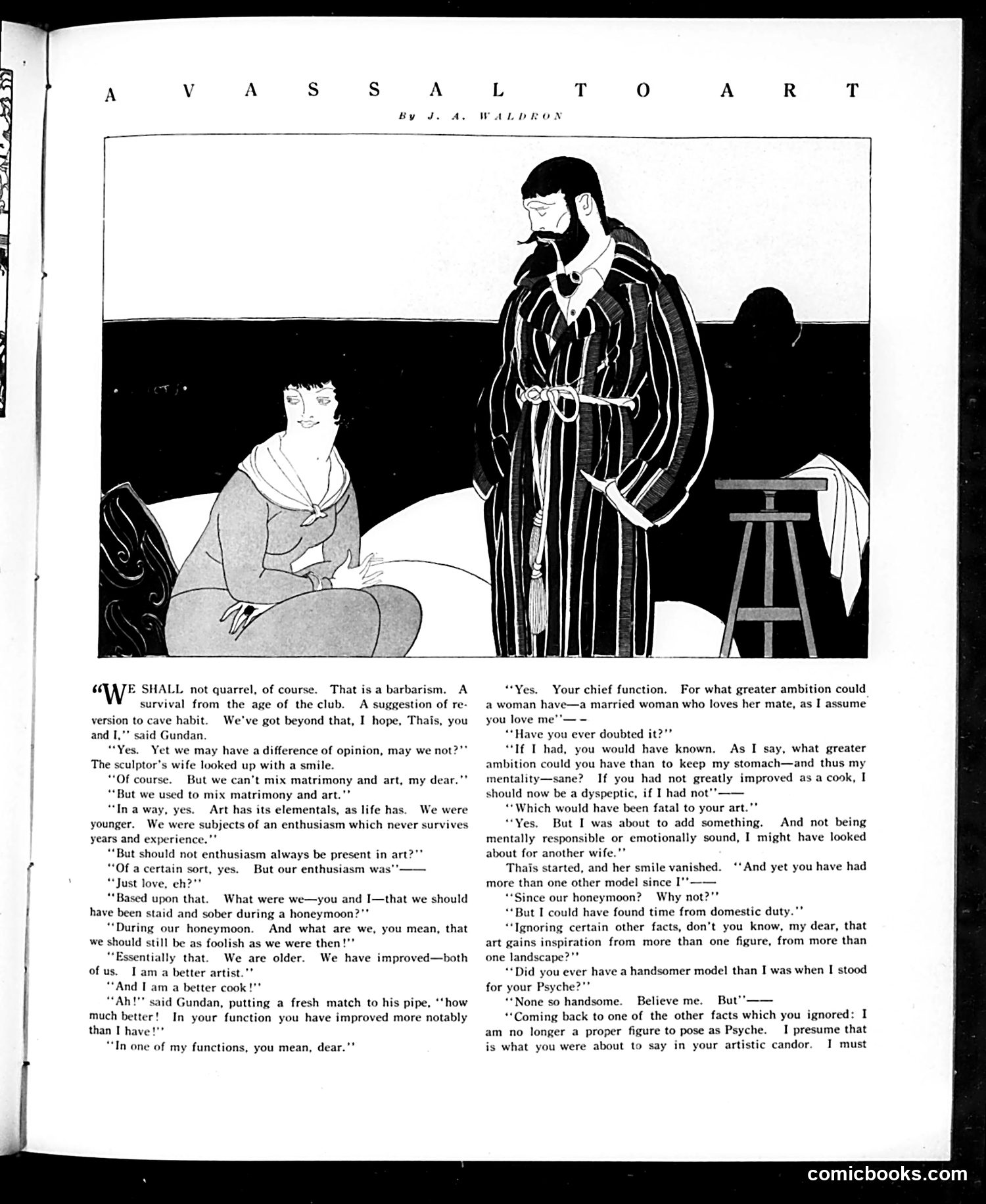
This satirical dialogue depicts a sculptor named Gundan and his wife Thais discussing the compromises of married life. The satire targets the tension between artistic pursuits and domestic responsibility. Gundan argues that his wife's greatest ambition should be maintaining his health through cooking—which keeps him mentally sound for his art. He justifies taking other female models (including presumably more attractive ones) as artistically necessary. Thais, initially patient, grows visibly angry when he suggests she's no longer an adequate model due to aging. The cartoon mocks the self-serving rationalization men use to justify infidelity: framing it as "artistic necessity" while simultaneously praising their wives' domestic improvements. It satirizes how male artists claimed their work required multiple female subjects, and how marriage was reduced—from the husband's perspective—to cooking and household management rather than genuine partnership. The piece critiques both artistic pretension and marital hypocrisy in early-20th-century relationships.
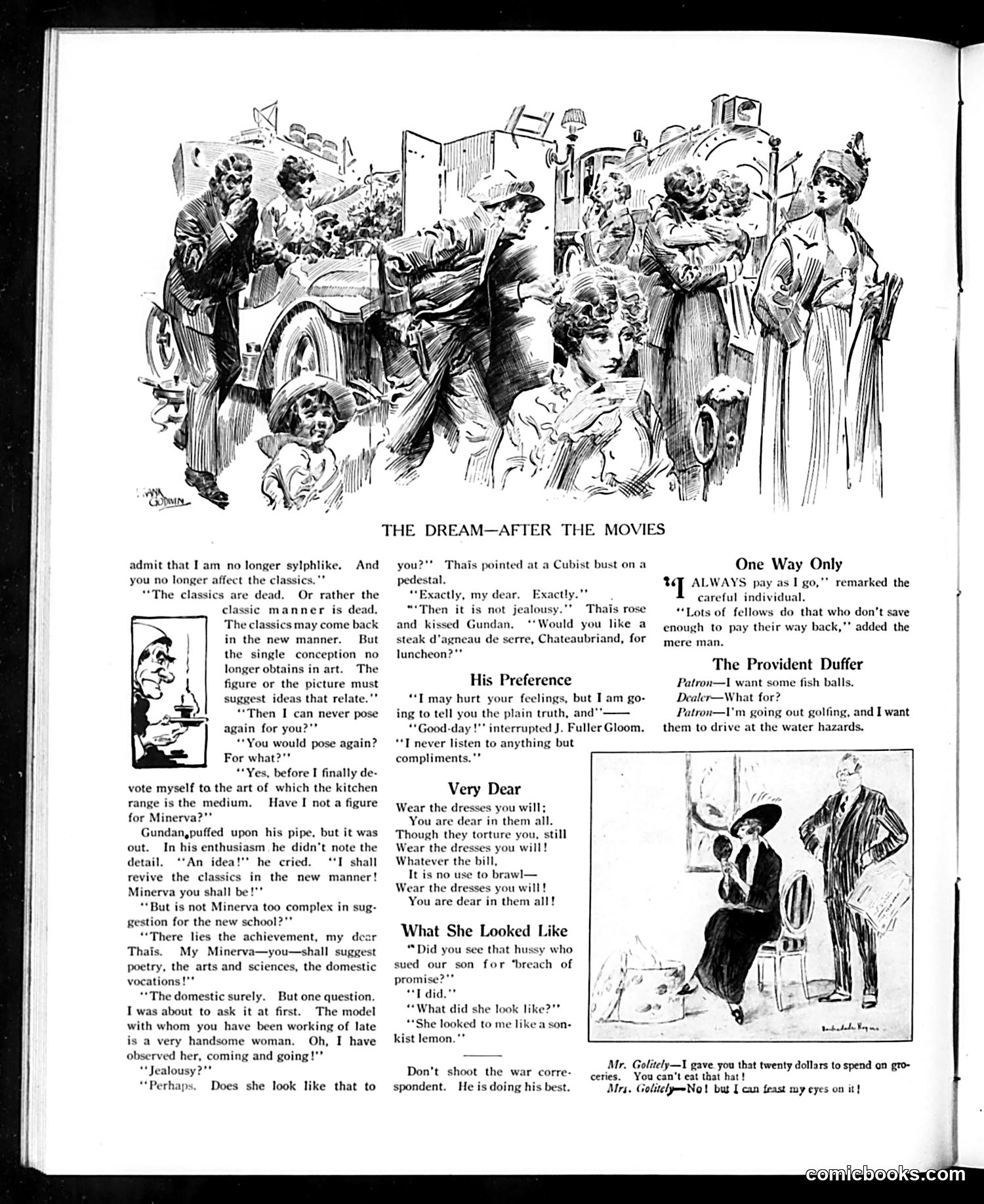
This page from *Judge* contains multiple short satirical pieces mocking early 20th-century American social pretensions and absurdities. **"The Dream—After the Movies"** (top) depicts an artist and his model discussing modernism's rejection of classical ideals. The satire targets intellectuals who abandon traditional art for fashionable "new" movements (referencing Cubism, visible in the "Cubist bust"), while the woman reduces herself to domestic work—suggesting that pseudo-artistic modernism produces hollow results. The remaining pieces are brief comedic vignettes: - **"One Way Only"**: Mocks cheap people who can't afford return travel - **"The Provident Duffer"**: Absurdist humor about using fish balls as golf practice - **"Very Dear"**: A romantic poem about indulging a woman's expensive dress purchases - **"What She Looked Like"**: Mean-spirited joke about an unattractive woman Together, these pieces satirize vanity, artistic pretension, financial anxiety, and gender relations in the post-WWI era, using sharp wit typical of *Judge*'s humor.
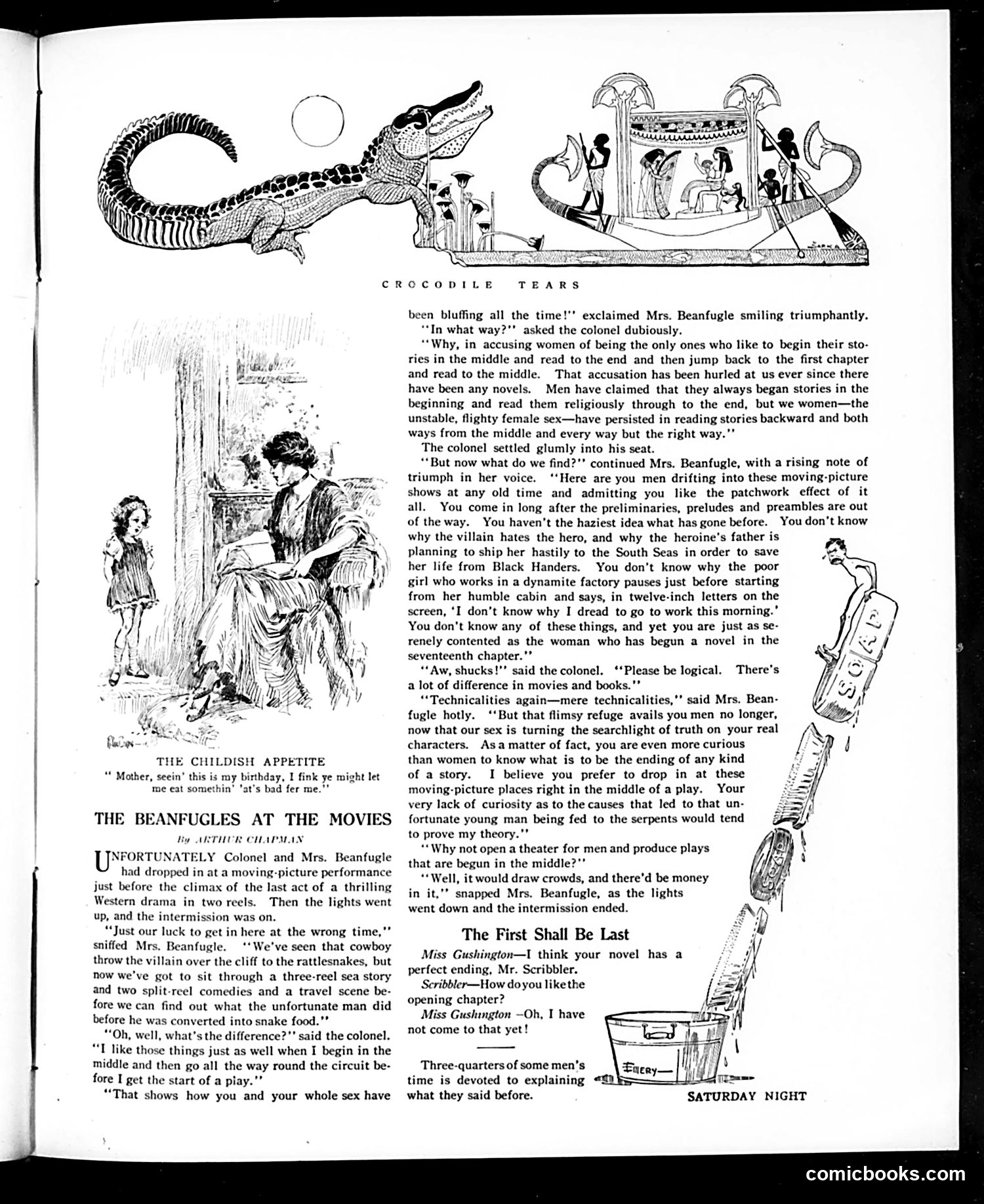
This satirical piece by Arthur Chapman mocks early 1900s gender stereotypes about narrative preferences. The Beanfugles arrive mid-film at a moving picture show, and Mrs. Beanfugle seizes the moment to expose male hypocrisy. For decades, men had accused women of being scatterbrained for reading novels non-sequentially—jumping between chapters, starting in the middle. Now, Mrs. Beanfugle triumphantly observes, men casually enter cinema mid-story without concern, contradicting their claims of superior logical thinking. The cartoon inverts the era's common complaint that women were frivolous and disorganized compared to methodical men. By catching men exhibiting the exact behavior they'd criticized in women, Chapman exposes this accusation as baseless posturing—men were simply "bluffing all the time," as Mrs. Beanfugle declares.
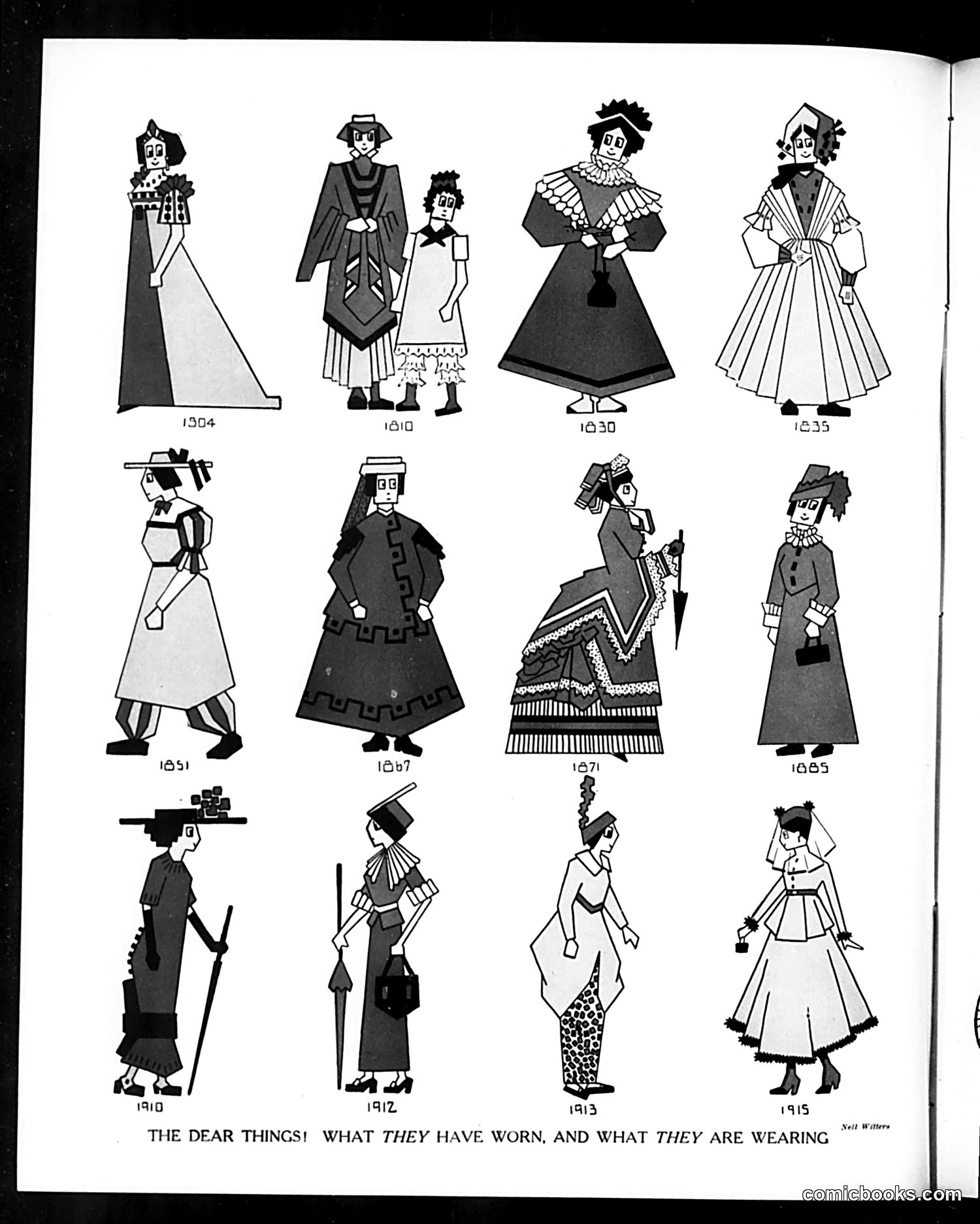
This page satirizes women's fashion evolution over approximately four centuries (1504-1915). The title "THE DEAR THINGS! WHAT THEY HAVE WORN, AND WHAT THEY ARE WEARING" uses ironic affection to mock fashion's absurdity. The chronological progression shows increasingly elaborate, restrictive garments—massive trains, towering headdresses, corseted silhouettes, ornamental collars—culminating in the 1915 figure wearing a simpler, more practical dress. The satire suggests women blindly followed ridiculous fashion dictates across generations, enduring uncomfortable, unwieldy clothing. By 1915, the cartoon appears to celebrate or at least acknowledge a shift toward more sensible women's dress, possibly reflecting early feminist critiques of restrictive fashion as a form of bodily constraint. The attribution to "Nell Willers" indicates the cartoonist's name.
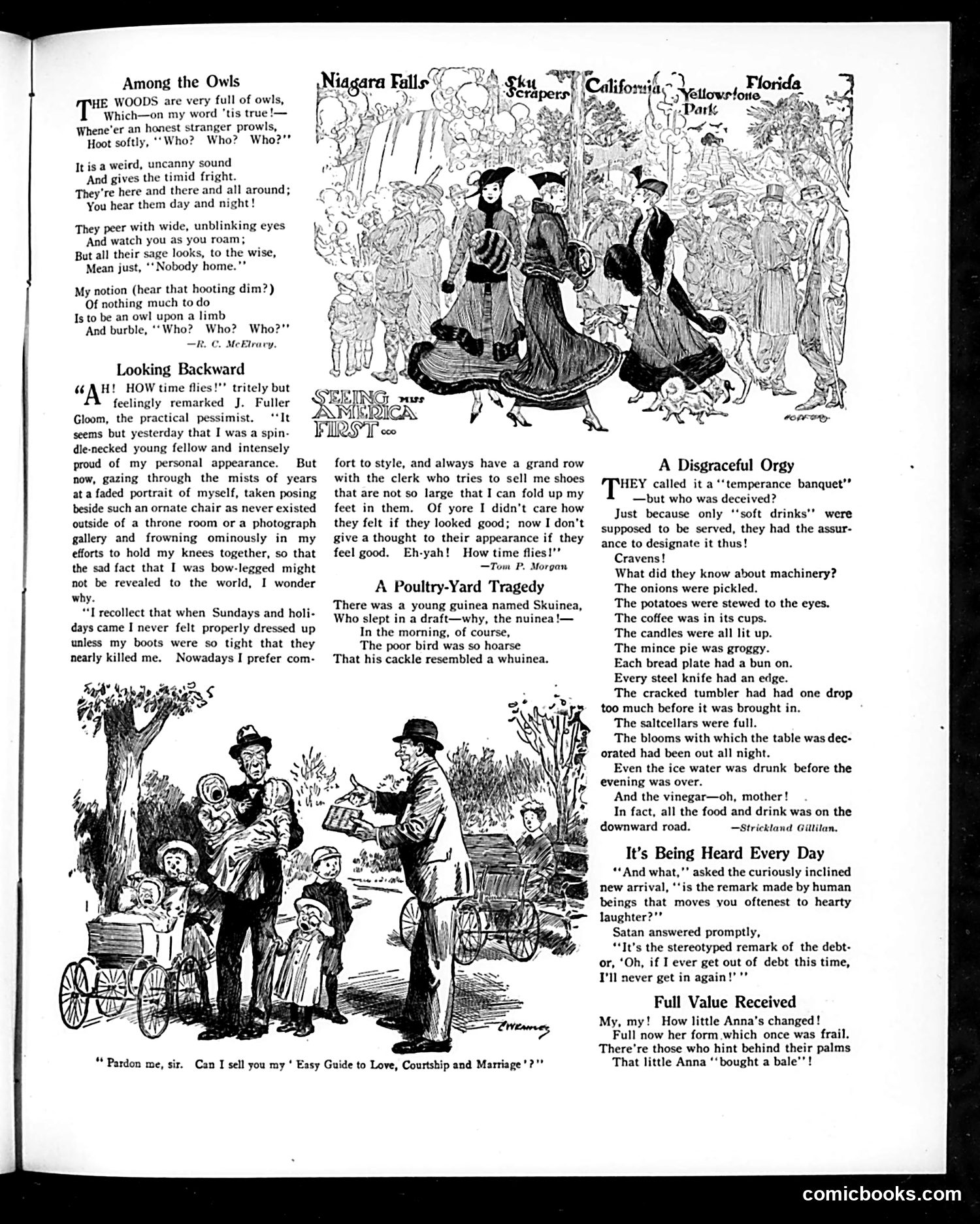
This page contains several humorous pieces typical of early 20th-century American satirical magazines: **"Among the Owls"** uses owls as metaphor for people who appear wise but are actually empty-headed ("Nobody home"), poking fun at pretentious intellectuals. **"Looking Backward"** satirizes aging and vanity—a man recalls obsessing over fashion and appearance in youth (tight boots, frowning to hide bow-legs) but now prioritizes comfort, mocking how priorities shift with age. **"A Disgraceful Orgy"** is clever wordplay: a "temperance banquet" supposedly serving only soft drinks is ridiculed because every food/beverage item described uses alcohol-related puns ("stewed to the eyes," "in its cups," "groggy," "edge"), suggesting the event was actually quite intoxicated despite its temperance claims. **"It's Being Heard Every Day"** presents a common debtor's false promise to reform finances—a joke about human nature's cyclical poor decisions. **"Full Value Received"** suggests a young woman has gained weight, implying she was "bought" or married for her dowry.
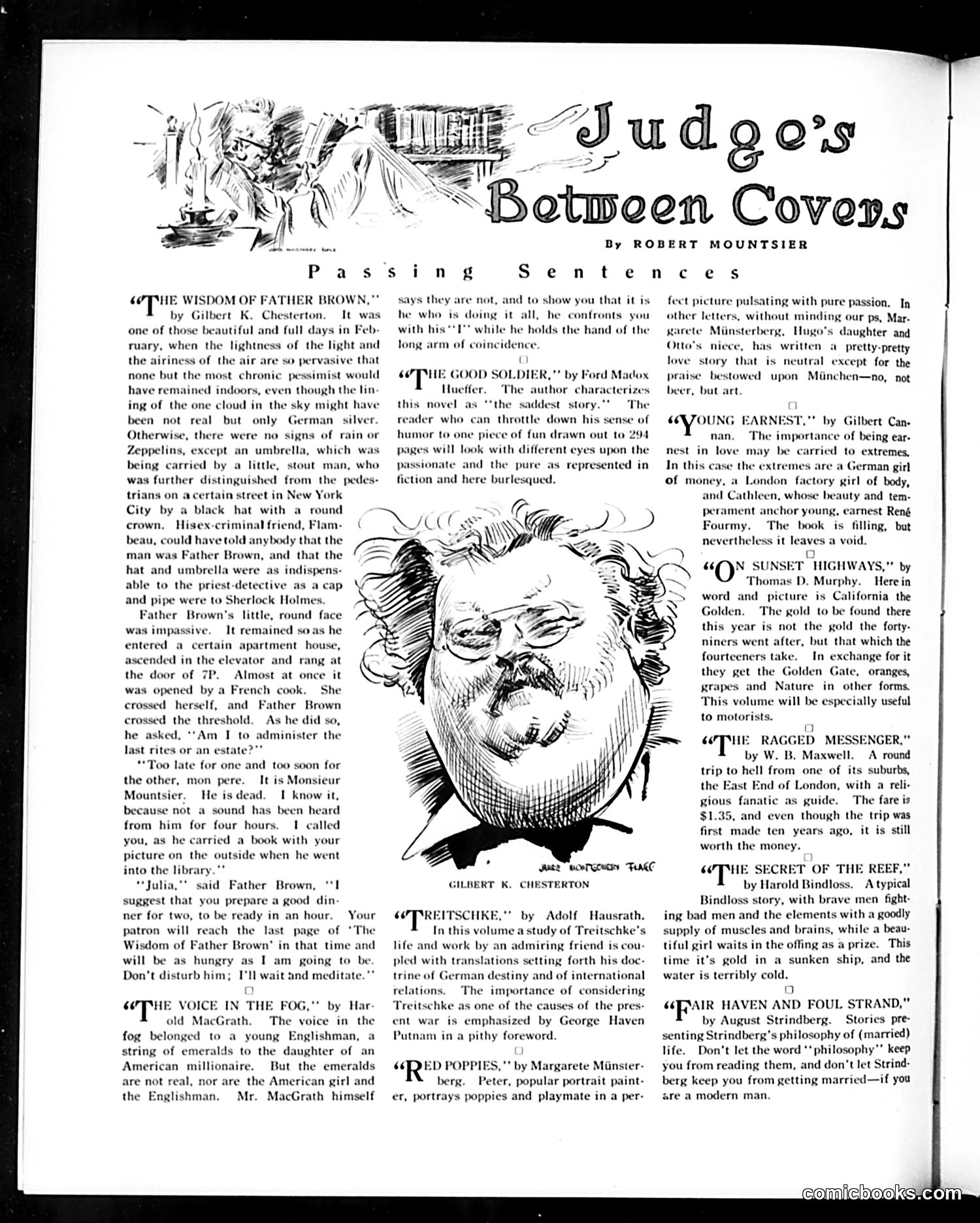
This page from *Judge* magazine presents brief reviews of recently published books, written by Robert Mountsier. The central illustration is a portrait sketch, likely of Gilbert K. Chesterton, whose short story "The Wisdom of Father Brown" is the first book discussed. The reviews cover literary works including Ford Madox Hueffer's "The Good Soldier" (described as "the saddest story") and Adolf Hausrath's study of Treitschke, a German nationalist whose work on "German destiny" is contextualized within discussions of the present war—indicating this page dates to World War I era. The content is primarily literary criticism rather than political satire. However, the reference to Treitschke's "doctrine of German destiny" and a mention of "German silver" in Chesterton's story reflect the anti-German sentiment typical of American publications during WWI. The page functions as cultural commentary through book selection and framing rather than through satirical cartoon imagery.
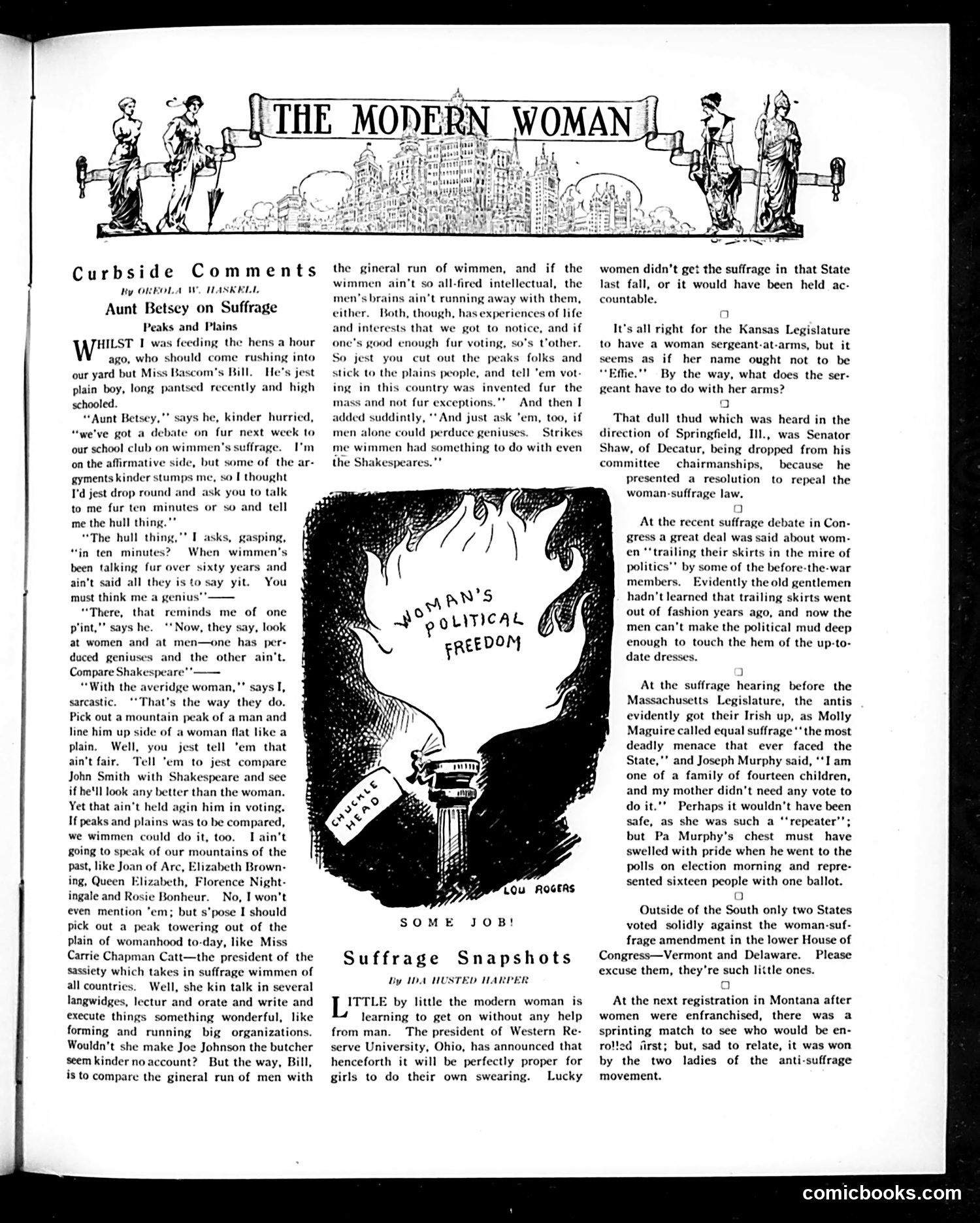
This Judge magazine page satirizes the women's suffrage debate circa 1910s America through two complementary pieces: **"Aunt Betsey on Suffrage"** presents a rural character's commonsense pro-suffrage argument. Aunt Betsey counters anti-suffrage rhetoric by noting that comparisons between men and women are unfair when using "peaks" (exceptional individuals like Shakespeare) rather than "plains" (ordinary people). Her point: if average men deserve voting rights, so do average women. She also credits women with intellectual contributions (mentioning Joan of Arc, Elizabeth Browning, Florence Nightingale, and Carrie Chapman Catt, the actual suffrage leader). **"Suffrage Snapshots"** by Ida Husted Harper offers satirical "news" items mocking anti-suffrage positions—particularly men's condescension about women entering politics while simultaneously opposing their legal rights. **The cartoon** depicts a woman breaking chains labeled "Effie's Head" and "Chains," symbolizing women's political liberation. The page's overall message: the suffrage opposition's arguments are logically inconsistent and outdated.
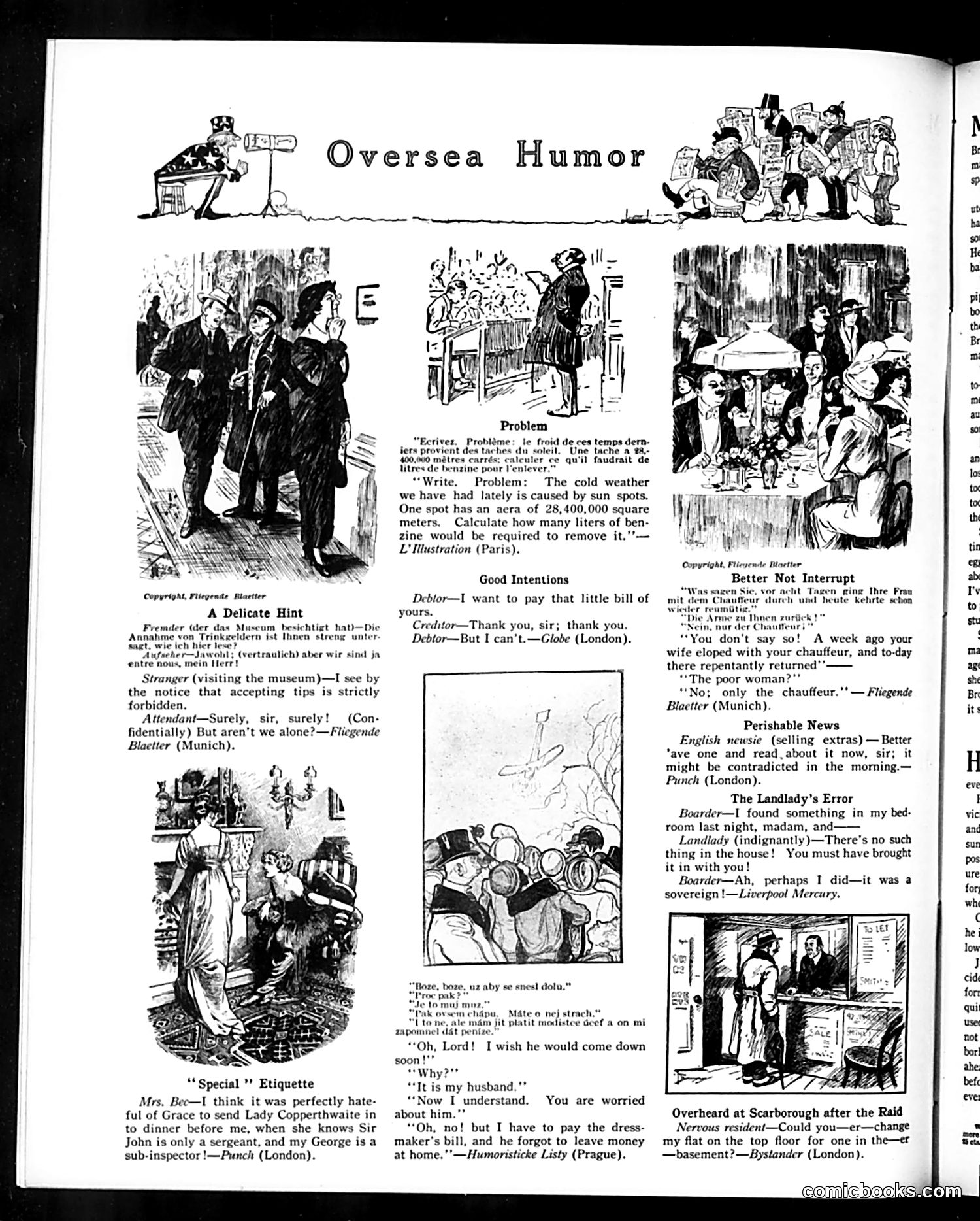
This page collects humorous shorts from European magazines, translated for English readers. The cartoons satirize everyday social pretenses and economic absurdities: **"A Delicate Hint"** mocks museum attendants who publicly forbid tips while privately soliciting them—hypocrisy dressed as propriety. **"Special Etiquette"** ridicules class snobbery: a woman resents seating a lady ahead of herself because the guest's husband is merely a sergeant versus her own sub-inspector spouse—trivial military rank distinctions elevated to social importance. **"Problem"** parodies absurd school math: a physics problem asks students to calculate benzine needed to remove a sunspot, treating an astronomical phenomenon as a practical cleaning task. Other shorts mock creditors (who accept non-payment gracefully), infidelity (where only the chauffeur returns, not the wife), newspaper unreliability, and wartime anxiety (requesting a basement flat after aerial raids). The humor relies on recognizing universal human foibles: social pretension, economic hypocrisy, and institutional absurdity—timeless targets across cultures.
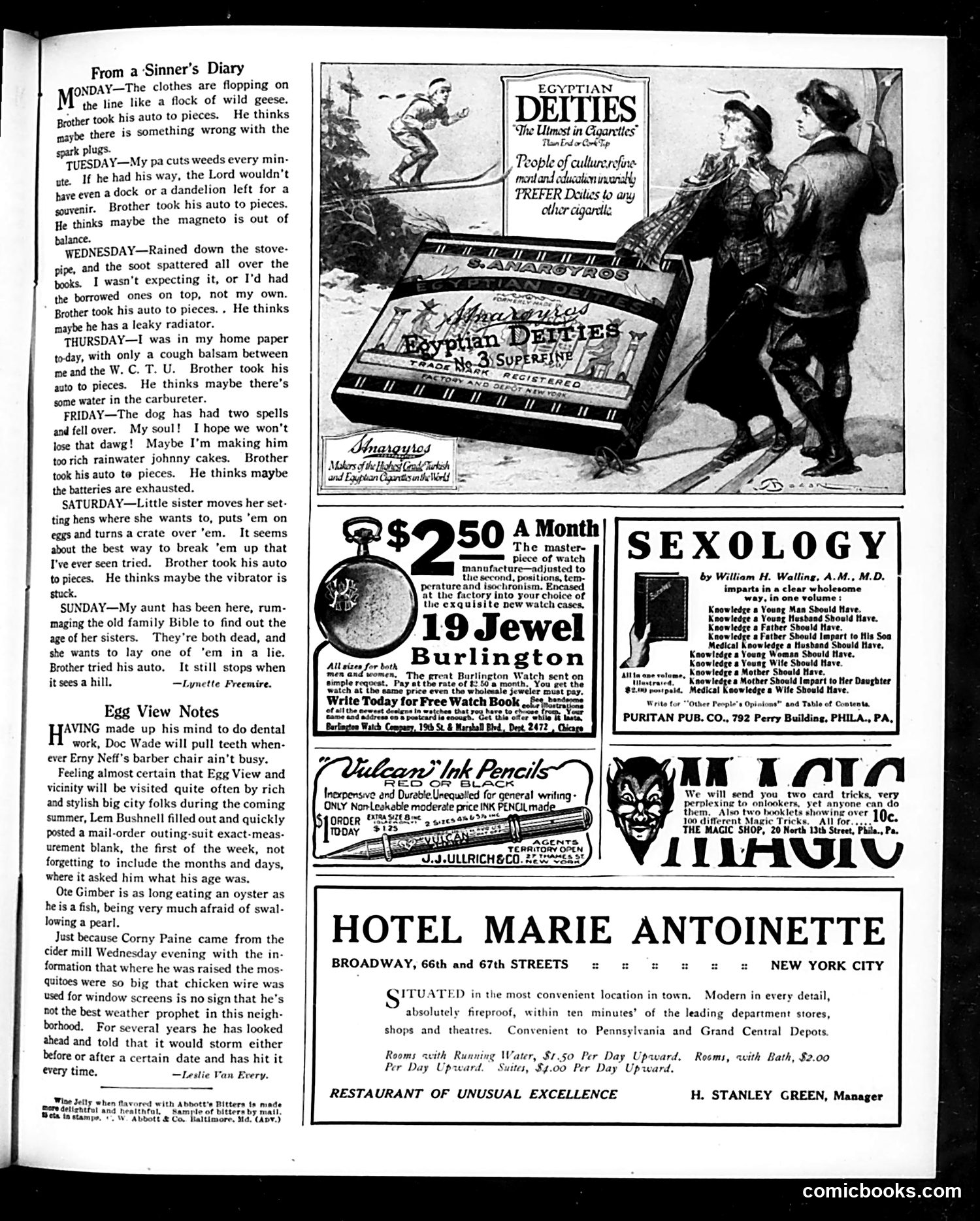
This page is primarily **humorous domestic fiction and advertising** rather than political satire. The main content includes "From a Sinner's Diary"—a comedic weekly journal where a family member repeatedly complains about household disasters (flopping laundry, rain down the stovepipe, sick animals) while noting their brother constantly disassembles his automobile, always diagnosing new mechanical problems. The humor derives from the absurdity of both situations and the brother's mechanical obsession. "Egg View Notes" offers small-town rural anecdotes—humorous character sketches of locals like a dentist-barber and an oyster-eating man afraid of pearls. The page is otherwise filled with period advertisements (Egyptian Deities cigarettes, Burlington watches, Vulcan ink pencils, a New York hotel, and a "Sexology" book). These reflect early 20th-century consumer culture but contain no political commentary. This appears to be a humor/lifestyle section rather than Judge's satirical editorial content.
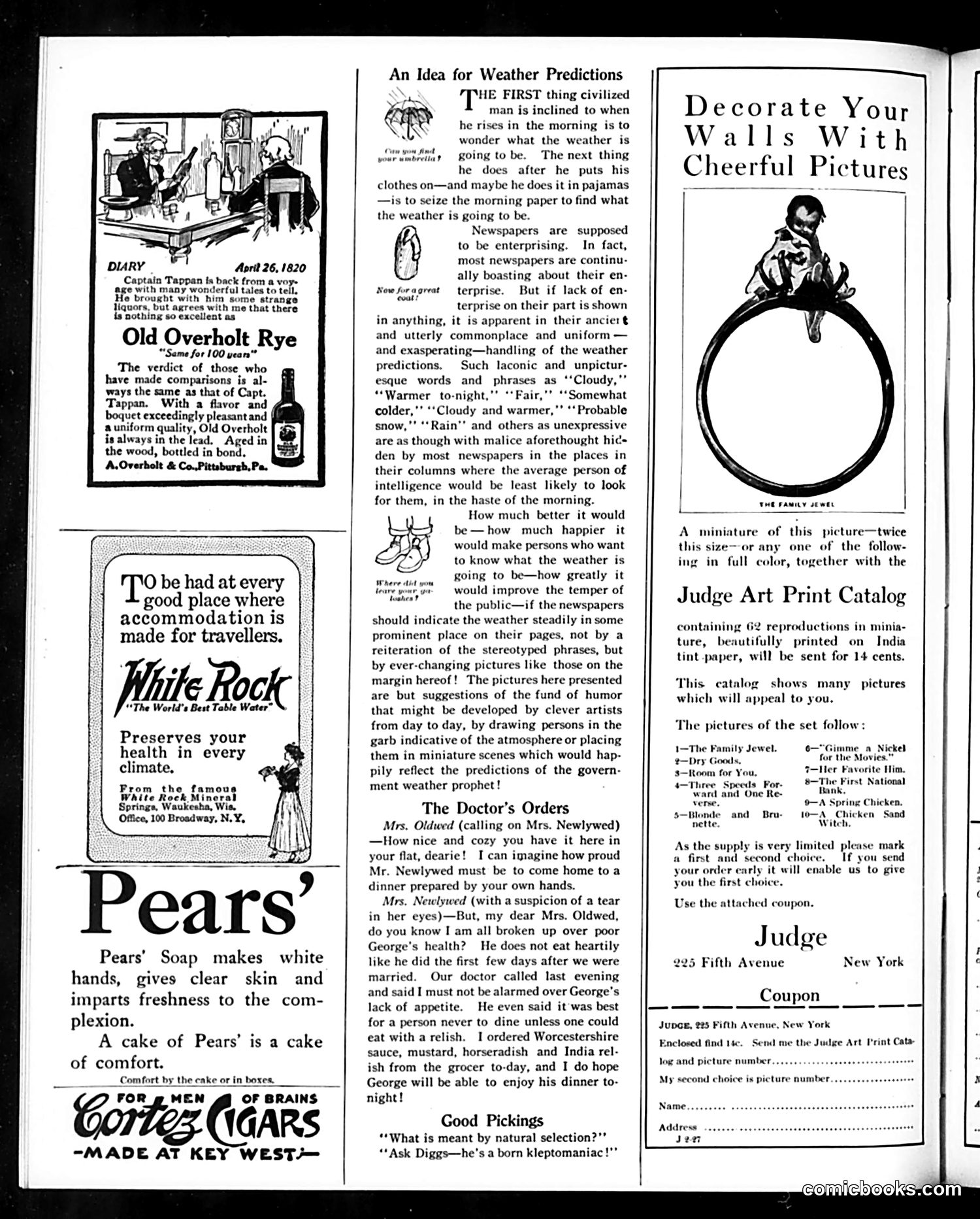
This page mixes advertisements with satirical content typical of *Judge* magazine (circa 1820, though the date appears anachronistic). **Main Satire — "An Idea for Weather Predictions":** The article mocks newspapers for boring, generic weather forecasts using clichéd phrases like "Cloudy" and "Warmer to-night." The author suggests newspapers should instead use illustrated vignettes—small drawings of people dressed for specific weather conditions—to make forecasts more engaging and visually interesting. **"The Doctor's Orders":** A brief domestic comedy where a newlywed wife misinterprets her doctor's advice. He suggested her husband should only eat when hungry, but she interprets this as a health crisis and loads dinner with heavy condiments (Worcestershire, mustard, horseradish) to stimulate appetite. **"Good Pickings":** A one-liner joke: when asked what "natural selection" means, someone suggests asking "Diggs," who is a "born kleptomaniac"—implying he naturally selects (steals) things. The remaining content is period advertising for liquor, soap, mineral water, and cigars.
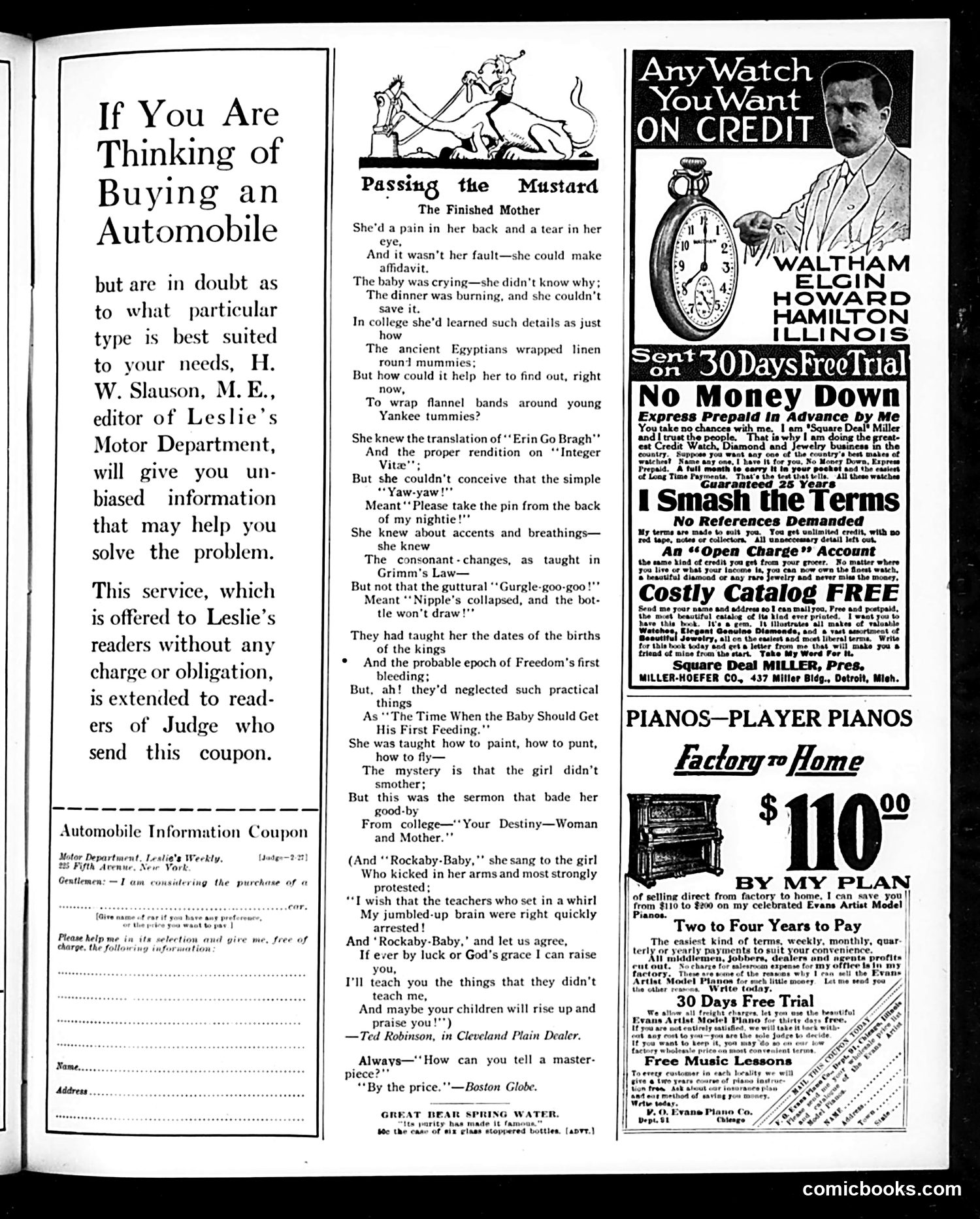
This page is primarily **advertising**, not satire. However, it contains one notable poem: **"Passing the Mustard: The Finished Mother"** by Ted Robinson satirizes the gap between women's classical education and practical motherhood. The poem mocks that college-educated women learned Latin ("Integer Vitae"), ancient history, and academic skills—yet received no training in basic childcare. A mother cannot translate her baby's cries ("Gurgle-goo-goo" means the bottle won't work) despite her classical training. The satire critiques early 20th-century education systems that prepared women for intellectual pursuits while ignoring domestic realities they'd face. The poem's resolution—the mother vows to teach her own daughter practical skills—is both sarcastic and pointed social commentary about women's limited options. The page's remaining content consists of period product advertisements: automobile information, watches on credit, and pianos—typical Judge magazine filler.
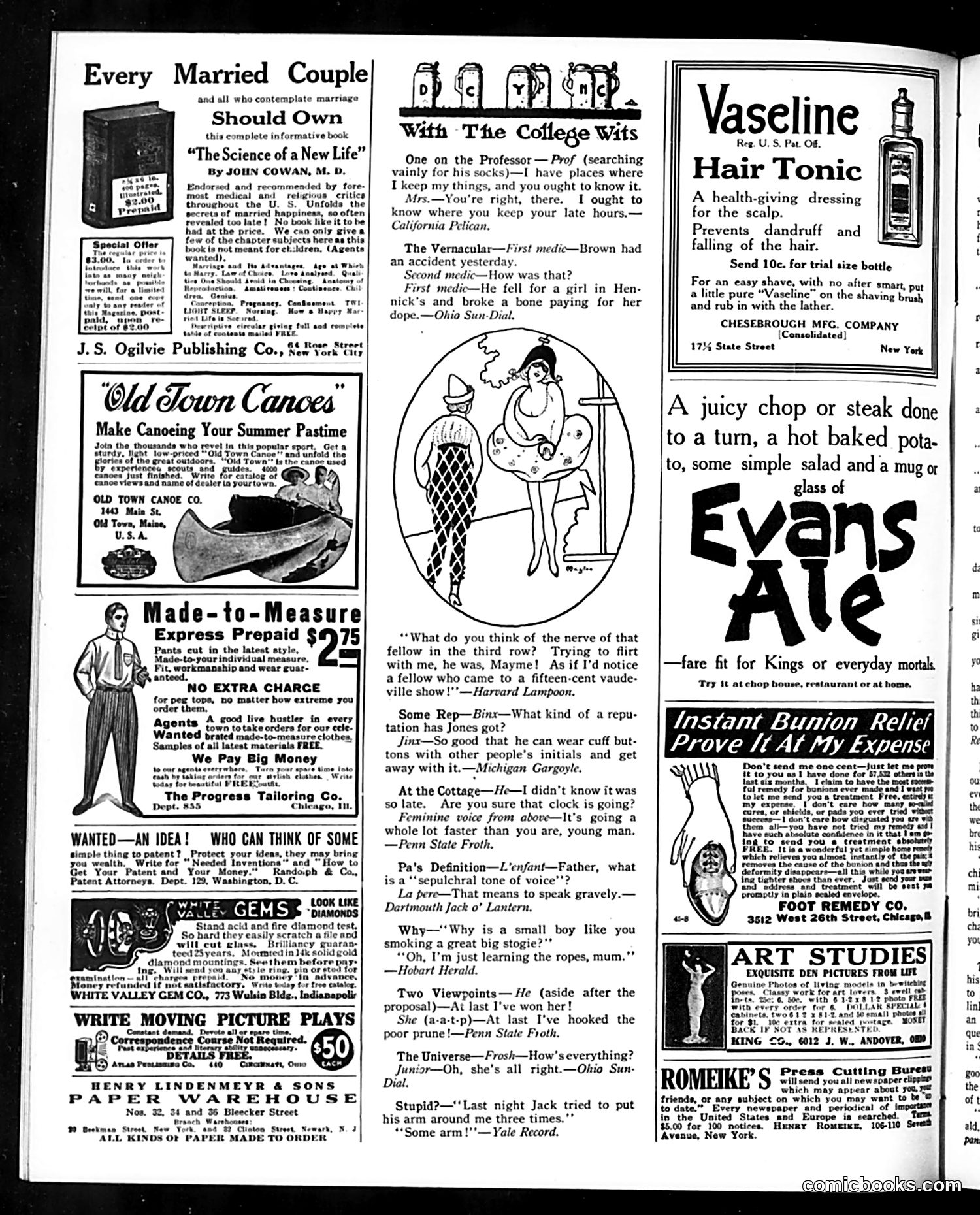
This is primarily an **advertising and humor page** from Judge magazine, containing college humor pieces and commercial advertisements typical of the early 20th century. The cartoon humor relies on **dating and courtship dynamics** familiar to that era. Jokes include: a professor absent-mindedly unaware of where his wife spends time (implying infidelity as comedy); a medical student's dating mishap; and multiple quips about flirtation, marriage proposals, and women's romantic entrapment of men—the latter two viewpoints joke treating marriage as competitive conquest rather than partnership. The advertisements—for "The Science of a New Life" (marriage advice), made-to-measure suits, Vaseline hair tonic, and Evans Ale—suggest the magazine's readership was young, educated, middle-class men navigating courtship and consumption. The satirical edge is **blunt and gendered**, portraying women as calculating and men as hapless or deceptive, reflecting period attitudes toward romance.
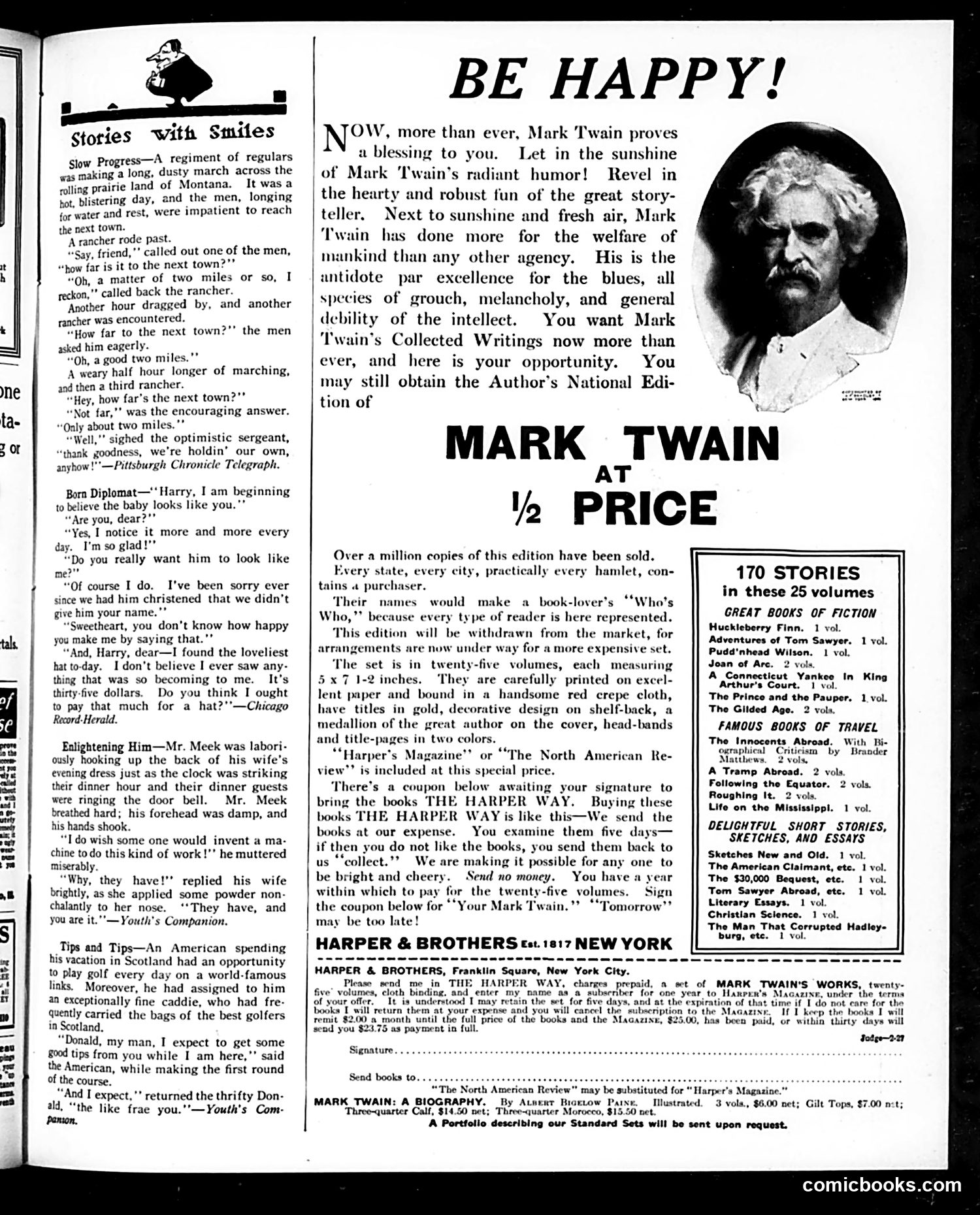
This page combines several short humorous anecdotes with a major advertisement for Mark Twain's Collected Writings at half price. **The Cartoons/Stories:** Four brief jokes illustrate everyday absurdities—soldiers repeatedly told towns are "two miles away," a husband flattered by his wife's backhanded compliments about their baby's resemblance to him, a henpecked husband struggling with dress hooks while his wife applies makeup, and a Scottish caddie's witty retort about expecting "tips" (gratuities) matching the American's promised rewards. **The Advertisement:** The dominant right-hand content promotes Twain's works as a cure for melancholy—"the antidote par excellence for the blues." It claims over one million copies sold and emphasizes the set's comprehensiveness across "25 volumes" at reduced price through Harper & Brothers. **Social Context:** The humor reflects early 20th-century gender dynamics (wives controlling finances, husbands as domestic helpers) and class consciousness (American tourists abroad). The advertising exemplifies period mass-marketing that positioned literature as both entertainment and self-improvement—appealing to aspirational readers seeking cultural refinement.
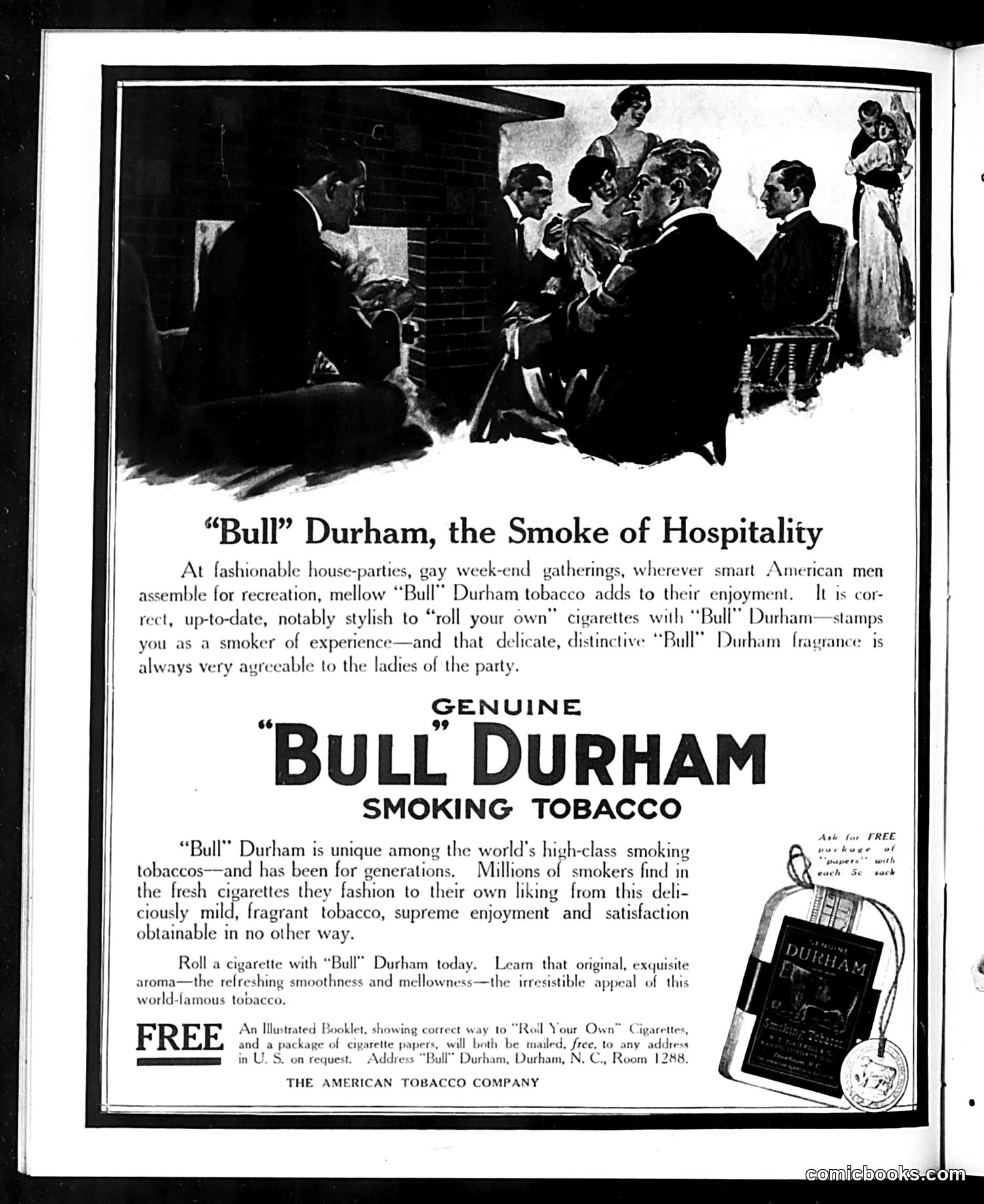
This is a **tobacco advertisement**, not satire or political commentary. It promotes "Bull" Durham rolling tobacco to wealthy American men by associating the product with social sophistication and masculine leisure. The illustration depicts well-dressed men at an upscale house party socializing—the aspirational setting where the product supposedly belongs. The ad claims that rolling your own cigarettes with Bull Durham marks you as "a smoker of experience" and is "correct, up-to-date, notably stylish." The appeal to women ("agreeable to the ladies") and emphasis on the tobacco's "delicate, distinctive fragrance" targets masculine vanity and social status anxiety. The free offer of a "Roll Your Own" instruction booklet and cigarette papers encourages trial purchase. This represents early 20th-century advertising strategy: linking consumer products to social class aspiration rather than product quality alone.