
Judge, 1915-02-27 · page 7 of 24
Judge — February 27, 1915 — page 7: what you’re looking at
What you’re looking at
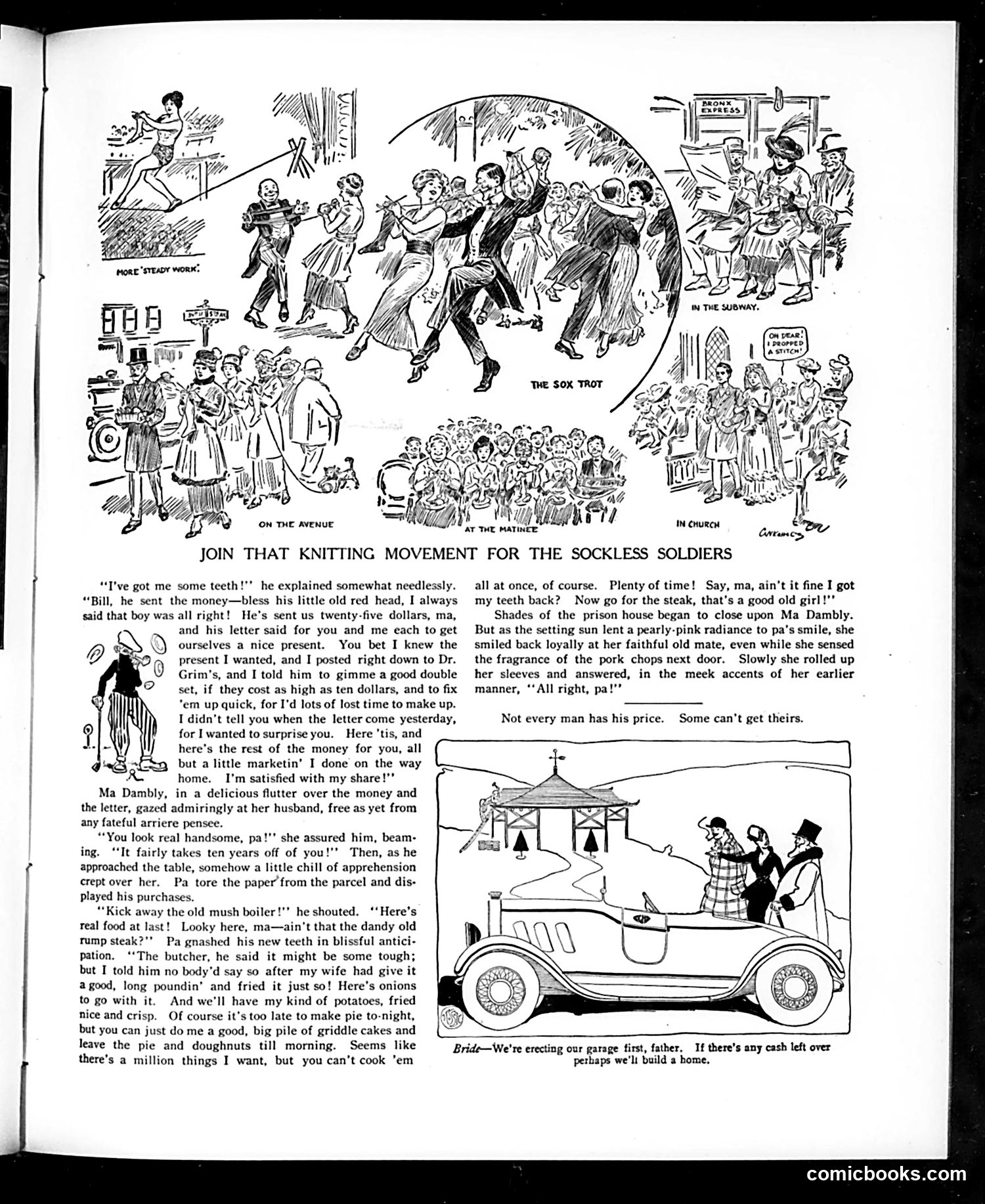
This page contains two separate satirical pieces from the WWI era: **Upper section ("Join That Knitting Movement for the Sockless Soldiers"):** A domestic comedy where a soldier son sends money home to his parents. The father uses his portion to buy false teeth and expensive meat, immediately demanding his wife cook elaborate meals. The satire mocks both masculine self-indulgence and the era's "knitting movement"—a genuine WWI charitable effort where citizens knitted socks and supplies for soldiers. The cartoon strips at top show various dance venues and social activities, contrasting civilian leisure with soldiers' needs. **Lower section (untitled automobile cartoon):** A newlywed bride announces they're building a garage before a house, with a caption suggesting they'll build a home "if there's cash left over." This satirizes the 1920s automobile craze and misplaced priorities—choosing cars over actual shelter, reflecting post-war consumer culture and changing American values. Both pieces use gentle domestic humor to critique contemporary American social behavior and values.
📄 Transcribed text from this page (OCR, searchable)
Machine-transcribed from the original scan — historical spelling and the odd misread are preserved.
—~ IN cHurcd JOIN THAT KNITTING MOVEMENT FOR THE SOCKLESS SOLDIERS “T've got me some teeth!’’ he explained somewhat needlessly. “Bill, he sent the money—bless his little old red head, I always said that boy was all right! He's sent us twenty-five dollars, ma, and his letter said for you and me each to get i) ourselves a nice present. You bet I knew the 0 present I wanted, and I posted right down to Dr. Qe Grim’s, and I told him to gimme a good double set, if they cost as high as ten dollars, and to fix "em up quick, for I'd lots of lost time to make up. I didn’t tell you when the letter come yesterday, Ma Dambly, in a delicious flutter over the money and the letter, gazed admiringly at her husband, free as yet from any fateful arriere pensee. “You look real handsome, pa!" she assured him, beam- ing. ‘‘It fairly takes ten years off of you!’’ Then, as he approached the table, somehow a little chill of apprehension crept over her. Pa tore the paper from the parcel and dis- played his purchases, “Kick away the old mush boiler!’ he shouted. ‘‘Here’s real food at last! Looky here, ma—ain’t that the dandy old Tump steak?’’ Pa gnashed his new teeth in blissful antici- pation. ‘‘The butcher, he said it might be some tough; but I told him no body'd say so after my wife had give it a good, long poundin’ and fried it just so! Here’s onions to go with it. And we'll have my kind of potatoes, fried nice and crisp. Of course it’s too late to make pie to-night, but you can just do me a good, big pile of griddle cakes and leave the pie and doughnuts till morning. Seems like there's a million things I want, but you can’t cook ’em for I wanted to surprise you. Here 'tis, and here’s the rest of the money for you, all but a little marketin’ I done on the way RO home. I'm satisfied with my share!"* all at once, of course. Plenty of time! Say, ma, ain't it fine I got my teeth back? Now go for the steak, that’s a good old girl!’" Shades of the prison house began to close upon Ma Dambly. But as the setting sun lent a pearly-pink radiance to pa’s smile, she smiled back loyally at her faithful old mate, even while she sensed the fragrance of the pork chops next door. Slowly she rolled up her sleeves and answered, in the meek accents of her earlier manner, ‘‘All right, pa!"’ Not every man has his price. Some can't get theirs. Bride—We're erecting our garage first, father. If there’s any cash left over pethaps we'll build a home. comicbooks.com