
Judge, 1915-02-27 · page 4 of 24
Judge — February 27, 1915 — page 4: what you’re looking at
What you’re looking at
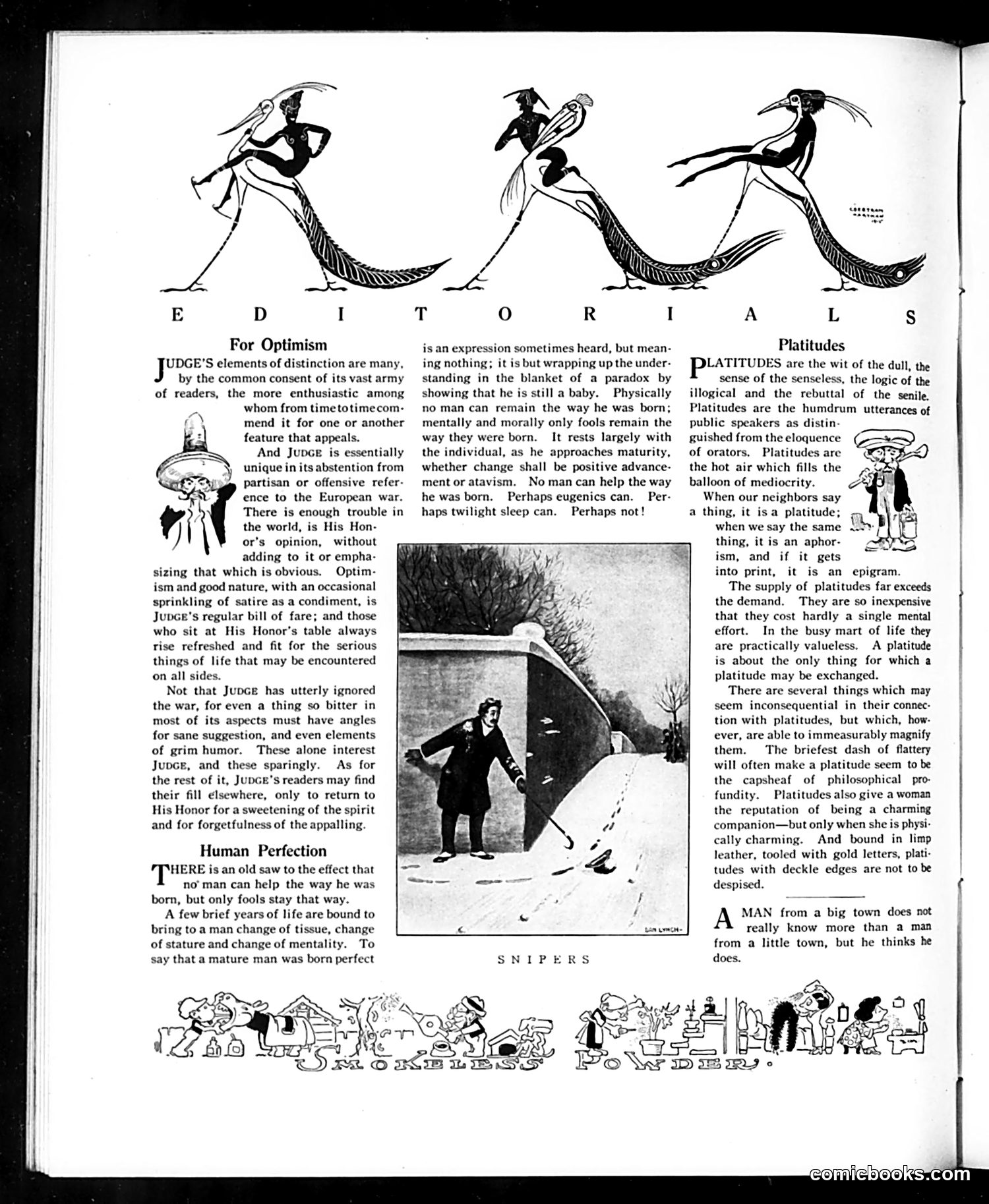
This page contains three distinct satirical pieces: **"For Optimism"** critiques judicial figures who remain enthusiastic despite wartime hardships, suggesting their optimism is naive or disconnected from reality. **"Human Perfection"** presents a philosophical argument that people are born imperfect and cannot fundamentally change, contradicting utopian ideals. **"Platitudes"** mocks the overuse of clichéd sayings and witticisms by public speakers and writers, arguing they require no mental effort and have become practically worthless. The "Snipers" illustration (center) appears to depict wartime combat, likely referencing World War I given the historical period. The page's overall tone suggests wartime cynicism about leadership's empty rhetoric and society's inability to improve through mere positive thinking.
📄 Transcribed text from this page (OCR, searchable)
Machine-transcribed from the original scan — historical spelling and the odd misread are preserved.
E For Optimism UDGE'’S elements of distinction are many, by the common consent of its vast army of readers, the more enthusiastic among whom from timetotimecom- mend it for one or another feature that appeals. And Jupce is essentially unique in its abstention from ; partisan or offensive refer- “ ence to the European war. ) There is enough trouble in j the world, is His Hon- ) or’s opinion, without adding to it or empha- sizing that which is obvious. Optim- ism and good nature, with an occasional sprinkling of satire as a condiment, is Jupce's regular bill of fare; and those who sit at His Honor’s table always rise refreshed and fit for the serious things of life that may be encountered on all sides. Not that Jupce has utterly ignored the war, for even a thing so bitter in most of its aspects must have angles for sane suggestion, and even elements of grim humor. These alone interest Jupce, and these sparingly. As for the rest of it, JubGe’s readers may find their fill elsewhere, only to return to His Honor for a sweetening of the spirit and for forgetfulness of the appalling. Human Perfection HERE is an old saw to the effect that no’ man can help the way he was born, but only fools stay that way. A few brief years of life are bound to bring to a man change of tissue, change of stature and change of mentality. To say that a mature man was born perfect is an expression sometimes heard, but mean- ing nothing; it is but wrapping up the under- standing in the blanket of a paradox by showing that he is still a baby. Physically no man can remain the way he was born; mentally and morally only fools remain the way they were born. It rests largely with the individual, as he approaches maturity, whether change shall be positive advance- ment or atavism. No man can help the way he was born. Perhaps eugenics can. Per- haps twilight sleep can. Perhaps not! SNIPERS Platitudes LATITUDES are the wit of the dull, the sense of the senseless, the logic of the illogical and the rebuttal of the senile. Platitudes are the humdrum utterances of public speakers as distin- guished from the eloquence of orators. Platitudes are the hot air which fills the balloon of mediocrity. When our neighbors say a thing, it isa platitude; when we say the same thing, it is an aphor- ism, and if it gets into print, it is an epigram. The supply of platitudes far exceeds the demand. They are so inexpensive that they cost hardly a single mental effort. In the busy mart of life they are practically valueless. A platitude is about the only thing for which a platitude may be exchanged. There are several things which may seem inconsequential in their connec: tion with platitudes, but which, how- ever, are able to immeasurably magnify them. The briefest dash of flattery will often make a platitude seem to be the capsheaf of philosophical pro- fundity. Platitudes also give a woman the reputation of being a charming companion—but only when she is physi- cally charming. And bound in limp leather, tooled with gold letters, plati- tudes with deckle edges are not to be despised. MAN from a big town does not really know more than a man from a little town, but he thinks he does.