
Judge, 1915-02-27 · page 16 of 24
Judge — February 27, 1915 — page 16: what you’re looking at
What you’re looking at
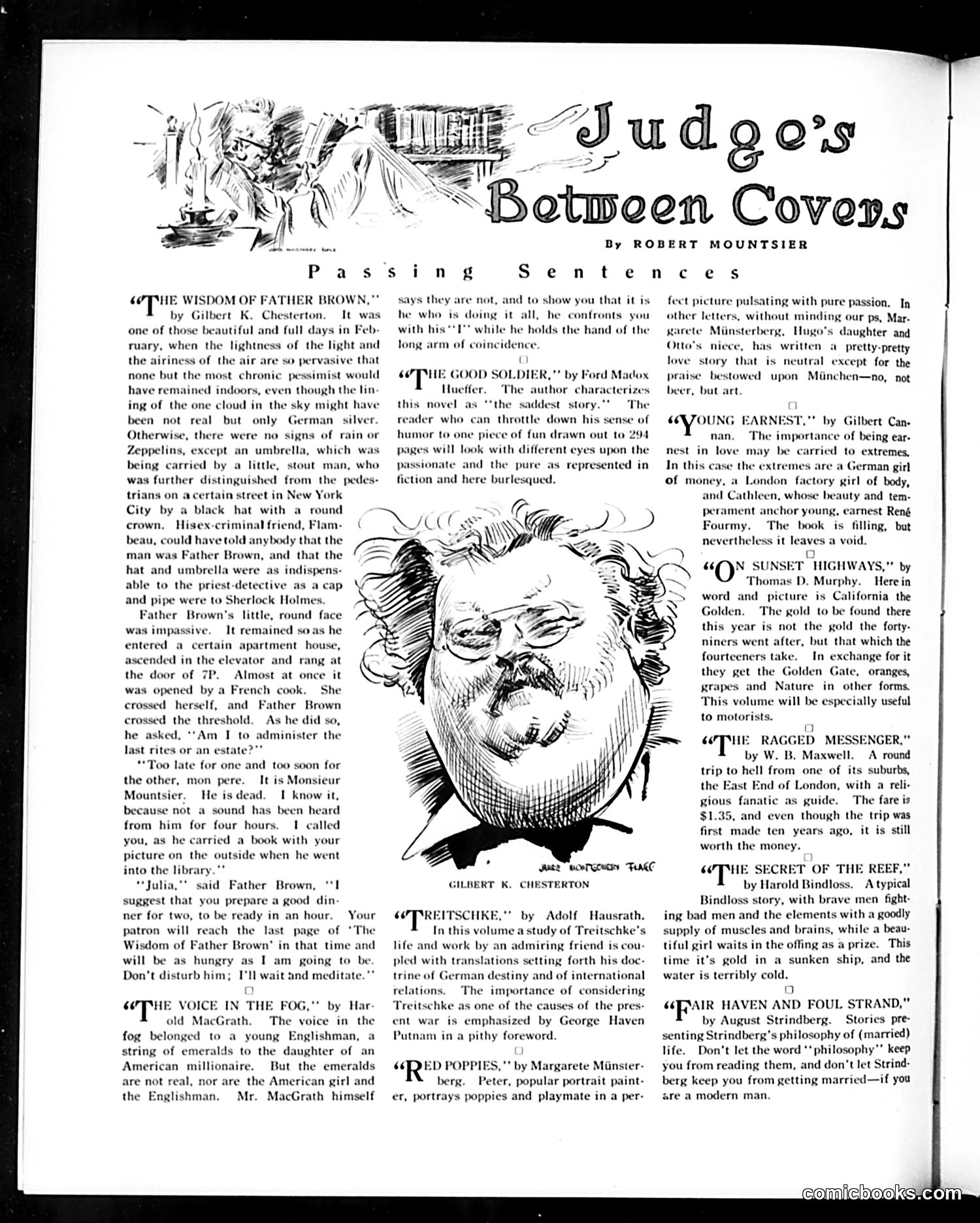
This page from *Judge* magazine presents brief reviews of recently published books, written by Robert Mountsier. The central illustration is a portrait sketch, likely of Gilbert K. Chesterton, whose short story "The Wisdom of Father Brown" is the first book discussed. The reviews cover literary works including Ford Madox Hueffer's "The Good Soldier" (described as "the saddest story") and Adolf Hausrath's study of Treitschke, a German nationalist whose work on "German destiny" is contextualized within discussions of the present war—indicating this page dates to World War I era. The content is primarily literary criticism rather than political satire. However, the reference to Treitschke's "doctrine of German destiny" and a mention of "German silver" in Chesterton's story reflect the anti-German sentiment typical of American publications during WWI. The page functions as cultural commentary through book selection and framing rather than through satirical cartoon imagery.
📄 Transcribed text from this page (OCR, searchable)
Machine-transcribed from the original scan — historical spelling and the odd misread are preserved.
6O THE WISDOM OF THER BROWN,”* by Gilbert K. Chesterton, It was one of those beautiful and full days in Feb: ruary, when the lightness of the light and the airiness of the air are so pervasive that none but the most chronic pessimist would have remained indoors, even though the lin ing of the one cloud in the sky might have been not real but only German. silv Otherwise, there were no signs of rain or Zeppelins, except an umbrella, which was being carried by a little, stout man, who was further distinguished from the pedes- trians on acertain street in New York City by a black hat with a round crown, Hisex-criminal friend, Flam- beau, could have told anybody that the man was Father Brown, and that the hat and umbrella were as indispens- able to the priest-detective as a cap and pipe were to Sherlock Holmes, Father Brown's little, round face was impassive. It remained soas he entered a certain apartment house, ascended in the elevator and rang at the door of 7P. Almost at once it was opened by a French cook. She crossed herself, and Father Brown crossed the threshold, As he did so, he asked, ‘‘Am I to administer the last rites or an estate?"* “Too late for one and too soon for the other, mon pere. It is Monsieur Mountsier, He is dead. I know it, because not a sound has been heard from him for four hours. 1 led you, as he carried a book with your picture on the outside when he went into the library."* “Juli said Father Brown, ‘‘I suggest that you prepare a good din- ner for two, to be ready in an hour. Your patron will reach the last page of ‘The Wisdom of Father Brown’ in that time and will be as hungry as I am going to be. Don’t disturb him; I'll wait and meditate."* 6@THE VOICE IN THE FC * by Har- old MacGrath, The voice in the fog belonged to a young Englishman, a string of emeralds to the daughter of an American millionaire. But the emeralds are not real, nor are the American girl and the Englishman. Mr. MacGrath himself By ROBERT MOUNTSIER n ¢g Sente says they are not, and to show you that it is he who is doing it all, he with his ‘1 while he holds the hand o long arm of coincidence. f Tue OOD SOLDIER," by Ford Madox Mueffer. The author characterizes this novel as ‘*the "The reader who can throttle down his sense of confronts you the saddest story. humor to one piece of fun drawn out to 294 pages will look with different eyes upon the passionate and the as represented in fiction and here burlesqued. pure GILBERT K. CHESTERTON 607 PREITSCHK by Adolf Hausrath, In this volume a study of Treitschke’s life and work by an admiring friend is cou- pled with translations setting forth his doc trine of German destiny and of internatior The importance of considering causes of the pres- Haven tions, schke as one of the ent war is emphasized by George Putnam in a pithy foreword. D POPPIES,"’ by Margarete Minster- berg. Peter, popular portrait paint- er, portrays poppies and playmate in a per- neces fect picture pulsating with pure passion. In other letters, without minding our ps, Mar- Minsterberg, Hugo's daughter and S niece, has written a_ pretty-pretty » story that is neutral except for the praise bestowed upon Miinchen—no, not art beer, bu «eV OUNG EARNEST," by Gilbert Can. nan, The importance of being ear- nest in love may be carried to extremes, In this case the extremes are a German girl of money, a London factory girl of body, and Cathleen, whose beauty and tem- perament anchor young, earnest René Fourmy. The book is filling, but nevertheless it leaves a void. “O” homas D, Murphy. Here in word and picture is California the Golden. The gold to be found there this year is not the gold the forty- niners went after, but that which the fourteeners take. In exchange for it they get the Golden Gate, oranges, gra and Nature in other forms. This volume will be especially useful to motorists. se pue RAGC MESSENGER,” by W. B. Maxwell. A round trip to hell from one of its suburbs, the East End of London, with a reli- gious fanatic as guide. The fare is $1.35, and even though the trip was first made ten years ago, it is still worth the money. 607)PHE SECRET OF THE REEF,” by Harold Bindloss. A typical Bindloss story, with brave men fight- ing bad men and the elements with a goodly supply of muscl while a beau- tiful girl waits in the offing as a prize. This time it’s gold in a sunken ship, and the water is terribly cold. o AND FOUL STRAND,” Stories pre- SUNS HIGHWAYS," by sePRalR HAVEN by August Strindberg. senting Strindberg’s philosophy of (married) life. Don't let the word you from reading them, berg keep you from getting married—if you are a modern man.