
Judge, 1915-02-27 · page 17 of 24
Judge — February 27, 1915 — page 17: what you’re looking at
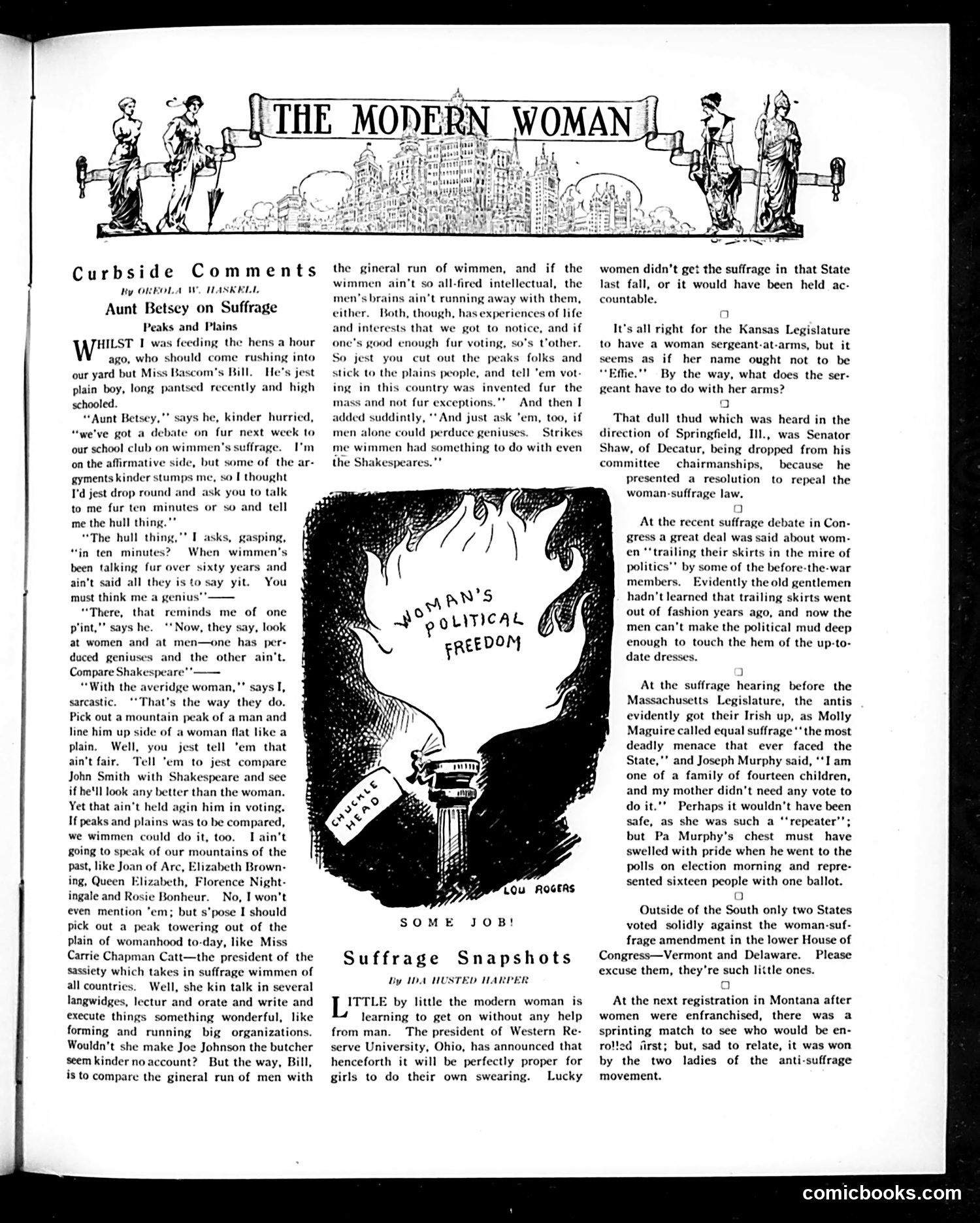
What you’re looking at
This Judge magazine page satirizes the women's suffrage debate circa 1910s America through two complementary pieces: **"Aunt Betsey on Suffrage"** presents a rural character's commonsense pro-suffrage argument. Aunt Betsey counters anti-suffrage rhetoric by noting that comparisons between men and women are unfair when using "peaks" (exceptional individuals like Shakespeare) rather than "plains" (ordinary people). Her point: if average men deserve voting rights, so do average women. She also credits women with intellectual contributions (mentioning Joan of Arc, Elizabeth Browning, Florence Nightingale, and Carrie Chapman Catt, the actual suffrage leader). **"Suffrage Snapshots"** by Ida Husted Harper offers satirical "news" items mocking anti-suffrage positions—particularly men's condescension about women entering politics while simultaneously opposing their legal rights. **The cartoon** depicts a woman breaking chains labeled "Effie's Head" and "Chains," symbolizing women's political liberation. The page's overall message: the suffrage opposition's arguments are logically inconsistent and outdated.
📄 Transcribed text from this page (OCR, searchable)
Machine-transcribed from the original scan — historical spelling and the odd misread are preserved.
Curbside Comments Ry OKEOLA Wy HASKELL Aunt Betsey on Suffrage Peaks and Plains HILST I was feeding the hens a hour ago, who should come rushing into our yard but Miss Bascom's Bill. He's jest plain boy, long pantsed recently and high schooled. “Aunt Betsey,"’ says he, kinder hurried, “we've got a debate on fur next week to our school club on wimmen’s suffrage. I'm on the affirmative side, but some of the ar- gyments kinder stumps me, so I thought I'd jest drop round and ask you to talk to me fur ten minutes or so and tell me the hull thing. “The hull thing,’’ I asks, gasping, “in ten minutes? When wimmen's been talking fur over sixty years and ain't said all they is to say yit. You must think me a genius’’ “There, that reminds me of one p'int,"” says he. ‘Now, they say, look at women and at men—one has per- duced geniuses and the other ain't. Compare Shakespeare’’ “With the averidge woman,"’ says I, sarcastic. ** 's the way they do. Pick out a mountain peak of a man and line him up side of a woman flat like a plain. Well, you jest tell "em that ain't fair. Tell ‘em to jest compare John Smith with Shakespeare and see if he'll look any better than the woman. Yet that ain't held agin him in voting. If peaks and plains was to be compare we wimmen could do it, too. [ain't going to speak of our mountains of the past, like Joan of Arc, Elizabeth Brown- ing, Queen Elizabeth, Florence Night- ingale and Rosie Bonheur. No, I won't even mention ‘em; but s’pose I should pick out a peak towering out of the plain of womanhood to-day, like Miss Carrie Chapman Catt—the president of the sassiety which takes in suffrage wimmen of all countries. Well, she kin talk in several langwidges, lectur and orate and write and execute things something wonderful, like forming and running big organizations. Wouldn't she make Joe Johnson the butcher seem kinder no account? But the way, Bill, is to compare the gineral run of men with the gineral run of wimmen, and if the wimmen ain't so all-fired intellectual, the men’s brains ain't running away with them, either, Both, though, has experiences of life and interests that we got to notice, and if one’s good enough fur voting, so’s t’other. So jest you cut out the peaks folks and stick to the plains people, and tell ‘em vot- ing in this country was invented fur the mass and not fur exception: And then I added suddintly, ** And just ask ‘em, too, if men alone could perduce geniuses. Strikes me wimmen had something to do with even the Shakespeare SOME JOB! Suffrage Snapshots IDA HUSTED HARPE! ITTLE by little the modern woman is learning to get on without any help from man. The president of Western Re- serve University, Ohio, has announced that henceforth it will be perfectly proper for girls to do their own swearing. Lucky women didn’t get the suffrage in that State last fall, or it would have been held ac- countable. 7 It's all right for the Kansas Legislature to have a woman sergeant-at-arms, but it seems as if her name ought not to be effie. By the way, what does the ser- geant have to do with her arms? o That dull thud which was heard in the direction of Springfield, Ill., was Senator Shaw, of Decatur, being dropped from hi: committee chairmanships, because he presented a resolution to repeal the woman-suffrage law. ) At the recent suffrage debate in Con- gress a great deal was said about wom- en “trailing their skirts in the mire of politics’’ by some of the before-the-war members. Evidently the old gentlemen hadn't learned that trailing skirts went out of fashion years ago, and now the men can't make the political mud deep enough to touch the hem of the up-to- date dre: 1 At the suffrage hearing before the Massachusetts Legislature, the antis evidently got their Irish up, as Molly Maguire called equal suffrage ‘‘ the most deadly menace that ever faced the State,'’ and Joseph Murphy said, ‘*I am one of a family of fourteen children, and my mother didn’t need any vote to do i Perhaps it wouldn't have been safe, as she was such a ‘‘repeater’’; but Pa Murphy's chest must have swelled with pride when he went to the polls on election morning and repre- sented sixteen people with one ballot. a Outside of the South only two States voted solidly against the woman-suf- frage amendment in the lower House of Congress—Vermont and Delaware. Please excuse them, they’re such little ones. a At the next registration in Montana after women were enfranchised, there was a sprinting match to see who would be en- rolled jirst; but, sad to relate, it was won by the two ladies of the anti-suffrage movement. comicbooks.com