
A complete issue · 24 pages · 1914
Judge — November 28, 1914
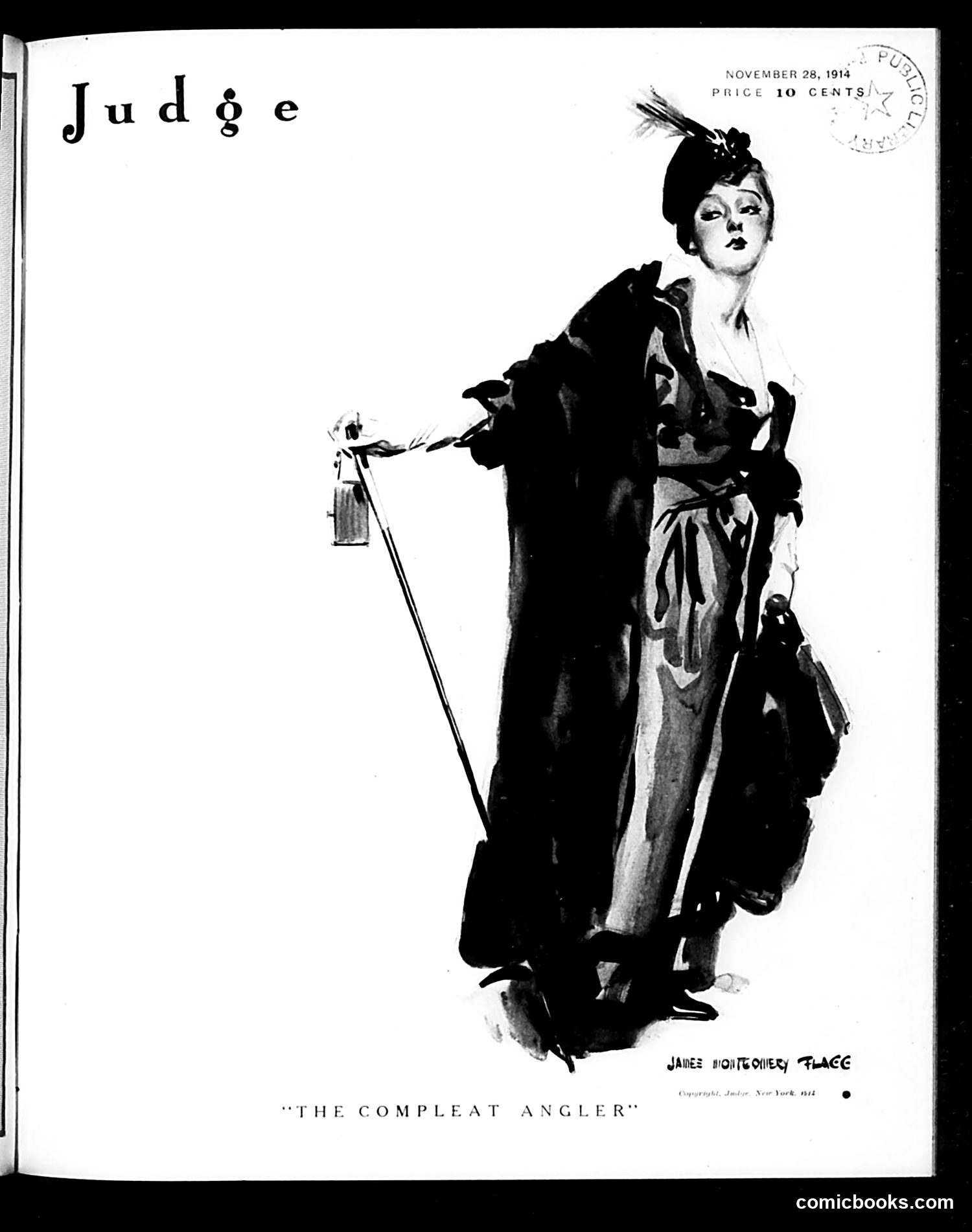
This is a satirical illustration by James Montgomery Flagg depicting a fashionably dressed woman as "The Compleat Angler" (a reference to Izaak Walton's famous fishing treatise). The woman holds a fishing rod with what appears to be a small lantern as bait, dressed in elegant coat and hat with feathered plumage. The satire likely comments on women's role in courtship and romance during the 1910s—portraying the woman as a skilled "angler" (fisherman) strategically deploying allures to "catch" romantic interests. The fashionable dress and deliberate positioning suggest commentary on feminine wiles, materialism, or the calculated nature of romantic pursuit during this era. The cartoon reflects early 20th-century attitudes about gender, attraction, and social courtship rituals.
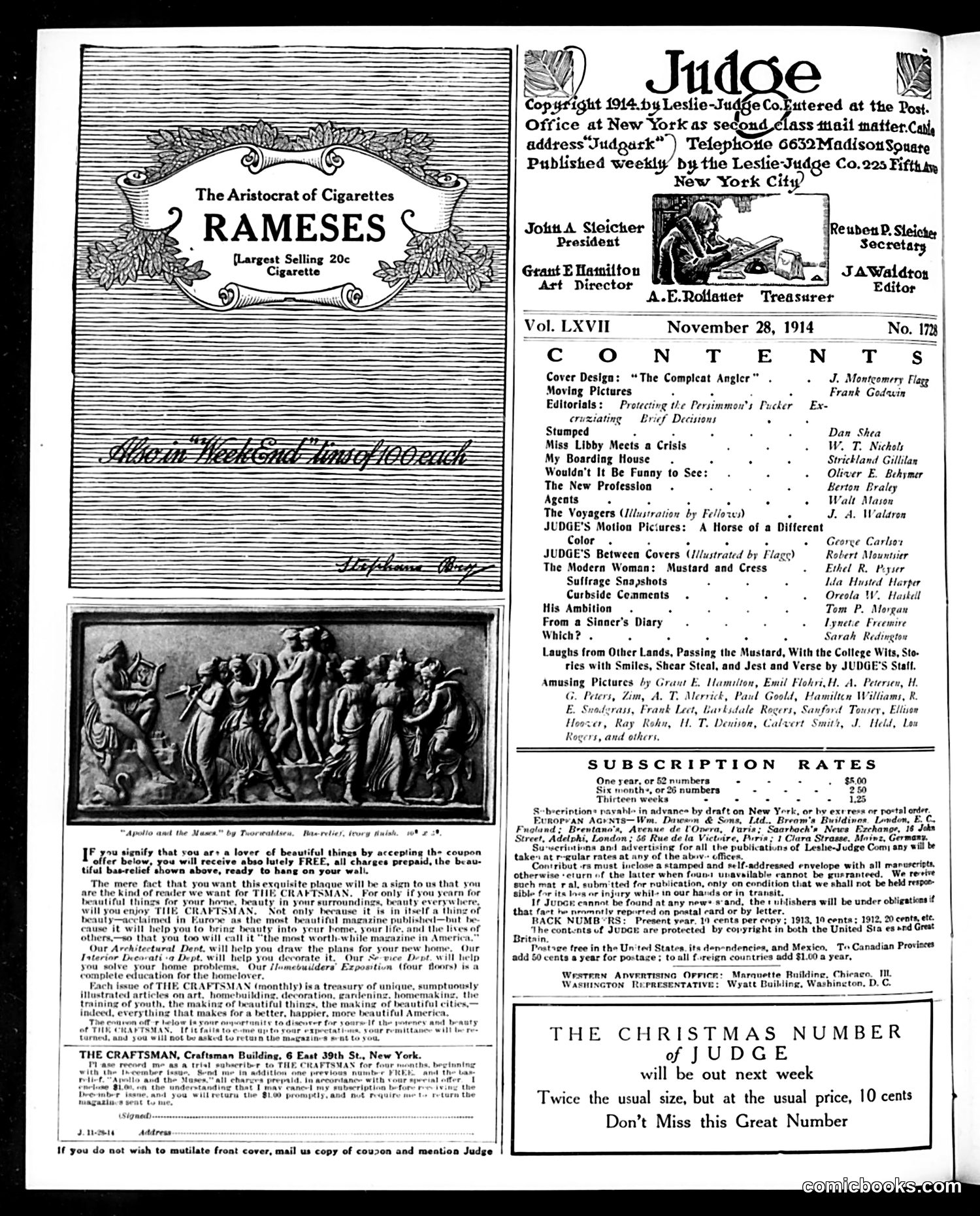
This page is primarily **advertising and editorial content** rather than political satire. The main visual is a classical engraving titled "Apollo and the Muses" promoting Ramses cigarettes as "The Aristocrat of Cigarettes." Below is promotional text for *The Craftsman* magazine, emphasizing home beauty and aesthetic improvement—typical early 20th-century arts-and-crafts philosophy. The contents listing indicates this November 1914 issue includes standard humor pieces, illustrations, and commentary. An advertisement announces the upcoming Christmas number "twice the usual size, but at the usual price, 10 cents." The page demonstrates how Judge combined satirical commentary with commercial advertising to sustain publication during the World War I era.
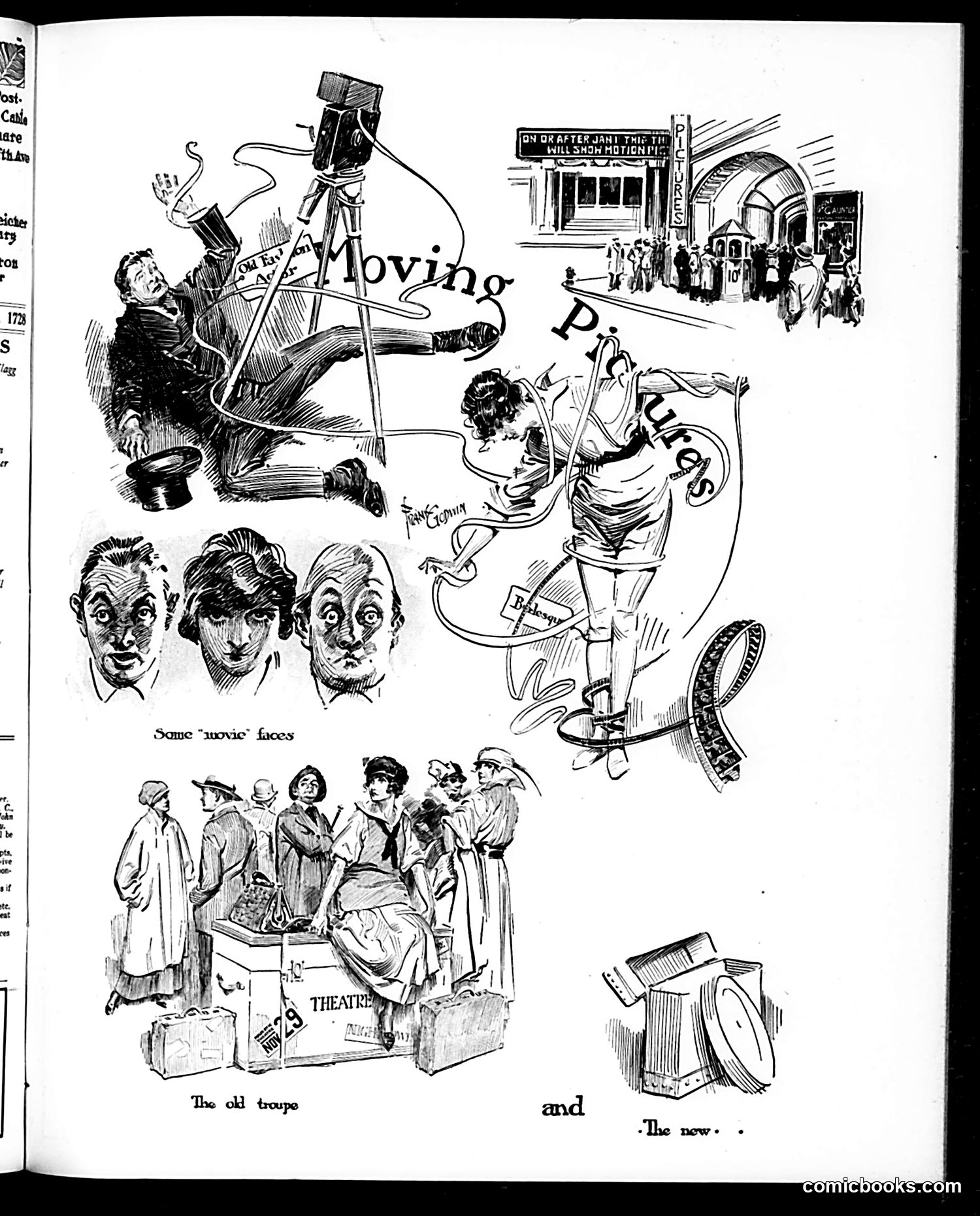
This Judge magazine page satirizes the emerging film industry's impact on traditional theater. The central image shows a man operating an early movie camera on a tripod, representing the new "moving pictures" technology disrupting entertainment. The contrasts are explicit: "The old troupe" shows traditional theater actors and equipment with their physical props and costumes, while "The new" depicts film equipment—suggesting cinema's displacement of live theater. The three "movie faces" caricatures mock the exaggerated expressions required for silent film acting without dialogue. The top right building appears to be an early cinema venue, showing how movie theaters were replacing traditional playhouses. The satire critiques how this new technology was revolutionizing entertainment and threatening established theatrical traditions during cinema's early commercial emergence.
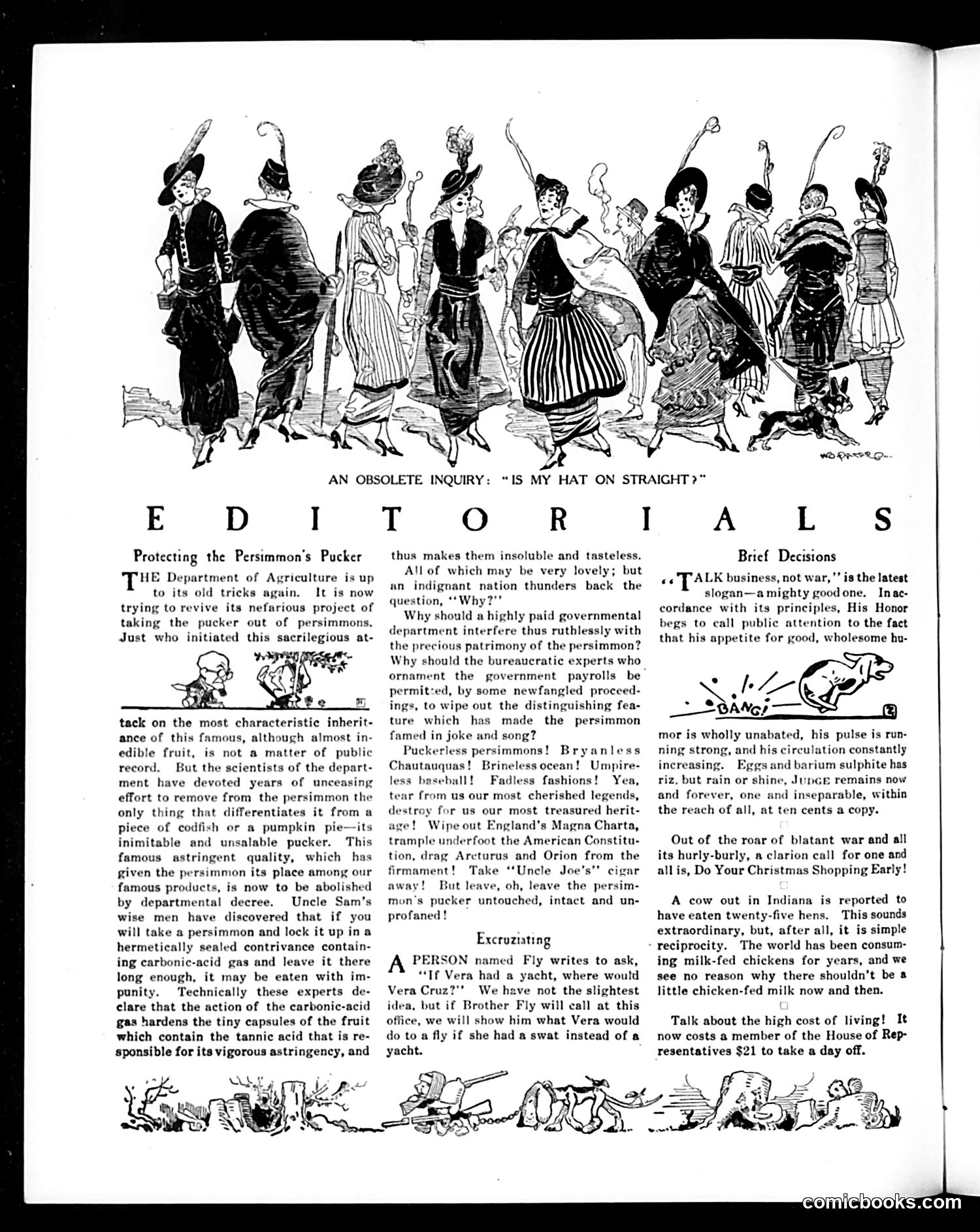
The top cartoon satirizes outdated fashion concerns. Figures sporting elaborate hats with plumes ask "Is my hat on straight?"—mocking the obsession with ornamental headwear among the wealthy and fashionable. The main editorial "Protecting the Persimmon's Pucker" criticizes the Department of Agriculture's interference with persimmon cultivation, arguing bureaucratic intervention ruins both the fruit's quality and American heritage. It's a broader satire of government overreach and red tape. The "Brief Decisions" section contains short satirical items: one mocks the slogan "Talk business, not war"; another ridicules Indiana's chicken shortage and high cost of living affecting Congress members. Overall, this page targets governmental inefficiency, fashion vanity, and economic concerns typical of early-20th-century American satirical journalism.
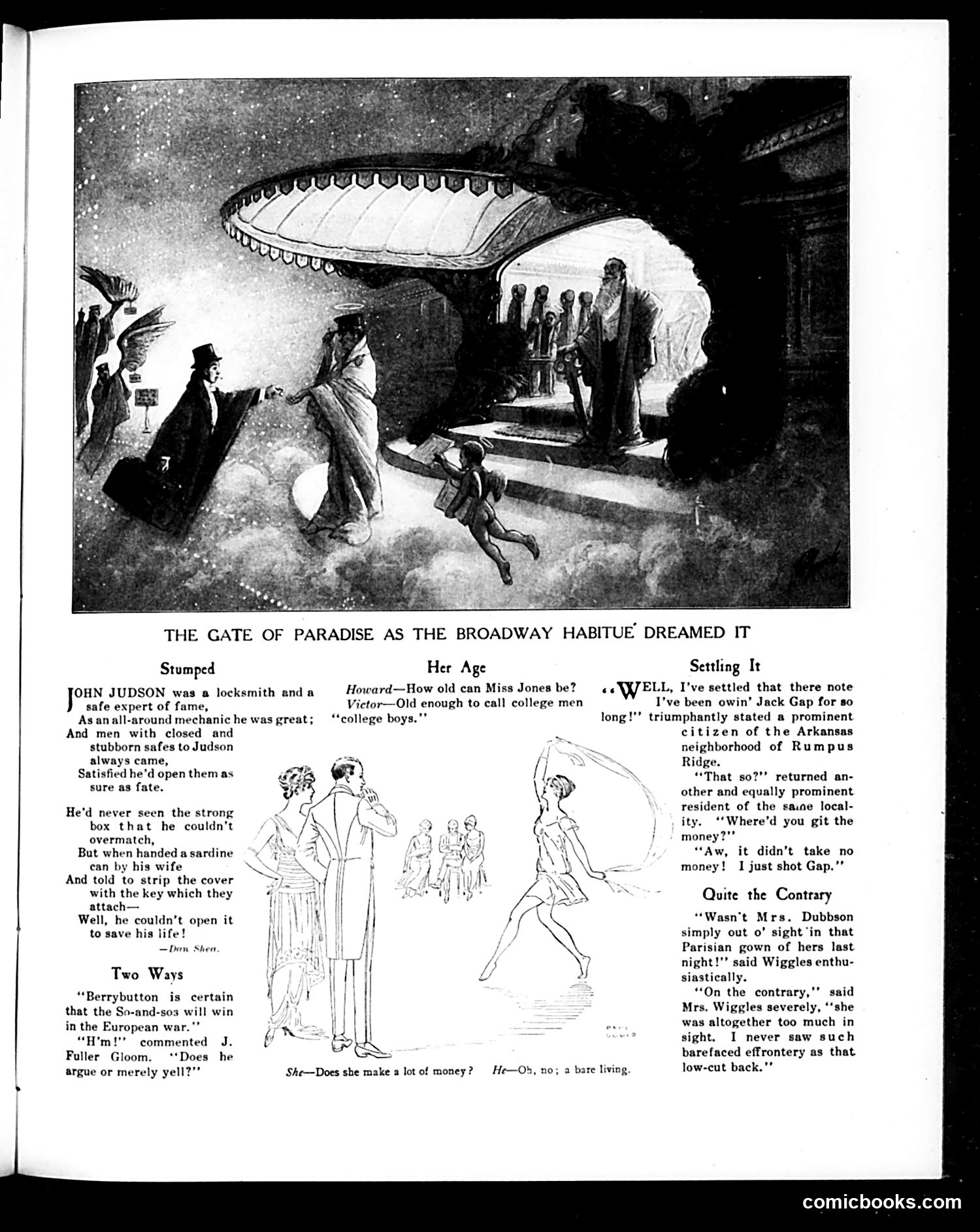
The main illustration depicts "The Gate of Paradise as the Broadway Habitué Dreamed It"—a satirical fantasy showing wealthy New York socialites entering heaven through an ornate gate. The humor contrasts their earthly preoccupations with spiritual judgment. Below are three brief comedic sections: 1. **"Stumped"**: A poem about John Judson, a locksmith, suggesting his expertise made him indispensable—a working-class man valued for practical skills. 2. **"Two Ways"**: A quip about war predictions, mocking certainty in military forecasting. 3. **"Her Age" and "Settling It"**: Dialogue jokes about a woman's marriageability and money, with characters debating whether she's wealthy or merely respectable—typical turn-of-the-century social satire about marriage and class status. The overall tone mocks upper-class vanity and social pretension.
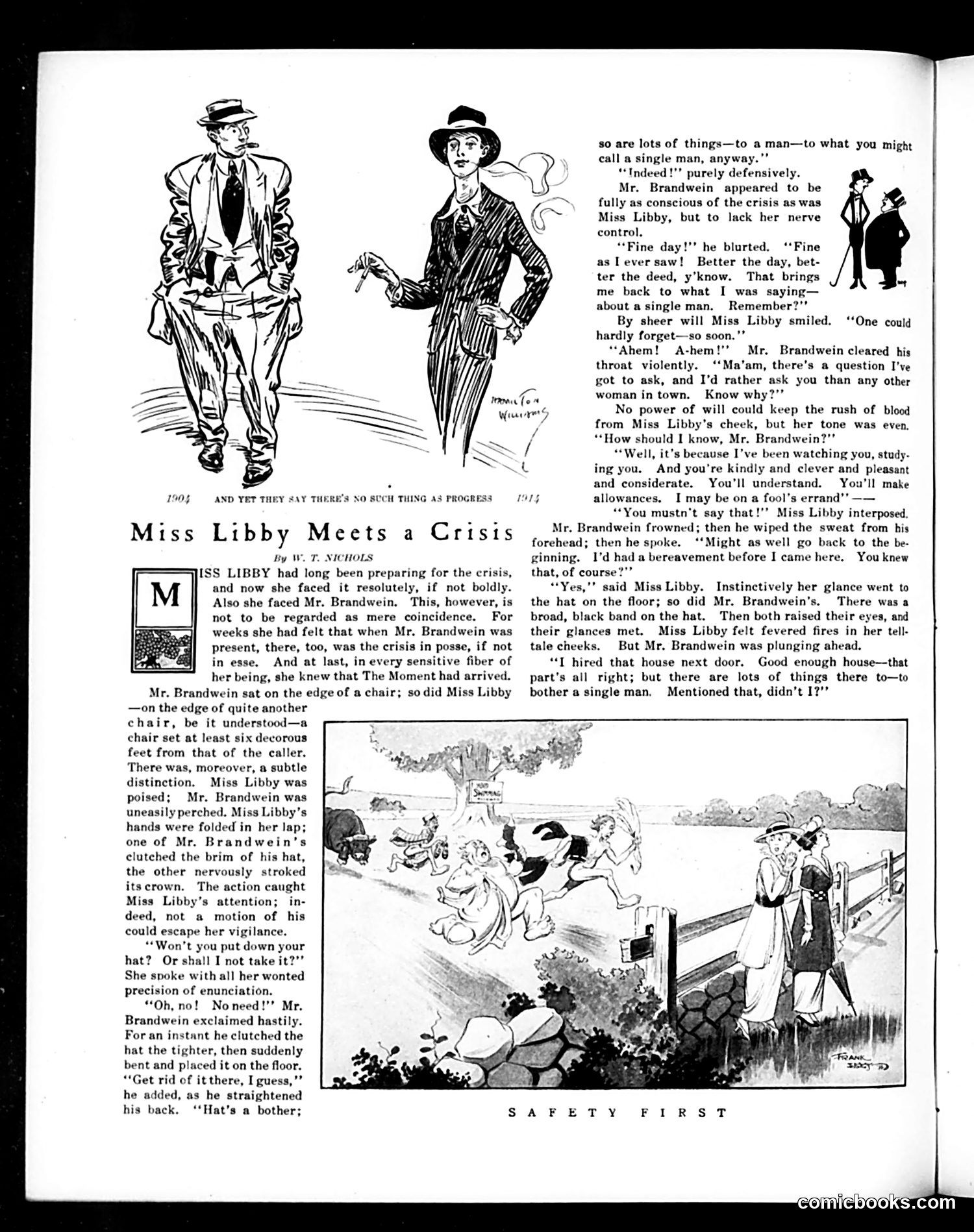
This is a domestic comedy story illustrated in Judge magazine (dates appear to be 1912-1913 based on the style). **The Plot:** Miss Libby receives a visit from Mr. Brandwein, a nervous widower (indicated by the black mourning band on his hat). He's awkwardly attempting to propose marriage, framing it as a practical solution to the challenges of being a single man living alone. **The Satire:** The humor lies in the formal, stilted courtship ritual of the Edwardian era. Brandwein's nervousness contrasts with Miss Libby's composed dignity—she maintains perfect posture and propriety while he fidgets with his hat. The illustration below (captioned "Safety First") appears to show domestic chaos, suggesting the "lots of things" that trouble a bachelor. **The Point:** Judge is gently mocking both the elaborate social conventions surrounding marriage proposals and the practical desperation that often motivated them. The title references the contemporary "Safety First" movement, sardonically suggesting marriage as a solution to life's discomforts rather than as romantic passion.
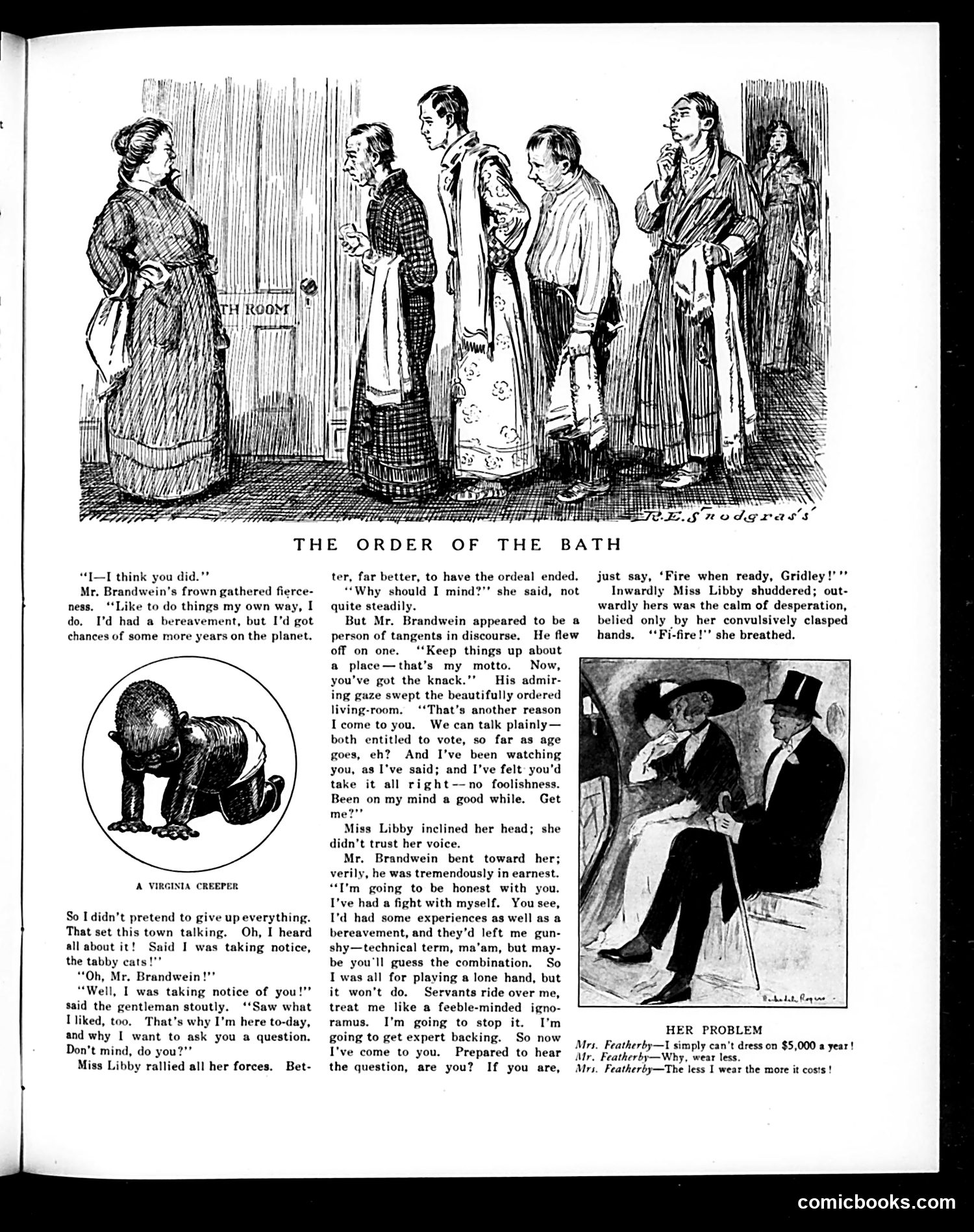
This page contains a serialized romantic story rather than political satire. The main narrative follows Mr. Brandwein's proposal to Miss Libby—he's a widower, somewhat socially awkward, seeking a companion to help manage his household and prevent servants from taking advantage of him. His rambling, earnest approach to proposing ("Fire when ready, Gridley!") is the humor. The sidebar illustration "A Virginia Creeper" appears to reference a climbing plant, likely symbolizing romantic pursuit. The bottom cartoon "Her Problem" satirizes wealth and consumption: a wealthy woman complains she cannot afford fashionable dress on $5,000 annually (a substantial sum in this era), while her husband suggests she simply wear less clothing—leading to her retort that cheaper fabrics cost *more* due to increased wear. This mocks nouveau riche excess and the paradox of conspicuous consumption. The page's humor derives from romantic miscommunication and class-based materialism rather than political commentary.
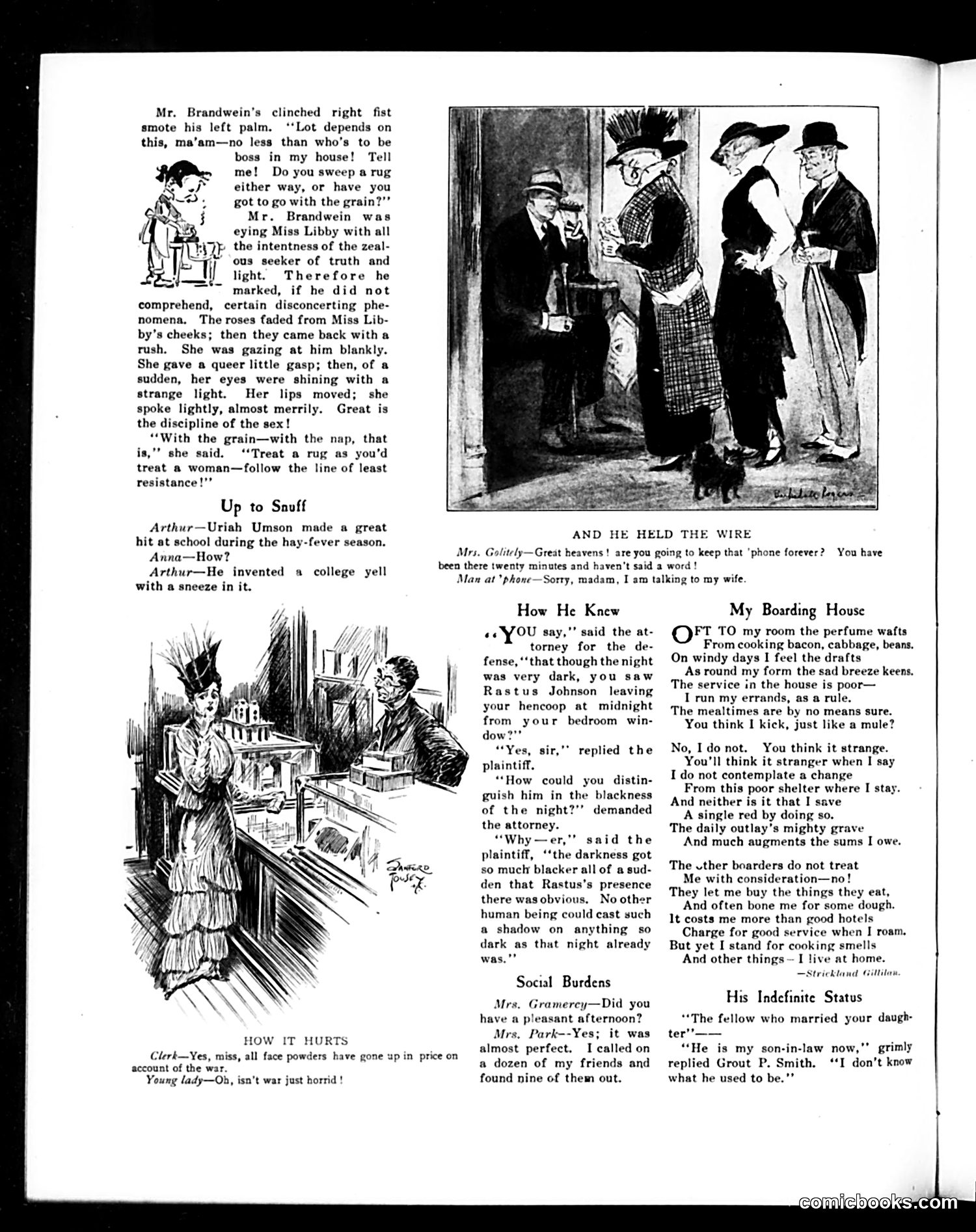
This page contains several short humorous pieces typical of early 20th-century American satire: **Main cartoon** (top right): Shows men on a telephone, satirizing early telephone etiquette and marital dynamics—a husband monopolizing the line while his wife waits, the caption joking that he's "talking to my wife" despite being silent. **"How He Knew"**: A racial stereotype joke featuring "Rastus Johnson," using crude logic to mock both a Black suspect and the witness's dubious testimony about identifying him in darkness. **"My Boarding House"** (poem): Social commentary on boarding house life—poor conditions, mediocre meals, unsociable roommates—yet the narrator stays because he "lives at home," suggesting immigrant or working-class attachment to familiar (if unpleasant) circumstances. **Scattered quips**: Include jokes about war-time cosmetic price inflation and a college student inventing a sneeze-based yell during hay-fever season. The humor relies on period-specific references (early telephones, boarding houses as common housing) and casual racial stereotyping typical of the era.
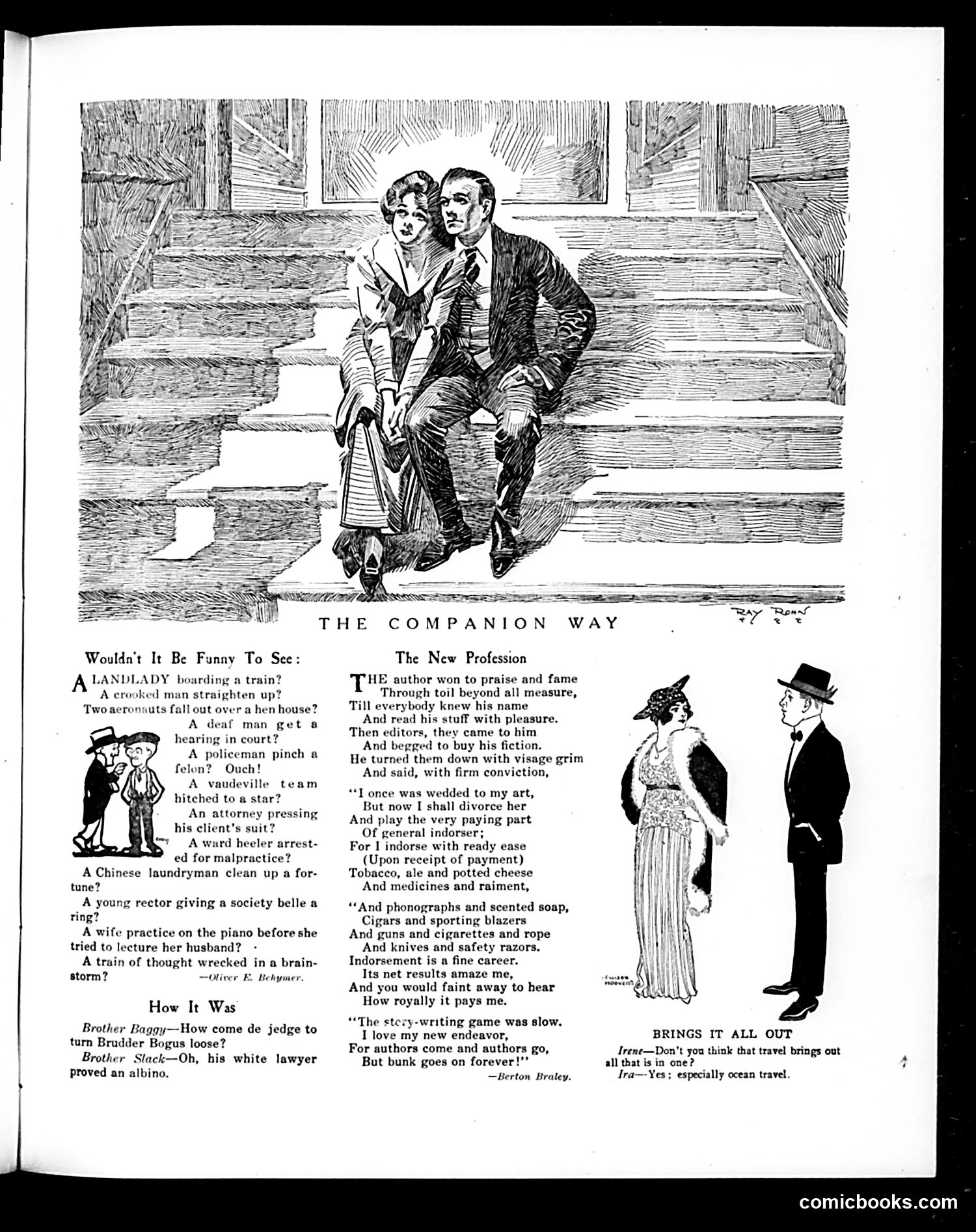
This page from *Judge* contains three satirical pieces mocking early 20th-century American society: **"Wouldn't It Be Funny To See"** is a humorous list of absurd scenarios—a landlady boarding a train, a crooked man straightening up, a Chinese laundryman becoming wealthy. These jokes rely on ethnic and class stereotypes common to the era, treating social hierarchies as inherently comic. **"How It Was"** is a brief racial joke playing on the term "albino" as a punchline about a white lawyer helping a Black defendant escape justice—relying on crude racial humor. **"The New Profession"** satirizes authors who abandon serious literary work to become paid endorsers of commercial products (tobacco, soap, razors, etc.). The poet ironically celebrates this mercenary shift, noting that "bunk goes on forever"—criticizing how advertising and commercial promotion had corrupted literary integrity. **"Brings It All Out"** is a brief double-entendre joke about ocean travel inducing seasickness. The page reflects *Judge*'s satirical approach to commercial culture, labor, and social pretension, though its humor relies heavily on now-offensive racial and ethnic stereotypes.
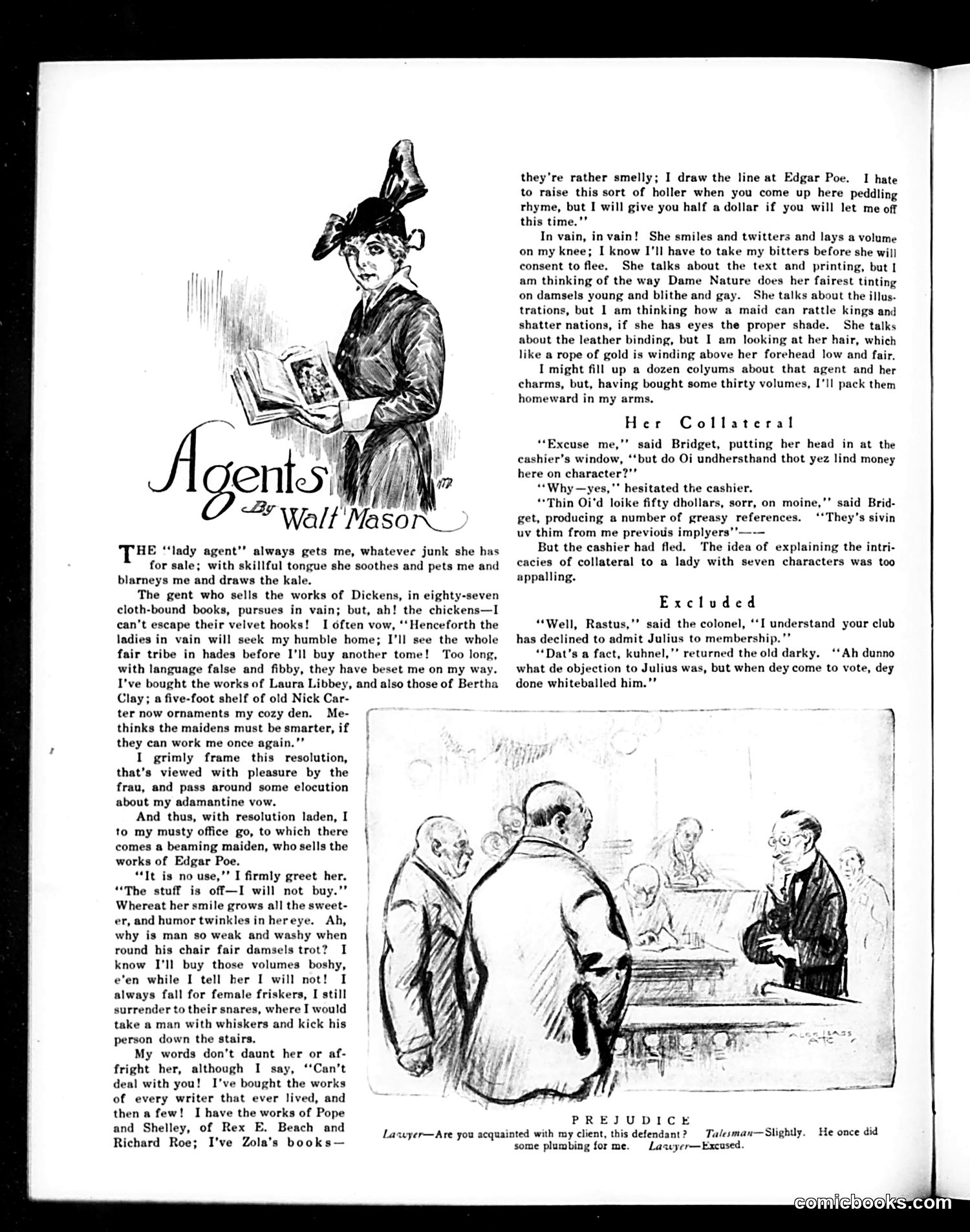
This page contains three satirical pieces lampooning social foibles of the era. **"Agents"** mocks the irresistible saleswoman—specifically female book agents peddling literature. The narrator vows never to buy again after accumulating works by Laura Libbey, Bertha Clay, and Nick Carter (popular authors of the period), yet capitulates when a charming young woman appears selling Edgar Poe. The satire targets both aggressive sales tactics and male weakness before feminine appeal, suggesting that female charm trumps rational resistance. **"Her Collateral"** depicts an Irish immigrant woman (Bridget, marked by dialect) seeking a $50 loan on "character" references. The cashier flees rather than explain collateral to someone with "seven characters"—a pun on her immigrant status and limited English. **"Excluded"** uses an African American man (Rastus) describing his friend Julius's rejection from a club via "whiteballing" (blackballing)—a heavy-handed racial pun on exclusion. All three rely on stereotypes (aggressive women, immigrants, African Americans) for humor typical of early-20th-century American satire.
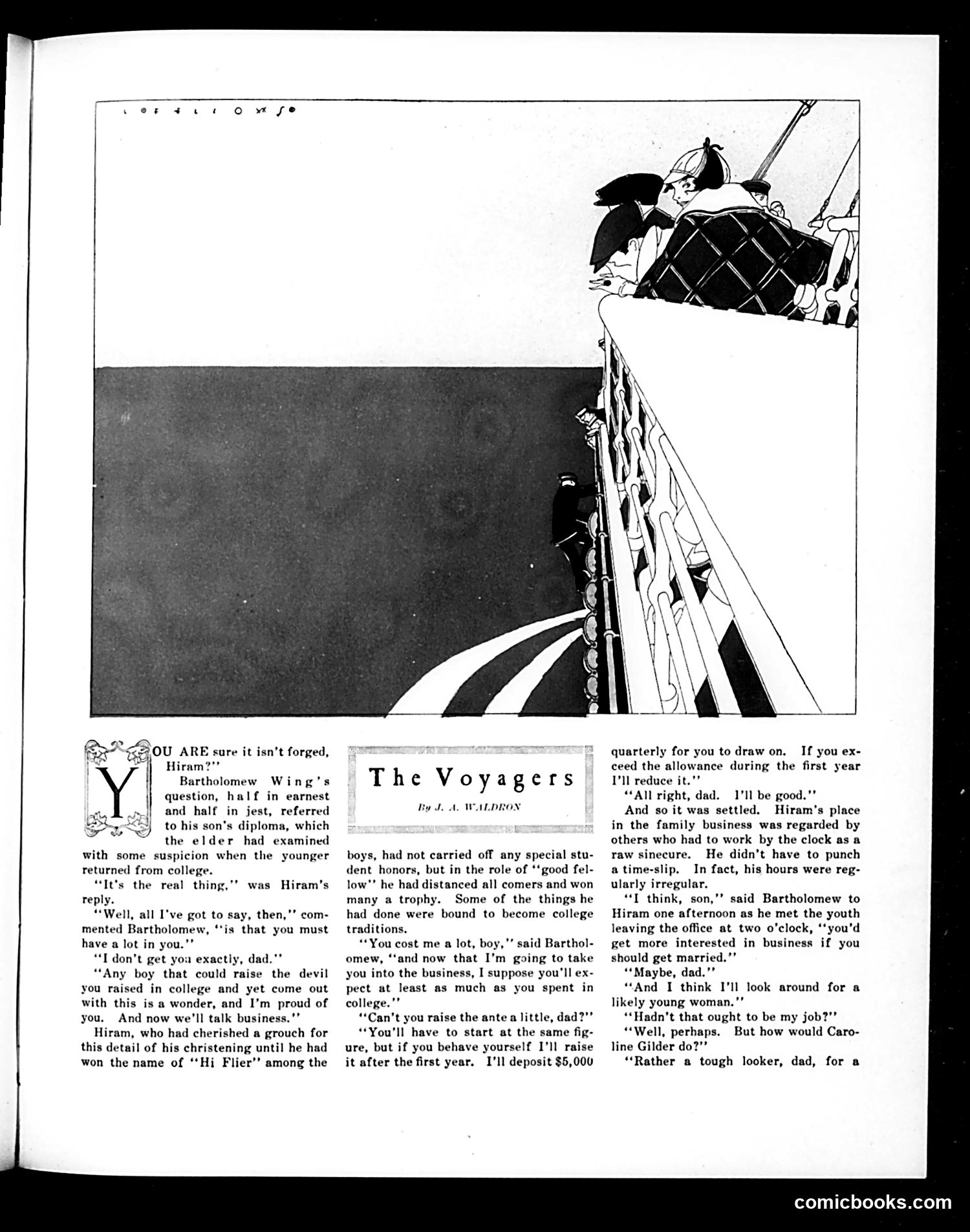
This story satirizes the entitled rich son entering the family business. Hiram, a college graduate known as "Hi Flier" for his partying antics rather than academics, returns home to join his father Bartholomew Wing's company. The satire targets nepotism and entitlement: despite being a mediocre student who "cost" his father dearly, Hiram receives a cushy sinecure with irregular hours and no time-clock requirements—luxuries unavailable to other employees. His father offers $5,000 quarterly (substantial for the era) and threatens only minor consequences for overspending. The joke deepens when Bartholomew suggests arranging a marriage to "Caroline Gilder," which Hiram dismisses as "tough looking." The satire critiques both generational wealth (the son's unearned advantages) and patriarchal control (the father orchestrating his son's marriage for business purposes). The illustration shows figures aboard a ship, likely metaphorically representing life's voyage or social navigation.
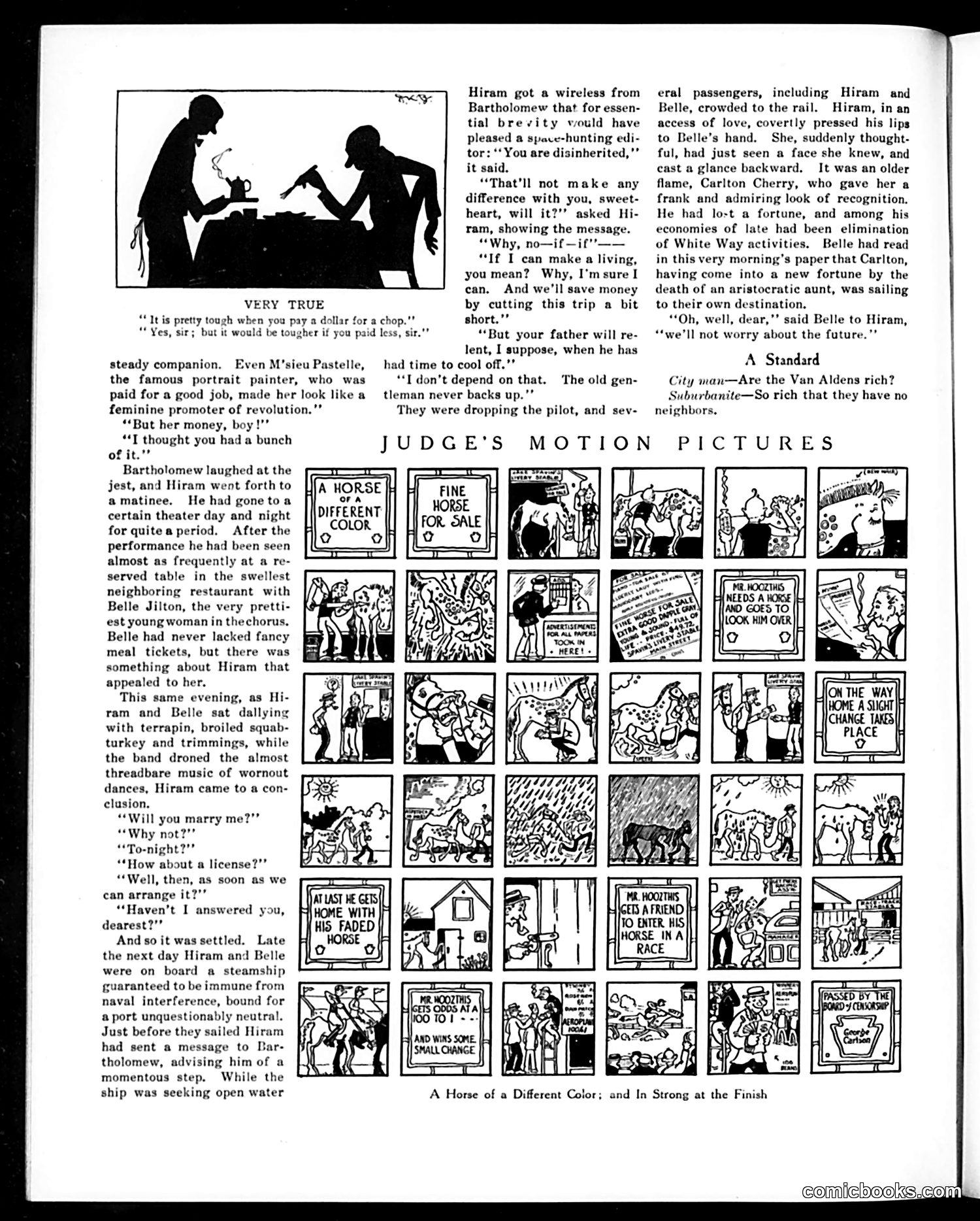
This page presents a romantic comedy narrative about Hiram, a young man who proposes to Belle, a chorus girl, after being disinherited by his father Bartholomew. The story satirizes early 20th-century class anxieties: despite losing his fortune, Hiram's love proves genuine—Belle accepts him anyway, and they elope on a steamship to a neutral port to marry. The humor targets wealthy fathers' control over inheritance and upper-class assumptions about marriage motivated by money. The inserted joke about the Van Aldens suggests extreme wealth creates social isolation ("so rich they have no neighbors"). The "Judge's Motion Pictures" comic strip below appears to depict a horse-trading storyline (titled "A Horse of a Different Color; and In Strong at the Finish"), though individual panels are too small to read clearly. This reflects Judge's typical satirical focus on American social pretensions and romantic entanglements among the leisure classes.
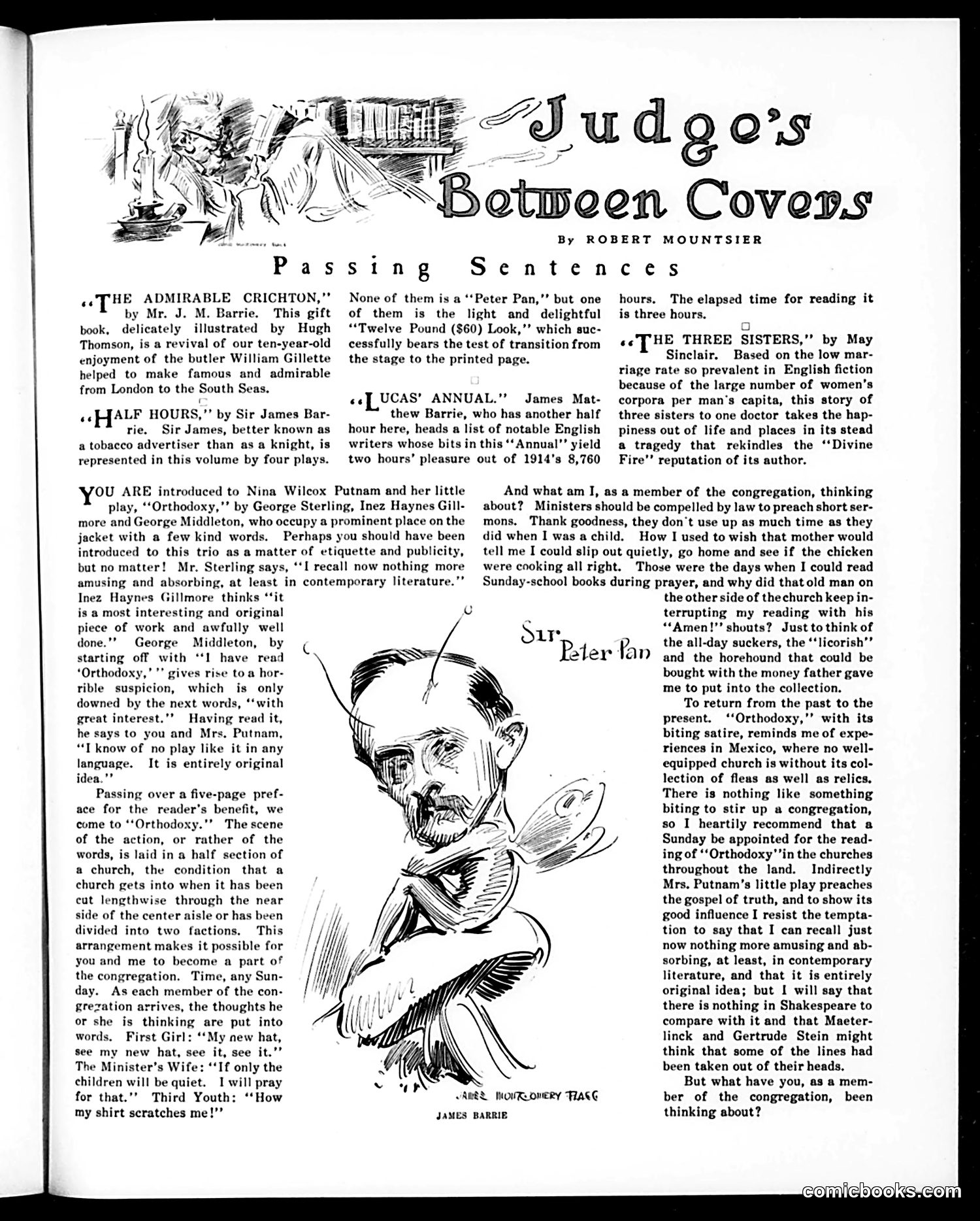
This is a literary review column by Robert Mountsier discussing recent books, featuring a cartoon of Peter Pan by James Barrie illustrating the text. The main subject is a play called "Orthodoxy" by Nina Wilcox Putnam, introduced with blurbs from literary figures George Sterling, Inez Haynes Gillmore, and George Middleton. The satire gently mocks how these critics oversell the work with hyperbolic praise—Sterling claims he recalls "nothing more amusing and absorbing" despite admitting he can't actually remember much about it. The page also reviews Barrie's "The Admirable Crichton" and other contemporary books. The cartoon illustrates Barrie's Peter Pan character. The lengthy italic passage appears to be from the "Orthodoxy" script itself, depicting the wandering thoughts of church congregation members during Sunday service—a satirical commentary on inattention during worship. The overall tone gently ridicules both contemporary theatrical pretension and the gap between critical enthusiasm and actual merit.
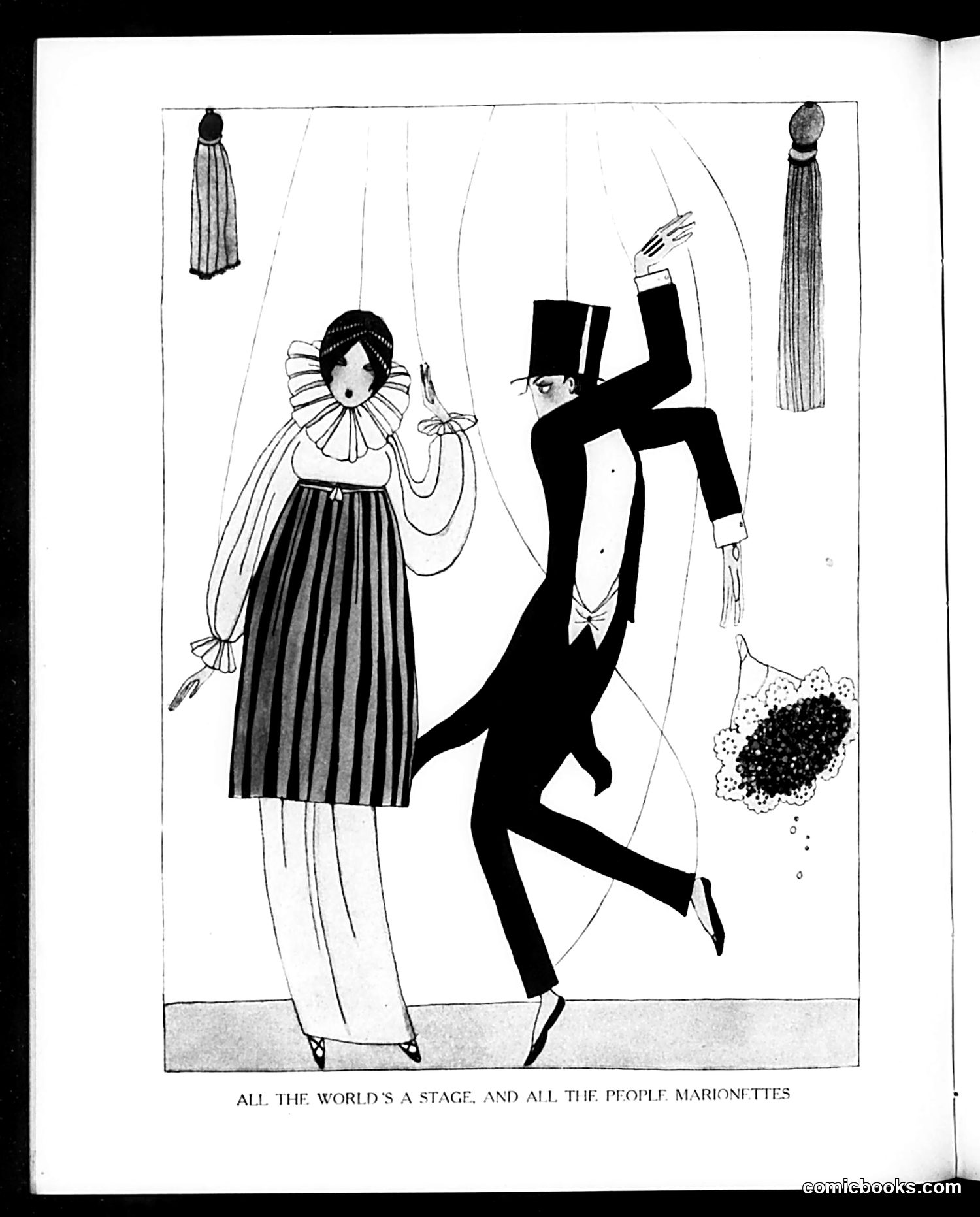
The caption quotes Shakespeare's "All the World's a Stage," adapting it to "All the world's a stage, and all the people marionettes." This is a satirical commentary on social control and manipulation during the early 20th century. The illustration depicts two figures as puppets on strings: a woman in fashionable dress with an elaborate collar, and a man in formal attire with a top hat, both suspended by strings held by unseen puppet masters above. The hanging garments at top appear to represent costume options. The satire suggests that ordinary people—particularly the fashionable classes—are not autonomous agents but rather controlled by invisible powers (likely referring to wealthy elites, politicians, or social conventions). The marionette metaphor critiques how society orchestrates human behavior and limits genuine free will.
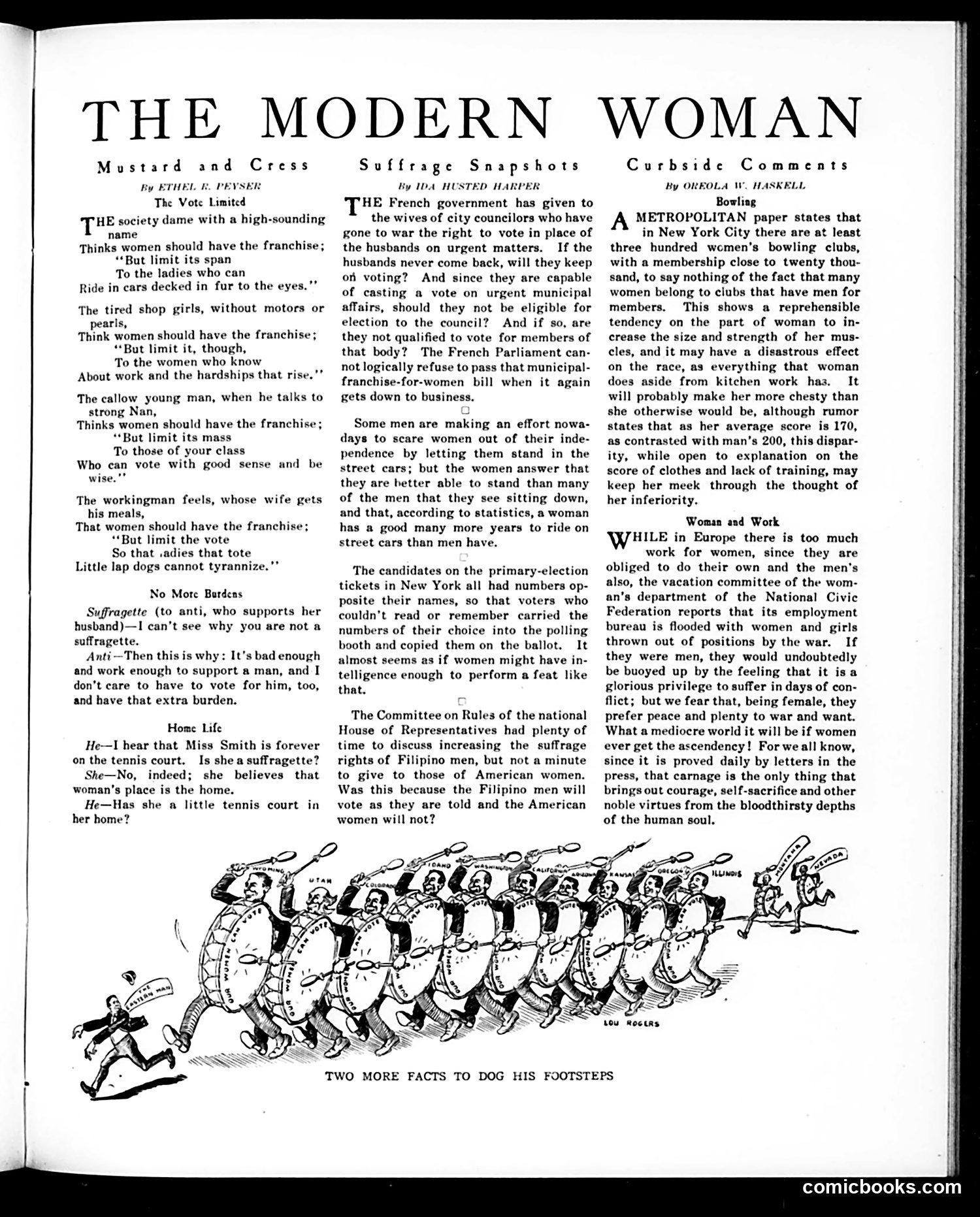
This page satirizes early 20th-century arguments against women's suffrage through multiple angles: **"The Vote Limited"** mocks selective franchise arguments: different social classes (society women, shop girls, working-class men) each claim women *should* vote—but only women like themselves. The satire exposes the hypocrisy of limiting voting rights by class while claiming principle. **The cartoon "Two More Facts to Dog His Footsteps"** depicts a man fleeing from a parade of suffragettes with drums, suggesting anti-suffrage anxiety about women's activism gaining momentum. **"Suffrage Snapshots"** uses logic to undermine anti-suffrage positions: if French women can vote on municipal matters for absent husbands, why deny them broader rights? If women can handle street cars better than men, why restrict voting? **"Bowling"** satirically presents a false concern: women's bowling supposedly threatens the race by making them "chesty" and muscular—a ridiculous anti-feminist argument the writer mocks by noting women bowlers still score lower than men. The overall effect: exposing anti-suffrage arguments as arbitrary, hypocritical, and absurd.
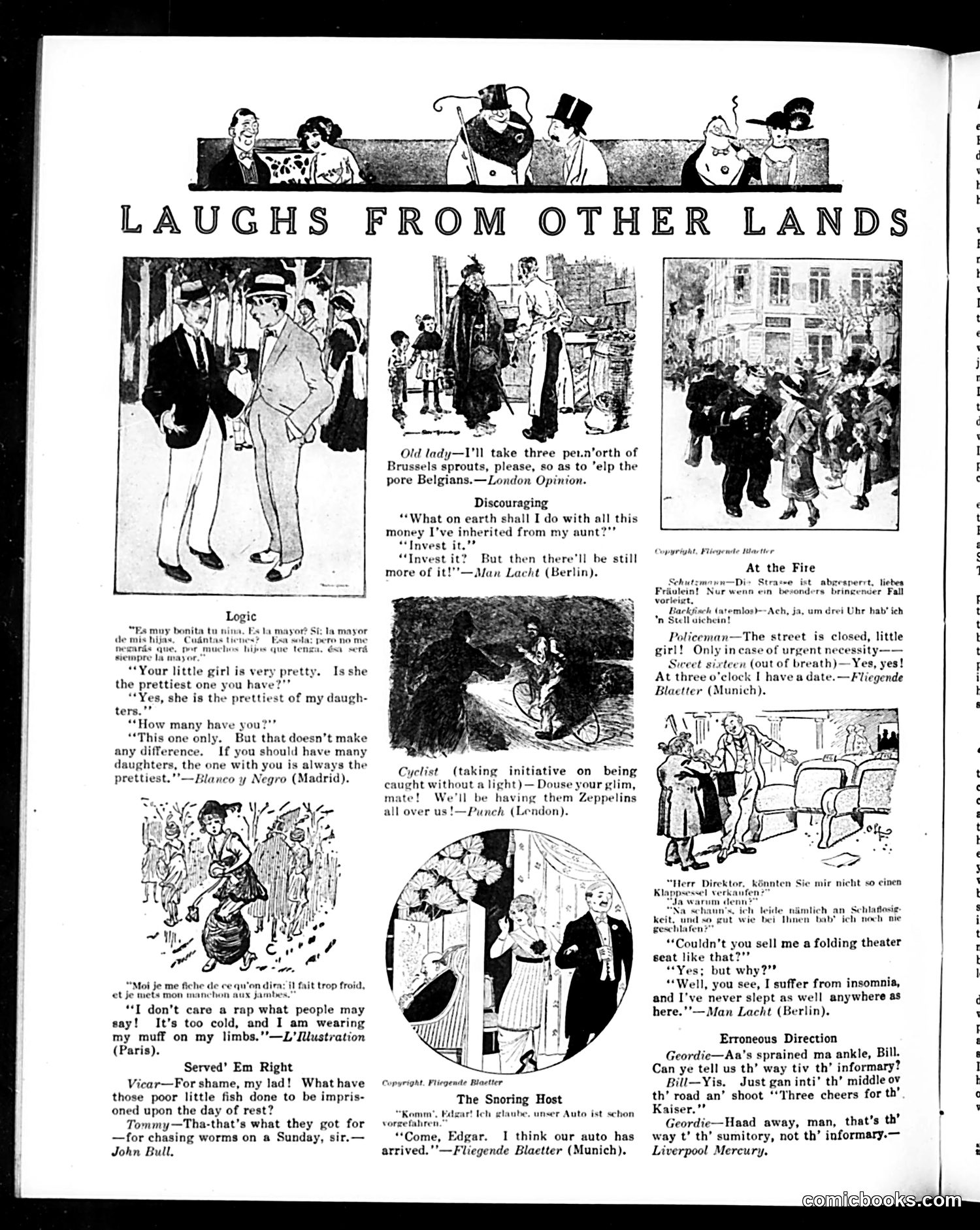
This page collects humorous anecdotes translated from European magazines, satirizing contemporary life during the World War I era (suggested by references to Zeppelins and Belgians). **Key jokes:** - **"Served 'Em Right"**: A vicar scolds a boy for fishing on Sunday; the boy replies the fish deserve it for chasing worms on the Sabbath—satirizing religious hypocrisy about rule-breaking. - **Cyclist/Zeppelins**: A cyclist without a light tells a policeman to "douse your glim" (turn off lights) to avoid German air raids—mocking wartime paranoia. - **Brussels sprouts for Belgians**: An old lady buys vegetables to help poor Belgians, satirizing well-meaning but ineffectual charity during the war. - **"Erroneous Direction"**: A Geordie (Northeast English speaker) is told to shout "Three cheers for the Kaiser" to reach a hospital—dark humor about pro-German sentiment or mistaken directions. The page showcases international humor magazines' perspectives on wartime anxieties, class attitudes, and absurdities.
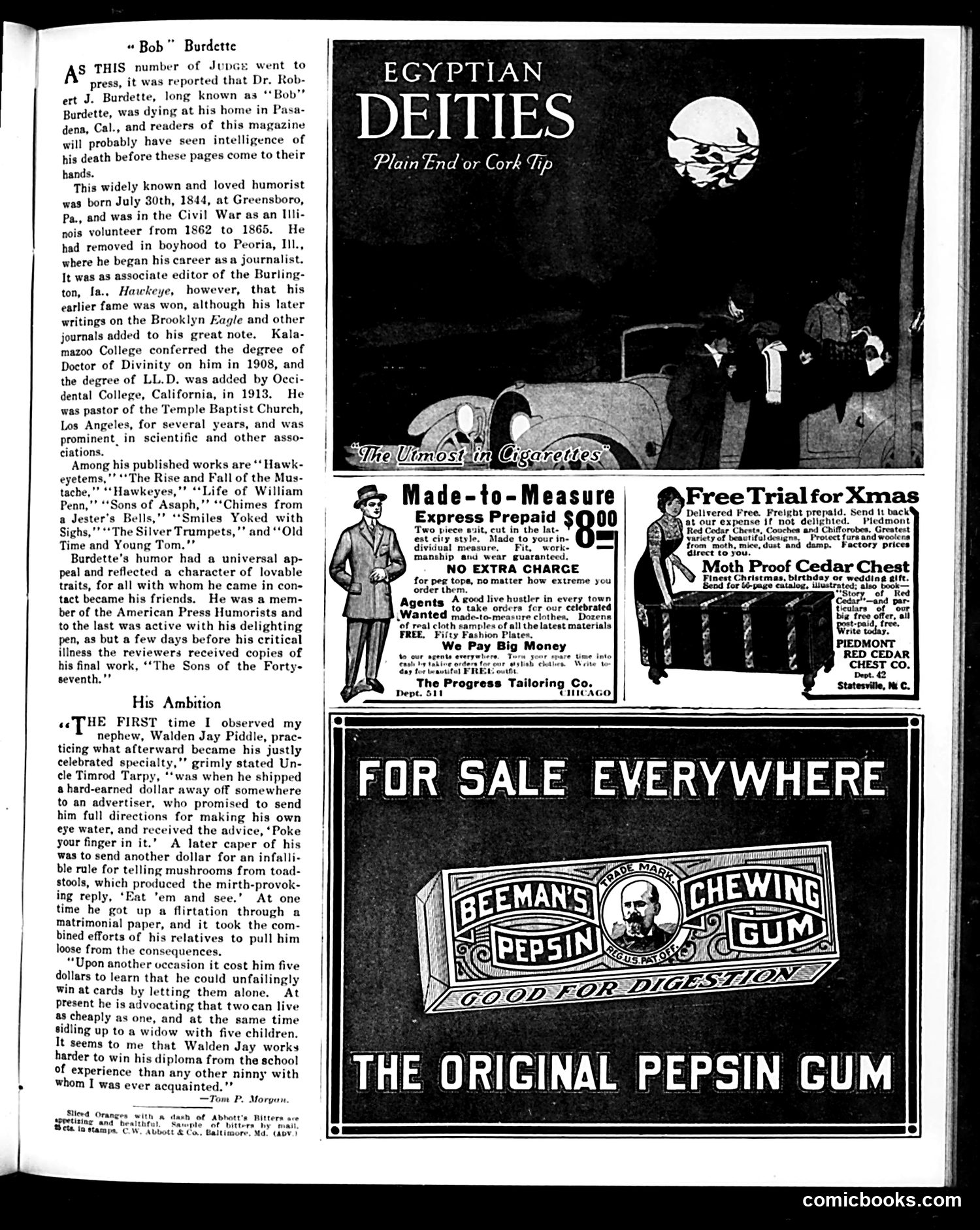
This page is primarily **biographical and advertising content**, not political satire. The main article commemorates **"Bob" Burdette** (Dr. Robert J. Burdette, 1844–died around publication), a widely-known American humorist and journalist. The text obituary-style recounts his Civil War service, career at publications like the *Brooklyn Eagle*, ministerial work, and published books. It establishes him as a respected, beloved figure in American letters. The secondary story, "His Ambition," is a **humorous anecdote** by Uncle Timrod Tarpy about his nephew Walden Jay Piddle—a gullible schemer who repeatedly falls for mail-order scams (fake eye-water instructions, mushroom identification tips, matrimonial schemes, card-winning secrets). The joke satirizes **mail-order fraud schemes and gullible consumers** who waste money on dubious advertiser promises. The page is dominated by **period advertisements**: made-to-measure tailoring, Egyptian Deities chewing gum, and moth-proof cedar chests—typical early 20th-century consumer products.
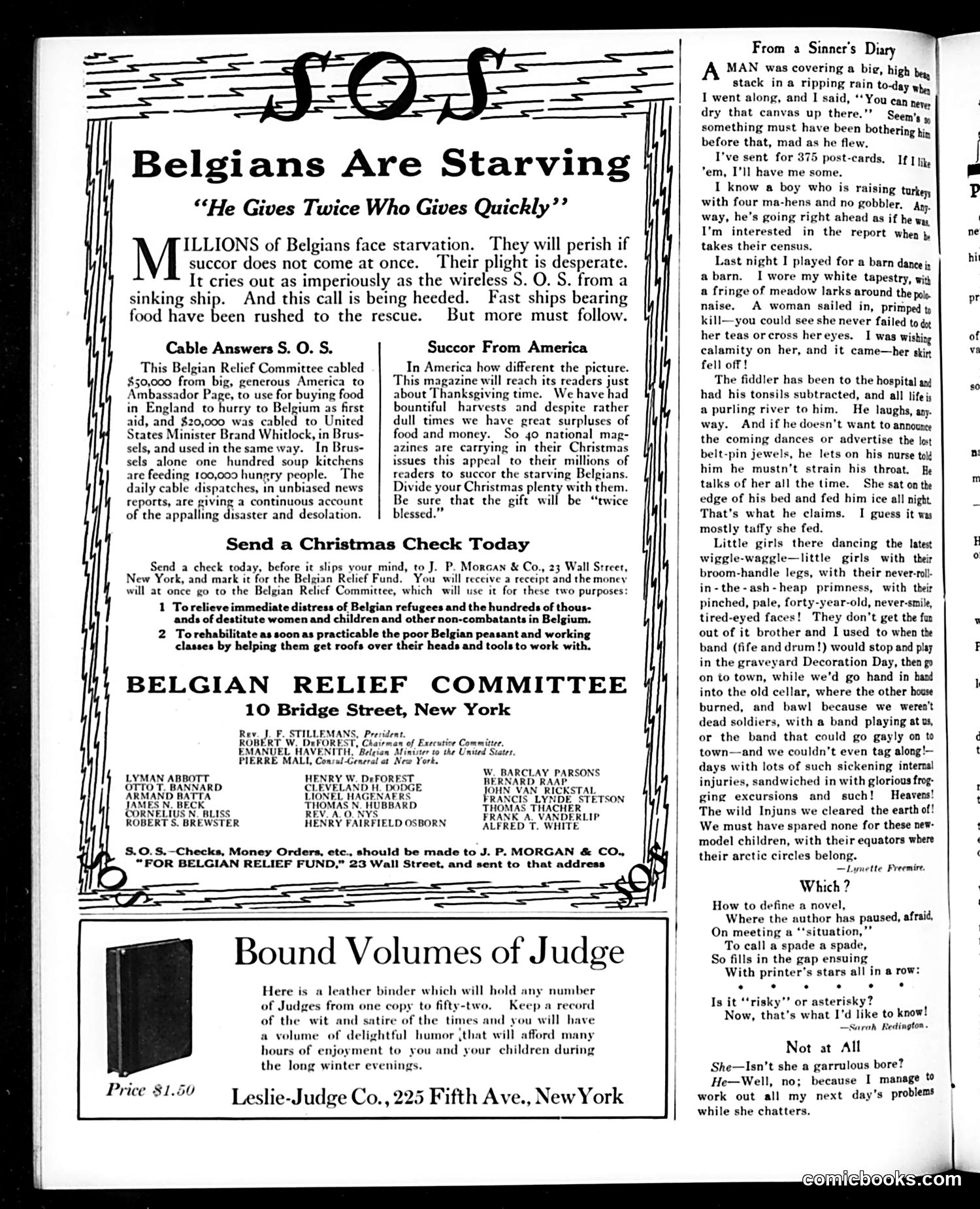
This page is primarily a **fundraising appeal for Belgian relief during World War I**, not satire. The dominant content is a earnest plea from the Belgian Relief Committee for American donations to feed starving Belgian civilians. The appeal contrasts Belgium's desperate hunger (100,000+ people in soup kitchens) with America's abundance at Thanksgiving. It urges readers to send checks immediately to J.P. Morgan & Co., which will forward funds to Ambassador Page and Minister Whitlock in Belgium. The page includes endorsements from prominent Americans (Lyman Abbott, Otto Bannard, etc.), detailing two relief purposes: immediate aid and post-war reconstruction. The right column contains unrelated filler content—"A Sinner's Diary" (humorous anecdotes) and literary definitions—typical of Judge's standard format. This reflects historical context: Belgium faced genuine starvation under German occupation (1914-1918), prompting major American charitable campaigns before U.S. entry into the war.
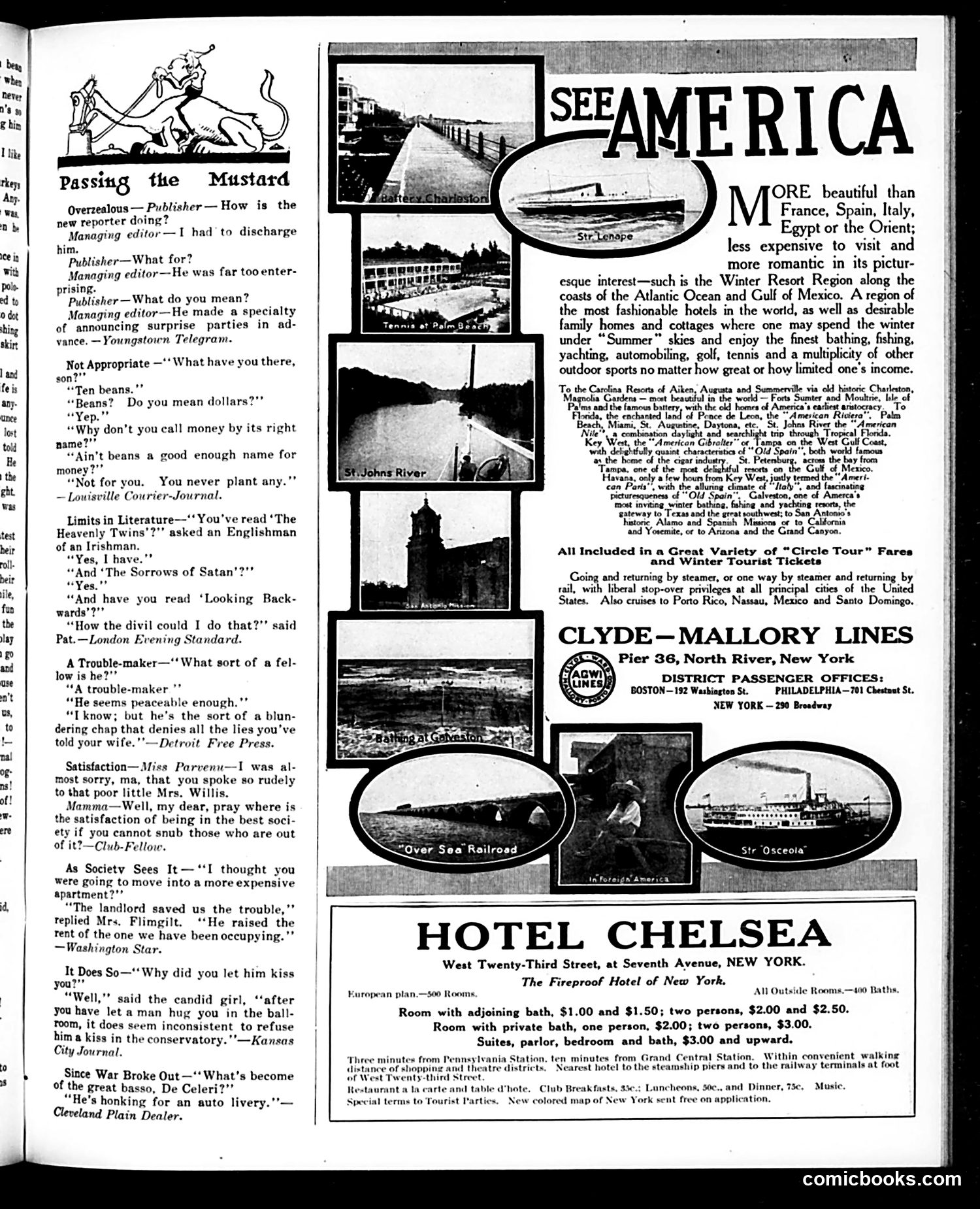
This page contains multiple brief satirical jokes rather than a single political cartoon. The humor targets everyday social absurdities: **"Passing the Mustard"** mocks an overeager newspaper reporter who ruins surprise parties by announcing them in advance—satirizing journalistic sensationalism. Other jokes lampoon: - Working-class slang ("beans" for dollars), suggesting class pretension - Literary snobbery among the Irish - Social climbing and cruelty toward the poor by wealthy parvenus - Marital dishonesty and the double standards of courtship The right side features travel advertisements for steamship lines and a New York hotel, typical of Judge's commercial content. The humor is genteel and domestic, reflecting early 20th-century magazine satire aimed at middle-class readers—poking fun at social hypocrisy, class anxiety, and the gap between propriety and actual behavior, rather than political satire.
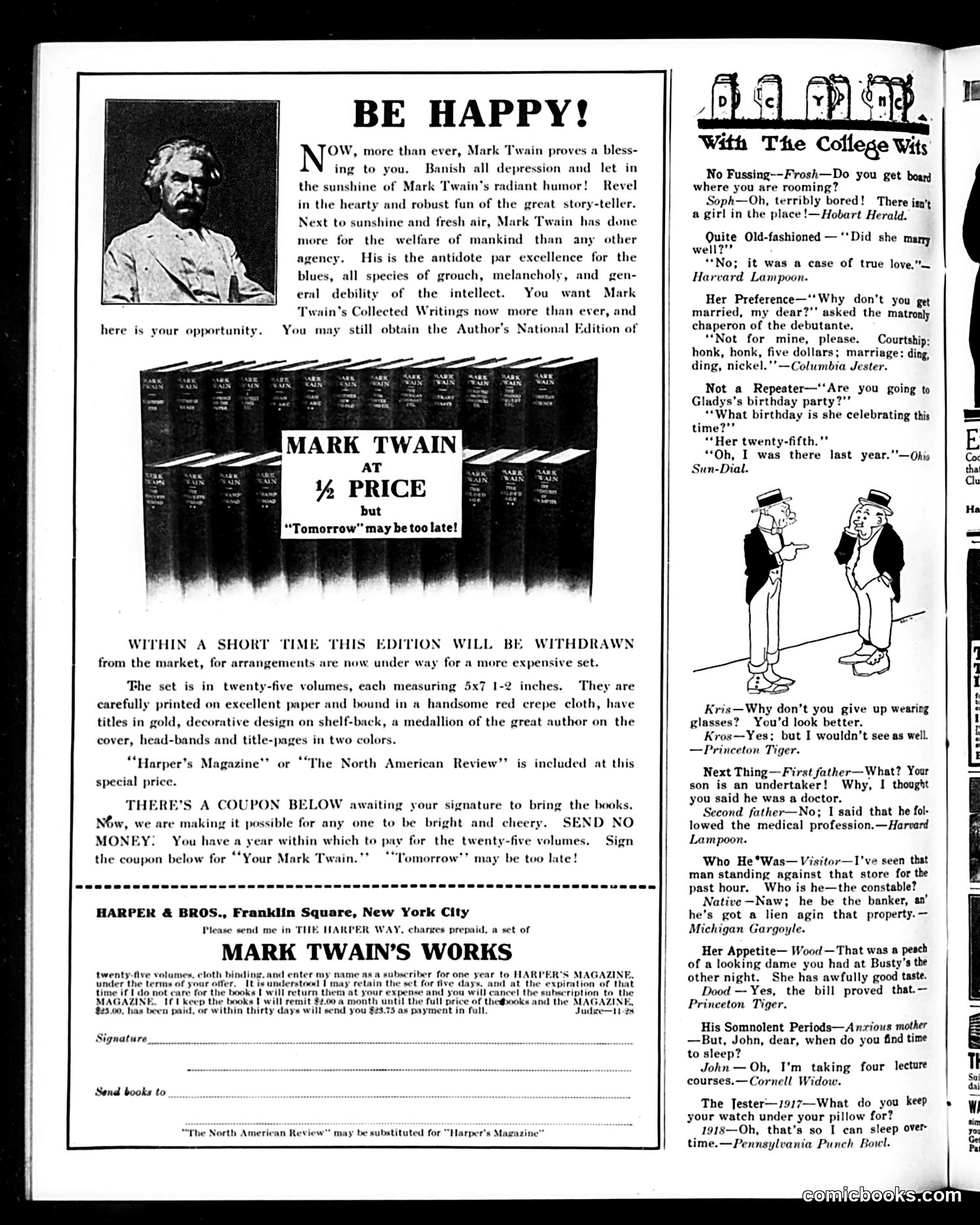
This page is primarily **advertising for Mark Twain's collected works**, not political commentary. The left side features a large promotional advertisement from Harper & Bros. offering a 25-volume set of Mark Twain's complete writings at half price. The ad uses Twain as a cure for depression and melancholy, calling his humor "the antidote par excellence for the blues." It emphasizes urgency ("Tomorrow may be too late!") and offers an installment payment plan with no money down. The right side contains "With the College Wits"—a collection of brief jokes from various college humor magazines (Harvard Lampoon, Columbia Jester, etc.). These are typical early 20th-century campus humor: wordplay about dating, courtship costs, undertakers, bankers, and student life. The jokes reflect contemporary concerns like dating etiquette and academic pressures. **This is primarily a commercial page**, not satirical commentary on politics or major social issues. It's a straightforward advertisement exploiting Twain's reputation as a beloved humorist, paired with filler content of light collegiate humor.
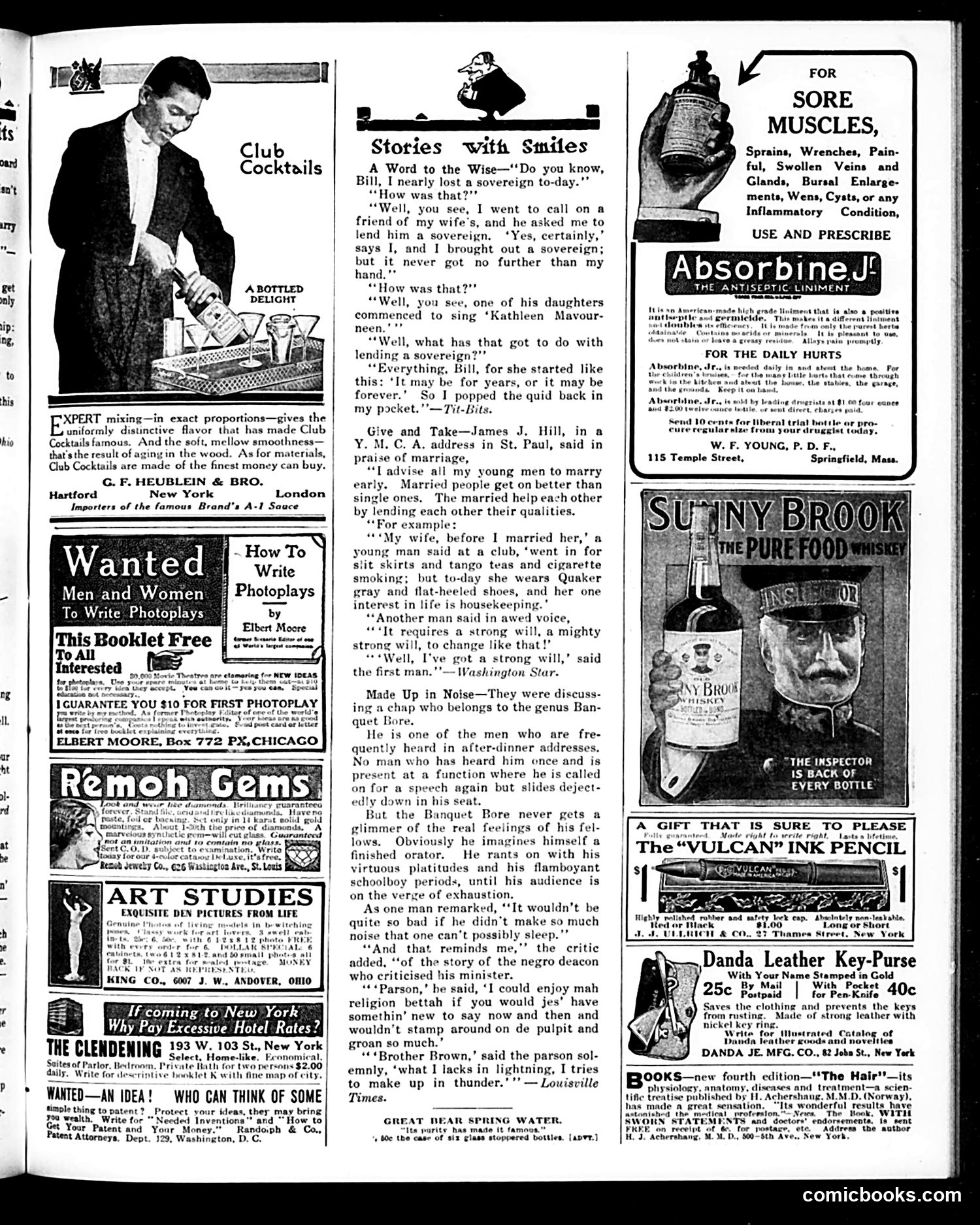
This is primarily an **advertising and humor page** from Judge magazine. The main content includes: **"Stories with Smiles"**: Three brief jokes about marriage and social behavior. The first concerns a man who nearly lends money but changes his mind when his friend's daughter sings a mournful song. The second, attributed to businessman James J. Hill, praises marriage as mutually beneficial. The third mocks "Banquet Bores"—men who monopolize after-dinner conversations with tedious speeches and platitudes, boring audiences into exhausted silence. **The satire targets**: Social climbers and tedious after-dinner speakers who imagine themselves as eloquent orators but actually exhaust their audiences. The final anecdote references a Black deacon criticizing his minister, using period-appropriate dialect humor typical of early 20th-century publications. The page is otherwise filled with product advertisements (cocktails, liniments, ink pencils, leather goods), reflecting Judge's commercial model alongside its satirical content.
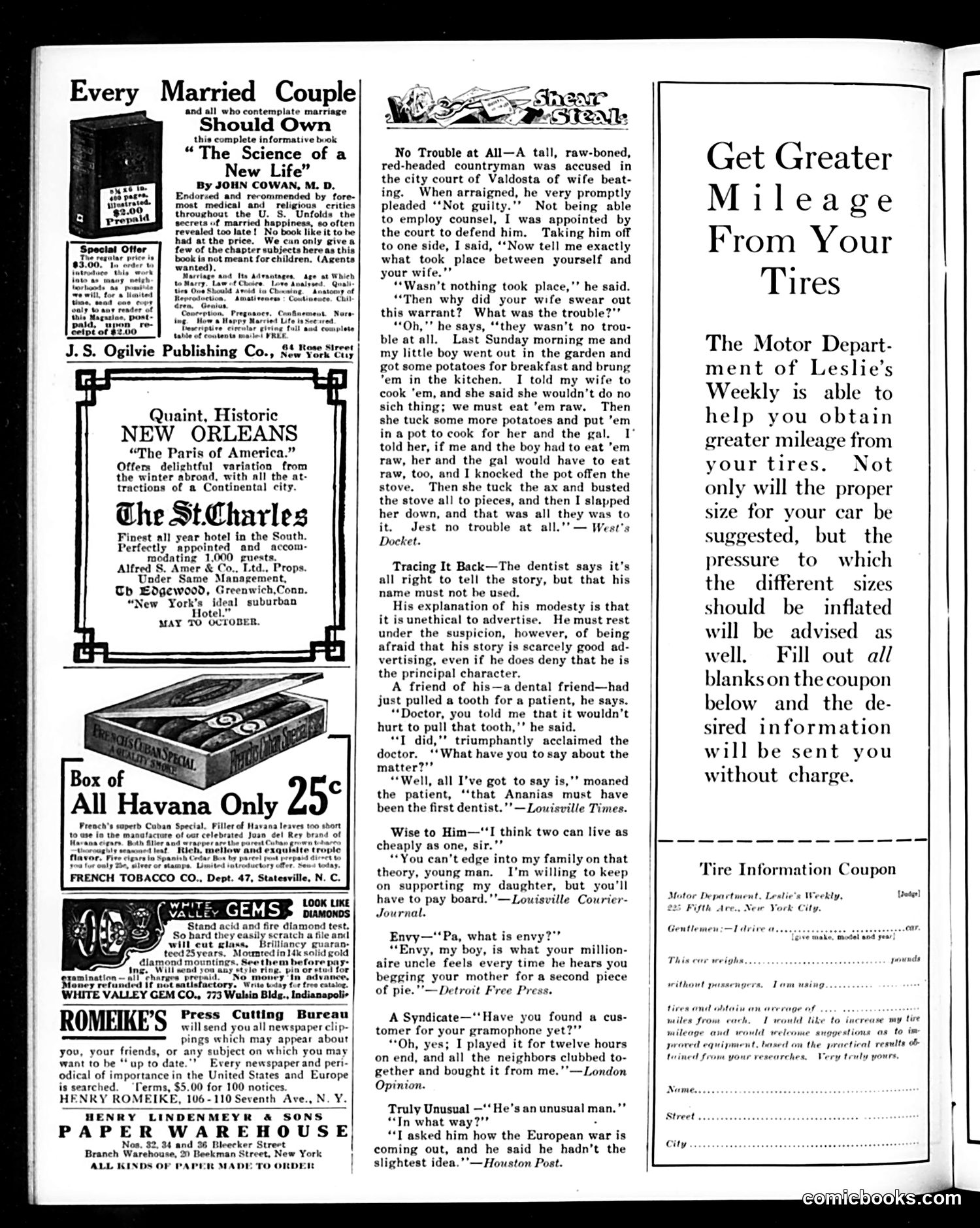
This page is primarily **advertisements and humor columns**, not political cartoons. The content includes: **Main Features:** - Marriage/relationship advice book ads - Tourism ads (New Orleans hotel) - Fake diamond and cigar advertisements - Humorous anecdotes in the "Heart Throbs" section **The Humor:** The anecdotes mock rural/working-class figures through exaggerated dialect and situations. "No Trouble at All" depicts a countryman defending wife-beating in court with absurdly casual logic—he beat his wife over a potato dispute but insists there was "no trouble." The humor relies on portraying rural people as ignorant and violent. "Tracing It Back" jokes about a dentist's dubious claim that tooth-pulling won't hurt. **Social Context:** These stereotyping anecdotes reflect early-20th-century urban magazine culture that mocked rural and working-class Americans. The ads target middle-class readers seeking respectability and leisure travel. The page contains **no identifiable political figures or references**—it's entertainment and commerce aimed at a specific demographic.
This is primarily **advertising copy**, not a cartoon. The text promotes Judge magazine's special Christmas issue while making a patriotic pitch during wartime. **Historical Context:** The reference to "foreign sources of supply cut off" indicates this was published during World War I (likely 1917-1918), when imports were restricted and American goods were being emphasized for patriotic reasons. **The Pitch:** Judge's advertisers are cleverly framing consumer spending as patriotic duty—urging readers to buy American-made products as Christmas gifts. Santa Claus becomes a vehicle for this message: he must now shop domestically instead of importing goods. **The Satire:** Judge subtly mocks commercial interests by portraying major advertisers as collectively "suggesting" to Santa what Americans should buy, while simultaneously promoting their own issue as the guide for these purchases. **Key Detail:** The circulation claim of "145,000 prospering homes" suggests an affluent readership—the target consumers most likely to purchase advertised luxury goods.
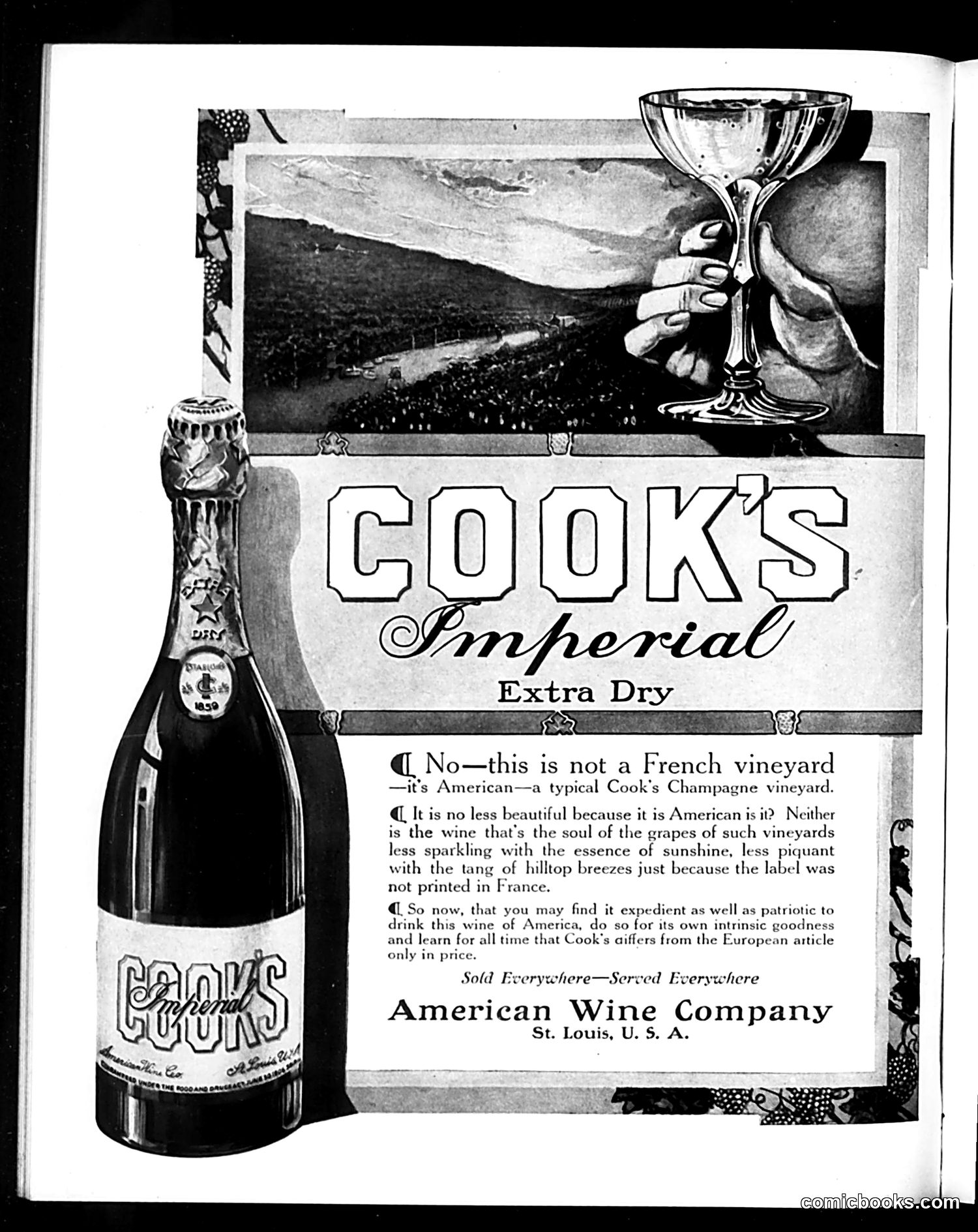
This is primarily a **wine advertisement**, not political satire. The ad promotes Cook's Champagne, an American wine made in St. Louis, against the prestige of French imports. The "satire" is subtle: the ad defensively argues that American wine deserves respect despite lacking a French label. It appeals to patriotism ("expedient as well as patriotic") while claiming Cook's differs from European wines "only in price"—suggesting American quality at lower cost. The vineyard photograph and champagne glass imagery position the product as elegant and worthy. The rhetoric reflects early 20th-century American commercial nationalism: celebrating domestic production while acknowledging French wine's cultural dominance. The advertisement essentially asks readers to choose American products for both quality and patriotic reasons, a marketing approach common during this era.