
Judge, 1914-11-28 · page 6 of 24
Judge — November 28, 1914 — page 6: what you’re looking at
What you’re looking at
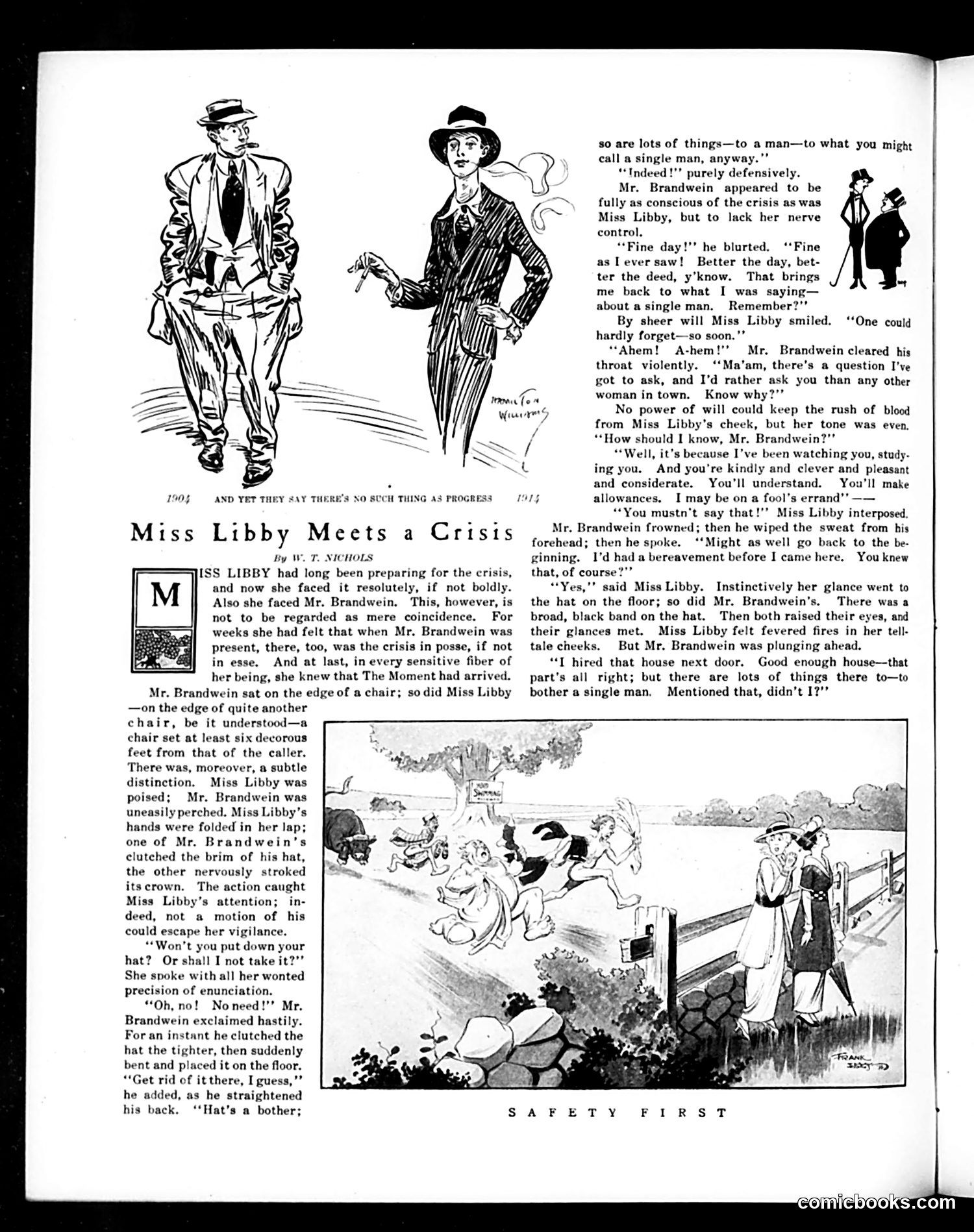
This is a domestic comedy story illustrated in Judge magazine (dates appear to be 1912-1913 based on the style). **The Plot:** Miss Libby receives a visit from Mr. Brandwein, a nervous widower (indicated by the black mourning band on his hat). He's awkwardly attempting to propose marriage, framing it as a practical solution to the challenges of being a single man living alone. **The Satire:** The humor lies in the formal, stilted courtship ritual of the Edwardian era. Brandwein's nervousness contrasts with Miss Libby's composed dignity—she maintains perfect posture and propriety while he fidgets with his hat. The illustration below (captioned "Safety First") appears to show domestic chaos, suggesting the "lots of things" that trouble a bachelor. **The Point:** Judge is gently mocking both the elaborate social conventions surrounding marriage proposals and the practical desperation that often motivated them. The title references the contemporary "Safety First" movement, sardonically suggesting marriage as a solution to life's discomforts rather than as romantic passion.
📄 Transcribed text from this page (OCR, searchable)
Machine-transcribed from the original scan — historical spelling and the odd misread are preserved.
rmoaufon Were 190 AND YET THEY SAY THERE'S NO SUCH THING AS PROGRESS Miss Libby Meets a Crisis By W. T. NICHOLS ISS LIBBY had long been preparing for the crisis, and now she faced it resolutely, if not boldly. Also she faced Mr. Brandwein, This, however, is not to be regarded as mere coincidence. For weeks she had felt that when Mr. Brandwein was present, there, too, was the crisis in posse, if not in esse. And at last, in every sensitive fiber of her being, she knew that The Moment had arrived. Mr. Brandwein sat on the edge of a chair; so did Miss Libby —on the edge of quite another chair, be it understood—a chair set at least six decorous feet from that of the caller. There was, moreover, a subtle distinction. Miss Libby was poised; Mr. Brandwein was uneasily perched. Miss Libby’s hands were folded in her lap; one of Mr. Brandwein’s clutched the brim of his hat, the other nervously stroked itscrown. The action caught Miss Libby’s attention; deed, not a motion of his could escape her vigilance. “Won't you put down your hat? Or shall I not take it?’’ She spoke with all her wonted precision of enunciation. “Oh, no! Noneed!’’ Mr. Brandwein exclaimed hastily. For an instant he clutched the hat the tighter, then suddenly bent and placed it on the floor. “Get rid of itthere, I guess,”” he added, as he straightened his back. ‘‘Hat’s a bother; ty so are lots of things—to a man—to what you might call a single man, anyway.” “Indeed !'’ purely defensively. Mr. Brandwein appeared to be fully as conscious of the crisis as was Miss Libby, but to lack her nerve control, ‘Fine day!’’ he blurted. ‘Fine as lever saw! Better the day, bet- ter the deed, y’know. That brings me back to what I was saying— about a single man. Remember?" By sheer will Miss Libby smiled. hardly forget—so soon.”* “Ahem! A-hem!'’ Mr. Brandwein cleared his throat violently. ‘‘Ma’am, there’s a question I’ve got to ask, and I’d rather ask you than any other woman in town. Know why?’ No power of will could keep the rush of blood from Miss Libby's cheek, but her tone was even, **How should I know, Mr. Brandwein?"’ “Well, it’s because I've been watching you, study- ing you. And you're kindly and clever and pleasant and considerate. You'll understand. You'll make allowances, I may be on a fool’s errand’? —— “You mustn't say that!'’ Miss Libby interposed. Mr. Brandwein frowned; then he wiped the sweat from his forehead; then he spoke. ‘‘Might as well go back to the be- ginning. I'd had a bereavement before I came here. You knew that, of course?” “*Yes,’’ said Miss Libby. Instinctively her glance went to the hat on the floor; so did Mr. Brandwein's. There was a broad, black band on the hat. Then both raised their eyes, and their glances met. Miss Libby felt fevered fires in her tell- tale cheeks. But Mr. Brandwein was plunging ahead. “I hired that house next door. Good enough house—that part's all right; but there are lots of things there to—to bother a single man. Mentioned that, didn’t 1?’” “One could >