
Judge, 1914-11-28 · page 13 of 24
Judge — November 28, 1914 — page 13: what you’re looking at
What you’re looking at
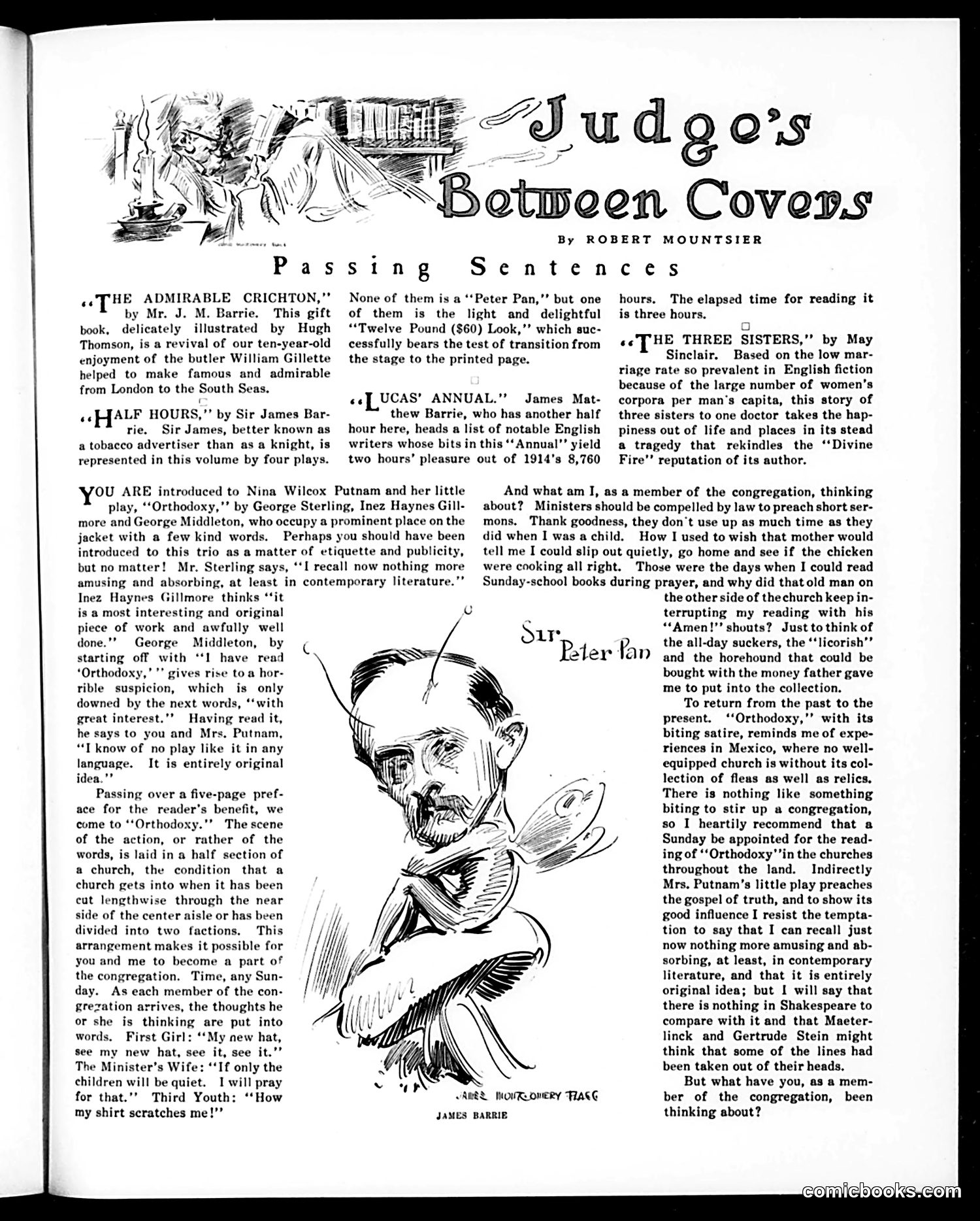
This is a literary review column by Robert Mountsier discussing recent books, featuring a cartoon of Peter Pan by James Barrie illustrating the text. The main subject is a play called "Orthodoxy" by Nina Wilcox Putnam, introduced with blurbs from literary figures George Sterling, Inez Haynes Gillmore, and George Middleton. The satire gently mocks how these critics oversell the work with hyperbolic praise—Sterling claims he recalls "nothing more amusing and absorbing" despite admitting he can't actually remember much about it. The page also reviews Barrie's "The Admirable Crichton" and other contemporary books. The cartoon illustrates Barrie's Peter Pan character. The lengthy italic passage appears to be from the "Orthodoxy" script itself, depicting the wandering thoughts of church congregation members during Sunday service—a satirical commentary on inattention during worship. The overall tone gently ridicules both contemporary theatrical pretension and the gap between critical enthusiasm and actual merit.
📄 Transcribed text from this page (OCR, searchable)
Machine-transcribed from the original scan — historical spelling and the odd misread are preserved.
«e'THE ADMIRABLE CRICHTON,” by Mr. J. M. Barrie. This gift book, delicately illustrated by Hugh Thomson, is a revival of our ten-year-old enjoyment of the butler William Gillette helped to make famous and admirable from London to the South Seas. os HALF HOURS,”’ by Sir James Bar- rie. Sir James, better known as a tobacco advertiser than as a knight, is represented in this volume by four plays. jacket with a few kind words. Inez Haynes Gillmore thinks ‘‘it is a most interesting and original piece of work and awfully well done.’ George Middleton, by starting off with ‘‘l have read ‘Orthodoxy,’ "’ gives rise toa hor- rible suspicion, which is only downed by the next words, ‘‘with great interest."” Having read it, he says to you and Mrs, Putnam, “T know of no play like it in any language. It is entirely original idea."’ Passing over a five-page pref- ace for the reader's benefit, we come to ‘‘Orthodoxy.’’ The scene of the action, or rather of the words, is laid ina half section of a church, the condition that a church gets into when it has been cut lengthwise through the near side of the center aisle or has been divided into two factions. This arrangement makes it possible for you and me to become a part of the congregation. Time, any Sun- day. As each member of the con- grezation arrives, the thoughts he or she is thinking are put into words. First Girl: ‘‘My new hat, see my new hat, see it, see it.’’ The Minister’s Wife: ‘‘If only the children will be quiet. I will pray for that.’’ Third Youth: ‘‘How my shirt scratches me!’’ Passing ‘OU ARE introduced to Nina Wilcox Putnam and her little play, ‘‘Orthodoxy,’’ by George Sterling, Inez Haynes Gill- more and George Middleton, who occupy a prominent place on the Perhaps you should have been introduced to this trio as a matter of etiquette and publicity, but no matter! Mr. Sterling says, ‘‘I recall now nothing more amusing and absorbing, at least in contemporary literature.’’ None of them is a ‘‘Peter Pan,’’ but one of them is the light and delightful “Twelve Pound ($60) Look,’’ which suc- cessfully bears the test of transition from the stage to the printed page. ee Ucas’ ANNUAL." James Mat- thew Barrie, who has another half hour here, heads a list of notable English writers whose bits in this ‘‘Annual”’ yield two hours’ pleasure out of 1914's 8,760 wABEL MOURLOMERY ACG JAMES BARRIB ~JSudgors Between Covers By ROBERT MOUNTSIER Sentences And what am I, as a member of the congregation, thinking about? Ministers should be compelled by law to preach short ser- mons. Thank goodness, they don’t use up as much time as they did when I was a child. How I used to wish that mother would tell me I could slip out quietly, go home and see if the chicken were cooking all right. Sunday-school books during prayer, and why did that old man on Peter fan hours, The elapsed time for reading it is three hours. ec THE THREE SISTERS,” by May Sinclair. Based on the low mar- riage rate so prevalent in English fiction because of the large number of women’s corpora per man’s capita, this story of three sisters to one doctor takes the hap- piness out of life and places in its stead a tragedy that rekindles the ‘Divine Fire’’ reputation of its author. Those were the days when I could read the other side of thechurch keep in- terrupting my reading with his “‘Amen!"’ shouts? Just to think of the all-day suckers, the ‘‘licorish’’ and the horehound that could be bought with the money father gave me to put into the collection. To return from the past to the present. ‘‘Orthodoxy,’’ with its biting satire, reminds me of expe- riences in Mexico, where no well- equipped church is without its col- lection of fleas as well as relics, There is nothing like something biting to stir up a congregation, so I heartily recommend that a Sunday be appointed for the read- ing of ‘‘Orthodoxy’’in the churches throughout the land. Indirectly Mrs. Putnam’s little play preaches the gospel of truth, and to show its good influence I resist the tempta- tion to say that I can recall just now nothing more amusing and ab- sorbing, at least, in contemporary literature, and that it is entirely original idea; but I will say that there is nothing in Shakespeare to compare with it and that Maeter- linck and Gertrude Stein might think that some of the lines had been taken out of their heads. But what have you, as a mem- ber of the congregation, been thinking about?