
Judge, 1914-11-28 · page 11 of 24
Judge — November 28, 1914 — page 11: what you’re looking at
What you’re looking at
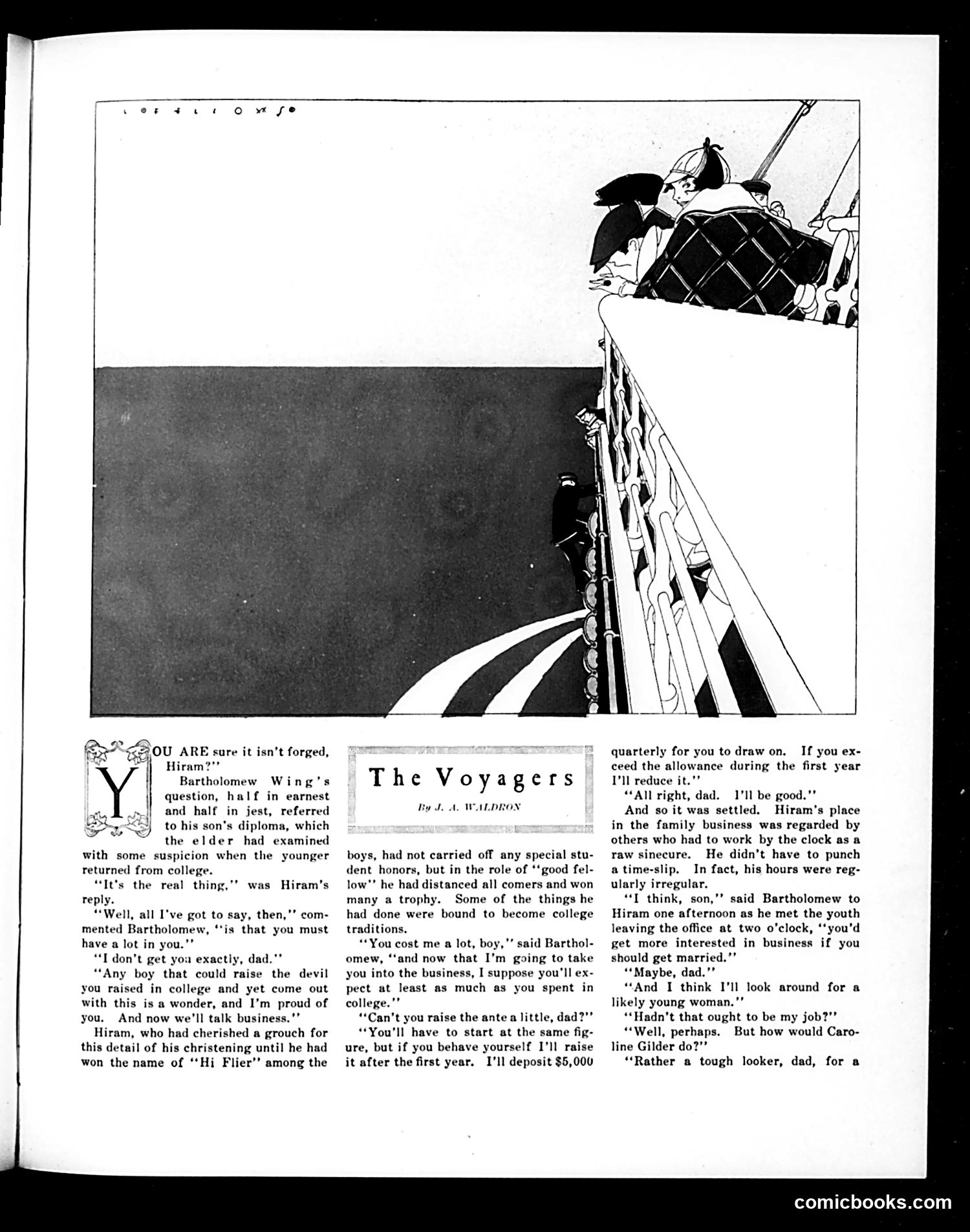
This story satirizes the entitled rich son entering the family business. Hiram, a college graduate known as "Hi Flier" for his partying antics rather than academics, returns home to join his father Bartholomew Wing's company. The satire targets nepotism and entitlement: despite being a mediocre student who "cost" his father dearly, Hiram receives a cushy sinecure with irregular hours and no time-clock requirements—luxuries unavailable to other employees. His father offers $5,000 quarterly (substantial for the era) and threatens only minor consequences for overspending. The joke deepens when Bartholomew suggests arranging a marriage to "Caroline Gilder," which Hiram dismisses as "tough looking." The satire critiques both generational wealth (the son's unearned advantages) and patriarchal control (the father orchestrating his son's marriage for business purposes). The illustration shows figures aboard a ship, likely metaphorically representing life's voyage or social navigation.
📄 Transcribed text from this page (OCR, searchable)
Machine-transcribed from the original scan — historical spelling and the odd misread are preserved.
ERE OU ARE sure it isn’t forged, s a Hiram?" Bartholomew Wing's question, half in earnest and half in jest, referred to his son's diploma, which the elder had examined with some suspicion when the younger returned from college. “It's the real thing,"’ reply. “Well, all I've got to say, then,’’ com- mented Bartholomew, ‘‘is that you must have a lot in you."” “I don’t get you exactly, dad."’ “Any boy that could raise the devil you raised in college and yet come out with this is a wonder, and I’m proud of you. And now we'll talk business.'’ Hiram, who had cherished a grouch for this detail of his christening until he had won the name of ‘Hi Flier’? among the was Hiram’s The Voyagers By Jo A. WALDRON boys, had not carried off any special stu- dent honors, but in the role of ‘‘good fel- low"’ he had distanced all comers and won many a trophy. Some of the things he had done were bound to become college traditions. “You cost me a lot, boy,’’ said Barthol- omew, ‘‘and now that I’m going to take you into the business, I suppose you'll ex- pect at least as much as you spent in college.’” “Can't you raise the ante a little, dad?”’ “*You'll have to start at the same fig- ure, but if you behave yourself I'll raise it after the first year. I'll deposit $5,000 quarterly for you to draw on. If you ex- ceed the allowance during the first year I'll reduce it.”” “Allright, dad. 1'll be good."’ And so it was settled. Hiram’s place in the family business was regarded by others who had to work by the clock as a raw sinecure. He didn’t have to punch atime-slip. In fact, his hours were reg- ularly irregular. “I think, son,’’ said Bartholomew to Hiram one afternoon as he met the youth leaving the office at two o'clock, ‘‘you'd get more interested in business if you should get married.’’ “‘Maybe, dad.’’ “And I think I'll look around for a likely young woman,”” ‘‘Hadn’t that ought to be my job?”” “Well, perhaps. But how would Caro- line Gilder do?” “Rather a tough looker, dad, for a comicbooks.com