
A complete issue · 24 pages · 1914
Judge — November 14, 1914
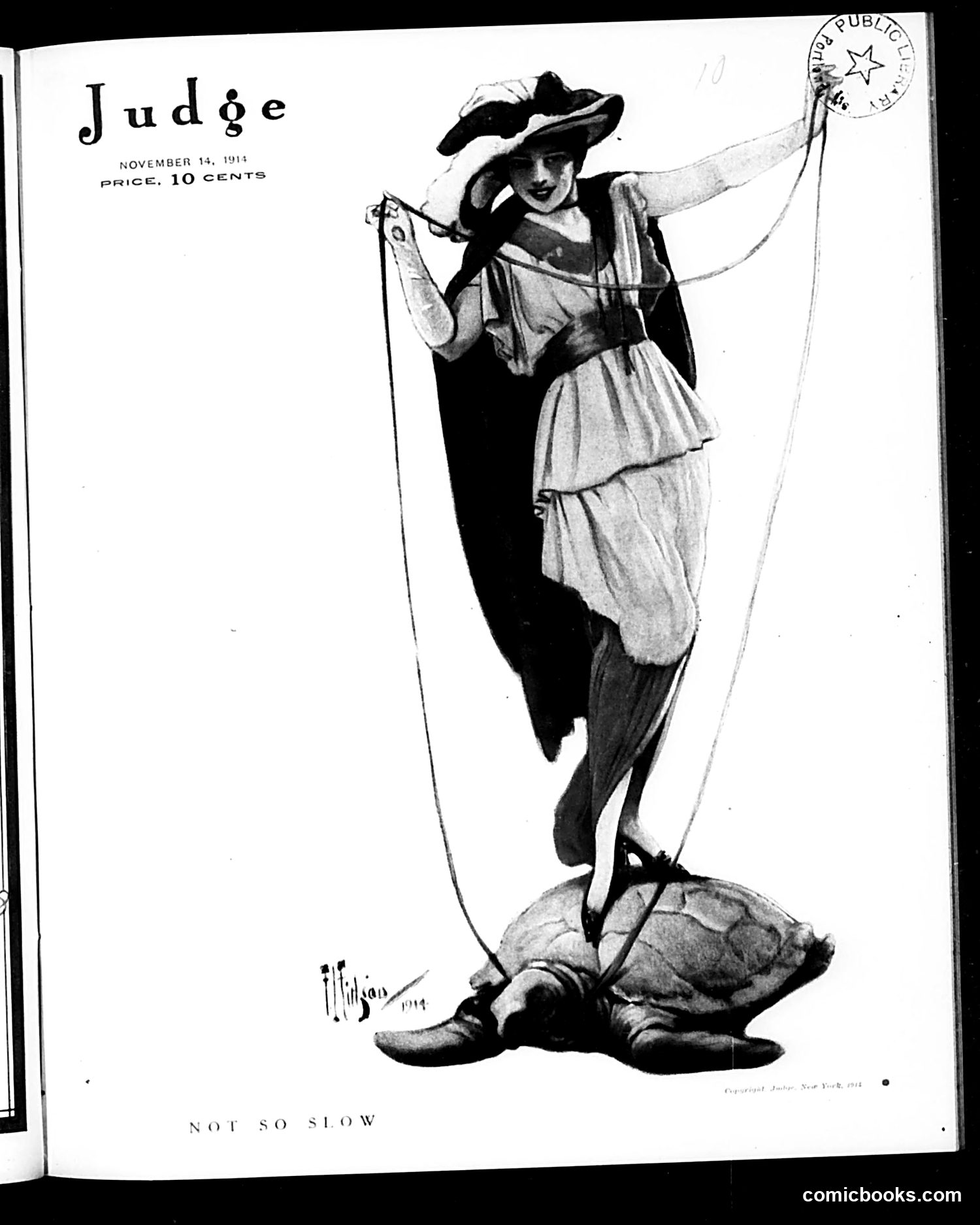
This satirical cover depicts a woman in early 1910s attire standing triumphantly on a tortoise, holding a rope. The caption "NOT SO SLOW" appears to reference Aesop's fable of the tortoise and the hare—suggesting the woman represents progress or advancement that will overtake something slow-moving. Given the 1914 date, this likely comments on women's suffrage or women's rights activism, which was accelerating during this period. The woman's confident pose and victory over the "slow" tortoise suggests satirical commentary on the pace of social change regarding women's rights. The tortoise may represent institutional resistance or conservative opposition to women's advancement. The overall message appears ironic—whether celebrating or mocking the momentum of women's movement advocates remains ambiguous from the image alone.
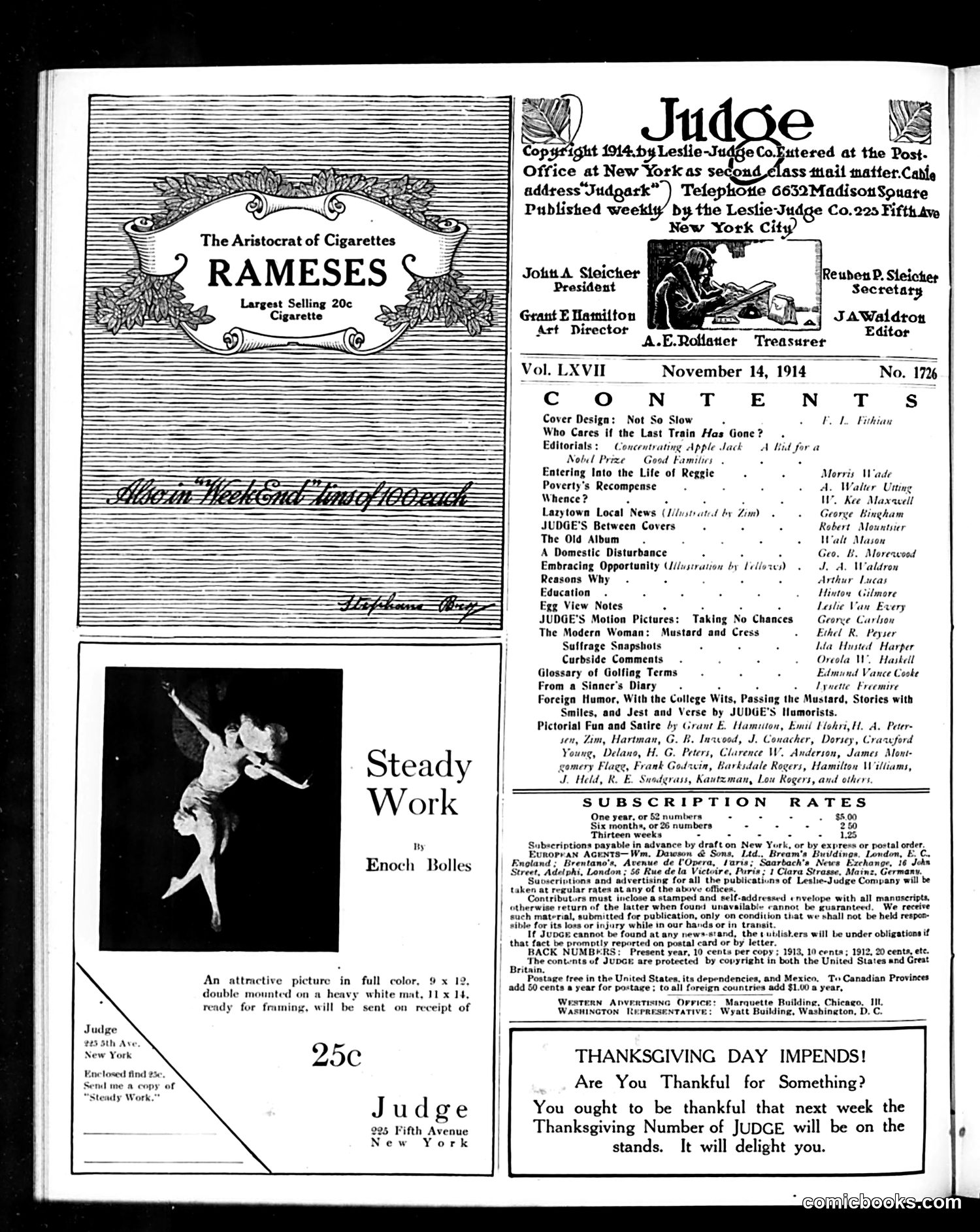
This page is primarily **advertising and editorial content** rather than political satire. The main visual element is an advertisement for "Steady Work" by Enoch Bolles—a 9x12 inch picture depicting a classical female nude figure, priced at 25 cents. The page also features the magazine's masthead, table of contents, and subscription information. A sidebar announces an upcoming Thanksgiving issue. The only potentially satirical element is the cover image advertising Rameses cigarettes ("The Aristocrat of Cigarettes"), though this appears to be a commercial advertisement rather than political commentary. The issue date (November 1914) falls during World War I, but no war-related satire is evident on this particular page.
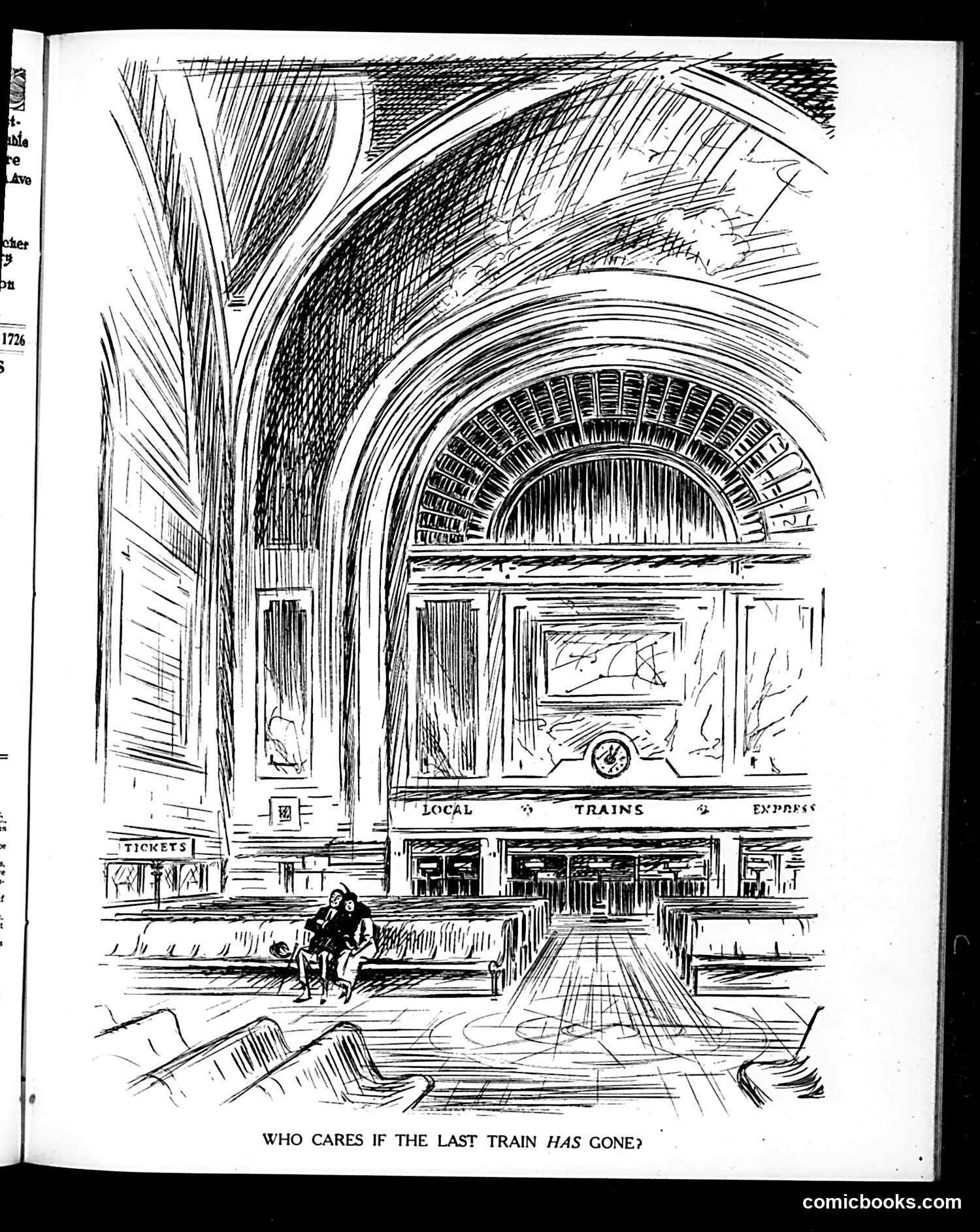
This is a single-panel cartoon depicting a train station interior with grand architectural features (arched ceiling, ticket booth). A solitary, dejected figure sits alone on a bench in the expansive, empty space. The caption reads: "WHO CARES IF THE LAST TRAIN HAS GONE?" The satire appears to comment on loneliness and social isolation—the figure's abandonment in an otherwise magnificent public space emphasizes emotional disconnection despite material surroundings. The rhetorical question suggests resignation or despair: when one is utterly alone, practical concerns (missing the final train) become irrelevant. The cartoon likely reflects broader themes about urban alienation or personal melancholy rather than specific political events. Without additional context or dateline visible, the exact historical moment remains unclear.
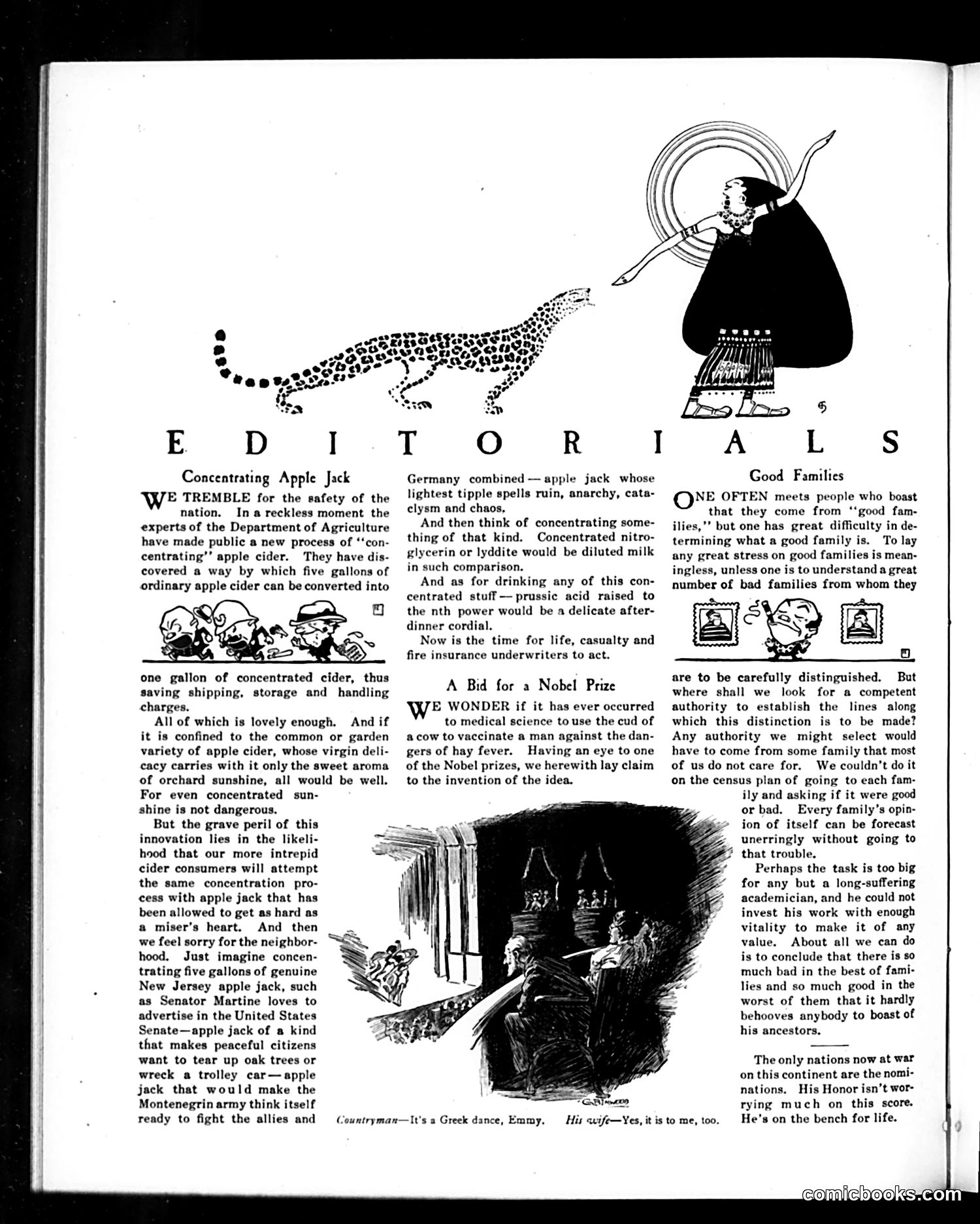
This page contains three editorial cartoons/pieces satirizing early 20th-century American concerns: 1. **"Concentrating Apple Jack"** mocks agricultural innovation—specifically a new process to concentrate apple cider. The satire suggests this efficiency could create dangerous concentrated alcohol, with absurd consequences (insurance companies going bankrupt, soldiers wanting to destroy trolleys while drunk). 2. **"A Bid for a Nobel Prize"** appears to joke about using cattle vaccination methods on humans to prevent hay fever—a comically impractical medical idea worthy of Nobel consideration. 3. **"Good Families"** discusses inherited family character, suggesting that genealogy alone doesn't determine morality; both "good" and "bad" families exist among all ancestry. The cartoons use exaggeration and whimsy to critique contemporary scientific enthusiasm and social pretension.
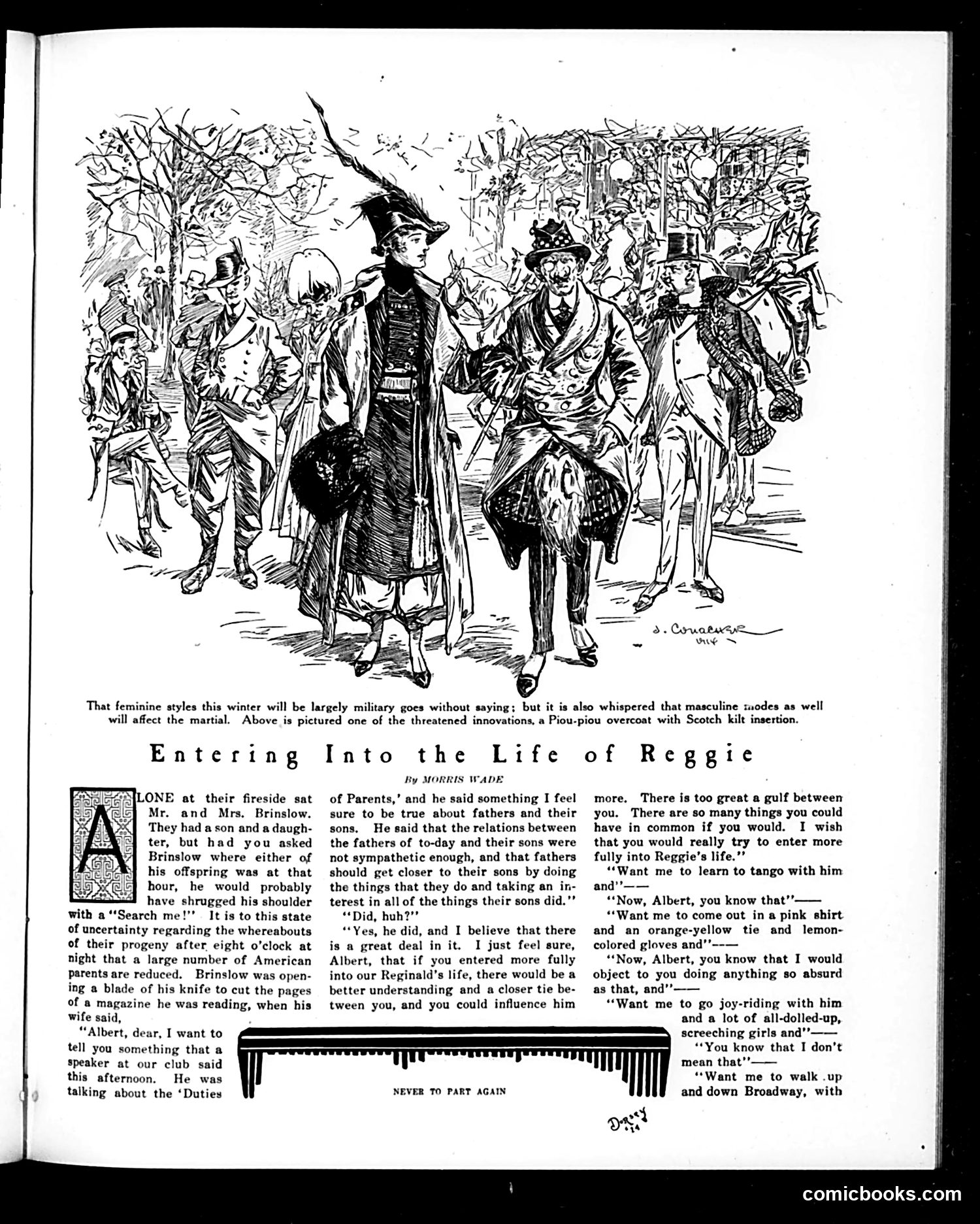
The illustration satirizes fashion trends and gender norms of the era. The header notes that "feminine styles this winter will be largely military" and references a "Pou-piou overcoat with Scotch kilt insertion"—mocking women's adoption of military-inspired clothing. The sketch shows a fashionable woman in masculine-influenced attire among well-dressed figures, likely satirizing the anxiety among some observers about women's changing fashion choices. The accompanying story text discusses a father-son relationship and social influence, suggesting the satire connects fashion innovation to broader concerns about social roles and propriety. The cartoon appears to mock both the extreme fashion statements and the cultural hand-wringing they generated, typical of Judge's satirical approach to contemporary social debates.
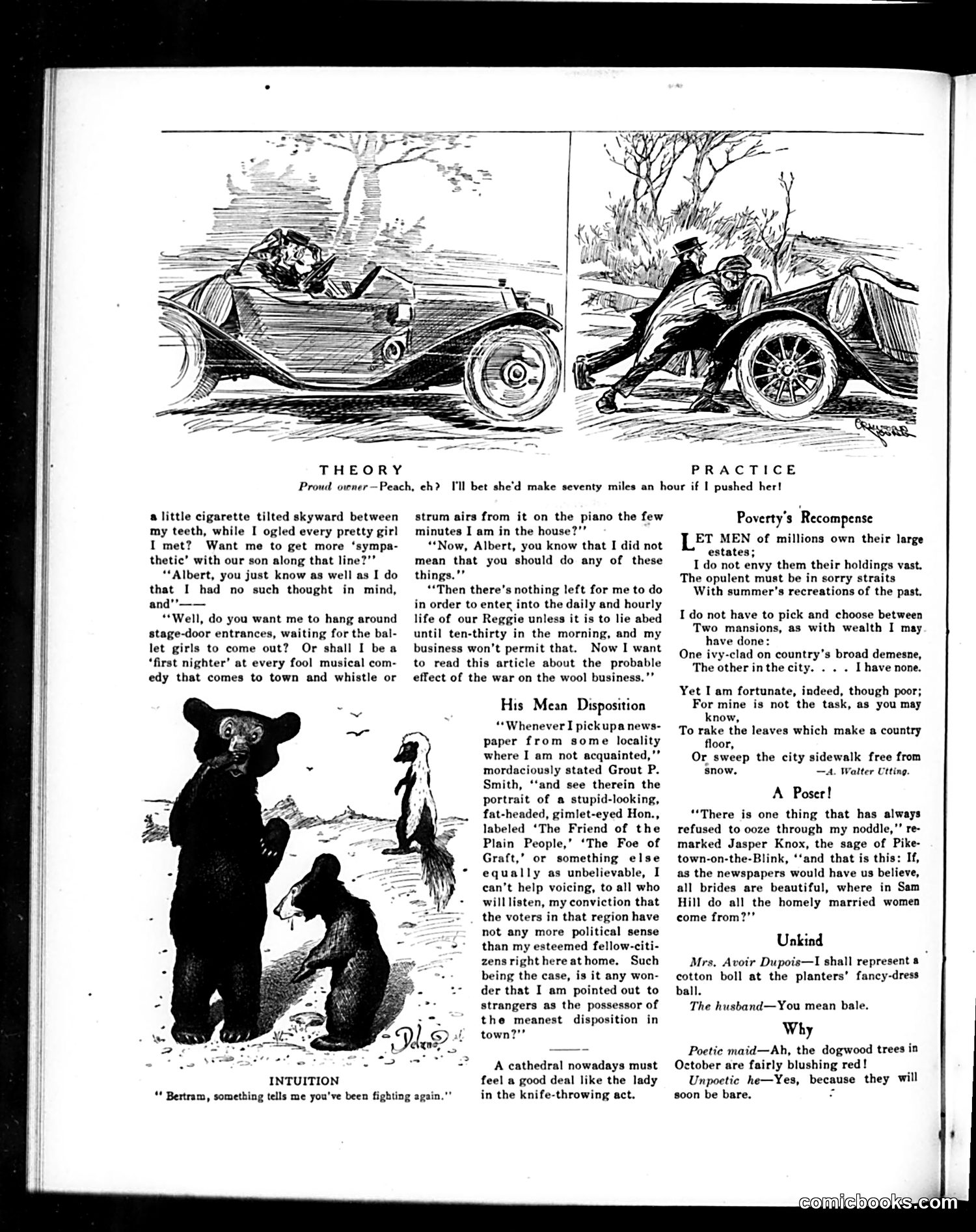
**Top cartoons ("Theory" vs. "Practice"):** These paired illustrations mock the gap between automotive aspirations and reality. The "Theory" shows a proud car owner boasting his vehicle will go "seventy miles an hour," while "Practice" depicts two men frantically pushing the same car—satirizing early automobiles' unreliability and weakness. **"Intuition" (animal cartoon):** A bear and bird observe a bruised cat, with the caption suggesting the cat has been fighting. This is a simple visual gag with no apparent political meaning. **Text sections:** The remaining content comprises short humorous pieces: a domestic dialogue about a husband's proper conduct; complaints about dishonest politicians; commentary on wealthy people's summer burdens; and various one-liner jokes about marriage, poverty, and nature. **Overall context:** This appears to be a typical Judge magazine humor page from the early 1900s, blending automotive satire, domestic comedy, and light social commentary without significant political messaging.
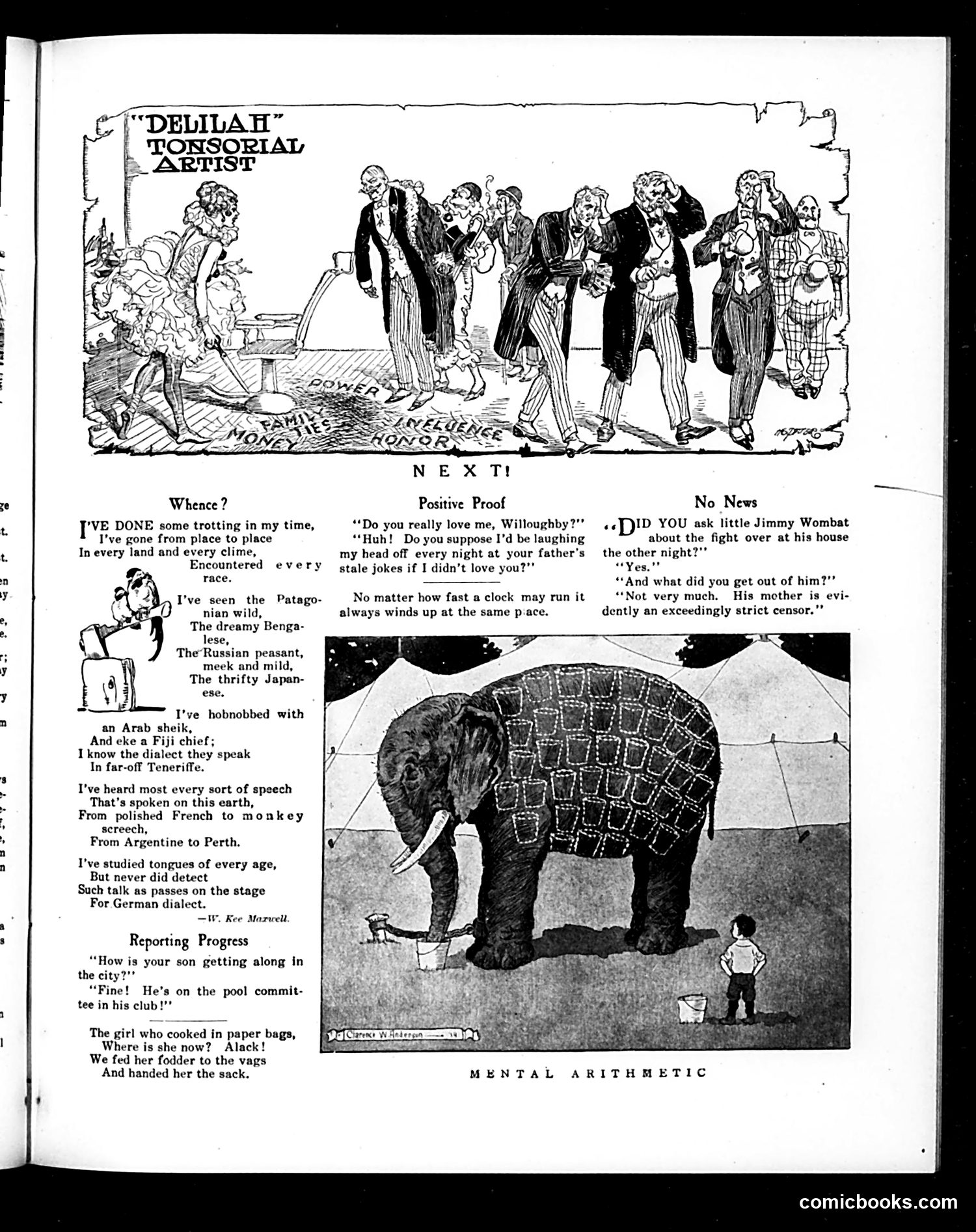
**Top Cartoon ("Delilah Tonsorial Artist"):** The title references the biblical Delilah, who betrayed Samson. The cartoon depicts well-dressed men entering a barbershop where a woman (the "barber") appears to be extracting something from them—likely their money, power, or influence. The labels "POWER," "MONEY," and "INFLUENCE" on the ground suggest the satire: women who work in service industries (here, a barber) are portrayed as dangerously extractive figures, emasculating their male clients while appearing demure. **Bottom Cartoon ("Mental Arithmetic"):** Shows a small boy measuring an elephant with a bucket, illustrating the humorous disconnect between effort and result—the child's tiny bucket cannot possibly measure the elephant's size, making his task absurd and futile. It's a joke about attempting impossible calculations. **Text Content:** Mostly light humor pieces about traveling linguists, social climbing, romantic banter, and domestic scenes—typical Judge magazine fare of the era, mixing satire with gentle comedy.
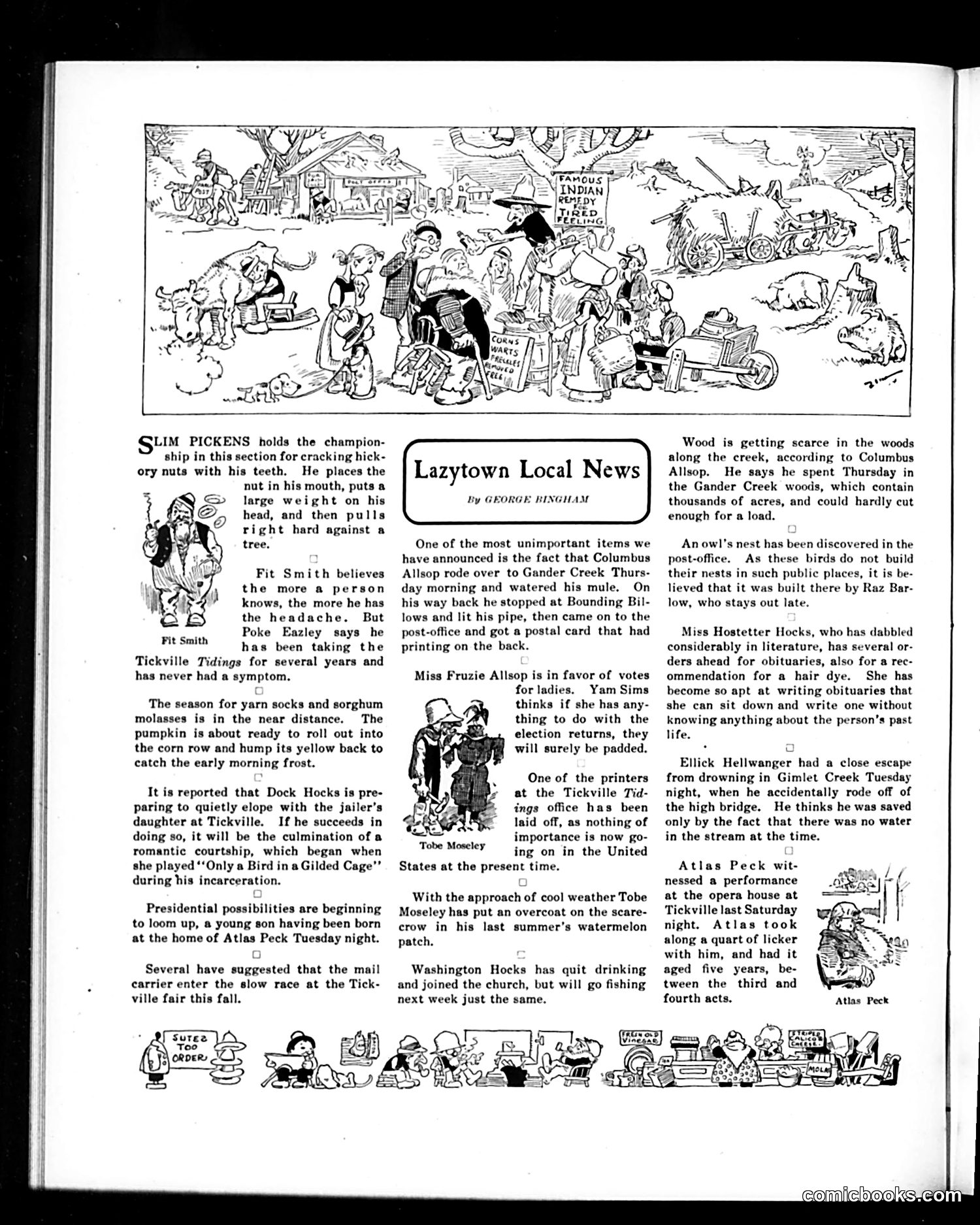
This page parodies rural American life through fictional "news" from a backwoods town. The humor targets small-town absurdities and provincial attitudes. **Main figures and jokes:** - **Slim Pickens**: Cracks hickory nuts with his teeth using a weight—mocking rural toughness stereotypes - **Dock Hocks**: Romantic elopement plotline poking fun at sentimental melodrama and jail courtships - **Columbus Allsop**: His mundane errand (watering a mule, getting a postcard) is treated as "important news"—satirizing how little happens in small towns - **Miss Fruzie Allsop & women's suffrage**: Mocking women's voting rights by having a character assume women would "pad" election returns - **Atlas Peck's newborn as "presidential possibility"**: Absurdly suggesting any birth matters politically **The satire's point**: Urban readers are invited to laugh at rural Americans as simple-minded, superstitious, and intellectually limited. The exaggerated triviality masquerading as news ridicules both small-town life and the self-importance of local papers.
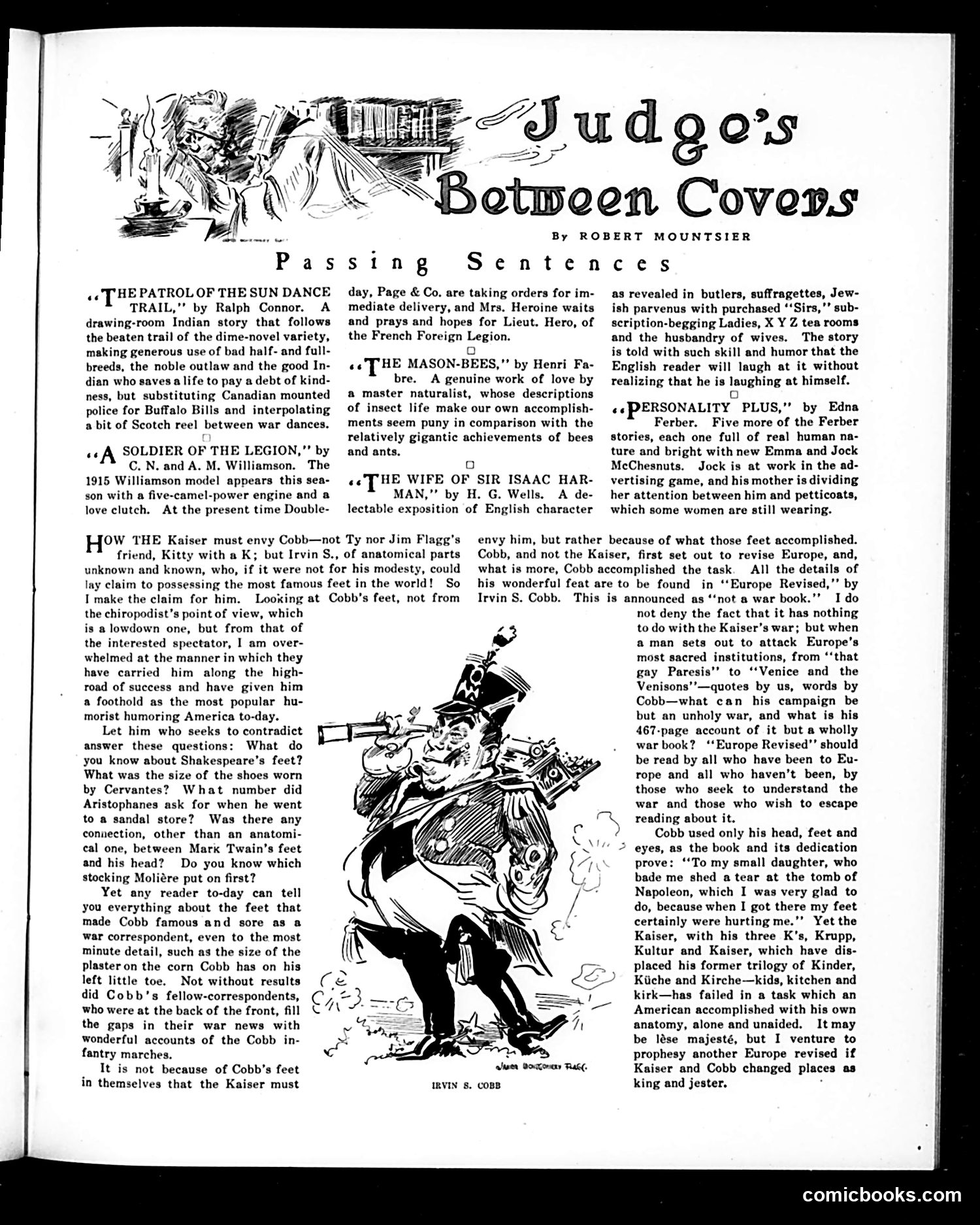
This page reviews new books while celebrating American humorist Irvin S. Cobb. The main article humorously argues that the Kaiser should envy Cobb—not for his feet themselves, but for what they accomplished as a war correspondent. The satire compares Cobb favorably to Shakespeare, Cervantes, and Mark Twain, claiming Cobb's feet are now historically documented in ways those literary giants' never were. The piece credits Cobb with revising Europe through his reporting from the front lines during World War I, treating his journalistic feet-work as superior to the Kaiser's military efforts. The accompanying caricature shows a grotesque figure (likely the Kaiser) examining or being confronted by the celebrated Cobb. The joke relies on American readers' familiarity with Cobb's celebrity status as a witty war correspondent whose dispatches and physical presence made him famous during WWI.
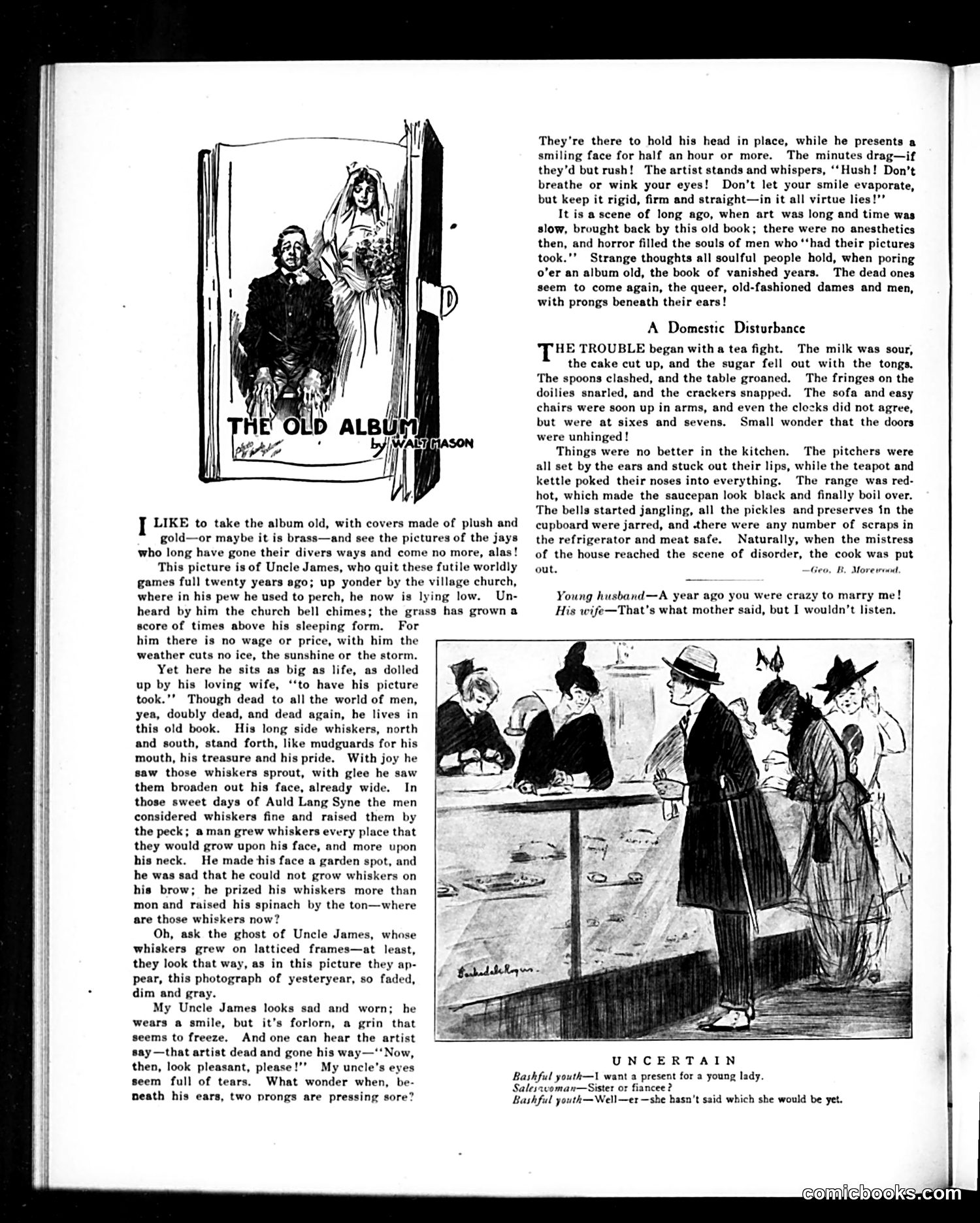
This page contains two satirical pieces mocking 19th-century life and customs. **"The Old Album"** nostalgically ridicules old photograph-taking. It describes Uncle James, now deceased, posed stiffly for a portrait decades earlier. The satire targets the agonizing process of early photography: subjects had to remain completely still and expressionless for extended periods while the artist barked instructions like "Don't breathe or wink your eyes!" The piece humorously anthropomorphizes the fashions of "Auld Lang Syne"—particularly the elaborate side-whiskers men cultivated as status symbols, which are now gone. The faded, forced smile in the photograph becomes a memento mori. **"A Domestic Disturbance"** uses absurdist humor to describe a household argument, with inanimate objects personified as combatants: "pitchers were all set by the ears," the teapot and kettle "poked their noses into everything," and household items wage war. A brief comic dialogue jokes that a wife married despite her mother's warnings—reversing typical marital anxiety narratives. Both pieces reflect Judge magazine's satirical commentary on social customs and domestic life.
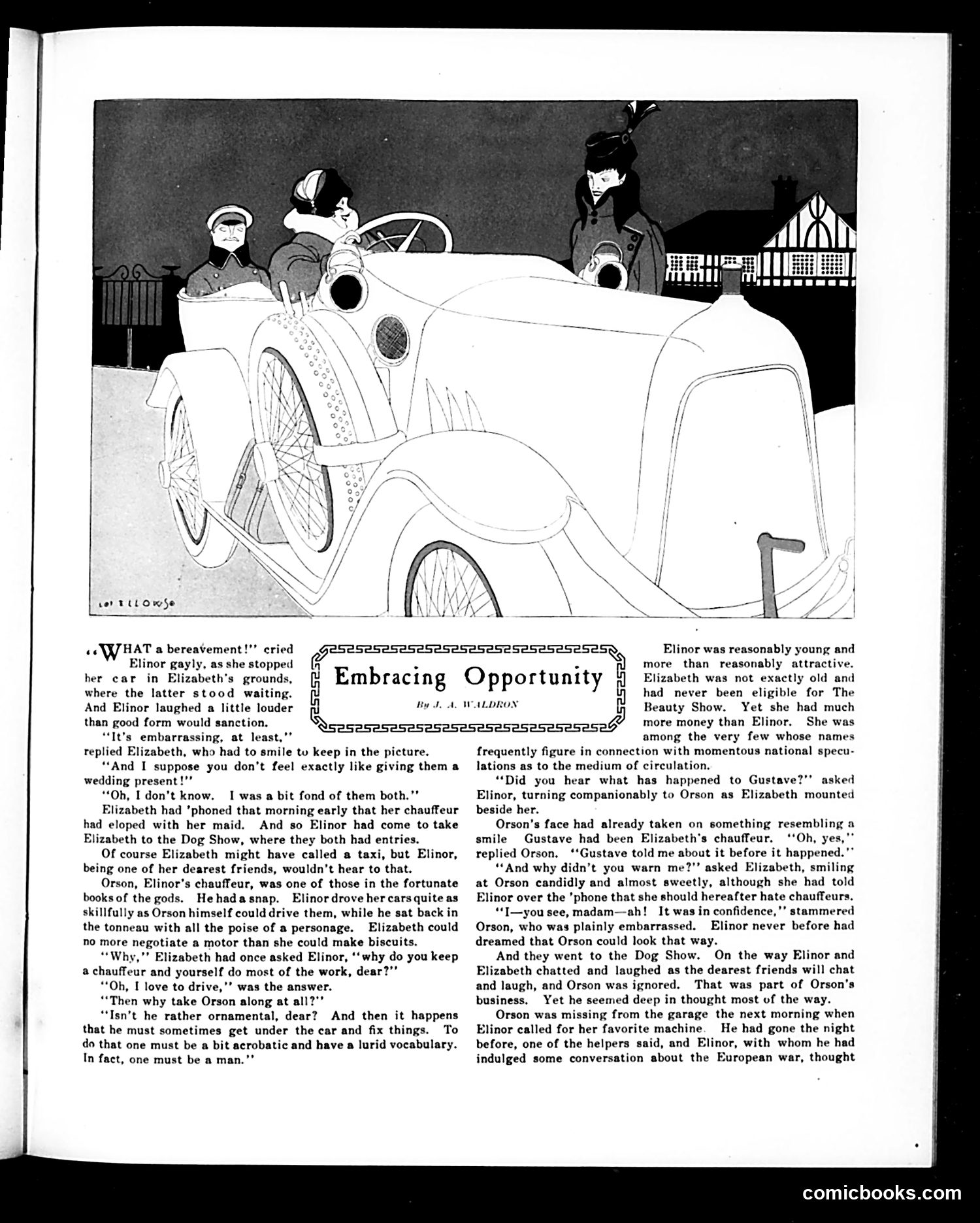
This is a satirical short story, not a political cartoon. It concerns social class and gender dynamics in the early 20th century. **The Setup:** Elinor, wealthy and independent, drives her own car (unusual for women then). Her chauffeur Orson is essentially decorative—she handles the driving while he sits in back as a status symbol. Elizabeth, richer but less capable, relies entirely on her chauffeur Gustave. **The Satire:** The story mocks how women of means navigate social limitations. Elinor keeps Orson partly for appearance and partly because "one must be a man" to fix cars and use profanity—a dig at gender restrictions of the era. When Gustave (Elizabeth's chauffeur) elopes, the story explores class, loyalty, and propriety. **The Point:** By story's end, Orson mysteriously vanishes after learning about the European war, suggesting even servants have ambitions beyond servitude—a subtle commentary on social mobility and changing times.
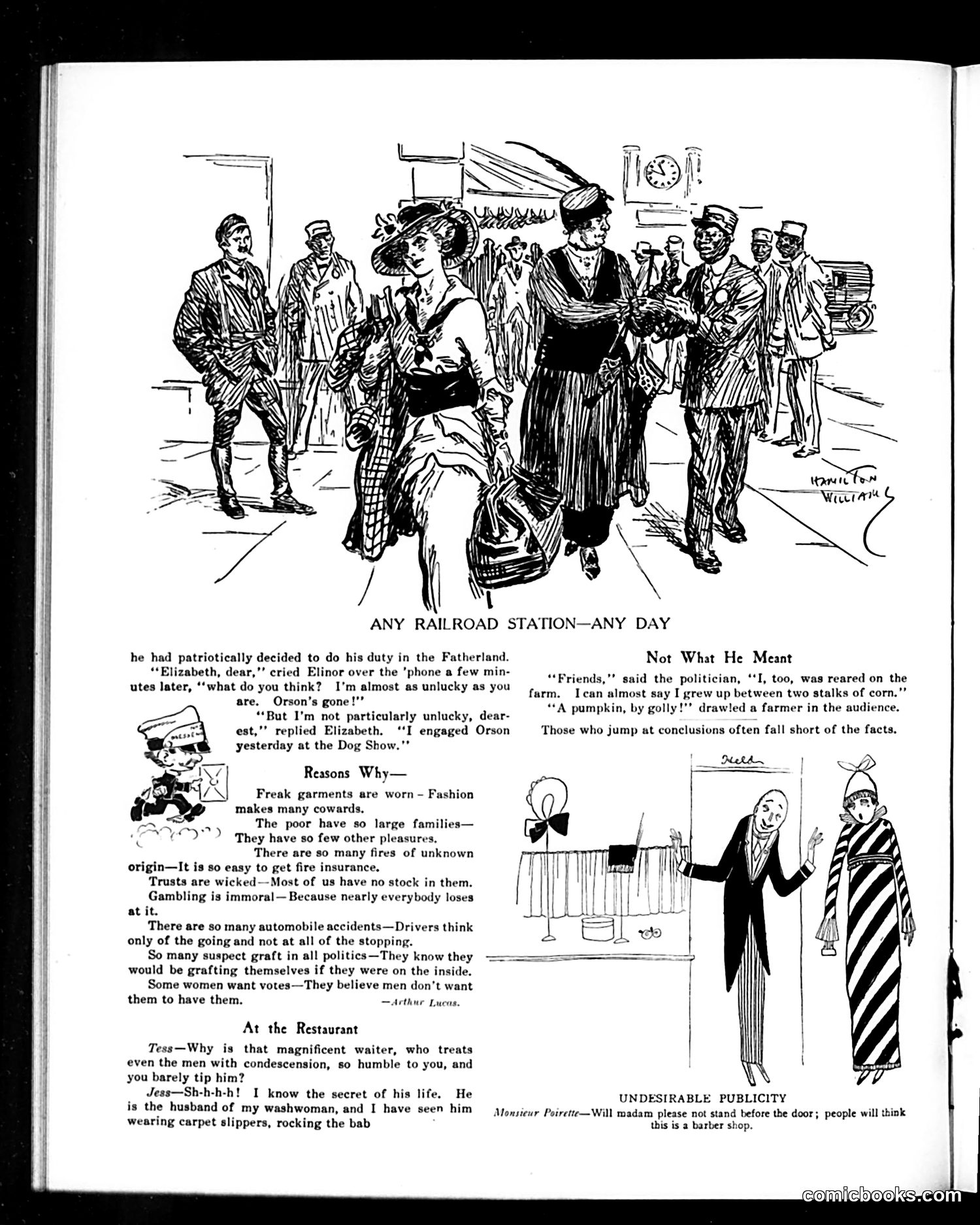
**Main Cartoon ("Any Railroad Station—Any Day"):** Shows a woman (Elinor) at a train station, apparently saying goodbye to a man (Orson) departing for military service in "the Fatherland" (Germany). The joke hinges on Elizabeth's reply: she engaged Orson yesterday at a dog show—meaning he was hired as a dog handler or similar worker, not a romantic partner. The satire mocks the assumption that all departures are patriotic military service when mundane employment changes are equally likely. **"Reasons Why" Section:** A list of social ironies explaining common behaviors—fashion drives frivolous spending, poverty causes large families, insurance fraud is rampant, gambling losses are inevitable, etc. This cynical commentary on human nature and societal hypocrisy is typical of Judge's satirical voice. **Restaurant and Political Jokes:** Brief humorous anecdotes about social pretension and misunderstanding—a waiter's deference explained by class anxiety, a politician's farm-boy rhetoric humorously misinterpreted by a literal-minded farmer. The page exemplifies Judge's blend of social satire and wordplay.
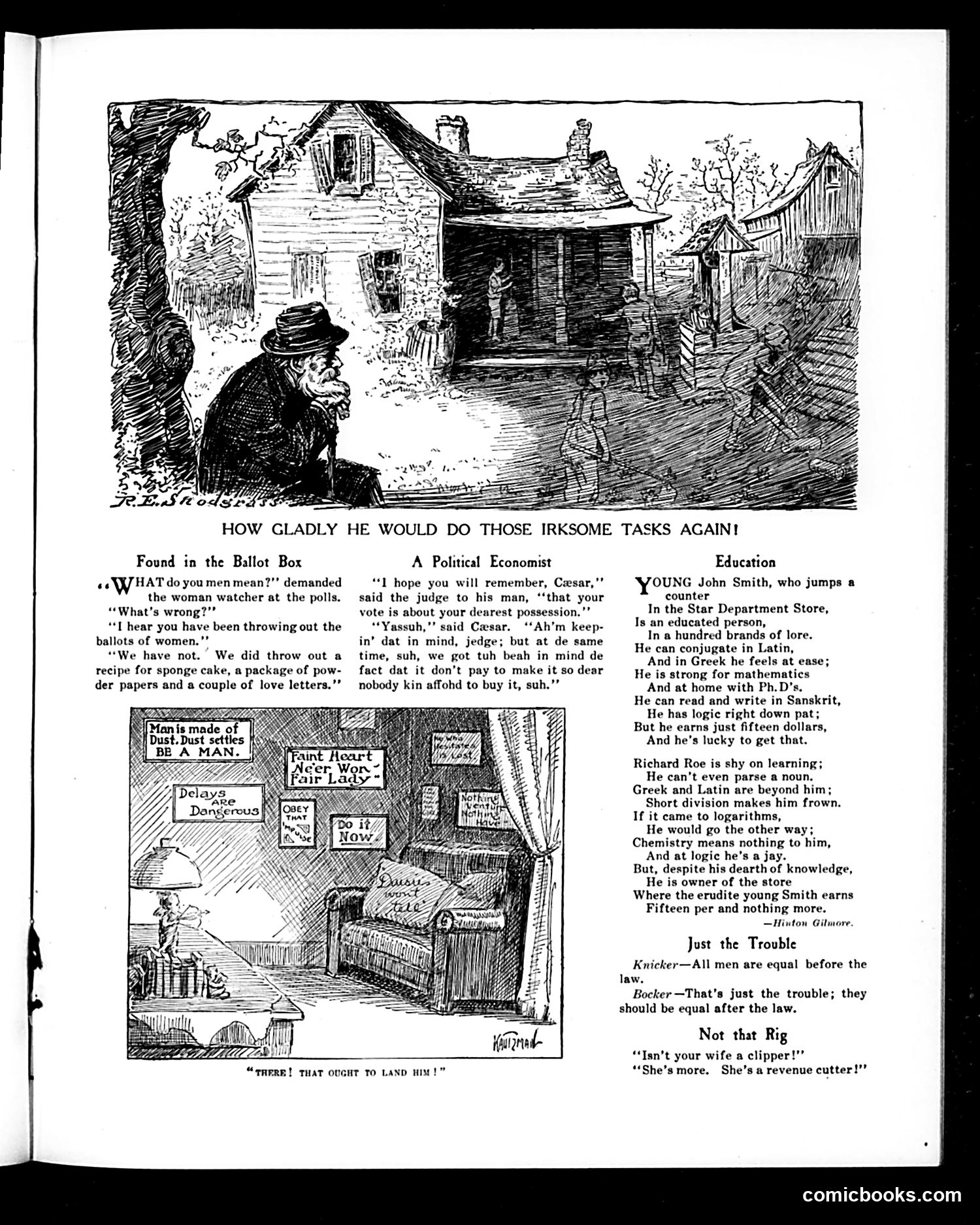
This page contains three distinct pieces of social commentary: **"Found in the Ballot Box"** mocks women's voting eligibility by having a poll watcher claim ballots were rejected for containing recipes and love letters—implying women weren't serious voters. **"A Political Economist"** uses dialect humor featuring "Caesar" (likely a Black character, given the phonetic speech pattern) to critique wage stagnation. Despite understanding economics, he earns so little his vote becomes worthless—satirizing how poverty undermines democratic participation. **"Education"** contrasts John Smith, formally educated but earning fifteen dollars (implying low wages), with Richard Roe, ignorant but wealthy as a store owner. The satire attacks the disconnect between education and economic success in American society. The remaining items—"Just the Trouble" (legal equality joke) and "Not that Rig" (wife spending money)—are brief quips on equality and domestic economics.
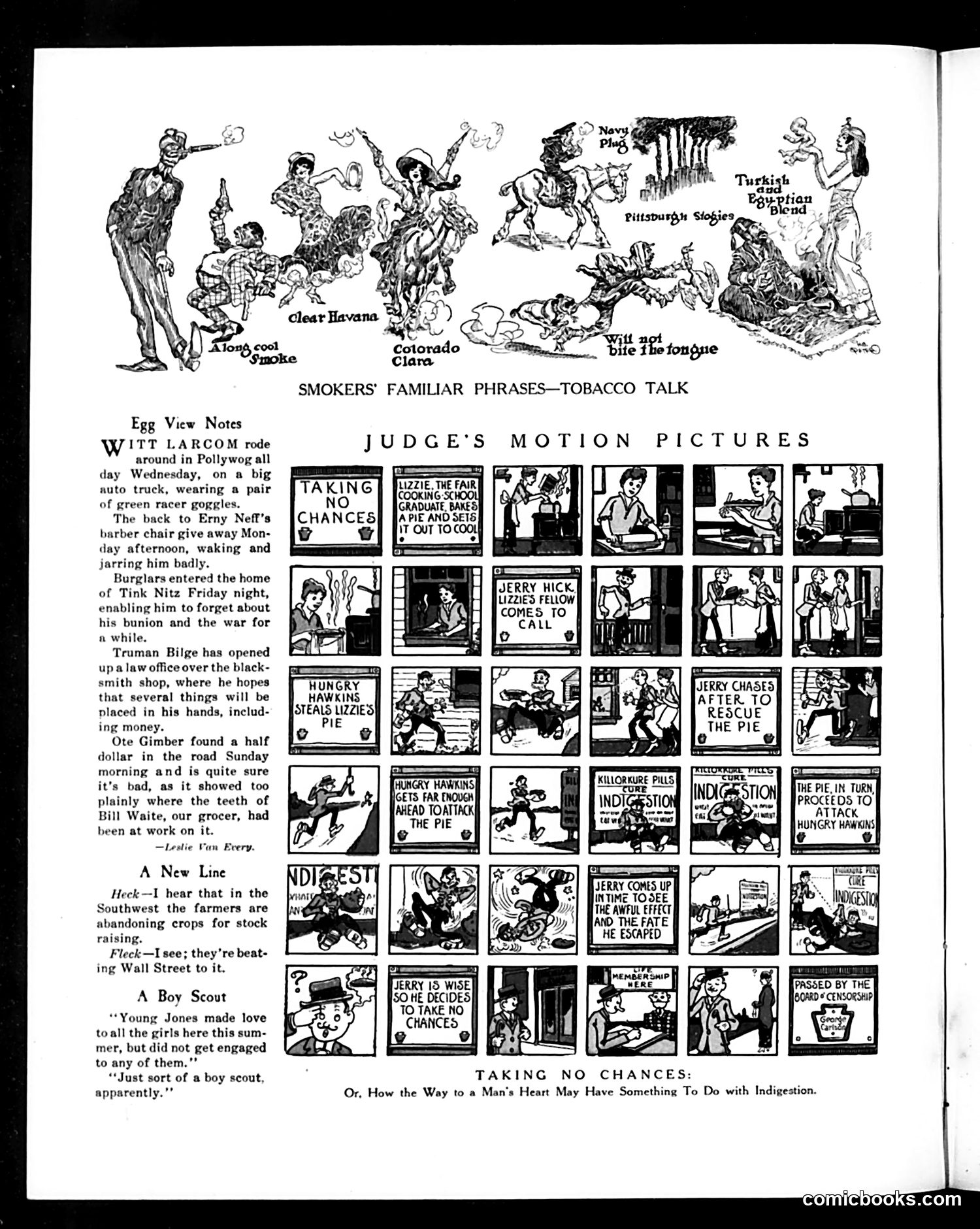
This page combines local humor with period advertising and a comic strip series. The top section features "Egg View Notes"—humorous small-town gossip from what appears to be a rural community, poking fun at local characters through absurdist situations (a man wearing goggles on a truck, a lawyer opening shop over a blacksmith, a grocer's teeth marks on a found coin). These are gentle, small-town satires typical of Judge's "Americana" humor. The main feature is "Judge's Motion Pictures: Taking No Chances"—a multi-panel comic strip depicting a domestic drama. The plot (evident from panel titles) follows Jerry Hick's girlfriend Lizzie and a rival named Hungry Hawkins competing for her affection through food, culminating in food-related indigestion humor. The subtitle's pun—"the way to a man's heart may have something to do with indigestion"—satirizes the cliché about cooking and romance while suggesting the messier reality of courtship and jealousy. The tobacco talk illustration at top appears unrelated advertising content.
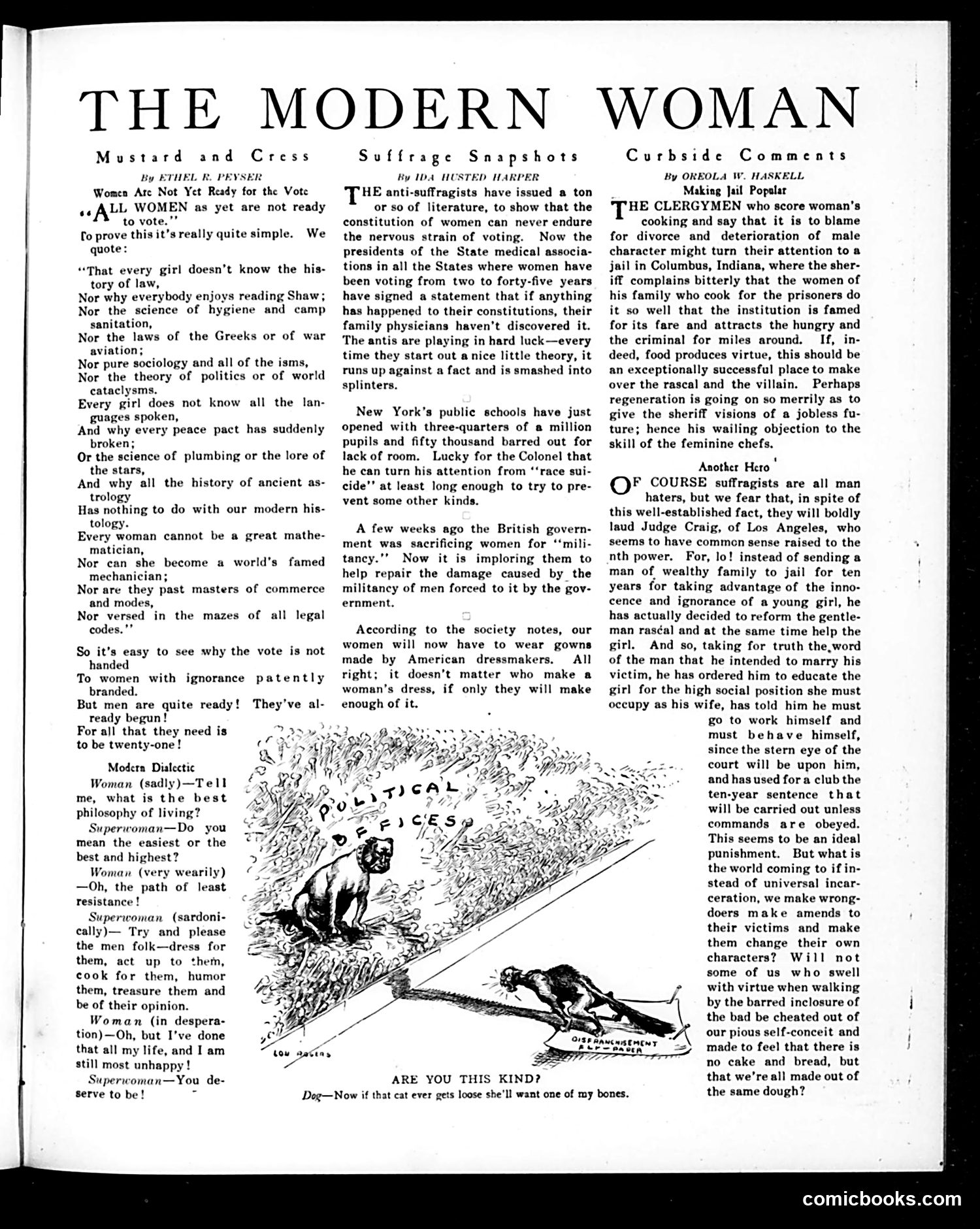
This Judge magazine page satirizes the women's suffrage debate circa 1910-1915. The central argument is ironic: Peyser's "Mustard and Cress" piece sarcastically lists exhaustive knowledge women supposedly lack (law, science, languages, mathematics) to argue they're "not ready to vote"—then undercuts this by noting men only need reach age twenty-one. The satire exposes the absurdity of such requirements applied selectively to women. The companion pieces support suffrage more directly. Harper's "Suffrage Snapshots" debunks anti-suffragist claims that voting harms women's health, citing male doctors in voting states as evidence. Haskell's "Curbside Comments" applauds women's competence (prison cooking reforming criminals), mocking clergy who blame women's cooking for divorce. The cartoon shows a dog protecting a bone from a cat, captioned "Are you this kind?"—likely suggesting women shouldn't be treated as territorial threats to male prerogatives. Overall, the page uses humor and logical contradiction to argue women deserve voting rights.
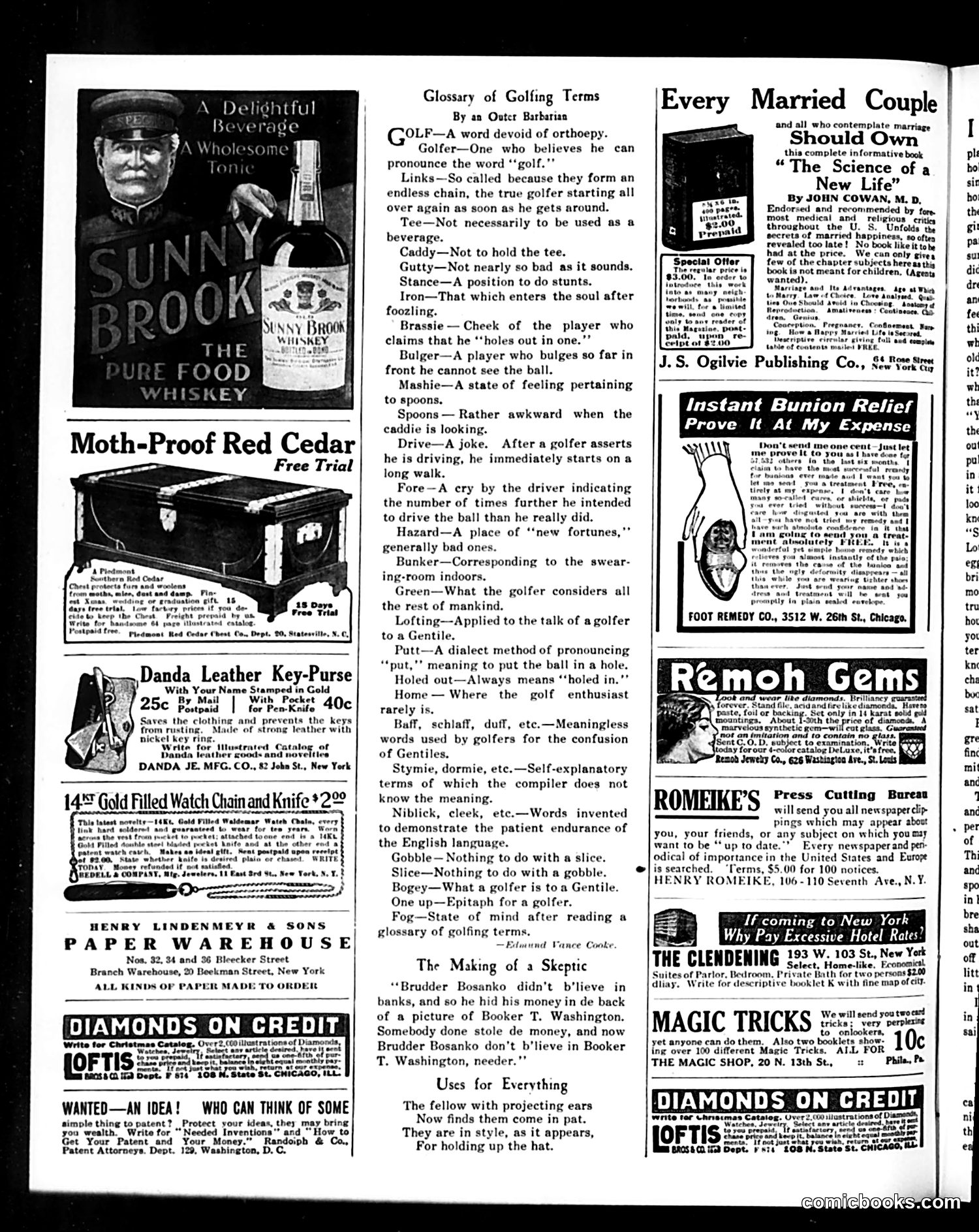
This is primarily an **advertising page** with a satirical "Glossary of Golfing Terms" as the main editorial content. ## The Golf Glossary The glossary mocks golf culture through wordplay and ethnic humor typical of the era. Key jokes include: - **"Golf"** as "a word devoid of orthoepy" (mispronounced constantly) - **"Links"** as an endless chain—golfers always start over - **"Drive"** as a joke—golfers claim to drive but take long walks instead - **"Fore"** as a cry indicating how many *extra* times the golfer will fail - References to **"Gentiles"** suggest Jewish authorship critiquing gentile golfers as pretentious The closing note attributes it to "an Outer Barbarian," implying the author views golf society as culturally crude. ## Other Content A brief anecdote about "Brudder Bosanko" uses dialect humor (common in the period) about hiding money in a Booker T. Washington portrait. The remainder consists of period advertisements for watches, leather goods, patent services, and marriage/health books—typical Judge magazine filler.
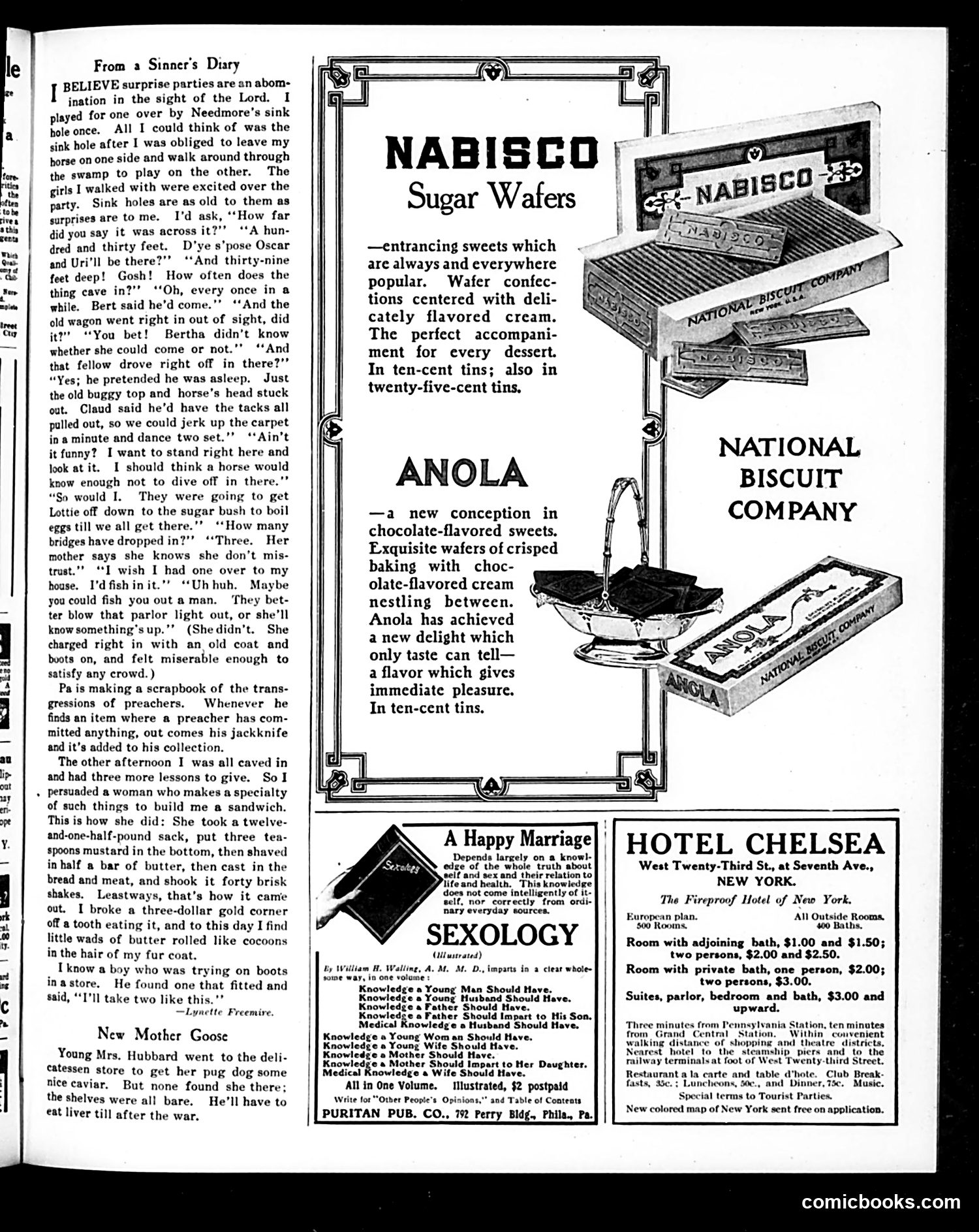
This page consists primarily of **advertisements and serialized fiction** rather than political cartoons. The main content is "From a Sinner's Diary" by Lynette Freemire—a humorous column recounting rural anecdotes. The narratives satirize small-town life through exaggerated dialect and absurd situations: people discussing sink holes with surprising casualness, a disastrous horse-drawn wagon accident, and a comedic description of an inedibly constructed sandwich. The advertisements showcase early 20th-century consumer products: **Nabisco Sugar Wafers** and **Anola** chocolate wafers (National Biscuit Company), a **Sexology** instructional book promising practical marital knowledge, and the **Hotel Chelsea** in New York. There are no political cartoons visible. The "satire" is gentle, domestic humor targeting rural customs and everyday mishaps rather than political figures or events. The page represents Judge magazine's mix of satirical commentary and commercial advertising typical of early American periodicals.
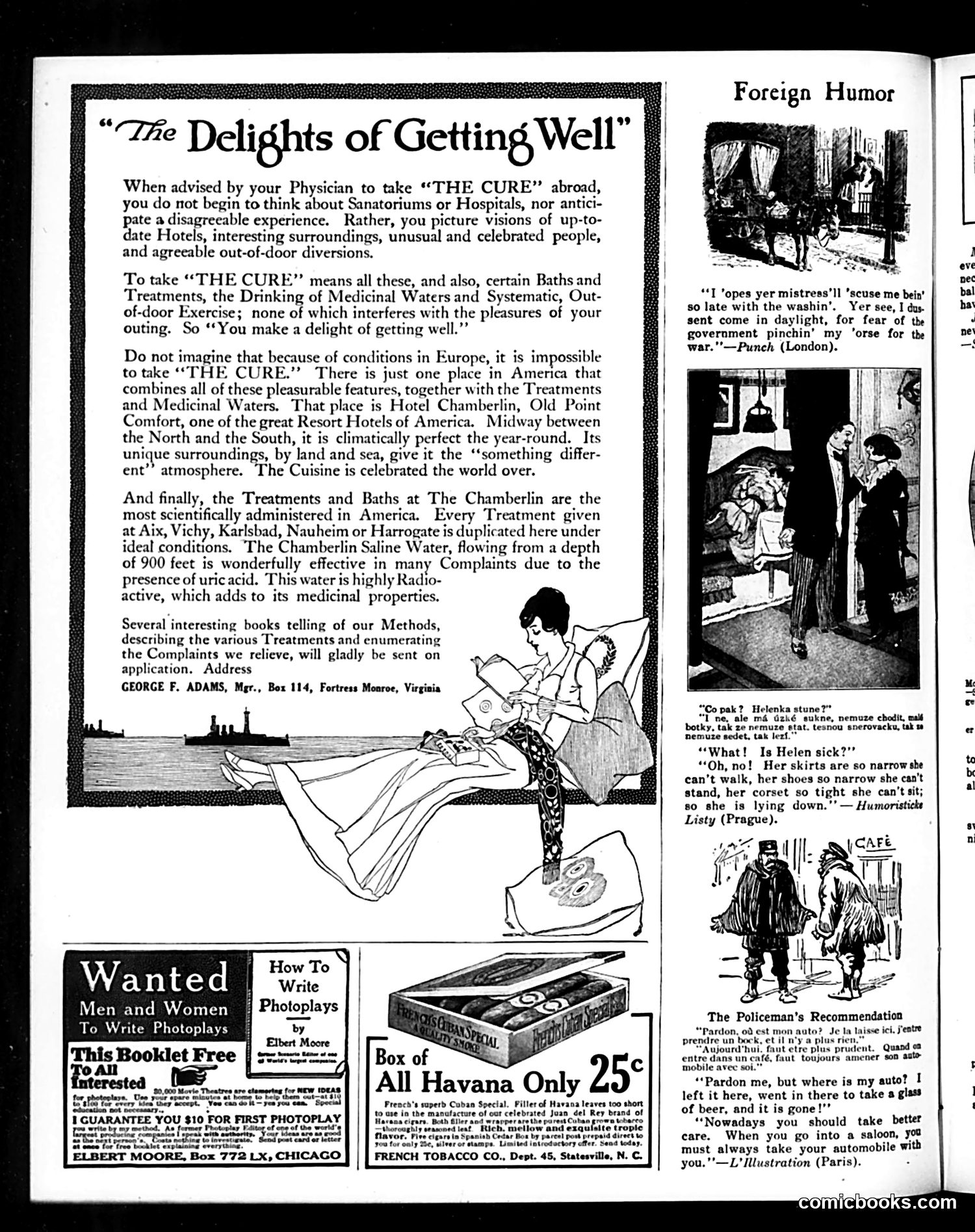
This page is primarily a **hotel advertisement** for the Hotel Chamberlin in Virginia, promoting it as an American alternative to European health spas. The ad argues that wealthy Americans needn't travel abroad to "take the cure"—a popular medical tourism practice involving mineral baths and treatments at famous European spas (Aix, Vichy, Karlsbad). The Chamberlin, located at Old Point Comfort between North and South, claims to replicate these treatments using radioactive saline water from 900 feet underground, while offering luxury hotel amenities. The **"Foreign Humor"** section features three satirical jokes mocking European life: a British servant afraid to deliver laundry during wartime for fear of military conscription; a Czech woman so constrained by fashionable tight clothing she cannot walk, stand, or sit; and a Parisian policeman recommending one bring one's automobile into a café for safekeeping. These jokes mock European social rigidity, fashion extremes, and urban theft. The page also includes ads for photoplay writing courses and cigars.
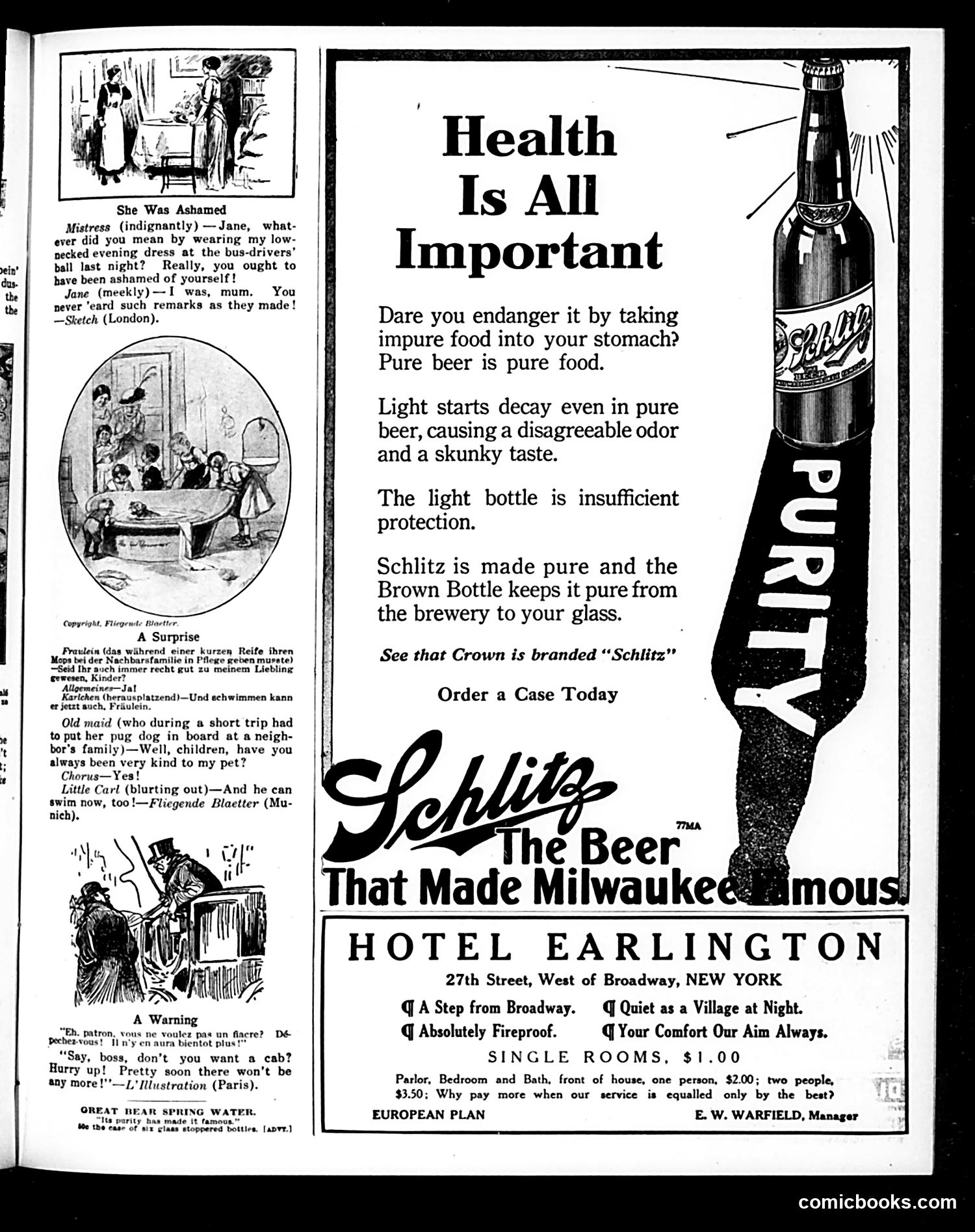
This Judge magazine page contains three brief comic anecdotes (reprinted from European sources) depicting working-class and servant characters in embarrassing situations, typical of early 20th-century humor emphasizing class distinctions and social propriety. The primary advertiser is **Schlitz Beer**, which uses a health-focused pitch—claiming "pure beer is pure food" and emphasizing that their brown bottles protect beer from light decay that causes "skunky taste." This reflects both pre-Prohibition era beer marketing and early advertising's adoption of pseudo-scientific health claims. A secondary advertisement promotes the **Hotel Earlington** in New York, advertising budget lodging ($1 single rooms). The cartoons themselves mock lower-class figures (servants, drivers, working-class foreigners) through dialect and naiveté—humor that relies on contemporary class assumptions largely invisible to modern readers. The overall page blends satirical content with commercial advertising, typical of Judge's format.
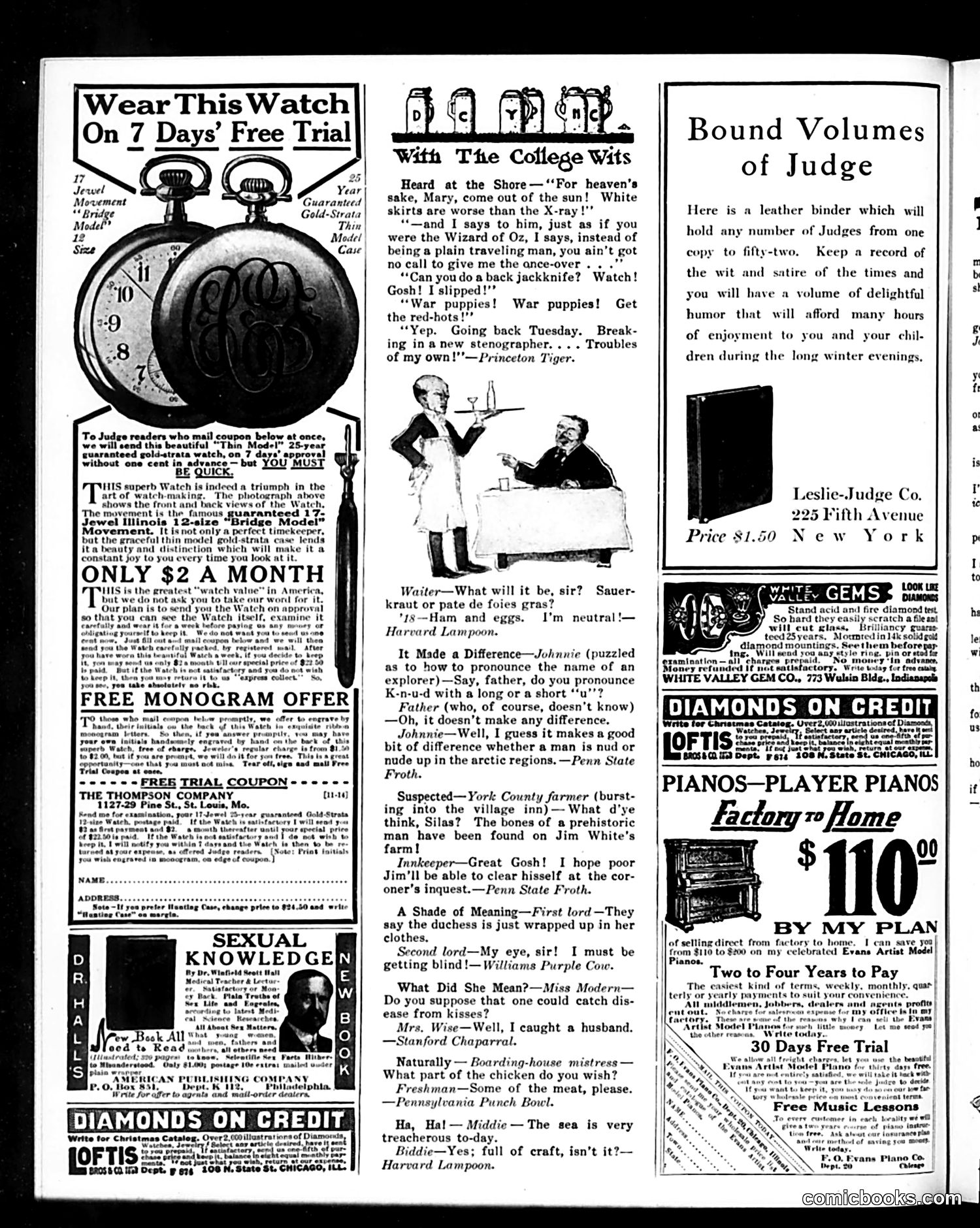
This page is primarily **advertising** with some scattered humor pieces typical of Judge magazine's collegiate comedy section. The "With The College Wits" section contains brief jokes from university publications (Princeton Tiger, Harvard Lampoon, Penn State Froth), mostly puns and light observations about campus life and romance—reflecting 1910s-era college humor. The page's central focus is **commercial advertising**: a pocket watch ($2/month installment), diamond rings, a player piano ($110), and a sexual knowledge book. These ads reveal the magazine's intended audience—young, middle-class readers with disposable income. The jokes themselves are innocuous social satire: a pun about a naval officer ("Middie") not understanding maritime wordplay; a farmer suspected of discovering prehistoric bones; a woman catching a "husband" rather than a disease from kisses. No specific political figures or events are referenced. The humor is generic period comedy, not partisan satire, suggesting this particular page emphasizes commercial revenue over editorial commentary.
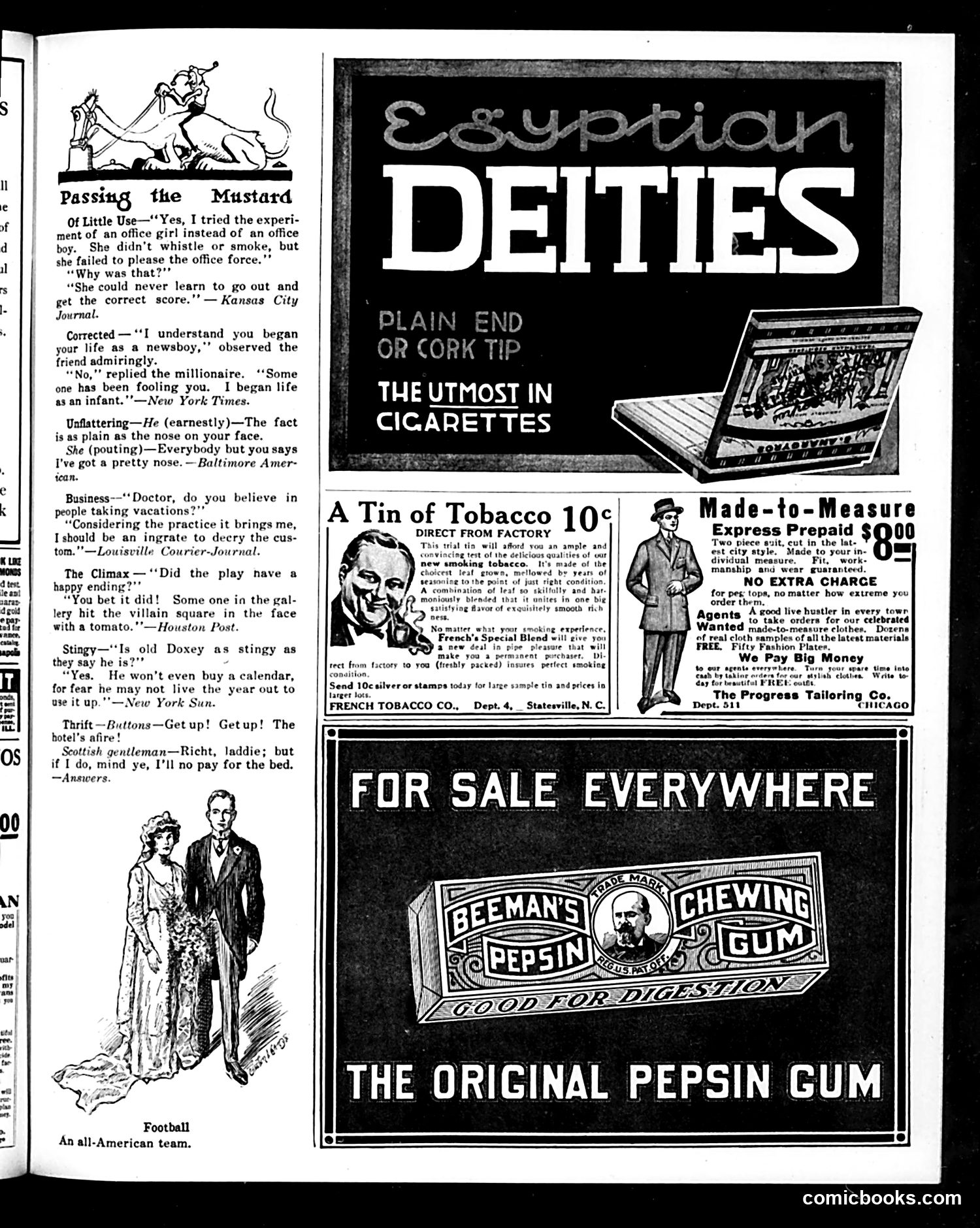
This page mixes humor with period advertising. The left column contains brief jokes typical of Judge's satirical humor—mostly playing on wordplay and social observations. For example, "Passing the Mustard" jokes about hiring an office girl who fails because she can't correctly report sports scores, reflecting early-20th-century assumptions about women's workplace capabilities. Another quip mocks Scottish frugality ("I'll no pay for the bed" during a fire). The advertisements dominate the page, reflecting the magazine's business model. They hawk products now obsolete or notorious: Egyptian Deities cigarettes, French Tobacco Company samples, Beeman's Pepsin Chewing Gum (marketed for digestion), and made-to-measure suits. The Pepsin gum ad is particularly notable—it advertises chewing gum as medicinal aid, reflecting pre-FDA regulatory practices when such health claims were unvetted. The illustrations are generic period graphics: a couple in formal dress, a businessman in a suit. No specific political figures or events are referenced on this page.
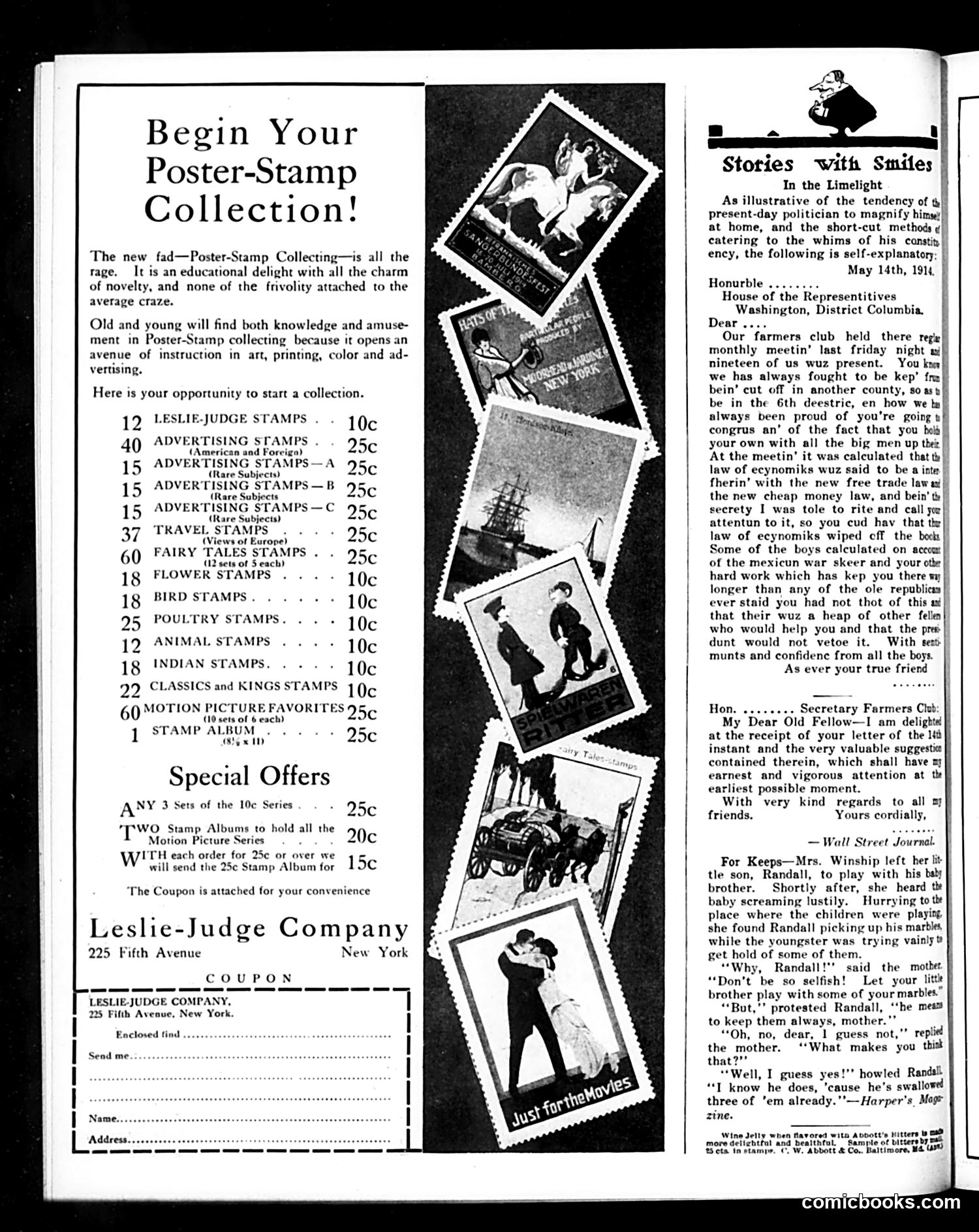
This page is primarily **advertising** for Leslie-Judge Company's poster-stamp collecting hobby, with two separate satirical humor pieces in the right column. The poster-stamp ads showcase collectible miniature stamps featuring Leslie-Judge imagery, advertising, travel scenes, fairy tales, animals, and "Motion Picture Favorites"—a popular early 1900s collecting fad marketed as educational and artistic. The humor section, "Stories with Smiles," contains two jokes satirizing American life: 1. **"In the Limelight"** (May 14, 1914): A farmer's club secretary writes their congressman in deliberately misspelled dialect, asking him to remove economic laws interfering with cheap money and free trade. The congressman's pompous reply thanks them for their "valuable suggestion" while committing to nothing—satirizing politicians' tendency to flatter constituents while ignoring their actual concerns. 2. **"For Keeps"**: A brief joke about a toddler swallowing his older brother's marbles, used as an excuse to keep them permanently—poking fun at childhood logic and sibling disputes.
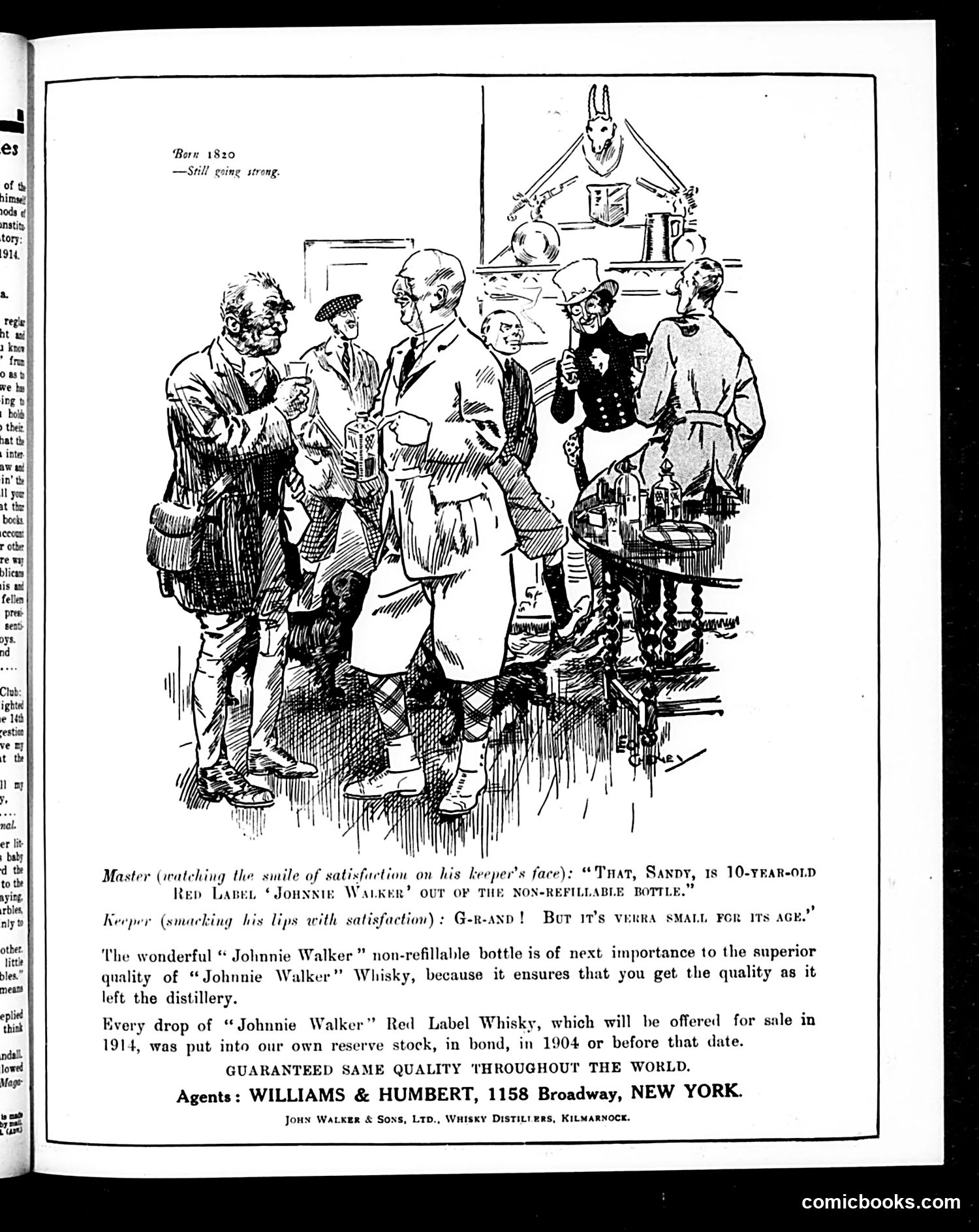
This is a **Johnnie Walker whisky advertisement** disguised as satirical content in Judge magazine (circa 1914). The cartoon depicts a master and keeper examining a bottle of Johnnie Walker Red Label, with the caption playing on a dark joke: a 10-year-old bottle is "small for its age"—implying the whisky is mature/aged despite appearing young. The devil-like figure presiding above reinforces the humorous tone. The advertisement emphasizes two selling points: the **non-refillable bottle** (preventing counterfeiting/dilution) and **guaranteed age** (stock from 1904 or earlier, bottled in 1914). The phrase "Born 1820—Still going strong" references the brand's founding date. For modern readers: this represents early 20th-century advertising strategy using satirical humor in a respected magazine to promote premium spirits, while the "non-refillable bottle" innovation addresses contemporary concerns about product authenticity and quality control in an era before standardized regulations.
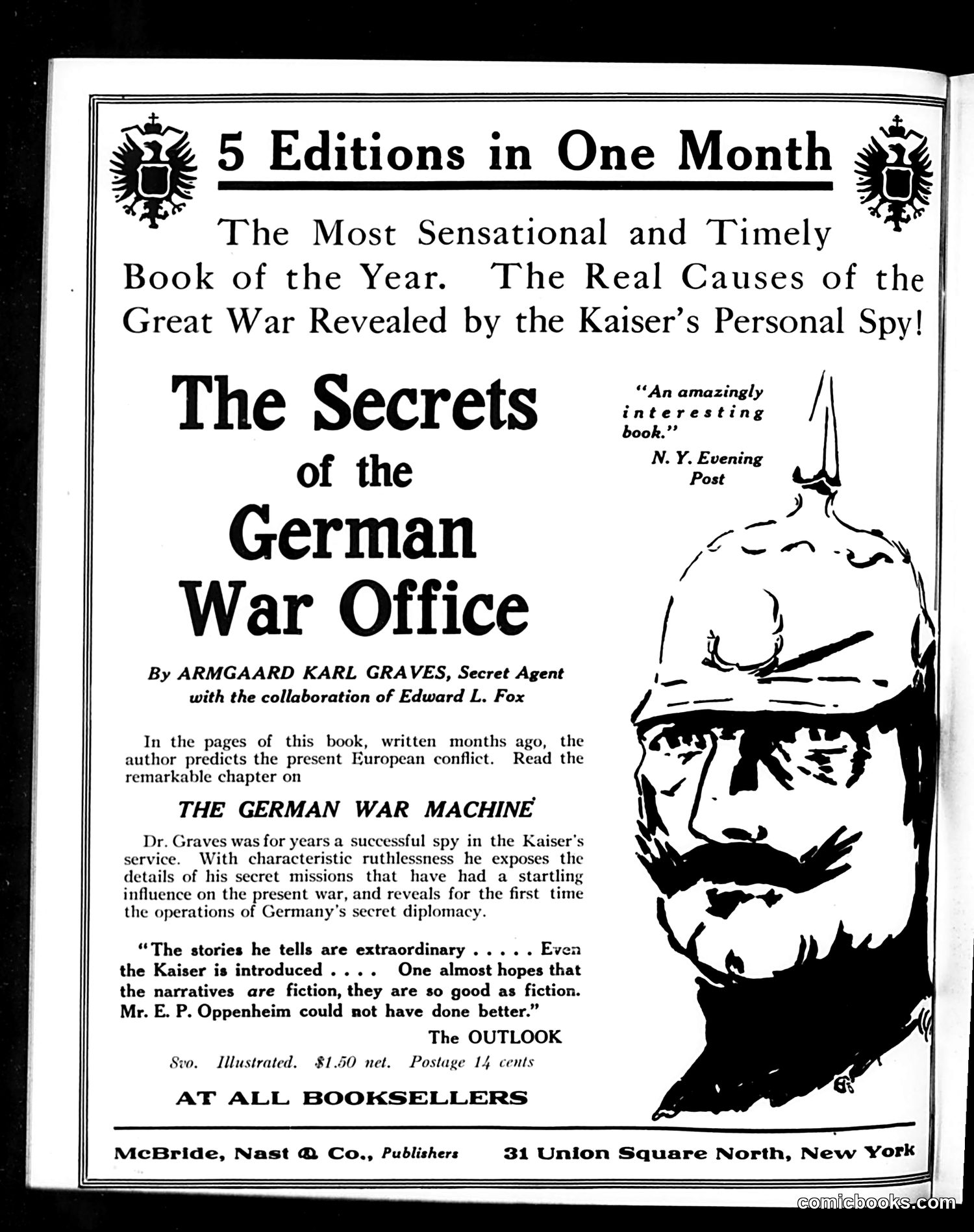
This is primarily a **book advertisement**, not a political cartoon. It promotes *The Secrets of the German War Office* by Armgaard Karl Graves, allegedly a former German spy, published during World War I. The **illustration** is a stark portrait of a German military officer wearing a spiked Prussian helmet (*Pickelhaube*), rendered in bold black-and-white with exaggerated features—likely caricaturing German militarism rather than depicting a specific historical figure. The marketing appeal exploits **wartime anxiety**: the book claims to reveal "real causes" of the Great War and Germany's "secret diplomacy," positioning the author as an insider exposé. The quoted endorsement from *The Outlook* magazine ironically notes the narratives read "so good as fiction," raising questions about the book's authenticity. This reflects American **pro-Allied propaganda and sensationalism** common during WWI, capitalizing on anti-German sentiment through claims of exposing German imperial secrets.