
Judge, 1914-11-14 · page 9 of 24
Judge — November 14, 1914 — page 9: what you’re looking at
What you’re looking at
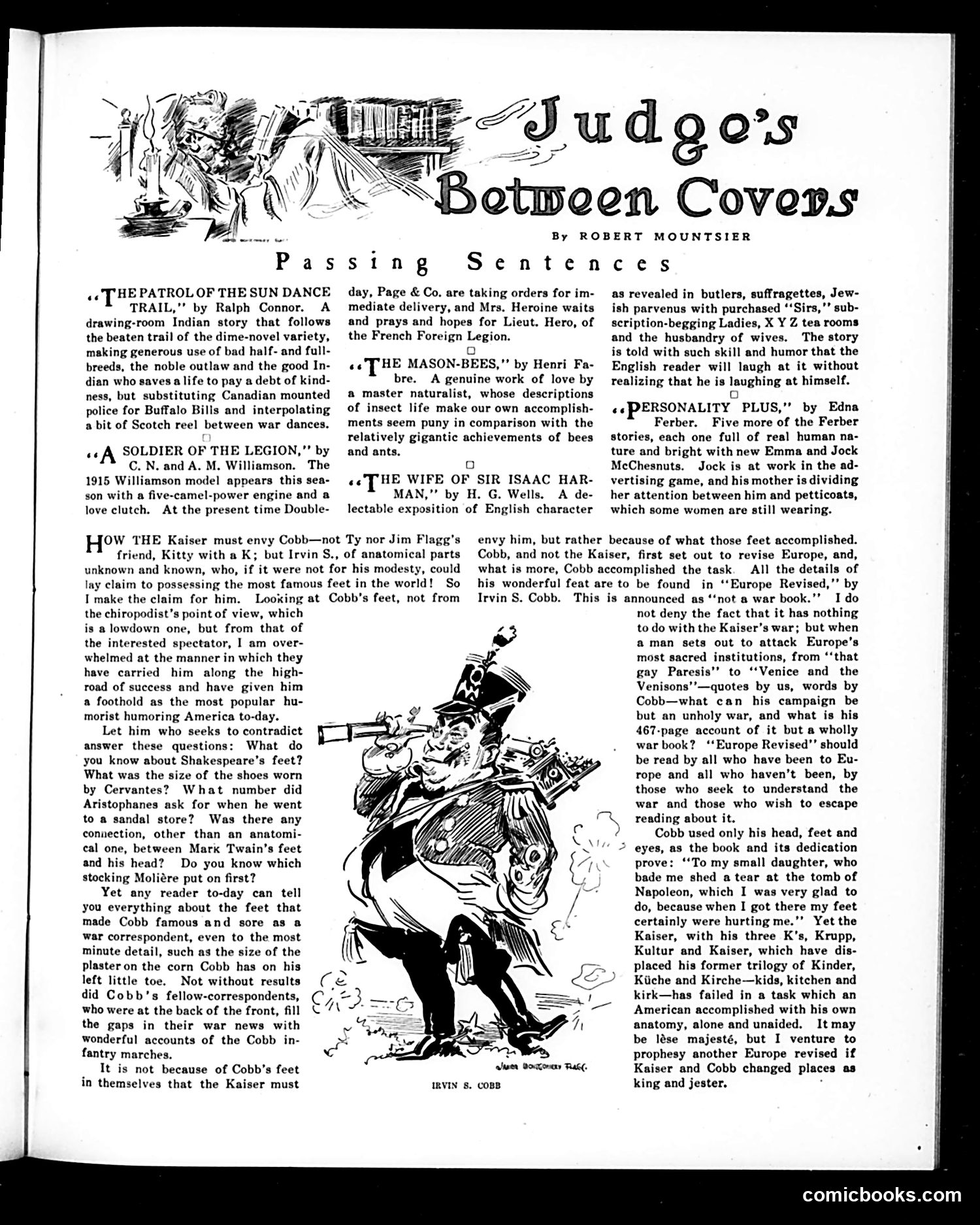
This page reviews new books while celebrating American humorist Irvin S. Cobb. The main article humorously argues that the Kaiser should envy Cobb—not for his feet themselves, but for what they accomplished as a war correspondent. The satire compares Cobb favorably to Shakespeare, Cervantes, and Mark Twain, claiming Cobb's feet are now historically documented in ways those literary giants' never were. The piece credits Cobb with revising Europe through his reporting from the front lines during World War I, treating his journalistic feet-work as superior to the Kaiser's military efforts. The accompanying caricature shows a grotesque figure (likely the Kaiser) examining or being confronted by the celebrated Cobb. The joke relies on American readers' familiarity with Cobb's celebrity status as a witty war correspondent whose dispatches and physical presence made him famous during WWI.
📄 Transcribed text from this page (OCR, searchable)
Machine-transcribed from the original scan — historical spelling and the odd misread are preserved.
Passing «ce THE PATROL OF THE SUN DANCE TRAIL,’’ by Ralph Connor. A drawing-room Indian story that follows the beaten trail of the dime-novel variety, making generous use of bad half- and full- breeds, the noble outlaw and the good In- dian who saves a life to pay a debt of kind- ness, but substituting Canadian mounted police for Buffalo Bills and interpolating a bit of Scotch reel between war dances. A SOLDIER OF THE LEGION,” by C. N. and A. M. Williamson. The 1915 Williamson model appears this sea- son with a five-camel-power engine and a love clutch. At the present time Double- OW THE Kaiser must envy Cobb—not Ty nor Jim Flagg's friend, Kitty with a K; but Irvin S., of anatomical parts unknown and known, who, if it were not for his modesty, could ea 2 Q*s <Between Covers By ROBERT MOUNTSIER day, Page & Co, are taking orders for im- mediate delivery, and Mrs. Heroine waits and prays and hopes for Lieut. Hero, of the French Foreign Legion. Qo ee THE MASON-BEES,"’ by Henri Fa- bre. A genuine work of love by a master naturalist, whose descriptions of insect life make our own accomplish- ments seem puny in comparison with the relatively gigantic achievements of bees and ants. o ee THE WIFE OF SIR ISAAC HAR- MAN,” by H. G. Wells. A de- lectable exposition of English character Sentences as revealed in butlers, suffragettes, Jew- ish parvenus with purchased ‘‘Sirs,’’ sub- scription-begging Ladies, X Y Z tea rooms and the husbandry of wives. The story is told with such skill and humor that the English reader will laugh at it without realizing that he is laughing at himself. oO ‘ «PERSONALITY PLUS,” by Edna Ferber. Five more of the Ferber stories, each one full of real human na- ture and bright with new Emma and Jock McChesnuts. Jock is at work in the ad- vertising game, and his mother is dividing her attention between him and petticoats, which some women are still wearing. envy him, but rather because of what those feet accomplished. Cobb, and not the Kaiser, first set out to revise Europe, and, what is more, Cobb accomplished the task. All the details of lay claim to possessing the most famous feet in the world! So his wonderful feat are to be found in ‘‘Europe Revised,” by I make the claim for him. Looxing at Cobb's feet, not from the chiropodist’s point of view, which is a lowdown one, but from that of the interested spectator, | am over- whelmed at the manner in which they have carried him along the high- road of success and have given him a foothold as the most popular hu- morist humoring America to-day. Let him who seeks to contradict answer these questions: What do you know about Shakespeare's feet? What was the size of the shoes worn by Cervantes? What number did Aristophanes ask for when he went to a sandal store? Was there any connection, other than an anatomi- cal one, between Mark Twain's feet and his head? Do you know which stocking Moliére put on first? Yet any reader to-day can tell you everything about the feet that made Cobb famous and sore as a war correspondent, even to the most minute detail, such as the size of the plaster on the corn Cobb has on his left little toe. Not without results did Cobb’s fellow-correspondents, who were at the back of the front, fill the gaps in their war news with wonderful accounts of the Cobb in- fantry marches. It is not because of Cobb’s feet in themselves that the Kaiser must IRVIN 8. COBB Irvin S. Cobb. This is announced as ‘‘not a war book.’’ I do not deny the fact that it has nothing to do with the Kaiser’s war; but when aman sets out to attack Europe's most sacred institutions, from ‘‘that gay Paresis’’ to ‘‘Venice and the Venisons’’—quotes by us, words by Cobb—what can his campaign be but an unholy war, and what is his 467-page account of it but a wholly war book? ‘‘Europe Revised’’ should be read by all who have been to Eu- rope and all who haven’t been, by those who seek to understand the war and those who wish to escape reading about it. Cobb used only his head, feet and > eyes, as the book and its dedication prove: ‘‘To my small daughter, who bade me shed a tear at the tomb of Napoleon, which I was very glad to do, because when I got there my feet certainly were hurting me.’’ Yet the Kaiser, with his three K's, Krupp, Kultur and Kaiser, which have dis- placed his former trilogy of Kinder, Kiiche and Kirche—kids, kitchen and kirk—has failed in a task which an American accomplished with his own anatomy, alone and unaided. It may be Iése majesté, but I venture to prophesy another Europe revised if Kaiser and Cobb changed places as king and jester. 7 comicbooks.com