
Judge, 1914-11-14 · page 10 of 24
Judge — November 14, 1914 — page 10: what you’re looking at
What you’re looking at
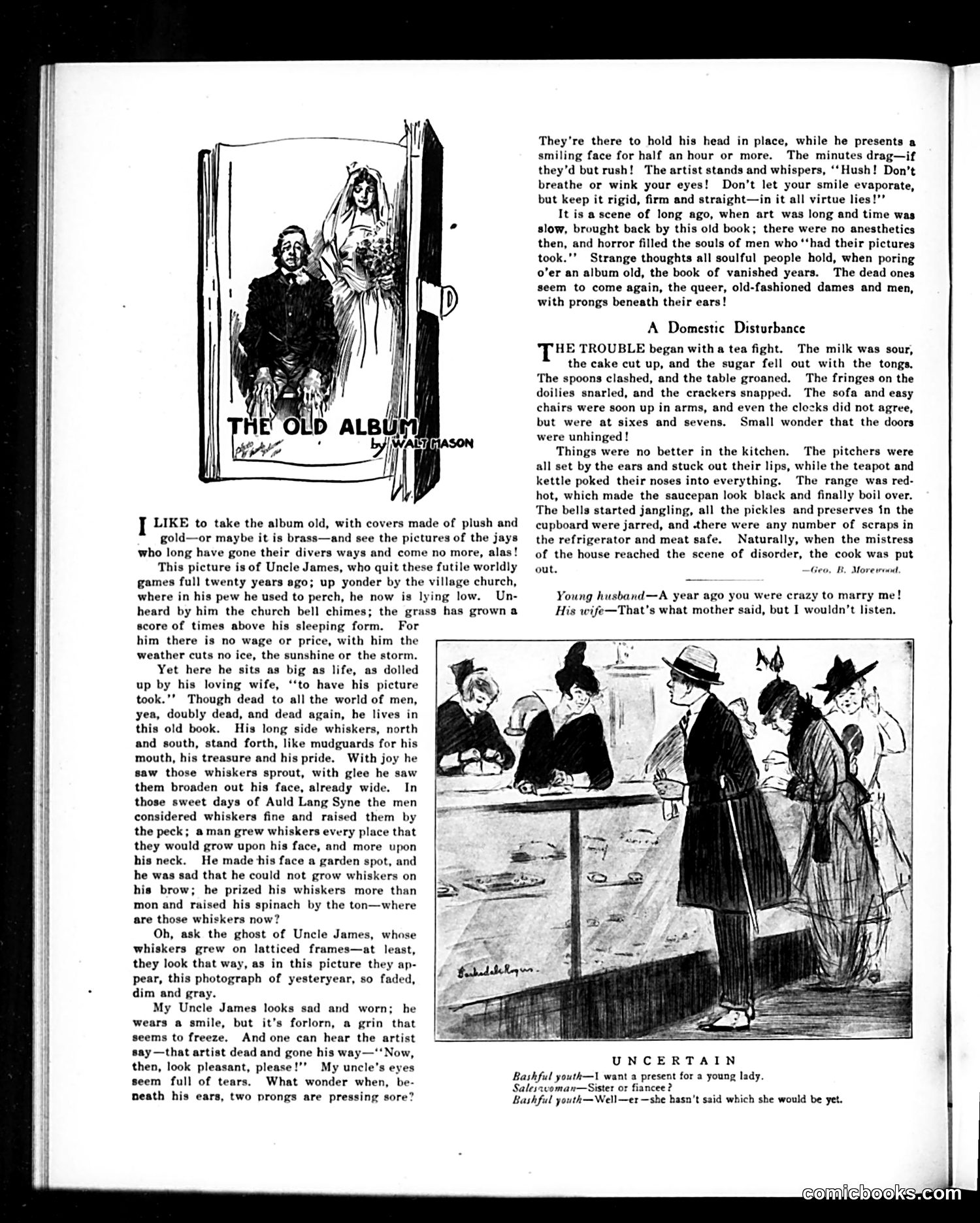
This page contains two satirical pieces mocking 19th-century life and customs. **"The Old Album"** nostalgically ridicules old photograph-taking. It describes Uncle James, now deceased, posed stiffly for a portrait decades earlier. The satire targets the agonizing process of early photography: subjects had to remain completely still and expressionless for extended periods while the artist barked instructions like "Don't breathe or wink your eyes!" The piece humorously anthropomorphizes the fashions of "Auld Lang Syne"—particularly the elaborate side-whiskers men cultivated as status symbols, which are now gone. The faded, forced smile in the photograph becomes a memento mori. **"A Domestic Disturbance"** uses absurdist humor to describe a household argument, with inanimate objects personified as combatants: "pitchers were all set by the ears," the teapot and kettle "poked their noses into everything," and household items wage war. A brief comic dialogue jokes that a wife married despite her mother's warnings—reversing typical marital anxiety narratives. Both pieces reflect Judge magazine's satirical commentary on social customs and domestic life.
📄 Transcribed text from this page (OCR, searchable)
Machine-transcribed from the original scan — historical spelling and the odd misread are preserved.
I LIKE to take the album old, with covers made of plush and gold—or maybe it is brass—and see the pictures of the jays who long have gone their divers ways and come no more, alas! This picture is of Uncle James, who quit these futile worldly games full twenty years ago; up yonder by the village church, where in his pew he used to perch, he now is lying low. Un- heard by him the church bell chimes; the grass has grown a score of times above his sleeping form. For They're there to hold his head in place, while he presents a smiling face for half an hour or more. The minutes drag—if they’d but rush! The artist stands and whispers, ‘‘Hush! Don’t breathe or wink your eyes! Don’t let your smile evaporate, but keep it rigid, firm and straight—in it all virtue lies!"’ It is a scene of long ago, when art was long and time was slow, brought back by this old book; there were no anesthetics then, and horror filled the souls of men who ‘‘had their pictures took.’’ Strange thoughts all soulful people hold, when poring o’er an album old, the book of vanished years. The dead ones seem to come again, the queer, old-fashioned dames and men, with prongs beneath their ears! A Domestic Disturbance THE TROUBLE began with a tea fight. The milk was sour, the cake cut up, and the sugar fell out with the tongs. The spoons clashed, and the table groaned. The fringes on the doilies snarled, and the crackers snapped. The sofa and easy chairs were soon up in arms, and even the clocks did not agree, but were at sixes and sevens. Small wonder that the doors were unhinged! Things were no better in the kitchen. The pitchers were all set by the ears and stuck out their lips, while the teapot and kettle poked their noses into everything. The range was red- hot, which made the saucepan look black and finally boil over. The bells started jangling, all the pickles and preserves in the cupboard were jarred, and .there were any number of scraps in the refrigerator and meat safe. Naturally, when the mistress of the house reached the scene of disorder, the cook was put out. Geo, B, Morewend. Young husband—A year ago you were crazy to marry me! His wife—That’s what mother said, but I wouldn’t listen. him there is no wage or price, with him the weather cuts no ice, the sunshine or the storm. Yet here he sits as big as life, as dolled up by his loving wife, ‘to have his picture took.’’ Though dead to all the world of men, yea, doubly dead, and dead again, he lives in this old book. His long side whiskers, north and south, stand forth, like mudguards for his mouth, his treasure and his pride. With joy he saw those whiskers sprout, with glee he saw them broaden out his face, already wide. In those sweet days of Auld Lang Syne the men considered whiskers fine and raised them by the peck; aman grew whiskers every place that they would grow upon his face, and more upon his neck. He made his face a garden spot, and he was sad that he could not grow whiskers on his brow; he prized his whiskers more than mon and raised his spinach by the ton—where are those whiskers now? Oh, ask the ghost of Uncle James, whose whiskers grew on latticed frames—at least, they look that way, as in this picture they ap- pear, this photograph of yesteryear, so faded, dim and gray. My Uncle James looks sad and worn; he wears a smile, but it’s forlorn, a grin that seems to freeze. And one can hear the artist say —that artist dead and gone his way—‘‘Now, then, look pleasant, please!’’ My uncle’s eyes seem full of tears. What wonder when, be- neath his ears, two prongs are pressing sore? UNCERTAIN Bashful youth—I want a present for a young lady. Saleswoman—Sister or fiancee? Bashful youth—Well—er —she hasn't said which she would be yet.