
Judge, 1914-11-14 · page 6 of 24
Judge — November 14, 1914 — page 6: what you’re looking at
What you’re looking at
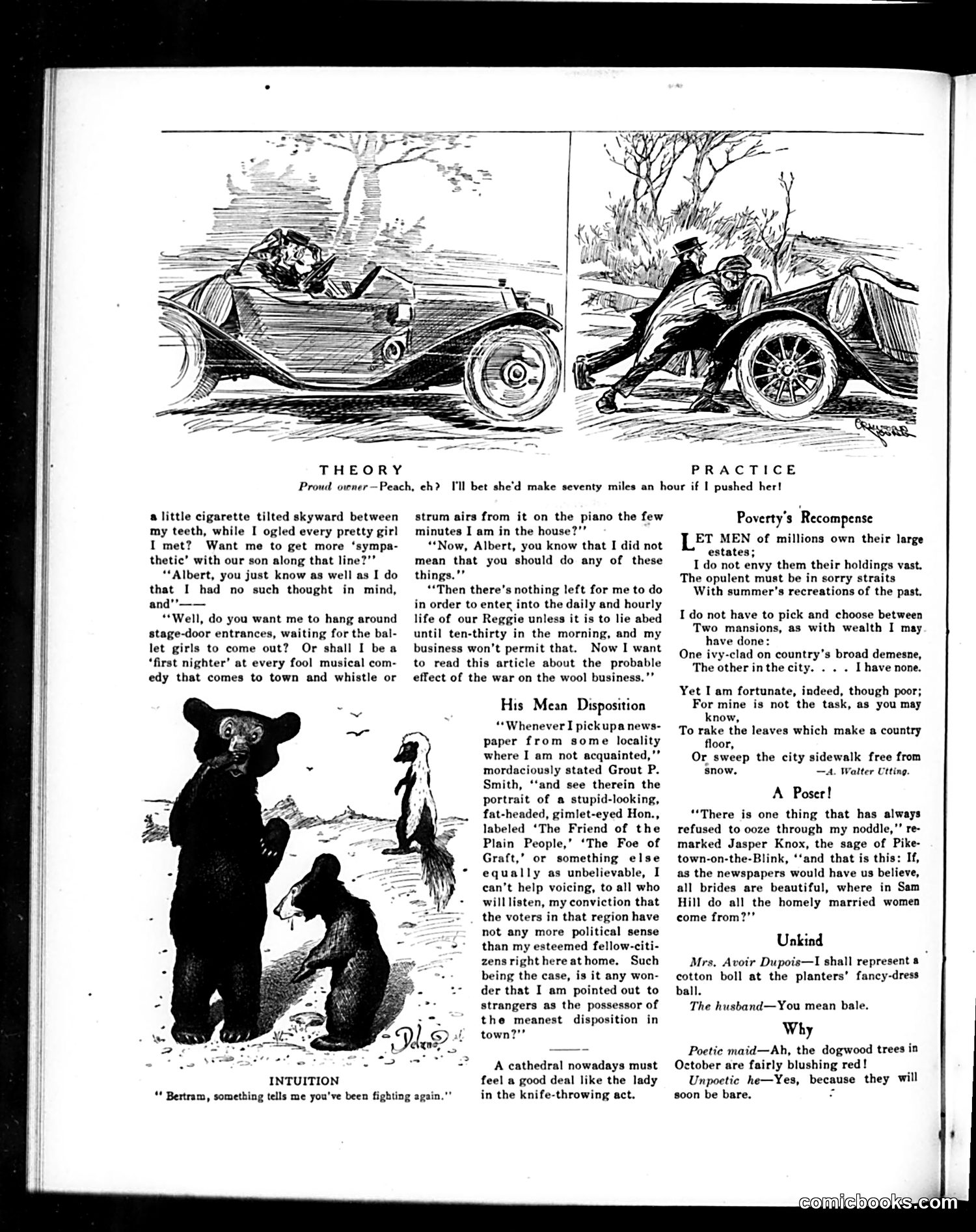
**Top cartoons ("Theory" vs. "Practice"):** These paired illustrations mock the gap between automotive aspirations and reality. The "Theory" shows a proud car owner boasting his vehicle will go "seventy miles an hour," while "Practice" depicts two men frantically pushing the same car—satirizing early automobiles' unreliability and weakness. **"Intuition" (animal cartoon):** A bear and bird observe a bruised cat, with the caption suggesting the cat has been fighting. This is a simple visual gag with no apparent political meaning. **Text sections:** The remaining content comprises short humorous pieces: a domestic dialogue about a husband's proper conduct; complaints about dishonest politicians; commentary on wealthy people's summer burdens; and various one-liner jokes about marriage, poverty, and nature. **Overall context:** This appears to be a typical Judge magazine humor page from the early 1900s, blending automotive satire, domestic comedy, and light social commentary without significant political messaging.
📄 Transcribed text from this page (OCR, searchable)
Machine-transcribed from the original scan — historical spelling and the odd misread are preserved.
Proud owner —Peach, eh? a little cigarette tilted skyward between my teeth, while I ogled every pretty girl I met? Want me to get more ‘sympa- thetic’ with our son along that line?’’ “Albert, you just know as well as I do that I had no such thought in mind, and"’—— **Well, do you want me to hang around stage-door entrances, waiting for the bal- let girls to come out? Or shall I bea ‘first nighter’ at every fool musical com- edy that comes to town and whistle or INTUITION “ Bertram, something tells me you've been fighting again.” strum airs from it on the piano the few minutes I am in the house?”’ “Now, Albert, you know that I did not mean that you should do any of these things."’ “Then there's nothing left for me to do in order to enter into the daily and hourly life of our Reggie unless it is to lie abed until ten-thirty in the morning, and my business won't permit that. Now I want to read this article about the probable effect of the war on the wool business.’’ His Mean Disposition “Whenever I pickupa news- paper from some locality where I am not acquainted,” mordaciously stated Grout P. Smith, ‘‘and see therein the portrait of a stupid-looking, fat-headed, gimlet-eyed Hon., labeled ‘The Friend of the Plain People,’ ‘The Foe of Graft,’ or something else equally as unbelievable, I can’t help voicing, to all who willlisten, my conviction that the voters in that region have not any more political sense than my esteemed fellow-citi- zens right here athome. Such being the case, is it any won- der that I am pointed out to strangers as the possessor of the meanest disposition in town?"’ A cathedral nowadays must feel a good deal like the lady in the knife-throwing act. PRACTICE I'll bet she'd make seventy miles an hour if | pushed her! Poverty’s Recompense L=t MEN of millions own their large estates; I do not envy them their holdings vast. The opulent must be in sorry straits With summer's recreations of the past. I do not have to pick and choose between Two mansions, as with wealth I may have done: One ivy-clad on country’s broad demesne, The other inthe city. . . . Ihave none. Yet I am fortunate, indeed, though poor; For mine is not the task, as you may know, To rake the leaves which make a country floor, Or sweep the city sidewalk free from Snow. —A. Walter Utting. A Poser! “There is one thing that has always refused to ooze through my noddle,’’ re- marked Jasper Knox, the sage of Pike- town-on-the-Blink, ‘‘and that is this: If, as the newspapers would have us believe, all brides are beautiful, where in Sam Hill do all the homely married women come from?"’ Unkind Mrs, Avoir Dupois—I shall represent 8 cotton boll at the planters’ fancy-dress ball. The husband—You mean bale. Why Poetic maid—Ah, the dogwood trees in October are fairly blushing red! Unpoetic he—Yes, because they will soon be bare. :