
Judge, 1914-11-14 · page 11 of 24
Judge — November 14, 1914 — page 11: what you’re looking at
What you’re looking at
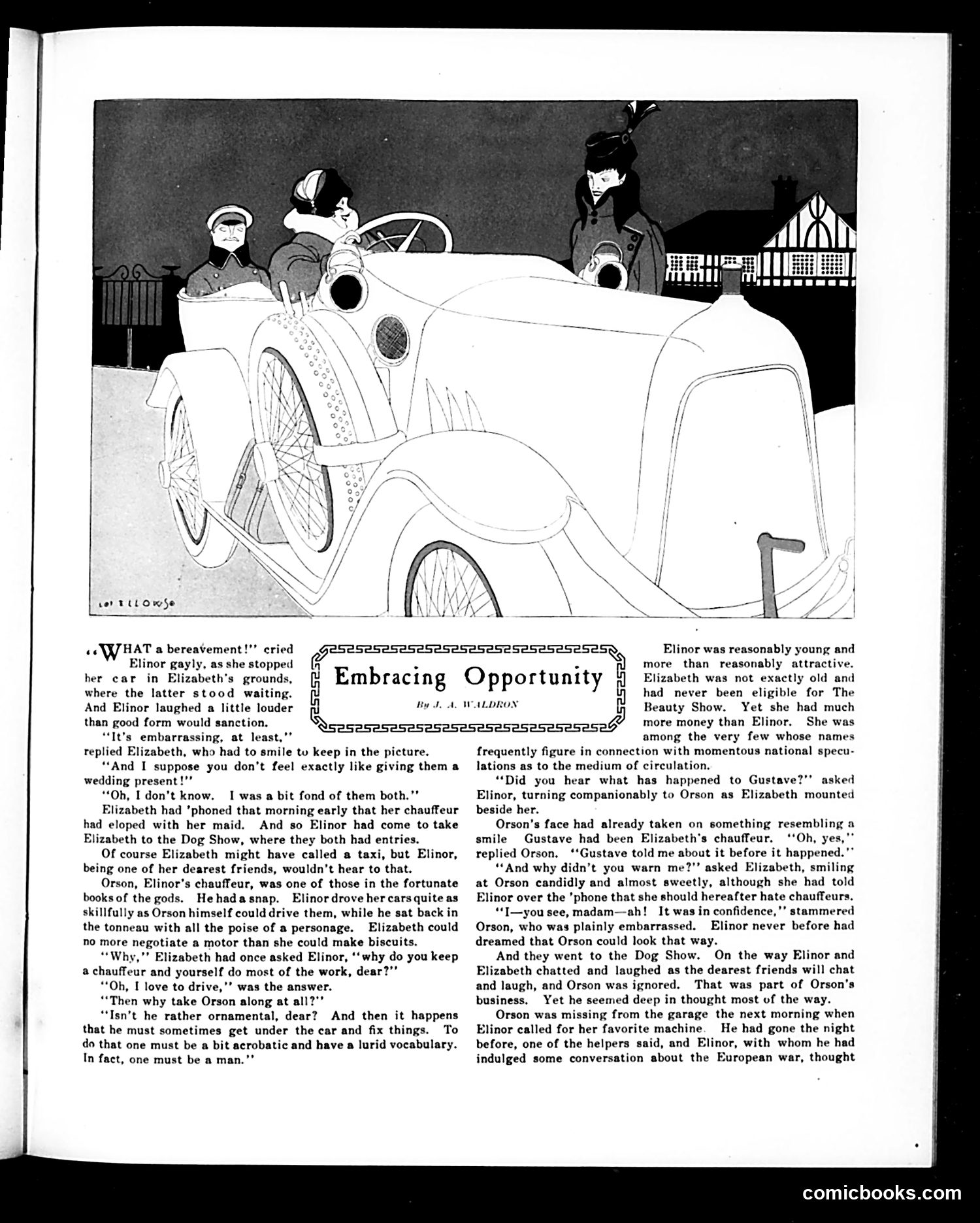
This is a satirical short story, not a political cartoon. It concerns social class and gender dynamics in the early 20th century. **The Setup:** Elinor, wealthy and independent, drives her own car (unusual for women then). Her chauffeur Orson is essentially decorative—she handles the driving while he sits in back as a status symbol. Elizabeth, richer but less capable, relies entirely on her chauffeur Gustave. **The Satire:** The story mocks how women of means navigate social limitations. Elinor keeps Orson partly for appearance and partly because "one must be a man" to fix cars and use profanity—a dig at gender restrictions of the era. When Gustave (Elizabeth's chauffeur) elopes, the story explores class, loyalty, and propriety. **The Point:** By story's end, Orson mysteriously vanishes after learning about the European war, suggesting even servants have ambitions beyond servitude—a subtle commentary on social mobility and changing times.
📄 Transcribed text from this page (OCR, searchable)
Machine-transcribed from the original scan — historical spelling and the odd misread are preserved.
[ser ELL owse Sesesesesesesesesesese Elinor was reasonably young and ‘ Wat a bereavement!"’ cried Elinor gayly, as she stopped her car in Elizabeth's grounds, where the latter stood waiting. And Elinor laughed a little louder than good form would sanction. 2 Embracing Opportunity Bu J. A, WALDRON Sesesesesesesesesesesese more than reasonably attractive. Elizabeth was not exactly old and had never been eligible for The Beauty Show. Yet she had much more money than Elinor. She was “It's embarrassing, at least,’’ replied Elizabeth, who had to smile tu keep in the picture. “And I suppose you don’t feel exactly like giving them a wedding present !"" “Oh, I don’t know. I was a bit fond of them both.”’ Elizabeth had ‘phoned that morning early that her chauffeur had eloped with her mi And so Elinor had come to take Elizabeth to the Dog Show, where they both had entries. Of course Elizabeth might have called a taxi, but Elinor, being one of her dearest friends, wouldn’t hear to that. Orson, Elinor’s chauffeur, was one of those in the fortunate books of the gods. Hehadasnap. Elinor drove her cars quite as skillfully as Orson himself could drive them, while he sat back in the tonneau with all the poise of a personage. Elizabeth could no more negotiate a motor than she could make biscuits. “Why,’’ Elizabeth had once asked Elinor, ‘‘why do you keep a chauffeur and yourself do most of the work, dear?”’ “Oh, I love to drive,’’ was the answer. “Then why take Orson along at all?"’ “Isn't he rather ornamental, dear? And then it happens that he must sometimes get under the car and fix things. To do that one must be a bit acrobatic and have a lurid vocabulary. In fact, one must be a man.”* among the very few whose names frequently figure in connection with momentous national specu- lations as to the medium of circulation, “Did you hear what has happened to G 7” asked Elinor, turning companionably to Orson as Elizabeth mounted beside her. Orson’s face had already taken on something resembling a smile Gustave had been Elizabeth's chauffeur. ‘‘Oh, yes,” replied Orson. ‘*Gustave told me about it before it happened." “(And why didn’t you warn me?" asked Elizabeth, smiling at Orson candidly and almost sweetly, although she had told Elinor over the ’phone that she should hereafter hate chauffeurs. “‘I—you see, madam—ah! It was in confidence,’’ stammered Orson, who was plainly embarrassed. Elinor never before had dreamed that Orson could look that way. And they went to the Dog Show. On the way Elinor and Elizabeth chatted and laughed as the dearest friends will chat and laugh, and Orson was ignored. That was part of Orson’s business. Yet he seemed deep in thought most of the way. Orson was missing from the garage the next morning when Elinor called for her favorite machine. He had gone the night before, one of the helpers said, and Elinor, with whom he had indulged some conversation about the European war, thought comicbooks.com