
A complete issue · 24 pages · 1914
Judge — September 19, 1914
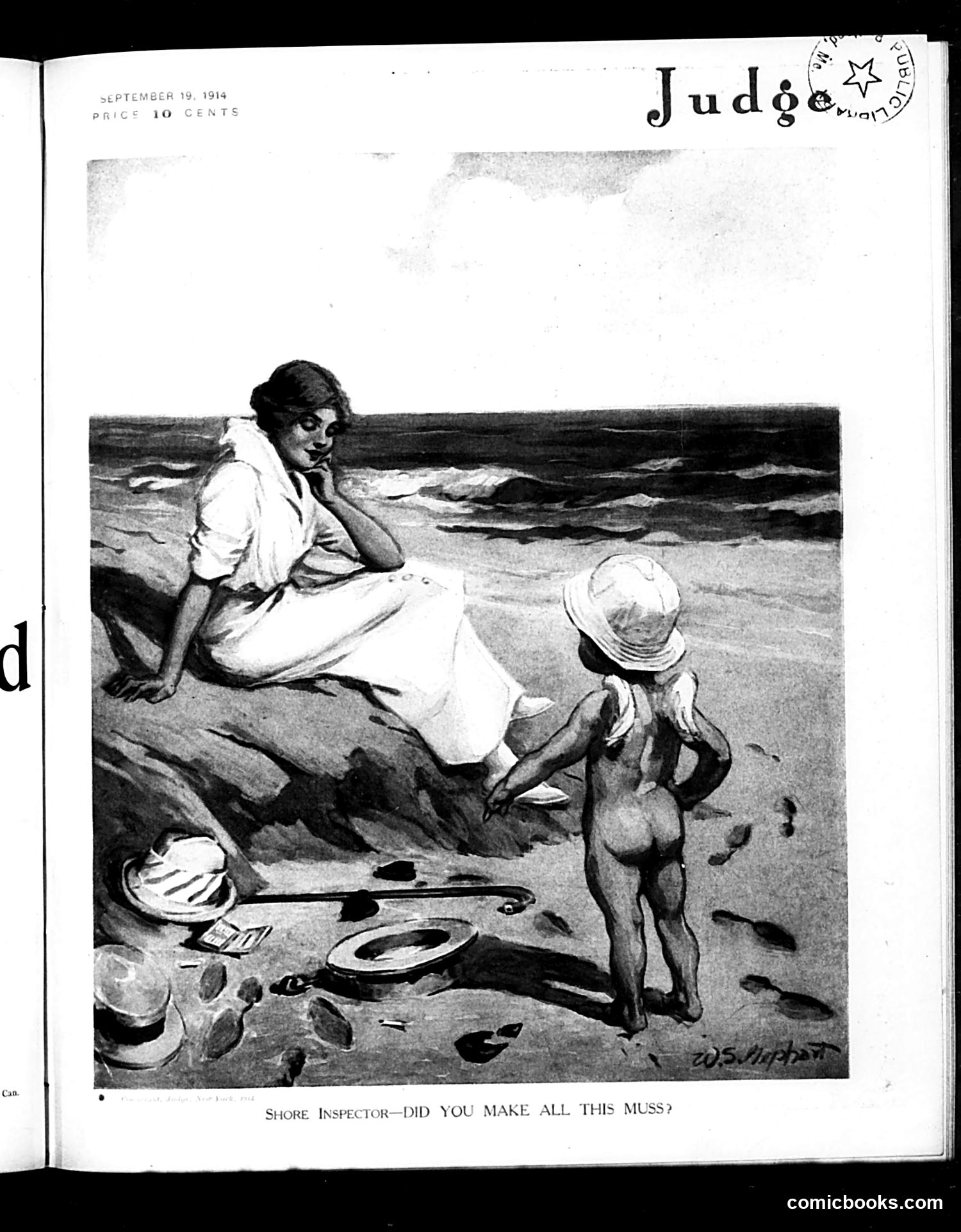
This cartoon depicts a domestic scene at the beach. A woman sits watching the ocean while a young child plays in the sand nearby, surrounded by scattered toys and buckets. The caption reads: "SHORE INSPECTOR—DID YOU MAKE ALL THIS MESS?" The humor is straightforward domestic satire: it shows a mother (or caregiver) confronting a child about the disarray created during beach play. The "shore inspector" reference is a playful way of describing the adult's supervisory role. This reflects early 20th-century middle-class beach leisure culture and the perpetual tension between children's messy play and adult expectations for tidiness. The joke requires no political or historical context—it's universal family humor about childhood and parental exasperation that remains relatable to modern audiences.
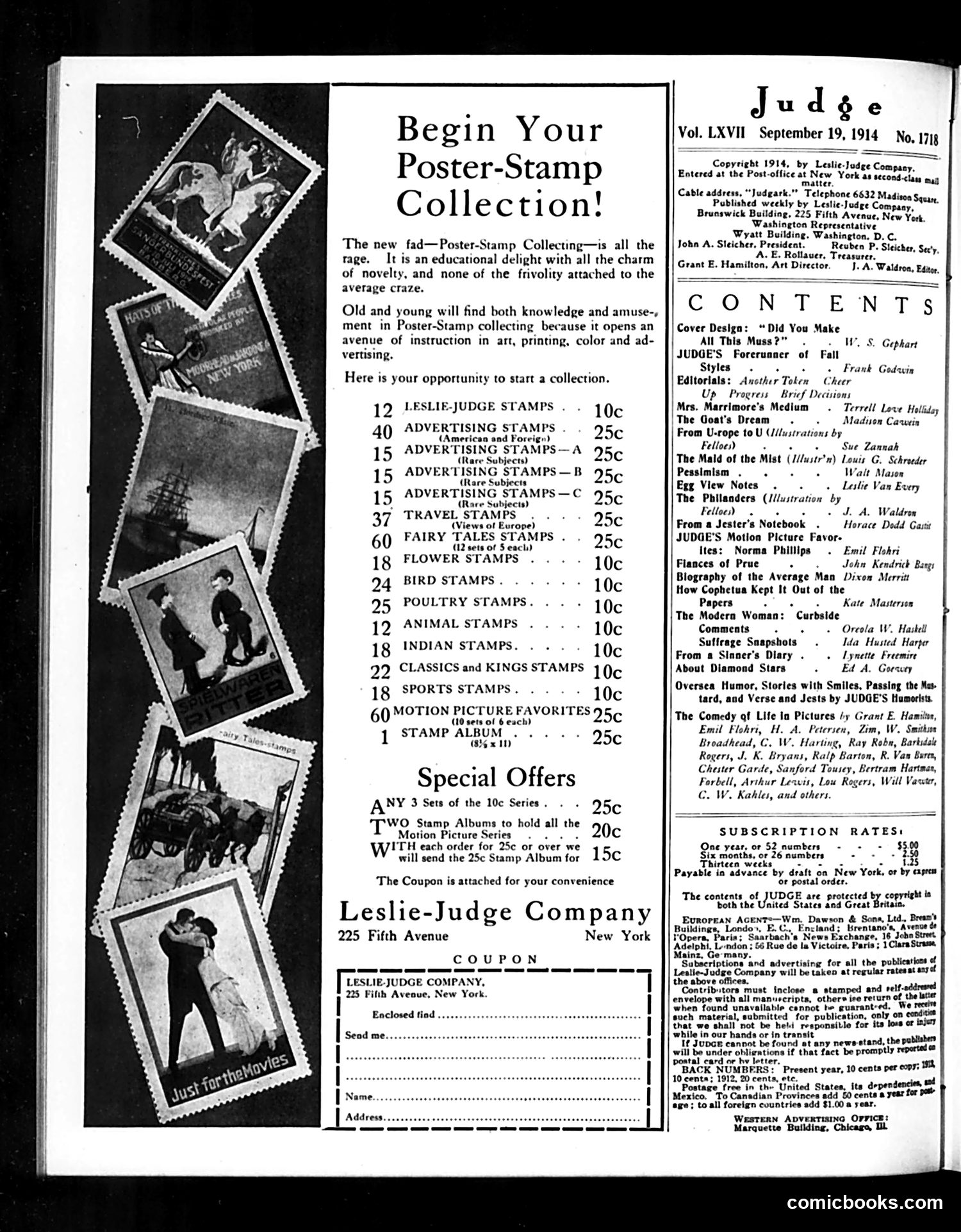
This page is primarily **advertising**, not editorial content. It promotes Leslie-Judge Company's "Poster-Stamp Collection" — a collecting fad of 1914 offering decorative stamps featuring various themes (travel, fairy tales, animals, motion pictures, etc.) at 10-25 cents per set. The visual elements show sample stamps arranged vertically, including what appears to be classical or artistic imagery. The text emphasizes this as an "educational delight" combining "knowledge and amusement" through instruction in "art, printing, color and advertising." A coupon at bottom allows readers to order collections. This reflects early-20th-century American consumer culture and the popular hobby of stamp collecting, which Judge's advertisers clearly targeted to their middle-class readership.
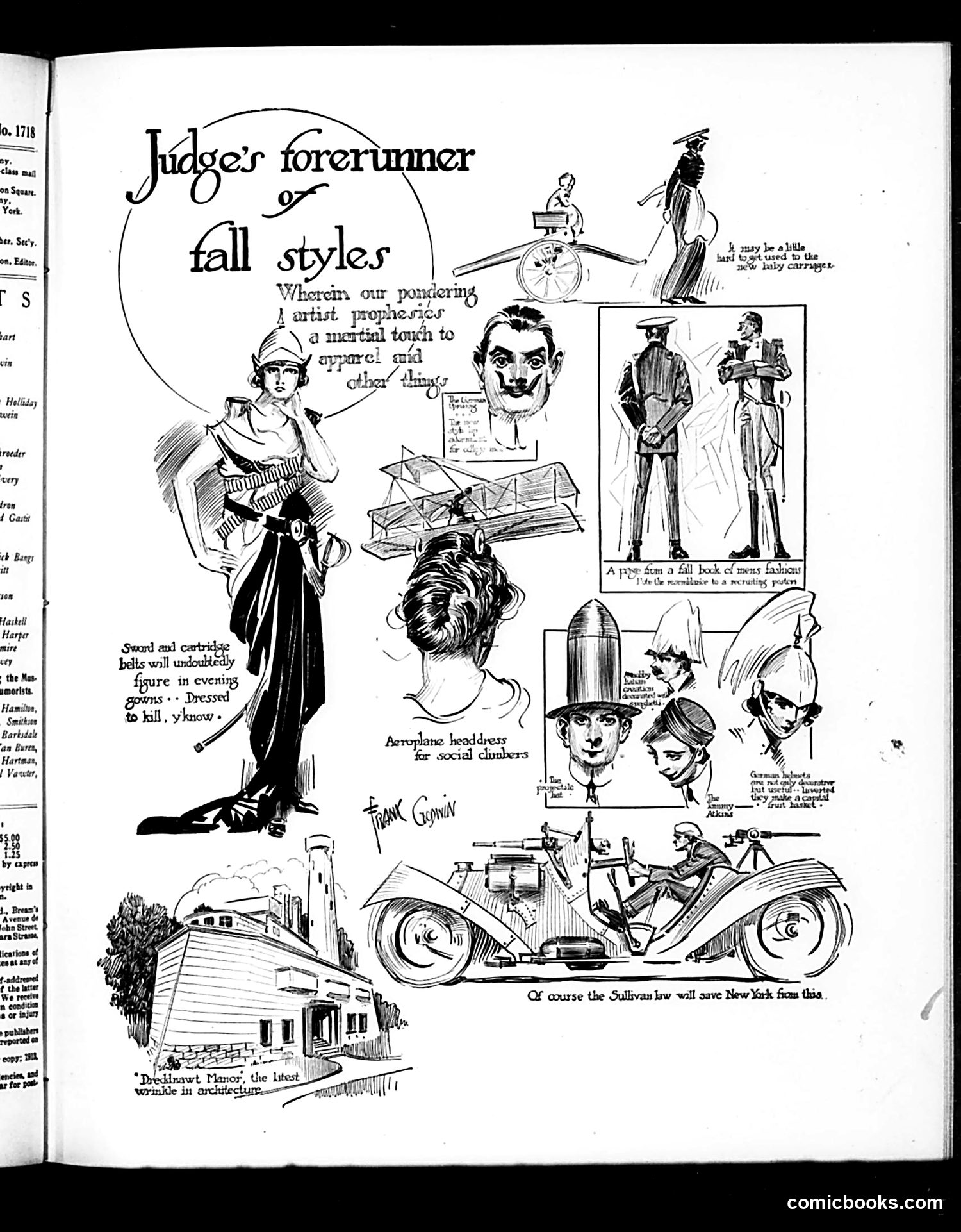
This is a humorous fashion commentary page by Frank Grawin satirizing 1910s-1920s trends. The central figure shows exaggerated "evening gowns dressed to kill, yellow" with sword and cartridge belts—mocking women's adoption of militaristic aesthetics during or after World War I. The surrounding vignettes mock other contemporary fashion absurdities: aeroplane headresses for "social climbers," exaggerated hats, and various ridiculous accessories. The motorcycle illustration and house sketch labeled "Dreadnought Manor" continue the military theme, suggesting satirical critiques of excessive modernism and war-influenced design trends. The closing caption references "Sullivan law" (NYC gun regulations), extending the satire about deadly fashion excess. The overall message ridicules how far fashion designers pushed absurdity and militaristic themes during this era.
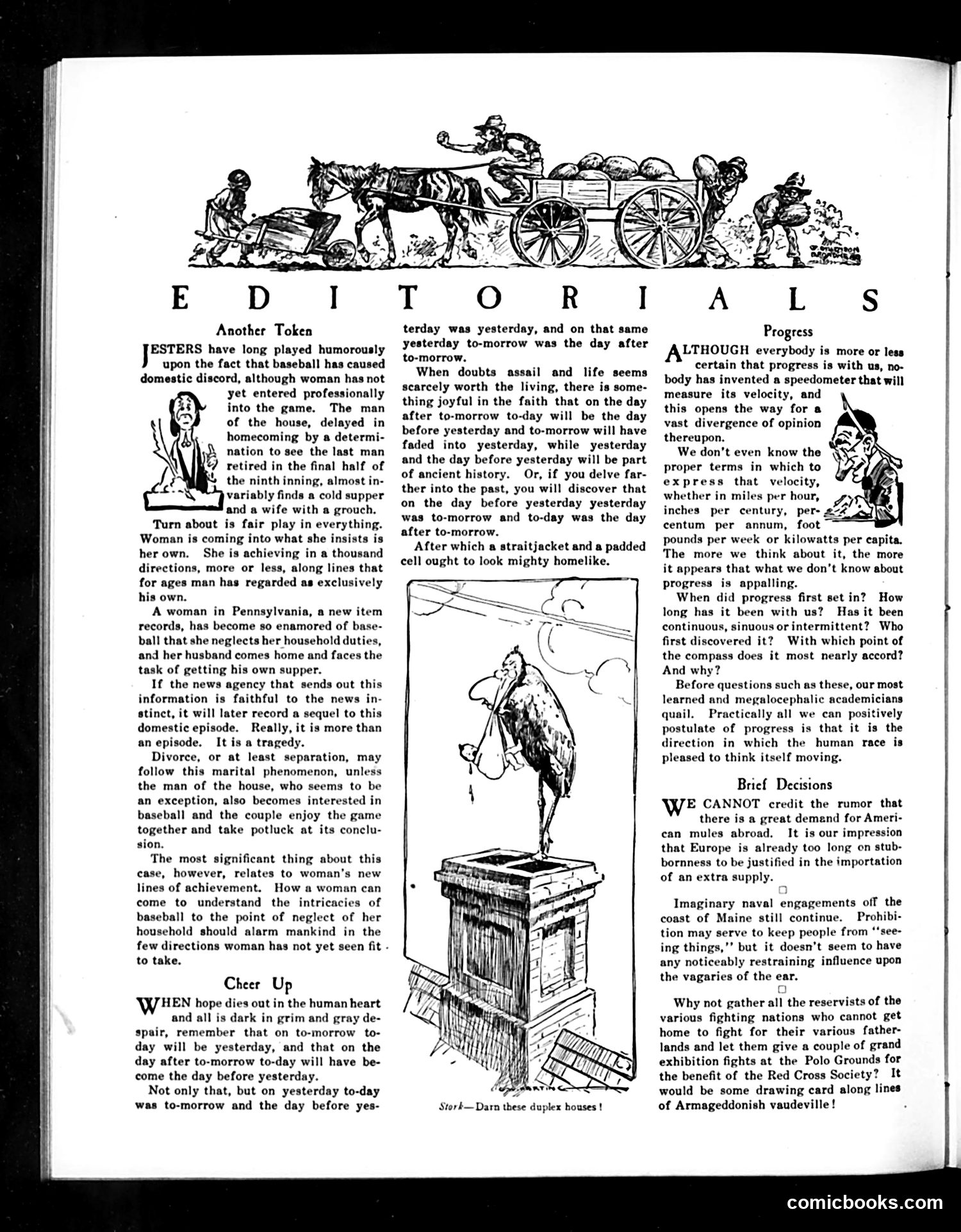
This appears to be an editorial/opinion page from *Judge* magazine featuring three distinct sections: **"Another Token"** discusses a Pennsylvania woman who became obsessed with baseball after her husband entered the game professionally. The satire suggests women's newfound interest in sports reflects changing social roles—previously considered a domestic distraction, baseball now represents women's expanding sphere of influence beyond household concerns. **"Cheer Up"** offers philosophical musings about time's relativity (yesterday/tomorrow conceptual wordplay), arguing optimism should sustain people through hardship. **"Brief Decisions"** contains short political commentary, including skepticism about American demand for rules abroad and mockery of imaginary naval conflicts. The accompanying illustrations appear to be generic satirical cartoons rather than caricatures of specific identified figures.
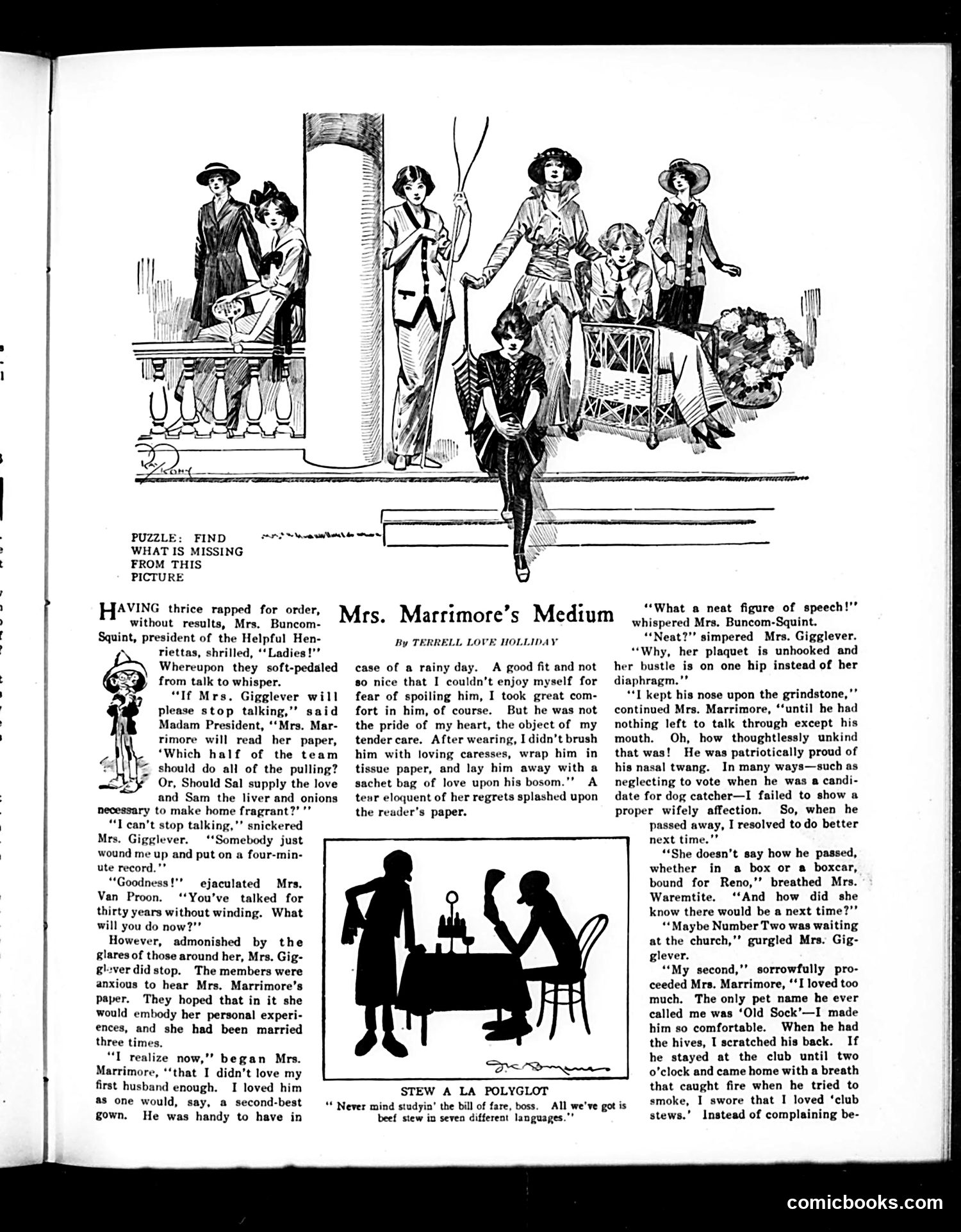
This page contains two distinct pieces: **Top illustration**: A puzzle asking readers to identify what's missing from a scene depicting well-dressed women and children at what appears to be a social gathering or event. The puzzle format was common entertainment in Judge. **Main story**: "Mrs. Marimore's Medium" by Terrell Lowe Holliday satirizes spiritualism and séances—popular phenomena in the early 20th century. Mrs. Marimore claims to communicate with the dead through a medium. The humor targets both the credulous wealthy women seeking spiritual comfort and the fraudulent mediums exploiting them. References to husbands, pet names, and domestic complaints suggest the story mocks women's gullibility about supernatural claims while humorously depicting marital dissatisfaction. **Bottom cartoon**: "Stew à la Polyglot" depicts diners discussing food in multiple languages—likely satirizing pretentious dining culture or immigrant communities.
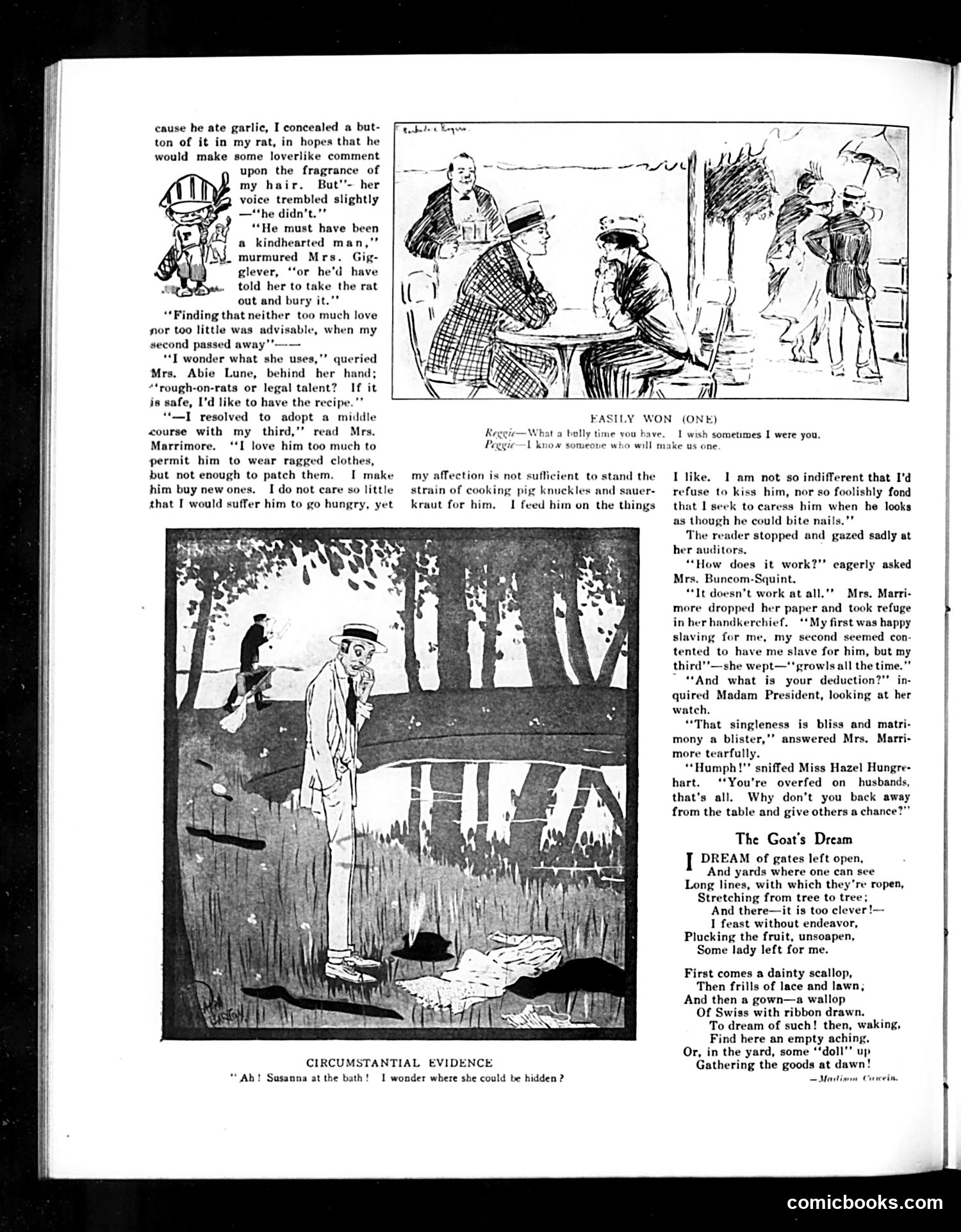
This page satirizes **marriage and domestic relations** through women's perspectives. The main story features Mrs. Marrimore describing three marriages, each representing different relationship dynamics: the first husband who loved her too much, the second she had to serve excessively, and the third who remains perpetually dissatisfied despite her careful middle-ground approach. The satire targets the **impossible position of wives**—no strategy satisfies a husband. The concluding joke by Miss Hazel Hungrehart suggests women are "overfed on husbands" and should step aside, likely a jab at competition for marriage prospects. The bottom cartoon, "Circumstantial Evidence," shows a man discovering a woman bathing—a cheeky visual gag playing on the phrase's double meaning. "The Goat's Dream" is a whimsical poem about a goat dreaming of stealing unguarded laundry and food, a humorous fantasy. The overall theme: **marriage dissatisfaction and women's domestic entrapment**, presented through humor typical of early 20th-century satirical magazines.
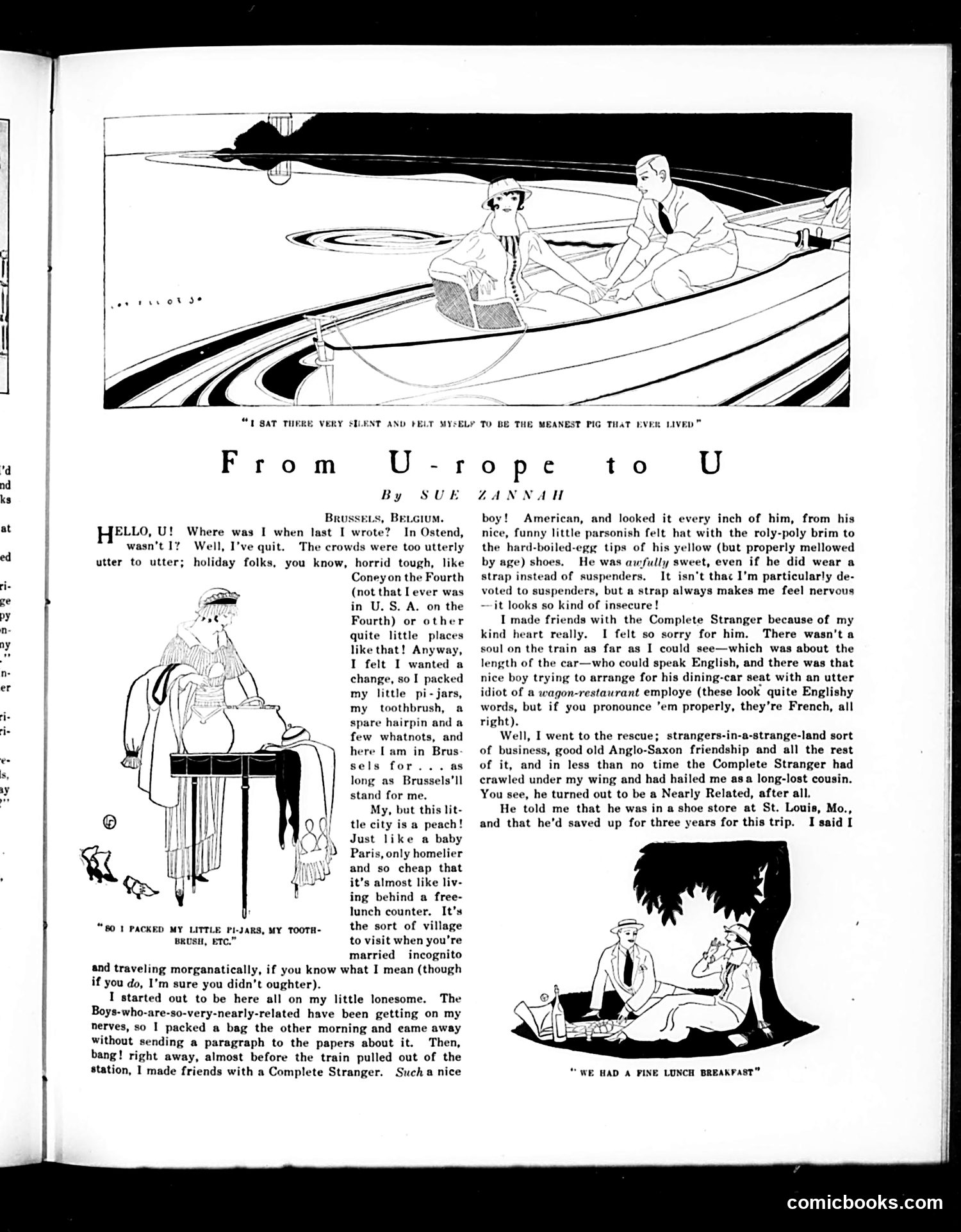
This is a travel humor column with illustrations, not political satire. Sue Zannah recounts a solo European trip from Belgium, describing her adventures meeting a "Complete Stranger" on a train. The piece satirizes travel writing conventions and American tourists abroad. Zannah pokes fun at herself for packing excessively ("pi-jars," toothbrush, hairpin), complains about European crowds and manners, and mocks language barriers (the "wagon-restaurant employe" speaking broken English/French). The humor centers on her relief at meeting another American despite initially wanting solitude, and her discovery that he's a distant relation who saved three years for this trip. The phrase "morganatically" (a marriage between unequals) humorously describes their casual travel companionship. The illustrations show typical 1920s travel scenes: packing luggage, boating, and dining together. It's lighthearted social commentary on American travelers navigating Europe rather than political commentary.
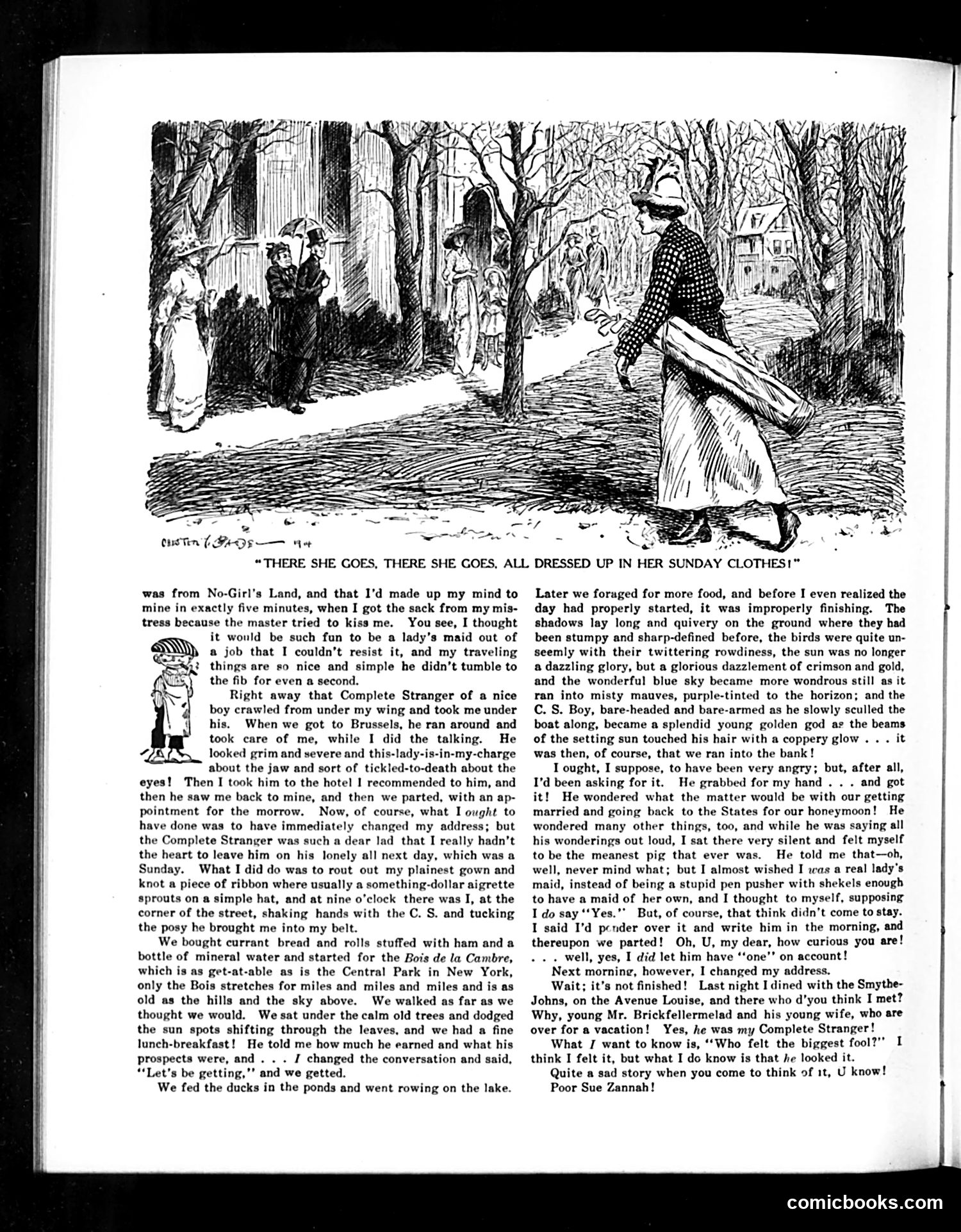
This page presents a romantic narrative titled "The Complete Stranger," illustrated with a sketch of a woman in a tree-lined park. The cartoon's caption—"THERE SHE GOES, THERE SHE GOES, ALL DRESSED UP IN HER SUNDAY CLOTHES!"—mocks a woman deliberately disguising herself to appear less wealthy than she is. The satire targets early 20th-century gender and class pretense: a wealthy woman masquerades as a jobless lady's maid to attract a suitor, fearing her money will repel him. The humor lies in her deception and the irony that she must perform poverty to seem desirable. The narrative's romantic tone gradually reveals how the ruse backfires—the man falls genuinely in love with the false persona, creating an ethical crisis for the deceiver. This reflects contemporary anxieties about female autonomy, marriage markets, and authenticity in courtship among the upper classes. The "Complete Stranger" represents the ideal romantic match, made ridiculous by the woman's need for artifice to secure him.
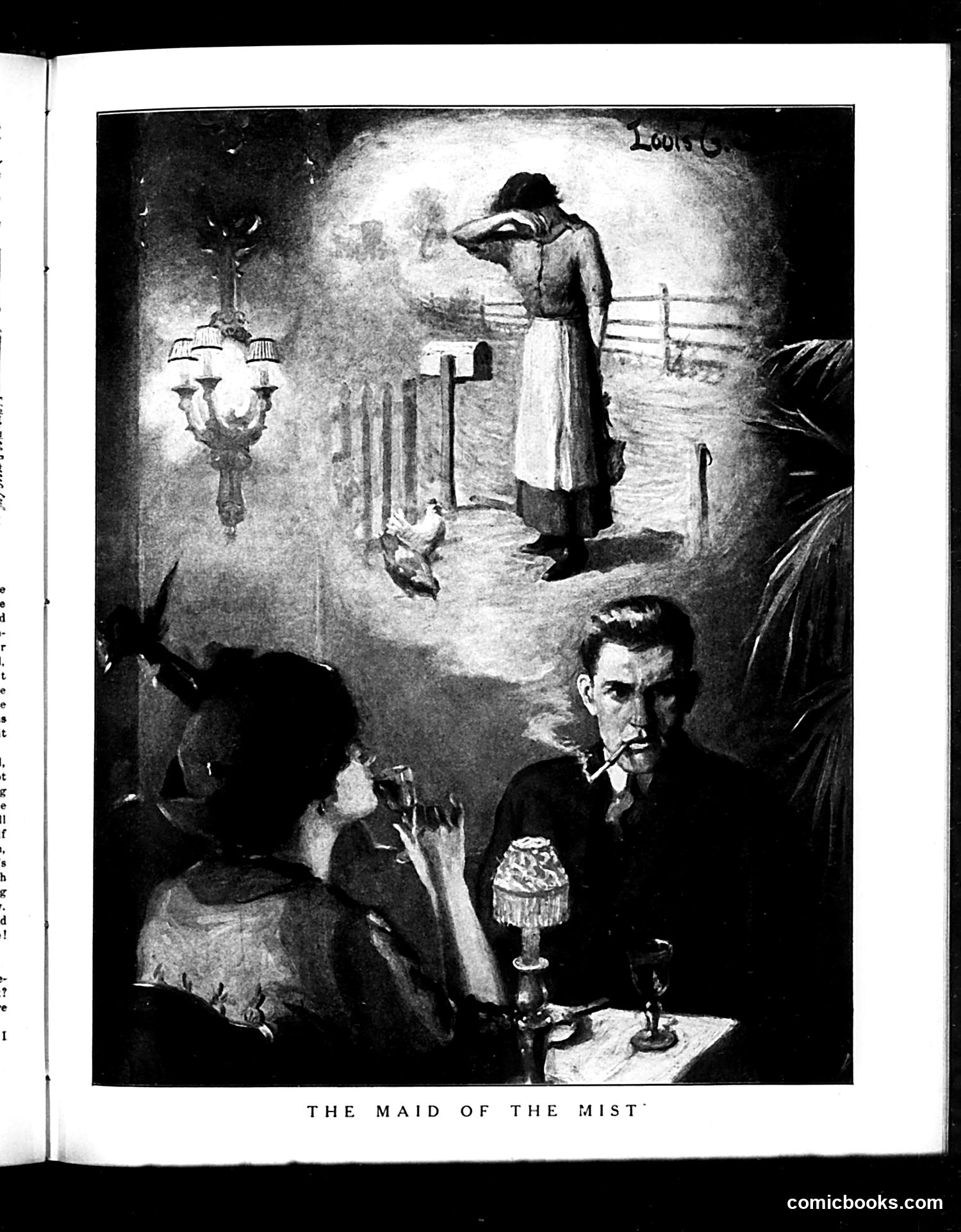
This appears to be an illustration from Judge magazine (indicated by "Look" marking in corner). The image depicts a dramatic scene with contrasting elements: in the foreground, two men in formal dress sit at a table with drinks and food in what appears to be an indoor, leisurely setting. In the background, a woman in simple dress stands outdoors near a fence, looking distressed or contemplative, with a lantern visible. The title "The Maid of the Mist" suggests this is likely social satire contrasting wealth and leisure with poverty or hardship. However, without additional context about the specific historical moment or publication date, the precise political or social commentary remains unclear. The composition implies commentary on class divisions or moral inequality.
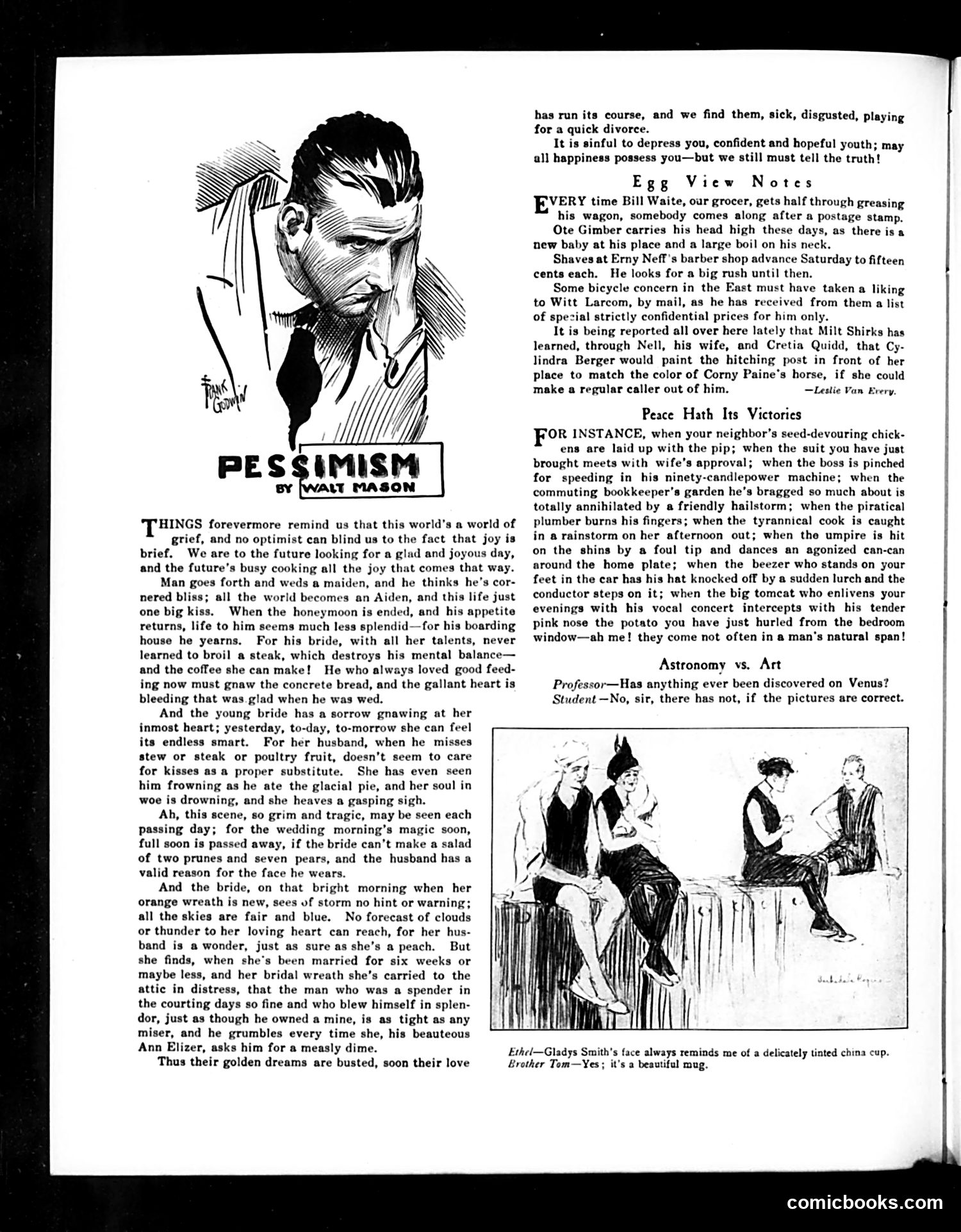
This page contains a cynical poem about marriage's decline from romantic ideals to domestic disappointment. Mason traces a husband's disillusionment: newly married men imagine paradise, but reality disappoints when wives can't cook properly—they serve "concrete bread" (bad food) instead of steaks. Brides, meanwhile, suffer when husbands' romantic attentiveness evaporates. The poem concludes bitterly: "thus their golden dreams are busted, soon their love has run its course, and we find them, sick, disgusted, playing for a quick divorce." The accompanying sections ("Egg View Notes," "Peace Hath Its Victories," "Astronomy vs. Art") are local gossip, humorous observations about small-town life, and a simple joke about Venus photographs. The art shows a sketch labeled "Pessimism"—a stern, lined male face reflecting the poem's grim tone about matrimonial failure.
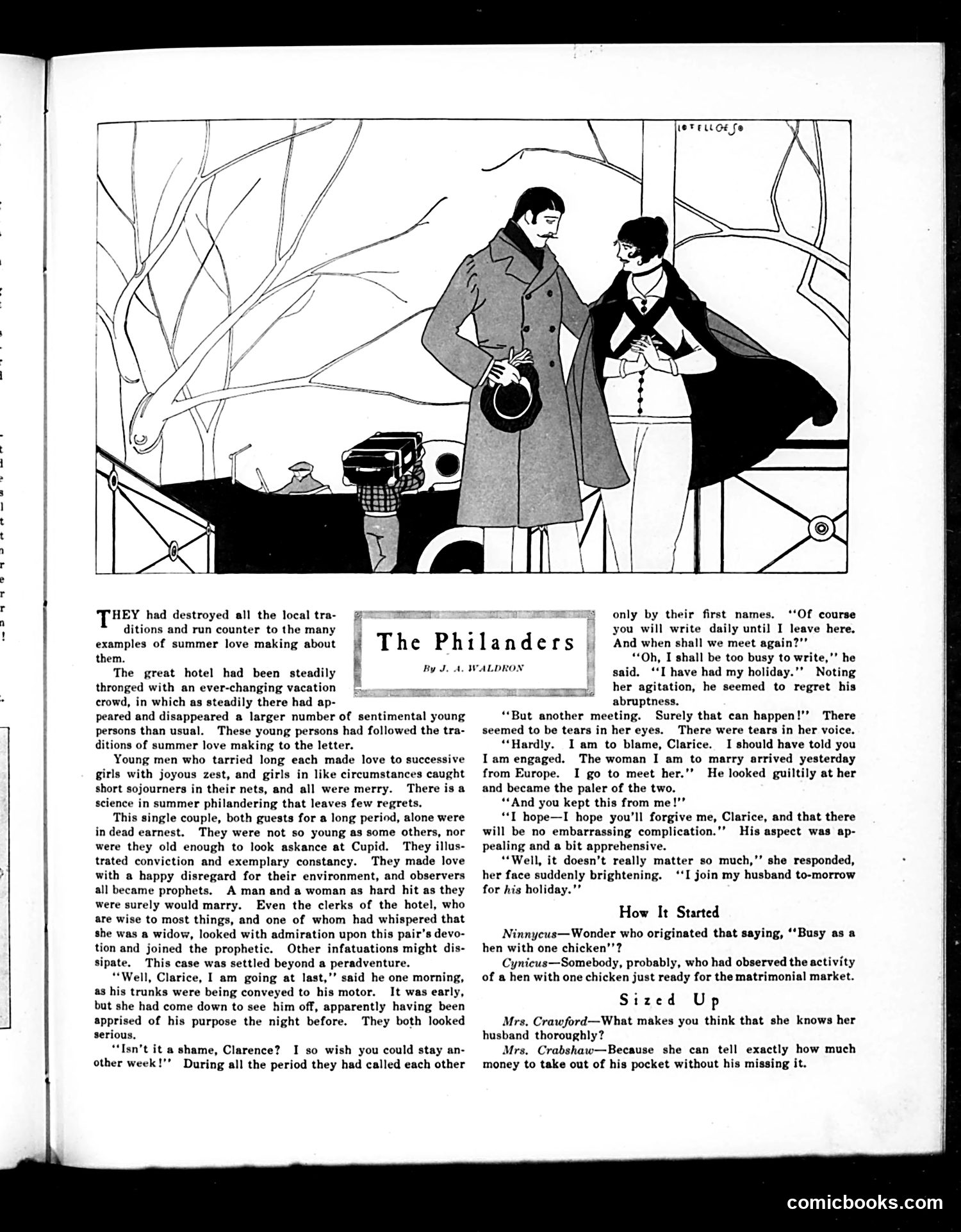
This story satirizes the hypocrisy of vacation affairs. Two middle-aged guests at a resort hotel conduct an intense summer romance, with hotel staff admiring their "true love" and predicting marriage. The punchline exposes the deception: when the man reveals he's actually engaged to a woman arriving from Europe, the woman casually responds that she's rejoining *her husband* tomorrow. The satire targets the false sentimentality and self-deception of summer romances—both parties were engaged/married the entire time, yet performed genuine emotion. The accompanying jokes below ("How It Started," "Sized Up") further mock domestic relations and infidelity with period humor about wives managing husbands' money. The cartoon illustrates this hypocrisy visually: two adults in an elaborate farewell scene, unaware they've both been lying about their situations.
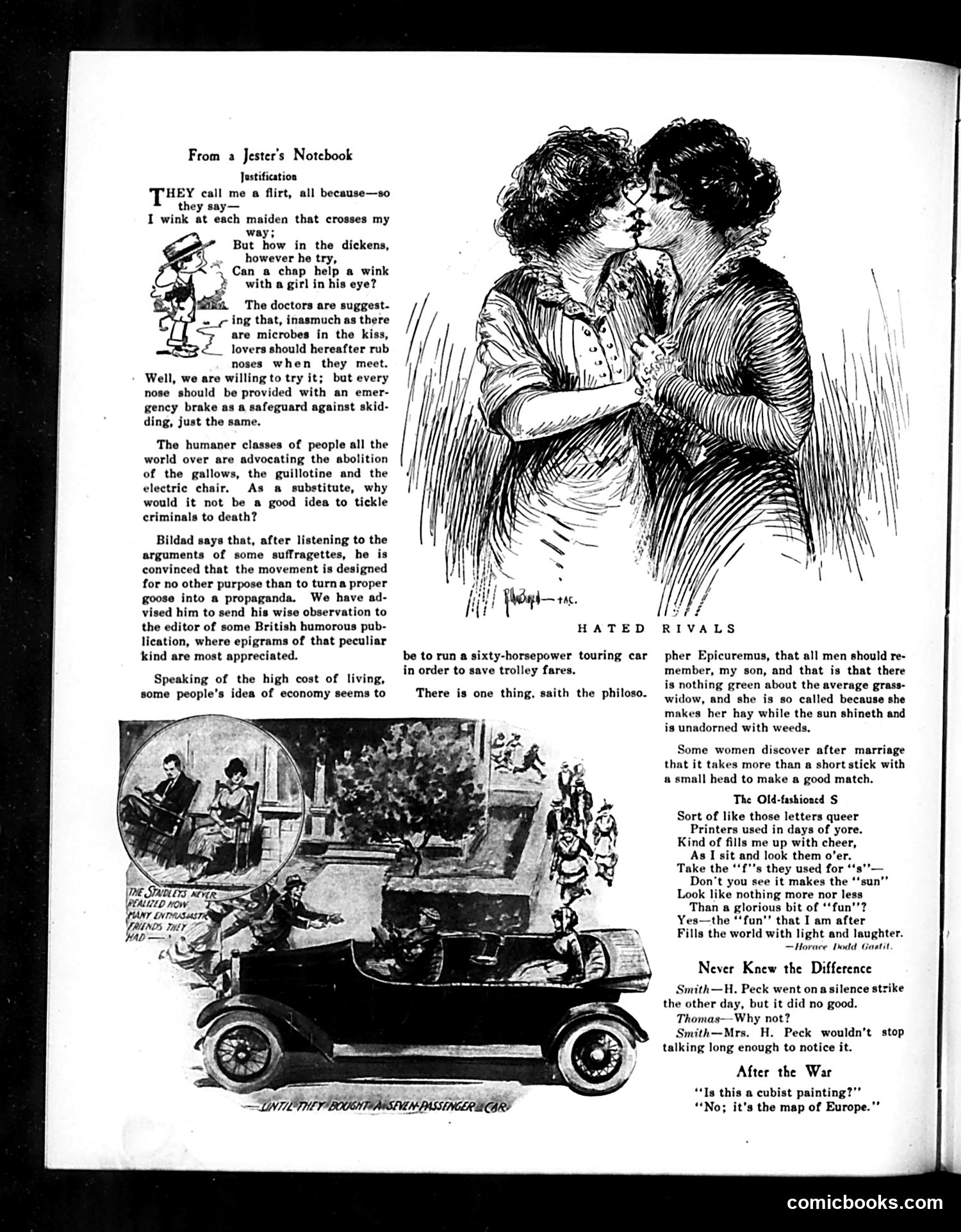
This page contains several brief humorous pieces typical of early 20th-century satirical magazines. **Main cartoons:** 1. **"Hated Rivals"** (top right): A sketch of two women kissing, illustrating the "Jestification" about romantic encounters and the flirtation theme. 2. **"Twenty-Passenger Car"** (center-left): A large illustration showing an impossibly crowded touring automobile, satirizing the absurdity of wealthy people buying expensive cars while claiming to economize on trolley fares—a joke about contradictory spending habits during the high cost of living. **Short jokes and observations** include: - Wordplay about flirting and winking - Medical commentary on germ-laden kisses - Commentary on women's suffrage ("suffragettes") - Domestic humor about marriage and nagging wives - A post-WWI joke equating Europe's map to abstract cubist art The overall tone mocks contemporary social issues, fashion, economics, and gender relations with light sarcasm rather than sharp political critique.
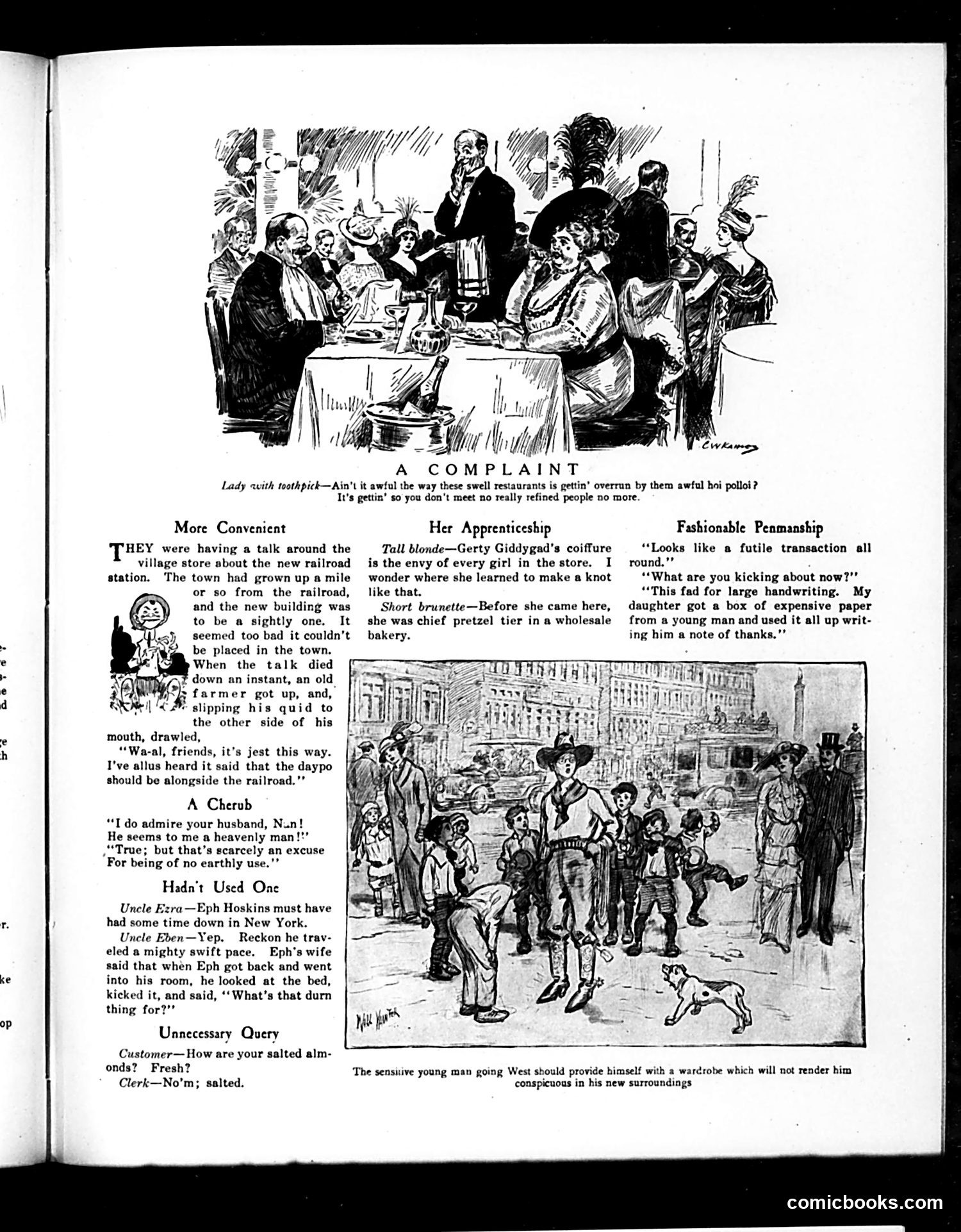
This page contains multiple short humorous anecdotes and sketches typical of early 20th-century American satirical humor. **"A Complaint"** (top) mocks wealthy diners complaining that fancy restaurants now attract "hoi polloi" (common people). The satire targets snobbish upper-class attitudes about exclusivity. **"More Convenient"** jokes about a railroad station's placement near a village store, with a farmer's folksy wisdom suggesting practicality over aesthetics. **"Her Apprenticeship"** contrasts a girl's fashionable hairstyle with her humble background as a pretzel-tier in a bakery—satirizing social climbing and appearance. **"Fashionable Penmanship"** mocks a fad for ostentatiously large handwriting, with the ironic detail that a young woman wasted expensive stationery thanking a man for providing it. **Other brief jokes** target marital relationships, travel, and urban etiquette. The bottom illustration shows a street scene of ordinary city life. The overall humor relies on class contrasts, pretension, and observational comedy about contemporary social behaviors.
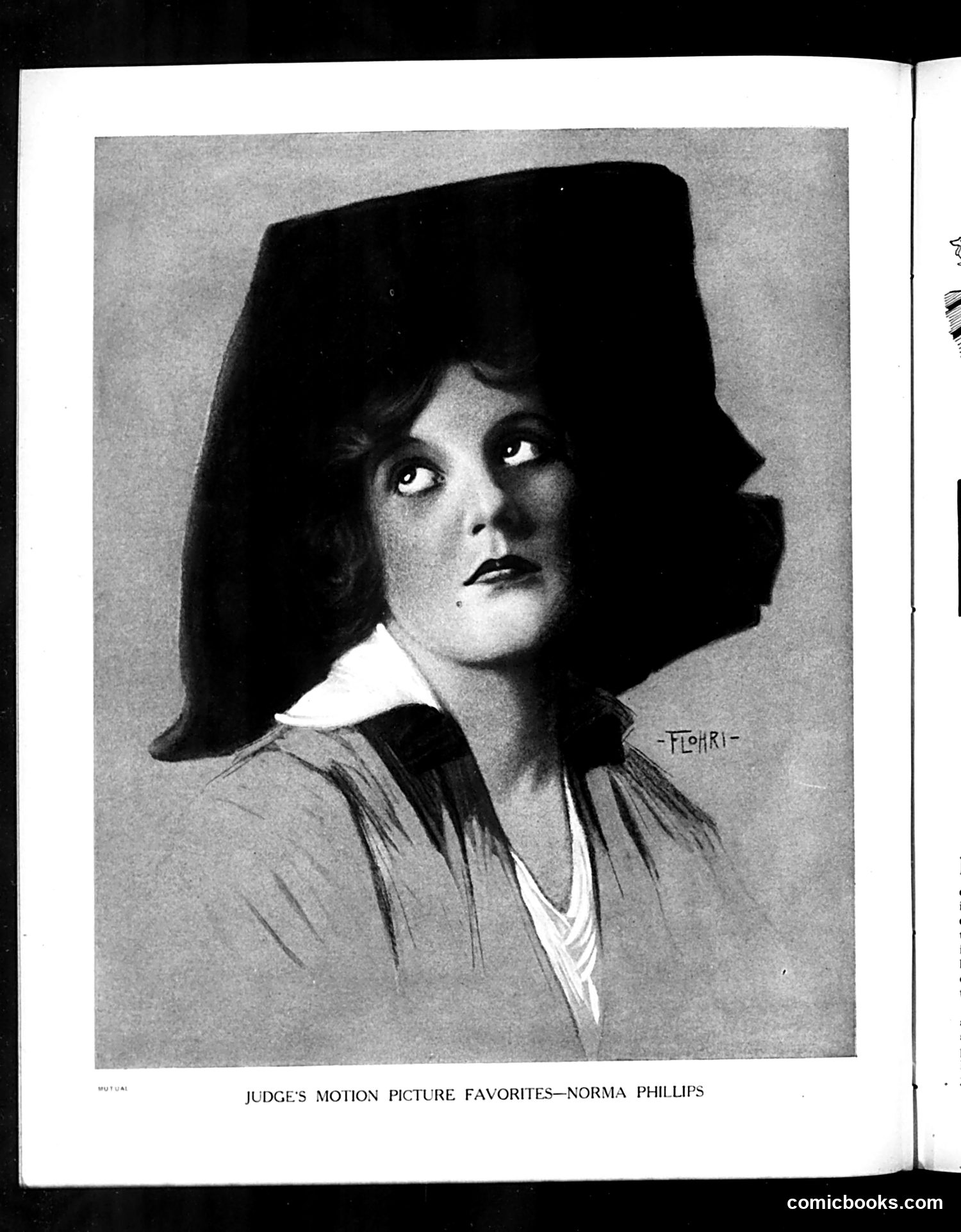
This page appears to be a **portrait feature rather than satire or political commentary**. It presents "Norma Phillips" as one of Judge magazine's "Motion Picture Favorites"—a celebrity endorsement or profile section common in early 20th-century publications. The photograph shows a woman in 1920s styling with characteristic bob-cut hair and theatrical makeup, credited to photographer "Flohr." Rather than mocking or satirizing the subject, Judge is promoting her as a notable film personality of the era. Without additional context about who Phillips was or what films she appeared in, the specific cultural significance remains unclear. This functions as entertainment industry coverage rather than the satirical political or social commentary Judge was typically known for.
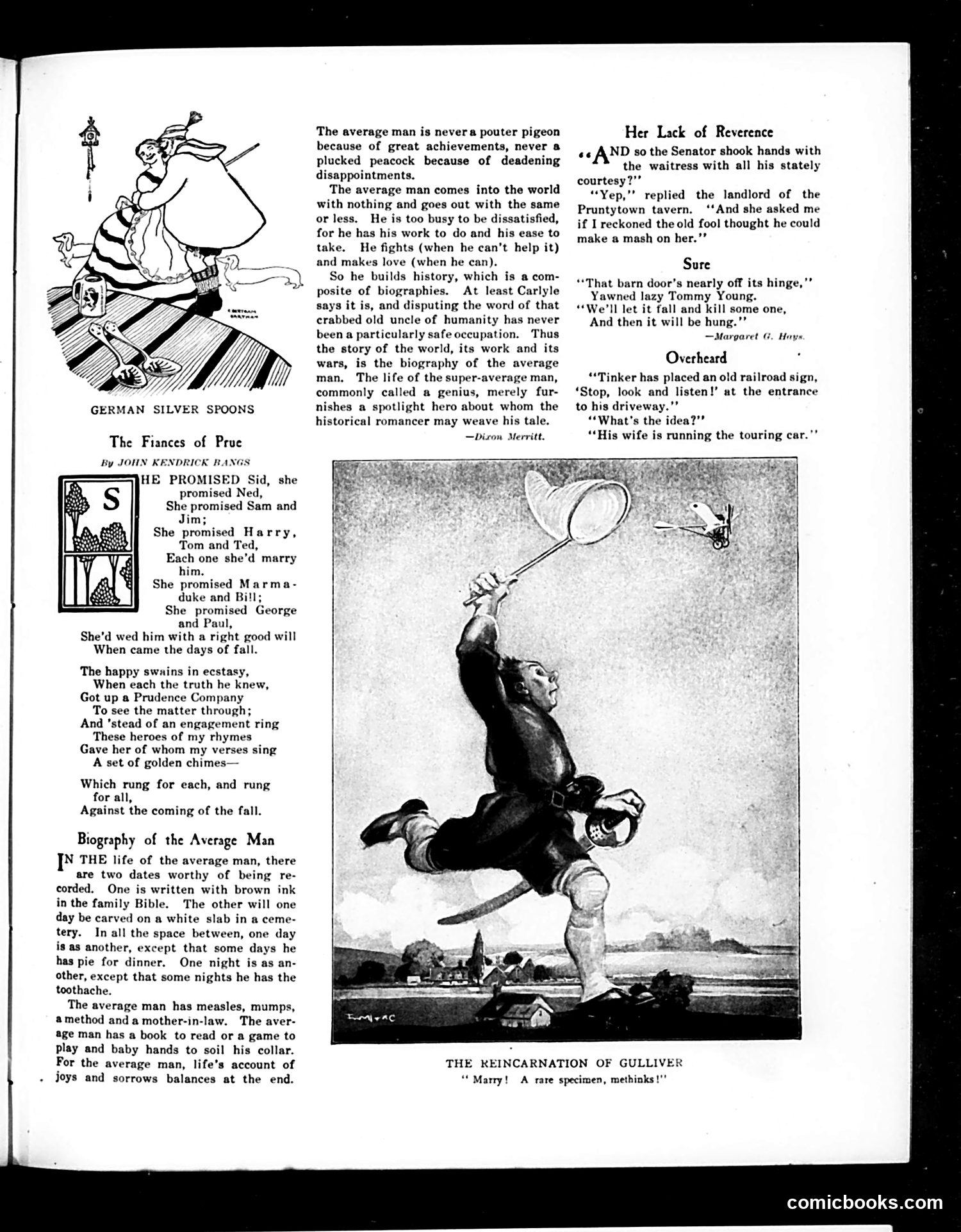
This page contains multiple satirical pieces typical of early 20th-century humor: **"The Fiancés of Prue"** (poem): A lighthearted joke about a woman named Prue who promises to marry multiple men, then receives "golden chimes" instead of engagement rings—satirizing either female fickleness or men's gullibility in matters of courtship. **"Biography of the Average Man"**: A philosophical essay mocking ordinary life's mundanity—birth, death, and unremarkable days between. It dismisses the average man as historically invisible, contrasting him with celebrated "geniuses" who capture historians' attention. **Three brief humor pieces** ("Her Lack of Reverence," "Sure," "Overheard"): Quick jokes about disrespect toward authority figures and marital dynamics. **"The Reincarnation of Gulliver"** (illustration): The large photograph shows a figure suspended in a net, apparently referencing Jonathan Swift's *Gulliver's Travels*—likely satirizing someone as absurdly out-of-proportion to modern life, though the specific target is unclear. The overall tone emphasizes ordinary people's skepticism toward pretense and authority.
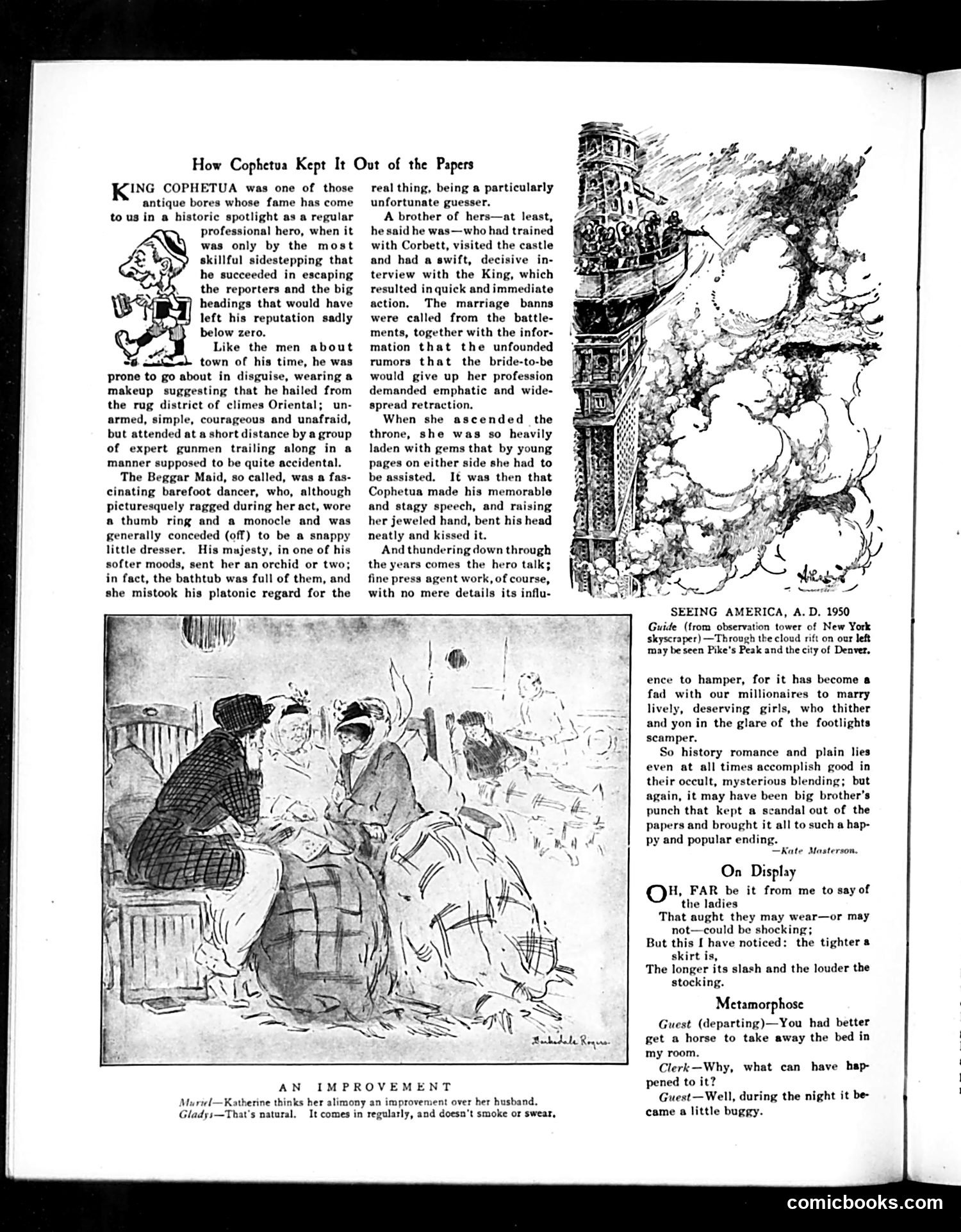
This page contains three distinct pieces of satirical content: **"How Cophetua Kept It Out of the Papers"** (main article with illustration): A cynical retelling of the King Cophetua legend, reframed as modern scandal management. The satire mocks how wealthy men use public relations tactics—"press agent work"—to control narratives around romantic indiscretions. The King's gift of orchids to a dancer is spun into respectable marriage through strategic announcements and suppressed rumors. The point: even scandalous behavior can be whitewashed through effective publicity, a critique of Gilded Age wealth and influence. **"An Improvement"** (small cartoon): A joke about alimony being preferable to an actual husband because it arrives regularly and lacks annoying habits like smoking or swearing—satirizing both marriage dissatisfaction and women's economic dependence on divorce settlements. **Minor pieces**: A 1950 futuristic travel guide joke and brief humorous observations on women's fashion ("the tighter a skirt is, / The longer its slash"). The overall tone targets wealthy men's moral hypocrisy and media manipulation.
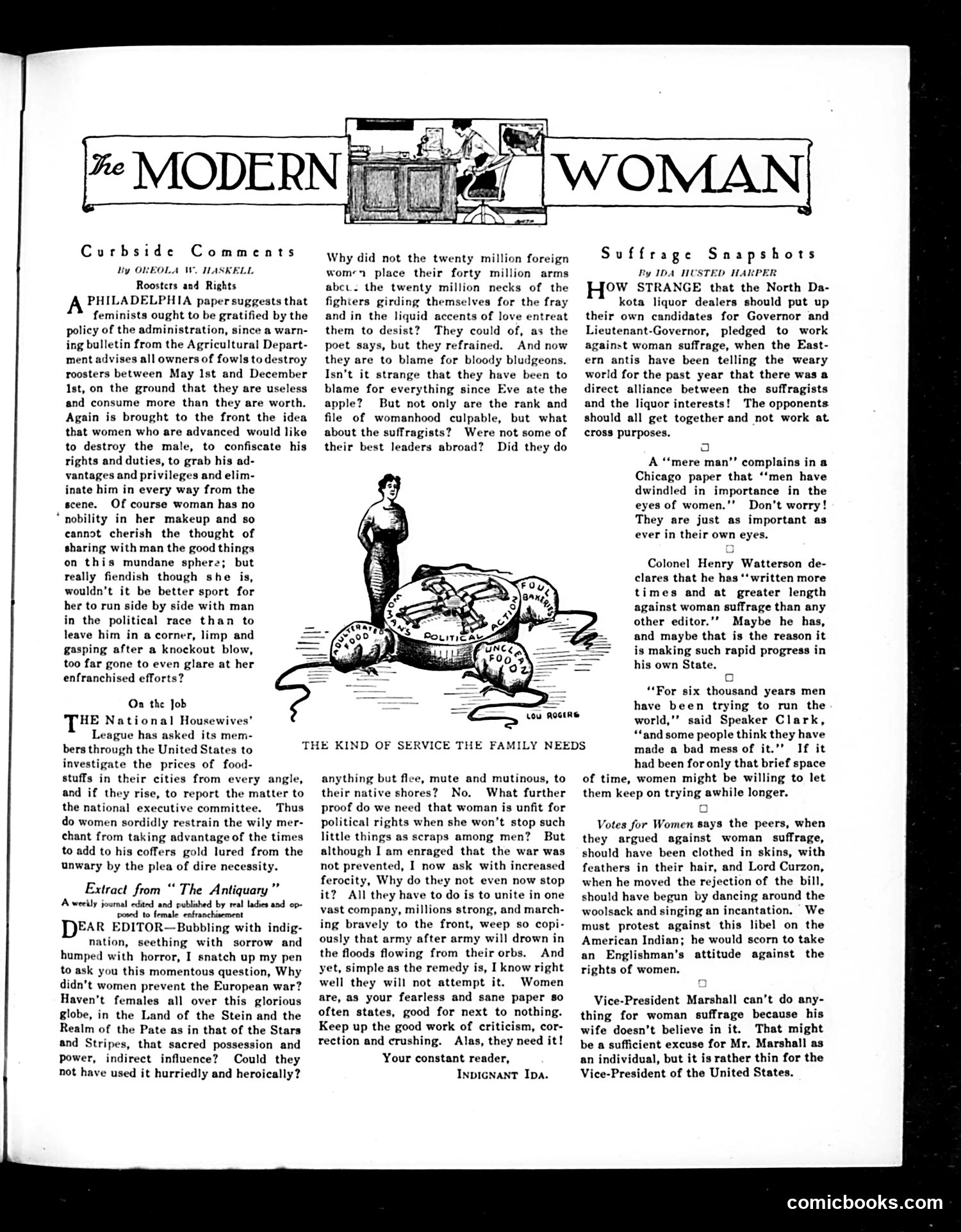
This page satirizes anti-suffrage arguments circulating during the women's suffrage debate. The central cartoon depicts a woman standing atop political issues (labeled spheres), a visual metaphor for feminist ambitions. The left column mocks a Philadelphia paper's claim that destroying roosters proves women's advancement—absurdly suggesting feminists want to eliminate men entirely. The text sarcastically argues women should instead "run side by side with man" politically rather than fighting him. The "Indignant Ida" letter (bottom) employs extreme irony to expose anti-suffrage logic: it blames women for not preventing World War I through their "indirect influence," then ridicules this same argument by suggesting women could stop the war simply by weeping at the front. This reductio ad absurdum exposes how opponents simultaneously denied women political competence while blaming them for not solving international crises. The right column references specific anti-suffrage objections, including Vice-President Marshall's opposition based on his wife's views—mocking how women's political exclusion was justified by appealing to women.
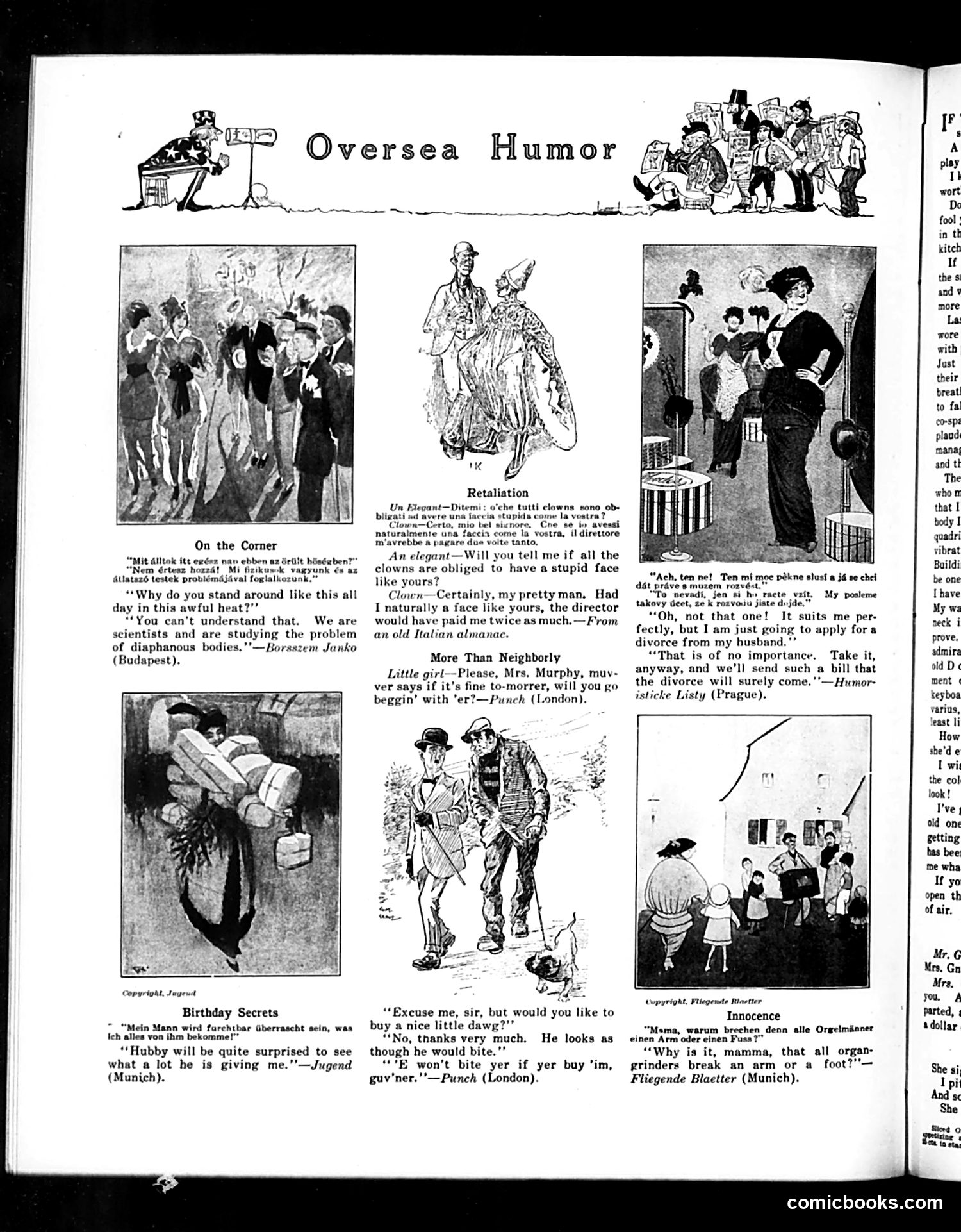
This page collects humorous anecdotes translated from European satirical magazines, demonstrating shared comedic sensibilities across cultures. The cartoons satirize everyday absurdities: **"On the Corner"** mocks pseudo-intellectual pretension—men claim to study "diaphanous bodies" as excuse for loitering in heat. **"Birthday Secrets"** plays on marital economics: a wife celebrates receiving expensive gifts, reframed as her husband's generosity becoming his own expense. **"Retaliation"** contrasts a dignified performer with a clown, suggesting physical unattractiveness is professional qualification for comedy. **"More Than Neighborly"** shows working-class desperation: a woman solicits a neighbor to help her beg; a dog seller manipulates a reluctant buyer. **"Innocence"** presents dark humor about organ grinders' injuries, with the retailer cynically suggesting sending expensive medical bills alongside the purchase—satirizing both poverty and commercial exploitation. These translated pieces emphasize universal human follies: pretension, marital strain, class struggles, and moral indifference to suffering.
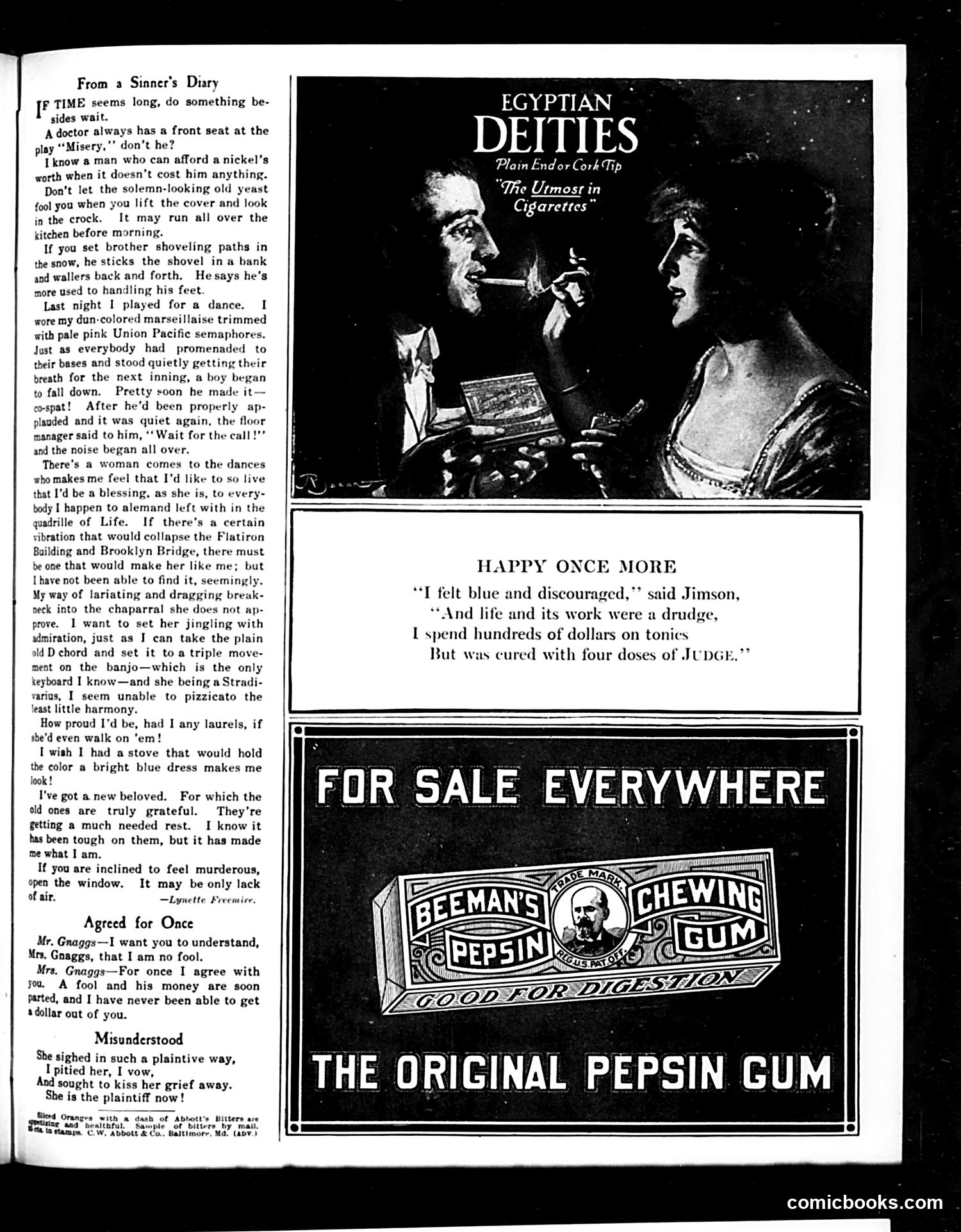
This page mixes humor writing with advertising. The left side contains diary entries and short jokes typical of Judge magazine's satirical style—witty observations about human nature ("A doctor always has a front seat at the play 'Misery'") and domestic life. The brief dialogue pieces ("Agreed for Once," "Misunderstood") use wordplay and marital tension for comedy. The right side advertises two products: Egyptian Deities cigarettes and Beeman's Pepsin Chewing Gum. Notably, there's a fake testimonial ("Happy Once More") where someone named Jimson claims "Judge" (the magazine itself, punning on the product name) cured his depression—a humorous self-advertisement. The page reflects early 20th-century advertising practices: products made dubious health claims (pepsin for digestion), and magazines freely mixed editorial content with promotional material, sometimes blurring the line between satire and actual product endorsement.
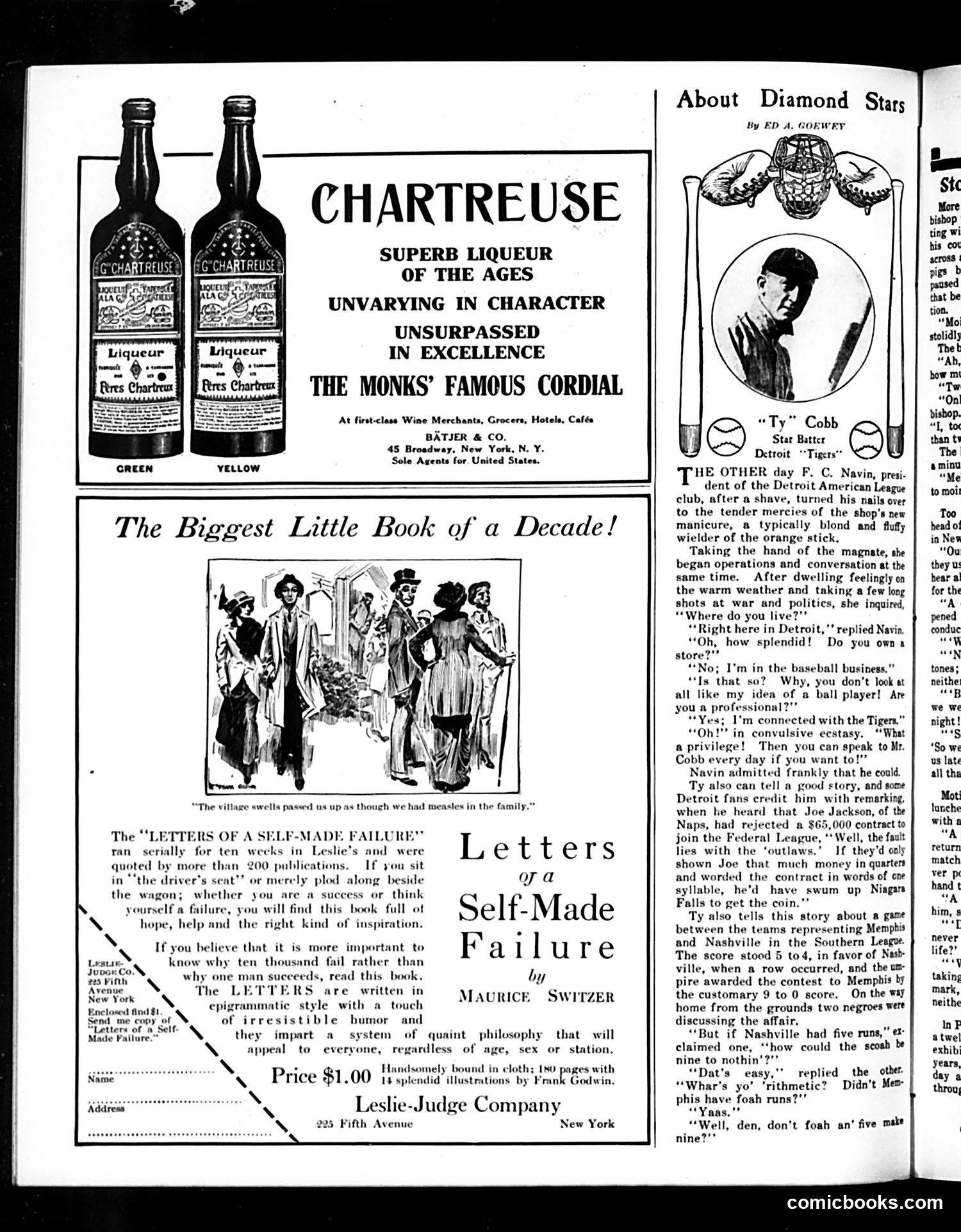
This page combines advertisements with sports humor and self-help book promotion, typical of early 20th-century Judge content. **Main Content:** The "About Diamond Stars" column by Ed A. Goewey features **Ty Cobb**, a famous Detroit Tigers baseball player. The piece presents anecdotes about Cobb and team owner F.C. Navin, trading on Cobb's reputation as a colorful personality. The humor relies on depicting a manicurist unfamiliar with baseball and a punchline joke featuring racial dialect about two Black men discussing a baseball game score—a reflection of the era's casual racist entertainment conventions. **Advertisements:** Upper left: Chartreuse liqueur ad (prominent spirits advertising of the period) Center: "Letters of a Self-Made Failure" by Maurice Switzer—a self-help book promoting inspirational philosophy through humor The page exemplifies how early 20th-century magazines blended celebrity gossip, advertising, and entertainment with casual prejudice now considered offensive.
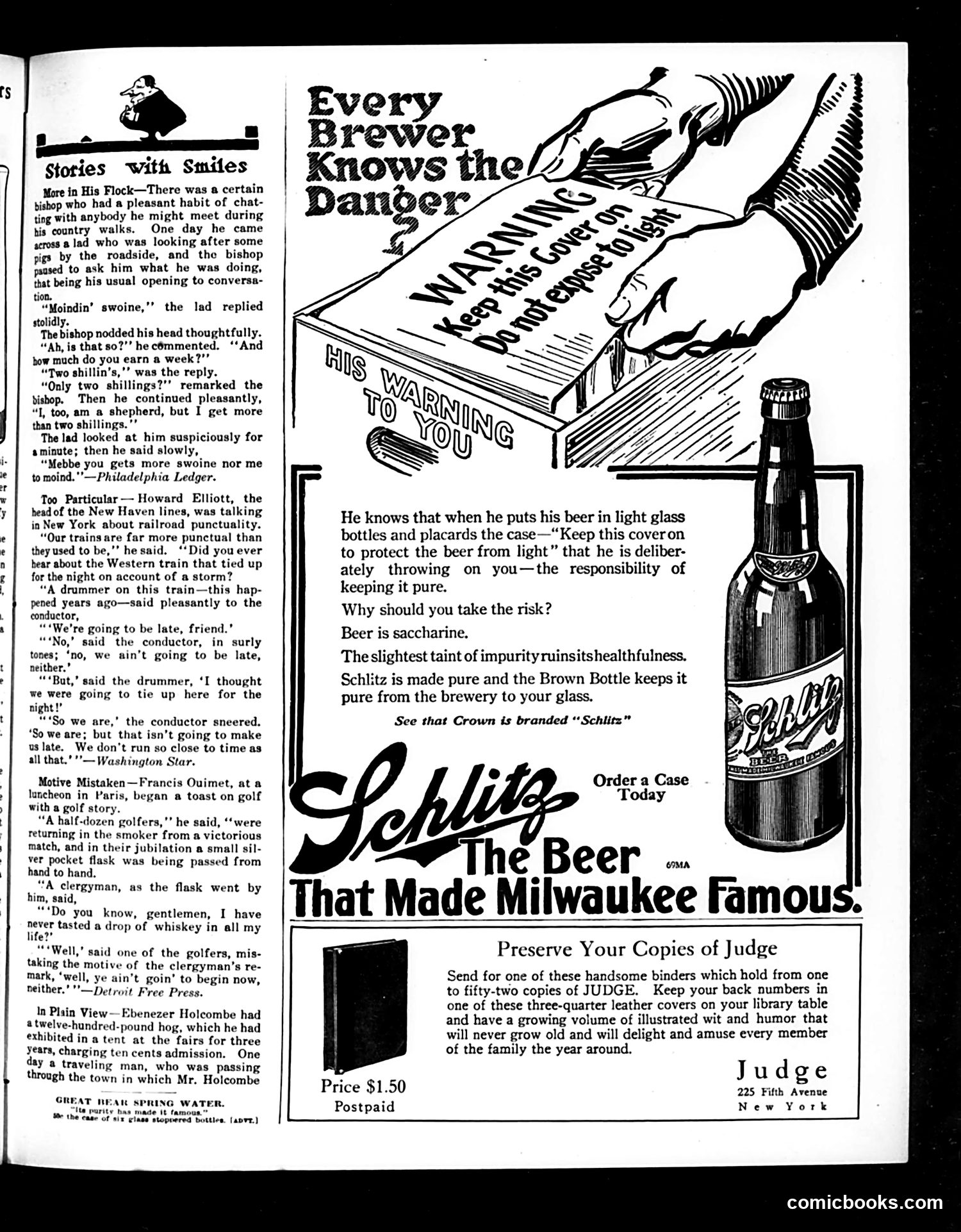
This page mixes humor columns with advertising. The left side contains three short anecdotal jokes typical of Judge's "Stories with Smiles" section—lighthearted tales about a bishop's pride, railroad punctuality absurdity, and a clergyman's misunderstood abstinence. The dominant right-side content is a **Schlitz beer advertisement**. The cartoon shows a warning hand holding a beer bottle with text about keeping covers on to protect from light. The ad's pitch exploits early 20th-century anxieties about food purity and contamination, claiming Schlitz's brown bottle uniquely protects beer from degradation—a competitive marketing claim emphasizing product superiority through scientific reasoning (though the actual benefit is debatable). Below is a smaller ad for Judge magazine's leather-bound binders, positioning the publication as collectible family entertainment. The page reflects an era when satirical magazines freely integrated advertising with editorial content, and when breweries marketed aggressively using pseudo-scientific purity claims.
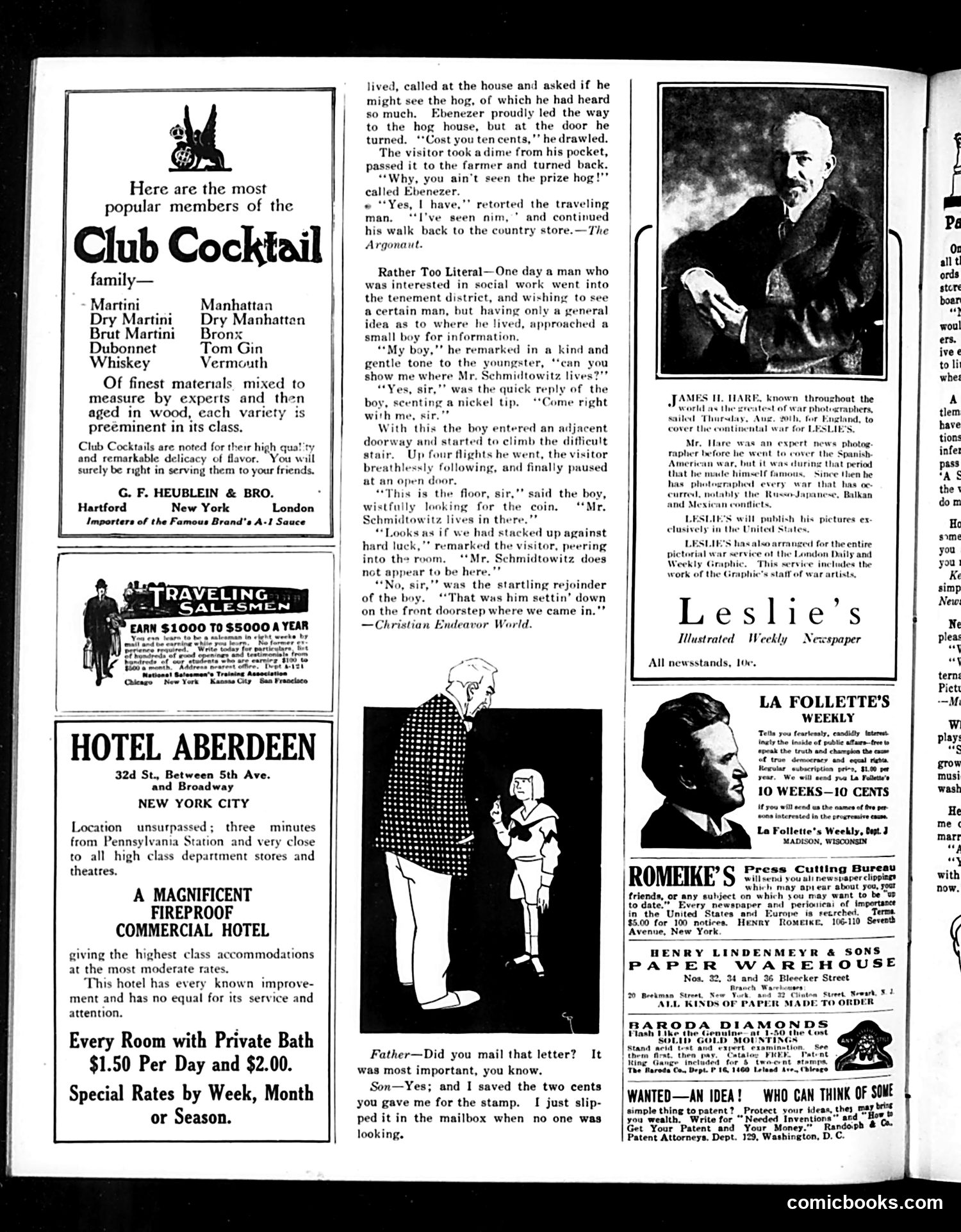
This page is primarily **advertising**, with two brief humorous anecdotes interspersed. The advertisements promote: - **Club Cocktails** (spirits/mixers) by Heublein & Bro. - **Hotel Aberdeen** in New York - **Traveling salesmen positions** (earning $1000-$5000/year) - **Leslie's Weekly** and **La Follette's Weekly** (magazines) - Various business services (press clipping bureau, paper warehouse, diamonds) - A patent/invention service The two cartoons/jokes are: 1. **"Rather Too Literal"**: A social worker asks a boy where "Mr. Schmidowitz" lives. The boy literally takes him to the correct tenement floor, then points out the man sitting on the front doorstep outside—the worker had asked to "see" the man but took it literally rather than understanding he wanted directions to the apartment. 2. **Father-Son exchange**: A boy saves two cents from postage money by mailing a letter without a stamp, not understanding postal regulations require payment. Both jokes play on misunderstandings of language and social norms typical of early 20th-century American humor.
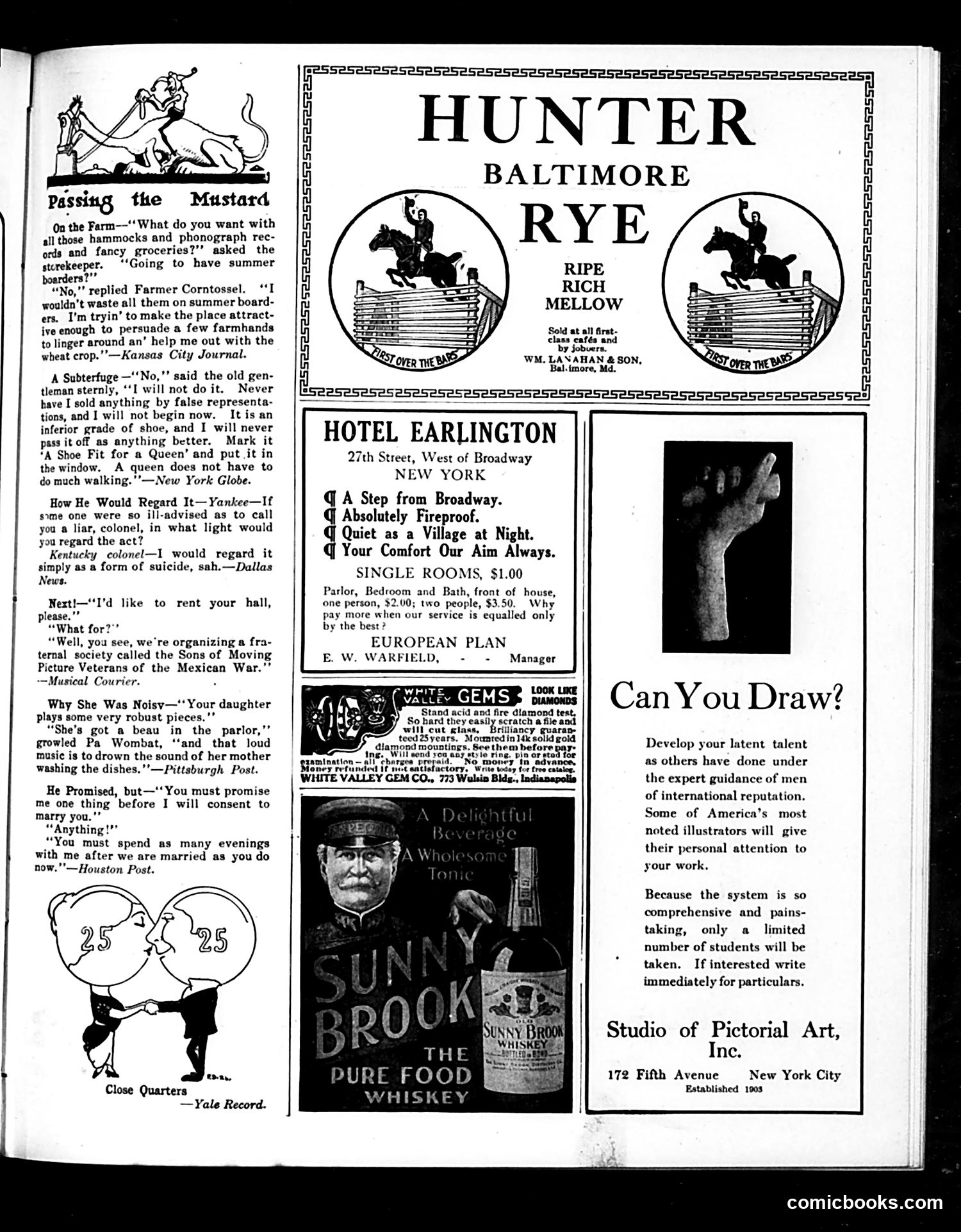
This page consists primarily of **advertisements and brief humor pieces** rather than political cartoons. The main content includes: **Humor Pieces:** Short anecdotes about rural life, business ethics, and courtship—typical of early 20th-century American humor magazines. These are largely self-explanatory jokes about farmers, shoe merchants, and romantic promises. **Advertisements:** The page features ads for Hunter Baltimore Rye whiskey, Hotel Earlington in New York, White Gems (synthetic diamonds), Sunny Brook whiskey, and a Studio of Pictorial Art offering drawing instruction. **Small cartoon:** One simple line drawing shows two men labeled "Close Quarters" from Yale Record—likely a college humor reference to cramped living conditions. The page reflects *Judge*'s format: mixing satirical commentary on American society with commercial advertising. The humor targets working-class life, small-town commerce, and romantic relationships—typical subjects for this era's satirical publications. There are no specific political figures or major social movements referenced here.
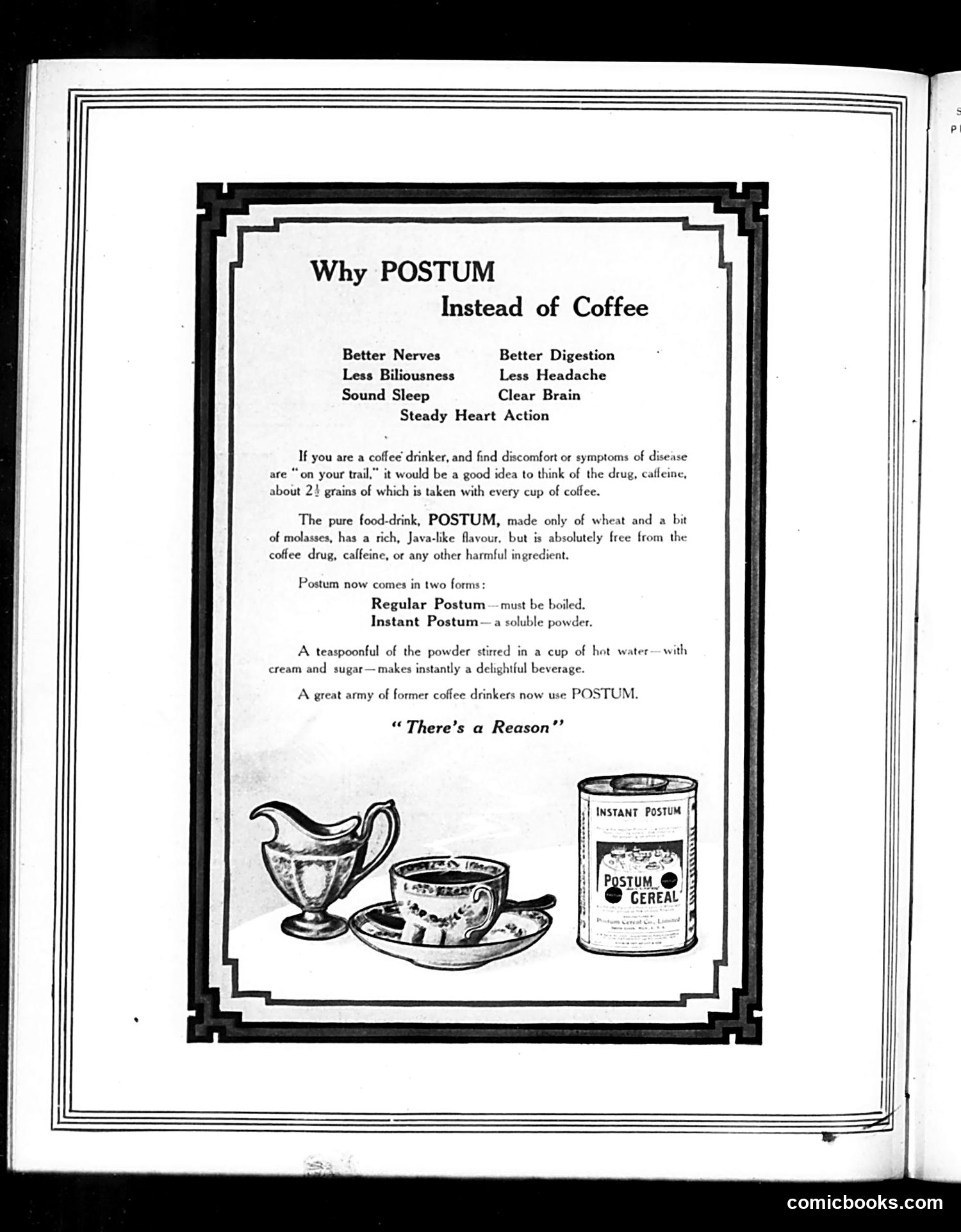
This is a **straightforward advertisement**, not satire or political commentary. It's a Postum cereal drink ad promoting a caffeine-free coffee substitute. The ad targets early 20th-century health anxieties about coffee's effects—nervousness, poor digestion, headaches, and insomnia—by listing Postum's supposed benefits: "Better Nerves," "Sound Sleep," "Clear Brain." It explicitly warns that regular coffee contains "about 2½ grains" of caffeine, framing this as a harmful "drug." Postum, made from "wheat and a bit of molasses," is presented as a pure, safe alternative with "Java-like flavour" (mimicking coffee's taste without the caffeine). The ad notes two product forms available and ends with the company's famous slogan, "There's a Reason." The illustrations show typical period dinnerware and the Postum package. This reflects genuine turn-of-the-century marketing around "pure food" movements and health-consciousness, not humor or satire.