
Judge, 1914-09-19 · page 4 of 24
Judge — September 19, 1914 — page 4: what you’re looking at
What you’re looking at
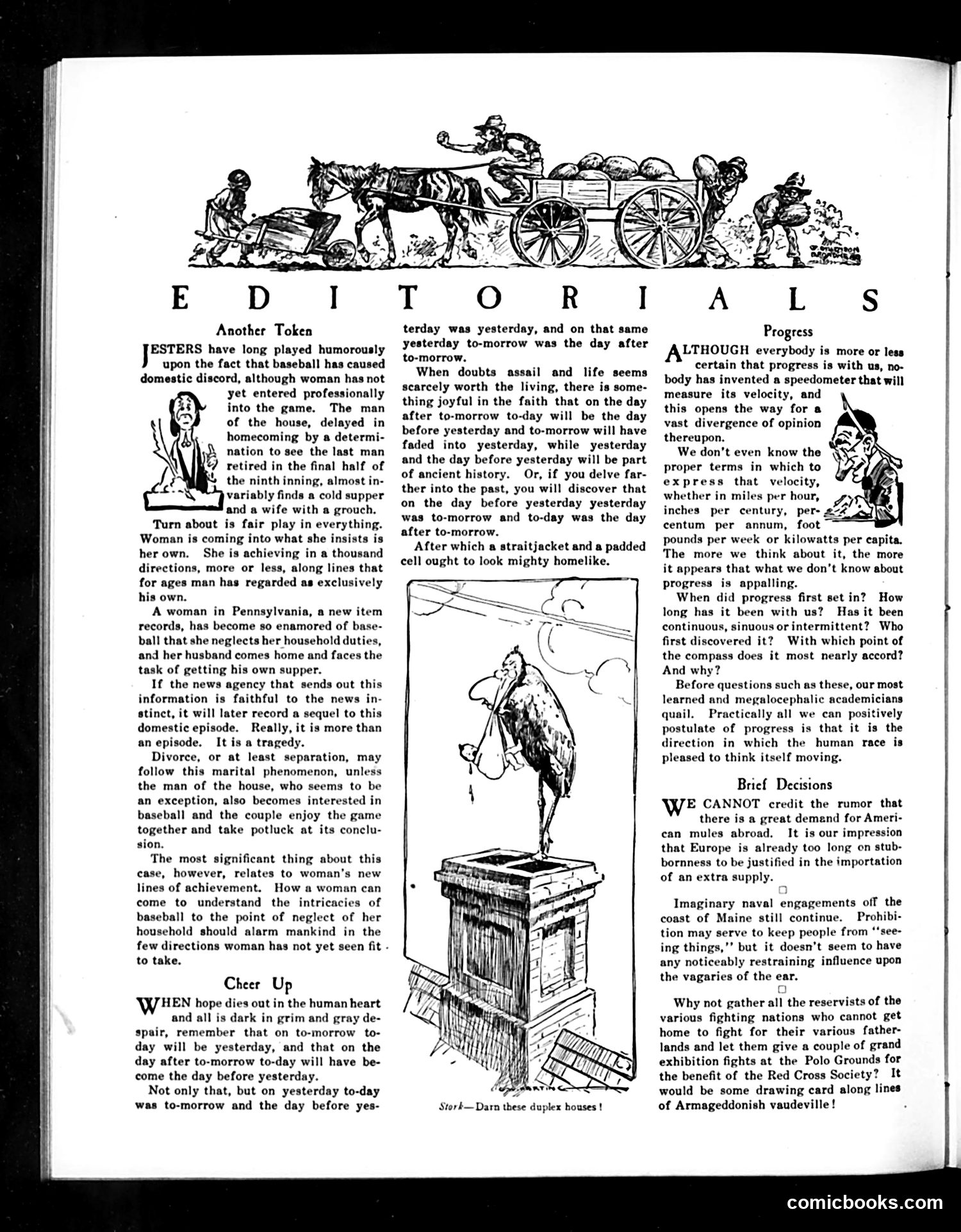
This appears to be an editorial/opinion page from *Judge* magazine featuring three distinct sections: **"Another Token"** discusses a Pennsylvania woman who became obsessed with baseball after her husband entered the game professionally. The satire suggests women's newfound interest in sports reflects changing social roles—previously considered a domestic distraction, baseball now represents women's expanding sphere of influence beyond household concerns. **"Cheer Up"** offers philosophical musings about time's relativity (yesterday/tomorrow conceptual wordplay), arguing optimism should sustain people through hardship. **"Brief Decisions"** contains short political commentary, including skepticism about American demand for rules abroad and mockery of imaginary naval conflicts. The accompanying illustrations appear to be generic satirical cartoons rather than caricatures of specific identified figures.
📄 Transcribed text from this page (OCR, searchable)
Machine-transcribed from the original scan — historical spelling and the odd misread are preserved.
Another Token ESTERS have long played humorously upon the fact that baseball has caused domestic discord, although woman has not yet entered professionally into the game. The man of the house, delayed in homecoming by a determi- nation to see the last man retired in the final half of the ninth inning, almost in- variably finds a cold supper and a wife with a grouch. Turn about is fair play in everything. Woman is coming into what she insists is her own. She is achieving in a thousand directions, more or less, along lines that for ages man has regarded as exclusively his own. A woman in Pennsylvania, a new item records, has become so enamored of basi ball that she neglects her household duties, and her husband comes home and faces the task of getting his own supper. If the news agency that sends out this information is faithful to the news in- stinct, it will later record a sequel to this domestic episode. Really, it is more than an episode. It is a tragedy. Divorce, or at least separation, may follow this marital phenomenon, unless the man of the house, who seems to be an exception, also becomes interested in baseball and the couple enjoy the game together and take potluck at its conclu- sion. The most significant thing about this case, however, relates to woman's new lines of achievement. How a woman can come to understand the intricacies of baseball to the point of neglect of her household should alarm mankind in the few directions woman has not yet seen fit - to take. Cheer Up WHEN hope dies out in the human heart and all is dark in grim and gray de- spair, remember that on to-morrow to- day will be yesterday, and that on the day after to-morrow to-day will have be- come the day before yesterday. Not only that, but on yesterday to-day was to-morrow and the day before yes- terday was yesterday, and on that same yesterday to-morrow was the day after to-morrow. When doubts assail and life seems scarcely worth the living, there is some- thing joyful in the faith that on the day after to-morrow to-day will be the day before yesterday and to-morrow will have faded into yesterday, while yesterday and the day before yesterday will be part of ancient history. Or, if you delve far- ther into the past, you will discover that on the day before yesterday yesterday was to-morrow and to-day was the day after to-morrow After which a straitjacket and a padded cell ought to look mighty homelike. Stork—Darn these duplex houses ! Progress ALTHOUGH everybody is more or less certain that progress is with us, no- body has invented a speedometer that will measure its velocity, and this opens the way for a vast divergence of opinion thereupon. We don’t even know the proper terms in which to express that velocity, whether in miles per hour, yy inches per century, per- af centum per annum, foot — pounds per week or kilowatts per capita, The more we think about it, the more it appears that what we don’t know about progress is appalling. When did progress first set in? How long has it been with us? Has it been continuous, sinuous orintermittent?) Who first discovered it? With which point of the compass does it most nearly accord? And why? Before questions such as these, our most learned and megalocephalic academicians quail. Practically all we can positively postulate of progress is that it is the direction in which the human race is pleased to think itself moving. Brief Decisions 'E CANNOT credit the rumor that there is a great demand for Ameri- can mules abroad. It is our impression that Europe is already too long on stub- bornness to be justified in the importation of an extra supply. Imaginary naval engagements off the coast of Maine still continue. Prohibi- tion may serve to keep people from “‘see- ing things,’’ but it doesn’t seem to have any noticeably restraining influence upon the vagaries of the ear. Why not gather all the reservists of the various fighting nations who cannot get home to fight for their various father- lands and let them give a couple of grand exhibition fights at the Polo Grounds for the benefit of the Red Cross Society? It would be some drawing card along lines of Armageddonish vaudeville! comicbooks.com