
A complete issue · 24 pages · 1914
Judge — September 5, 1914
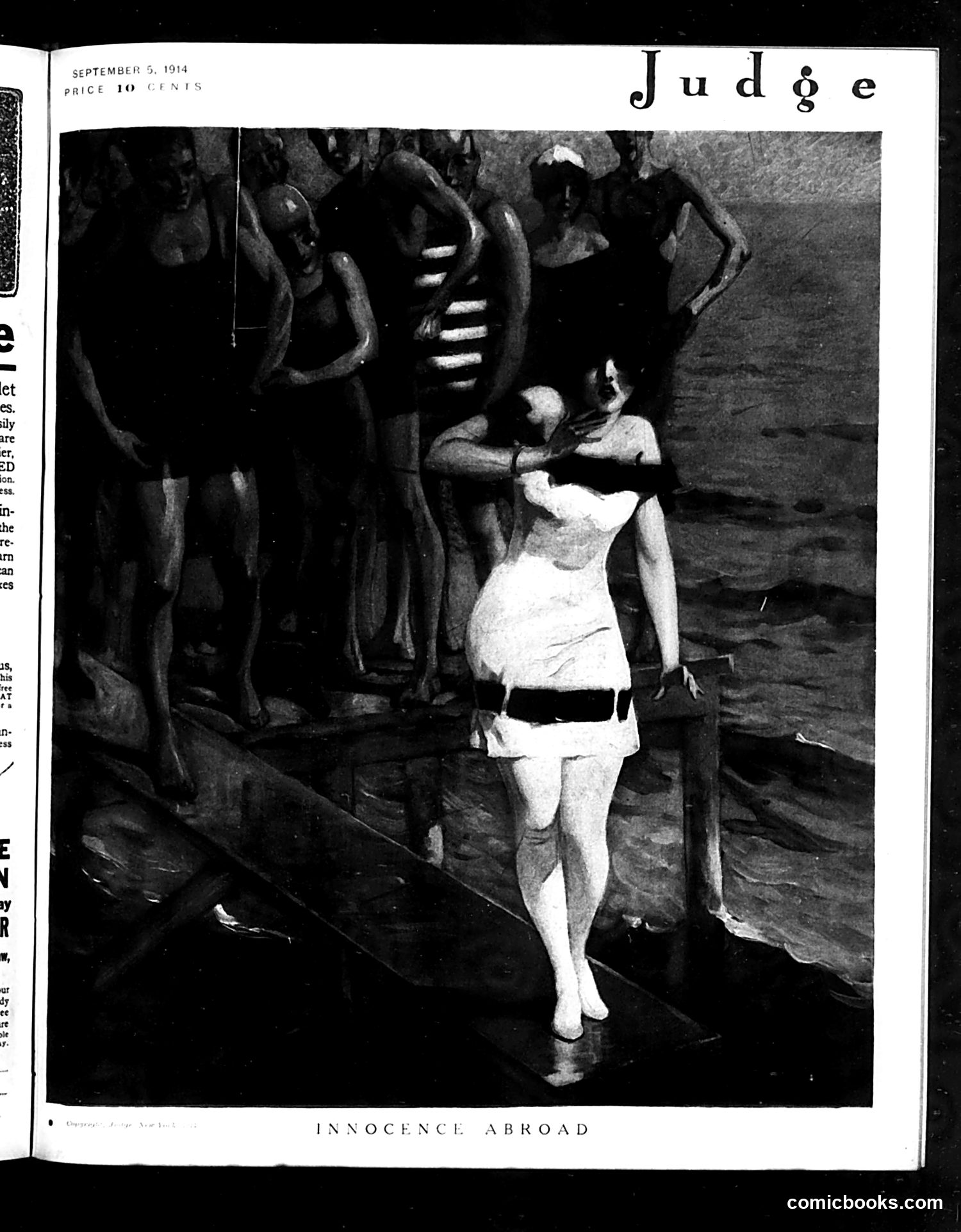
This satirical image depicts a young white woman in Western dress surrounded by darker-skinned figures, likely representing indigenous or colonial peoples. The caption "Innocence Abroad" suggests commentary on American women traveling to foreign lands. The satire likely critiques either: 1. Western naiveté about foreign cultures and potential dangers 2. The vulnerability or exploitation of American women in colonial contexts 3. Contemporary anxieties about American expansion and cultural contact abroad Given 1914's date—early WWI era—this may reference anxieties about Americans traveling in unstable regions. The woman's composed demeanor contrasts with her precarious situation, emphasizing the "innocence" of the title. The image reflects period attitudes about race, gender, and American cultural superiority, though the exact referenced incident remains unclear.
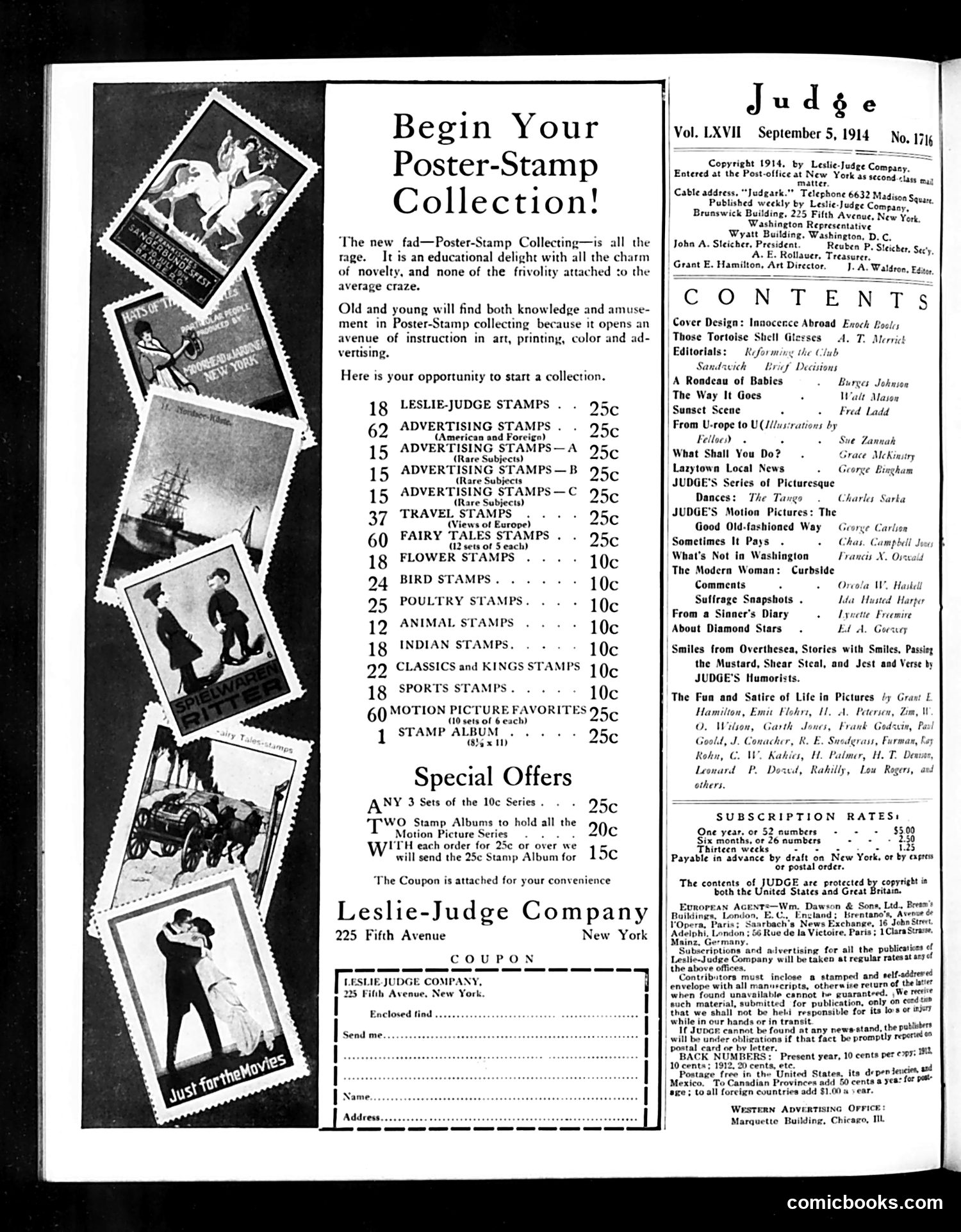
This page is primarily **advertising rather than political satire**. It promotes Leslie-Judge Company's new "Poster-Stamp Collecting" craze—small decorative stamps featuring movie stars, travel scenes, fairy tales, and other subjects, sold in sets for 10-25 cents. The left side displays sample stamp designs showing what appears to be silent film imagery and romantic scenes typical of 1914 entertainment. The advertisement frames stamp collecting as an educational hobby combining "instruction in art, printing, color and advertising." The bottom contains an order coupon for various stamp sets and albums. This reflects early 20th-century marketing strategy: creating collectible products to build consumer engagement and brand loyalty. **No political commentary is evident.** This is commercial promotion typical of Judge's mixed editorial-advertising format.
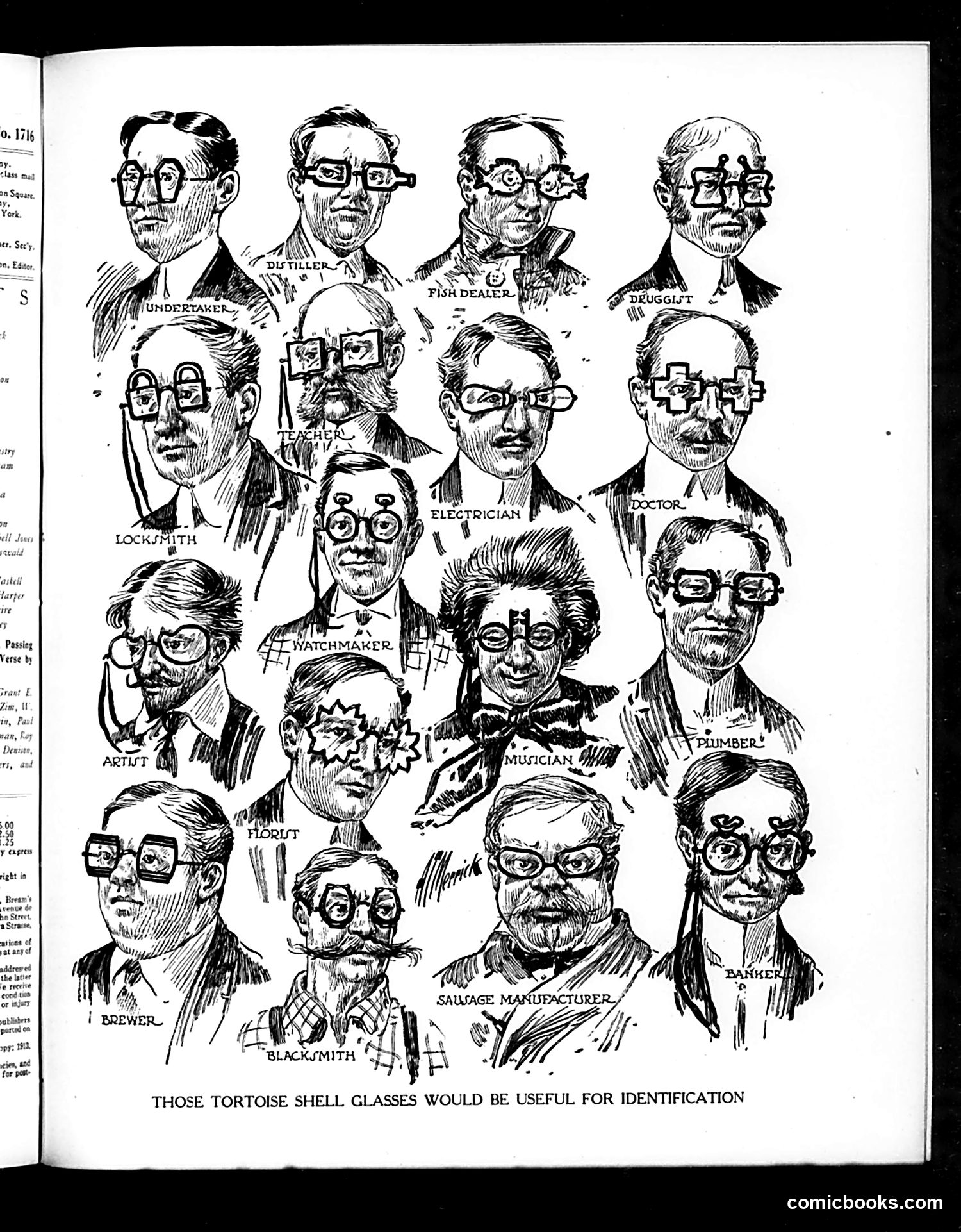
This cartoon from *Judge* magazine satirizes various working-class and merchant professions through exaggerated caricature. Each figure wears tortoise-shell glasses—a distinctive accessory—and is labeled by trade: undertaker, distiller, fish dealer, druggist, locksmith, electrician, doctor, watchmaker, artist, musician, plumber, brewer, blacksmith, salvage manufacturer, and banker. The caption "Those tortoise shell glasses would be useful for identification" suggests the joke: these glasses supposedly make each profession's practitioners instantly recognizable. The satire likely mocks either the stereotypical appearance of tradespeople or contemporary fashion trends where tortoise-shell frames were fashionable. Without additional context, the specific satirical target remains unclear—whether it critiques class distinctions, professional vanity, or simply pokes fun at a widespread eyewear trend.
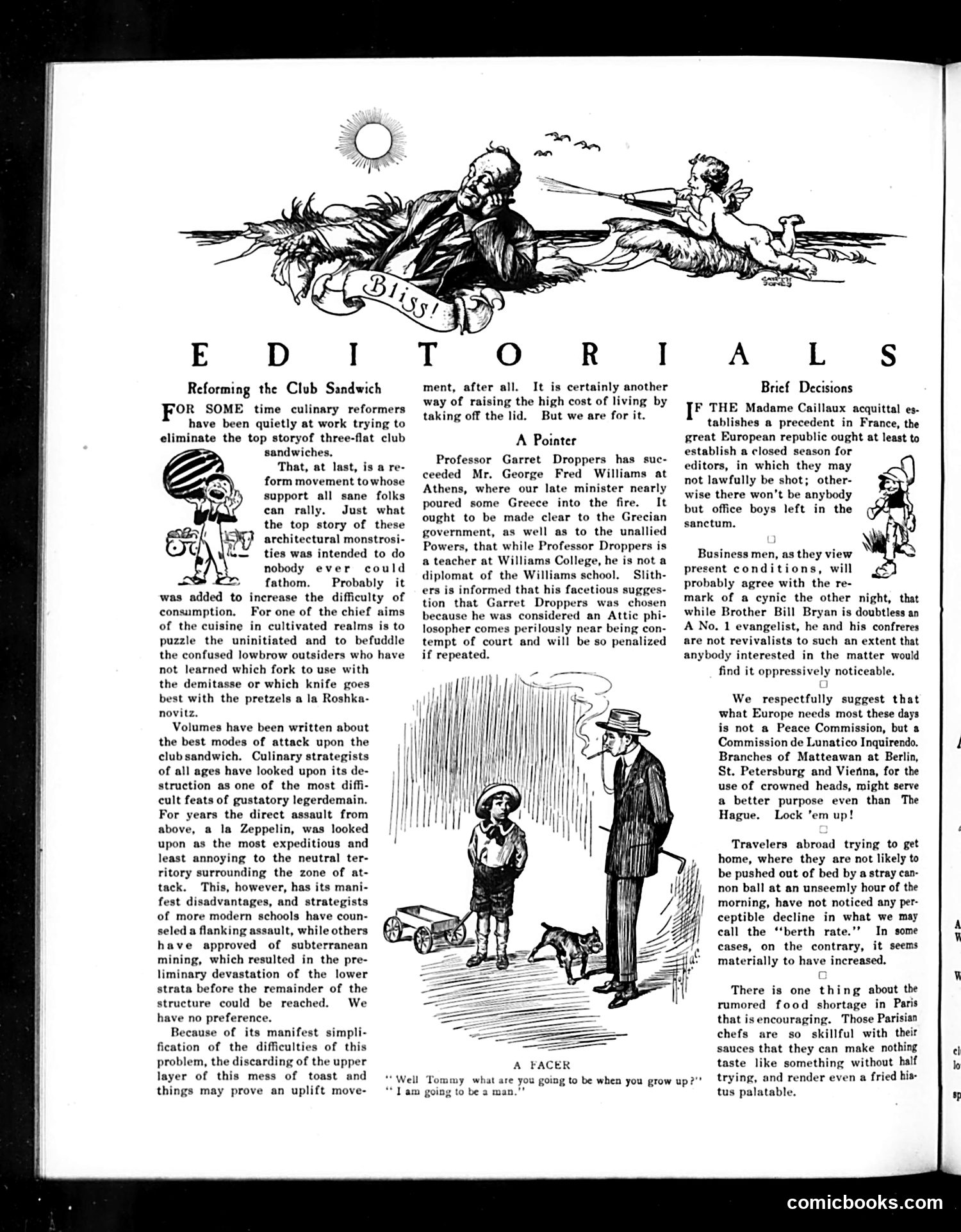
The main article critiques efforts to "reform" the club sandwich by eliminating its top layer of toast—a cost-cutting measure during what appears to be economic hardship. The author argues this simplification, while reducing consumption difficulty, misses the point: the real solution to high living costs is taking "the lid" off prices, not redesigning food. The accompanying cartoons illustrate kitchen/food service scenarios. The lower cartoon shows a child telling an adult "Well Tommy what are you going to be when you grow up?" with the reply "I am going to be a man"—likely satirizing how economic hardship is prematurely forcing childhood to end. The satire targets both culinary absurdism and broader economic anxiety of the era.
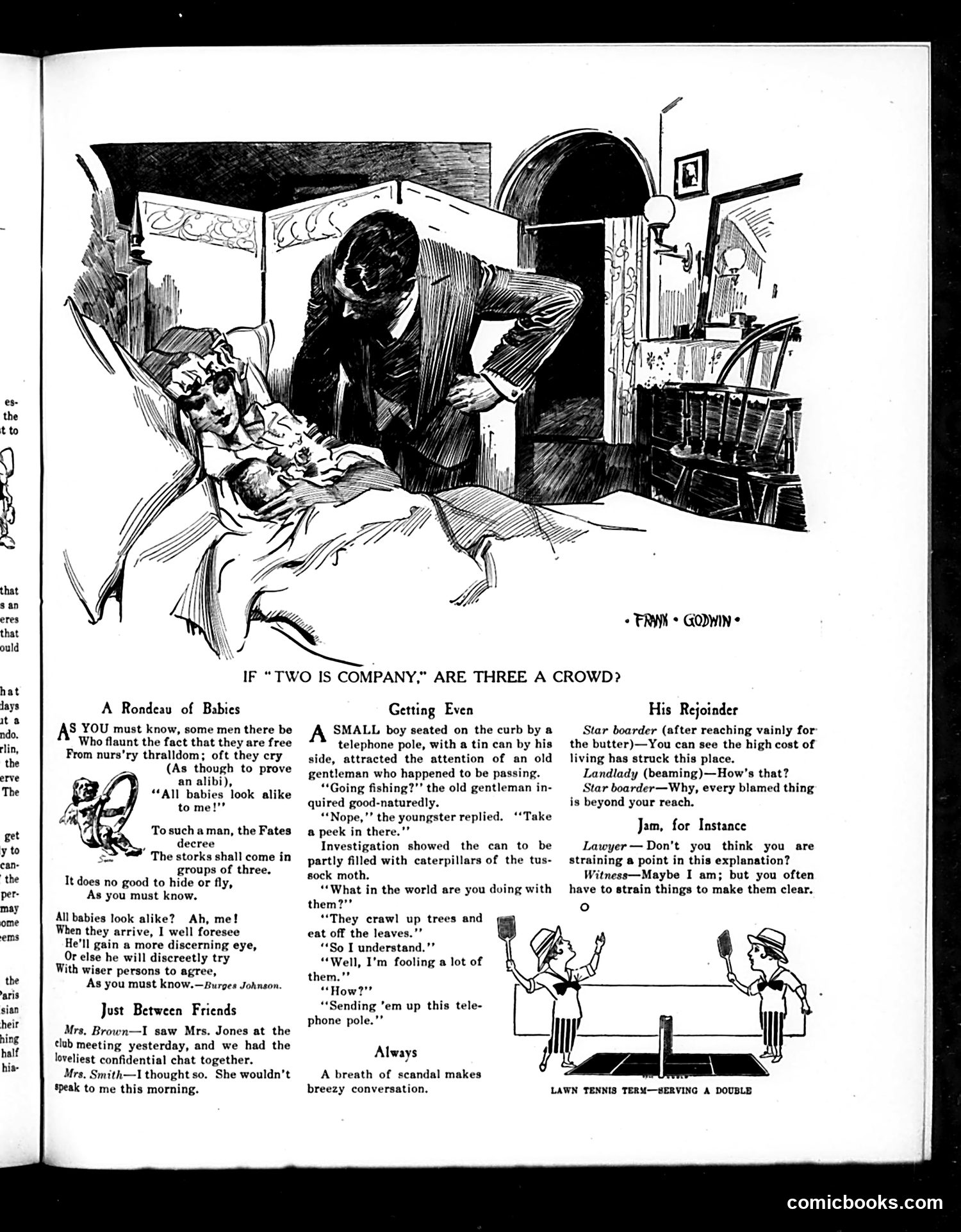
This page contains **humorous sketches and brief comic pieces** rather than political cartoons. The main illustration shows a doctor examining a sick child in bed while the mother watches—captioning "If 'Two Is Company,' Are Three a Crowd?" The surrounding text pieces are domestic humor: "A Rondeau of Babies" jokes about babies arriving in groups of three, "Just Between Friends" satirizes women's gossip, and "His Rejoinder" presents a married couple's banter about the husband's excuses. "Getting Even" depicts a boy fishing from a telephone pole, catching caterpillars. The final cartoon shows two lawn tennis players, illustrating "Always: A breath of scandal makes breezy conversation." These are **lighthearted social satires** about everyday life, domestic relations, and contemporary manners—typical Judge magazine fare emphasizing middle-class humor over political commentary.
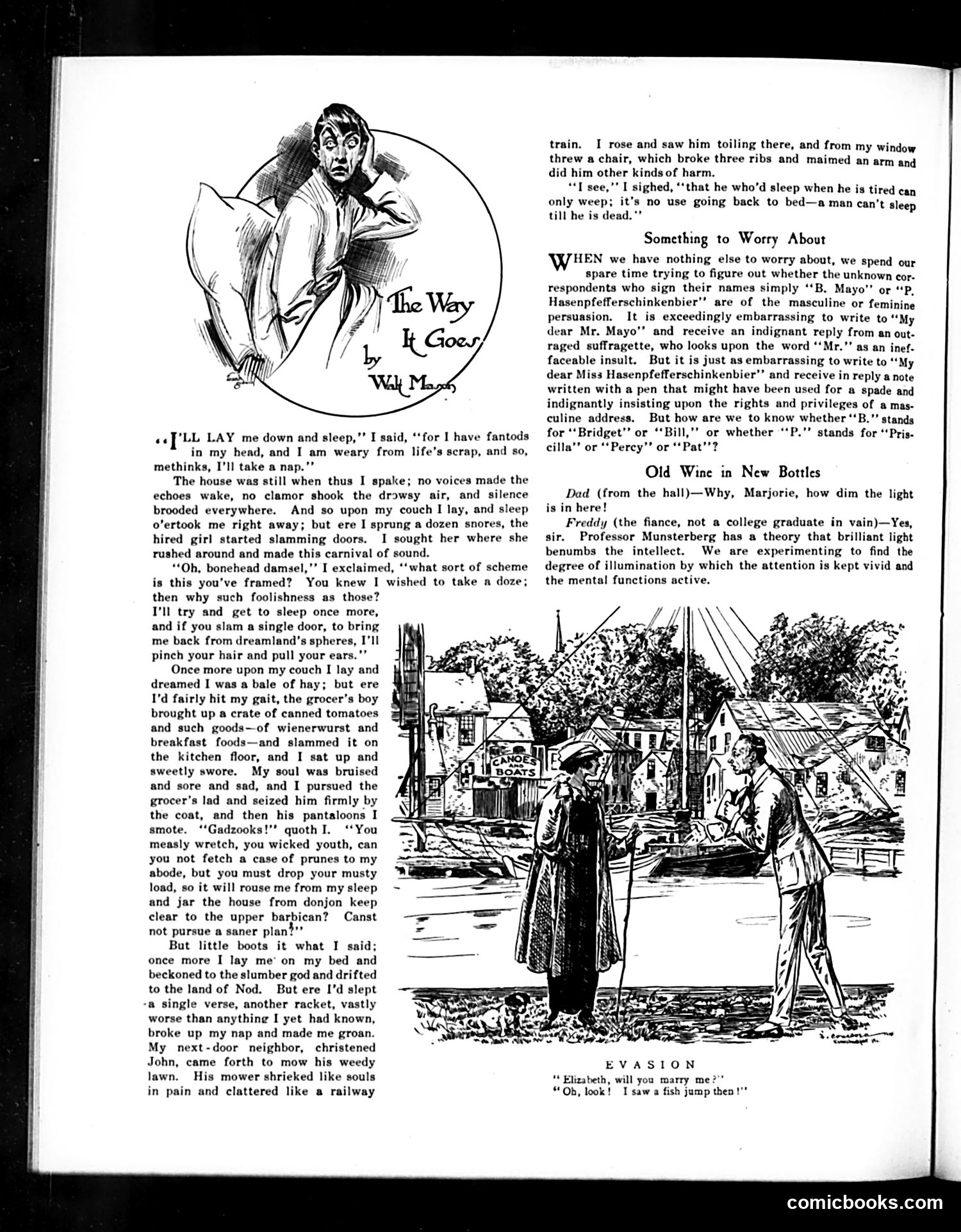
This page contains three satirical pieces typical of early 20th-century American humor: **"The Very Way It Goes"** (top): A narrative comic about a man trying to sleep but repeatedly disrupted by household noise—a maid slamming doors, a grocer's boy, a neighbor mowing. His escalating violent responses to each interruption (throwing a chair that breaks the neighbor's ribs) satirize urban domestic frustration and the comedic absurdity of disproportionate reactions to minor annoyances. **"Something to Worry About"** (middle): Social satire about magazine correspondents with ambiguous names like "B. Mayo" or "P. Hasenpfefferschinkenbier." The joke mocks both the embarrassment of misgendering readers AND the emerging women's suffrage movement—the "outraged suffragette" who objects to being addressed as "Mr." represents contemporary anxiety about changing gender roles. **"Old Wine in New Bottles"** (bottom): A brief scene where a young man (Freddy) uses pseudo-scientific psychology to justify dimming lights during courtship, fooling the father. The satire targets both fashionable intellectual pretense and dating deception.
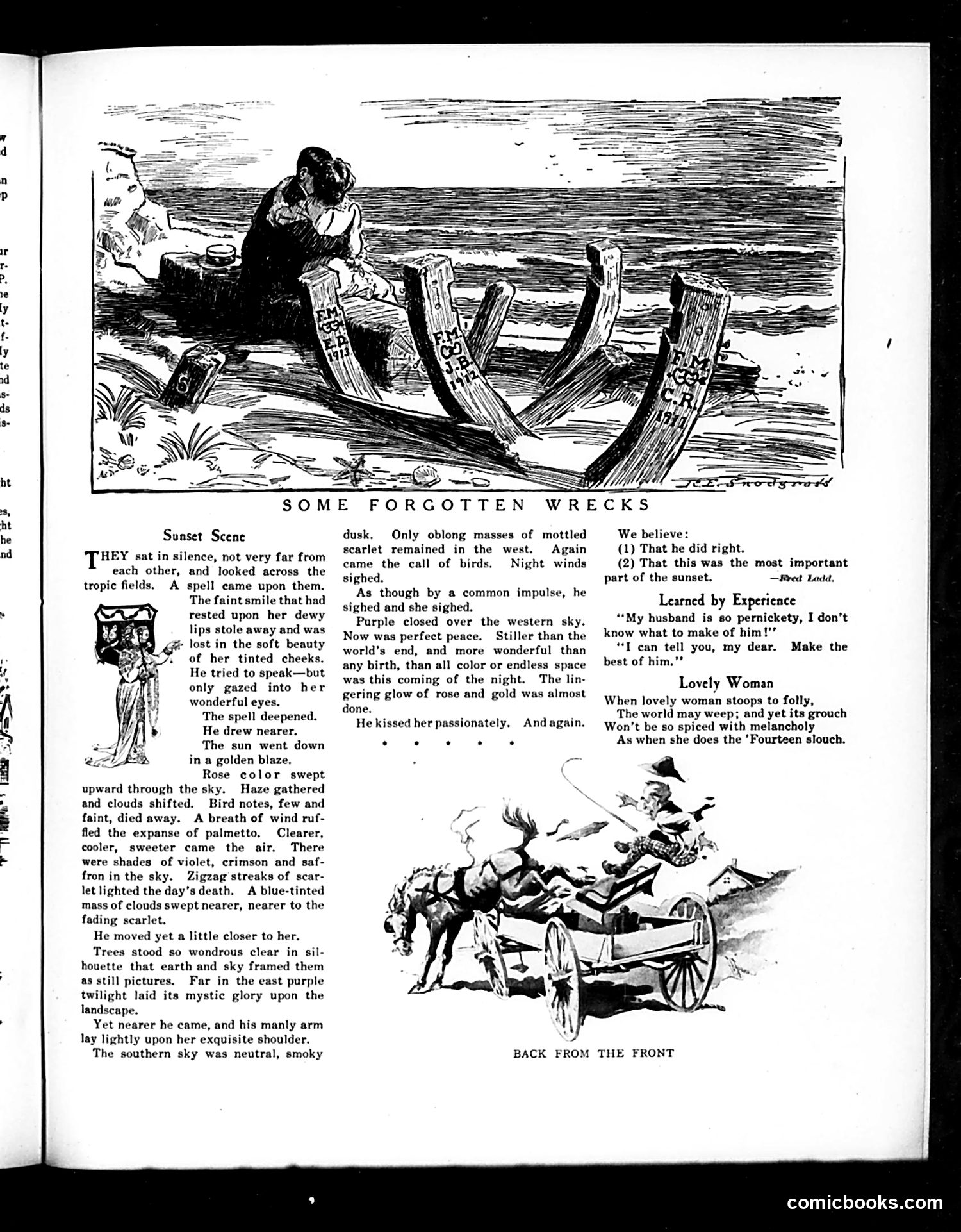
This page contains romantic and social humor typical of early 20th-century Judge magazine. **"Some Forgotten Wrecks - Sunset Scene"**: A sentimental romantic narrative where a couple shares an intimate sunset moment. The satire lies in the editors' commentary appended as "We believe," which reduces the entire poetic buildup to the punchline that the kiss—not the elaborate natural description—is "the most important part of the sunset." This mocks both overwrought romantic literature and male priorities. **"Learned by Experience"**: A brief domestic humor piece about a wife frustrated with her particular husband, with a spouse offering practical advice to "make the best of him"—typical period commentary on marriage adjustment. **"Lovely Woman"**: Light verse mocking the "Fourteen slouch" (a fashionable posture or dance move of the era), suggesting women's modern affectations are less sympathetic than traditional feminine "folly." **"Back from the Front"**: An illustration (likely referencing WWI) shows a soldier returning home in a cart, though context is limited. The page emphasizes romantic, domestic, and social satire rather than political commentary.
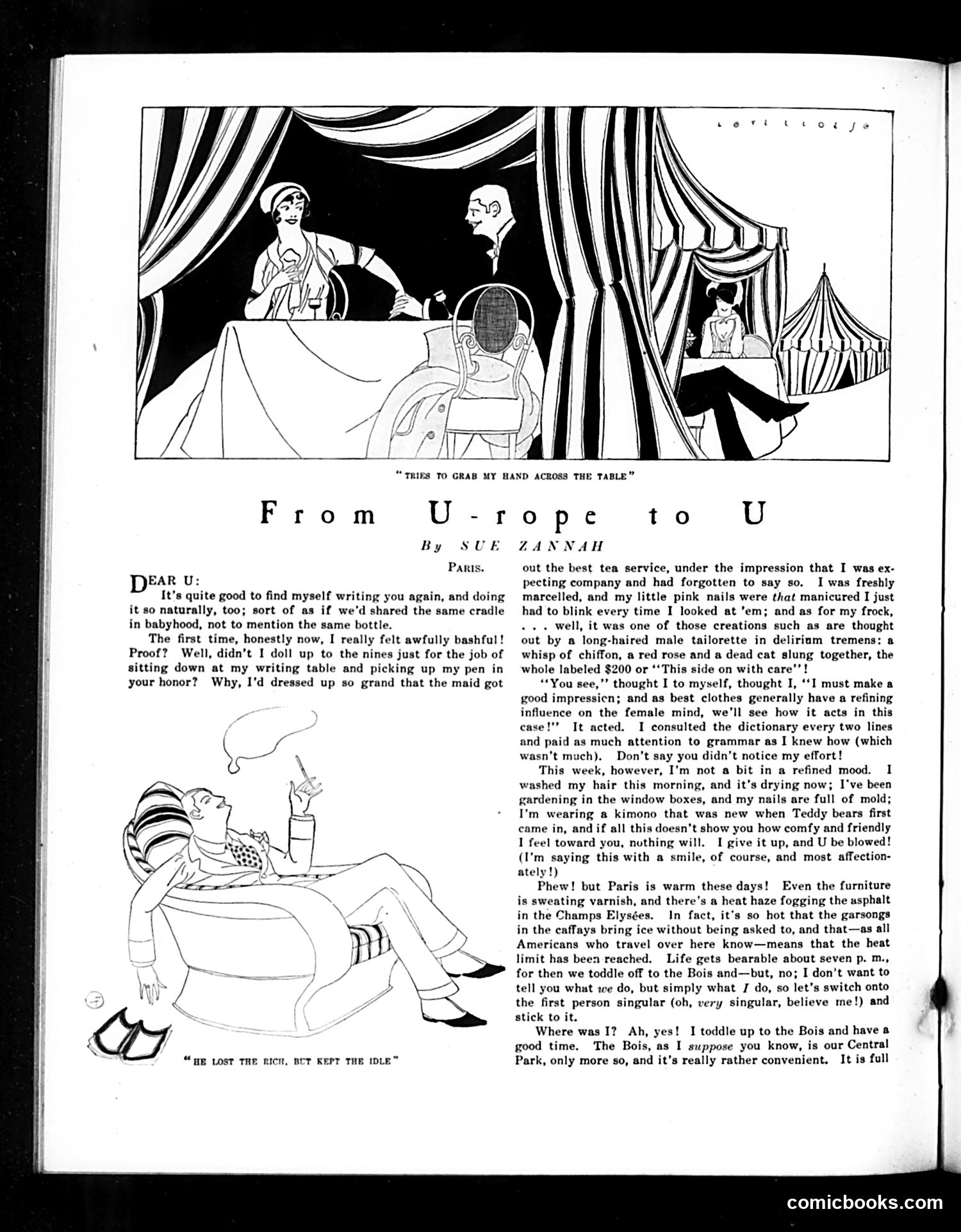
This is a humorous letter from Sue Zannah in Paris to a friend "U" (likely the magazine's reader). The cartoons illustrate the letter's themes of romantic pursuit and social pretense. **Top cartoon**: Shows a woman at a dining table with a man attempting to hold her hand across it—depicting the awkward flirtation referenced in the caption. **Bottom cartoon**: Titled "He Lost the Rich, But Kept the Idle," shows a woman lounging idly, likely satirizing how some women of leisure spent their time. **The satire**: Sue humorously describes her attempts to impress U through elaborate dress and proper grammar, then admits she's abandoned this facade. She's now comfortable in old clothes, describing Paris's summer heat and her leisurely activities at the Bois (a fashionable park). The joke targets the performative nature of courtship and wealthy women's idle lifestyles—Sue presents herself as refreshingly authentic compared to typical social pretense of the era.
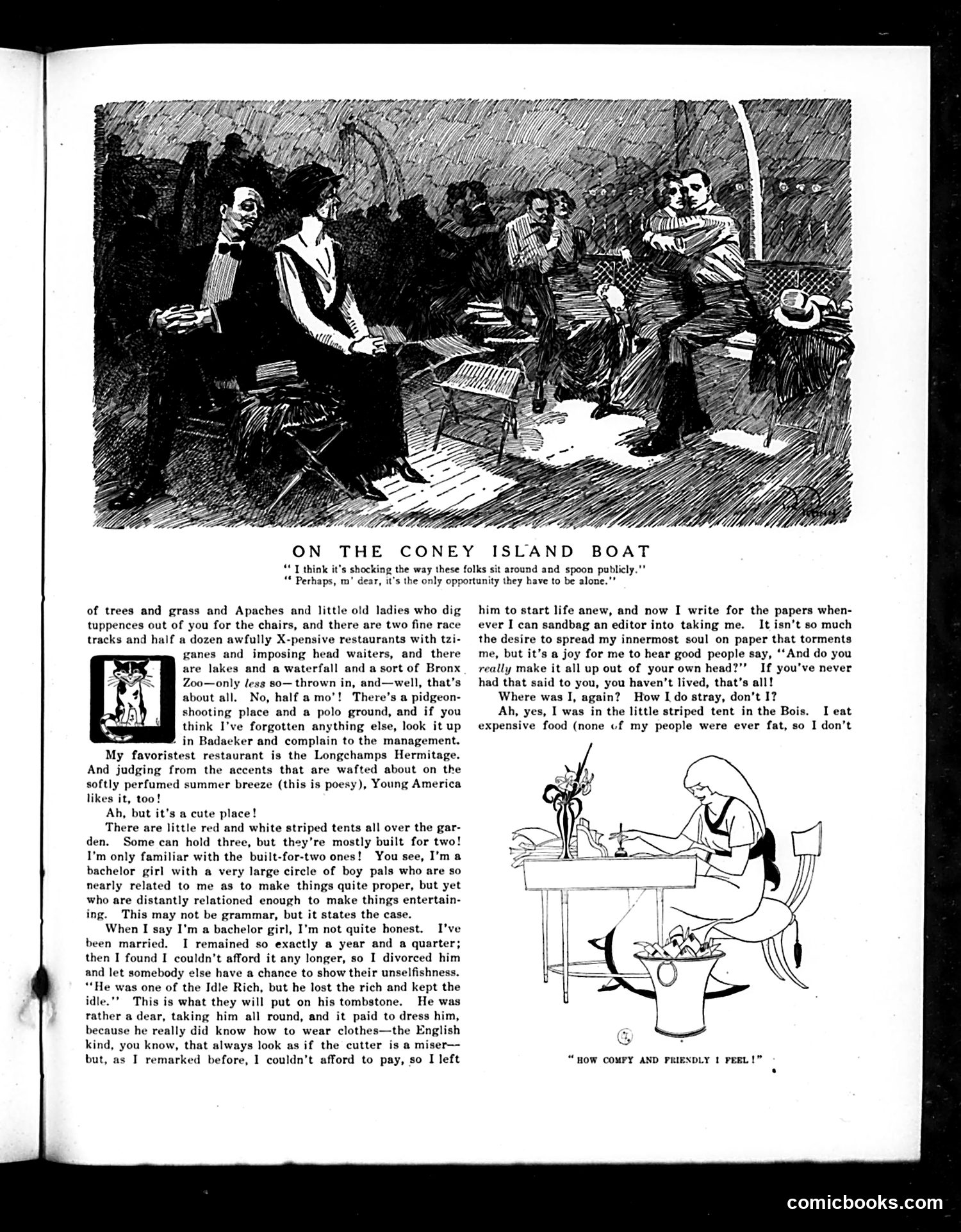
This page satirizes early 20th-century courtship customs and the "bachelor girl" phenomenon. The top cartoon mocks prudish Victorian attitudes: two observers criticize couples "spooning" (kissing/cuddling) publicly at Coney Island, unaware that the tent enclosures exist *precisely* to give young people private moments—making their criticism ironic. The accompanying text is a first-person narrative by a witty, unmarried woman writer describing her social life. She humorously discusses dating multiple male relatives (kept "proper" through distant relation), her failed marriage to an idle rich man who wouldn't work, and now supporting herself by writing for newspapers—a relatively unconventional life for a woman of that era. The lower illustration shows her dining alone at a restaurant, appearing content. The satire targets both prudish social hypocrisy about romance and celebrates the emerging "New Woman"—economically independent, romantically autonomous, and unashamed of her unconventional choices. The piece gently mocks both conservative morality and the performative nature of early-1900s social respectability.
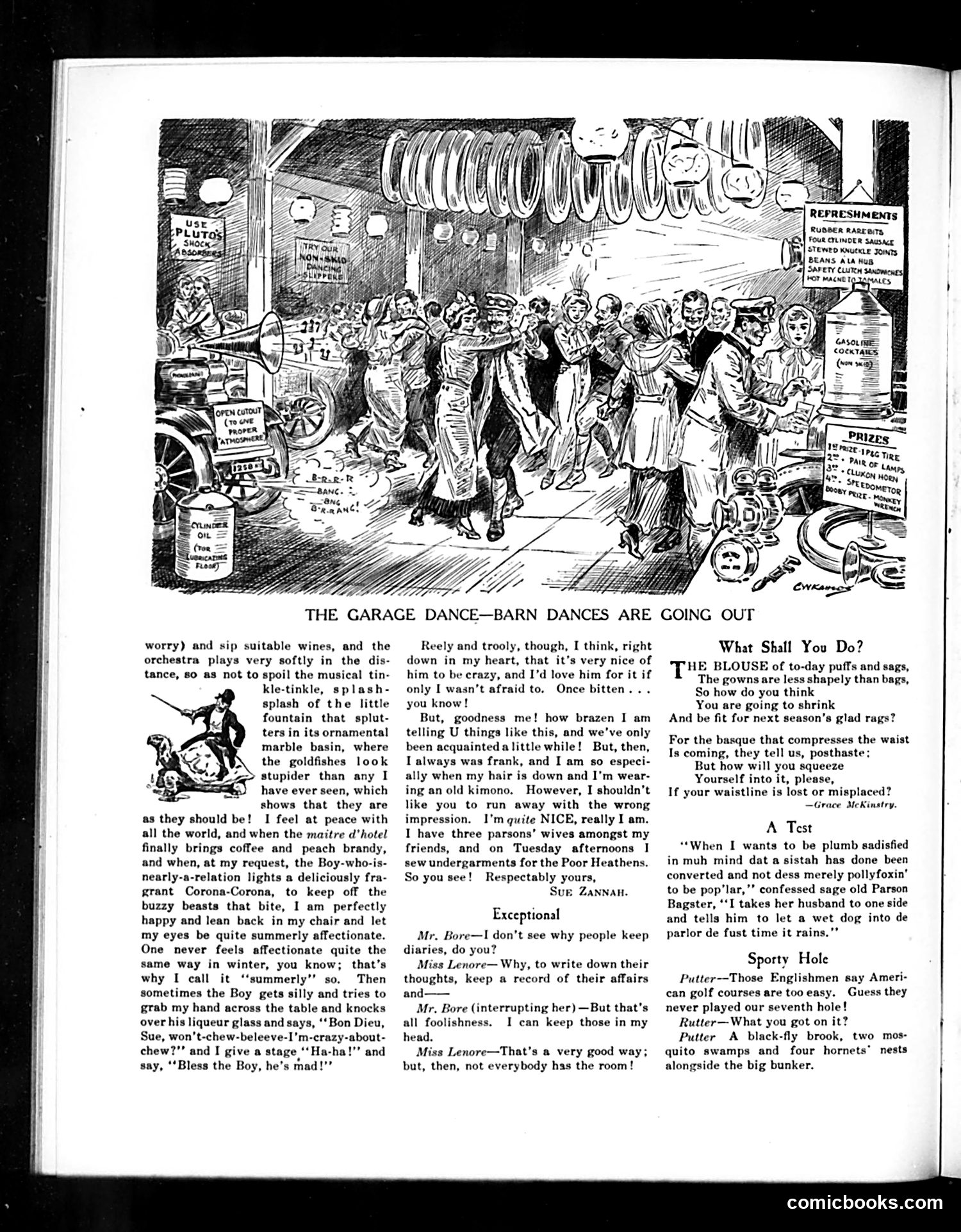
The main cartoon depicts a lively barn dance in a garage—a modern, working-class alternative to formal ballroom dancing. The setting satirizes how "barn dances are going out," suggesting that even rural or casual entertainment is becoming urbanized and commercialized. Visible are refreshment stands advertising mundane items (rubber raincoats, sausages, safety cloth) and "prizes," mocking how even informal social gatherings now involve commercial transactions. The accompanying text features humorous domestic vignettes: a woman's romantic musings about a French suitor, a witty exchange where Miss Lenore insults Mr. Bore's memory capacity, and period jokes about women's fashion (the "blouse" and "basque" corset challenges). Overall, the page satirizes early 20th-century social pretension, commercialization of leisure, and gender relations—poking fun at both bohemian affectations and stuffy propriety while mocking modern women navigating conflicting fashion demands.
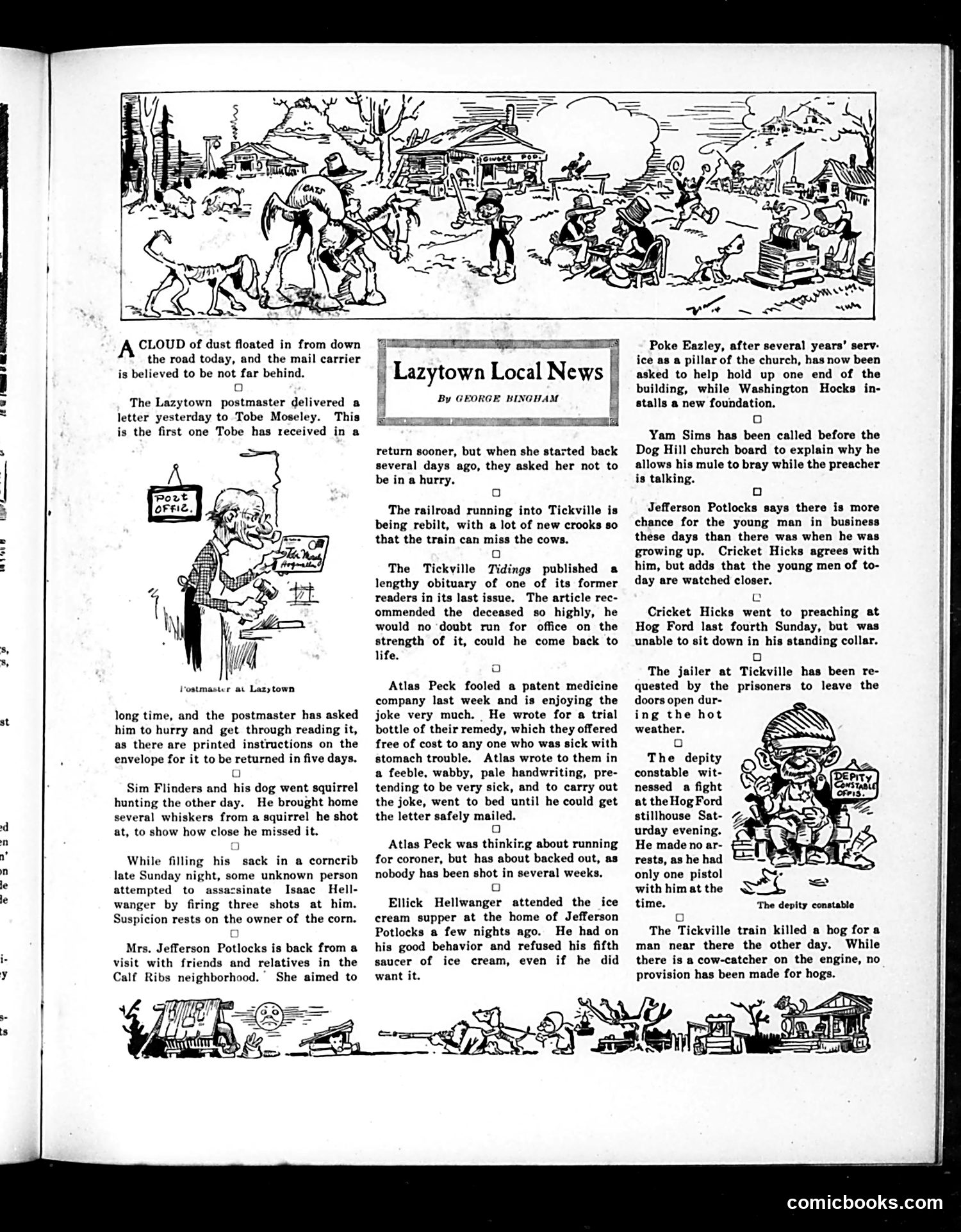
This is a humorous rural gossip column parodying small-town life. The satire targets provincial absurdities and lazy incompetence: **Key satirical points:** - **Mail service incompetence:** A letter takes so long to arrive that printed instructions demand its return within five days—impossible given delivery delays. - **Rural violence & danger:** Casual shooting incidents (Isaac Hellwanger, Atlas Peck considering running for coroner despite no recent shootings) mock frontier carelessness. - **Self-deception:** Atlas Peck tricks a patent medicine company by feigning illness—satirizing both the fraudulent remedy industry and rural gullibility. - **Social hypocrisy:** Characters like Ellick Hellwanger performing "good behavior" by refusing a fifth ice cream serve illustrate small-town moral pretense. - **Infrastructure neglect:** Trains require special tracks to avoid cows; no provisions exist for hogs—mocking rural disorder. The overall effect ridicules backwoods inefficiency, petty feuds, and the gap between rural self-image and actual chaos. The cartoonish illustrations reinforce the mockery of "Lazytown" life.
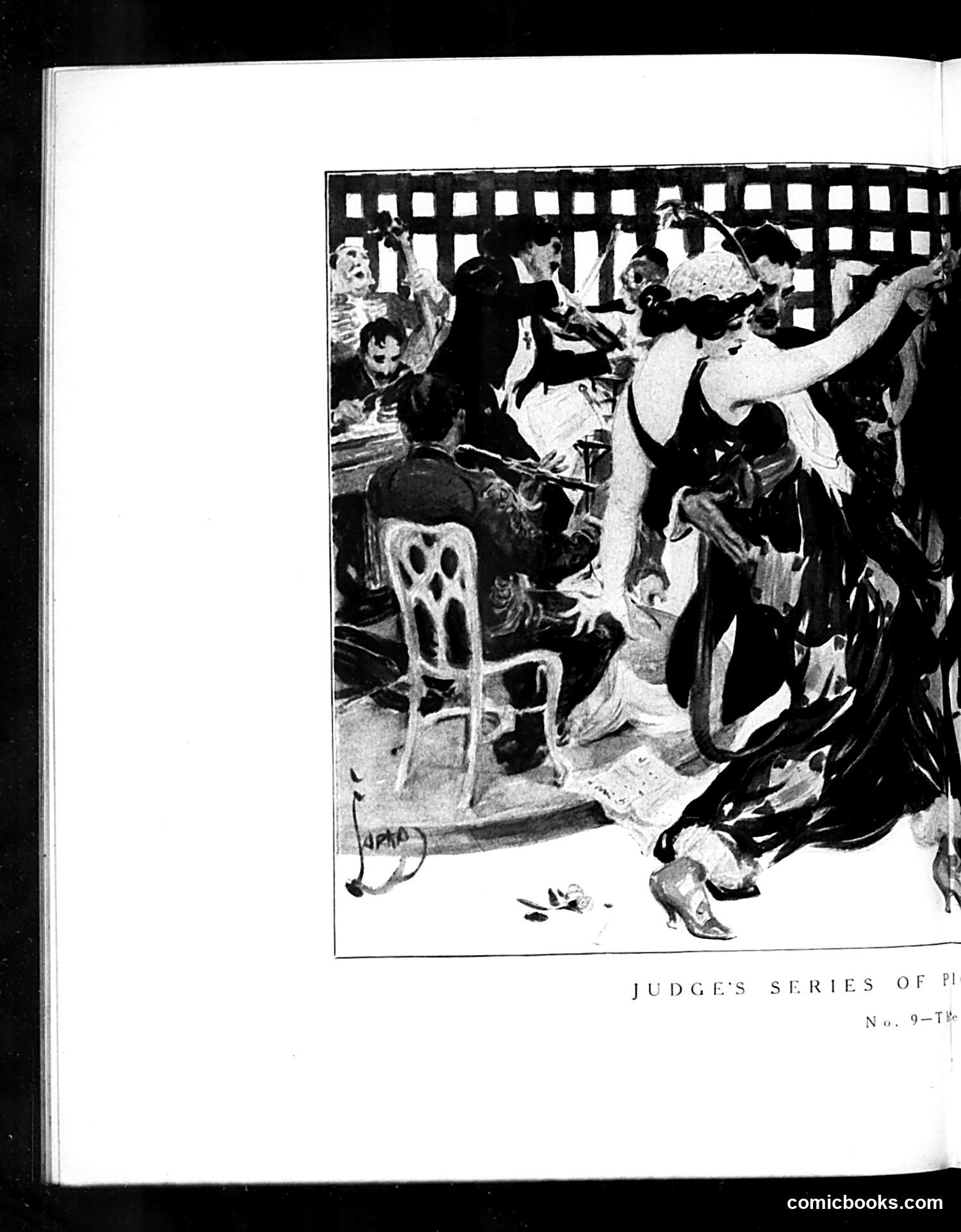
This appears to be a page from Judge magazine's "Series of Pli[ctures]" (text is cut off), numbered 9-T. The black and white illustration depicts a chaotic indoor party or social gathering, likely from the early 20th century based on the artistic style and clothing. The scene shows multiple figures in formal attire engaged in animated interaction—some dancing or gesturing dramatically, others seated. The composition suggests satirical commentary on social behavior, possibly mocking upper-class gatherings, excessive behavior, or changing social mores of the era. Without the complete caption or title visible, the specific political or social target remains unclear, though the exaggerated postures and crowded composition typical of Judge's satirical style indicate ridicule of contemporary social conventions or figures.
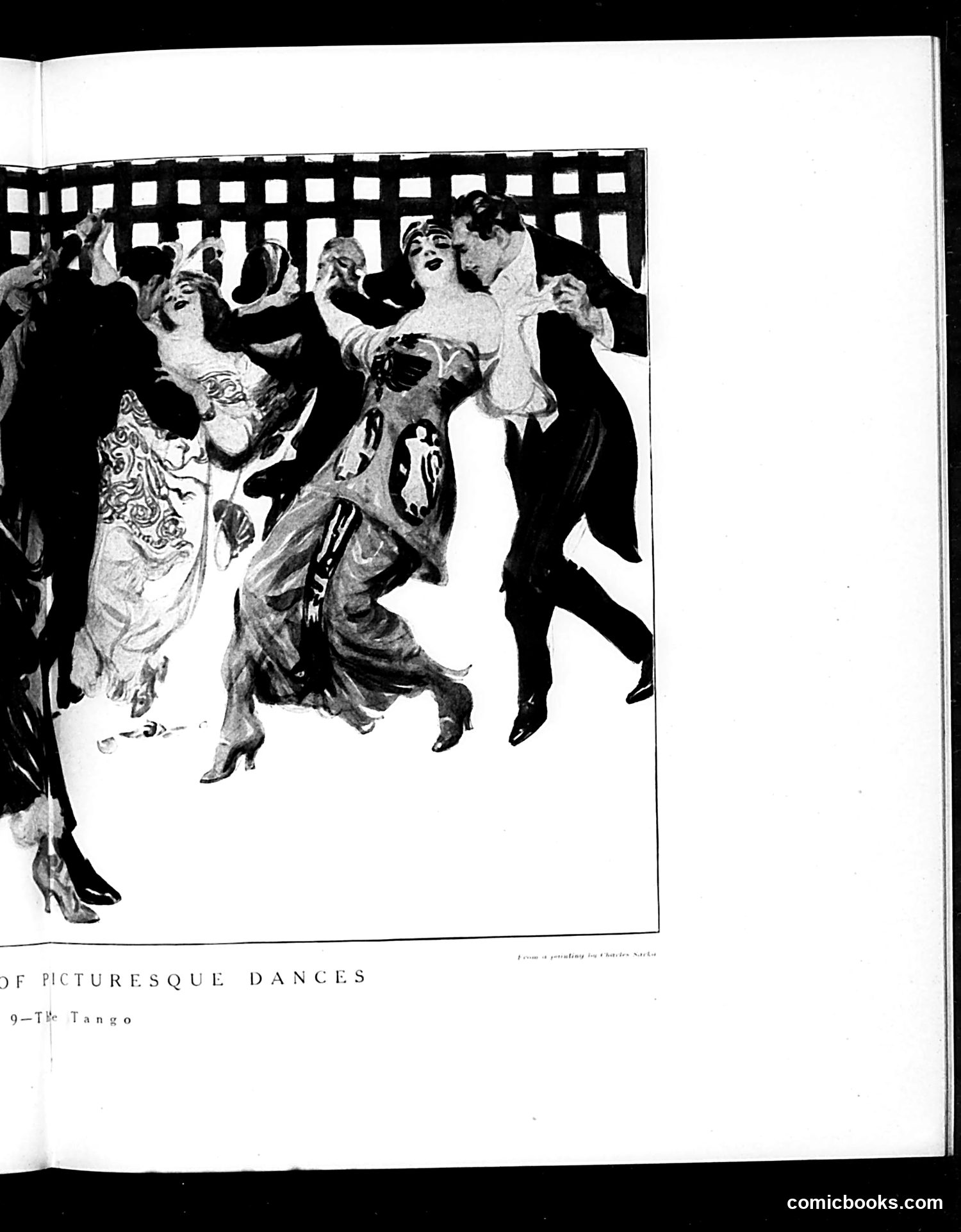
This page illustrates "The Tango," presented as part of a series on "Picturesque Dances." The illustration depicts couples dancing the tango in what appears to be an elegant venue with a latticed backdrop, suggesting a ballroom or high-society setting. The satire likely targets the tango craze that swept America in the early 1910s. The dance, originating from Argentina, was considered scandalously intimate and morally questionable by conservative Americans—couples danced in close embrace with dramatic movements. Judge, as a satirical publication, appears to mock both the dance's passionate nature and the fashionable society figures who eagerly adopted it despite moral objections. The exaggerated poses and expressions emphasize the sensuality that made the tango controversial among American moral watchdogs of the era.
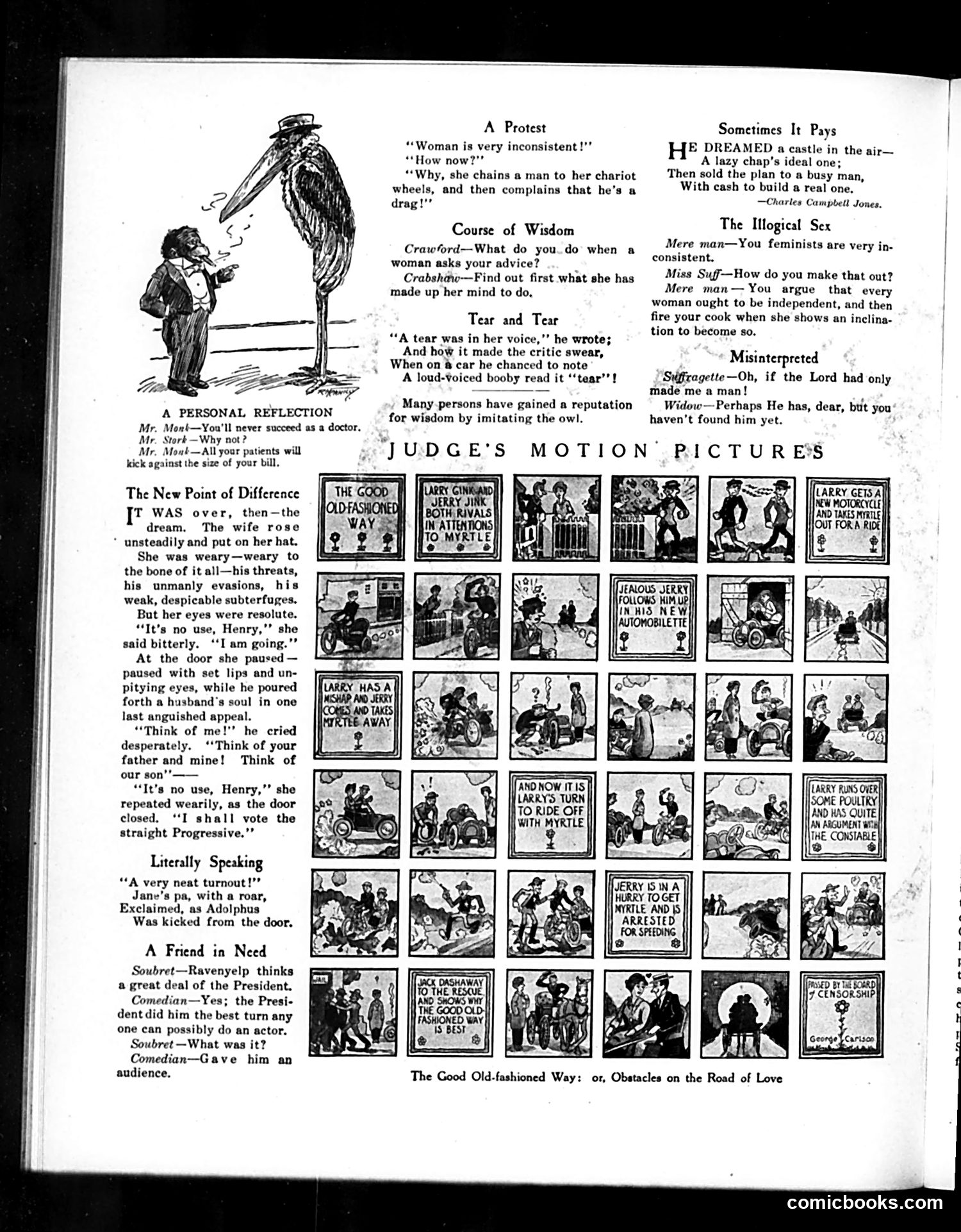
This page contains short humor pieces satirizing early 20th-century gender relations and social attitudes. Key content: **Political/Social Context:** - "The New Point of Difference" references the **Progressive Party** (likely 1912 election era), using a wife's threat to vote Progressive as ultimate marital rejection - **Suffragette references** appear in "Misinterpreted" and "The Illogical Sex," mocking women's suffrage advocates - The "Illogical Sex" satirizes feminist arguments for independence while criticizing domestic servants seeking autonomy—exposing the hypocrisy **General Satire:** Multiple jokes mock female "inconsistency" in relationships, play on courtship rituals, and poke fun at both men and women's romantic foibles. The humor relies on period-specific assumptions about gender roles and marital power dynamics. **"Judge's Motion Pictures"** appears to be a film strip summary (content unclear from OCR). The overall tone reflects turn-of-century magazine humor: mildly misogynistic jabs at women's emerging independence movements, presented as clever wordplay rather than serious critique.
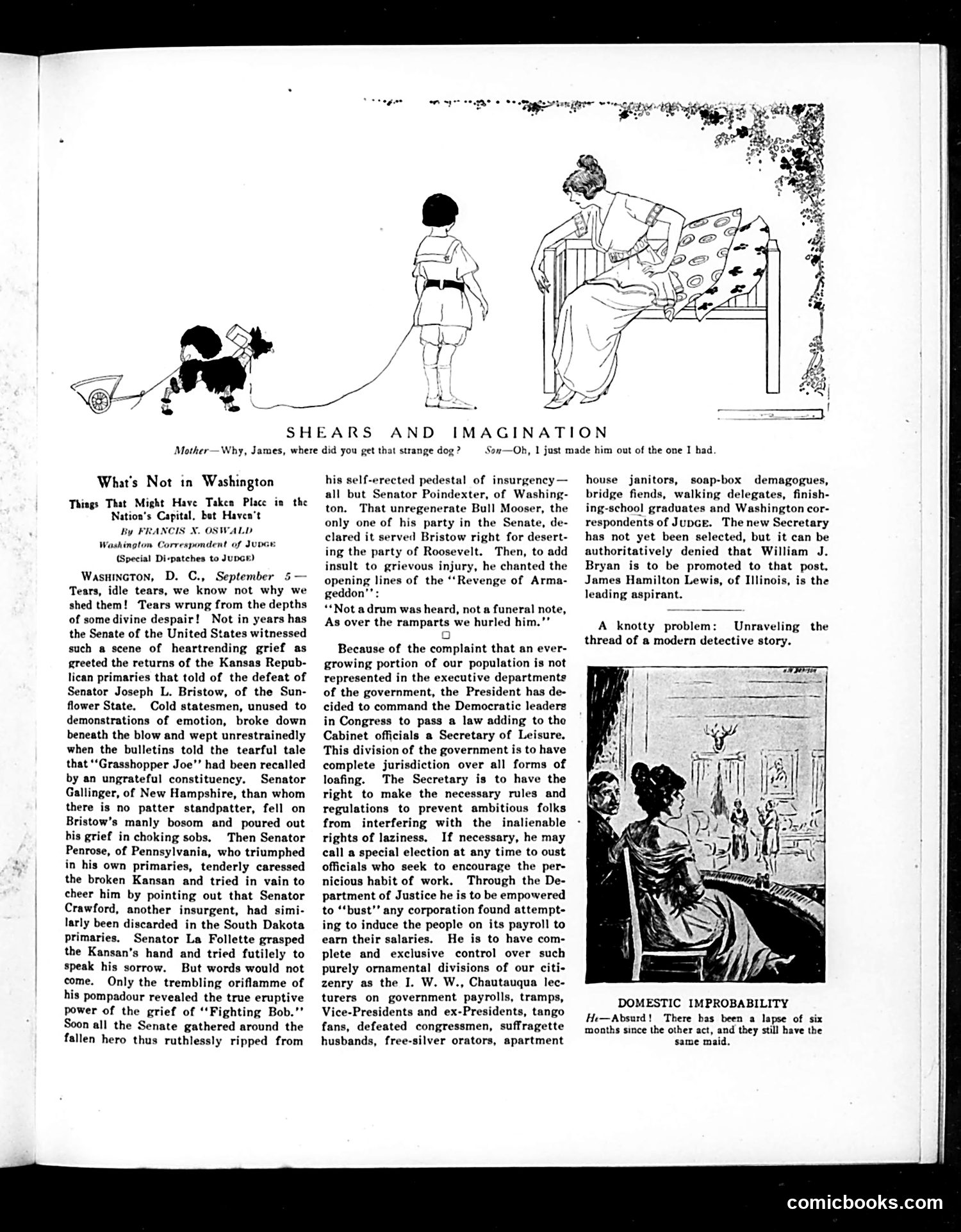
**"Shears and Imagination"** (top): A humorous domestic cartoon where a boy claims he "made" a poodle from one he already had, using shears—a simple visual gag about childhood creativity and parental bemusement. **"What's Not in Washington"** (main article): Political satire mocking Senate Republicans over Senator Joseph L. Bristow's defeat in Kansas primaries. The piece describes an imaginary scene of senators weeping over Bristow's loss—treating it as mock-tragedy. Senator Poindexter, a Progressive ("Bull Mooser"), alone refuses sympathy, saying Bristow deserved defeat for abandoning Roosevelt's party. The satire ridicules both the overwrought emotional response and factional disputes within the Republican Party. The second section satirizes an imaginary "Secretary of Leisure" department—mocking both the growing U.S. bureaucracy and various groups Judge deemed lazy: labor organizers (I.W.W.), politicians, and suffragettes. It's period-typical conservative mockery of social movements.
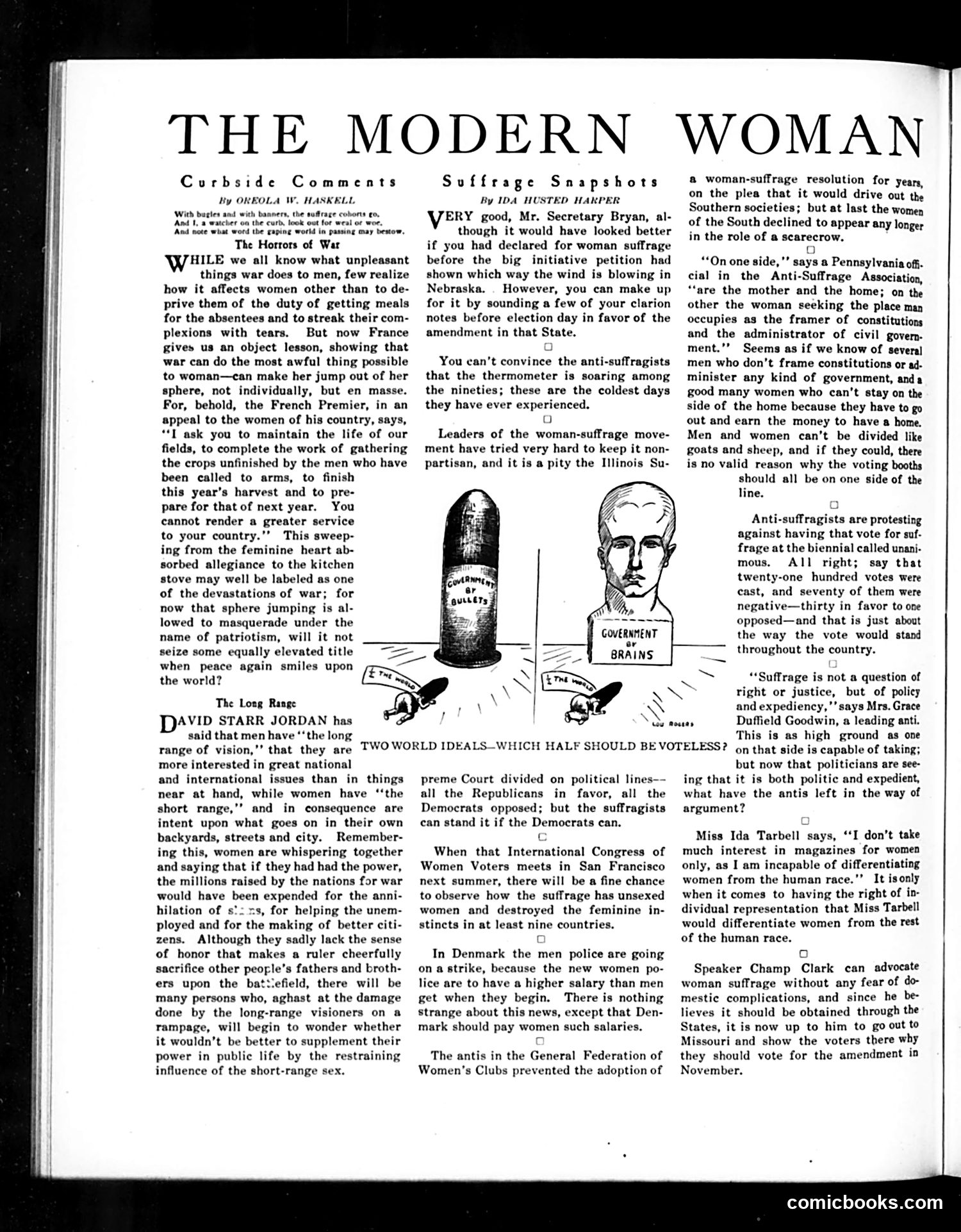
This *Judge* magazine page satirizes the women's suffrage movement through three opinion pieces: **"The Horrors of War"** mocks feminist arguments by claiming war's true devastation is forcing women out of domestic spheres. When France appeals to women to harvest crops, the author treats this patriotic duty as a catastrophic violation of women's "proper" sphere—the kitchen. **"The Long Range"** cites David Starr Jordan's claim that men have superior "long-range vision" for national issues while women focus only on immediate domestic concerns. The piece sarcastically suggests women's "short-range" perspective might actually prevent wasteful wars, undercutting its own condescension. **"Suffrage Snapshots"** reports on the suffrage movement with mock support, noting anti-suffragists' imperviousness to evidence and observing that a Danish police salary dispute proves women in public roles cause disruption. The cartoons show a bullet labeled "Government Brains," sarcastically suggesting women obtaining votes equals removing rationality from governance. The page presents anti-suffrage arguments dressed as satire—a common *Judge* tactic.
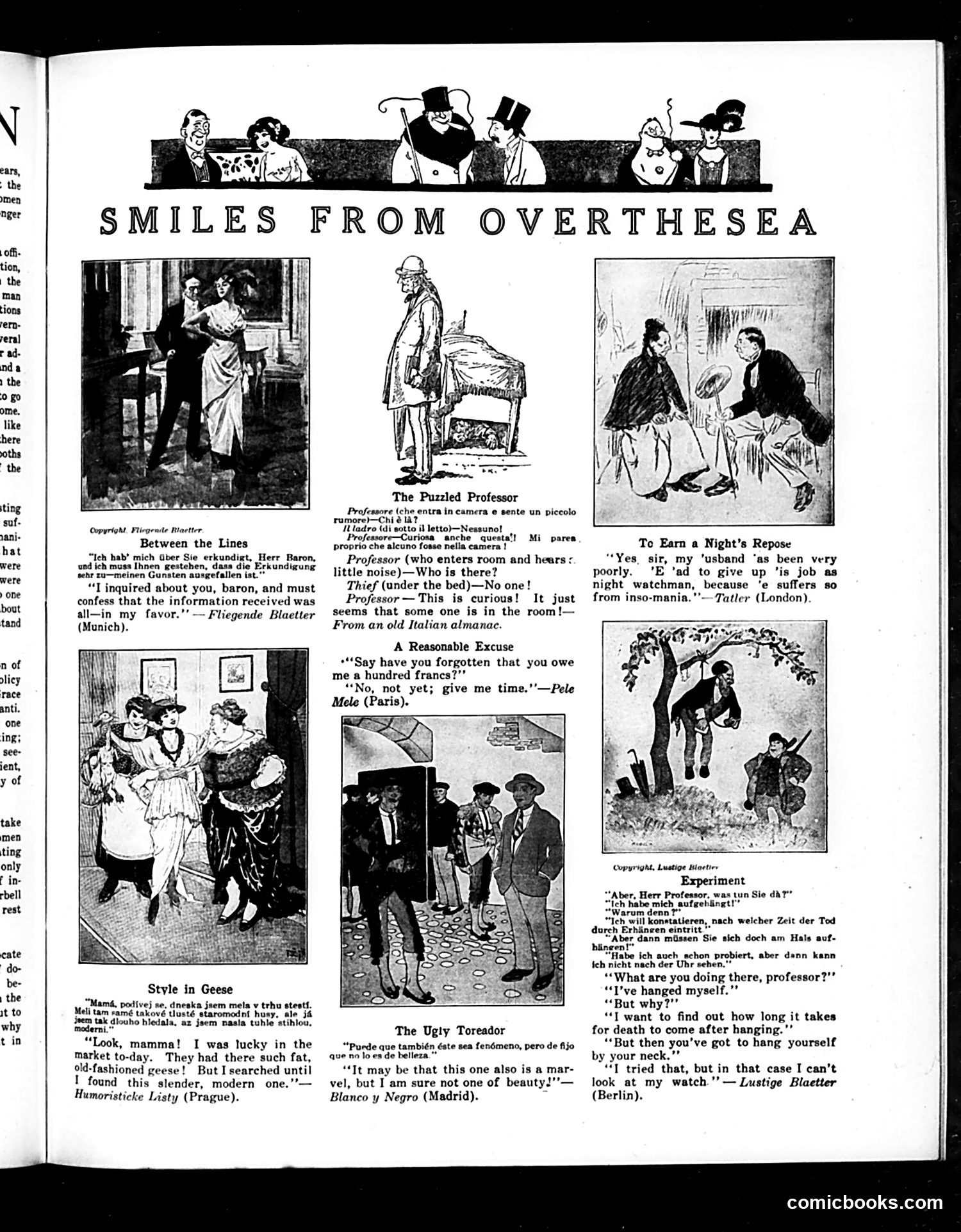
This page collects humorous anecdotes translated from European satirical publications, each illustrating mild social ironies rather than political critique: **"Between the Lines"** (Munich): A baron is pleased that inquiry about him yielded favorable results—the joke being his vanity about his reputation. **"Style in Geese"** (Prague): A woman boasts of finding a fashionable "modern" (thin) goose instead of old-fashioned fat ones—satirizing women's susceptibility to fashion trends, even in practical matters like poultry. **"The Puzzled Professor"** (Italian): A thief hiding under a bed denies being present when heard; the professor finds this logically contradictory—absurdist humor. **"The Ugly Toreador"** (Madrid): Observers acknowledge a bullfighter may be remarkable but certainly not beautiful—gentle mockery of appearance versus skill. **"To Earn a Night's Repose"** (London): A wife says her husband quit night watchman work due to "inso-mania" (insomnia)—a pun on the condition preventing sleep. **"Experiment"** (Berlin): A professor hangs himself to time death by hanging, but can't see his watch—absurdist dark humor about impractical scientific method.
This is primarily **advertising content**, not satire or political cartooning. It's a Judge magazine advertisement promoting *The New York Evening Post* newspaper. The page argues that during World War I (then ongoing in Europe), the Evening Post maintains superior accuracy compared to competitors who spread rumors and unreliable "war news." The text emphasizes the newspaper's 113-year commitment to factual reporting, contrasting it with other papers that publish sensationalized or false accounts that readers must later "unread." The historical references—to the War of 1812 and Napoleonic Wars—establish the Evening Post's longstanding credibility. A subscription coupon at bottom offers a special wartime rate ($1.00 for two months). **The implicit critique**: During WWI information chaos, many American papers chased sensational rumors rather than verified facts. This ad positions the Evening Post as the trustworthy alternative for readers fatigued by misinformation. No specific political figures or caricatures are depicted—this is straightforward commercial persuasion through appeals to reliability and reader exhaustion with propaganda.
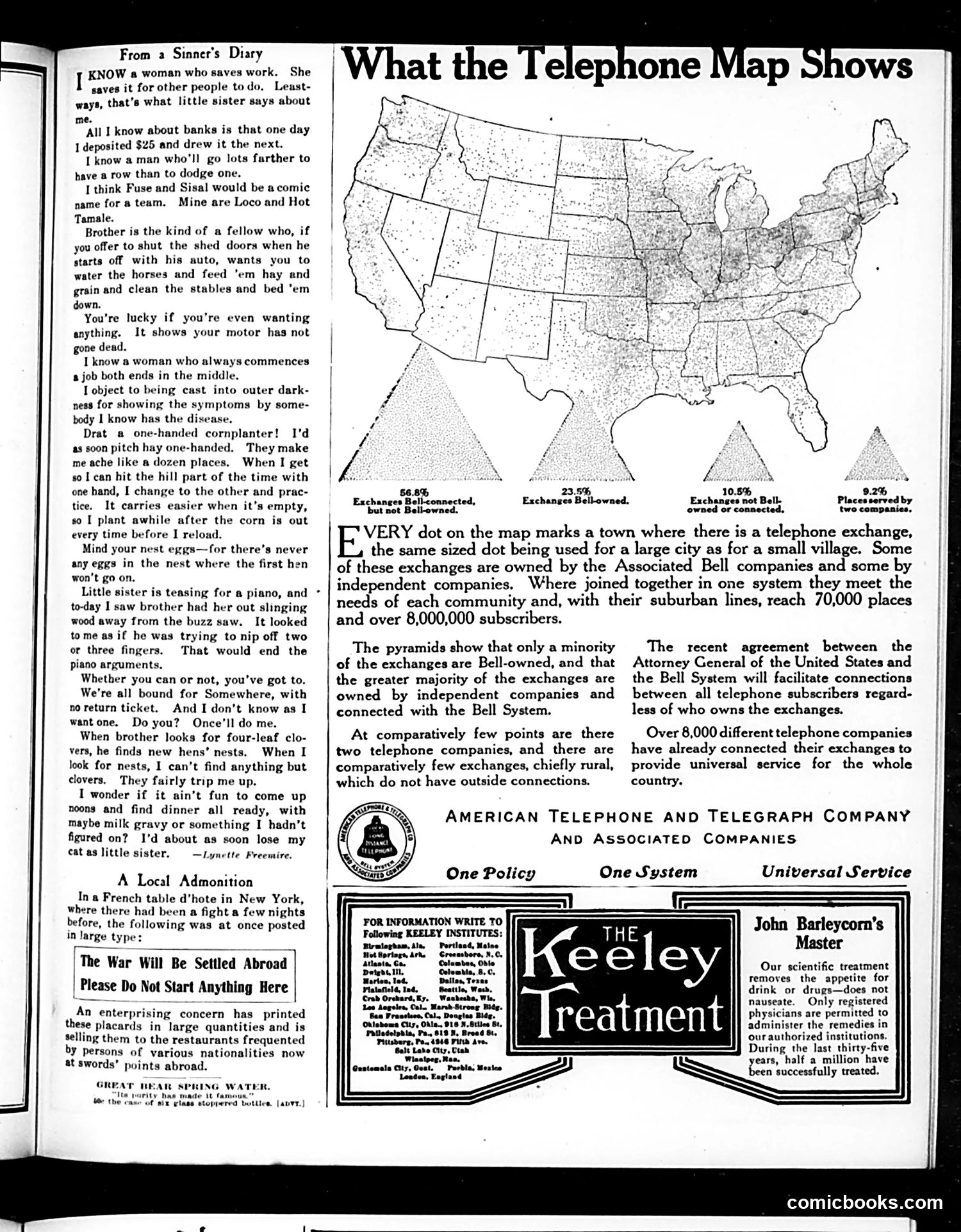
This is a mixed-content page from *Judge* magazine combining humor and corporate messaging. **Left side:** "From a Sinner's Diary" is a humorous column of pithy observations about everyday life—lazy women, peculiar relatives, farm work frustrations, and family dynamics. It's lighthearted social satire targeting common human foibles. **Right side:** A telephone infrastructure map with explanatory text. The content defends AT&T's Bell System monopoly by arguing that despite thousands of independent telephone companies existing, the Bell System's recent agreement with the U.S. Attorney General ensures universal service connectivity. The pyramids visualize that most exchanges are *not* Bell-owned, yet remain connected—framing this as proof the system works without full monopoly control. **Bottom:** Advertisements for Keeley Treatment (an addiction cure) and spring water complete the page. The telephone section functions as corporate advertising disguised as informational content, promoting Bell System efficiency during an era of antitrust scrutiny.
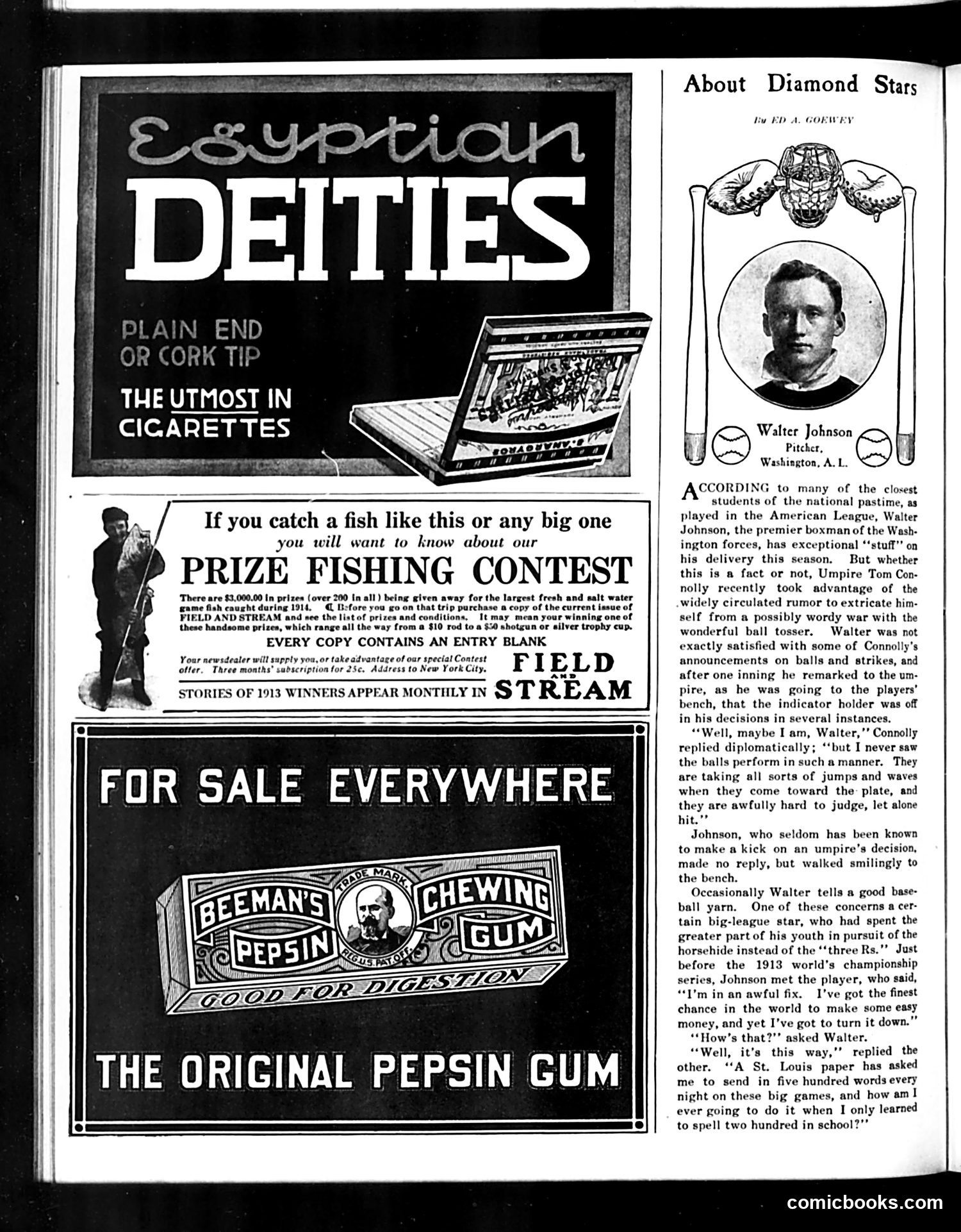
This page is primarily **advertising** with a brief sports anecdote. The main content includes: **Advertisements:** - Egyptian Deities cigarettes - Field and Stream magazine's fishing contest ($3,000 in prizes) - Beeman's Pepsin Chewing Gum **Sports Content:** A short humorous piece titled "About Diamond Stars" by Ed A. Goewey profiles **Walter Johnson**, the famous Washington Senators pitcher. The joke presents an anecdote where Johnson confronts umpire Tom Connolly about bad calls. Connolly deflects by claiming Johnson's pitches "take all sorts of jumps and waves," making them hard to judge—implying Johnson's exceptional skill rather than admitting umpire error. A second joke describes a ballplayer who received a lucrative offer to write game commentary but cannot accept because he only learned to spell two hundred words in school—satirizing athletes' limited education. The content reflects early 1910s baseball culture and the tension between players and umpires.
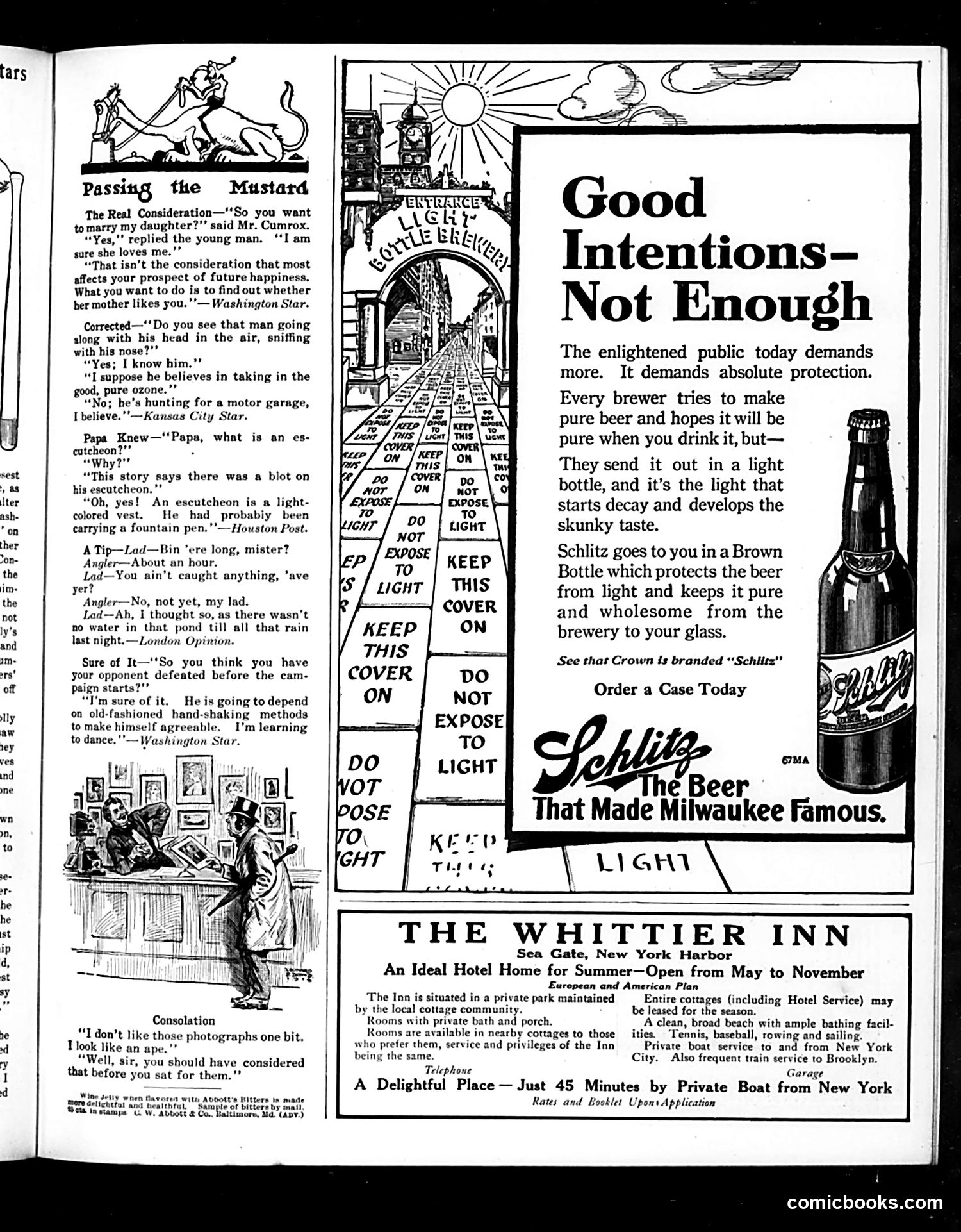
This page contains several short humor pieces and advertisements typical of early 20th-century Judge magazine. **The Comic Sketches:** Three brief jokes appear on the left: - "Passing the Mustard" jokes about courtship, suggesting a prospective groom should worry more about impressing the mother-in-law than proving his love - "Corrected" satirizes a man sniffing air, revealing he's actually searching for a motor garage (not enjoying "pure ozone") - Additional jokes mock escutcheons, fishing, political campaign tactics, and photography **The Schlitz Advertisement:** The large right-side ad argues that good intentions alone aren't enough in beer production. It emphasizes that Schlitz's brown bottles protect beer from light decay that causes "skunky taste," positioning the brown bottle as a superior protection feature over competitors' light bottles. **The Whittier Inn Advertisement:** Below is a resort hotel advertisement for Sea Gate, New York Harbor. The humor reflects period concerns: motorcar novelty, class consciousness, and consumer product quality as emerging marketplace issues.
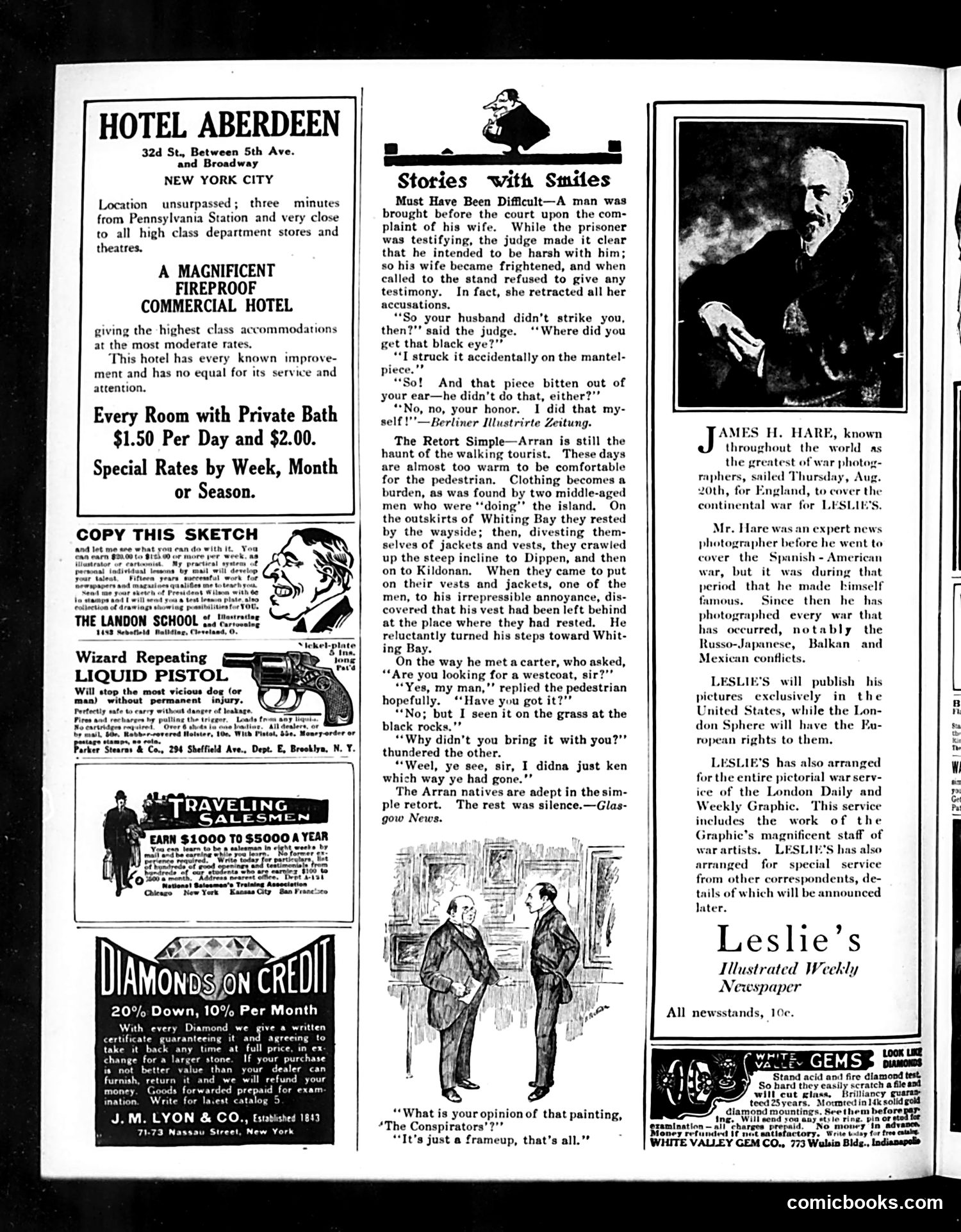
This page is primarily **advertising** for hotels, schools, and consumer goods (diamonds, pistols, insurance). The content includes three brief humorous anecdotes under "Stories with Smiles": 1. **Domestic violence joke**: A wife recants abuse accusations in court, then unconvincingly claims her black eye and bitten ear resulted from self-inflicted accidents. The satire targets both spousal abuse normalization and obviously false testimony in early-20th-century courts. 2. **Scottish dialect humor**: Two tourists on the Isle of Arran lose a vest; a carter's response—that he didn't know which direction the man traveled—mocks rural Scottish practicality and dialect speech. 3. **Art criticism pun**: A painting titled "The Conspirators" is dismissed as "just a frameup"—wordplay on "frame" (artwork frame vs. false accusation). The page also features a photograph and biography of **James H. Hare**, a war photographer sailing to cover European conflicts for *Leslie's* magazine. The humor is gentle, domestic, and relies on wordplay or cultural stereotypes rather than pointed political satire.
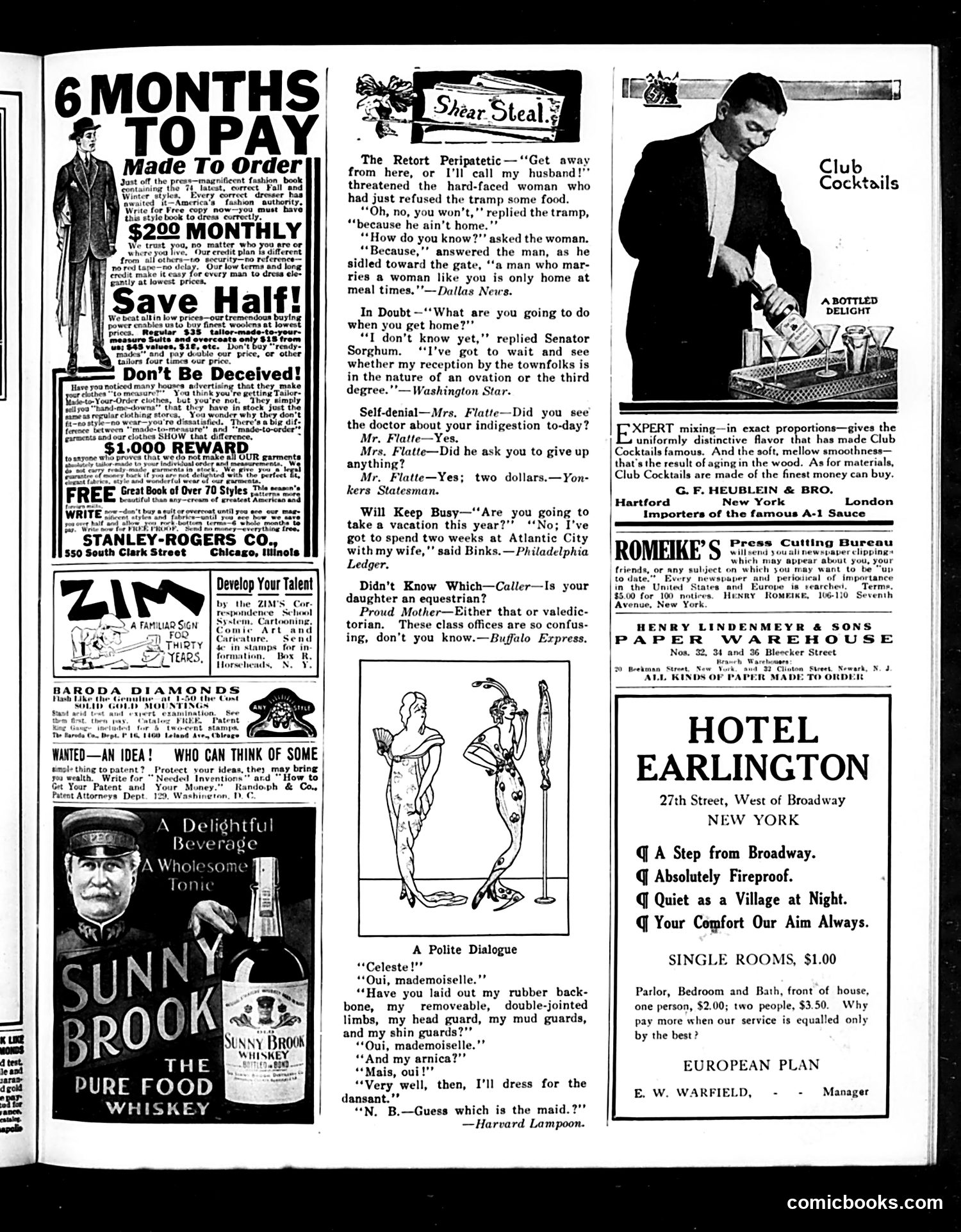
This page is primarily **advertising and humor content** rather than political satire. The dominant feature is a large clothing advertisement for Stanley-Rogers Co. (mail-order suits at $200/month), which uses typical early-20th-century hard-sell tactics ("Don't Be Deceived!"). The humor section contains several short jokes typical of Judge magazine: - **"The Retort Peripatetic"**: A tramp insults a woman by saying her husband only comes home at mealtimes—a jab at her unpleasantness - **"In Doubt"**: Senator Sorghum worries whether constituents will give him an ovation or "the third degree"—mild political humor about public reception - **"Will Keep Busy"**: A marital joke about a husband forced to vacation with his wife - **"A Polite Dialogue"**: A Harvard Lampoon contribution mocking the elaborate equipment (corsets, guards, etc.) women wore for dancing The remaining content is hotel, whiskey, and paper supply advertisements. There is **no significant political cartoon or satire** on this page.
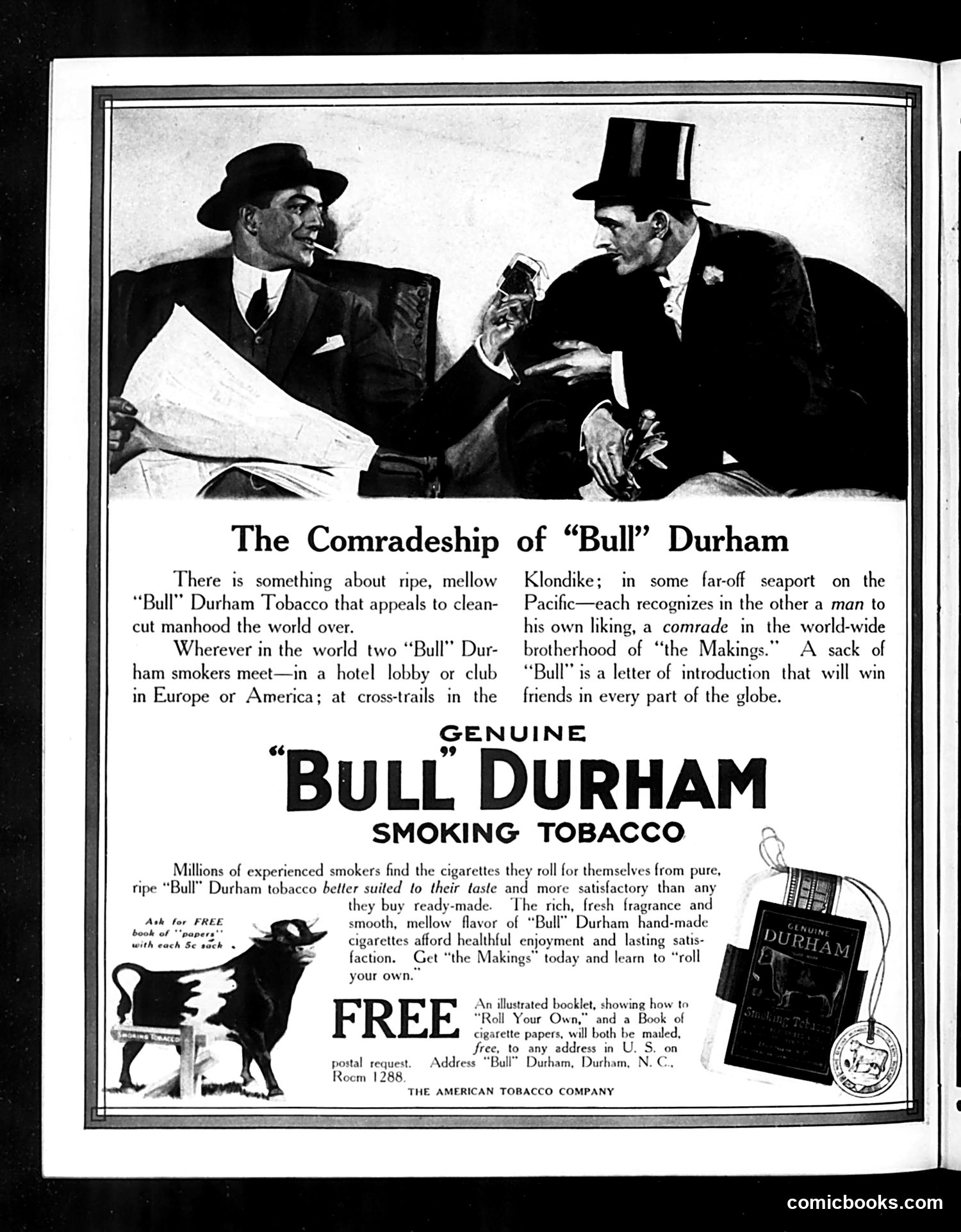
This is **not satire or political commentary**—it's a straightforward cigarette advertisement from *Judge* magazine. The image shows two well-dressed men in top hats exchanging a pouch of Bull Durham tobacco, illustrating the ad's central claim: that smokers of this brand form an instant "brotherhood" or camaraderie across the globe. The text emphasizes that Bull Durham creates a universal bond between "clean-cut" men, whether meeting in European hotels or at remote trading posts like the Klondike. The ad promotes hand-rolling cigarettes from loose tobacco as superior to ready-made ones and offers free instructional booklets and rolling papers. The bull mascot at bottom left was the brand's trademark symbol. This represents early 20th-century advertising strategies: building brand loyalty through appeals to masculine identity and social belonging rather than product features alone.