
A complete issue · 24 pages · 1914
Judge — August 15, 1914
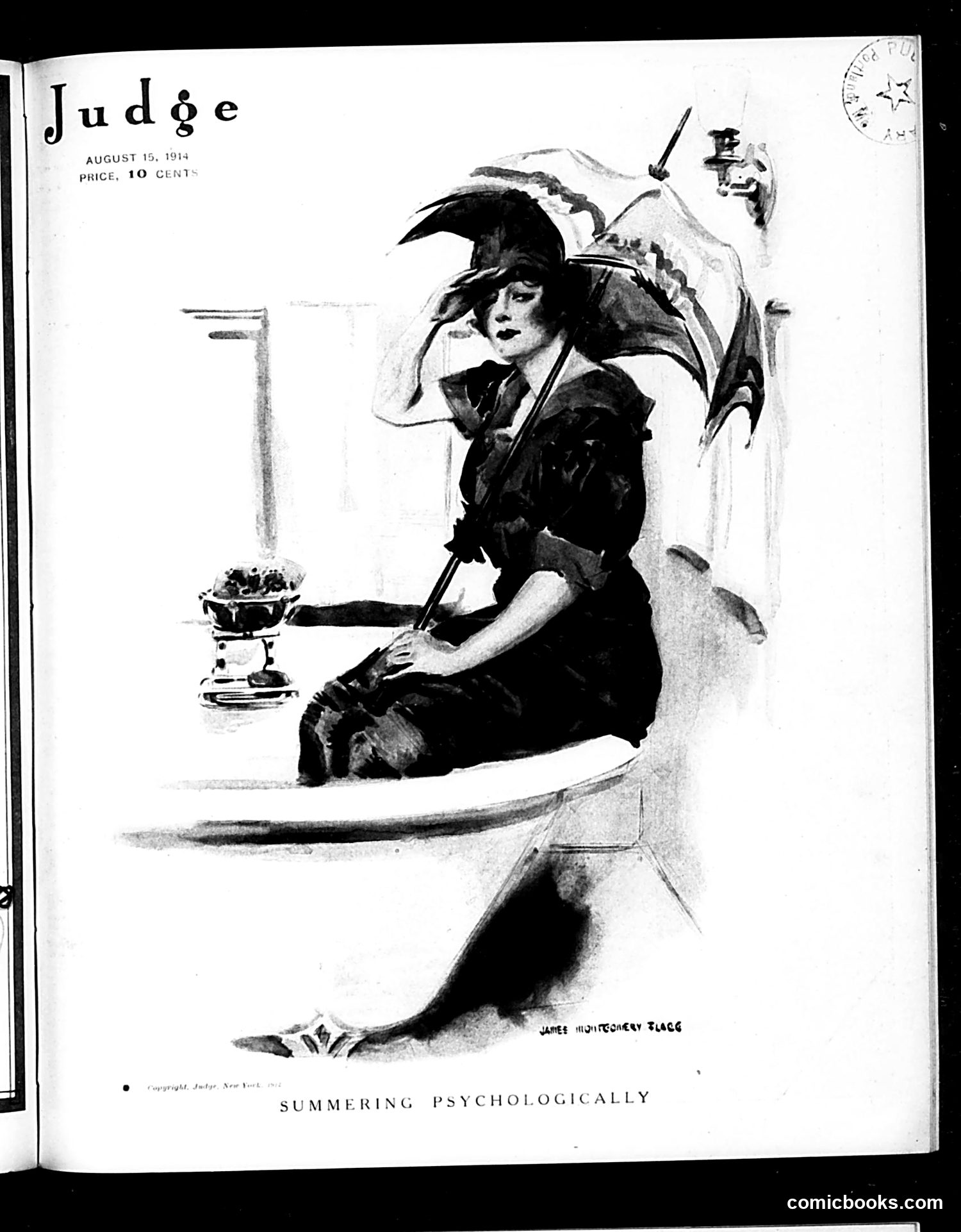
This August 1914 *Judge* cartoon satirizes a woman's approach to summer leisure during hot weather. The title "Summering Psychologically" suggests she's using mental rather than physical cooling methods. The illustration shows a fashionably dressed woman sitting in a bathtub holding a potted plant and what appears to be imagery of cooler scenes (possibly arctic or winter imagery visible in the background). The devil or demon figure looming behind her adds a humorous, mischievous tone. The satire likely mocks psychological self-help trends of the era—the notion that one could mentally imagine cooler conditions rather than actually escaping summer heat through traditional methods like traveling to cooler locales or simply using a real bath. It's commentary on pseudo-scientific wellness fads using visualization or imagination as substitutes for practical solutions.
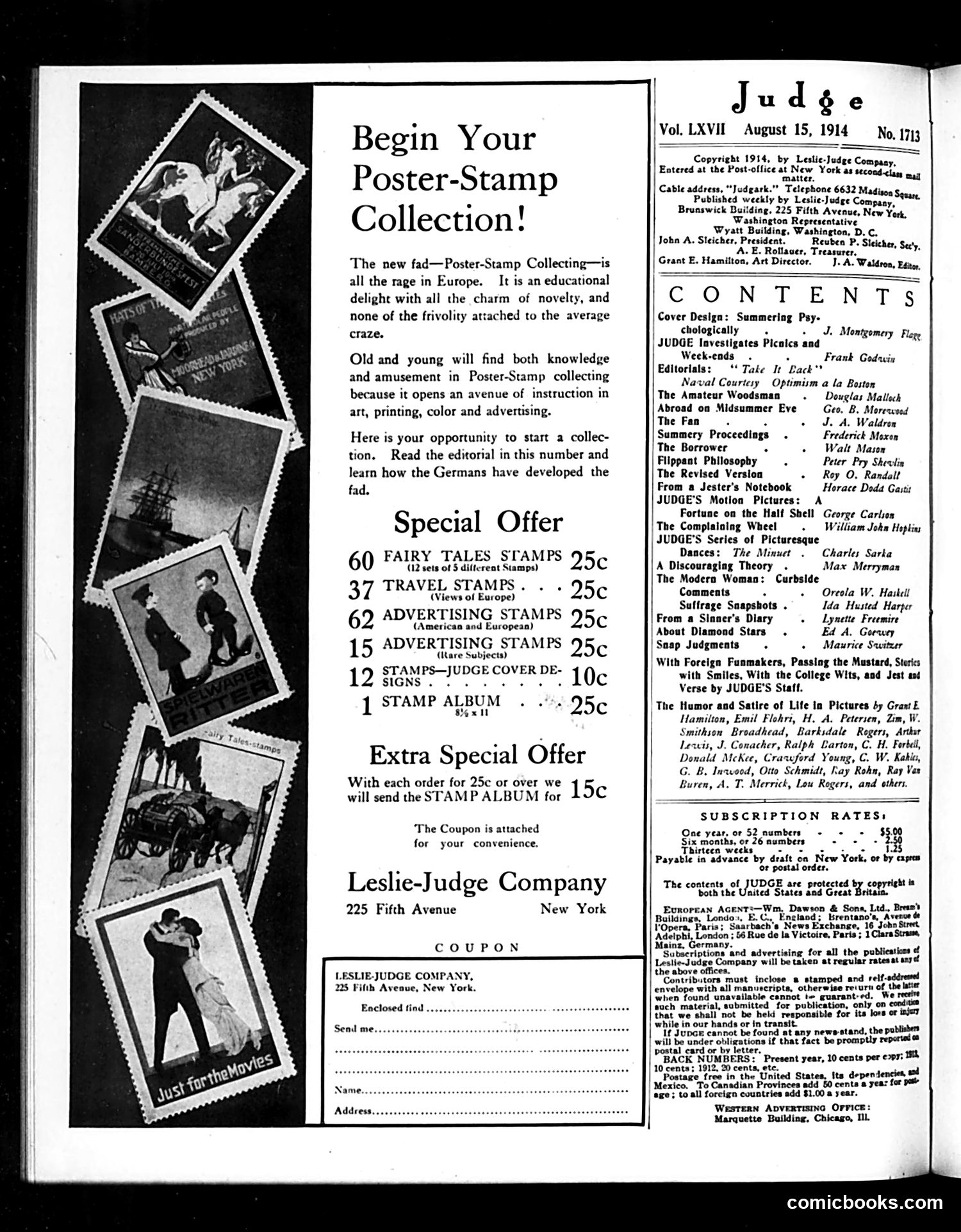
This page is primarily **advertising content**, not political satire. The Leslie-Judge Company promotes a "Poster-Stamp Collecting" fad popular in Europe at the time—small decorative stamps featuring artwork, advertisements, and fairy tales. The advertisement includes sample stamp images arranged vertically, showing various illustrated scenes. The company offers collections of these stamps at 25¢, plus a stamp album for collectors. The only contextual note: this August 1914 issue was published just as **World War I began in Europe**. The ads mention European origins of the fad and reference "Views of Europe," though there's no explicit war commentary visible on this particular page. The content reflects ordinary American commercial interests during the war's opening weeks.
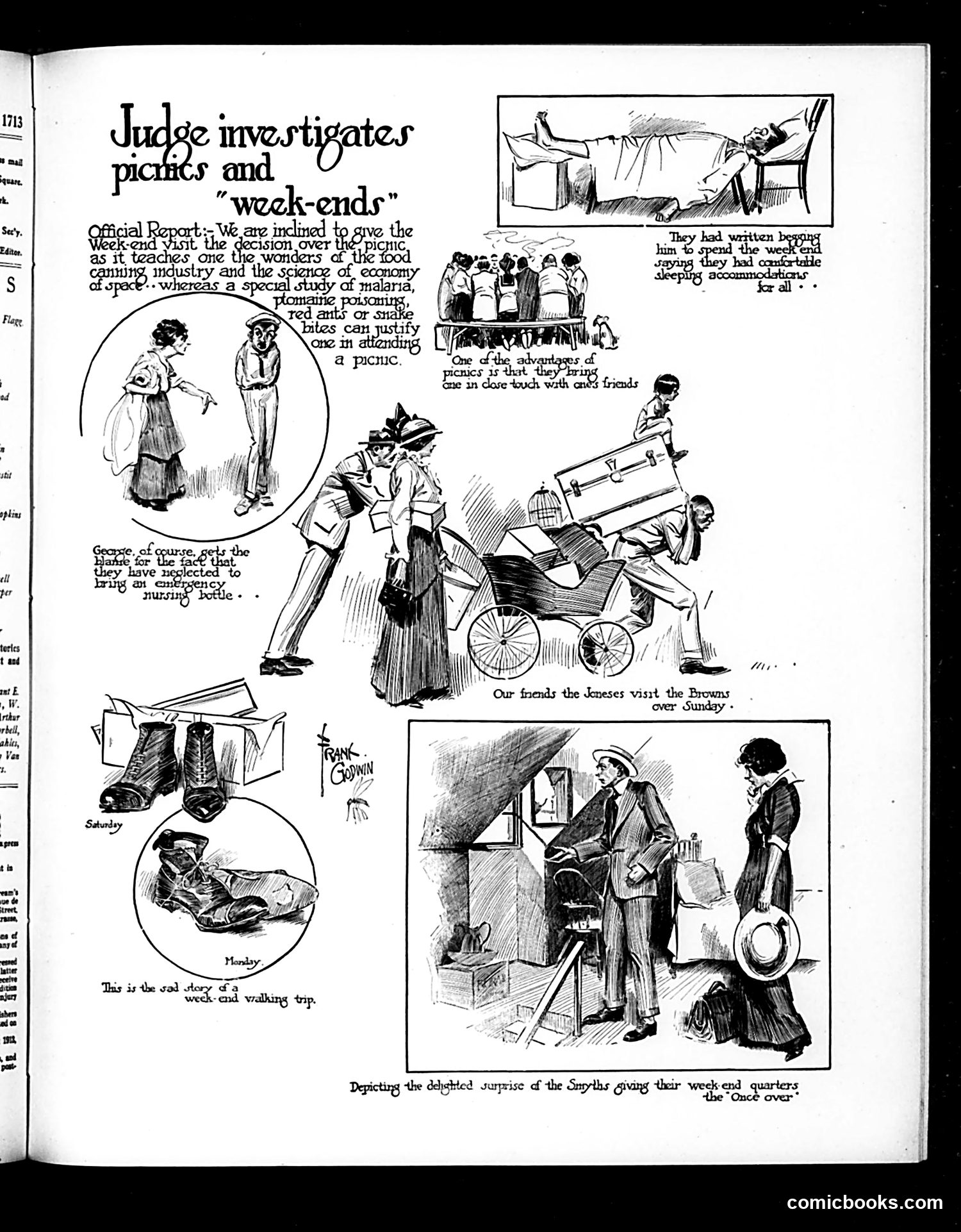
This satirical piece mocks the growing leisure-class practice of weekend outings and picnics in early 20th-century America. The cartoon critiques how the wealthy justify recreational trips through pseudo-intellectual reasoning—claiming picnics teach "the wonders of the food canning industry" and studying malaria, while really seeking social gatherings. The humor targets the gap between pretentious justifications and actual behavior: people dressing formally for "rustic" outings, the physical toll of weekend walking trips (shown via worn boots), and the Smythes family's elaborate preparations and excuses for their leisure activities. The piece satirizes upper-class hypocrisy about recreation and self-improvement during an era when weekend leisure was becoming fashionable among the affluent.
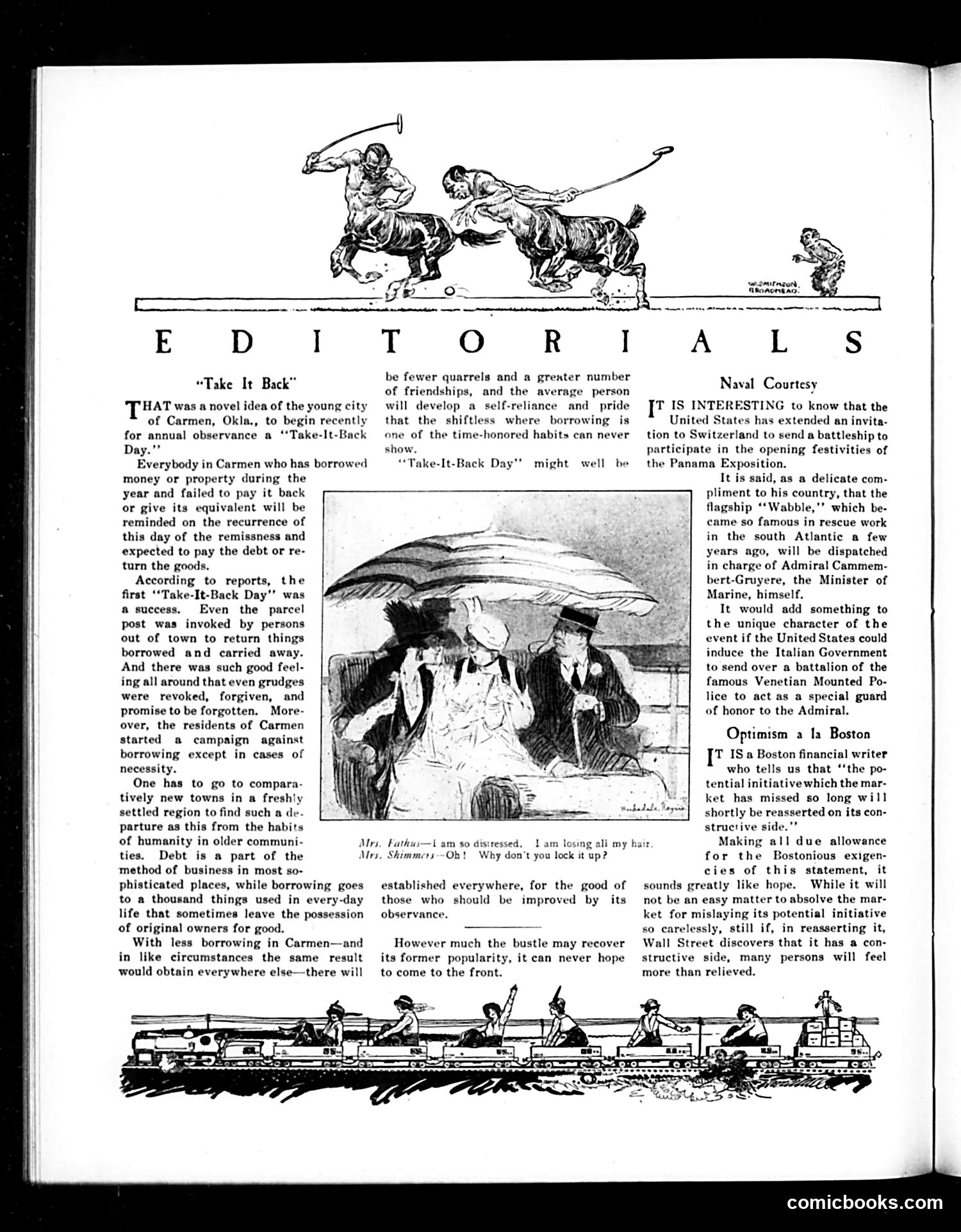
This page presents three distinct editorial pieces: **"Take It Back"** (left column): Satirizes Carmen, Oklahoma's novel "Take-It-Back Day," where residents must return borrowed items or pay restitution. The cartoon shows a frustrated woman confronting a man about unreturned property. The piece suggests this practice reveals character flaws—that borrowing habits reflect deeper moral issues about self-reliance and honesty. The satire critiques how communities enable irresponsible behavior. **"Naval Courtesy"** (right column): Discusses the U.S. inviting Switzerland to participate in Panama Exposition festivities, suggesting Italy send the famous "Wabbie," a Venetian mounted police unit, as a unique gesture. **"Optimism à la Boston"** (right column): A financial writer expresses cautious optimism about market recovery, though the underlying tone suggests skepticism about Wall Street's ability to rebuild public confidence.
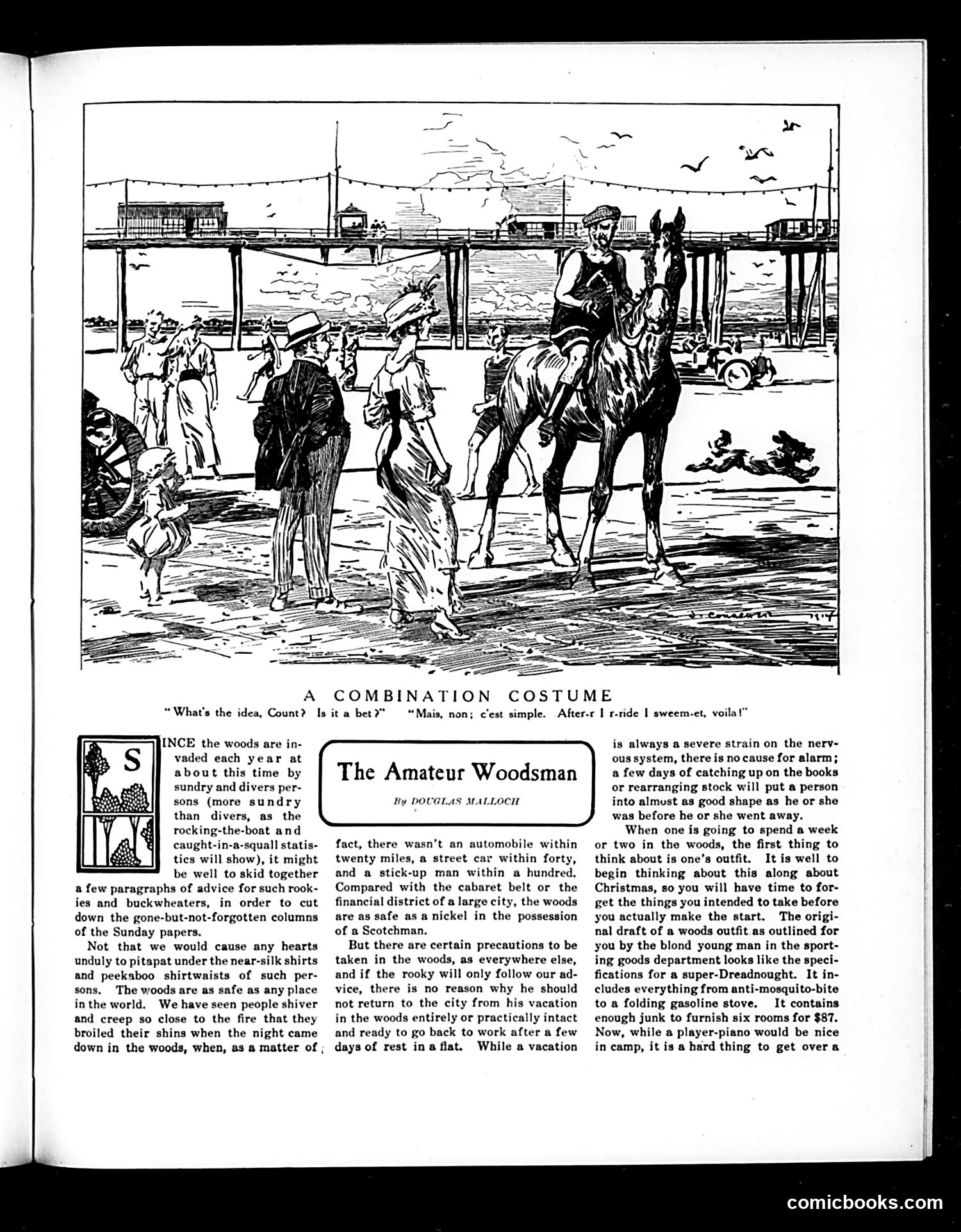
This page satirizes early 20th-century beach fashion through a scene at what appears to be a seaside pier or boardwalk. The caption's dialogue—"What's the idea, County? Is it a bet?" / "Main, non; C'est simple. Alter-et I-ride I sweem-et, voila!"—mocks a woman wearing a hybrid outfit combining riding habit and swimming costume. The satire targets the impracticality of women's fashionable clothing. The figure demonstrates an absurd "combination costume" attempting to serve multiple purposes (horseback riding and swimming), illustrating the ridiculous constraints Victorian and Edwardian dress imposed on women's activities. The accompanying article, "The Amateur Woodsman" by Douglas Malloch, shifts to discussing woods vacations, making this page a mixed-content satirical feature typical of Judge magazine.
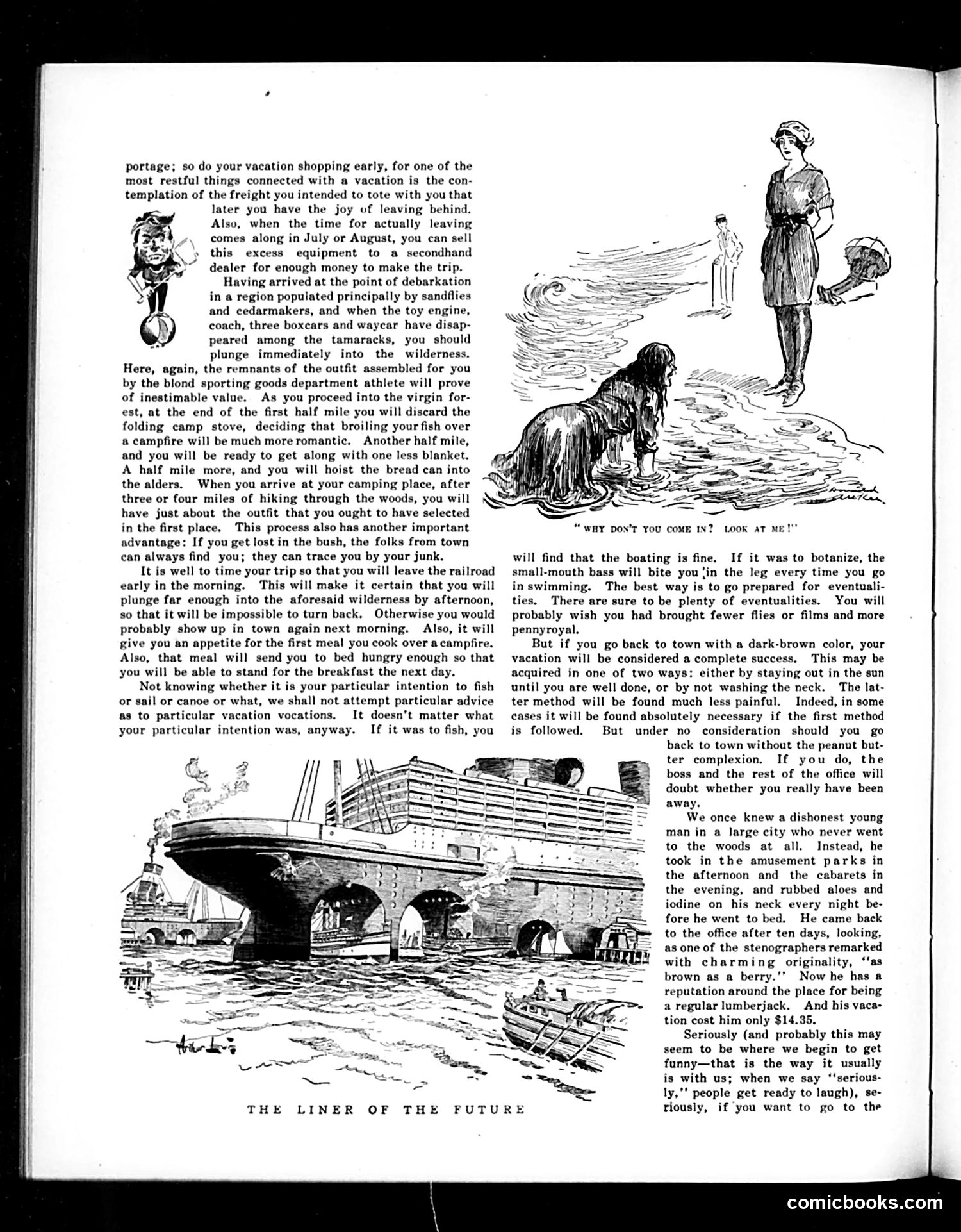
This is humorous advice about American summer vacation culture, likely from the 1910s-1920s. The text satirizes: **The Vacation Outfit Problem**: Judge mocks how city workers buy excessive camping gear from sporting goods "department athletes" (salesmen), then progressively discard it while hiking into the wilderness—keeping only what's actually useful. **The Fake Tan Requirement**: The piece jokes that returning to the office requires visible proof of outdoor time. The anecdote about the "dishonest young man" who faked a tan using iodine and aloes (without actually vacationing) satirizes this absurd status competition among office workers. **The illustrations** show wilderness camping scenes and "THE LINER OF THE FUTURE"—a steamship, suggesting vacation travel contexts. **The Satire's Point**: Judge ridicules urban middle-class anxiety about appearing sufficiently "outdoorsy" and properly rested to colleagues, and the wasteful consumer culture surrounding vacations.
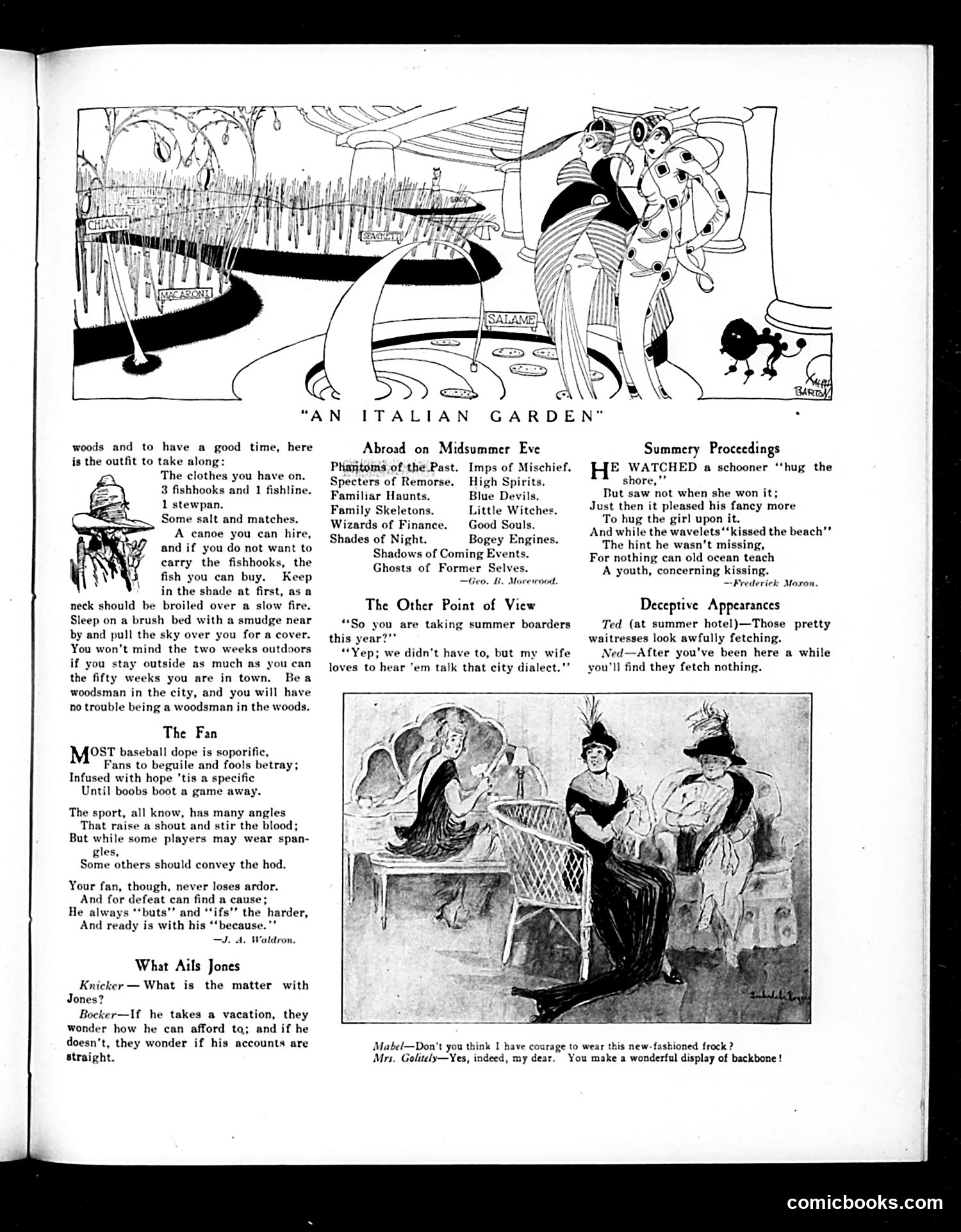
This Judge magazine page contains light satirical humor about summer leisure and social pretense, typical of early 20th-century American humor. **"An Italian Garden"** (top cartoon): A surreal illustration mocking fashionable summer garden parties—the elaborate dress and theatrical poses suggest affectation masking emptiness. **"The Fan"** and **"What Ails Jones"**: Poetry and jokes mocking baseball fans' blind loyalty (always finding excuses for losses) and social hypocrisy (people judging whether Jones can "afford" vacation or suspecting financial dishonesty either way). **"Deceptive Appearances"** (bottom): Two jokes about summer hotel life—young men finding waitresses attractive until they realize the girls won't provide service beyond their job, and a backhanded "compliment" about a woman's new revealing dress, sarcastically calling her "brave" for displaying her backbone (body). The satire targets vanity, social pretense, and the gap between appearance and reality in leisure culture.
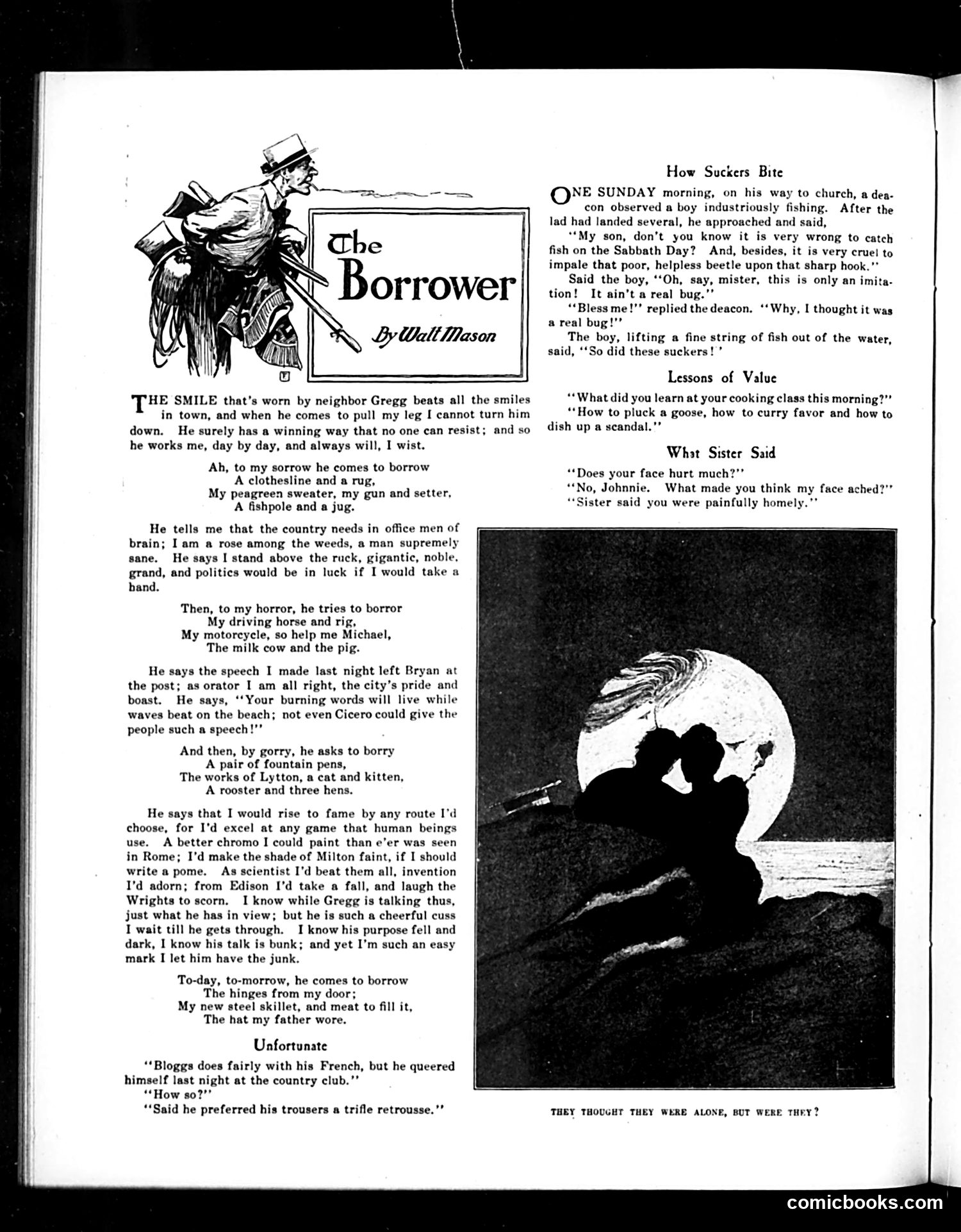
This page contains humorous anecdotes satirizing social behavior and character types common in early 20th-century America. **"The Borrower"** is the main piece—a poem about "neighbor Gregg," a manipulative charmer who flatters the narrator extravagantly while systematically borrowing his possessions (horse, motorcycle, cow, pig, fountain pens, even his father's hat). The satire targets the "confidence man" archetype: someone who uses charm and flattery to exploit generous but gullible people. The narrator admits knowing Gregg's scheme but cannot refuse him—commenting on his own weakness. **Other brief items** include: - A fishing anecdote mocking a gullible deacon fooled by a fake lure - A cooking-class joke about learning to "dish up scandal" - Observations on vanity and painful honesty ("Sister said you were painfully homely") - A final item about someone committing a social faux pas by using French slang at a country club The overall theme: exploitation of human vanity, gullibility, and social pretension.
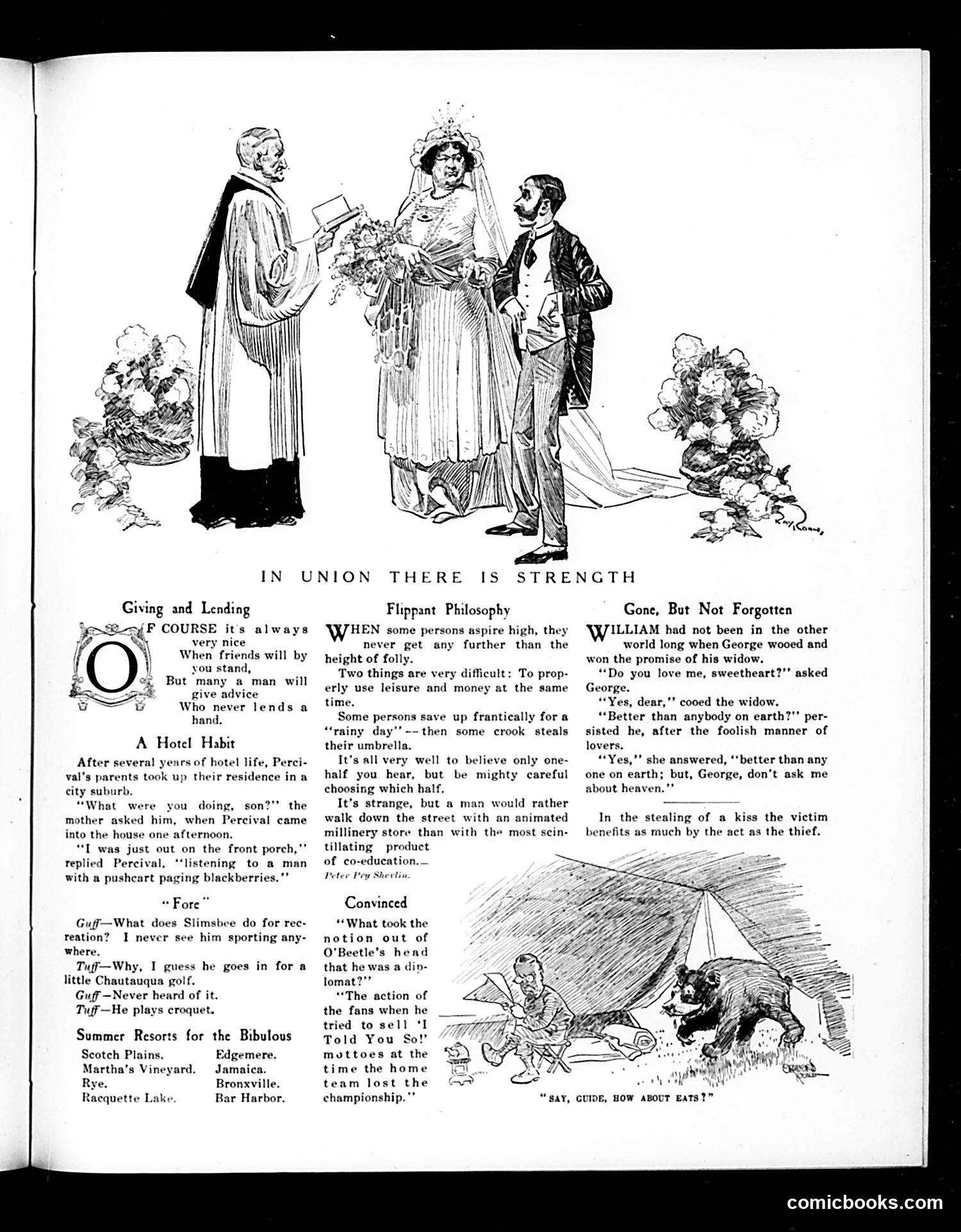
This page contains humor pieces typical of early 20th-century American satirical magazines: **Top illustration**: "In Union There Is Strength" depicts a wedding scene with a clergyman, bride, groom, and best man—likely satirizing marriage as a formal "union" while the heading ironically suggests strength through unity. **Text pieces** include brief comedic anecdotes: a boy raised in hotels who treats his porch like a public venue; wordplay about "Chautauqua golf" (croquet); and a joke about a failed diplomat trying to sell "I Told You So" mottoes after his team loses—mocking empty optimism. **"Gone But Not Forgotten"** tells of a widow who loves her deceased husband more than anyone "on earth" but won't compare him to heaven—a mild joke about female infidelity and the afterlife. **Bottom illustration**: Shows people camping or picnicking with the caption "Say, Guide, How About Eats?"—likely a joke about outdoor recreation priorities. The page reflects period humor: domestic situations, wordplay, and gentle social observation rather than sharp political satire.
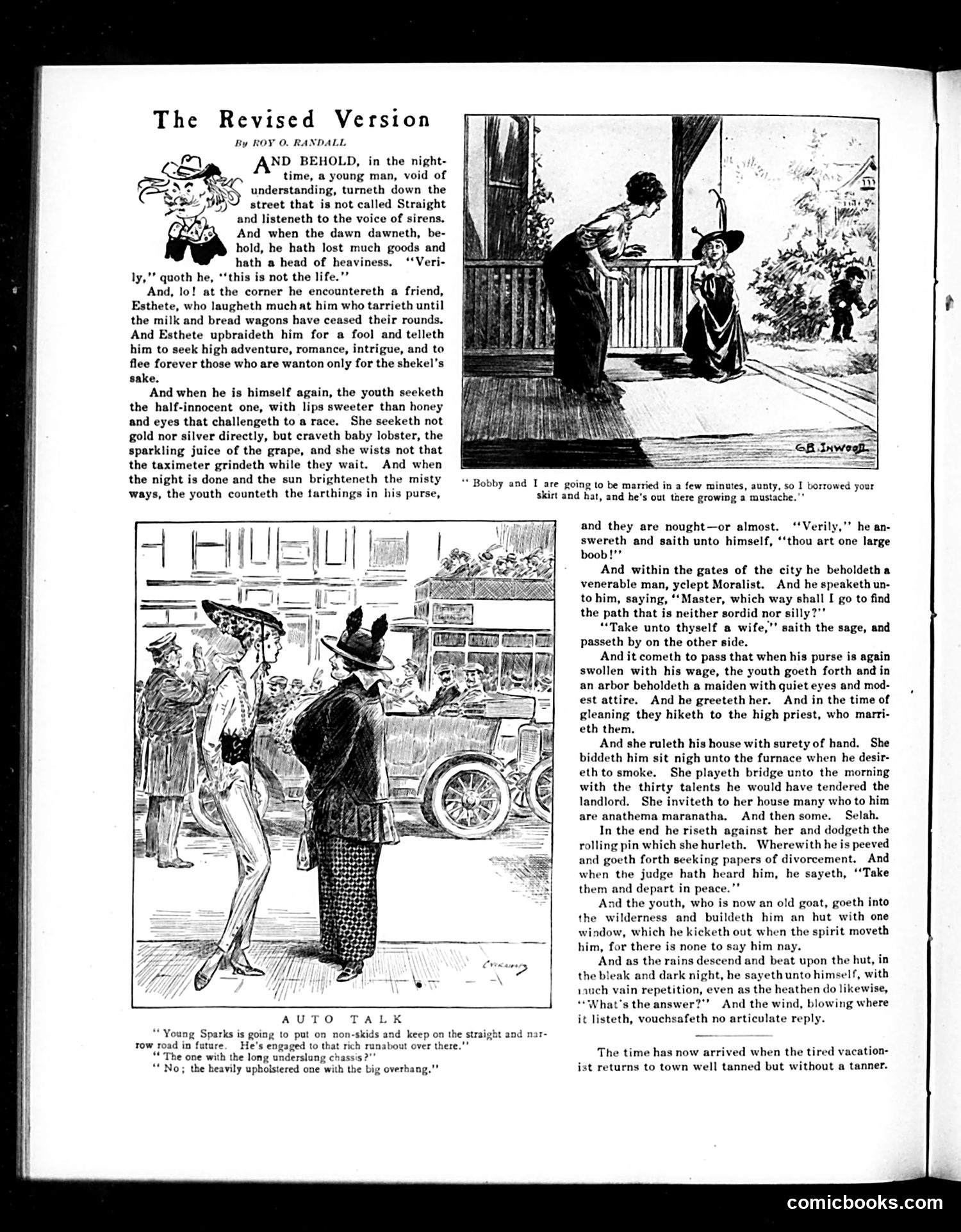
This is a satirical retelling of a young man's life trajectory, written in mock-Biblical language. The story depicts a cautionary moral arc: a dissipated youth who squanders money on nightlife ("sirens," "taximeter grinding") eventually marries a modest woman. However, the marriage deteriorates as she dominates him financially and socially—hosting parties with people he dislikes, playing bridge with his money. He eventually divorces and retreats to solitary hermitage. The satire targets both romantic excess and marriage's disillusionment. The "AUTO TALK" cartoon below mocks wealthy automobile enthusiasts obsessed with luxury vehicles and chassis specifications. The piece reflects early 20th-century skepticism about both bachelor hedonism and matrimony, suggesting all paths lead to unhappiness. The Biblical parody (thee/thou, "yclept," "maranatha") creates humorous distance from its cynical message about love, money, and domestic life.
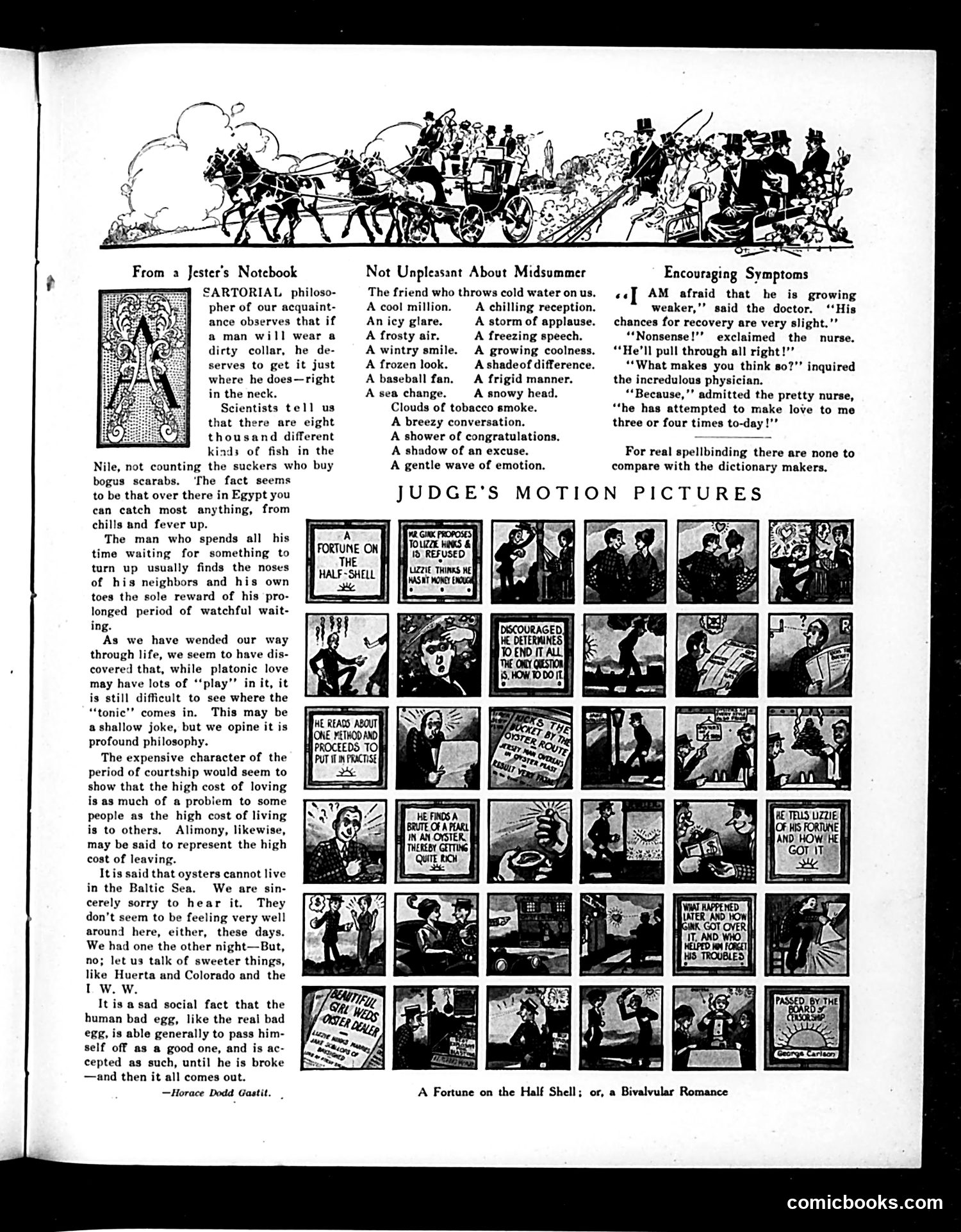
This page from *Judge* magazine contains three distinct sections: **"From a Jester's Notebook"** presents short satirical observations on social behavior—dirty collars, Egyptian tourist scams, lazy people, platonic love, courtship expenses, and the cost of alimony. These are light, disconnected quips mocking human nature and contemporary social issues. **"Not Unpleasant About Midsummer"** is a humorous word-association list contrasting "cold" things with summer—playing on the double meanings of "cold" (temperature, emotion, reception). **"Judge's Motion Pictures"** shows a film strip titled *"A Fortune on the Half Shell; or, a Bivalvular Romance"*—a comedic silent-film parody about oysters. The caption notes oysters "cannot live in the Baltic Sea," and the author humorously laments they're also "not feeling very well" locally, suggesting oysters are dying/scarce in the publication's timeframe. The overall page emphasizes light social satire and wordplay typical of early-20th-century American humor magazines.
This is a fable-style moral tale about complaint and perspective. A farmer's wagon wheel squeaks while climbing a hill, prompting the wheel to blame other wheels for not helping. Other wheels respond with their own grievances—each claiming they're doing their share of the work. When the farmer reaches a wheelwright, he removes the "complaining wheel" entirely, replacing it with a new one. The moral: constant complaining only gets you discarded. The secondary dialog "Giving It Time" appears to show characters named Skids and Skittles debating work ethic during hot weather—Skids urging hustle, Skittles resisting hard labor in summer heat. The satire targets workplace complainers and those seeking easy conditions, suggesting that voicing grievances leads to replacement rather than improvement.
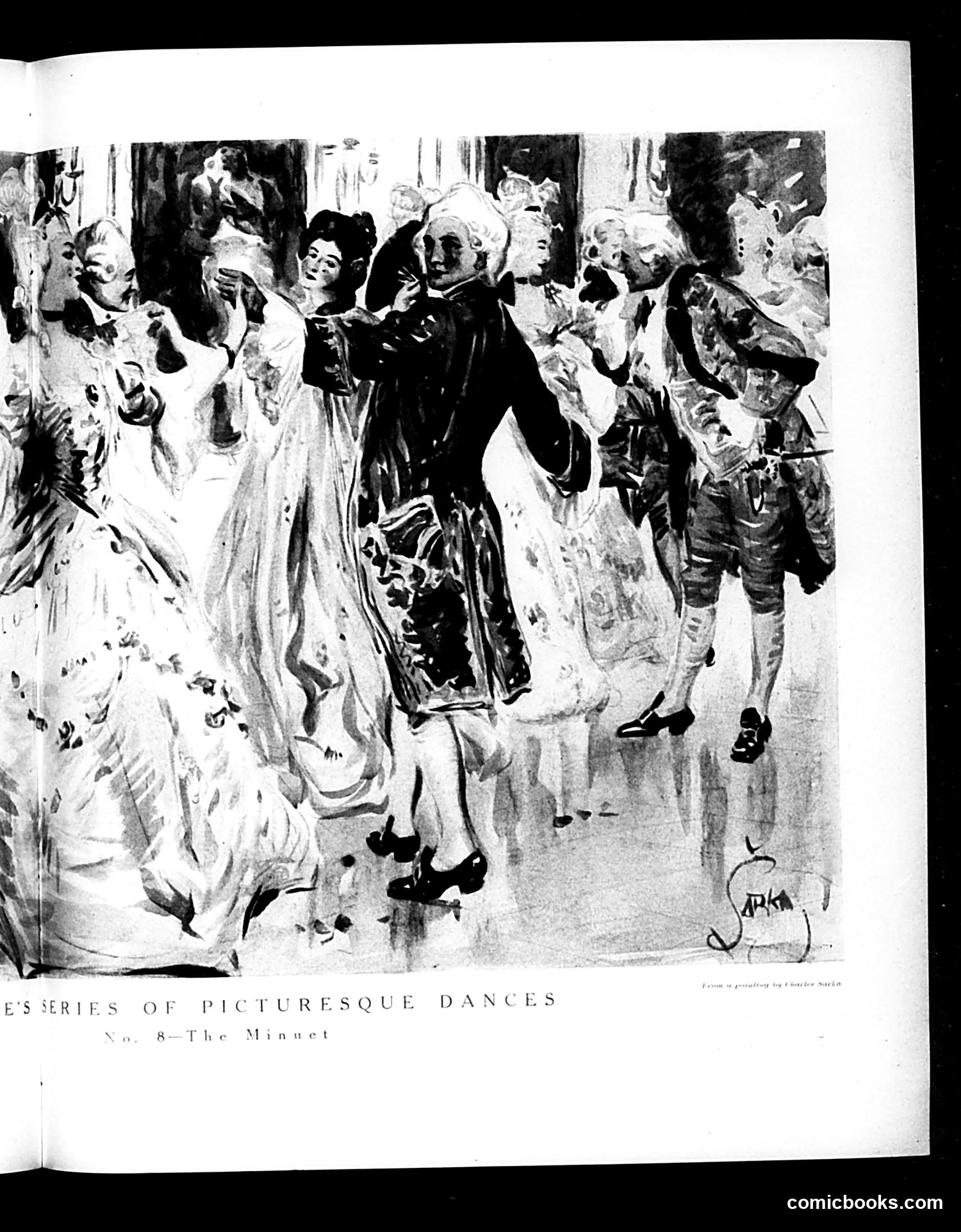
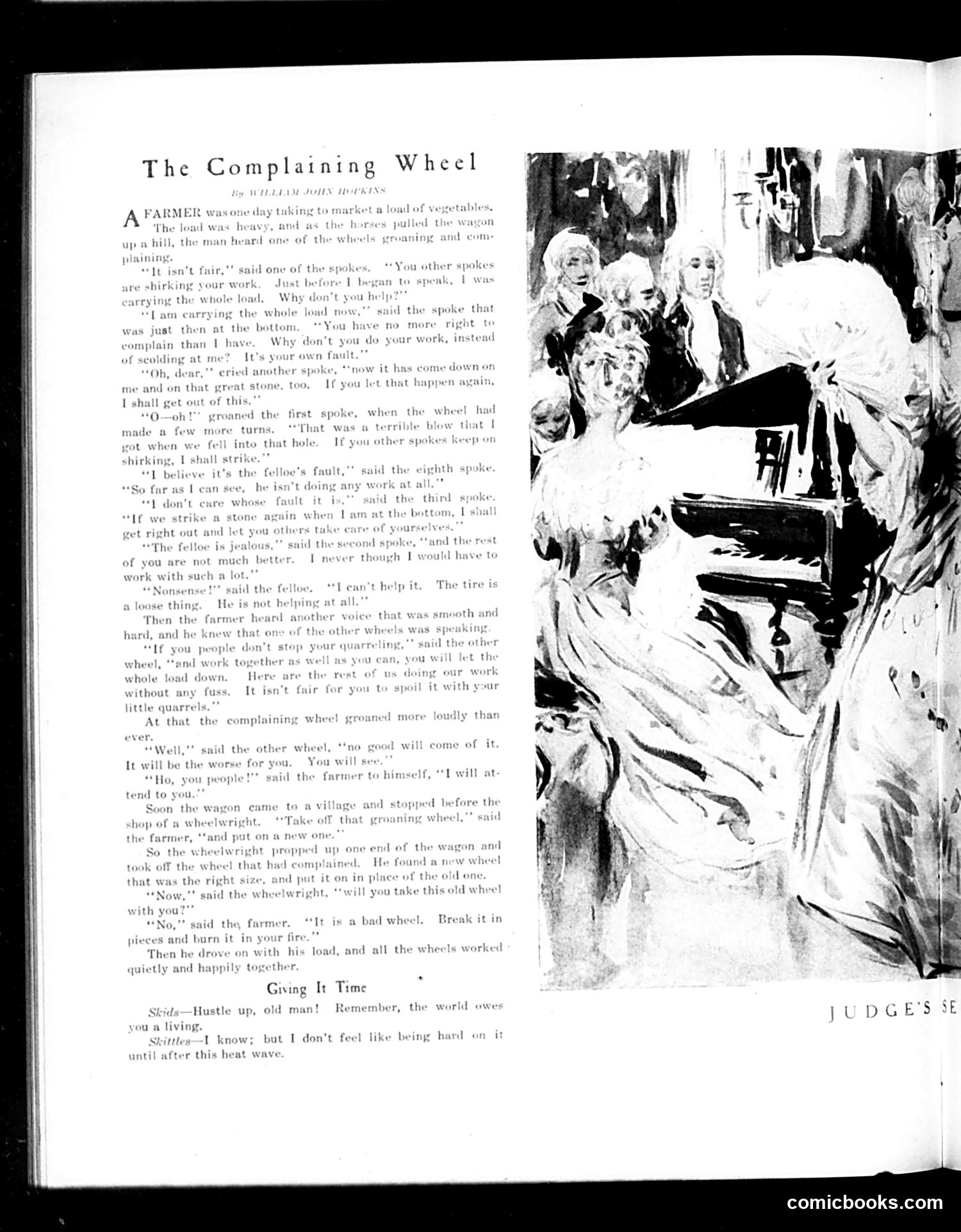
This illustration depicts an 18th-century formal court dance scene. The central figure wears a dark coat while surrounded by women in elaborate gowns with floral patterns and long trains, styled in rococo fashion. The composition captures the aristocratic minuet, a refined, choreographed dance popular among European nobility. The satire likely mocks the pretension and rigid formality of high society and courtly customs through exaggerated character types and posturing. The minuet exemplified aristocratic excess and artificiality—contrasting sharply with ordinary life—making it an easy target for Judge magazine's satirical commentary on class distinctions and social affectation. The artist's signature appears in the lower right corner.
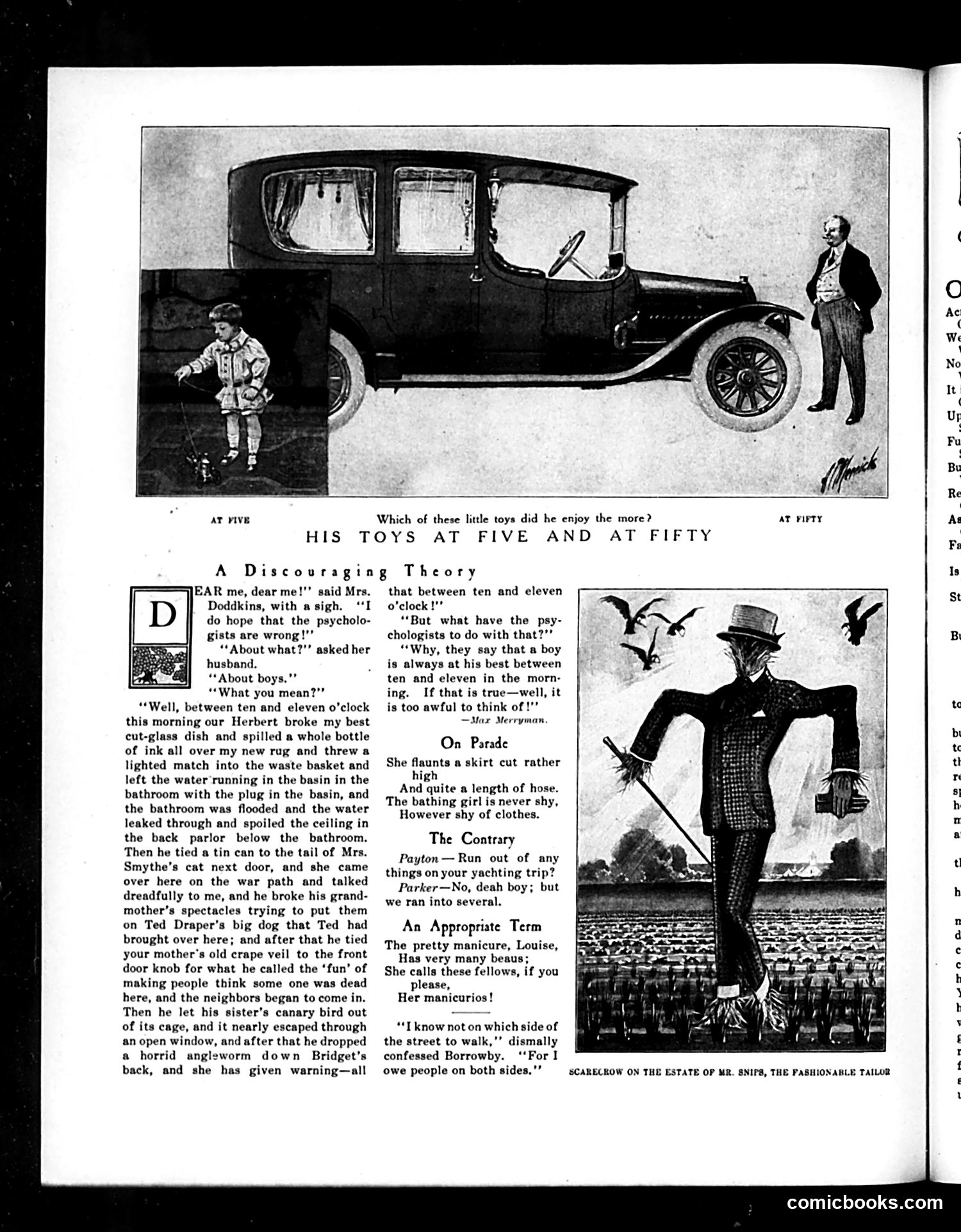
This page satirizes a psychological theory (likely early 20th-century developmental psychology) claiming boys are "always at their best between ten and eleven in the morning." **The main cartoon** shows a child at age five with toys, and an adult man at age fifty with an automobile—visual evidence that boys never actually outgrow destructive behavior. The accompanying story supports this: Mrs. Doddkins catalogs her son Herbert's morning chaos (broken dishes, spilled ink, flooded bathroom, tied tin cans to cats, dropped worms) to mock the psychologists' optimistic claim. **The satire's point:** If boys are supposedly well-behaved at that age, yet Herbert caused such mayhem, the theory is absurd—or worse, boys remain destructive throughout life. The page includes unrelated comic snippets about fashion, debt, and wordplay ("manicurios"), typical of Judge magazine's miscellaneous humor format.
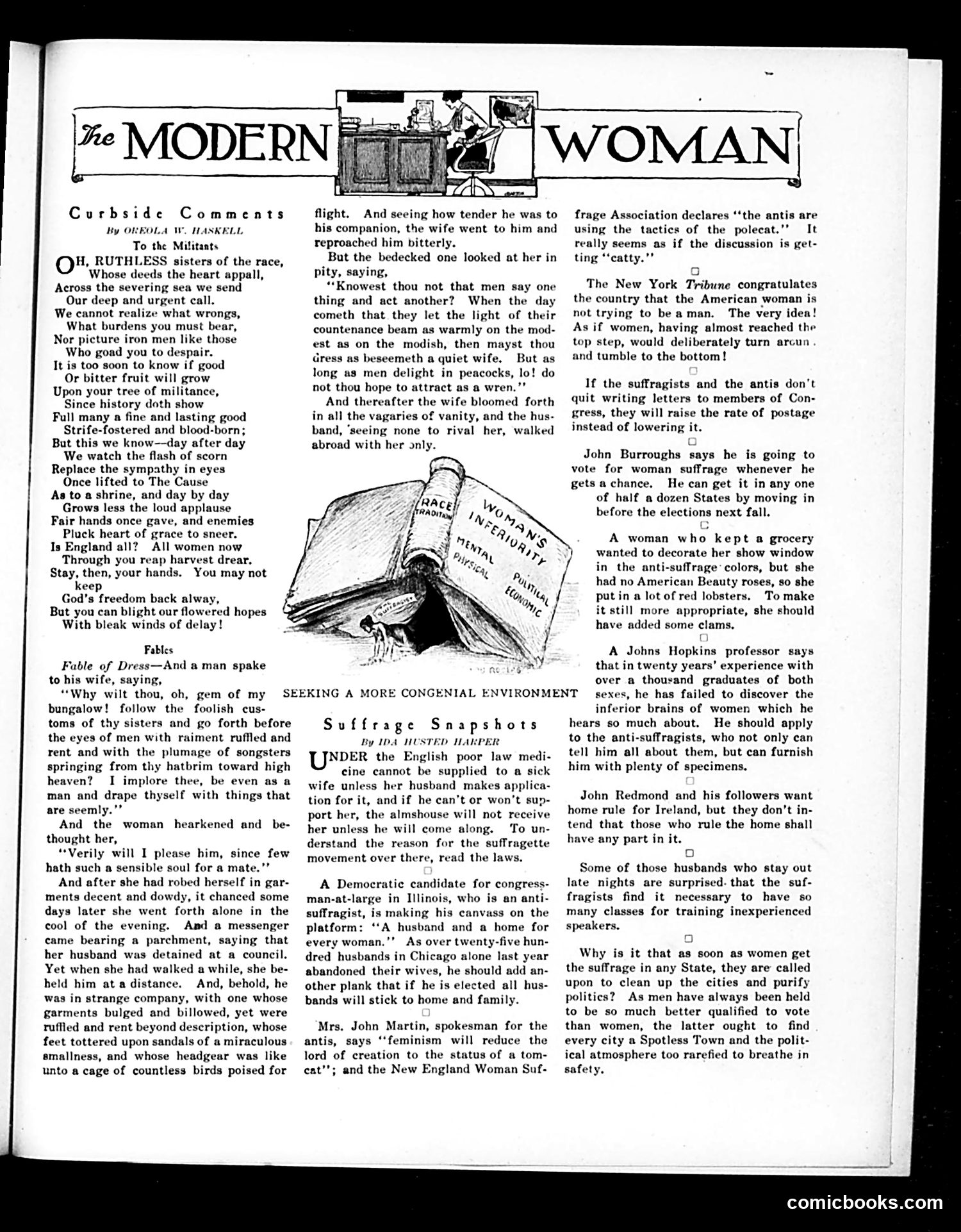
This page satirizes the women's suffrage debate circa 1910s through multiple pieces: **"Curbside Comments"** addresses British suffragettes' militant tactics (property destruction, arson), urging them to abandon violence as it damages public support for women's rights generally. **"Fable of Dress"** mocks men's hypocrisy: a husband demands his wife dress modestly, then flirts with a fashionably dressed woman. The moral: men say they want demure wives but actually prefer decorative ones. **"Suffrage Snapshots"** presents arguments for suffrage by highlighting legal inequities—wives cannot access medicine without husbands' consent; abandoned wives face almshouse rejection. It also ridicules anti-suffragists' platform ("A husband and home for every woman") by noting thousands of Chicago husbands abandoned their wives annually, making such promises hollow. The overall message critiques both militant suffragettes and male inconsistency, while advancing pro-suffrage arguments through concrete examples of women's legal vulnerability.
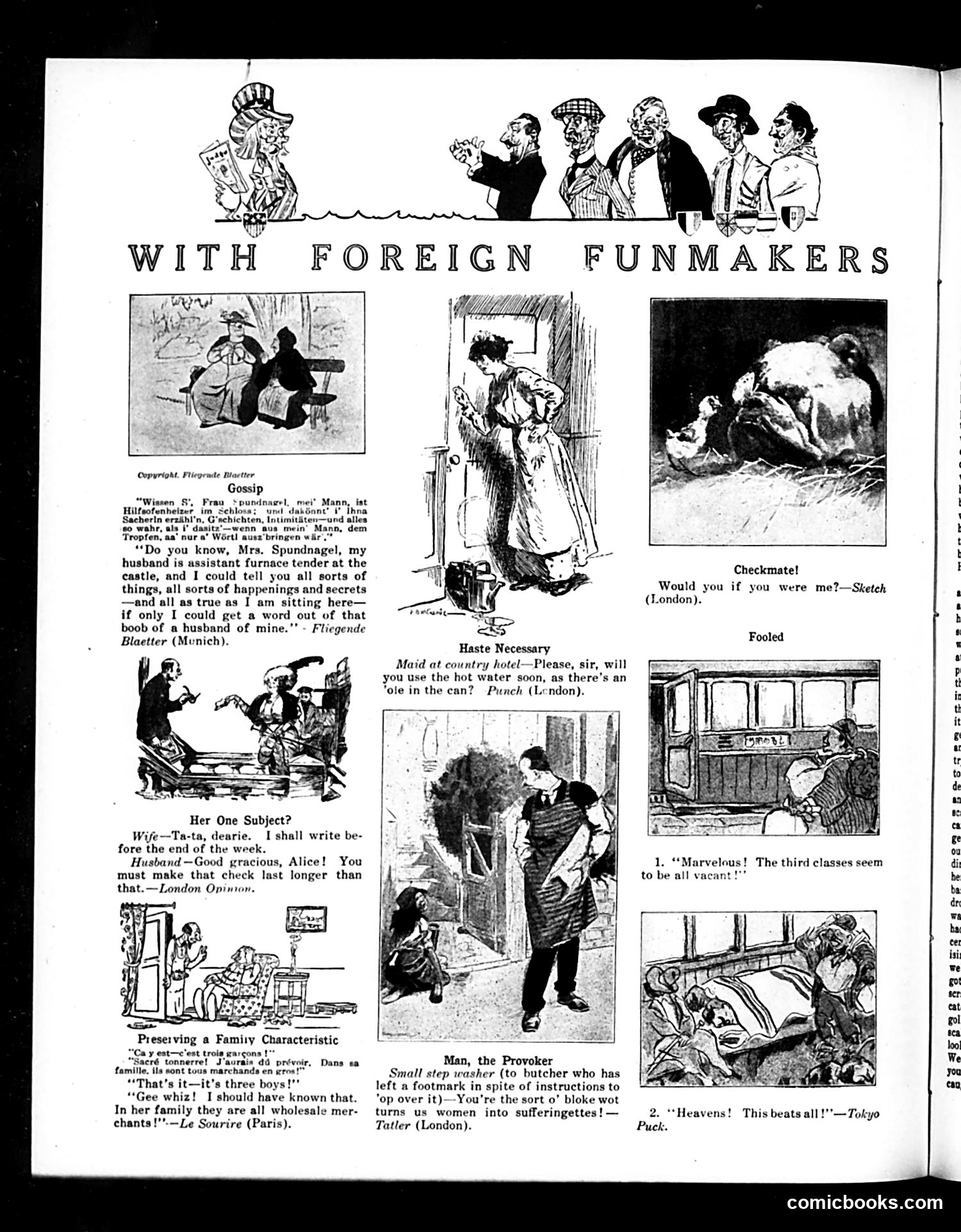
This page reprints humorous cartoons and jokes from European satirical publications (Munich's *Fliegende Blätter*, Paris's *Le Sourire*, London's *Punch* and *Tatler*, Tokyo *Puck*), presented as examples of international comedy for American readers. The jokes target domestic life: a gossipy wife whose husband won't share castle secrets; a wife who writes checks her husband must stretch; three sons inheriting their mother's mercenary nature; a maid annoyed by a butcher's messiness; a woman frustrated by male provocation; and crowded train accommodations. The satire is gentle and universal—marital friction, class differences, gender relations—rather than politically pointed. The collection demonstrates that common social irritations transcended national borders, offering *Judge* readers amusement in recognizing shared human foibles across cultures during the early 20th century.
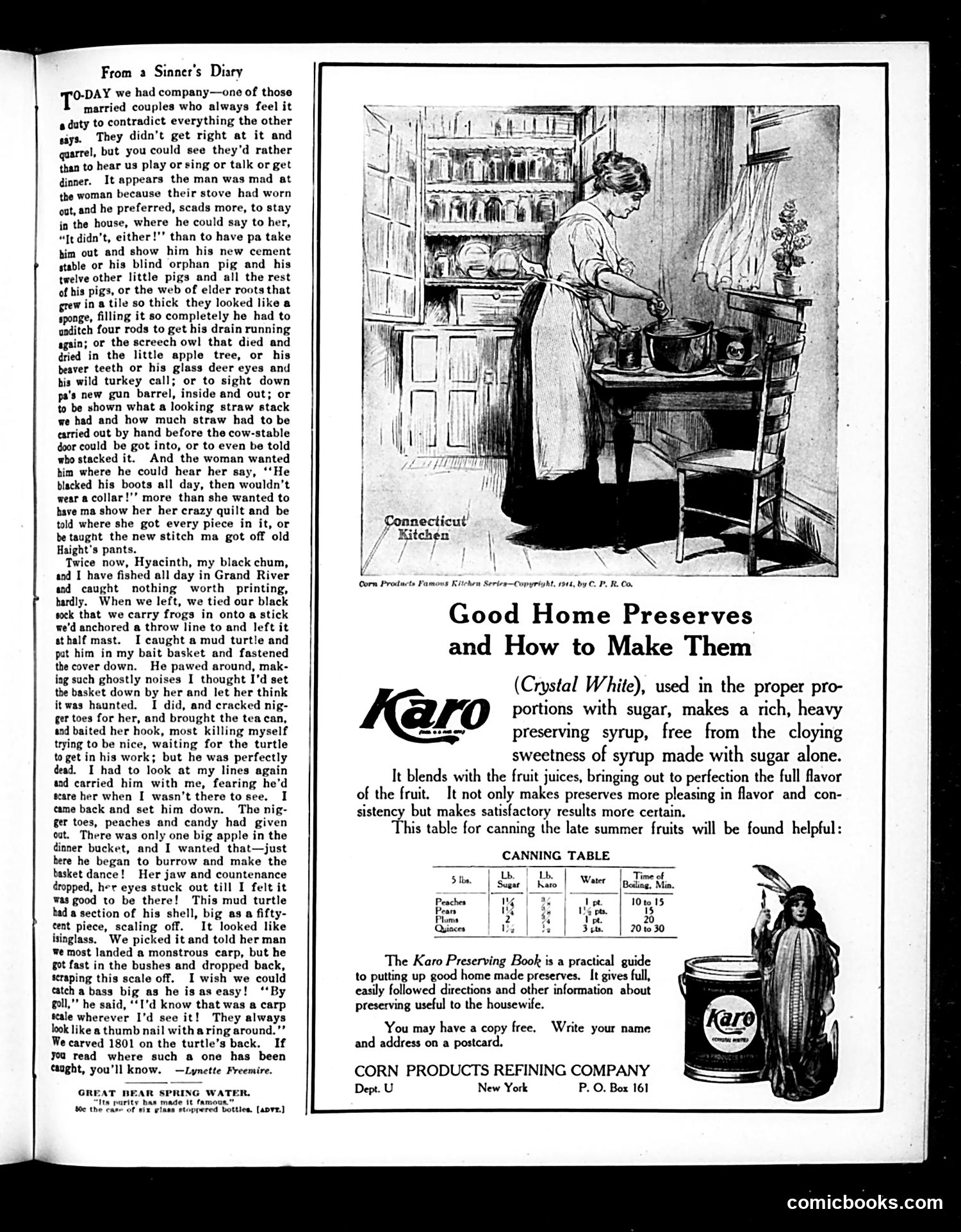
This page contains two distinct elements: a humorous diary entry and an advertisement. **The Diary Entry** satirizes a married couple whose relationship is defined by petty contradictions. The husband resents their worn stove so much he'd rather stay indoors bickering ("It didn't, either!") than tour the husband's various rural accomplishments and curiosities. The wife similarly prefers complaining about his fashion choices to admiring her needlework. The satire mocks domestic discord and spouses who weaponize disagreement over genuine connection. The second anecdote about fishing with "Hyacinth" (a Black companion) uses lowbrow humor involving a mud turtle and crude racial language typical of early-20th-century publications. **The Advertisement** promotes Karo corn syrup for home preserving, featuring a canning table and a "Connecticut Kitchen" illustration. This represents the magazine's commercial content mixed with editorial material—standard for Judge during this period. The page reflects contemporary attitudes while satirizing middle-class marriage dynamics.
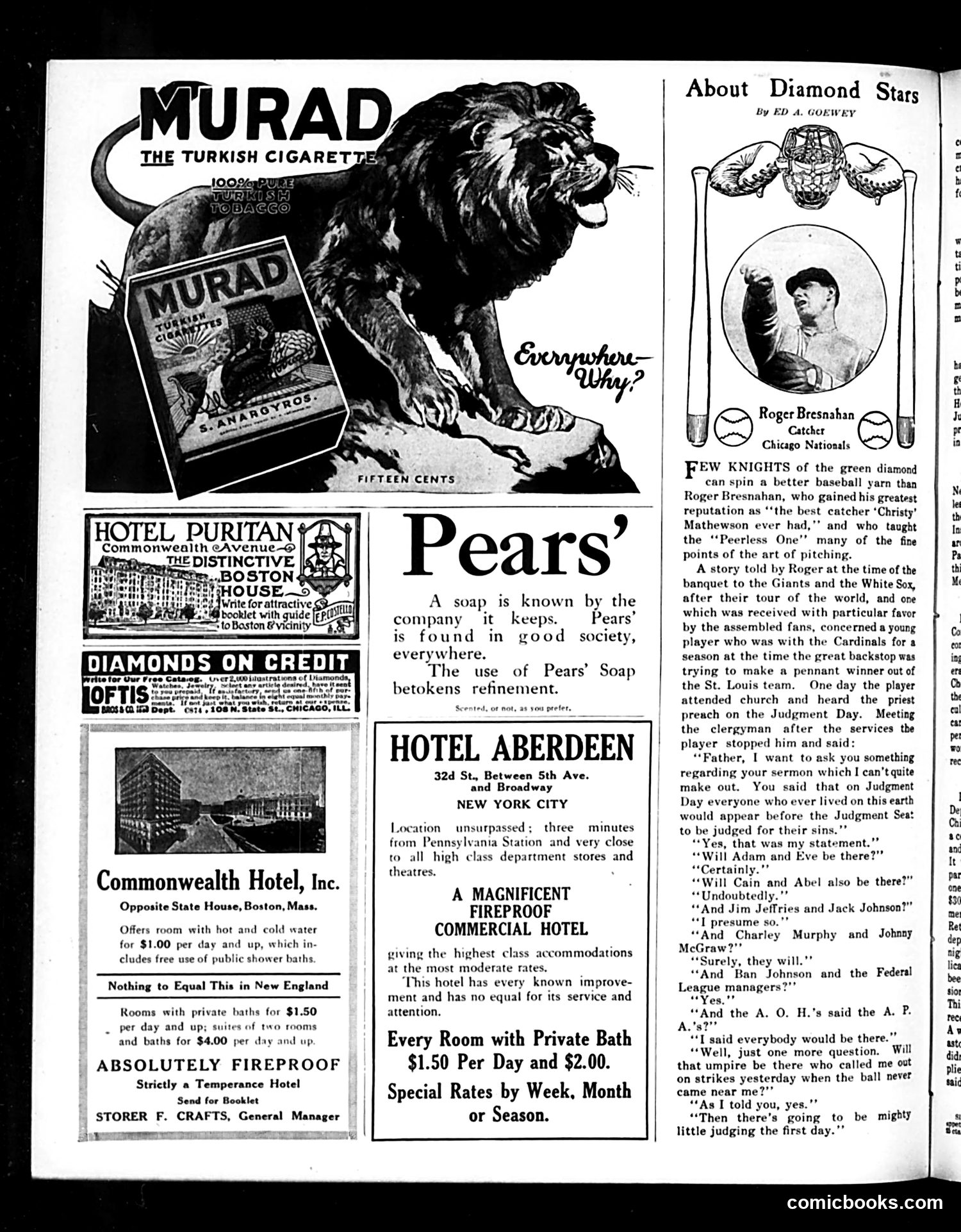
This page is primarily **advertising** (hotels, cigarettes, diamonds, soap) with an embedded humorous baseball story by Ed A. Goewey. The story features **Roger Bresnahan**, a real Chicago Nationals catcher famous for working with pitcher Christy Mathewson. The joke is a religious parable: a young St. Louis Cardinals player asks a priest about Judgment Day, listing famous figures (Adam, Eve, Jim Jeffries, Jack Johnson, baseball managers Charley Murphy and Ban Johnson). The punchline: when the priest agrees all will be judged, the player asks whether a particular umpire who made a bad call against him will also appear. The priest says yes—prompting the player's final quip that "there's going to be mighty little judging the first day" because that umpire will be too busy being punished. The humor mocks both **baseball's passionate fans** and **umpirical fallibility**—a timeless sporting complaint.
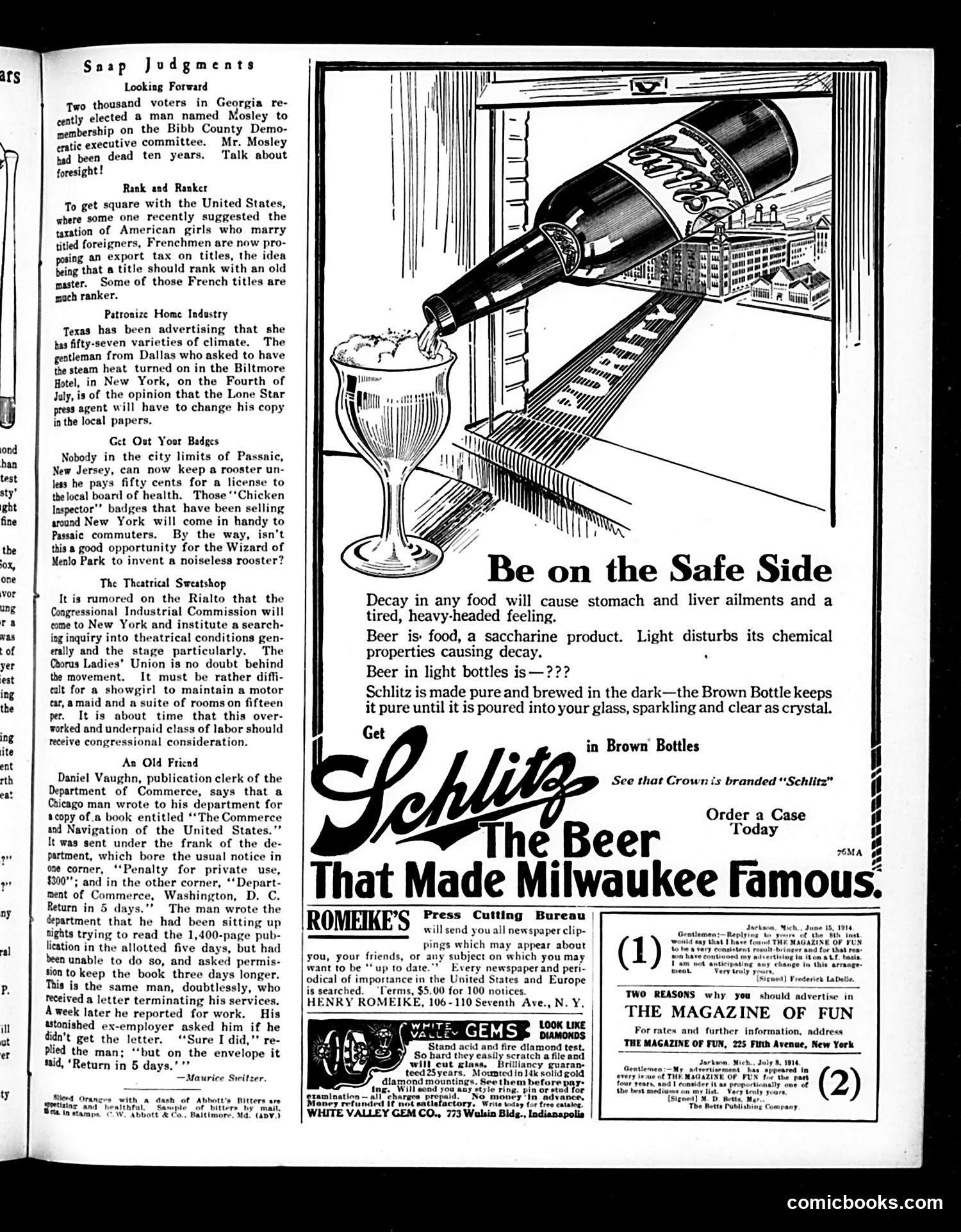
This page from *Judge* magazine contains several short satirical pieces mocking contemporary American politics and society, plus a beer advertisement. The "Snap Judgments" section ridicules voting irregularities (a deceased Georgian elected to office), French aristocratic pretensions (taxing titles like art exports), Texas's exaggerated climate claims, and New Jersey's new rooster licensing law. A theatrical piece critiques congressional indifference to chorus girls' poor working conditions. The closing anecdote mocks bureaucratic absurdity: a clerk asks to keep a government book beyond its five-day return deadline, but the department official misinterprets the request as literal—treating the frank's "Return in 5 days" instruction as binding even on the recipient. The dominant advertisement promotes **Schlitz beer in brown bottles**, claiming light damages beer's chemical properties while brown glass preserves quality. This reflects early 20th-century beer marketing emphasizing purity and modern scientific preservation—concerns that seem quaint today but reflected genuine contemporary anxieties about food safety.
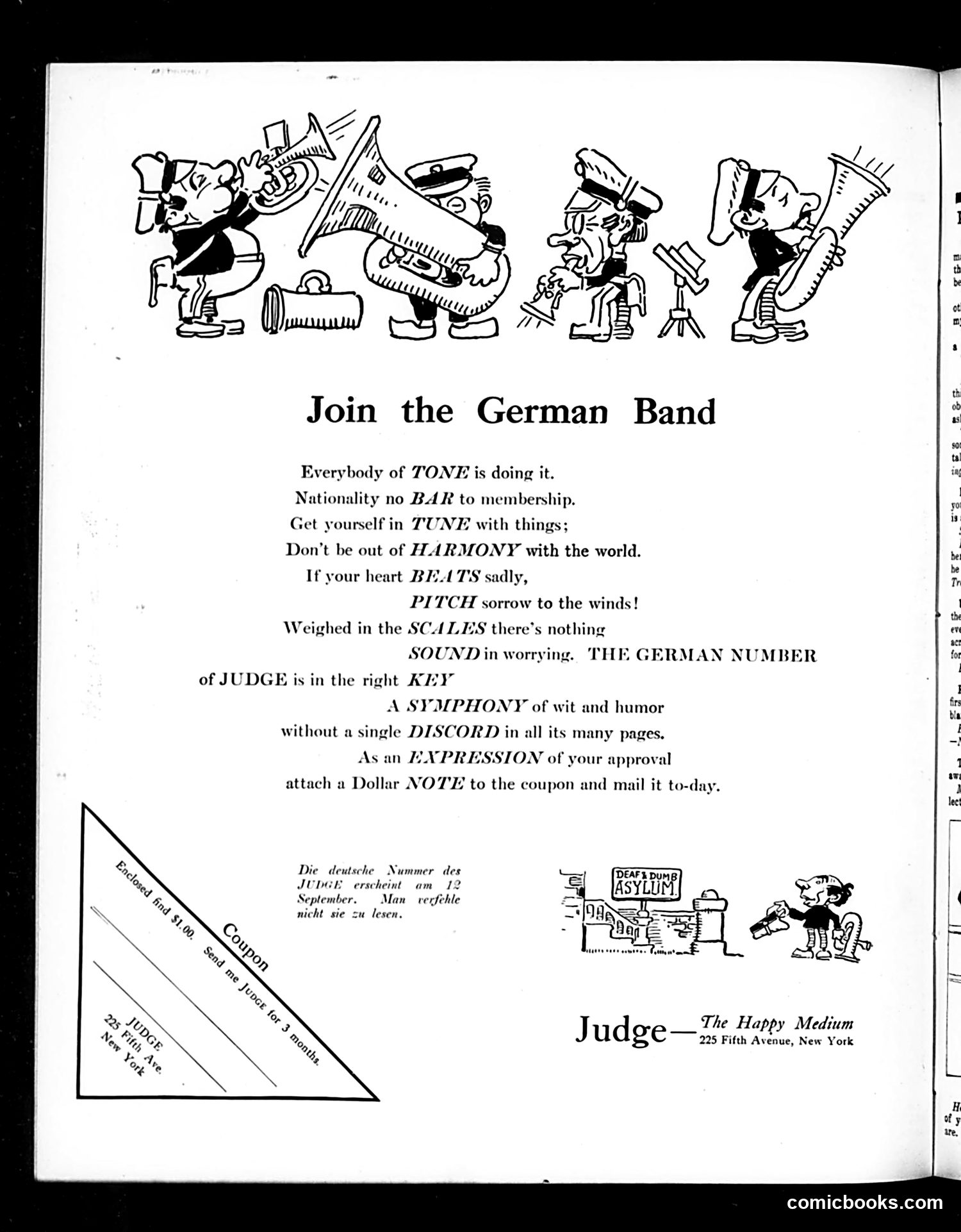
This is a **subscription advertisement** for Judge magazine's special German-language edition (published September 12, unclear which year, but likely early 1900s based on style). The ad uses **musical puns** as its central conceit: TONE, TUNE, HARMONY, BEATS, PITCH, SCALES, SOUND, KEY, SYMPHONY, DISCORD, and NOTE are all emphasized to encourage subscriptions. The cartoons at top show band musicians in exaggerated style. The phrase "Nationality no BAR to membership" suggests Judge was marketing this German edition to American readers of German descent—a significant immigrant population. The text includes actual German language ("Die deutsche Nummer des JUDGE..."), reinforcing the ethnic appeal. The satire appears gentle: it's simply promoting the magazine's humor and wit to German-American audiences during a period when such ethnic-specific publications were common. The "Deaf & Dumb Asylum" cartoon in the lower right is unclear in meaning without more context.
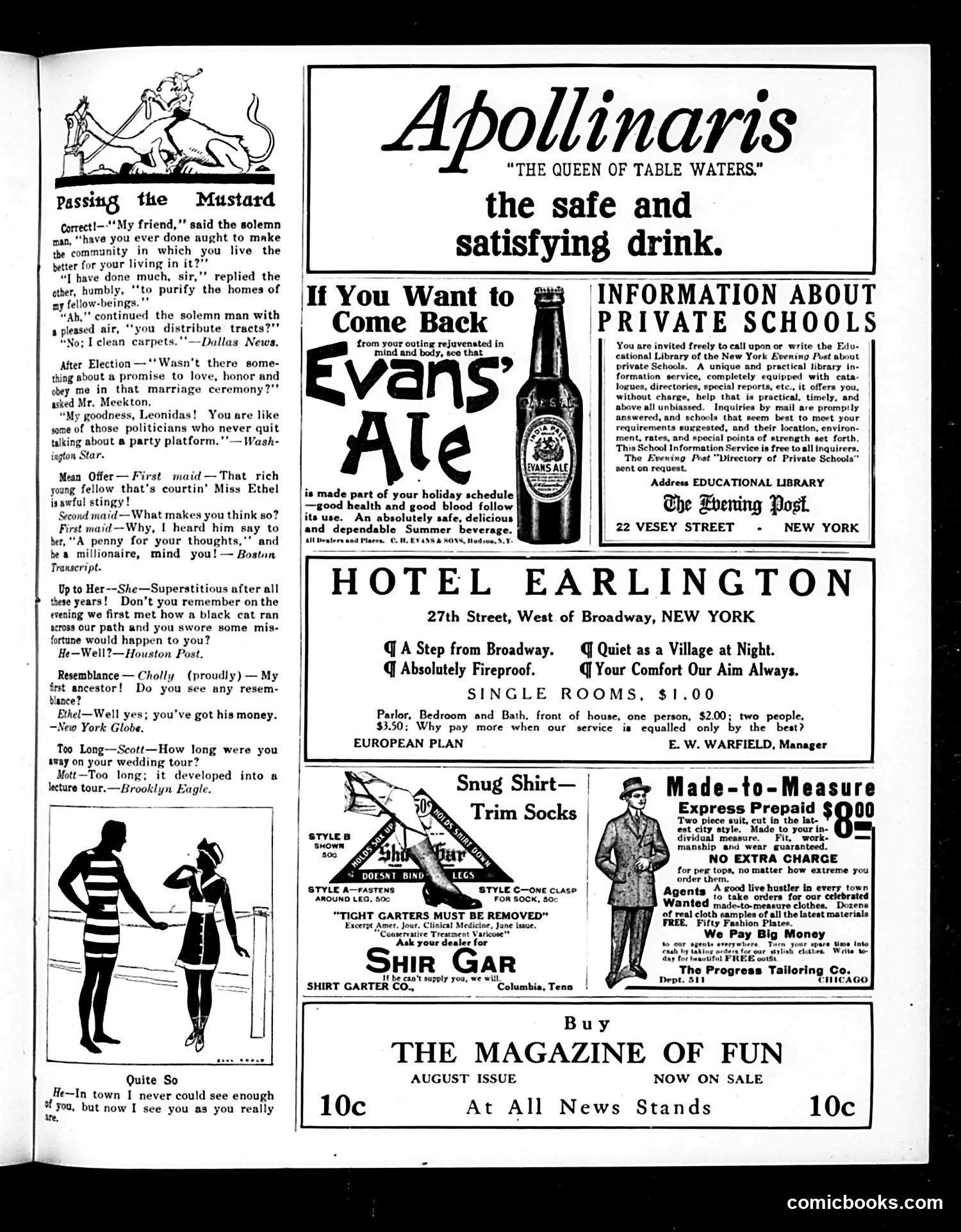
This page is primarily **advertisements and humor anecdotes**, not political cartoons requiring historical context. The left column contains brief joke items from various newspapers—quips about marriage, courtship, and domestic life with punchlines about materialism and gender dynamics typical of early 20th-century American humor. These aren't satirizing specific figures or events; they're generic social comedy. The right side features product advertisements: Apollinaris mineral water, Hotel Earlington, private school information services, made-to-measure suits, and shirt garters. One small illustrated panel shows people in swimming attire, captioned "Quite So"—a mild joke about romantic perception. **No identifiable political figures or specific historical events** are referenced on this page. The humor reflects period attitudes toward wealth, marriage, and gender roles but requires no specialized historical knowledge beyond understanding early 1900s social conventions. The page serves primarily as a **vehicle for advertising** rather than satire or commentary.
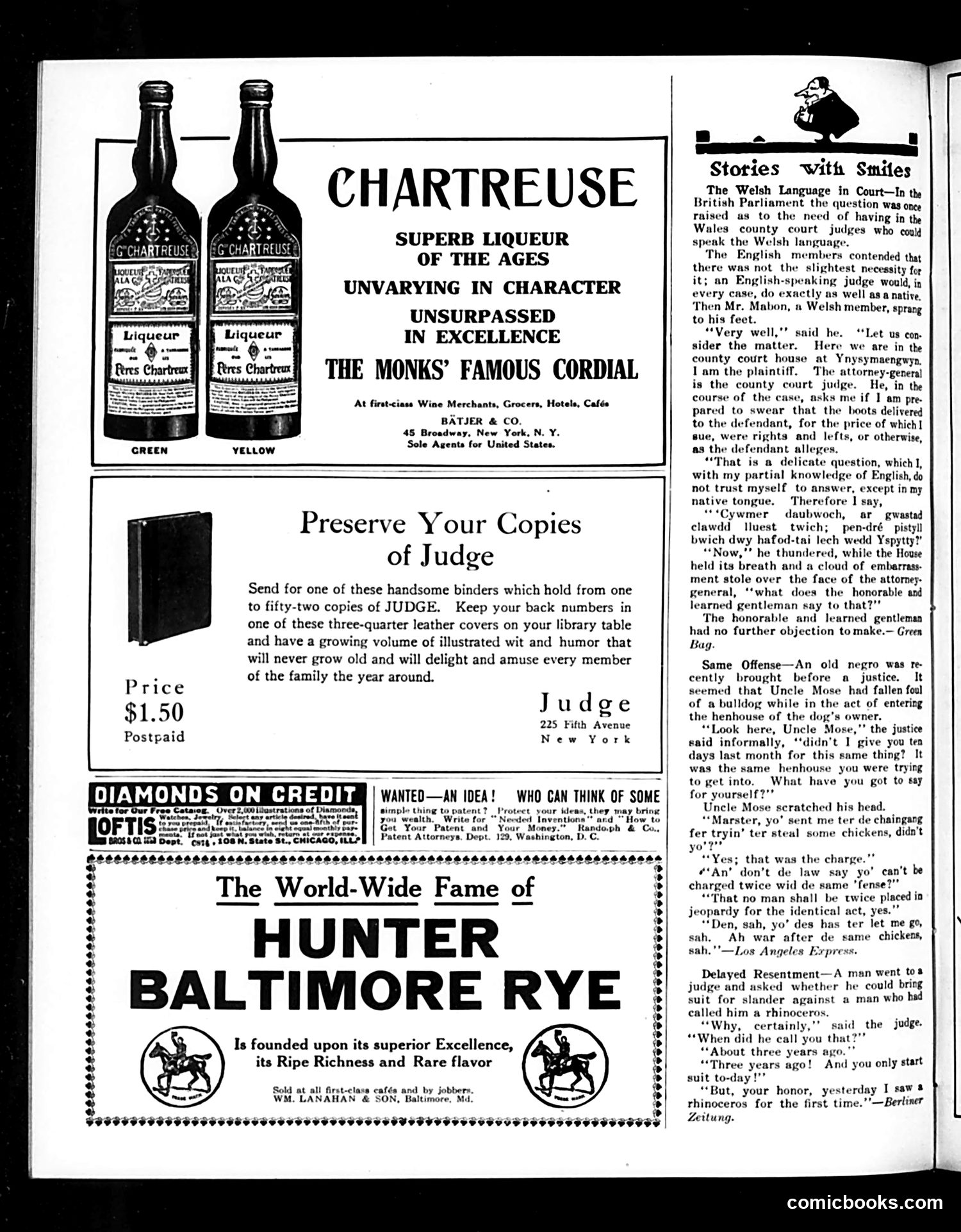
This page is primarily **advertising** for liqueurs, binders, and whiskey, with two humor pieces on the right side. The main content consists of **"Stories with Smiles,"** short humorous anecdotes: 1. **Welsh Language in Court**: A Welsh Parliament member (Mr. Mabon) argues for Welsh-speaking judges by demonstrating that an English judge cannot understand Welsh legal testimony. He speaks incomprehensible Welsh, embarrassing the English attorney-general and proving his point—a satire on English resistance to accommodating Welsh language rights. 2. **Same Offense**: A humorous dialect story where an elderly Black man argues he cannot be charged twice for the same crime (double jeopardy principle), though he's repeatedly caught stealing from the same henhouse. The joke relies on period-typical racial stereotypes in dialect. 3. **Delayed Resentment**: A brief joke about a man suing for being called a "rhinoceros"—three years after the insult. These are light, anecdotal humor pieces typical of Judge magazine's satirical content.
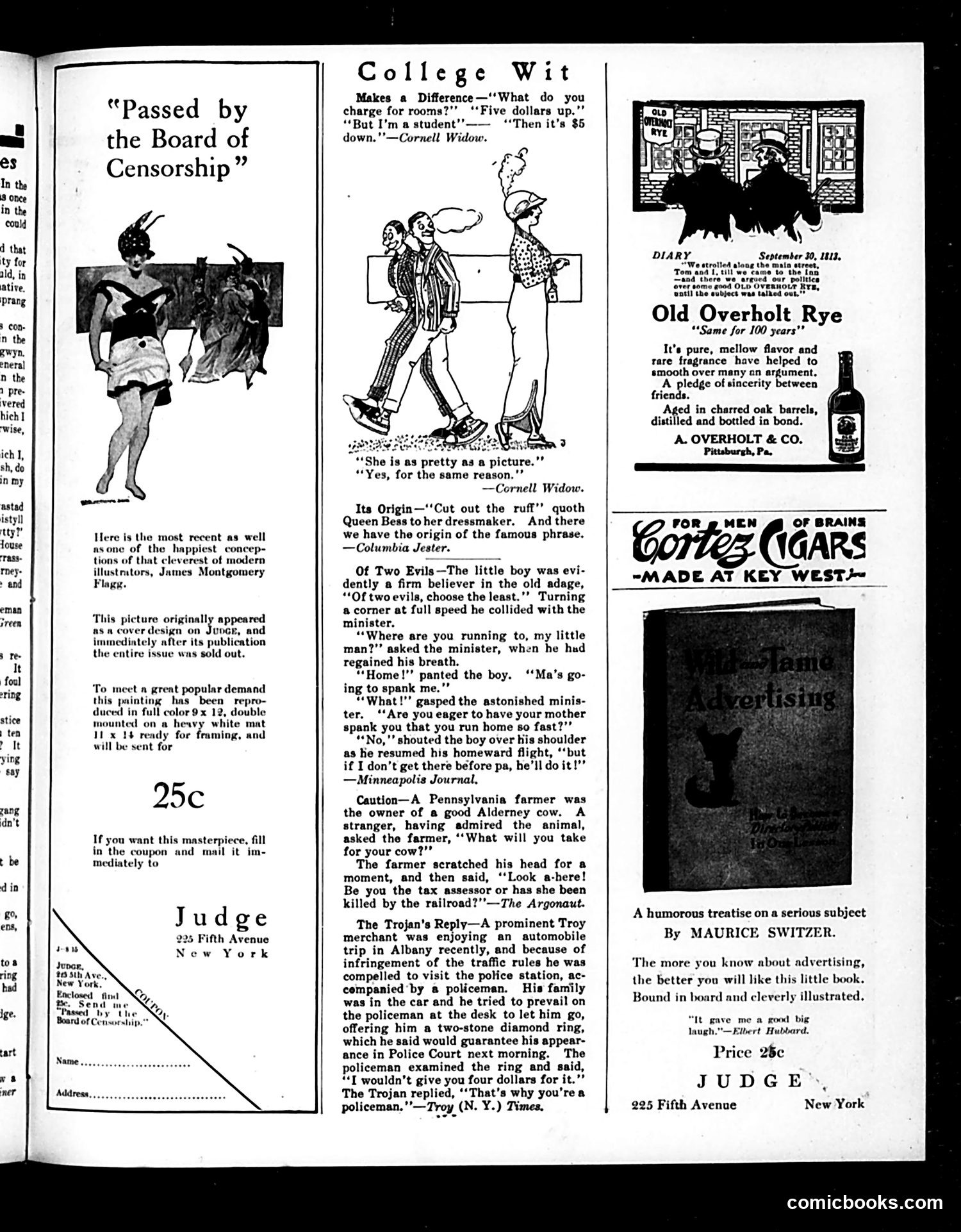
This page from *Judge* magazine contains college humor and advertisements rather than political cartoons. The main illustration shows a flapper-era woman captioned "Passed by the Board of Censorship"—satirizing how risqué imagery could be published if officially approved by censors. The drawing itself is relatively modest by modern standards, making the joke about censorship's arbitrary nature clear. The "College Wit" section collects brief jokes from various college publications (Cornell Widow, Columbia Jester, Minneapolis Journal). These are lightweight campus humor: wordplay about room rates, a boy choosing to be spanked by his mother rather than his father, and pastoral absurdities. The advertisements—for Old Overholt Rye whiskey, Cortez cigars, and Maurice Switzer's book on advertising—represent typical magazine revenue during Prohibition's tail end (the page shows "charred oak barrels, distilled and bottled in bond"). The censorship cartoon is the sole satirical content, mocking arbitrary moral gatekeeping of the era.
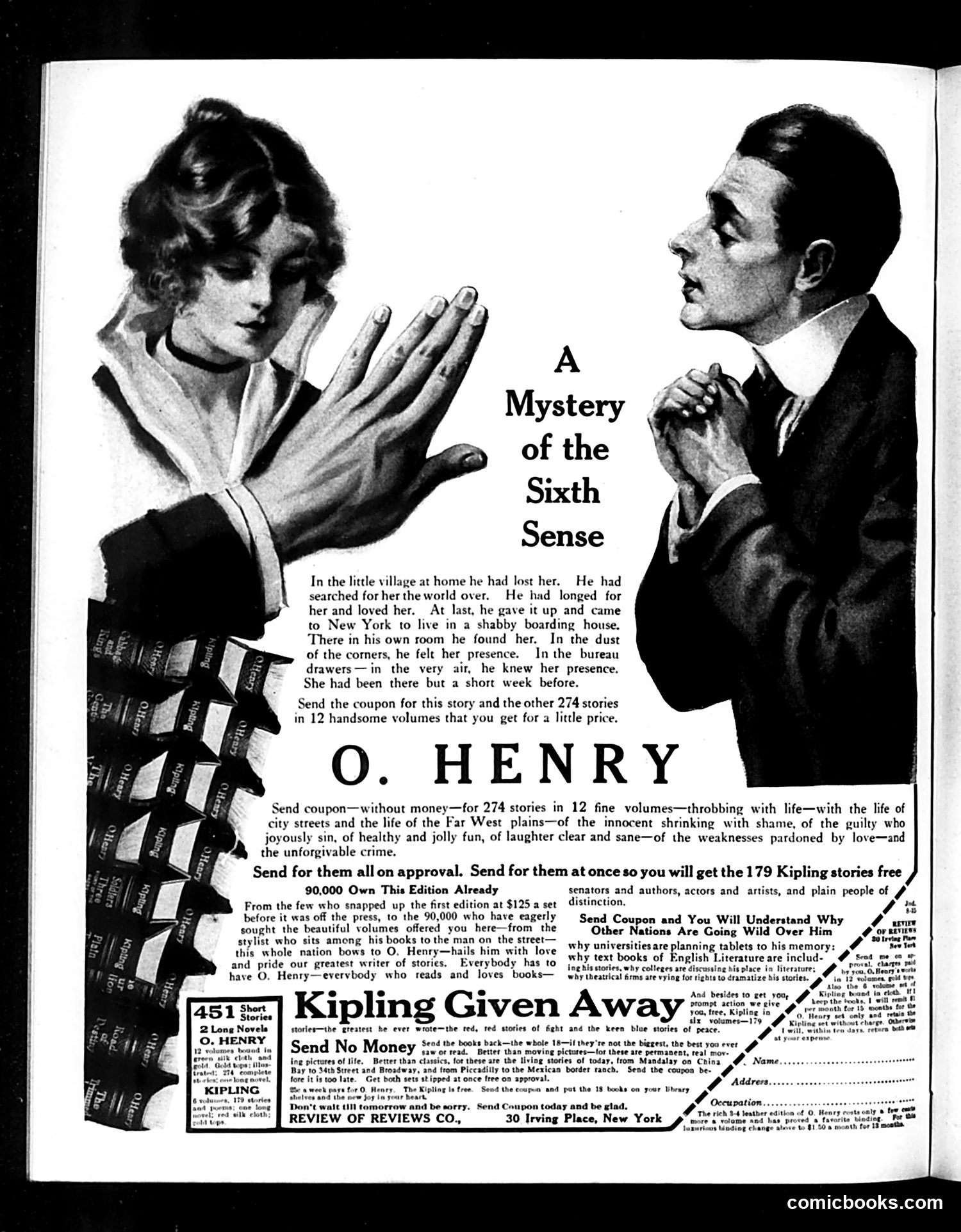
This page is primarily a **book advertisement**, not a political cartoon. It promotes two classic literature collections: O. Henry's complete stories and Rudyard Kipling's works, offered on approval by Review of Reviews Co. The visual element—two figures (a woman and man) separated by space—illustrates the accompanying O. Henry story excerpt about a man who finds his lost love's "presence" in a New York boarding room despite her physical absence. This demonstrates Henry's sentimental storytelling style to potential buyers. The advertisement exploits early 20th-century literary enthusiasm, claiming 90,000 people already own the O. Henry edition and emphasizing that universities, teachers, and "other nations" celebrate both writers. The sales pitch targets educated, book-loving readers by positioning these volumes as culturally essential—a status symbol for the literate middle class.