
Judge, 1914-08-15 · page 14 of 24
Judge — August 15, 1914 — page 14: what you’re looking at
What you’re looking at
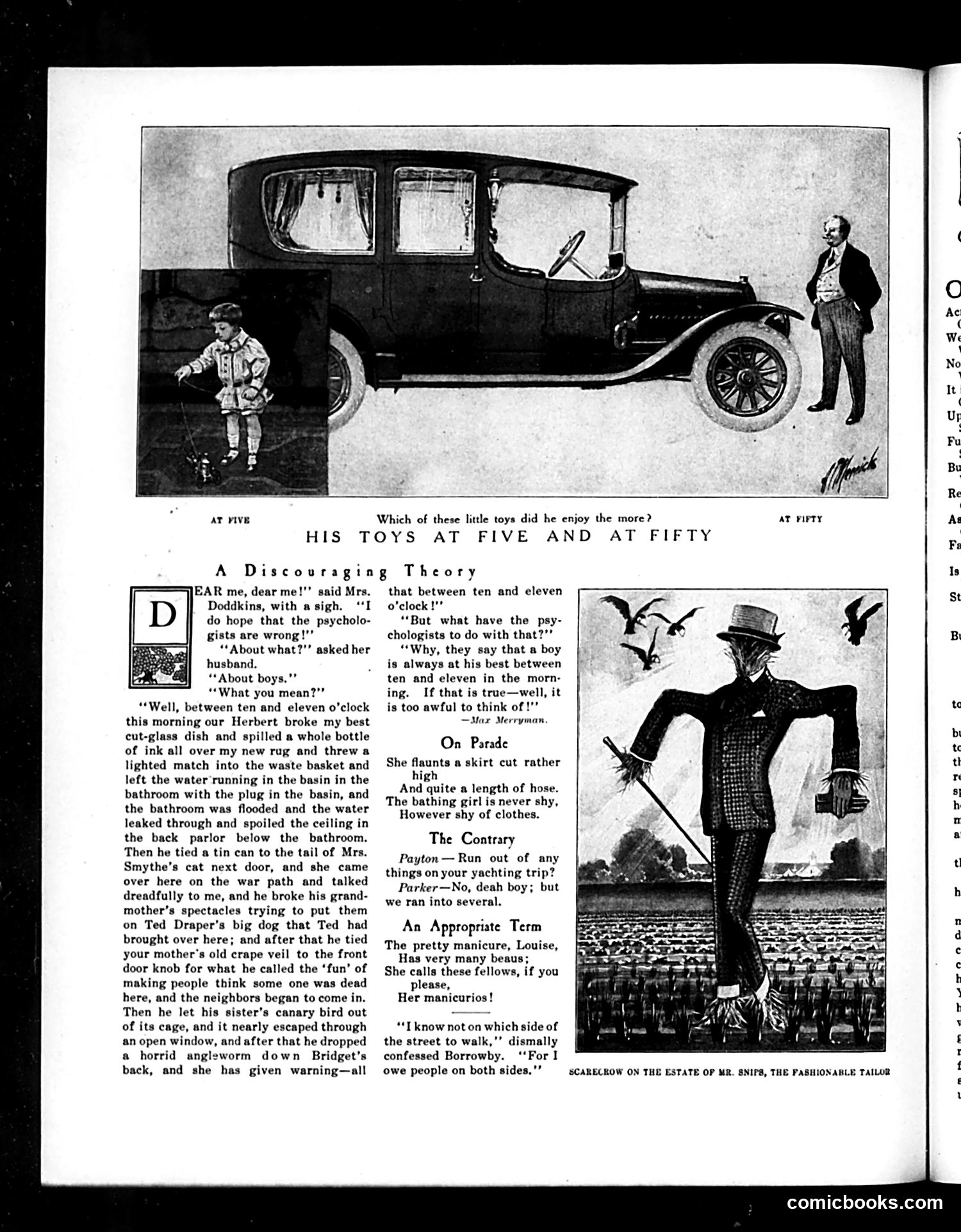
This page satirizes a psychological theory (likely early 20th-century developmental psychology) claiming boys are "always at their best between ten and eleven in the morning." **The main cartoon** shows a child at age five with toys, and an adult man at age fifty with an automobile—visual evidence that boys never actually outgrow destructive behavior. The accompanying story supports this: Mrs. Doddkins catalogs her son Herbert's morning chaos (broken dishes, spilled ink, flooded bathroom, tied tin cans to cats, dropped worms) to mock the psychologists' optimistic claim. **The satire's point:** If boys are supposedly well-behaved at that age, yet Herbert caused such mayhem, the theory is absurd—or worse, boys remain destructive throughout life. The page includes unrelated comic snippets about fashion, debt, and wordplay ("manicurios"), typical of Judge magazine's miscellaneous humor format.
📄 Transcribed text from this page (OCR, searchable)
Machine-transcribed from the original scan — historical spelling and the odd misread are preserved.
AT VIVE Which of these little toys did he enjoy the more? HIS TOYS AT FIVE AND AT FIFTY A Discouraging Theory EAR me, dear me!"’ said Mrs. Doddkins, with a sigh. do hope that the psycholo- gists are wrong!"’ “About what?’’ asked her husband. **About boys.'’ “What you mean?” “*Well, between ten and eleven o'clock this morning our Herbert broke my best cut-glass dish and spilled a whole bottle of ink all over my new rug and threw a lighted match into the waste basket and left the water running in the basin in the bathroom with the plug in the basin, and the bathroom was flooded and the water leaked through and spoiled the ceiling in the back parlor below the bathroom. Then he tied a tin can to the tail of Mrs. Smythe’s cat next door, and she came over here on the war path and talked dreadfully to me, and he broke his grand- mother’s spectacles trying to put them on Ted Draper's big dog that Ted had brought over here; and after that he tied your mother’s old crape veil to the front door knob for what he called the ‘fun’ of making people think some one was dead here, and the neighbors began to come in. Then he let his sister’s canary bird out of its cage, and it nearly escaped through an open window, and after that he dropped a horrid angleworm down Bridget’'s back, and she has given warning—all that between ten and eleven o'clock !’" “But what have the psy- chologists to do with that?’’ “Why, they say that a boy is always at his best between ten and eleven in the morn- ing. If that is truae—well, it is too awful to think of!’ —Max Merryman. On Parade She flaunts a skirt cut rather high And quite a length of hose. The bathing girl is never shy, However shy of clothes. The Contrary Payton — Run out of any things on your yachting trip? Parker—No, deah boy; but we ran into several. An Appropriate Term The pretty manicure, Louise, Has very many beaus; She calls these fellows, if you please, Her manicurios! “I know not on which side of the street to walk,’’ dismally confessed Borrowby. ‘‘For I owe people on both sides.’’ AT PITY SCARECROW ON THE ESTATE OP MR. SNIPS, THE FASHIONABLE TAILOR comicbooks.com