
A complete issue · 24 pages · 1914
Judge — August 1, 1914
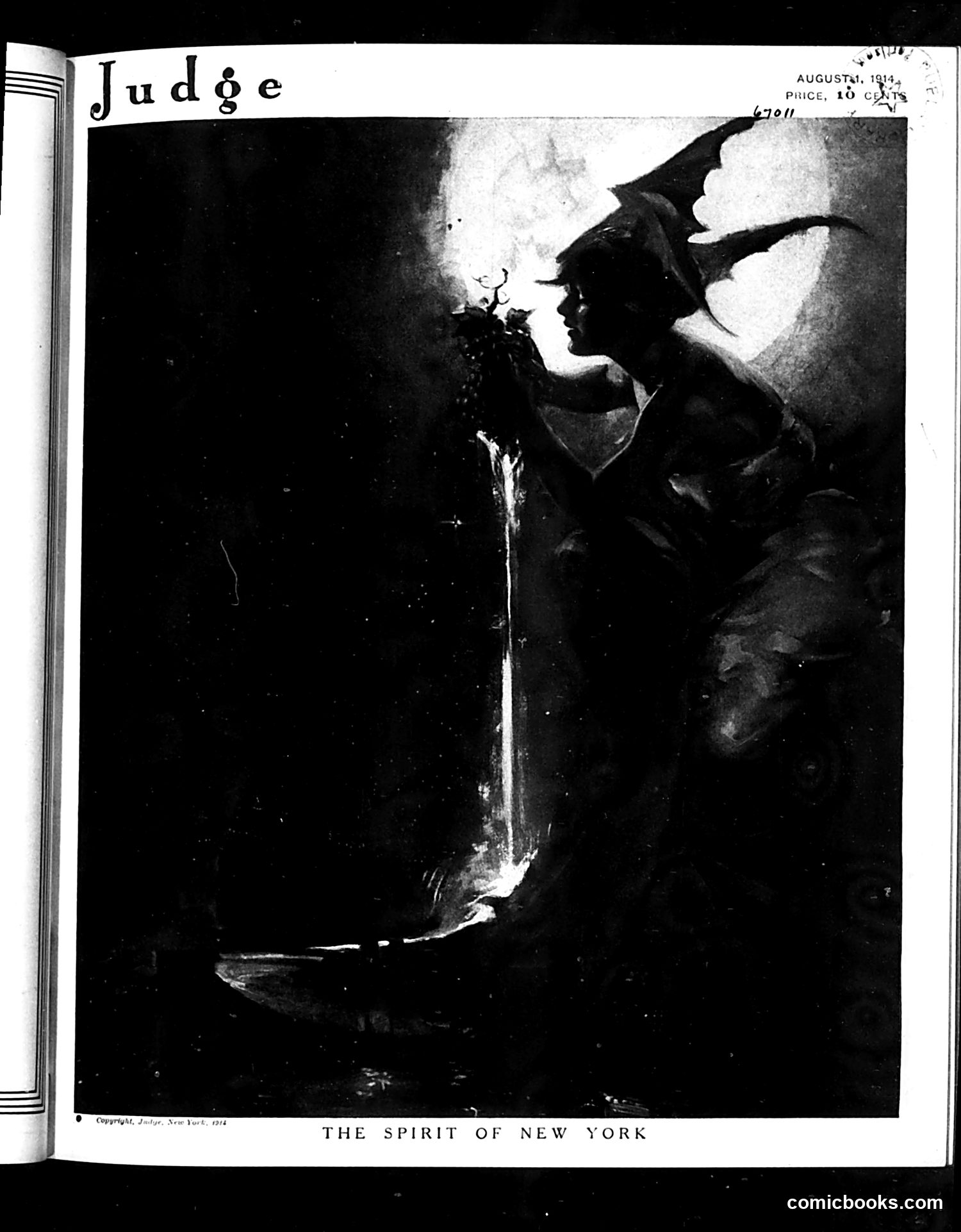
This illustration depicts a demonic or witch-like figure in profile against a dark background, titled "The Spirit of New York." The character wears pointed horns and appears menacing or supernatural in nature. Published in August 1914—at the outbreak of World War I in Europe—this likely represents contemporary anxieties about New York's character or influence. The demonic imagery suggests social or moral criticism, possibly referencing urban corruption, crime, or the city's perceived negative influences during a turbulent period. Without accompanying text or context on the page, the specific target of satire remains unclear, though the grotesque personification indicates Judge magazine's critical commentary on some aspect of New York life or culture during this era.
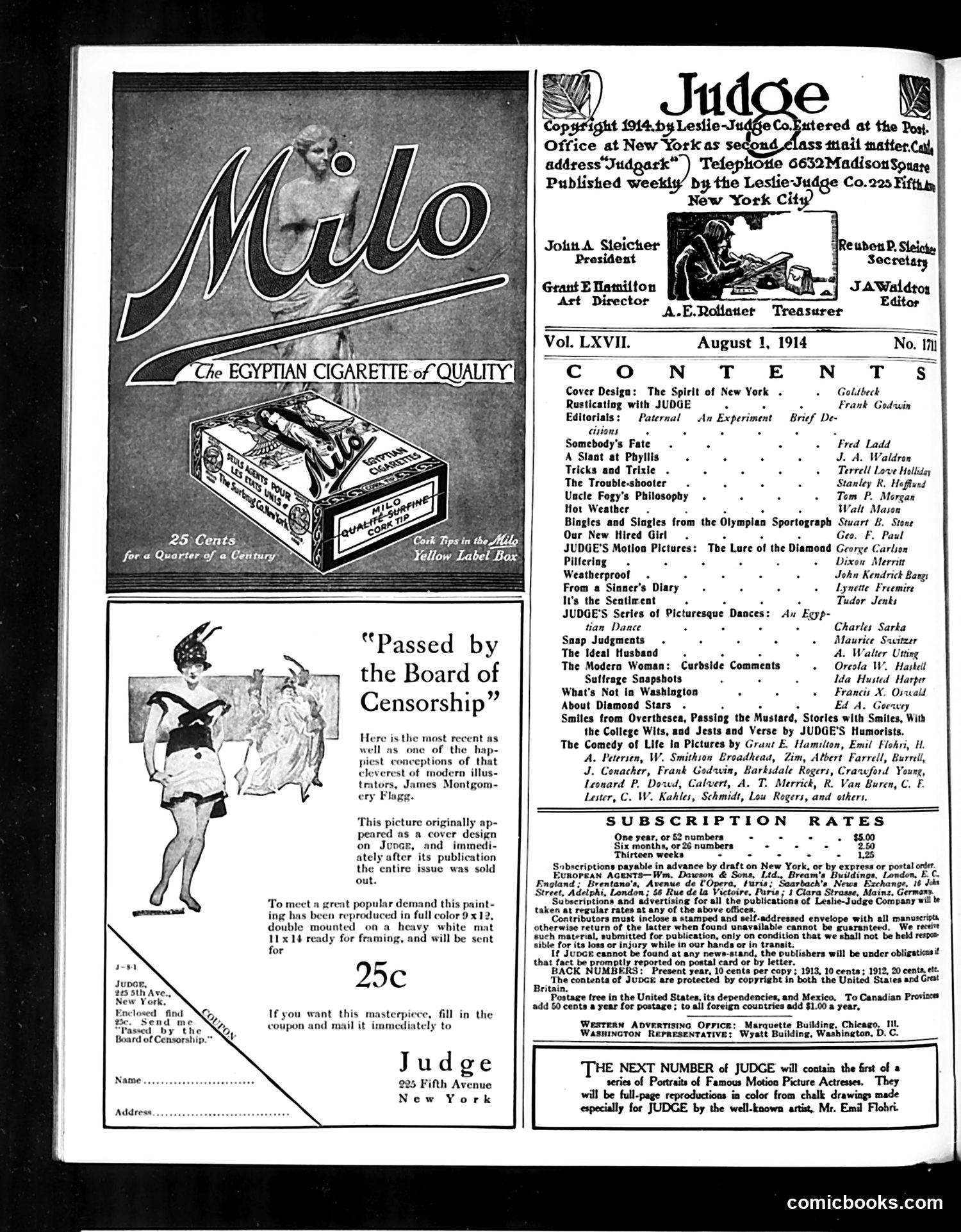
This page is primarily **advertising and editorial content** rather than political satire. The dominant feature is a **Milo cigarette advertisement** ("The Egyptian Cigarette of Quality"), priced at 25 cents. Below that is a cartoon labeled **"Passed by the Board of Censorship,"** depicting a woman in revealing attire. The accompanying text explains this image was originally rejected by Judge's censors but was reproduced on heavy white mat stock to meet popular demand—a tongue-in-cheek commentary on censorship versus public interest in risqué content. The page also includes the magazine's masthead, subscription rates, and a table of contents listing various articles and contributors. The overall content reflects Judge's mix of humor, satire, and advertising typical of 1914 American magazines.
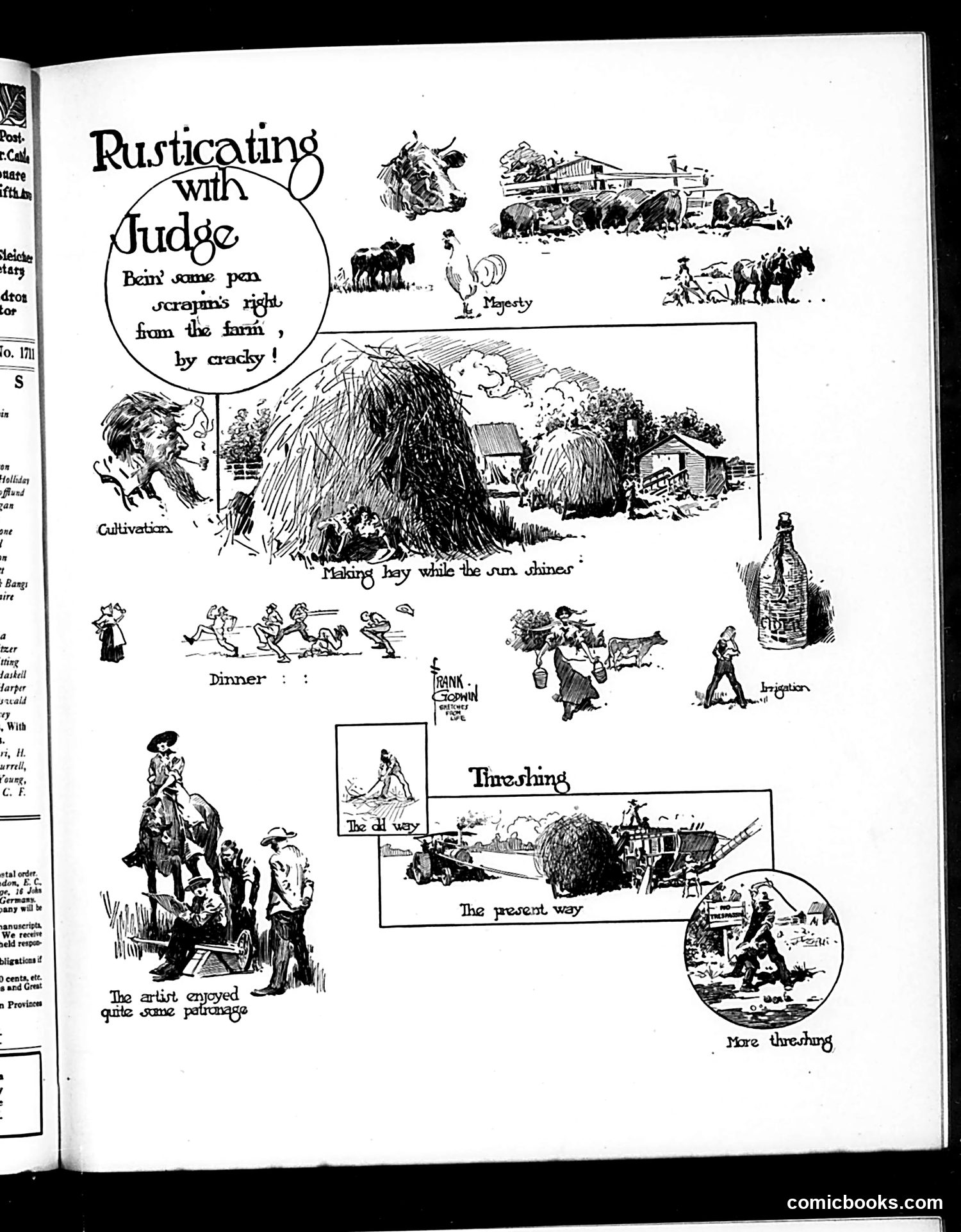
This page satirizes rural farming life through a series of illustrations comparing past and present agricultural practices. The main heading quotes a judge criticizing farm work as "scraping right from the farm by cracky!" The cartoons mock outdated farming methods ("The old way") versus modern mechanization ("The present way"), showing progression from manual labor to machinery. Scenes depict traditional activities like "Making hay while the sun shines," "Dinner," and "Threshing." The satire appears to critique either: (1) farmers resisting modernization, or (2) the rapid mechanization displacing traditional rural life. The phrase "The artist enjoyed quite some patronage" suggests ironic commentary on who benefited from these changes. A cider bottle appears, likely referencing rural culture. The overall tone suggests Judge magazine's urban perspective on agricultural transformation during America's industrial era.
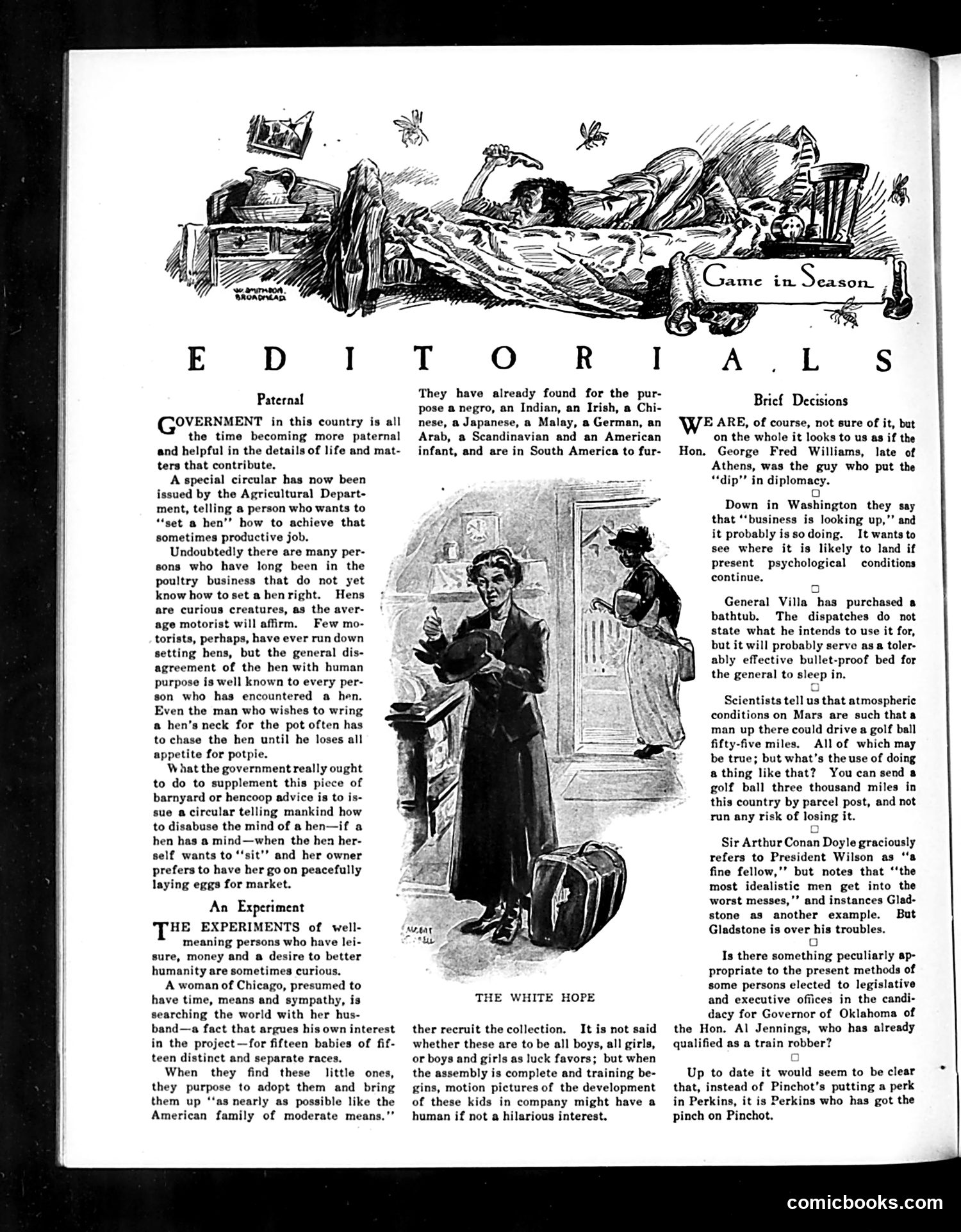
This cartoon illustrates an editorial about a Chicago couple's project to adopt orphaned children of various ethnicities—"a negro, an Indian, an Irish, a Chinese, a Japanese, a Malay, a German, an Arab, a Scandinavian and an American infant." The cartoon depicts a woman at a doorway with multiple children and luggage, titled "The White Hope"—an ironic reference to the couple's presumably white, middle-class American family serving as a model for raising diverse children together. The satire targets both Progressive-era social experiments in assimilation and the paternalistic notion that American family life could "civilize" children from different backgrounds. The crowded scene and heavy luggage suggest the ambitious—and somewhat comedic—scope of their undertaking.
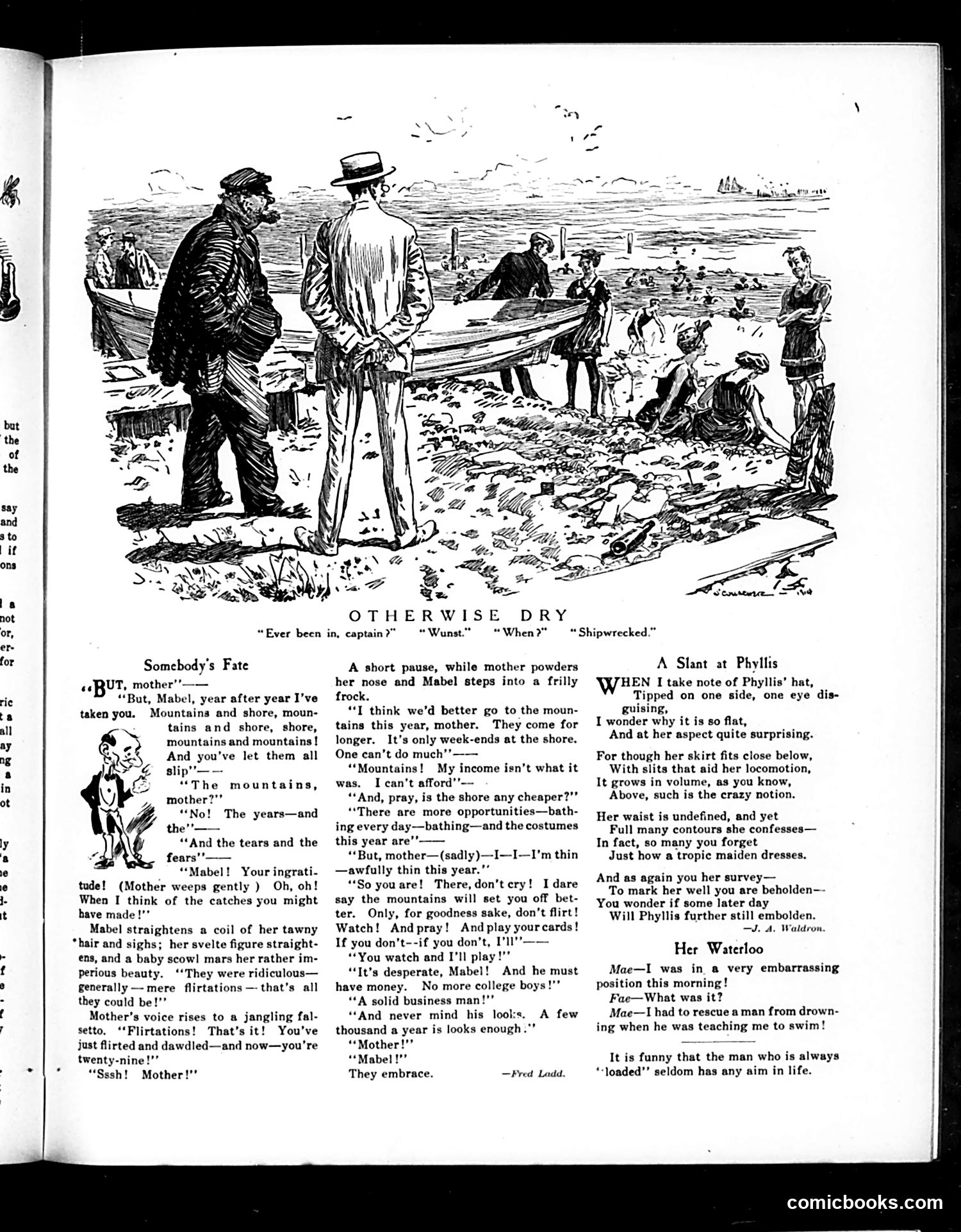
This page from *Judge* magazine contains three separate pieces of humorous writing and one illustration. The main illustration, titled "Otherwise Dry," depicts a beach scene with well-dressed gentlemen observing shipwreck survivors. The caption suggests ironic contrast—the scene itself is tragic, but appears "otherwise dry" (humorously understatement). The three literary pieces below—"Somebody's Fate," "A Slant at Phyllis," and "Her Waterloo"—are satirical vignettes about domestic and social situations. They mock upper-class pretensions and gender dynamics of the era, with particular focus on women's fashion, marital tensions, and romantic complications. The humor relies on wordplay and exaggeration of period social anxieties rather than explicit political commentary.
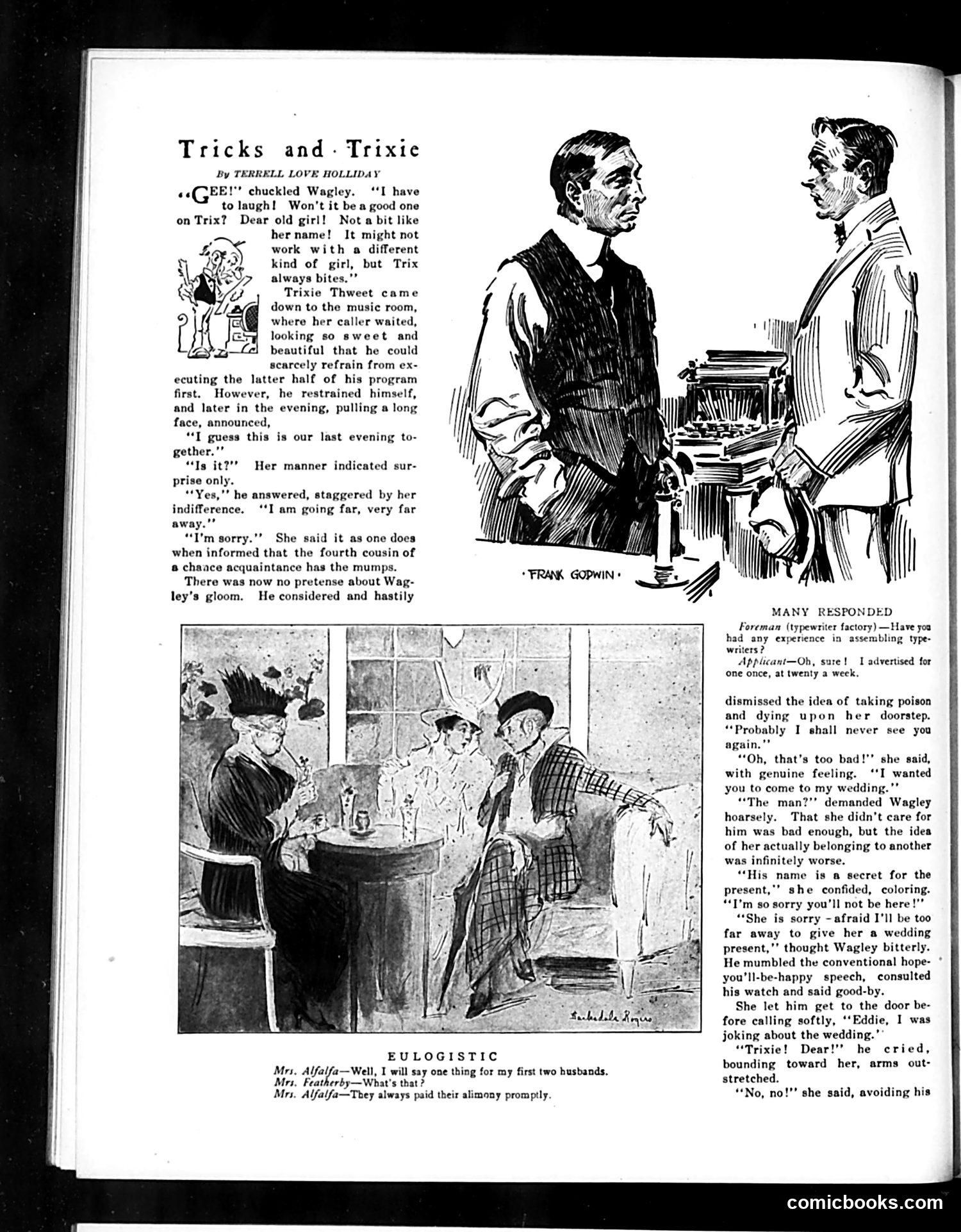
This is a romantic comedy story about a man named Wagley who attempts to manipulate his girlfriend Trixie through a trick. He pretends he's leaving town forever, expecting her to reveal her feelings. Instead, she responds with indifference, devastating him. The joke's twist: Trixie announces she's getting married to someone else. Wagley is crushed—not caring about her was bad enough, but losing her to another man is worse. However, Trixie reveals she was joking about the wedding all along, testing *his* feelings. The satire mocks both parties: his manipulative scheme backfires, and her playful deception proves she's equally shrewd. The lower cartoon ("Eulogistic") is a brief joke about alimony—a woman boasts her ex-husbands always paid promptly. These pieces reflect early 20th-century dating anxieties and gender dynamics in romance.
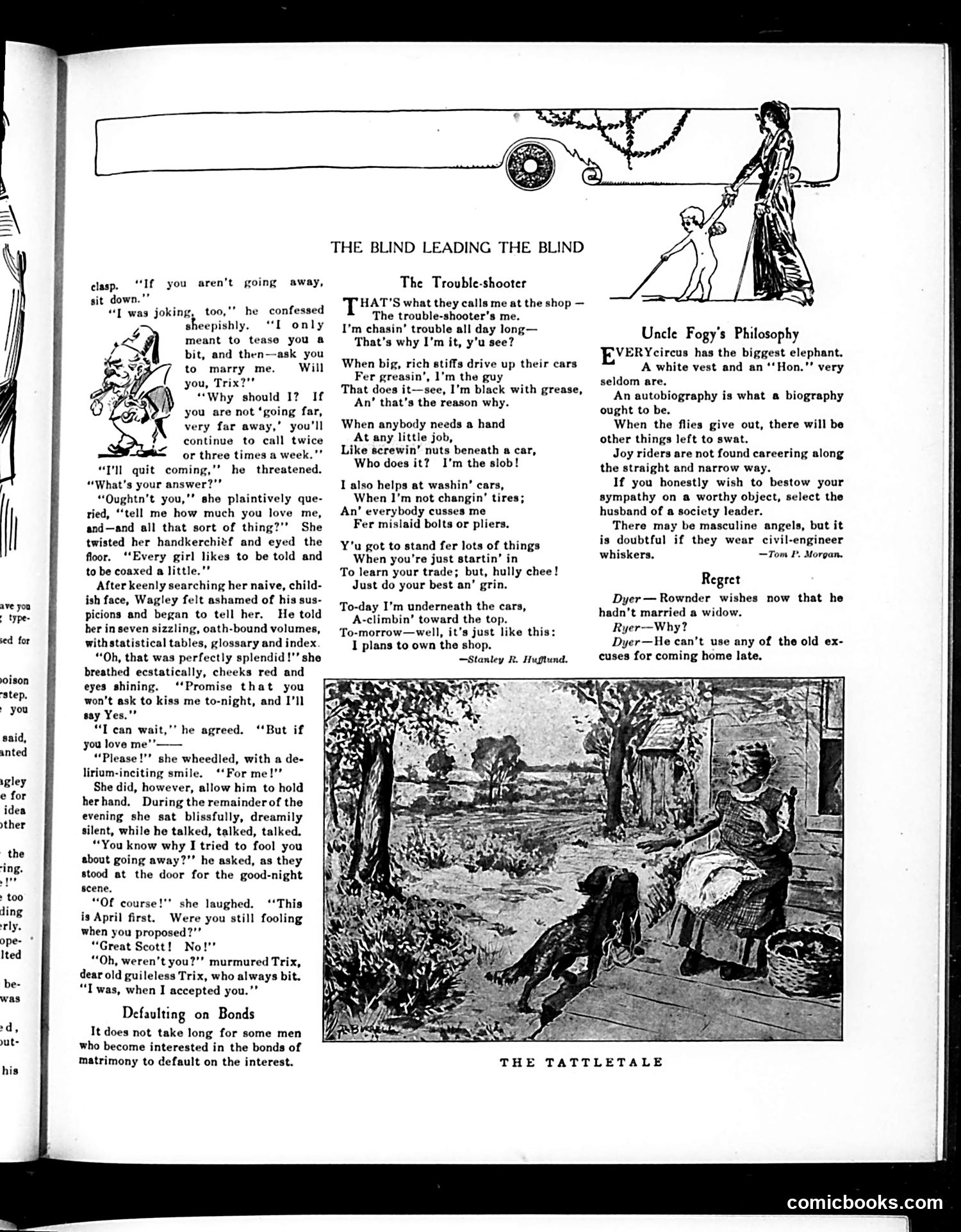
This page contains three satirical pieces typical of early-20th-century American humor: **"The Blind Leading the Blind"** (main story): A cynical April Fools' tale mocking courtship rituals. A man proposes as a joke; the woman accepts his elaborate declarations of love—then reveals she knew he was fooling the whole time. The satire targets both romantic pretense and feminine manipulation, suggesting both parties are morally blind to their own deceptions. **"The Trouble-shooter"** (poem): A working-class monologue celebrating humble persistence. A garage worker performs menial labor but dreams of ownership, embodying the aspirational "bootstrap" mythology common in era publications. **"Uncle Fogy's Philosophy"** and **"Regret"** (brief quips): Cynical one-liners about marriage, society, and human nature—standard filler content mocking spouses and social pretension. The overall tone reflects Judge's target audience: middle-class readers enjoying gentle mockery of courtship conventions, working-class ambition, and marital regret.
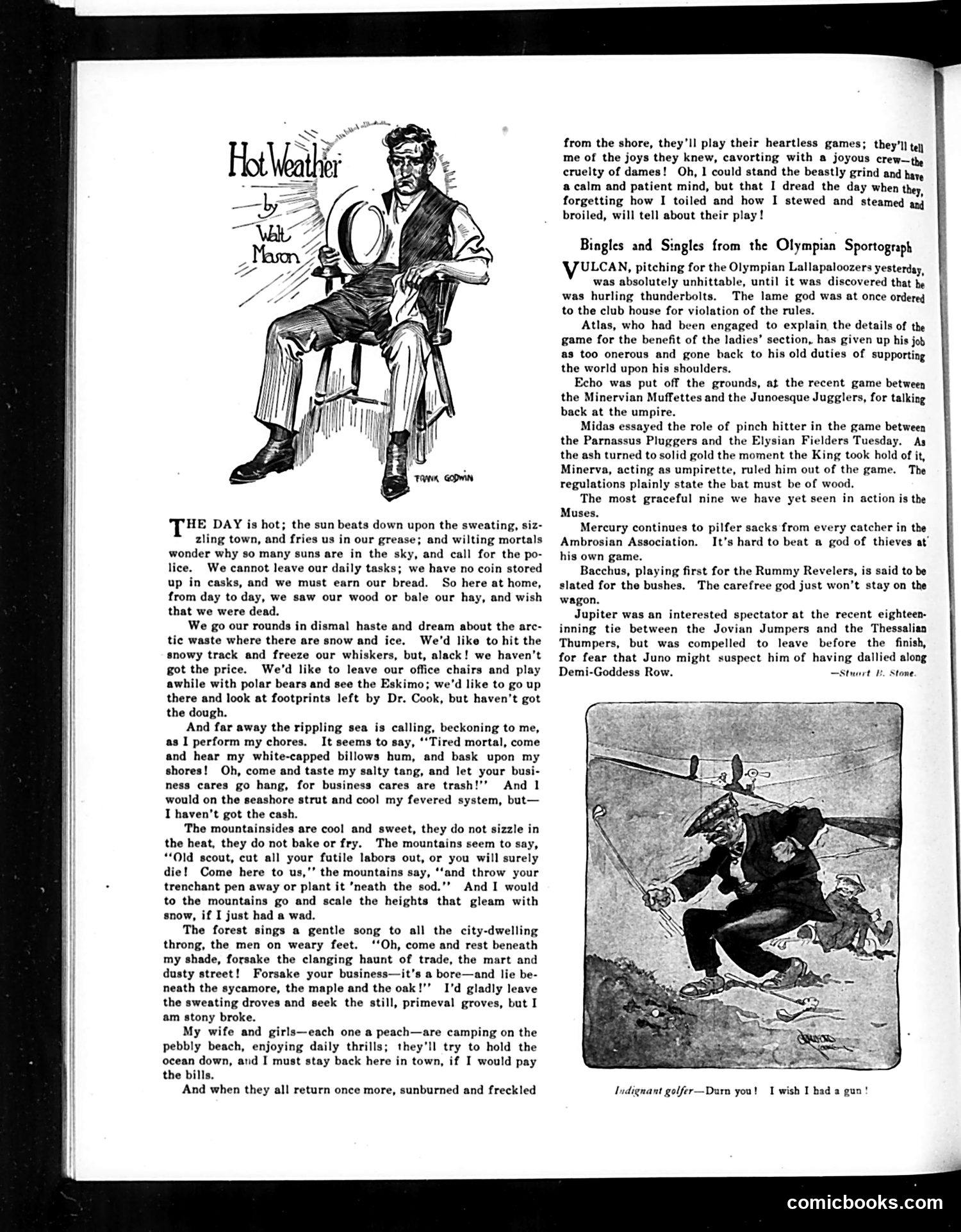
This page contains two distinct pieces of satire: **"Hot Weather" (main essay):** A working-class lament about being trapped in a sweltering city, unable to afford vacations. The narrator envies those escaping to mountains, forests, and beaches while he must toil to pay bills—particularly resenting his wife and daughters camping at the beach without him. The satire targets the gap between desire and economic reality for ordinary workers, and pokes fun at domestic relationships where wives enjoy leisure while husbands labor. **"Bingles and Singles from the Olympian Sportograph" (right column):** Sports satire using Greek mythology. It describes fictional baseball games featuring mythological figures (Vulcan, Atlas, Echo, Midas, Minerva, Mercury) treated as athletes. The humor comes from applying their mythical characteristics to baseball rules—Vulcan's thunderbolts violate equipment regulations, Midas's touch turns his bat to gold (making it illegal), Echo gets ejected for "talking back" at the umpire. This mocks both sports reporting conventions and classical mythology through absurdist juxtaposition.
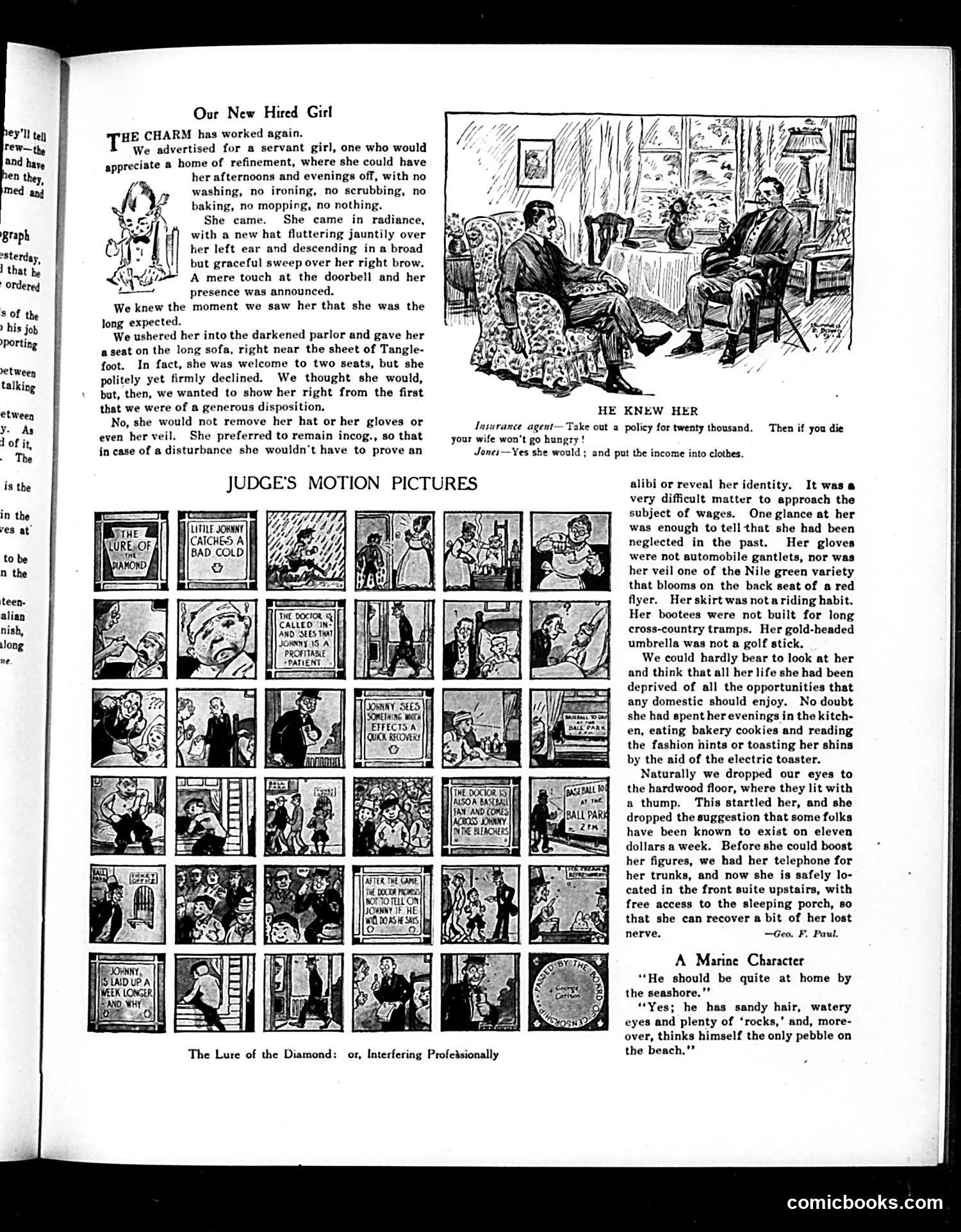
This piece satirizes wealthy employers' self-delusional hypocrisy about servant labor. The family advertises for a maid offering minimal work ("no washing, no ironing...no nothing") and maximum free time—an obvious impossibility they claim to offer from "generosity." When a plainly-dressed girl arrives, the employers patronize her, assuming she's been exploited her whole life because her clothes lack luxury (no "automobile gantlets," no "Nile green" veil). They obsess over her deprivation while simultaneously trying to hire her cheaply, eventually settling her upstairs and congratulating themselves on their benevolence. The satire targets class pretense: employers congratulating themselves for "generosity" while perpetuating low wages and harsh conditions. The joke is that their elaborate concern for the servant's welfare masks pure economic self-interest. The ironic title—"Our New Hired Girl"—emphasizes she belongs to them.
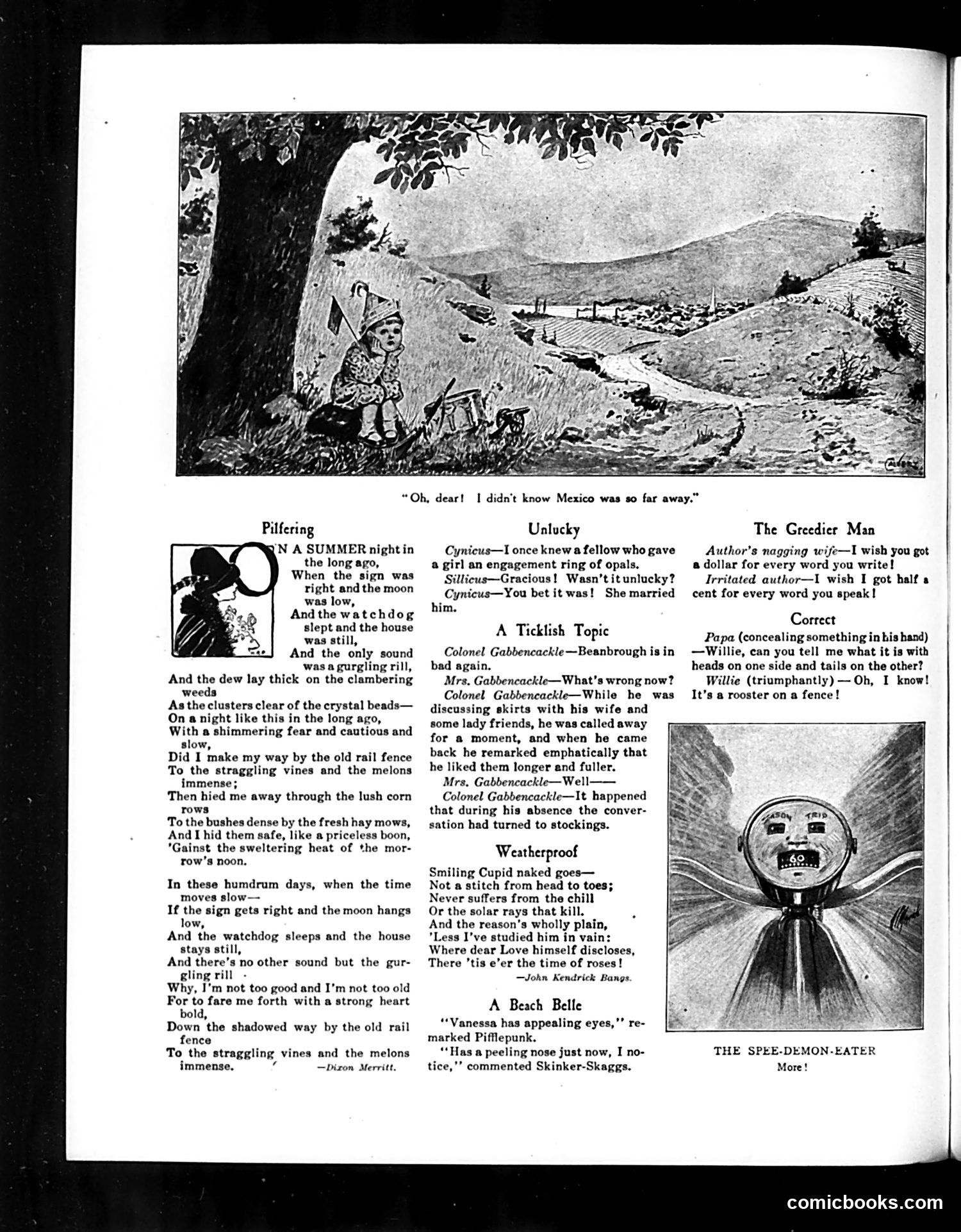
This page contains multiple brief humorous items typical of early-20th-century satirical magazines: **Main cartoon** (top): Shows a child beneath a tree with distant Mexican landscape. The caption jokes that Mexico seems unexpectedly far away—likely referencing American assumptions about Mexico's proximity or the wanderlust of the era. **Text items** include: - A sentimental poem by Dixon Merritt about stealing melons as a youth, now tempted to repeat the misdeed - **"Unlucky"**: A joke about opals as bad-luck engagement rings (a folk superstition)—the punchline being the marriage itself was the real misfortune - **"Ticklish Topic"**: A marital misunderstanding where Colonel Gabbencackle's comment about preferring longer, fuller "skirts" is revealed to reference stockings, not clothing - **"The Greedier Man"**: A domestic quarrel joke about a nagging wife - **"Weatherproof"**: A poem suggesting Cupid's nakedness works because love exists in perpetual spring - **"Beach Belle"**: A pun contrasting "appealing eyes" with sunburned, "peeling" skin These represent typical Judge humor: domestic squabbles, puns, and mild social satire.
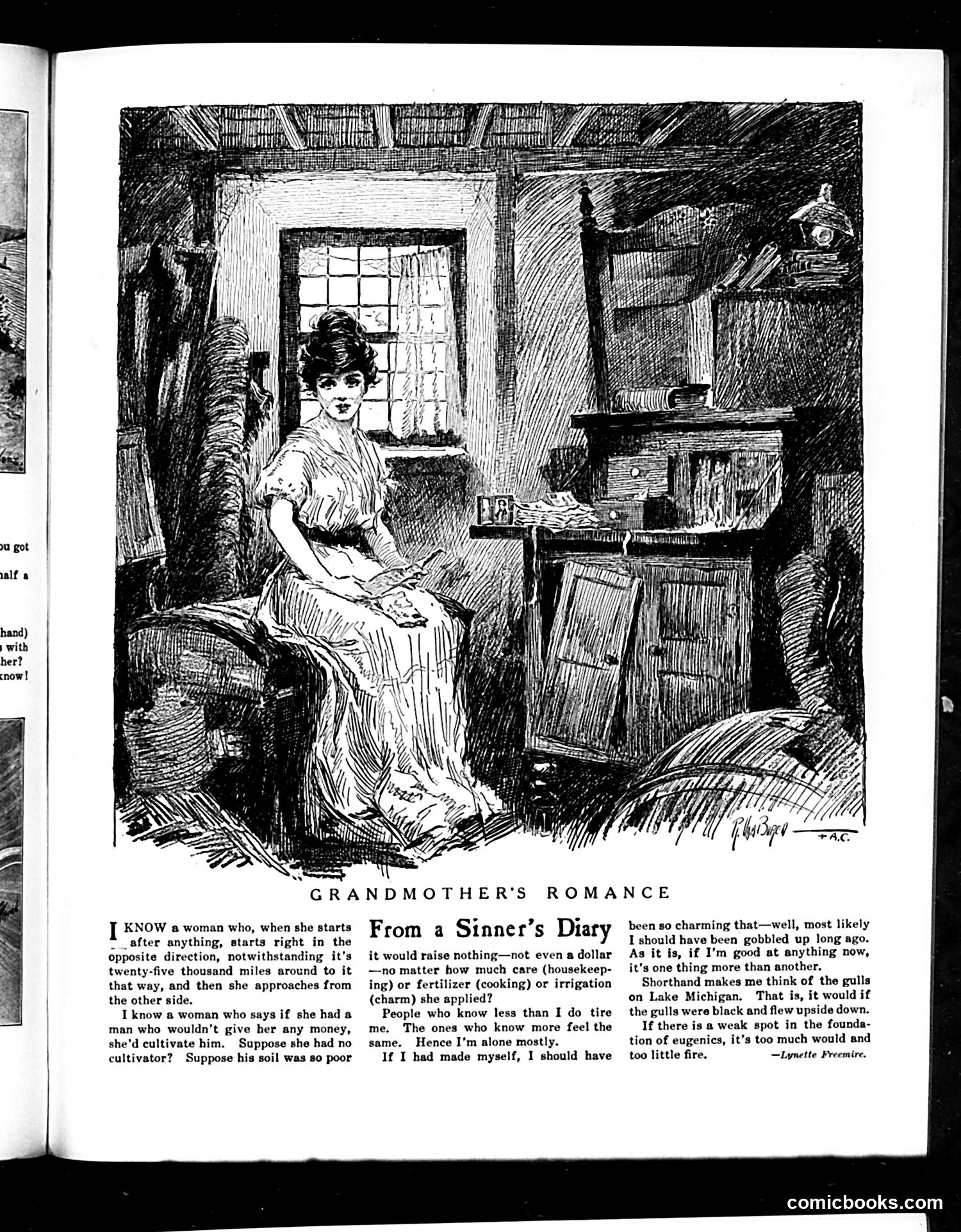
This page contains two separate pieces of satirical writing rather than political cartoons. **"Grandmother's Romance"** (left) is a humorous essay mocking women's illogical behavior—specifically a woman who takes the longest possible route to get somewhere, and another who claims she'd "cultivate" a poor man (implying romantic investment in an unpromising partner). The satire targets female romantic and financial reasoning as contradictory and foolish. **"From a Sinner's Diary"** (right) is a cynical column by "Lynette Freemire" offering misanthropic observations: the narrator is lonely because people who know less are tiresome and those who know more feel the same way. It ends with pseudo-intellectual musings on eugenics (a disturbing topic popular in early 20th-century discourse) and random absurdist humor (comparing shorthand to upside-down black gulls). Both pieces reflect *Judge* magazine's satirical style: mocking social pretensions, gender relations, and offering darkly comic social commentary typical of early 20th-century American humor magazines.
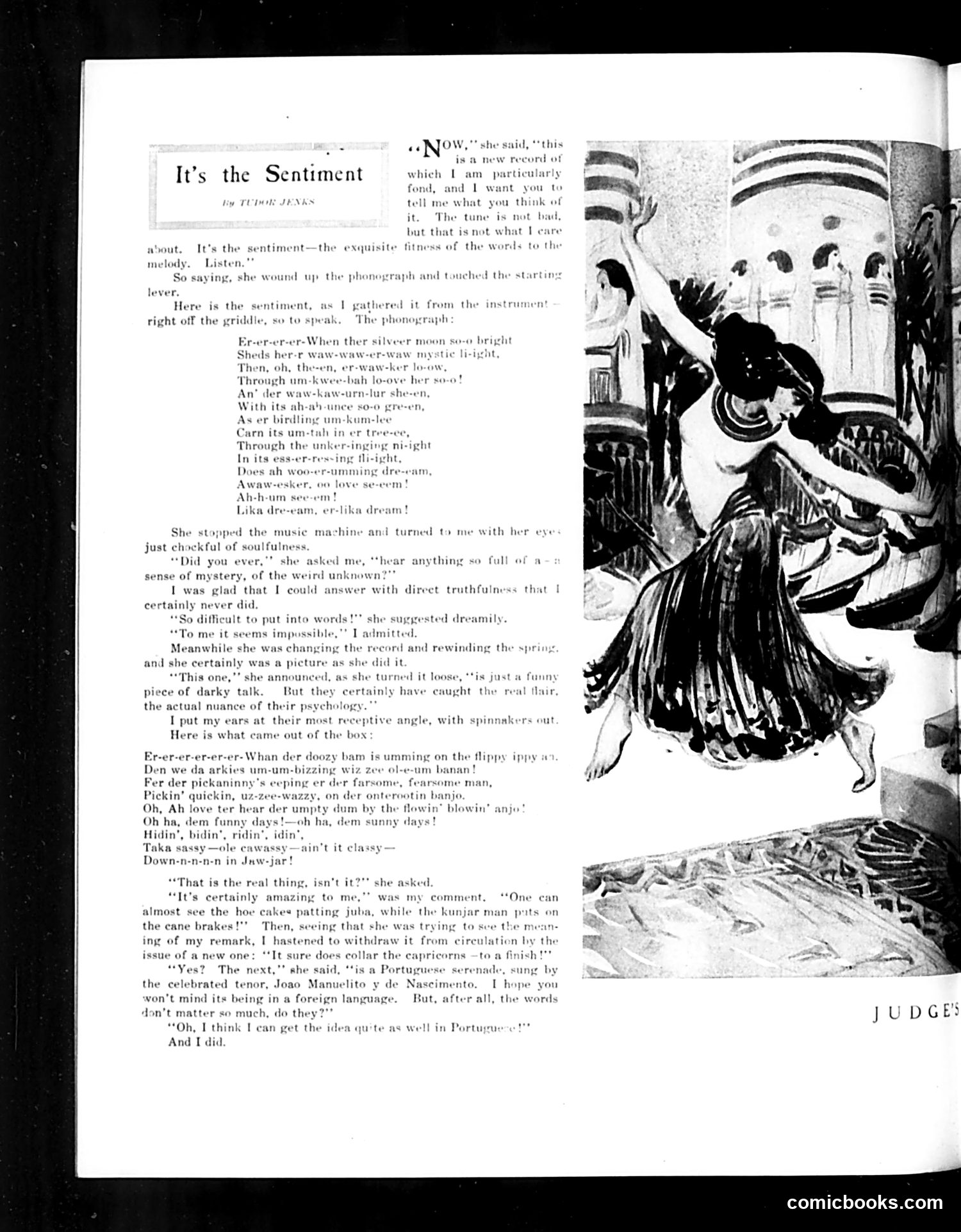
This page satirizes affected artistic pretension and racial stereotyping common in early 20th-century America. A woman plays a phonograph recording, claiming to appreciate its "exquisite melody" and "sentiment." When the narrator listens, the machine produces nonsensical gibberish—specifically a crude "darky" minstrel song with phonetic mockery of Black speech and dialect ("um-um-bizzing," "kunjar man," references to slavery and cotton picking). The satire works on two levels: First, it mocks the woman's false sophistication—she hears profound artistry where only gibberish exists. Second, and more troublingly, it ridicules Black vernacular speech itself as inherently absurd and laughable. The illustration shows theatrical figures, emphasizing the performative nature of both the woman's pretense and minstrelsy entertainment itself. The joke assumes readers will find dialect humor entertaining, reflecting period attitudes about race and entertainment.
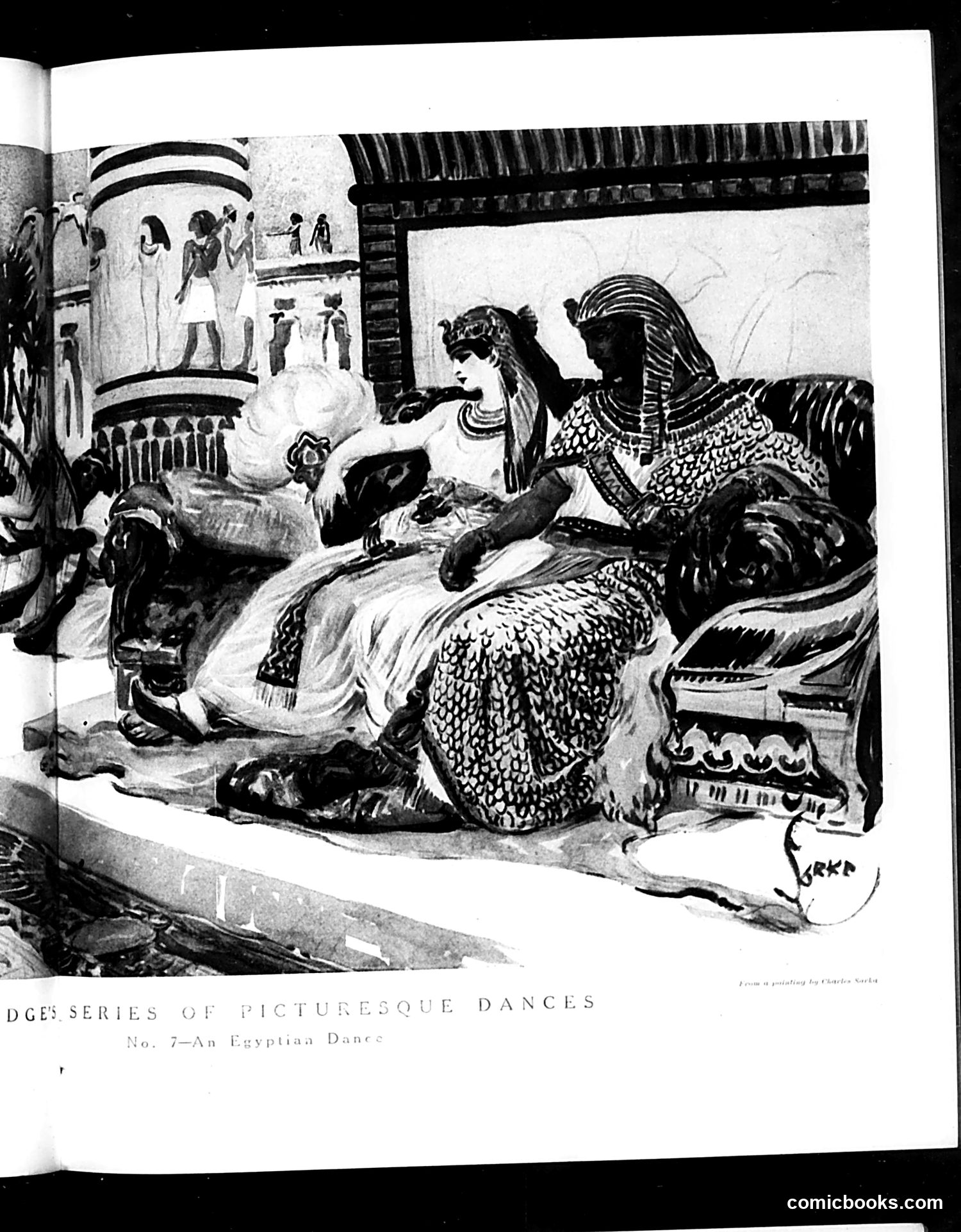
This illustration from *Judge* magazine depicts an Orientalist fantasy scene labeled as an Egyptian dance. A reclining figure in elaborate Egyptian dress is entertained by performers, with attendants visible in the background pyramid structure. The satire likely mocks contemporary Western fascination with "exotic" Egyptian culture—a popular entertainment trend of the era. The detailed, exaggerated costumes and theatrical staging suggest ridicule of how Americans dramatized and fantasized about non-Western cultures rather than documenting them authentically. The series format indicates *Judge* was satirizing broader cultural trends of staging elaborate, often inaccurate "picturesque" performances for entertainment, reflecting period attitudes of cultural superiority and orientalism.
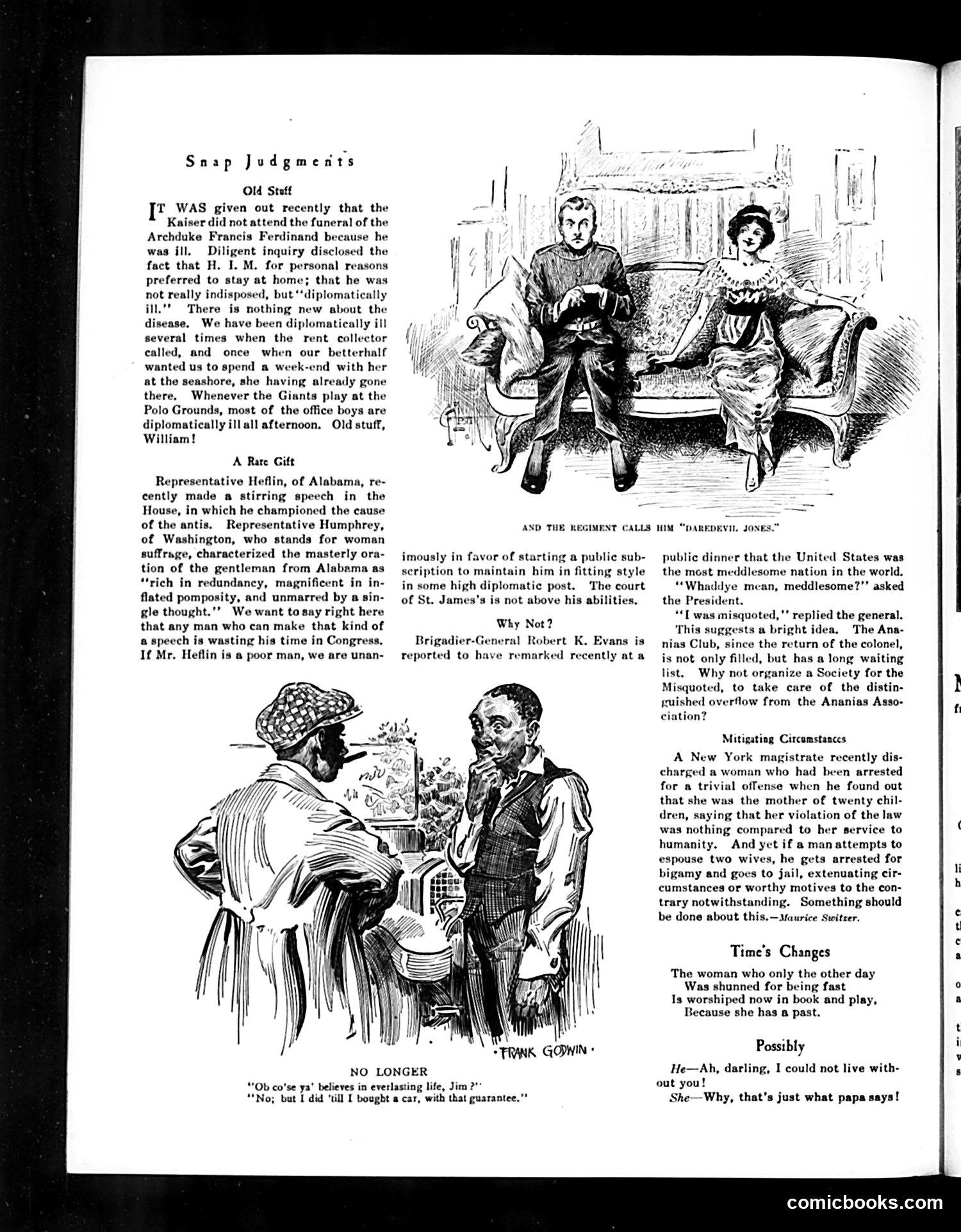
This Judge magazine page contains multiple satirical short pieces mocking contemporary politics and social hypocrisy: **"Old Stuff"** ridicules the Kaiser's claimed illness at Archduke Franz Ferdinand's funeral as "diplomatically ill"—a transparent excuse. The satire equates this transparent lie with everyday American excuses (avoiding rent collectors, avoiding wives). **"A Rare Gift"** attacks Representative Heflin (Alabama, anti-suffrage) through backhanded praise, suggesting his verbose, empty speech qualifies him only for a cushy diplomatic post. **"Why Not?"** mocks General Robert K. Evans for calling America "meddlesome," then asking the President what he meant—implying the President himself is the source of meddling. References the "Ananias Club" (a real satire group named for biblical liars). **The Frank Godwin cartoon** shows a man claiming he believed in "everlasting life" until buying a car with a guarantee—suggesting the guarantee is worthless, a running joke about automobile reliability in this era. Other pieces satirize gender double standards and modern social changes around women's behavior and reputation.
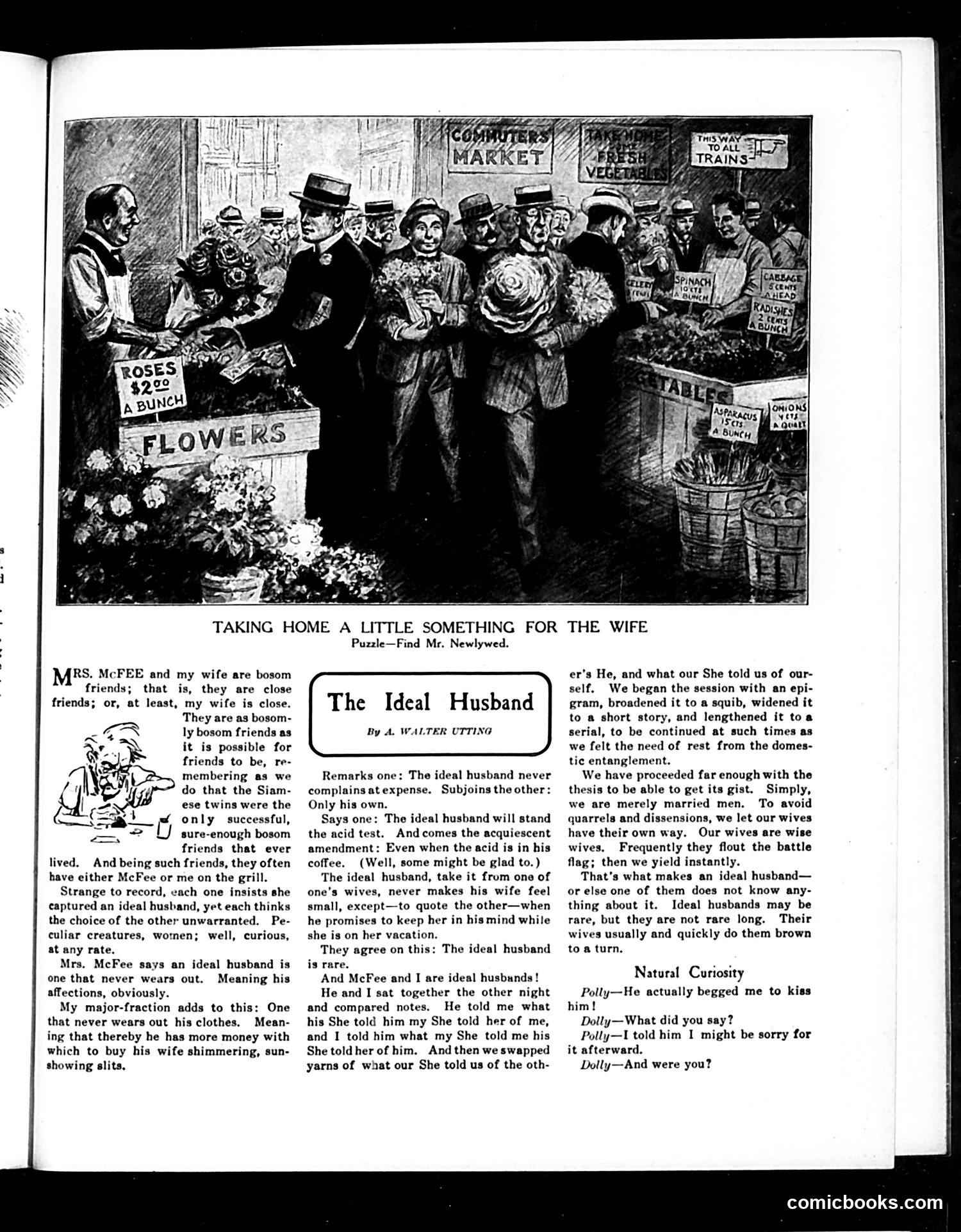
This satirical piece mocks the concept of the "ideal husband" through humorous domestic commentary. The cartoon at top shows a market scene where husbands shop for flowers and gifts—"taking home a little something" to appease their wives. The text presents two couples (the narrator and his wife, the McFees) debating what constitutes an ideal husband. The satire suggests that an "ideal husband" is actually a fiction: he's one who never complains about expenses, accepts nagging ("acid in his coffee"), and crucially, simply **gives his wife her way to avoid quarrels**. The joke's real point: there's no such thing as an ideal husband—only men who've learned to surrender to domestic demands. The wives "do them brown," meaning they ultimately dominate. The final section, "Natural Curiosity," adds a lighter joke about a woman feigning reluctance to kiss a suitor while secretly hoping she'll regret refusing. The satire reflects early-20th-century anxieties about female authority in marriage.
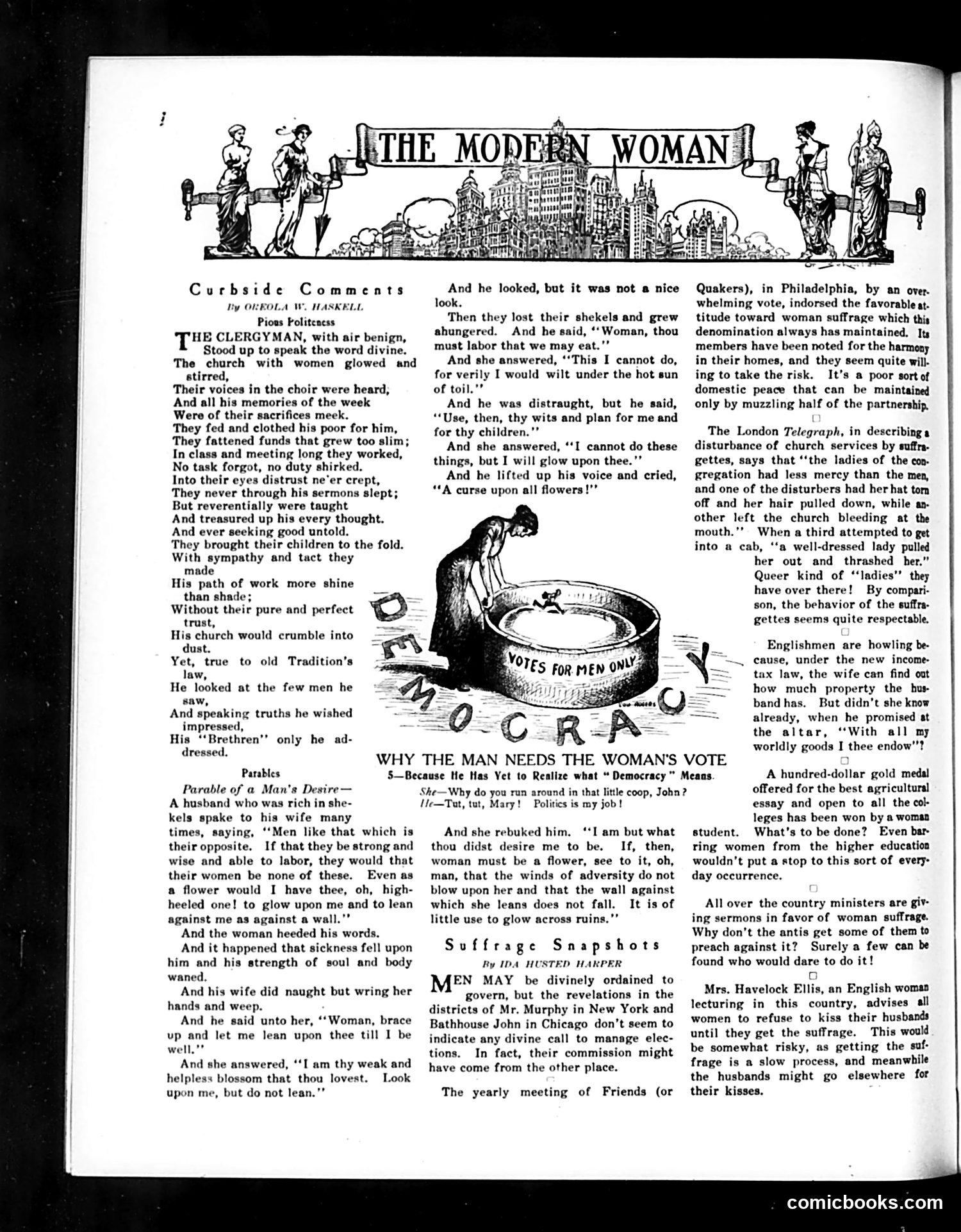
This page from Judge magazine satirizes opposition to women's suffrage using religious and domestic arguments. **Main Cartoons/Content:** 1. **"Curbside Comments"** - A poem mocking clergy who rely entirely on women's labor and devotion in church yet exclude them from leadership decisions, treating them as passive "flowers." 2. **"Parable of a Man's Desire"** - A biblical-style parable exposing the hypocrisy of men who demand women be weak and decorative, then expect them to work and provide wisdom during hardship. The man's curse—"A curse upon all flowers!"—represents the absurdity of this contradiction. 3. **"Why the Man Needs the Woman's Vote"** - A dialogue showing a man absorbed in politics while confined to a domestic "coop," satirizing how men monopolize civic participation. 4. **"Suffrage Snapshots"** - Brief items noting that various groups (Quakers, the London Telegraph) support women's suffrage, contrasting this with corrupt male-run political machines. **Overall Point:** The satire argues that denying women voting rights while demanding their labor and wisdom is hypocritical and self-destructive.
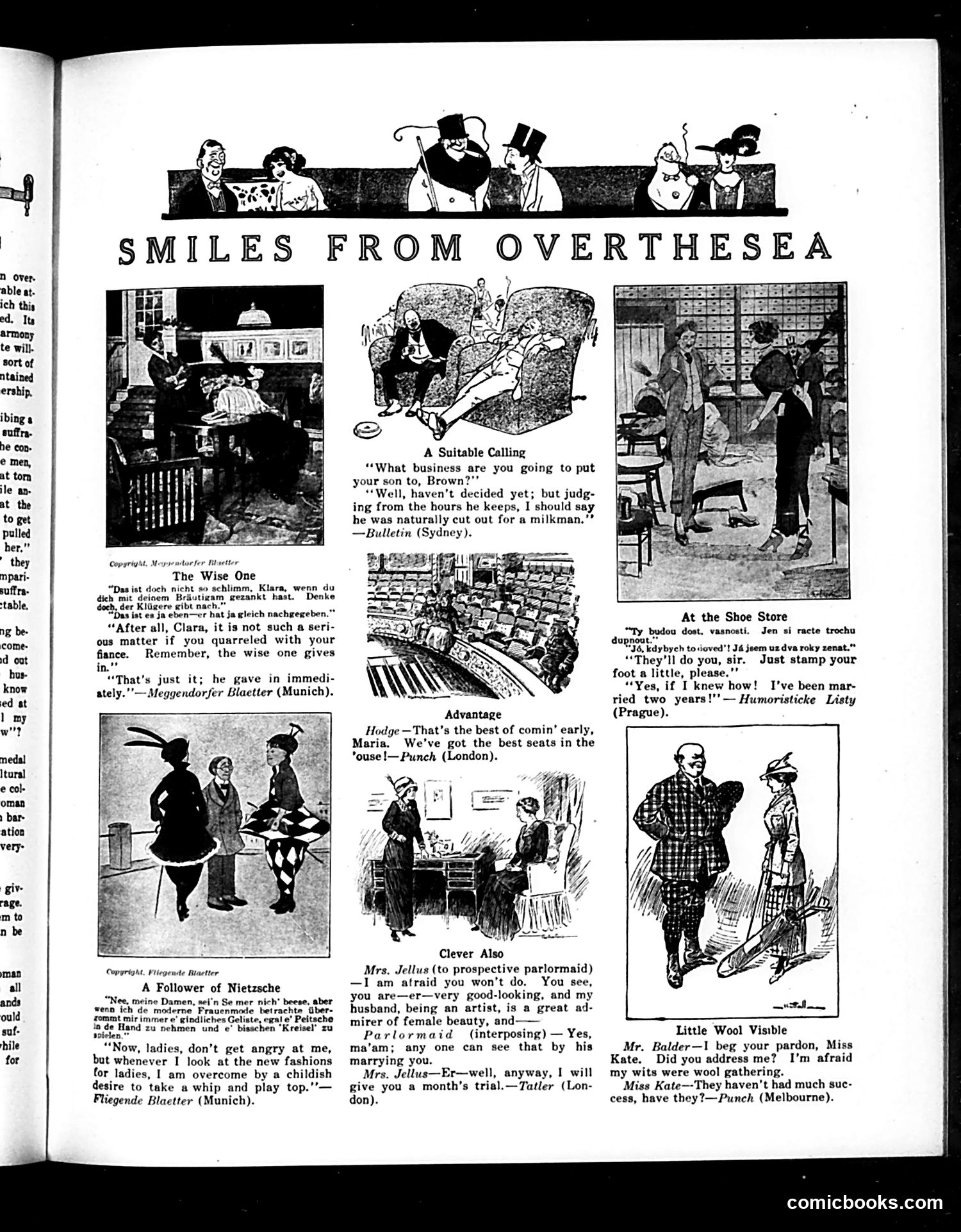
This page collects short humorous anecdotes translated from European satirical publications (Munich, London, Prague). The jokes target familiar domestic situations: **"The Wise One"** mocks marital dynamics—a wife is actually *upset* her husband capitulated too quickly in an argument, preferring a man who stands his ground. **"A Follower of Nietzsche"** satirizes modern women's fashion (likely the 1920s, given context) by depicting a man so frustrated by contemporary styles that he wants to treat women like children with whips and toys—a crude jab at both new fashions and Nietzschean philosophy about dominance. **Other sketches** joke about class differences ("milkman" implies unsociable hours), romantic jealousy (an artist husband's appreciation of beauty threatens a vain employer), marital decline (a husband's "wool gathering" implies mental absence after two years of marriage), and shoe-shopping rituals. The satire assumes readers share conservative anxiety about modern social change—fashion, women's independence, marriage stability.
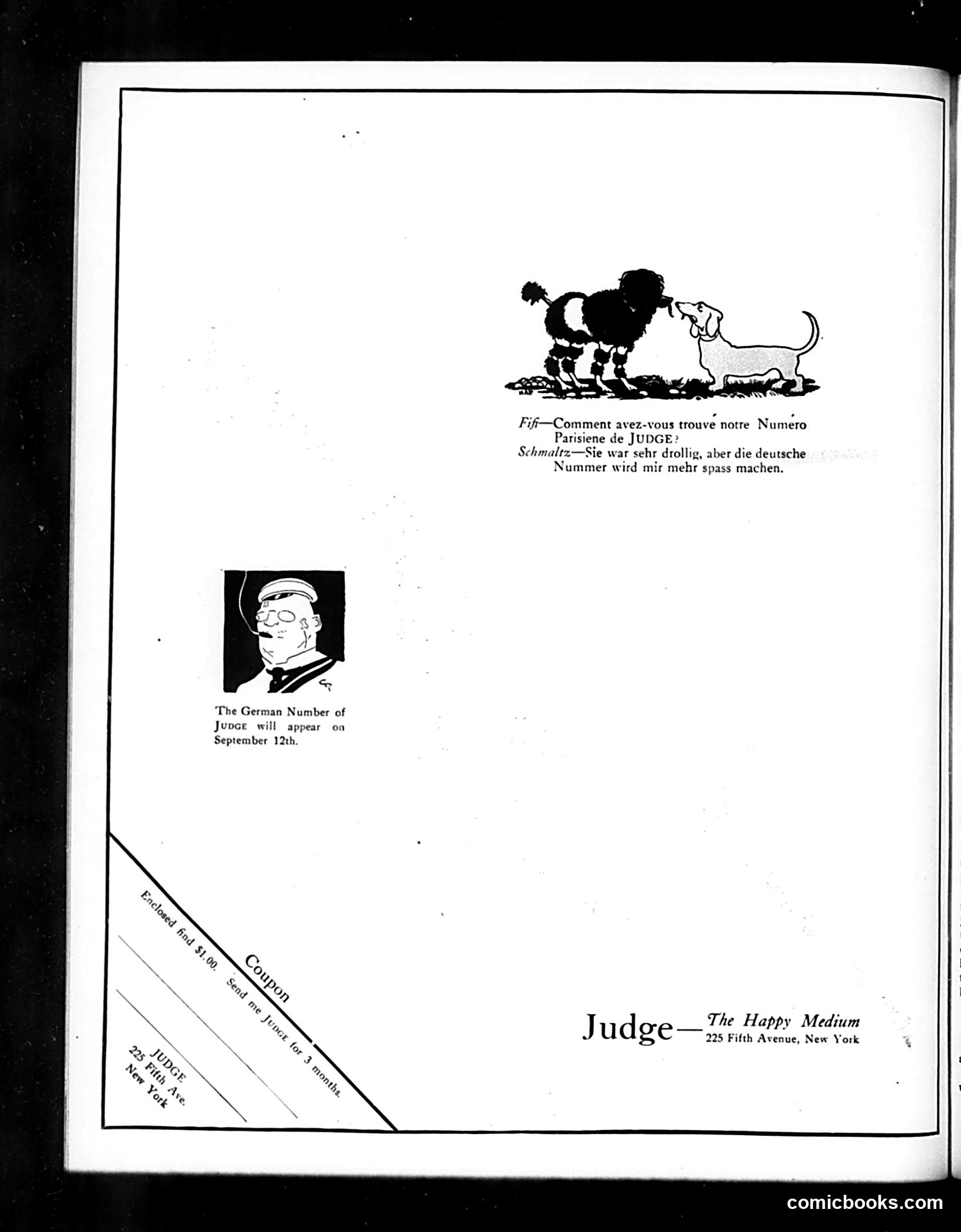
This is primarily an **advertisement page** for *Judge* magazine, not a political cartoon. The small illustration at top shows two figures discussing *Judge*'s "Parisian Number." One character (labeled "Fif") asks in French how they found it; the other (labeled "Schmaltz," a Yiddish term) responds in German that while the French issue was amusing, he prefers the German one. The joke appears to be ethnic humor playing on **immigrant stereotypes**—a French speaker and German speaker praising their respective national editions of the magazine. This reflects early 20th-century American print culture's casual ethnic caricature. The page announces an upcoming **"German Number" launching September 12th** and promotes *Judge* as "The Happy Medium," positioned at 225 Fifth Avenue, New York. The small portrait likely represents the publication's mascot or editor.
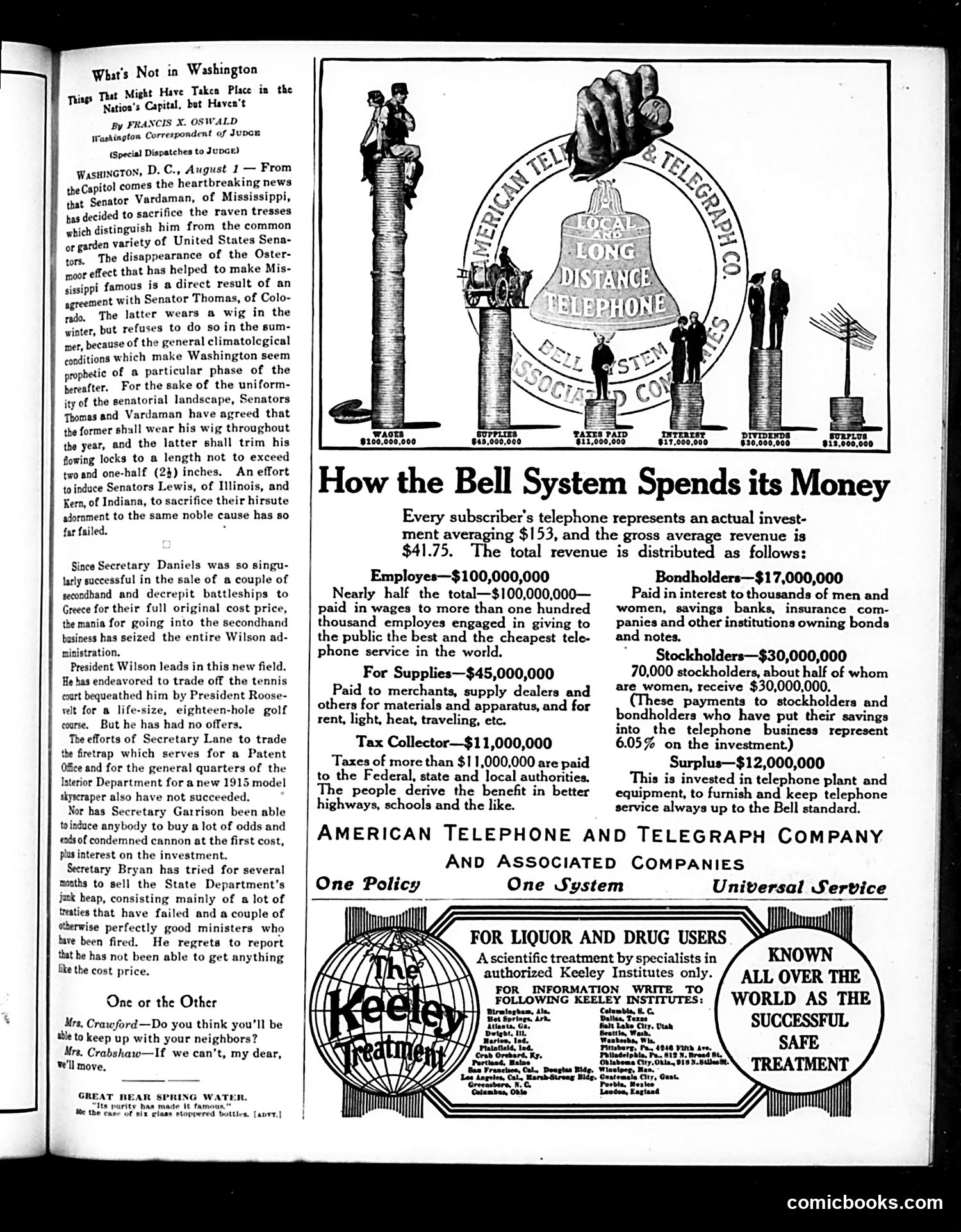
This *Judge* magazine page contains two distinct satirical pieces: **"What's Not in Washington"** mocks the Wilson administration's misguided attempts to economize. After Secretary Daniels successfully sold old battleships to Greece at full price, other cabinet members eagerly tried similar deals—Wilson attempted to trade President Roosevelt's tennis court for a golf course; Secretary Lane tried selling a condemned Patent Office building; Secretary Garrison couldn't unload condemned cannons; Secretary Bryan couldn't sell the State Department's failed treaties and fired diplomats. The humor lies in the absurdity of these officials trying to replicate Daniels's success with obviously worthless items, suggesting administrative incompetence and waste. **"How the Bell System Spends Its Money"** is corporate propaganda advertising the American Telephone and Telegraph Company's revenue distribution. Displayed as an infographic with a bell logo, it emphasizes how much money goes to employees ($100 million) and taxes ($11 million), presenting the company as a responsible employer and civic contributor. This advertisement attempts to create positive public perception of Bell's business practices.
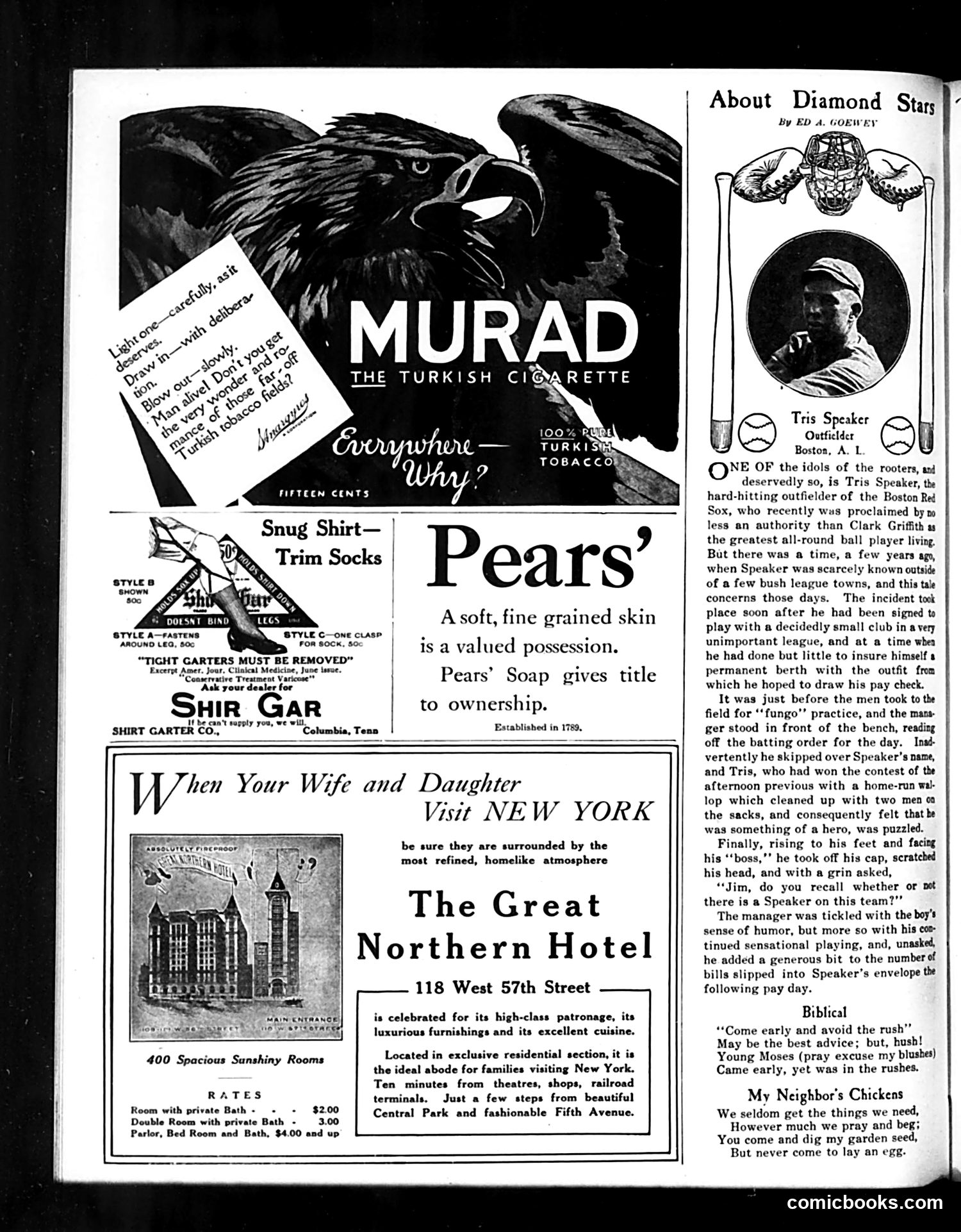
This page is primarily **advertisements and light humor columns**, not political satire. The main content includes: **"About Diamond Stars"** — a biographical anecdote about **Tris Speaker**, a famous Boston Red Sox outfielder. The story illustrates his early obscurity in the minor leagues: when a manager accidentally omitted Speaker from the batting order, Speaker humorously asked if there was "a Speaker on this team?" The manager appreciated his wit and rewarded him with a raise. This celebrates Speaker as both a talented player and personable character. **Commercial ads** dominate: Murad cigarettes (15¢), Pears' Soap, The Great Northern Hotel in New York, and Shir Gar garters. **Light verse** at bottom includes two poems: "Biblical" (a pun on "rushes") and "My Neighbor's Chickens" (complaint about garden theft). There is **no political content** here—this is a typical Judge magazine page mixing sports nostalgia, advertising, and genteel humor for early 20th-century readers.
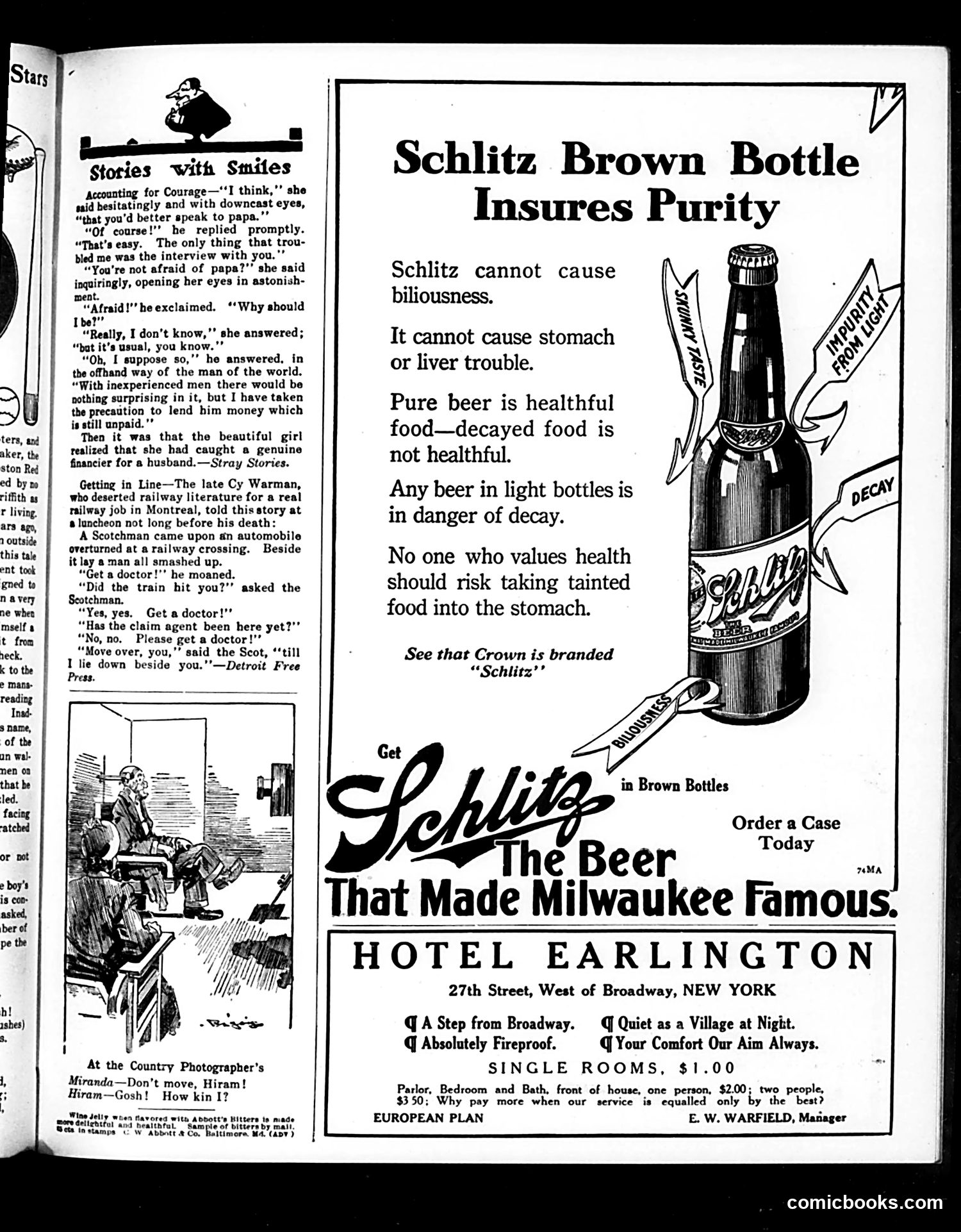
This page contains two distinct elements: **humor columns** on the left and a **Schlitz beer advertisement** on the right. The humor pieces are short anecdotes playing on social expectations. The first mocks courtship rituals—a man seeks approval from his fiancée's father but admits he's already secured the father's consent by lending him unpaid money, revealing cynicism about financial manipulation in marriage. The second jokes about a Scottish stereotype: a railway accident victim pleads for a doctor, but the Scotsman lies down beside him waiting for an insurance claim agent—satirizing Scottish frugality and Americans' emerging litigation culture. The **Schlitz advertisement** addresses early 20th-century concerns about beer quality and food safety. Light bottles allowed UV exposure, causing beer to spoil ("skunky"). Schlitz's brown bottle was marketed as superior protection against decay and contamination—a genuine innovation presented as health insurance. The copy emphasizes purity and safety during an era of food adulteration concerns and before strict food regulation.
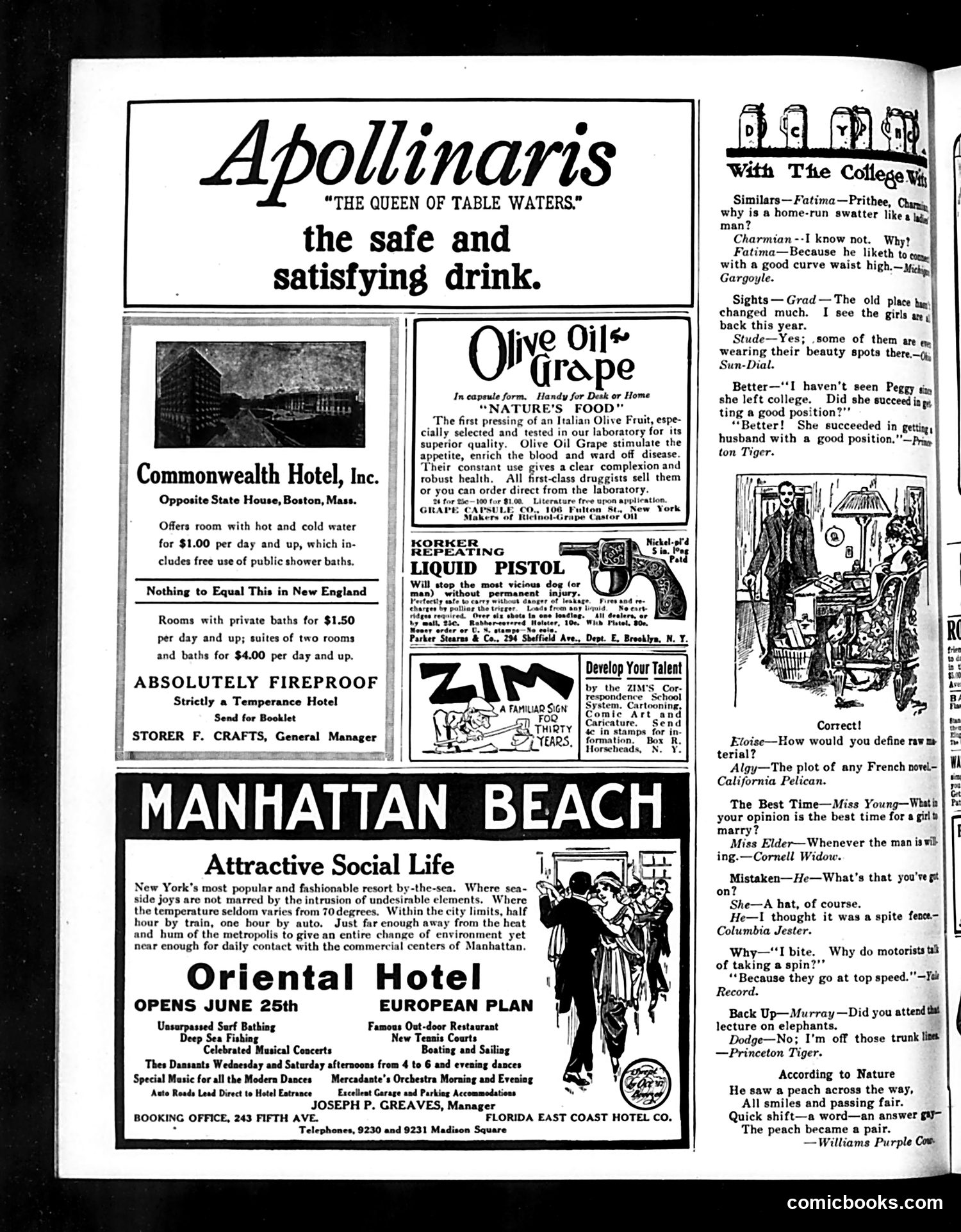
This is primarily a **advertisements and humor page** rather than political satire. The content includes: **Major Advertisements:** - Apollinaris mineral water ("Queen of Table Waters") - Commonwealth Hotel (Boston temperance hotel) - Olive Oil Grape capsules (Italian health product) - Korker Repeating Liquid Pistol (dog repellent) - Manhattan Beach resort - Oriental Hotel (Florida) **Humor Section ("With The College Wit"):** A collection of college magazine jokes and witty exchanges, mostly puns and mild romantic humor. Examples include wordplay about baseball ("home-run swatter"), fashion, and dating advice. These appear reprinted from university publications like the Cornell Widow and Princeton Tiger. **Social Context:** The page reflects early 20th-century American consumer culture—advertising "health" products (olive oil tonics), leisure destinations, and temperance establishments. The college humor reflects genteel, upper-class collegiate culture focused on courtship and social etiquette rather than political commentary. This is characteristic of Judge's mixed content: **commercial advertising subsidizing satirical content**.
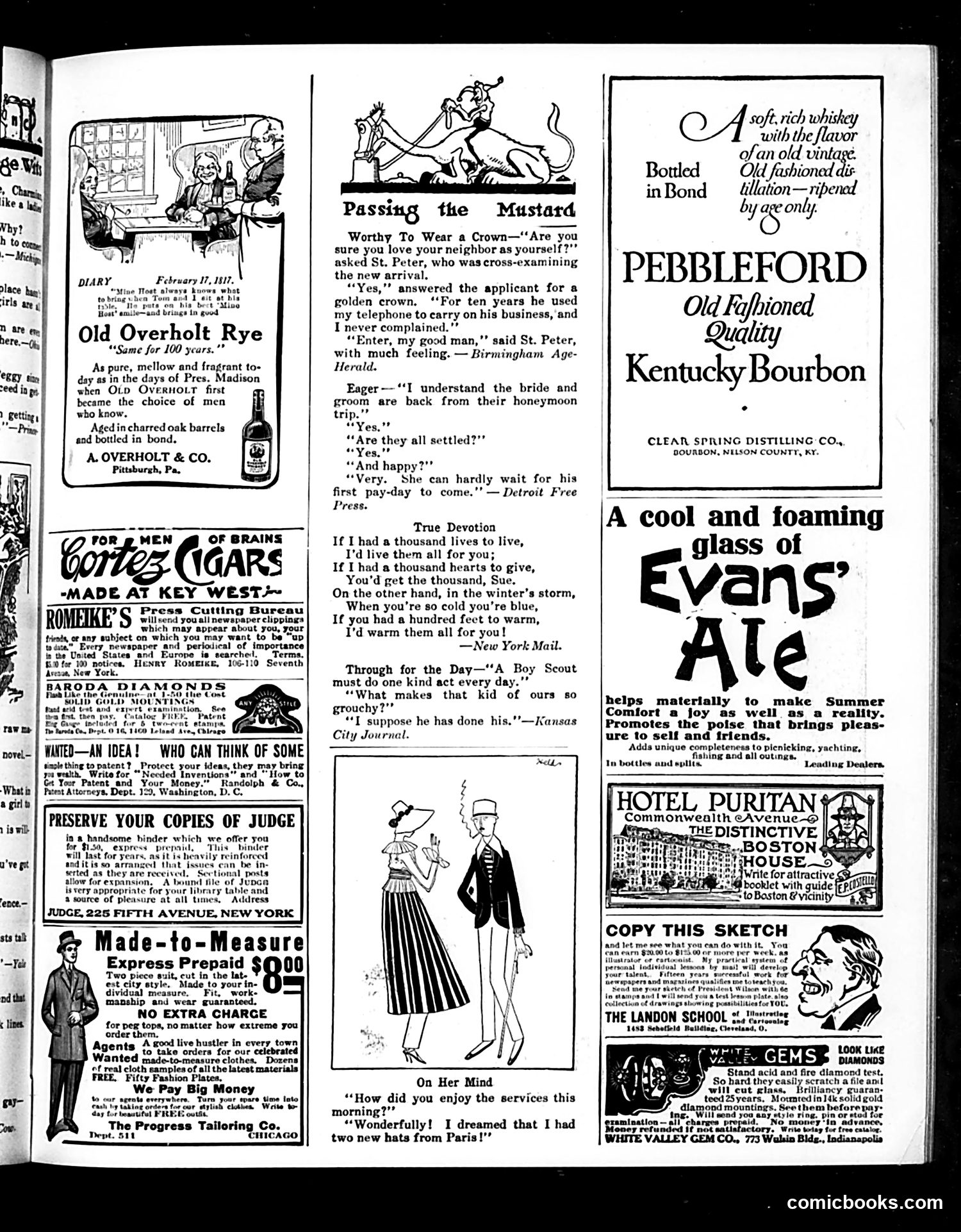
This page is primarily **advertising with light satirical content**. The advertisements dominate—promoting whiskey (Old Overholt Rye, Pebbleford Kentucky Bourbon, Evans' Ale), tailoring services, patent attorneys, and other goods typical of the era. The satirical content consists of brief **joke sections** labeled "Passing the Mustard" and related pieces. These are gentle, non-political humor: - A St. Peter/Heaven joke mocking a man's complaint that his neighbor overused his telephone for a decade, suggesting petty grievances don't belong in heaven - Jokes about newlyweds and honeymoons - A "True Devotion" poem satirizing romantic exaggeration - Quips about Boy Scouts and dutiful acts **None appears overtly political**. Instead, the humor targets everyday social behavior—neighborly disputes, marital dynamics, hypocrisy in declared devotion—reflecting concerns of early 20th-century American middle-class life. The magazine appears to be a general humor/lifestyle publication rather than primarily political satire.
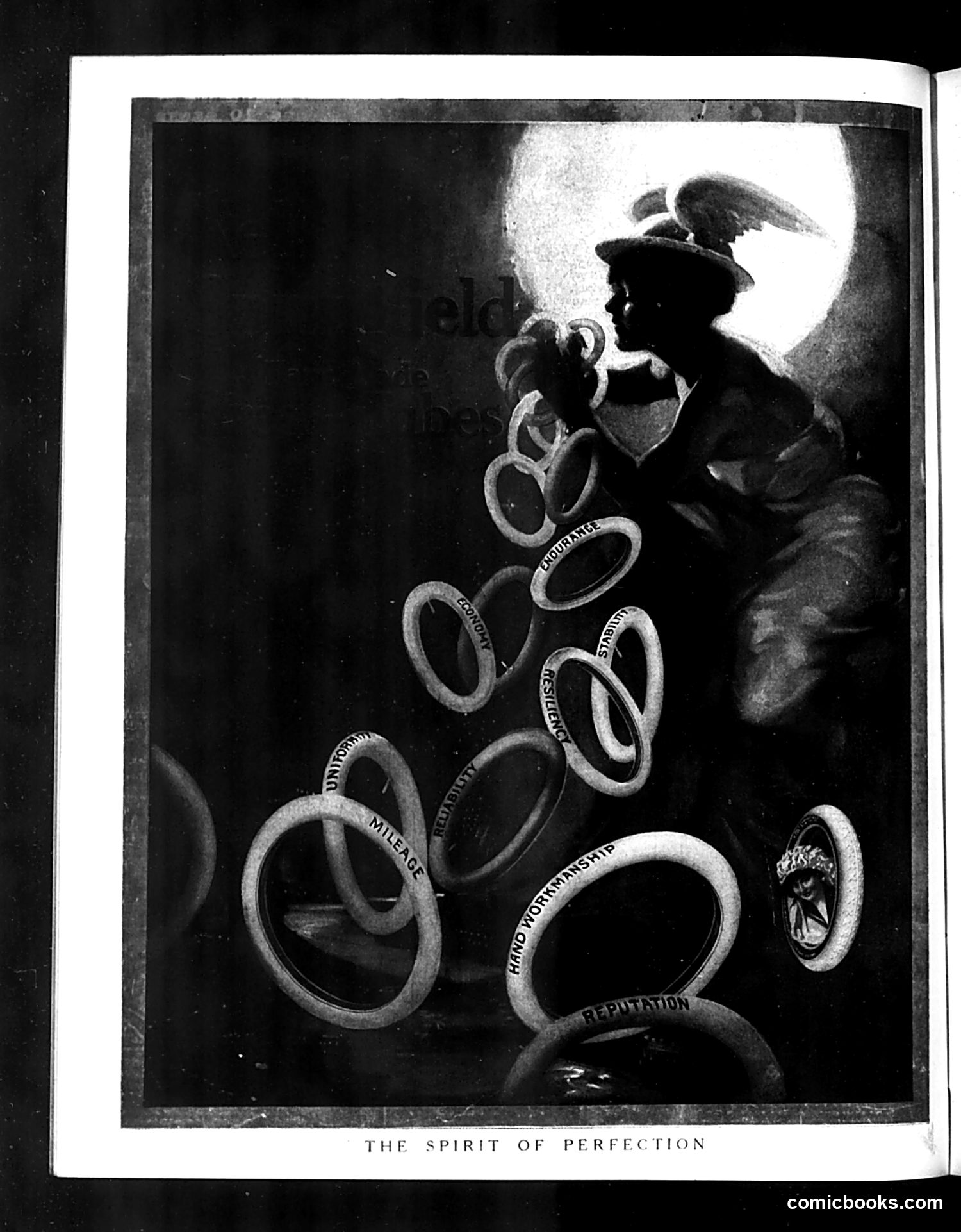
This illustration depicts a silhouetted figure in profile against a large moon, juggling automobile tires labeled with what appear to be brand names or product attributes (text is partially legible but includes terms like "MILEAGE" and "REPUTATION"). The cartoon satirizes the automobile industry's competitive claims about perfection—each manufacturer promoting their tires as superior through various marketing promises. The juggling act suggests the difficulty or impossibility of simultaneously achieving all these touted qualities. The angelic wing adds ironic commentary: manufacturers present themselves as achieving divine perfection, when in reality they're performing a precarious balancing act of competing marketing claims. This likely dates to the early automotive era when tire technology and brand competition were intensifying.