
Judge, 1914-08-01 · page 15 of 24
Judge — August 1, 1914 — page 15: what you’re looking at
What you’re looking at
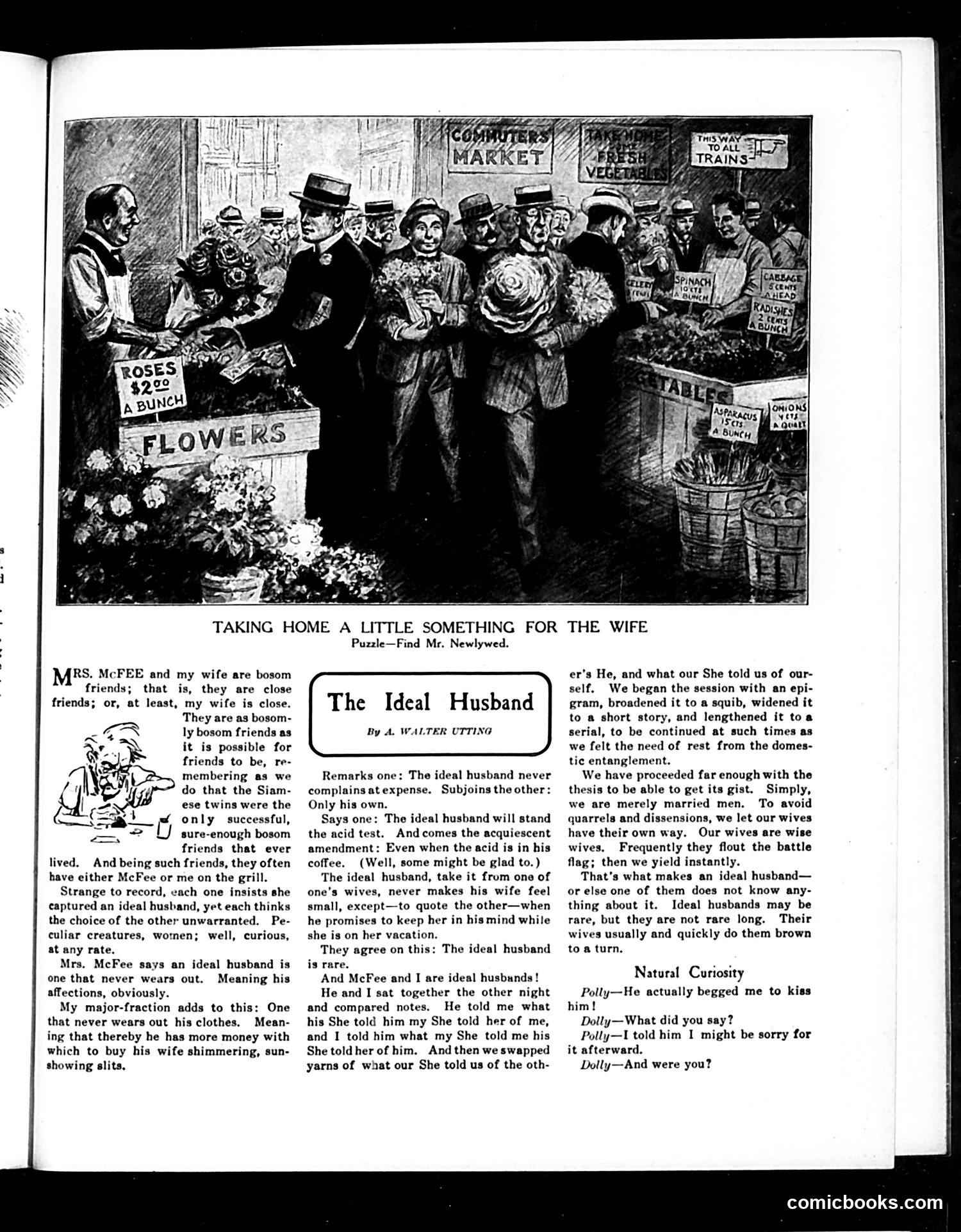
This satirical piece mocks the concept of the "ideal husband" through humorous domestic commentary. The cartoon at top shows a market scene where husbands shop for flowers and gifts—"taking home a little something" to appease their wives. The text presents two couples (the narrator and his wife, the McFees) debating what constitutes an ideal husband. The satire suggests that an "ideal husband" is actually a fiction: he's one who never complains about expenses, accepts nagging ("acid in his coffee"), and crucially, simply **gives his wife her way to avoid quarrels**. The joke's real point: there's no such thing as an ideal husband—only men who've learned to surrender to domestic demands. The wives "do them brown," meaning they ultimately dominate. The final section, "Natural Curiosity," adds a lighter joke about a woman feigning reluctance to kiss a suitor while secretly hoping she'll regret refusing. The satire reflects early-20th-century anxieties about female authority in marriage.
📄 Transcribed text from this page (OCR, searchable)
Machine-transcribed from the original scan — historical spelling and the odd misread are preserved.
TAKING HOME A LITTLE SOMETHING FOR MBS. McFEE and my wife are bosom friends; that is, they are close friends; or, at least, my wife is close. They are as bosom- ly bosom friends as it is possible for friends to be, re- membering as we do that the Siam- ese twins were the only successful, sure-enough bosom friends that ever lived. And being such friends, they often have either McFee or me on the grill. Strange to record, each one insists she captured an ideal husband, yet each thinks the choice of the other unwarranted. Pe- culiar creatures, wornen; well, curious, at any rate. Mrs. McFee says an ideal husband is one that never wears out. Meaning his affections, obviously. My major-fraction adds to this: One that never wears out his clothes. Mean- ing that thereby he has more money with which to buy his wife shimmering, sun- showing slits. Puzzle—Find Mr. Newlywed. The Ideal Husband By A. WALTER UTTING Remarks one: The ideal husband never complains atexpense. Subjoins the other: Only his own. Says one: The ideal husband will stand the acid test. And comes the acquiescent amendment: Even when the acid is in his coffee. (Well, some might be glad to.) The ideal husband, take it from one of one’s wives, never makes his wife feel small, except—to quote the other—when he promises to keep her in his mind while she is on her vacation. They agree on this: The ideal husband is rare. And McFee and I are ideal husbands! He and I sat together the other night and compared notes. He told me what his She told him my She told her of me, and I told him what my She told me his She told her of him. And then we swapped yarns of what our She told us of the oth- THE WIFE er's He, and what our She told us of our- self. We began the session with an epi- gram, broadened it to a squib, widened it to a short story, and lengthened it toa serial, to be continued at such times as we felt the need of rest from the domes- tic entanglement. We have proceeded far enough with the thesis to be able to get its gist. Simply, we are merely married men. To avoid quarrels and dissensions, we let our wives have their own way. Our wives are wise wives, Frequently they flout the battle flag; then we yield instantly. That's what makes an ideal husband— or else one of them does not know any- thing about it. Ideal husbands may be rare, but they are not rare long. Their wives usually and quickly do them brown to a turn. Natural Curiosity Polly—He actually begged me to kiss him! Dolly—What did you say? Polly—I told him I might be sorry for it afterward. Dolly—And were you? comicbooks.com