
A complete issue · 24 pages · 1914
Judge — July 18, 1914
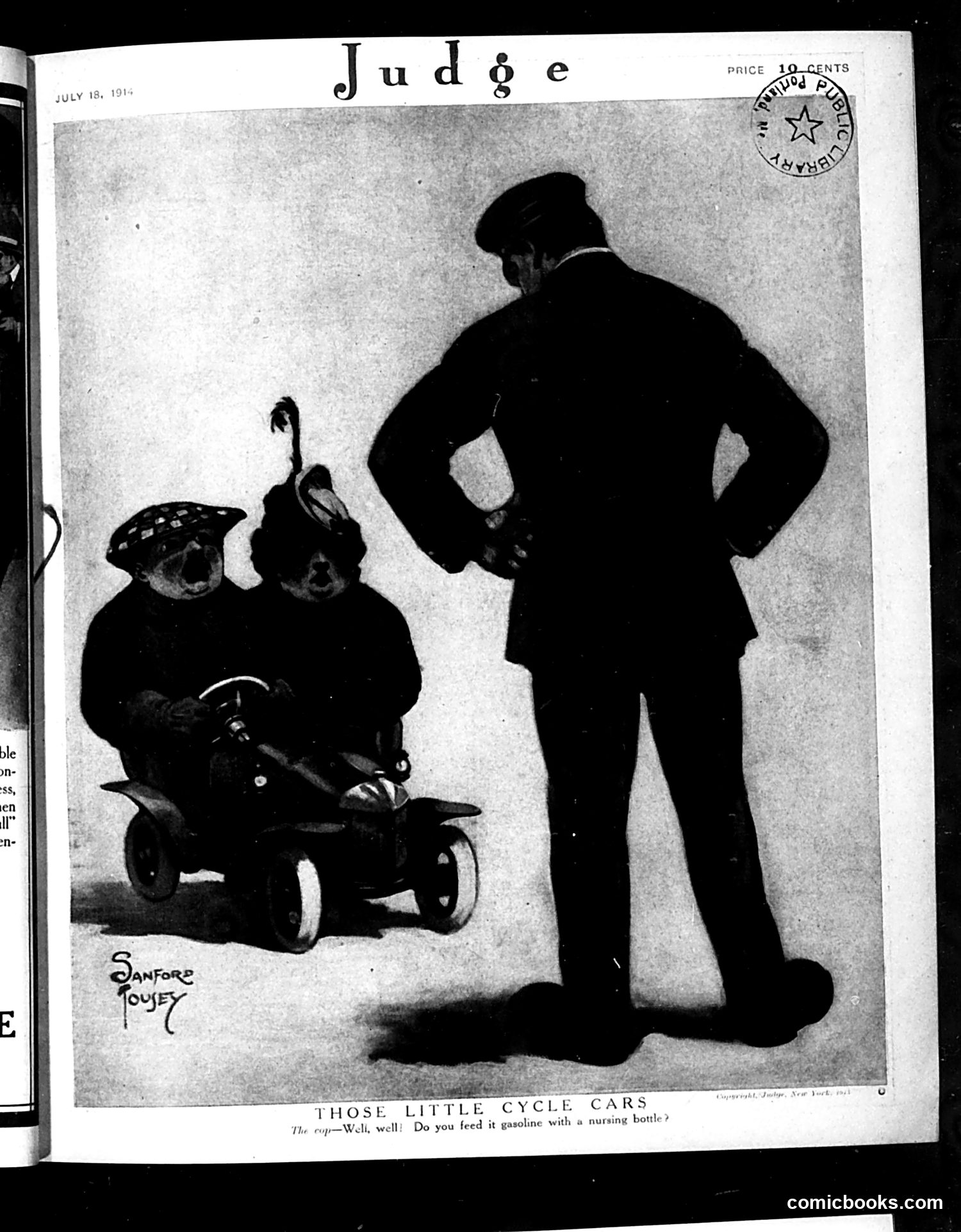
This cartoon satirizes the emerging market for small, affordable "cycle cars"—motorized vehicles bridging bicycles and full automobiles. The humor targets their questionable practicality and safety. The silhouetted figures show an adult man supervising two young children in a tiny vehicle. The caption's joke—"Well, well. Do you feed it gasoline with a nursing bottle?"—mocks the cars' diminutive size and suggests they're toy-like rather than serious transportation. The cartoon likely critiques both the novelty of cycle cars as a fad and parental judgment in using them with children. The artist is Sanford Tousey, a prolific Judge illustrator. This reflects early-1910s skepticism about whether these economical vehicles were legitimate alternatives to traditional cars or merely frivolous gadgets.
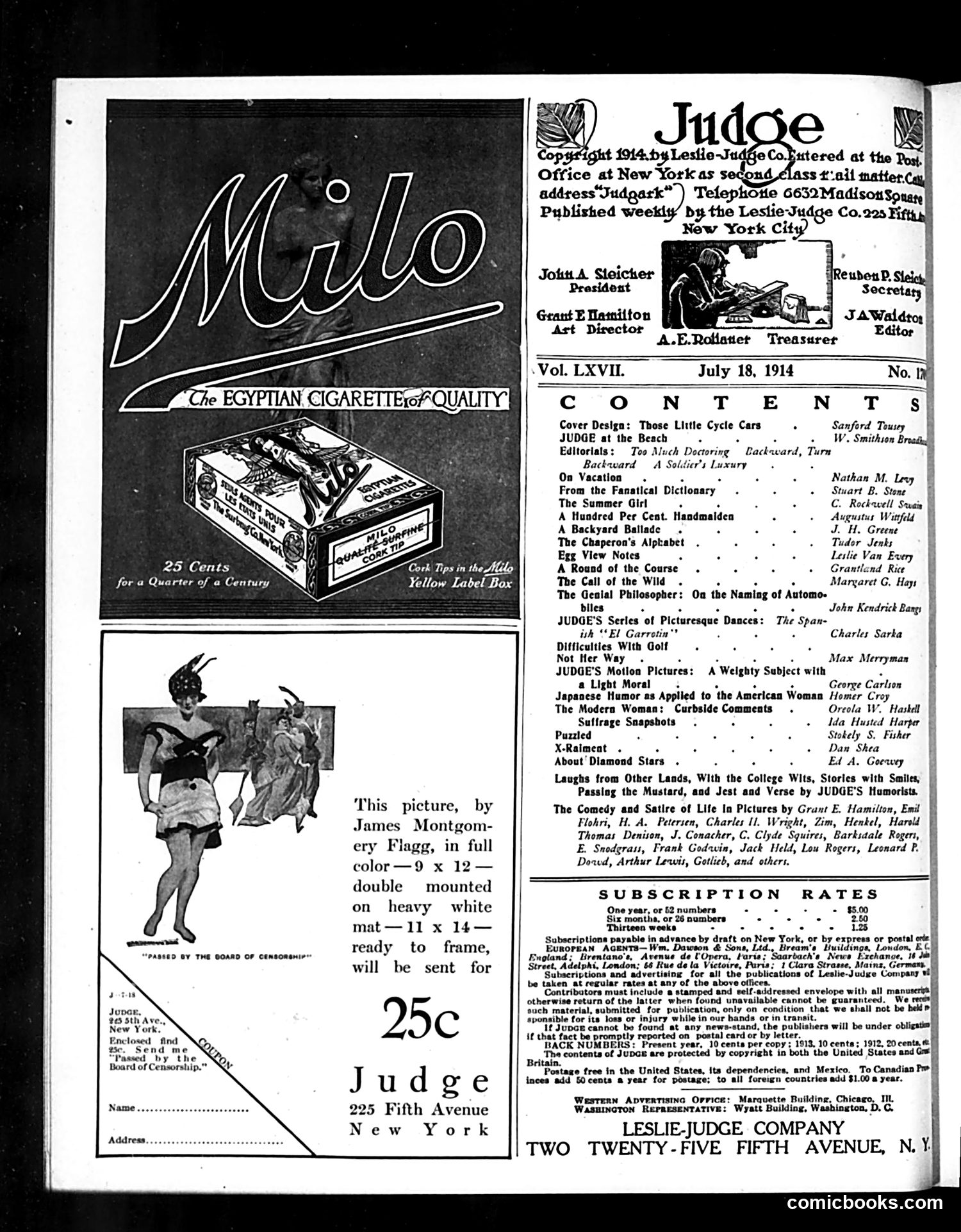
This page is primarily **advertising and masthead information** rather than political satire. The dominant feature is an advertisement for "Milo," described as "the Egyptian Cigarette of Quality," selling for 25 cents. Below appears a James Montgomery Flagg illustration marked "Passed by the Board of Censorship"—likely depicting a woman in classical/orientalist styling, referencing the cigarette's Egyptian marketing theme. The right side contains the magazine's contents page and subscription information. While Judge was known for satirical commentary, this particular page focuses on commercial advertising and publication details rather than political cartooning or social satire.
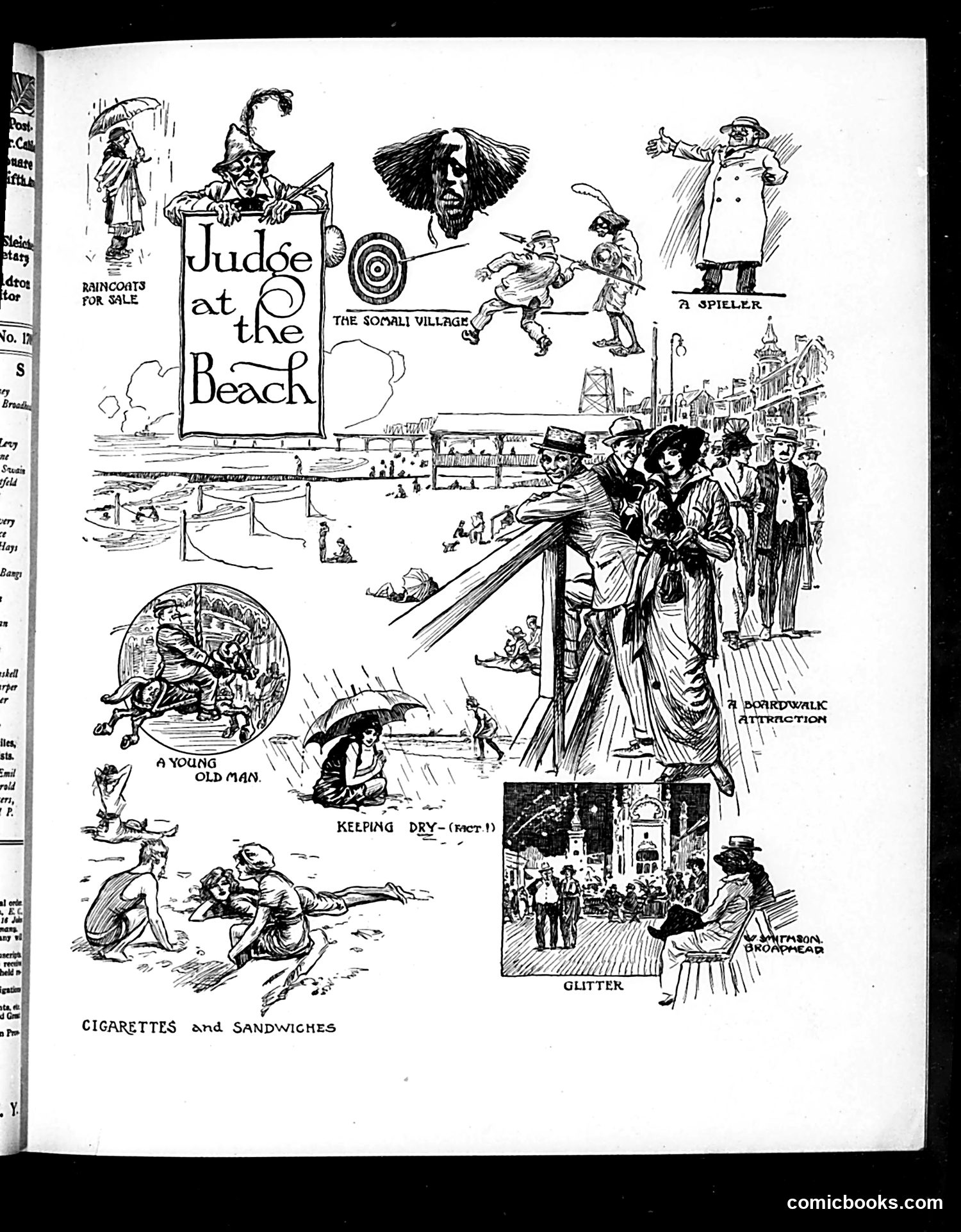
This page presents various beach and seaside resort scenes from an early 20th-century American perspective. The central title "Judge at the Beach" frames vignettes satirizing typical vacation activities and social types. The sketches mock predictable beach behavior: "A Speller" (likely a reference to someone showing off), "The Somali Village" (an apparent ethnic caricature attraction), "A Young Old Man," and "Keeping Dry (Part 1)." These captions suggest gentle humor about vacation mishaps and social pretension. "A Boardwalk Attraction" and "Glitter" scenes depict seaside entertainment venues, while "Cigarettes and Sandwiches" shows casual beachgoers. The overall tone is lighthearted social observation rather than sharp political commentary—typical of Judge's entertainment-focused content from this era.
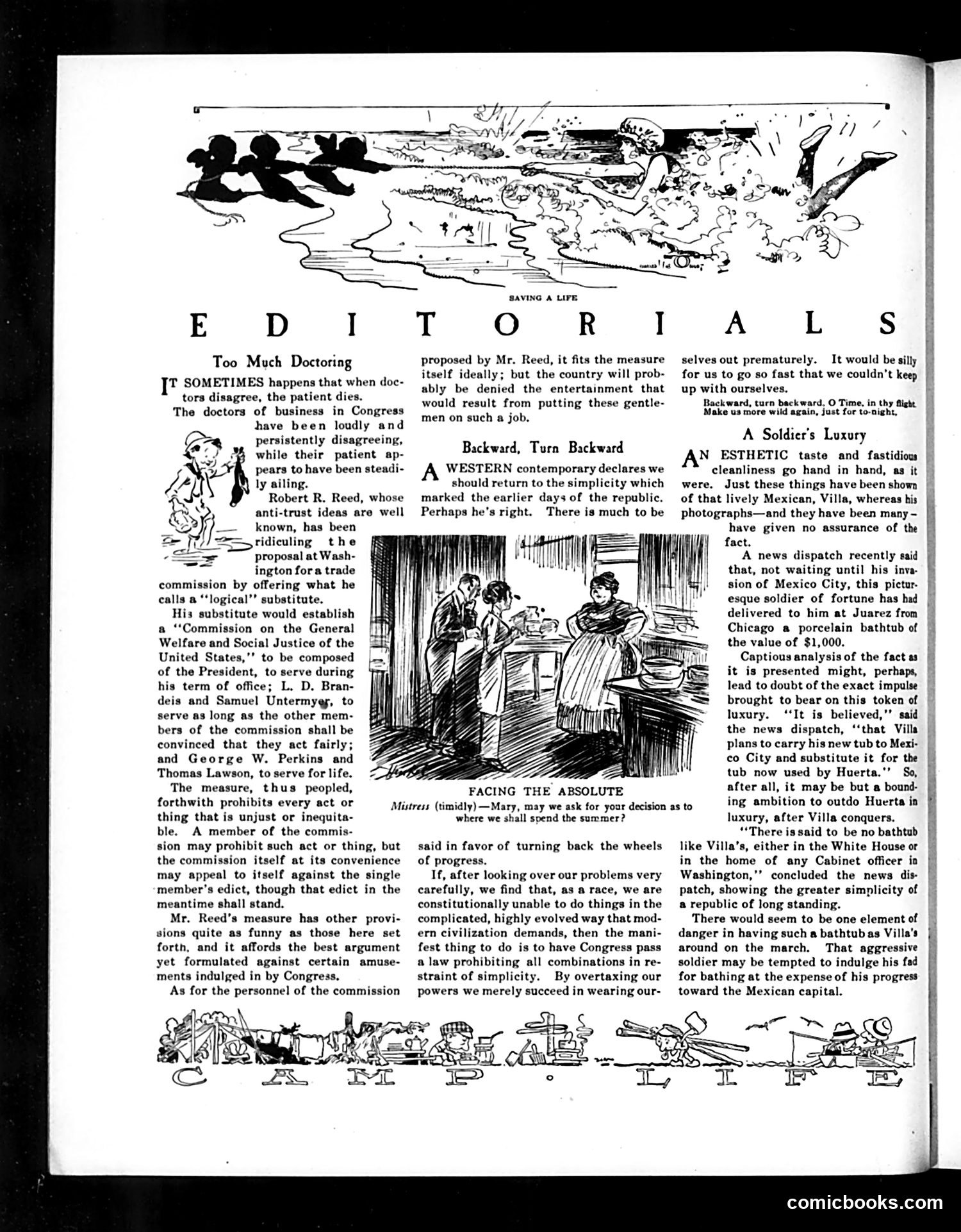
This **Judge** editorial page contains three satirical pieces critiquing Progressive Era politics: 1. **"Too Much Doctoring"** attacks Robert H. Reed's proposed "logical substitute" commission to replace doctors, arguing Congress shouldn't micro-manage medical practice. 2. **"Backward, Turn Backward"** mocks Western calls for returning to "simplicity of earlier days." The cartoon shows a couple discussing summer plans, satirizing nostalgia for simpler times while living in modern complexity. 3. **"A Soldier's Luxury"** criticizes a Mexican soldier receiving expensive porcelain from Chicago—suggesting American goods enable indulgence incompatible with military discipline and progress. The page reflects **Judge's** conservative stance against Progressive government expansion and romantic idealization of the past.
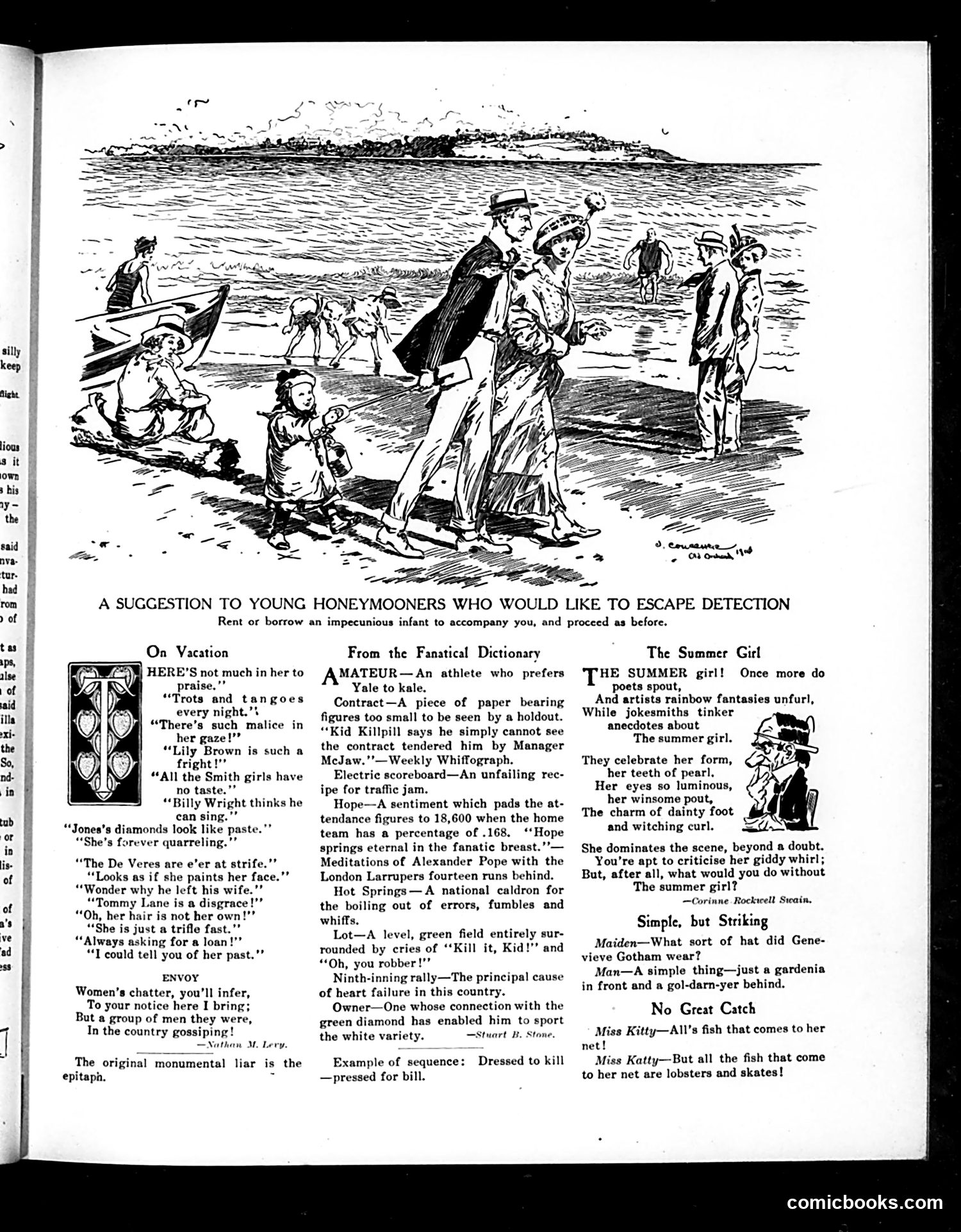
The main illustration satirizes young honeymooners attempting to evade detection during vacation by renting an "impecunious infant" as a cover—suggesting married couples disguised themselves as families with children to avoid scandal or gossip about unmarried cohabitation. The accompanying text sections ("On Vacation," "From the Fanatical Dictionary," "The Summer Girl") consist of humorous definitions and quips about leisure activities, social types, and romantic pursuits typical of early 20th-century American life. The satire targets social hypocrisy: strict Victorian-era conventions prohibited unmarried couples from traveling together, forcing those seeking privacy to adopt deceptive pretenses. The joke exposes the gap between rigid public morality and private behavior, mocking both the couples' schemes and society's surveillance of intimate conduct.
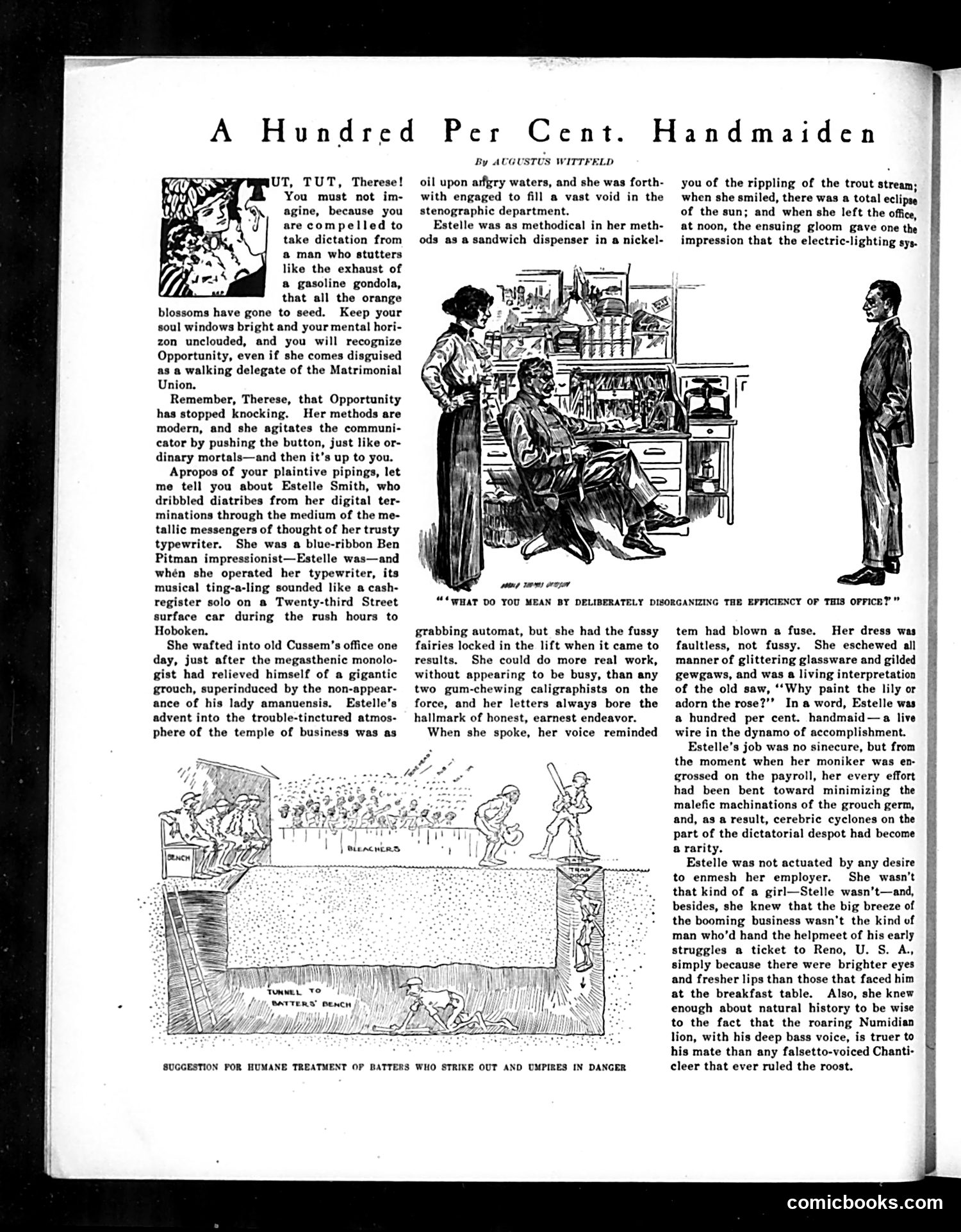
This story satirizes early 20th-century office culture and gender dynamics. The narrative mocks flowery, affected language ("megasthenic monologist," "metallic messengers of thought") while describing Estelle Smith, an exemplary stenographer/secretary who quietly transforms her boss's chaotic office through competence and dedication. The satire operates on multiple levels: it ridicules both pretentious business jargon and the romantic notion that a woman's "100 percent" value lies in selfless labor for her employer. The repeated emphasis on Estelle's invisibly perfect work—her efficiency without appearing busy, her faultless appearance, her devotion to minimizing her boss's moods—suggests ironic commentary on exploitative workplace expectations for women, dressed up in flowery praise. The cartoon showing a man confronting a woman at a desk (captioned about "deliberately disorganizing efficiency") and the separate "suggestion for humane treatment of batters" cartoon appear to address workplace power dynamics and labor issues, though the latter's specific reference is unclear.
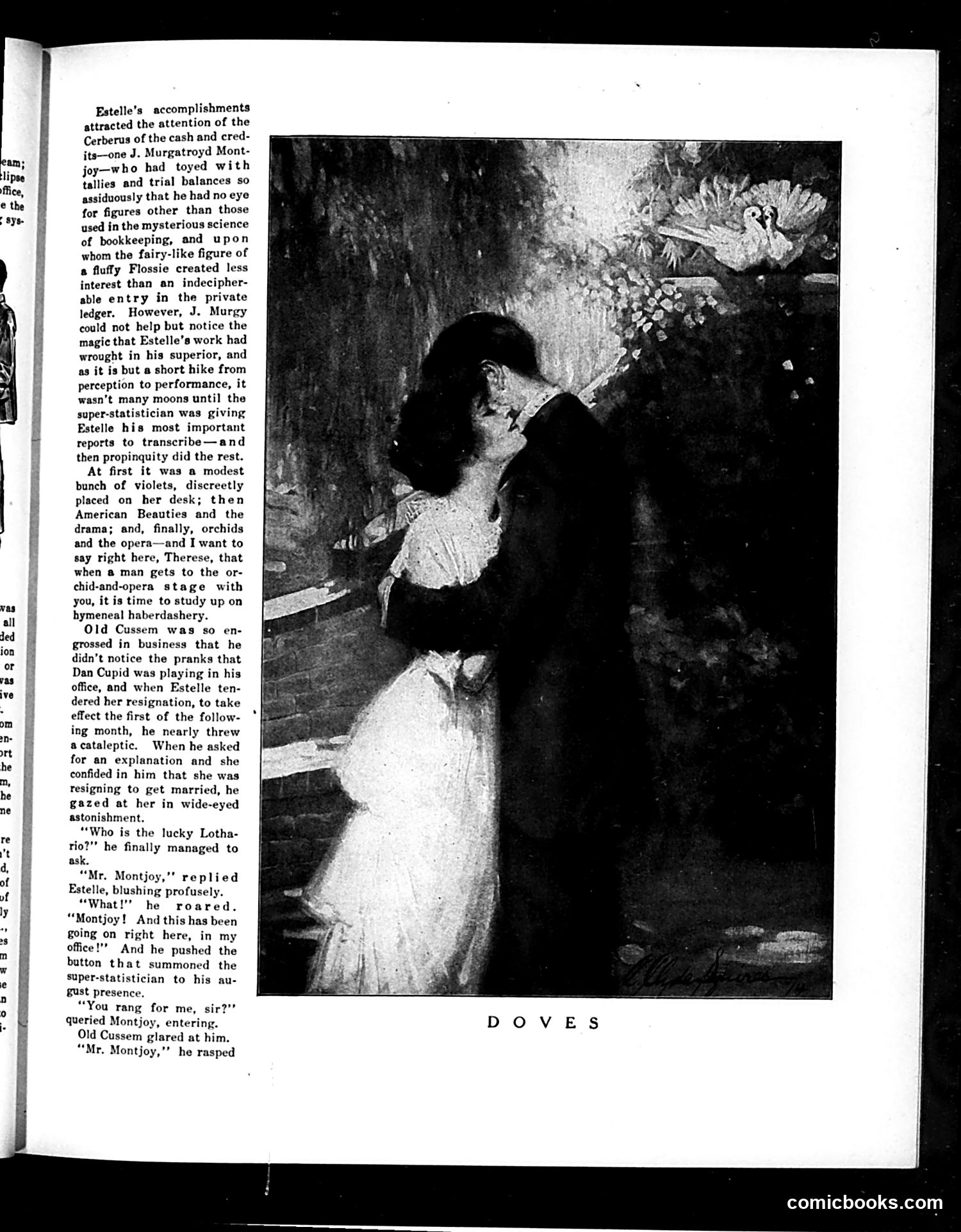
This is a romantic office comedy satirizing workplace romance and male obliviousness. The narrative describes how Estelle, a competent secretary, catches the eye of J. Murgatroyd Montjoy, the office's obsessive accountant ("super-statistician"), who normally cares only for ledgers and figures. The satire targets Montjoy's emotional blindness—he's so consumed with bookkeeping that he cannot perceive anything beyond numbers until Estelle's presence directly affects his superior. The joke escalates through increasingly expensive romantic gestures (violets → American Beauty roses → orchids and opera), a Victorian trope mocking male courtship rituals. The cartoon illustrates the moment when the boss ("Old Cussem") discovers his employees' secret engagement, having been completely unaware despite the romance unfolding "right here, in my office." The title "Doves" suggests the cooing, innocent nature of their romance—a gentle mockery of office sweethearts.
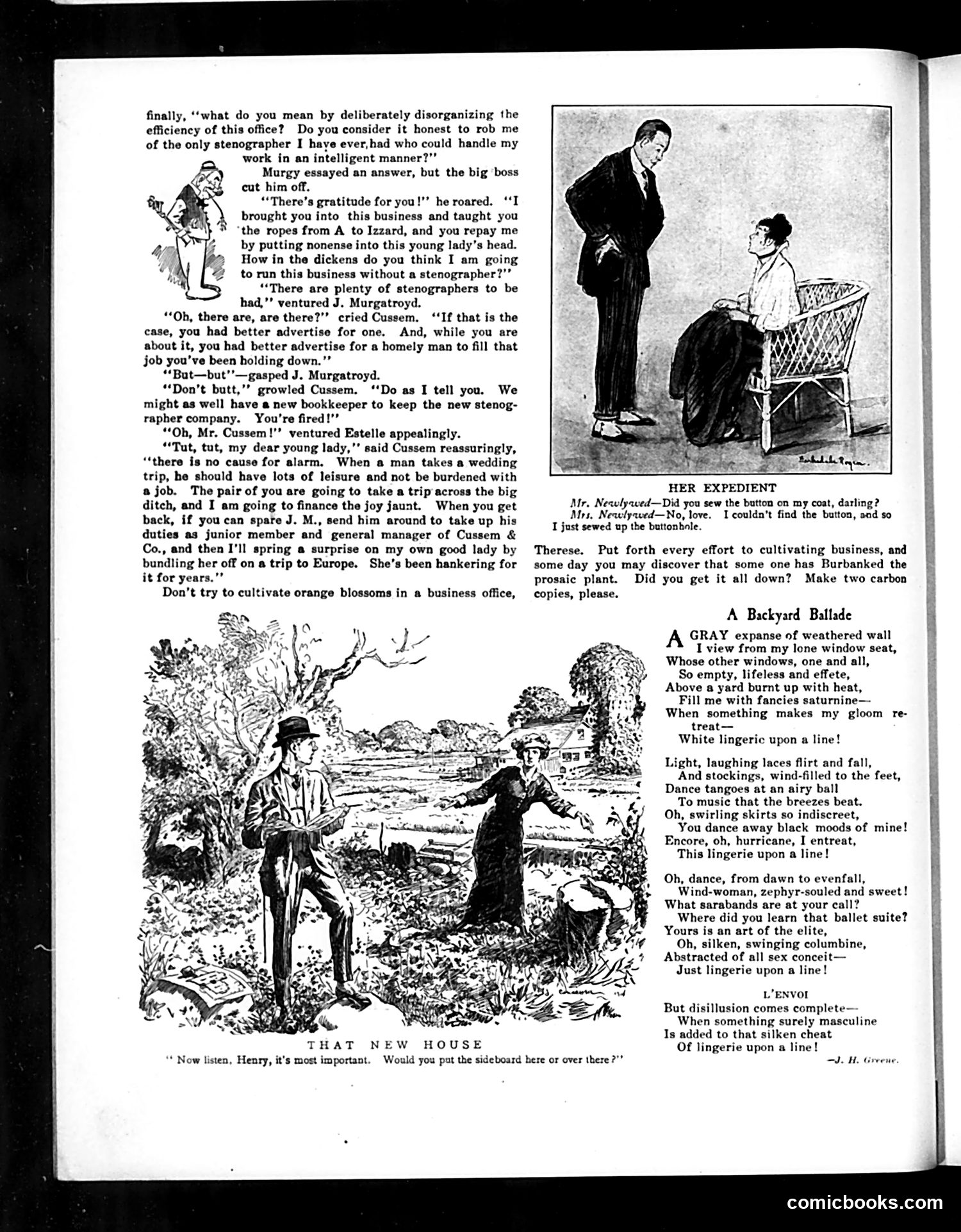
This page contains three distinct pieces of satire typical of early 20th-century humor: **"That New House"** (bottom left cartoon): A newlywed couple's domestic squabble—she's fussing over furniture placement while he seeks practical input. The satire mocks newly married couples' differing priorities in establishing a household. **Main story** (top and middle): An office manager (Cussem) fires his male employee (J. Murgatroyd) for supposedly "corrupting" his stenographer (Estelle) by encouraging her to take a honeymoon. The boss then finances their European trip himself while planning one for his own wife. The satire targets employer paternalism and the contradiction between controlling workers' personal lives while claiming benevolence—typical Progressive-era workplace critiques. **"A Backyard Ballade"** (right): A melancholic poem about a lonely man observing women's lingerie hanging on a clothesline, finding it erotically stimulating until he realizes actual people wear it. The satire mocks romantic idealization versus reality, a common literary theme. All three pieces address domestic and workplace relationships with gentle mockery of their absurdities.
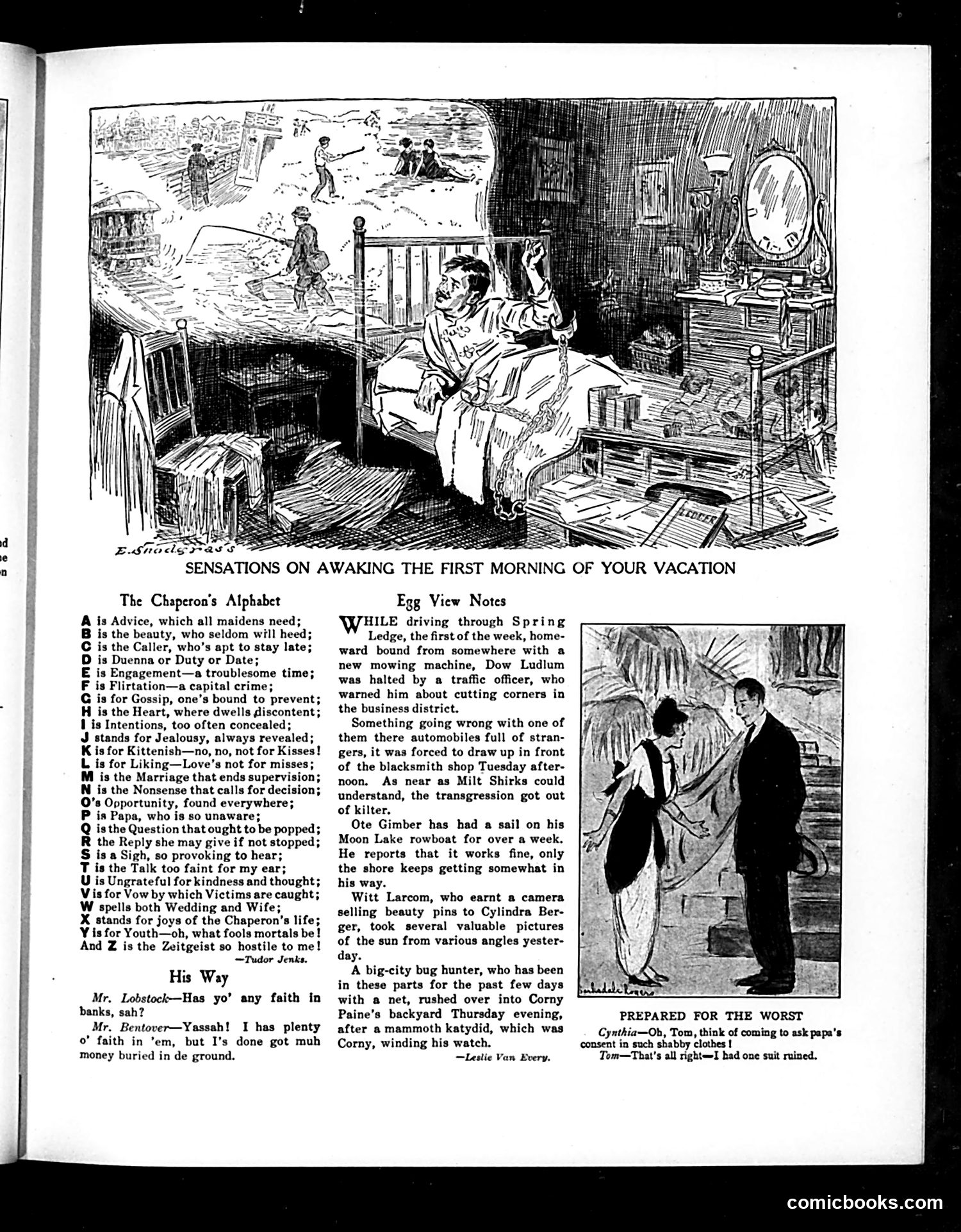
This page contains humor pieces satirizing early 20th-century American social conventions: **Main Cartoon** (top): A man in bed on vacation's first morning, fantasizing about beach activities while surrounded by bedroom furniture—mocking the gap between vacation dreams and reality. **"The Chaperon's Alphabet"**: A satirical poem by Tudor Jenks ridiculing the restrictive social rules governing unmarried women. Each letter represents courtship conventions—chaperones preventing flirtation (F), controlling gossip (G), preventing kisses (K). The final lines mock how these restrictions frustrate both youth and their guardians. This reflects genuine Victorian/Edwardian anxiety about female sexuality and parental control. **"His Way"**: A brief dialect humor piece about a Black man who distrusts banks, keeping money buried instead—playing on contemporary racist stereotypes about Black financial literacy. **"Egg View Notes"** and **"Prepared for the Worst"**: Rural/small-town humor and romantic comedy about a poorly-dressed suitor asking for a woman's hand. The page represents typical early Judge content: social satire, gender/courtship humor, and period-specific racial caricature.
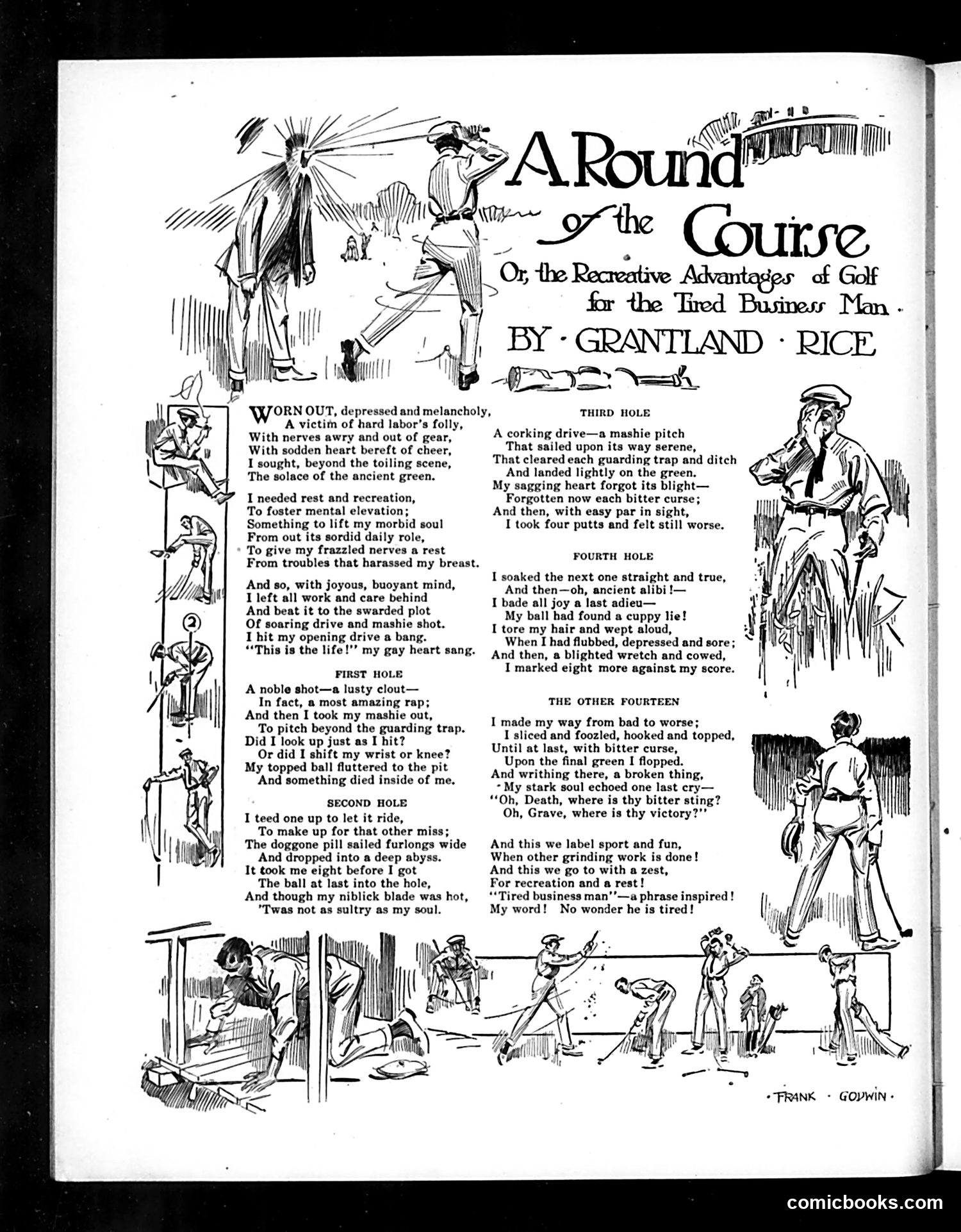
This is a humorous poem about golf's frustrations, illustrated with Frank Godwin's cartoon panels. The narrator—a stereotypical "tired businessman" seeking mental rejuvenation through golf—experiences mounting frustration across eighteen holes. Each hole delivers fresh disappointment: topped balls, sliced drives, missed putts, and increasingly worse scores. The satire targets the contradiction in the era's popular phrase "tired business man"—golf was marketed as relaxing recreation for stressed workers, yet the sport itself proves utterly maddening and exhausting. By the final holes, the protagonist is spiritually destroyed, ironically ending more exhausted than before. The illustrations show the golfer's physical and emotional deterioration. The joke is that pursuing "rest and recreation" through golf accomplishes the opposite: it transforms a weary man into a wreck, making him truly *deserve* the label "tired."
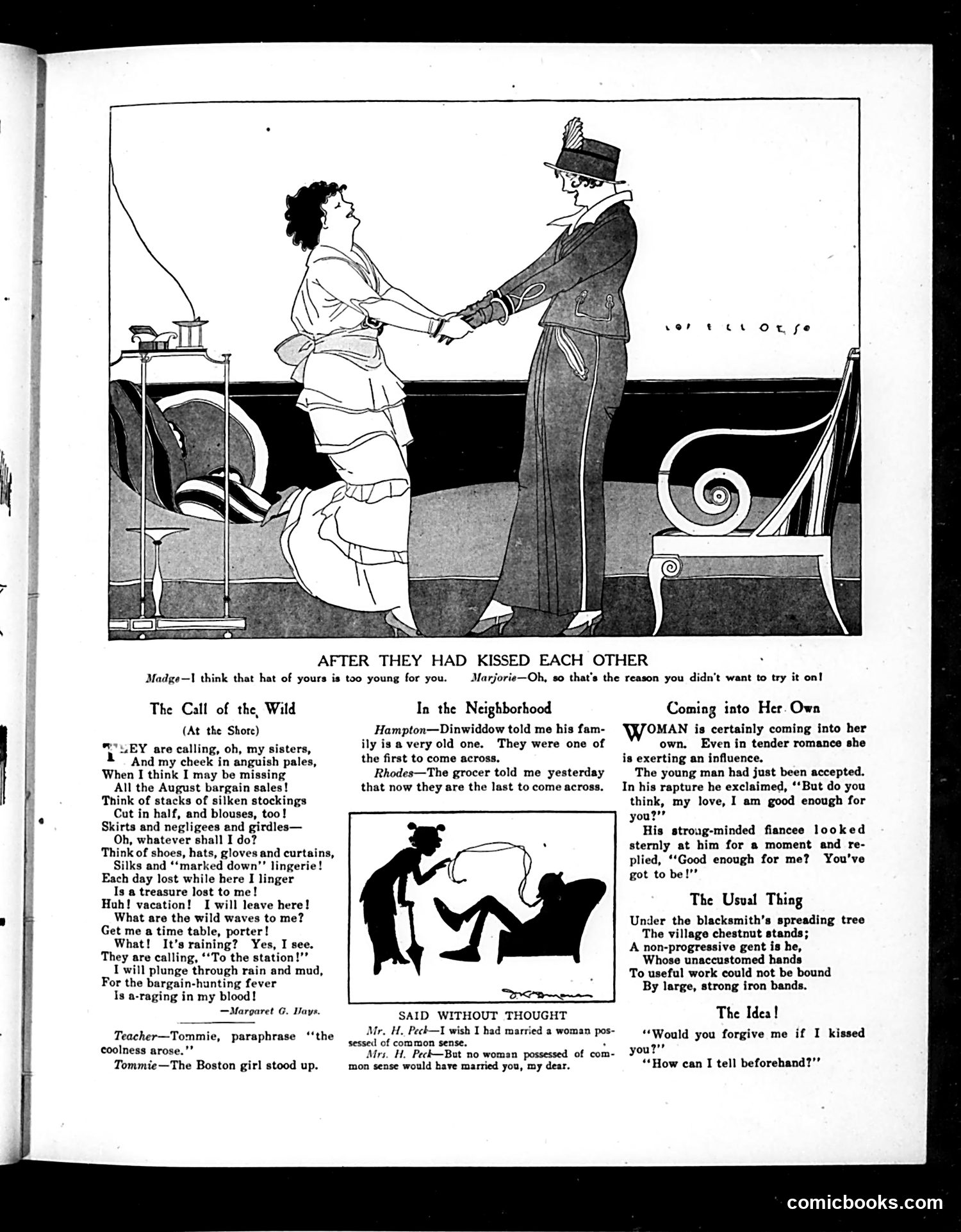
This page of *Judge* magazine presents several comedic sketches mocking early 20th-century social attitudes, particularly regarding gender roles and courtship. The top cartoon satirizes female materialism: a woman prioritizes bargain shopping over vacation, abandoning seaside relaxation to hunt sales. The poem "The Call of the Wild" ironically contrasts nature's appeal with her obsession with discounted goods. "In the Neighborhood" jokes about social climbing—a family claims old ancestry but is actually among the *last* to arrive (suggesting they're newcomers pretending status). "Coming into Her Own" mocks the "New Woman" of the era. The engaged woman rejects her suitor's self-deprecating question, asserting instead that *he* must prove worthy of *her*—reversing traditional courtship power dynamics in a way the era found humorous and slightly threatening. The final joke about kissing plays on modern women's boldness: rather than demurely accepting or refusing, she demands he prove his intentions work before she commits. These sketches reflect anxieties about changing gender roles as women gained more independence and social agency.
This page contains two separate pieces: **"The Genial Philosopher: On the Naming of Automobiles"** (left/main text): A dialogue satirizing the emerging automotive industry's practice of naming individual cars with elaborate, prestigious names rather than numbers or generic designations. The philosopher argues that named cars (referencing famous horses, yachts, and legendary figures) deserve personalized identities. The satire targets both the pretentiousness of early automobile owners who wanted their vehicles to seem dignified and cultured, and society's tendency to anthropomorphize consumer goods. **"Difficulties With Golf"** (bottom section): A separate satirical Q&A about golf's challenges. It humorously presents golfers' common problems—keeping eyes on the ball, maintaining direction, controlling distance—in pseudo-philosophical dialogue, mocking both the sport's frustrations and the verbose excuses players make. The illustration (upper right) shows what appears to be an early automobile or carriage, supporting the naming theme. Both pieces exemplify Judge's typical early-20th-century satirical style: gentle mockery of contemporary social habits and leisure pursuits.
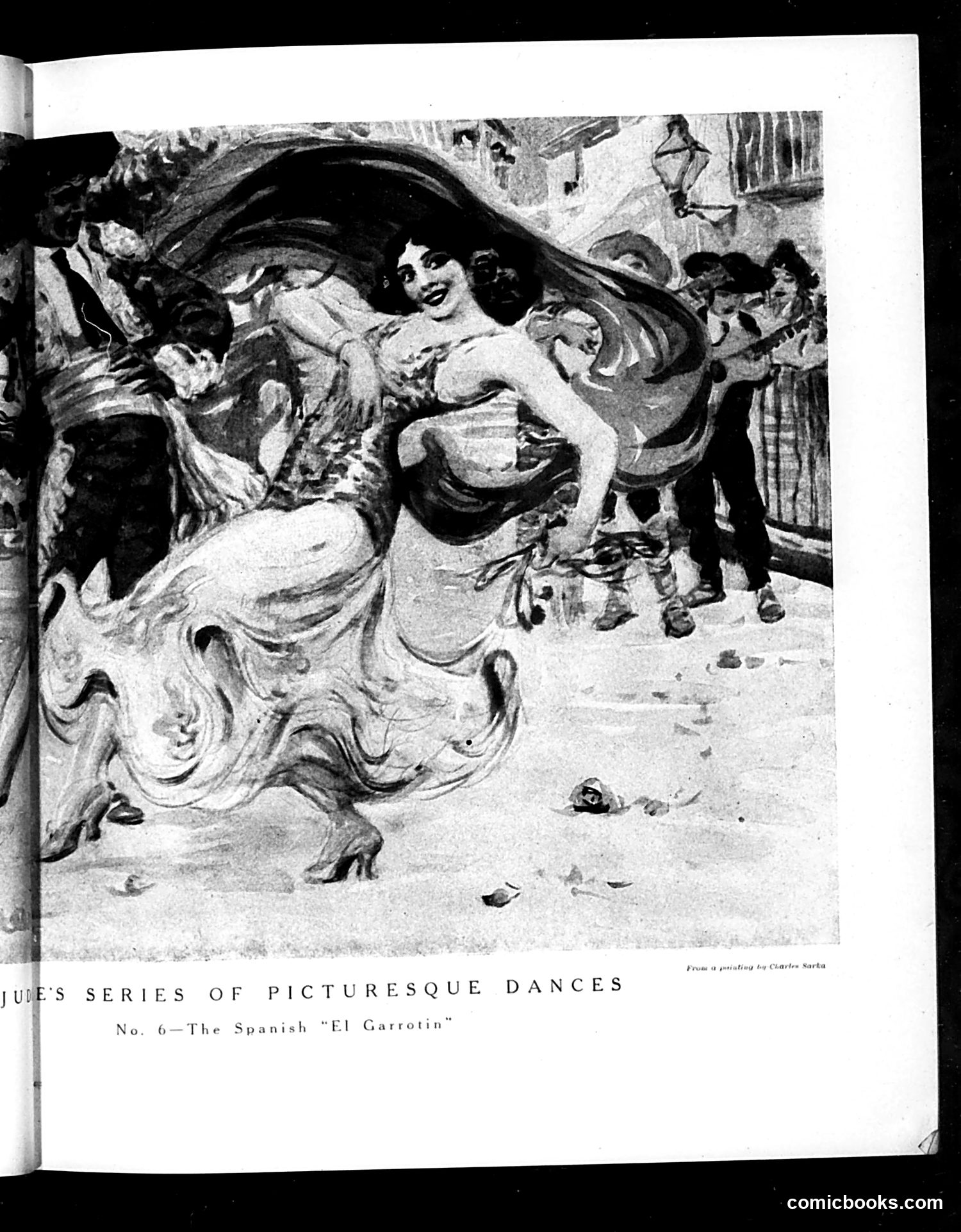
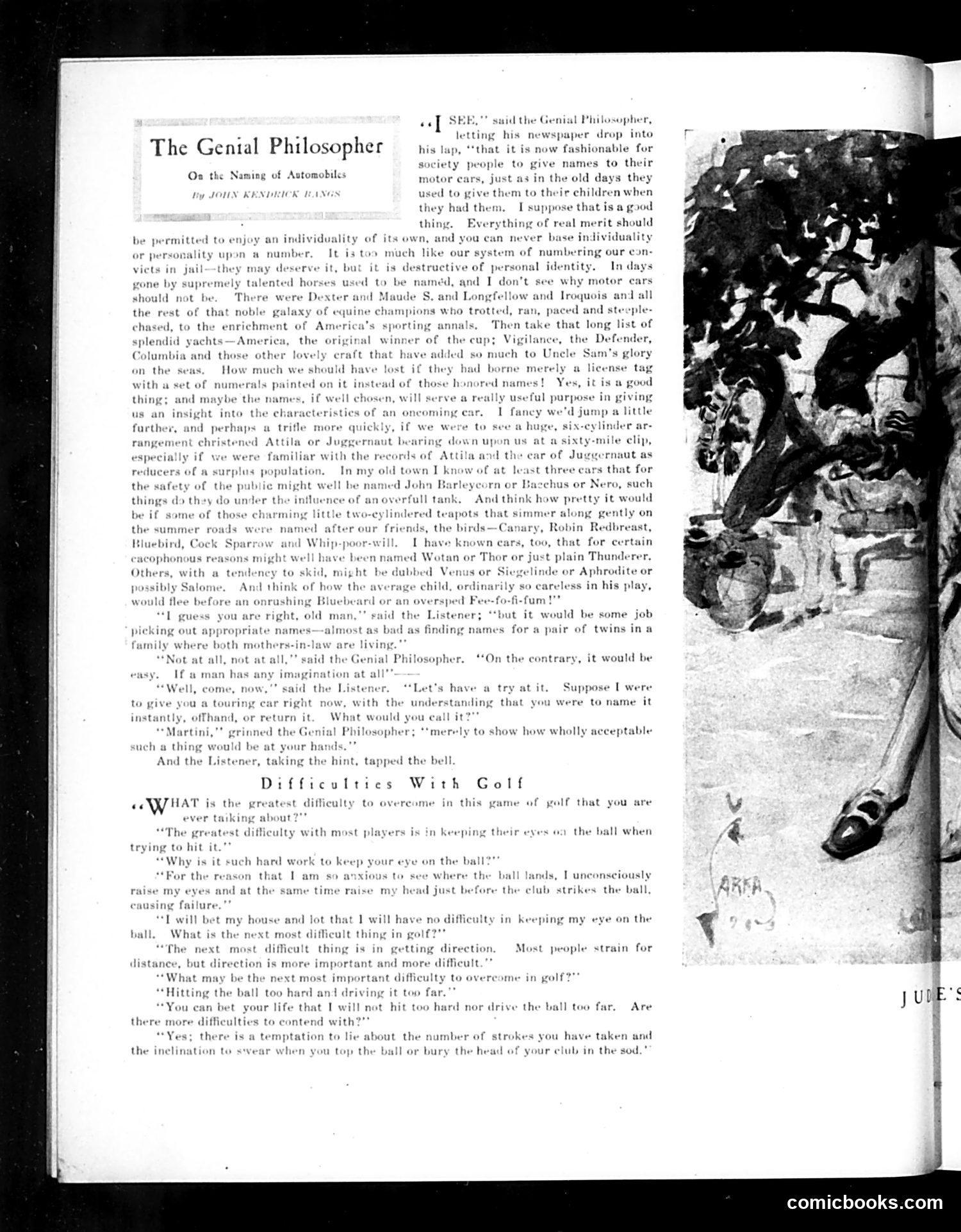
This is part of Judge magazine's "Series of Picturesque Dances," featuring the Spanish folk dance "El Garrotín" (No. 6). The illustration, credited to Charles Sarka, depicts a woman in elaborate flowing costume performing the dance in what appears to be a Spanish street setting, with onlookers in the background. The "picturesque dances" series appears to be lighthearted cultural content showcasing international dance traditions. El Garrotín is an actual Spanish folk dance, typically performed with dramatic, rhythmic movements. Judge used such content to entertain readers with exotic or foreign cultural subjects that were considered novel and amusing to American audiences of the era. The dramatic artistic rendering emphasizes the dance's theatrical, sensuous qualities.
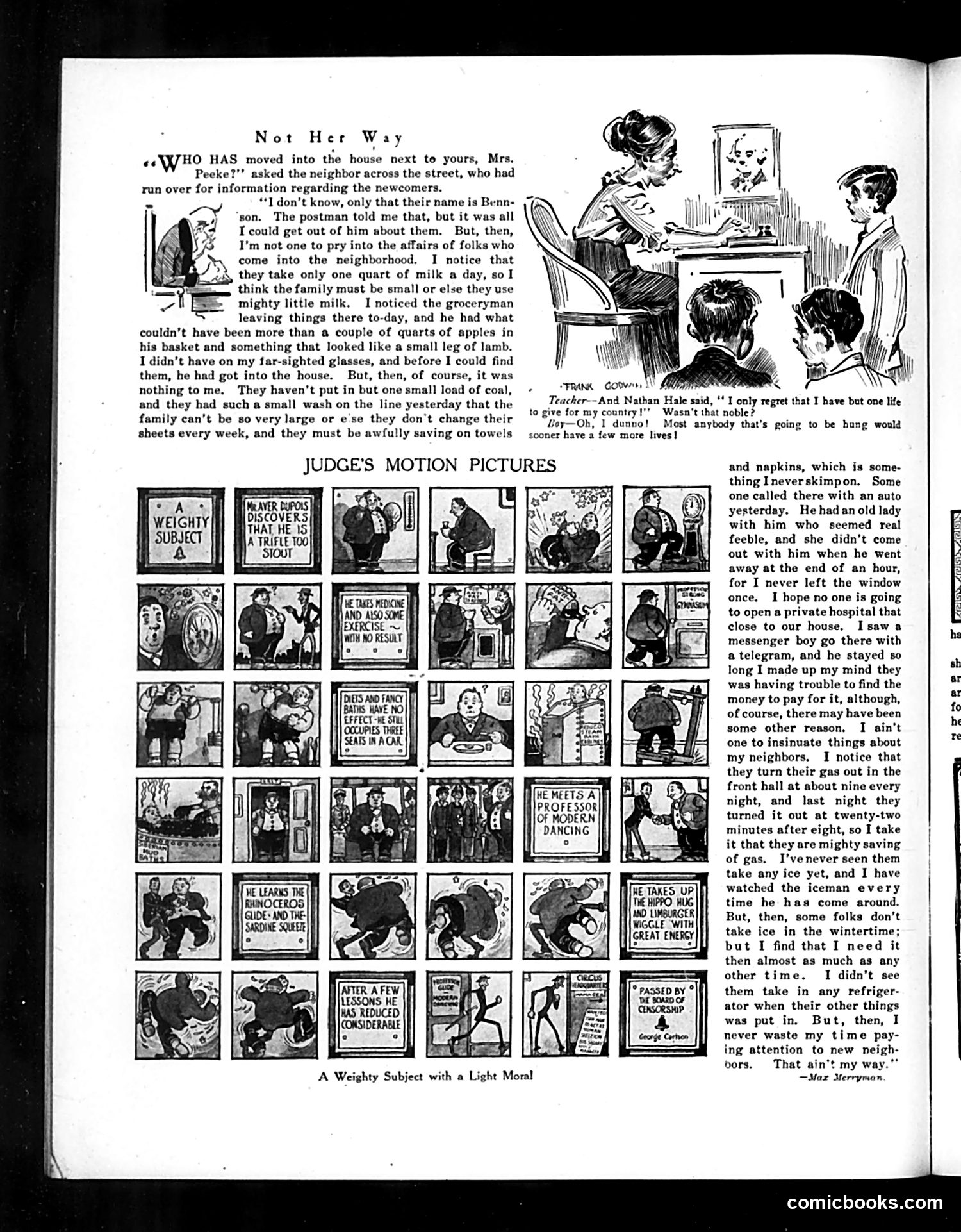
This page satirizes the nosiness of Mrs. Peeke, a self-proclaimed non-gossip who proceeds to obsessively catalog her new neighbors' private details: milk consumption, grocery purchases, laundry habits, coal deliveries, and even the timing of their gas usage. The humor lies in her transparent hypocrisy—she repeatedly insists "I'm not one to pry" while doing exactly that, monitoring their visitor (an elderly woman she suspects indicates a private hospital) and a telegram delivery boy. The satirical point: intrusive neighbors who disguise their meddling as innocent observation. "That ain't my way," she concludes while having thoroughly invaded the Bennsons' privacy. The "Judge's Motion Pictures" film strips below appear unrelated—various comedic vignettes about weight, exercise, and modern life—forming the magazine's typical mixed-content format.
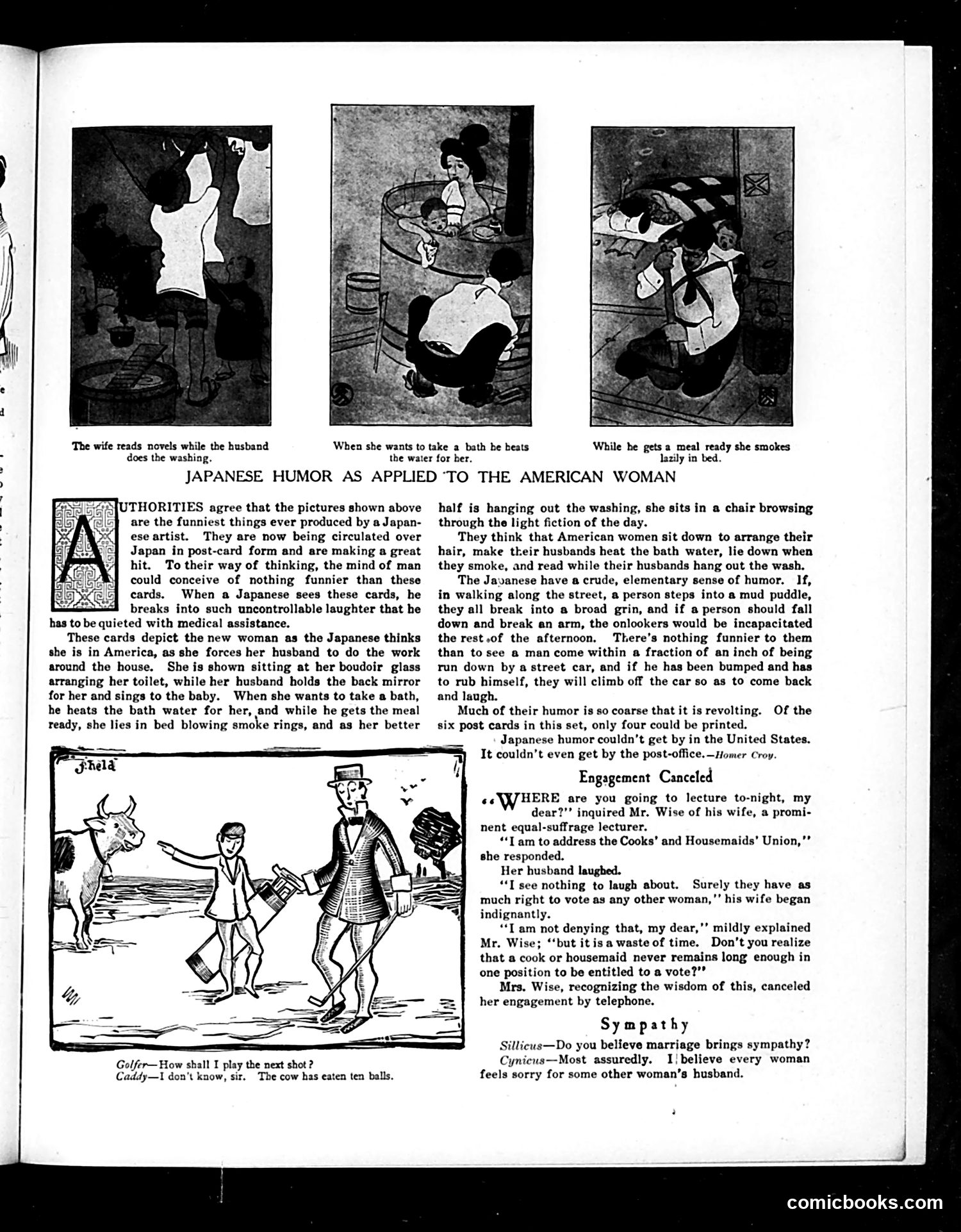
This 1910s Judge magazine page mocks both Japanese culture and American women's emerging independence through three separate pieces: **Top section:** Japanese postcards caricature American women as lazy, demanding wives who force husbands into domestic servitude. The satire targets the "New Woman"—the early 20th-century feminist movement advocating women's rights and independence. The article notes Japanese find this scenario hilarious because it inverts traditional gender roles they consider absurd. **Middle cartoon:** A golfer and caddy joke; unrelated to the main theme. **"Engagement Canceled":** Ridicules female suffrage advocates. A woman lecturer planning to address maids about voting rights is mocked when her husband points out servants change jobs too frequently to establish voting residence—implying women lack stability for political participation. **"Sympathy":** A cynical one-liner about marriage. The page's underlying message: women demanding equality and domestic relief from husbands is laughable to both Japanese and American audiences. It reflects period anxieties about changing gender roles.
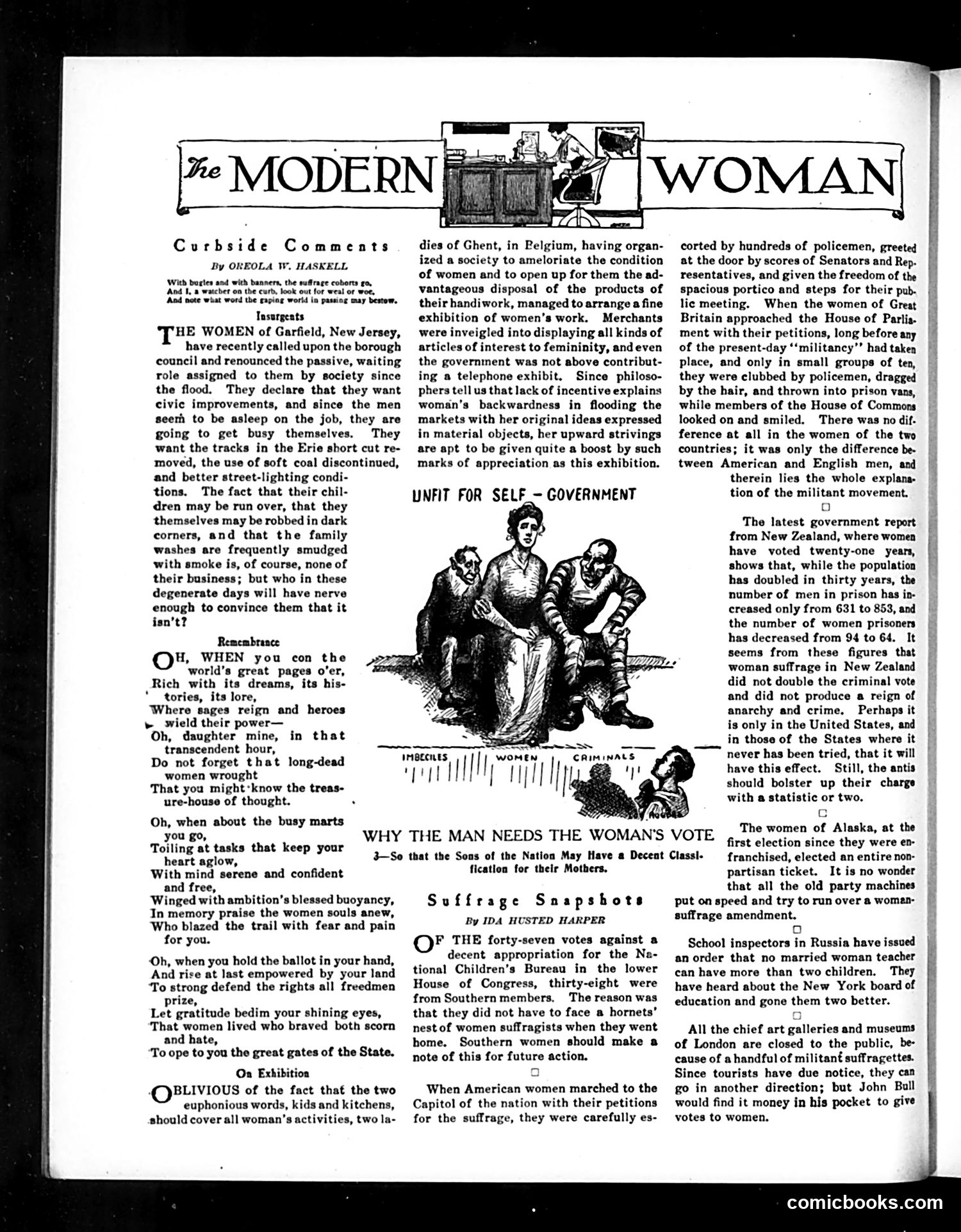
This Judge magazine page satirizes the women's suffrage movement through multiple pieces. The main cartoon titled "Unfit for Self-Government" depicts three women appearing distressed or arguing, sarcastically suggesting women lack the competence to vote—a common anti-suffrage argument of the era. The accompanying article "Why the Man Needs the Woman's Vote" ironically reverses this, claiming men *need* women voters to ensure proper moral classification of mothers, implying women's moral superiority should influence politics. The poetry and commentary sections mock women activists in Garfield, New Jersey, who demanded civic improvements (track removal, pollution reduction, better lighting), sarcastically suggesting these practical concerns are beneath women's proper sphere. References to Belgian and British suffragists contrast American suffragists' orderly Capitol march with British women's more militant tactics. Overall, Judge presents anti-suffrage arguments while simultaneously demonstrating women's legitimate grievances and activism, undermining its own mockery.
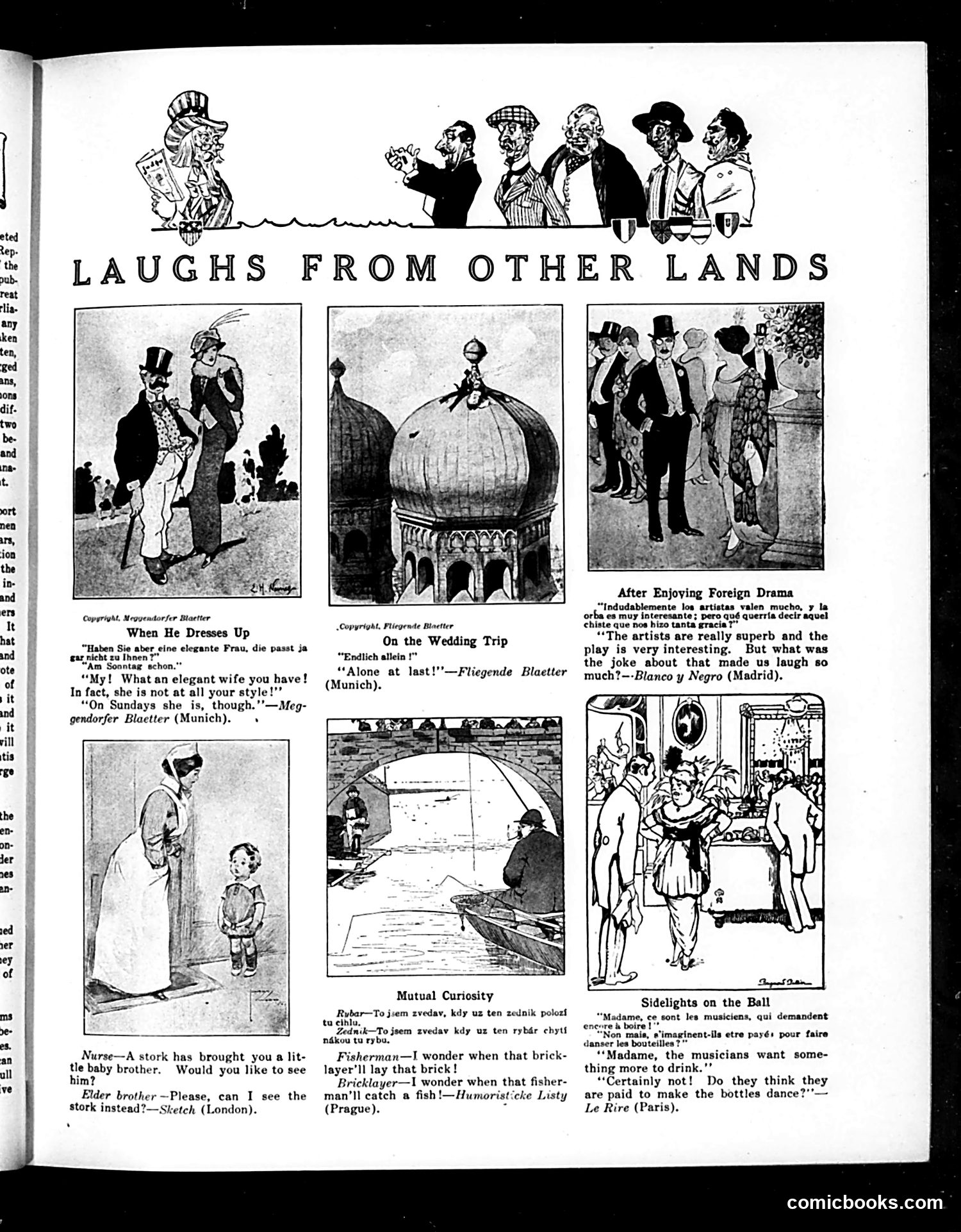
This page compiles short humorous comic strips and jokes translated from European satirical magazines (German, Czech, Spanish, and French sources). Each cartoon illustrates a brief joke with visual and textual punchlines. The humor relies on domestic and social observations: a man's wife dresses elegantly only on Sundays; newlyweds finally alone together; professionals (fisherman and bricklayer) distracted from work; a child preferring to see the stork rather than a baby brother; audience confusion over a play's jokes despite appreciating the performance; and musicians demanding drinks, prompting a woman to joke they expect payment for making "bottles dance." These are gentle, observational comedies about marriage, work, and social customs—typical of early 20th-century European humor magazines. The page demonstrates Judge magazine's practice of reprinting international comedy to entertain American readers.
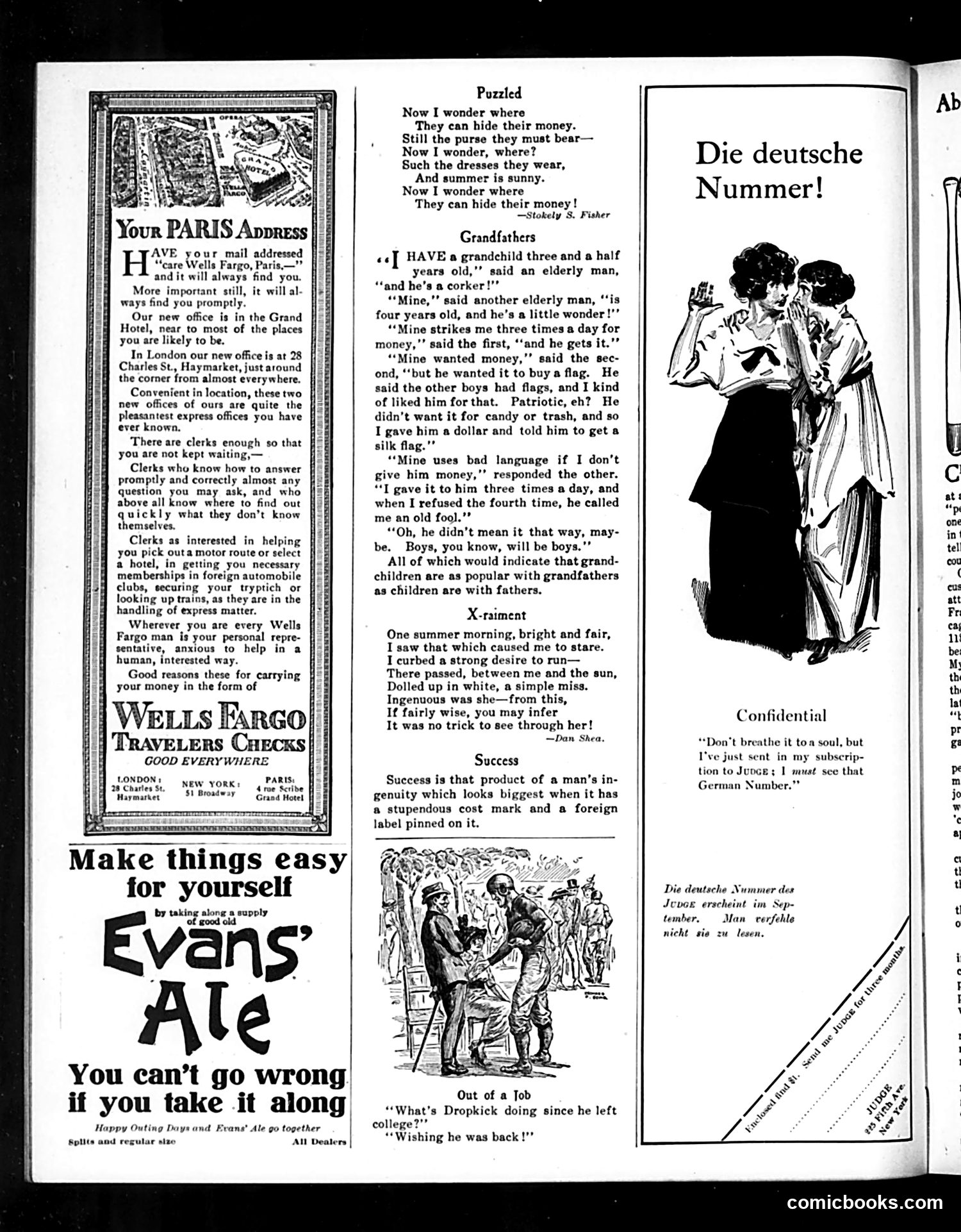
This page from Judge contains mostly **advertisements and short humorous pieces** rather than political cartoons with clear satirical targets. The notable content includes: **"Die deutsche Nummer!" section**: A small illustration and advertisement promoting Judge's upcoming German-language issue. The "Confidential" joke plays on readers secretly wanting to read German content—likely referencing World War I tensions when German culture faced suspicion in America. The humor suggests interest in German culture persisted despite wartime attitudes. **Other pieces**: Light comedy sketches like "Puzzled" (about women's fashion hiding money), "Grandfathers" (generational humor about grandchildren), and "X-raiment" (a joke about transparent clothing). **Advertisements**: Wells Fargo travelers' checks and Evans' Ale dominate the page's commercial space. The German-language section appears to be the only content with potential contemporary relevance—reflecting either pre-war cosmopolitanism or ironic post-war attitudes toward German culture, though the exact historical moment is unclear without a publication date.
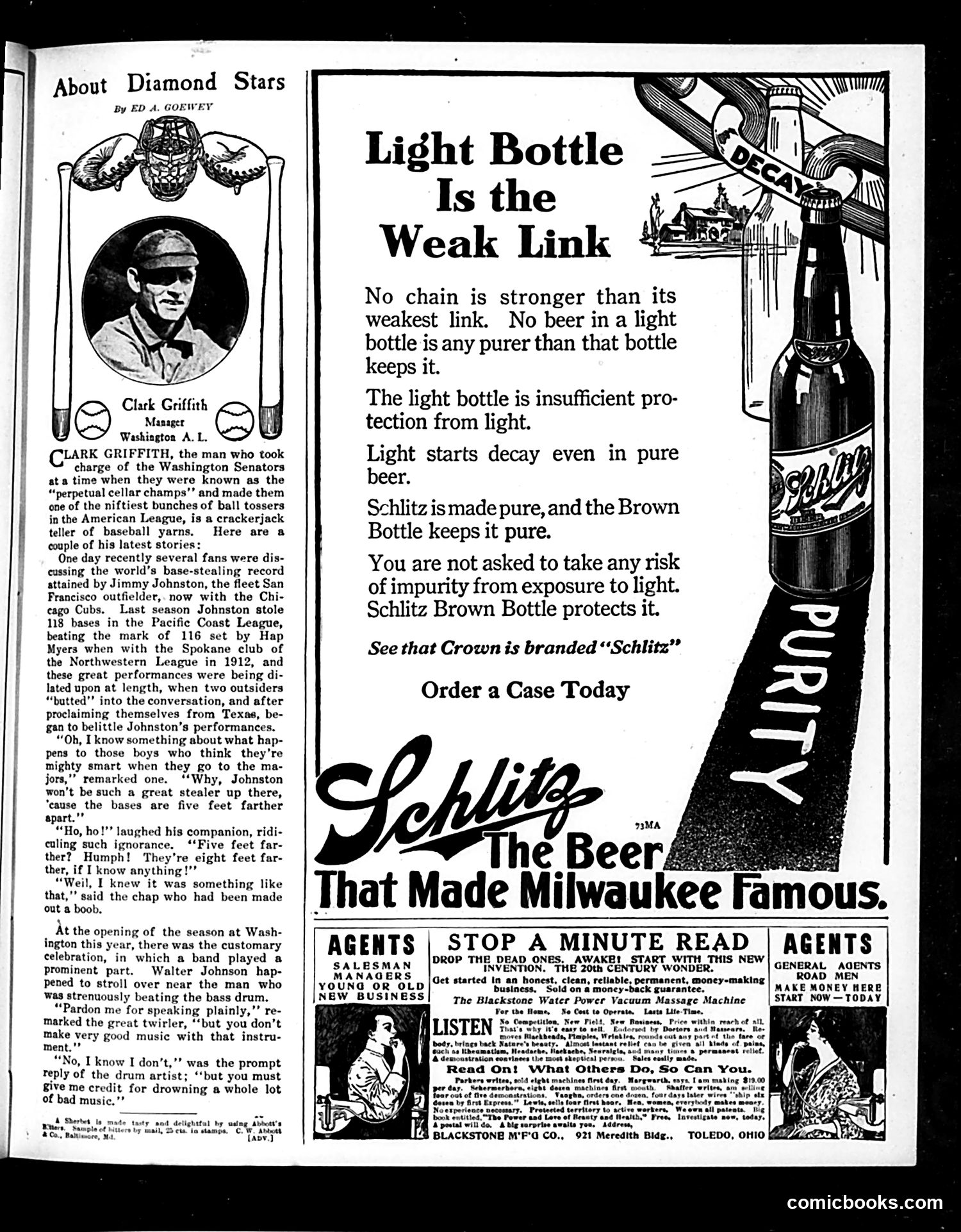
This page contains two distinct elements: a baseball anecdote and a beer advertisement. **"About Diamond Stars"** features Clark Griffith, manager of the Washington Senators, telling humorous stories about baseball players and musicians. The jokes rely on exaggeration and misunderstanding—Texas fans wildly misjudging base distances, a drum player admitting he's drowning out bad music. These are light, character-driven humor typical of early 20th-century sports journalism. **The main advertisement** promotes Schlitz beer in brown bottles, using the "weakest link" metaphor to argue that light bottles expose beer to harmful light, causing decay. The brown bottle allegedly provides superior protection. This reflects genuine 1920s beer industry concerns about light exposure degrading product quality—a real technical advantage before modern refrigeration and stabilization. The page also includes small advertisements for sales positions and a "Blackstone Water Power Vacuum Massage Machine," typical period hustles and patent remedies.
This page is primarily **advertising** with small comedic filler items typical of early 20th-century magazines. The main content includes hotel and product ads (Apollinaris mineral water, Pears' soap, Hotel Earlington, Commonwealth Hotel). The humor pieces are brief, disconnected jokes: - A "Busy magnate" offers work to an unemployed man who declines, claiming he must march in an I.W.W. (Industrial Workers of the World) parade—satirizing labor activism as a time-consuming commitment rather than serious organizing. - Several short dialogue jokes about social manners and misunderstandings (an exchange about Native American tribal hierarchy; a lawyer relieved exams are over being told he'll have decades more work ahead). - A deaf uncle mishearing "bananas" as "nightgowns"—simple wordplay humor. The satire is gentle and scattered, typical of Judge's mix of advertising revenue and light social commentary. No major political figures or events are referenced on this particular page.
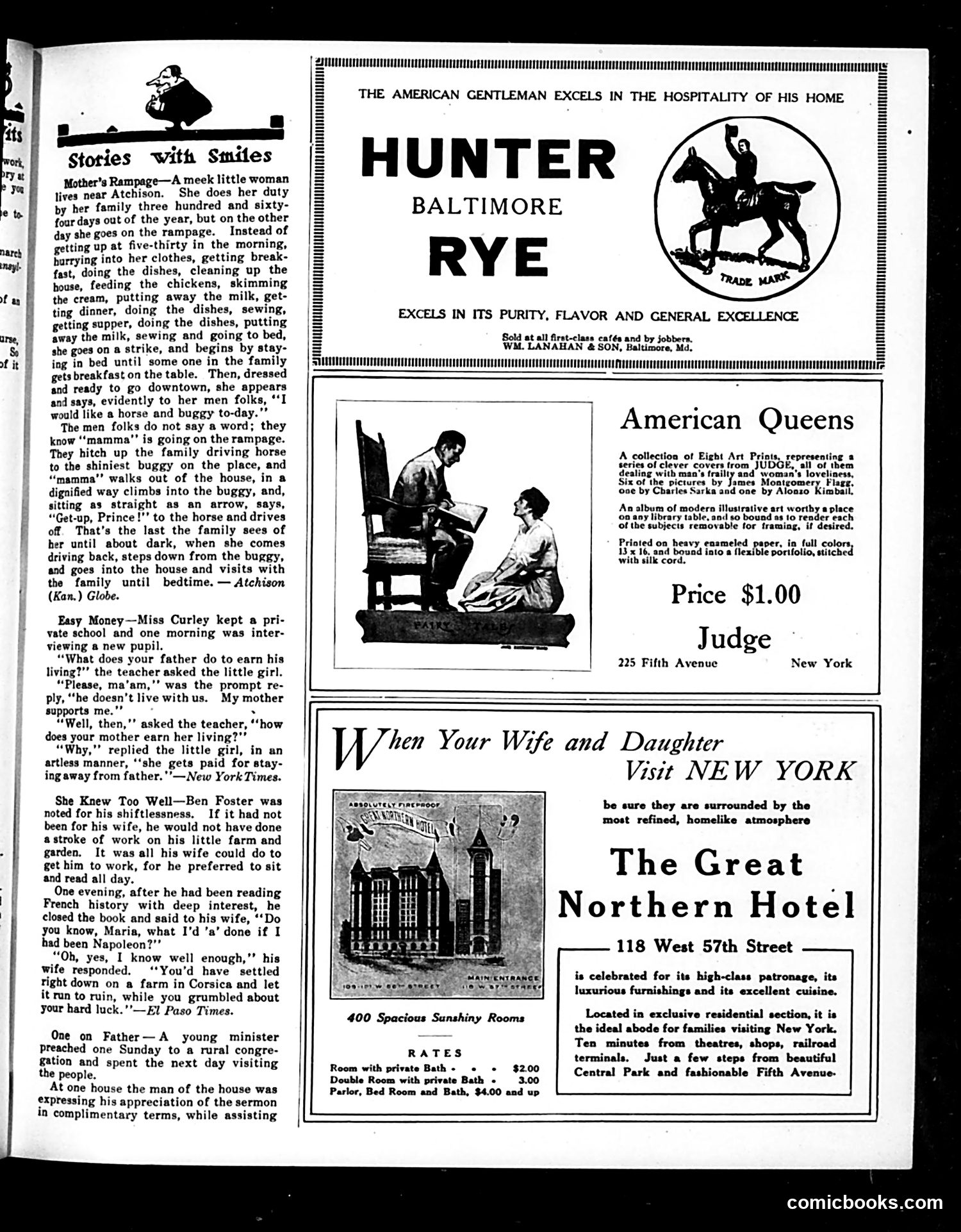
This page is primarily **advertising and short humorous anecdotes** rather than political cartoons. The "Stories with Smiles" section presents gentle domestic humor about American life, circa early 1900s. "Mother's Rampage" satirizes the exhausting, relentless labor of housewives—the joke being that one day off annually makes a woman so desperate for freedom she commandeers the family buggy. "Easy Money" plays on modern divorce settlements (a woman receiving alimony for *not* living with her husband). These reflect genuine social anxieties about women's domestic servitude and evolving marital arrangements. The remaining content consists of advertisements: Hunter Baltimore Rye whiskey (emphasizing "American Gentleman" hospitality), "American Queens" art prints (featuring female subjects), and The Great Northern Hotel in New York. The page reflects *Judge*'s audience—affluent, urban American men—and contains no overt political satire, focusing instead on gentle mockery of domestic life and consumption.
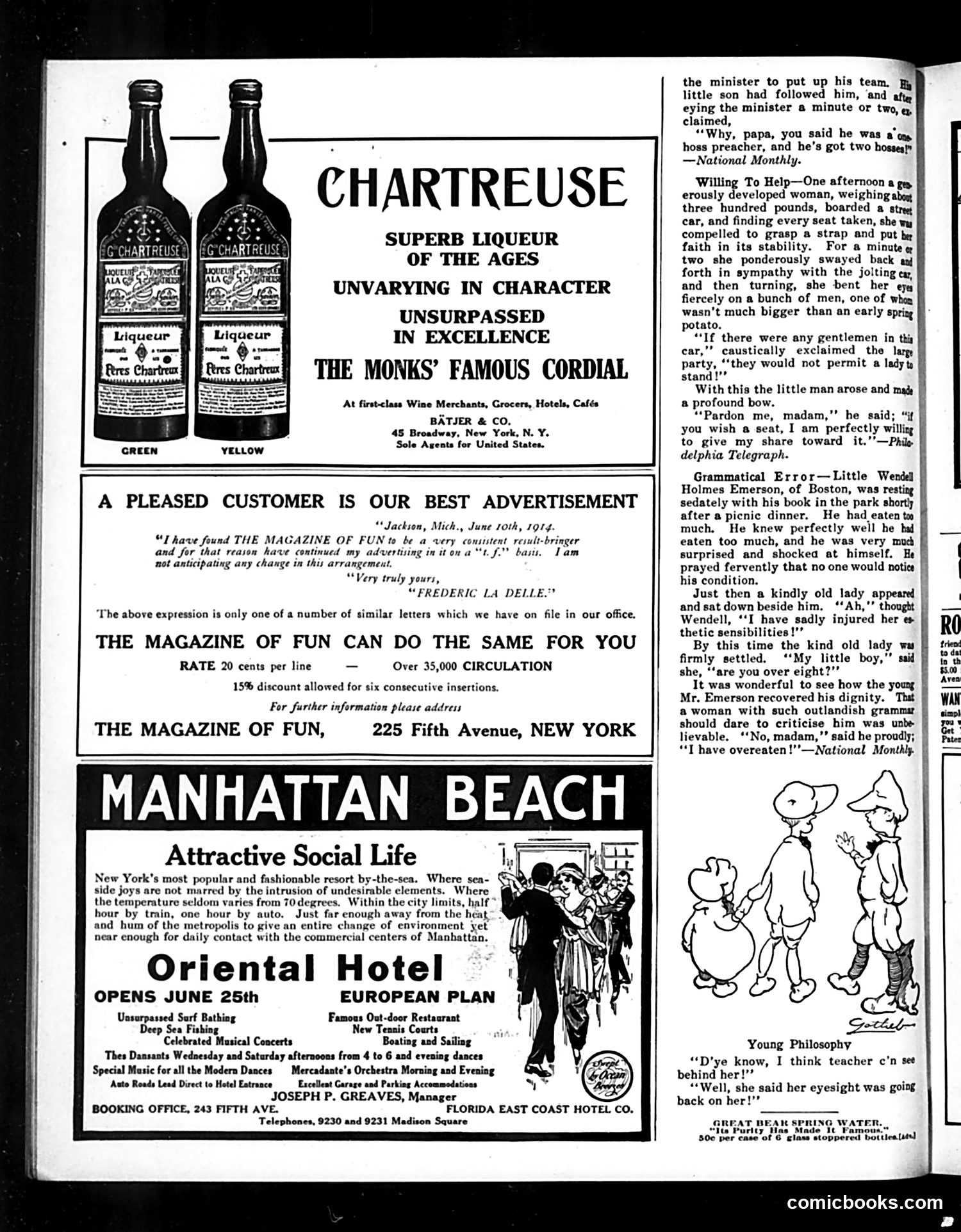
This page is primarily **advertising**, not political satire. The main content consists of three advertisements: 1. **Chartreuse Liqueur** - promoting a French cordial as "The Monks' Famous Cordial" 2. **The Magazine of Fun** - a self-promotional ad featuring a testimonial letter from an advertiser praising the magazine's effectiveness 3. **Oriental Hotel at Manhattan Beach** - advertising a new resort opening June 25th, marketed as an exclusive, fashionable destination with specific appeal to those seeking escape from city heat while remaining accessible by train or auto The right column contains **humorous anecdotes** typical of Judge's content: stories about a minister's horses, a large woman on a streetcar, and a boy with digestive troubles. These illustrate the magazine's comedic style but contain no political commentary. The page reflects early 1910s advertising aesthetics and consumer culture rather than satirical commentary on current events.
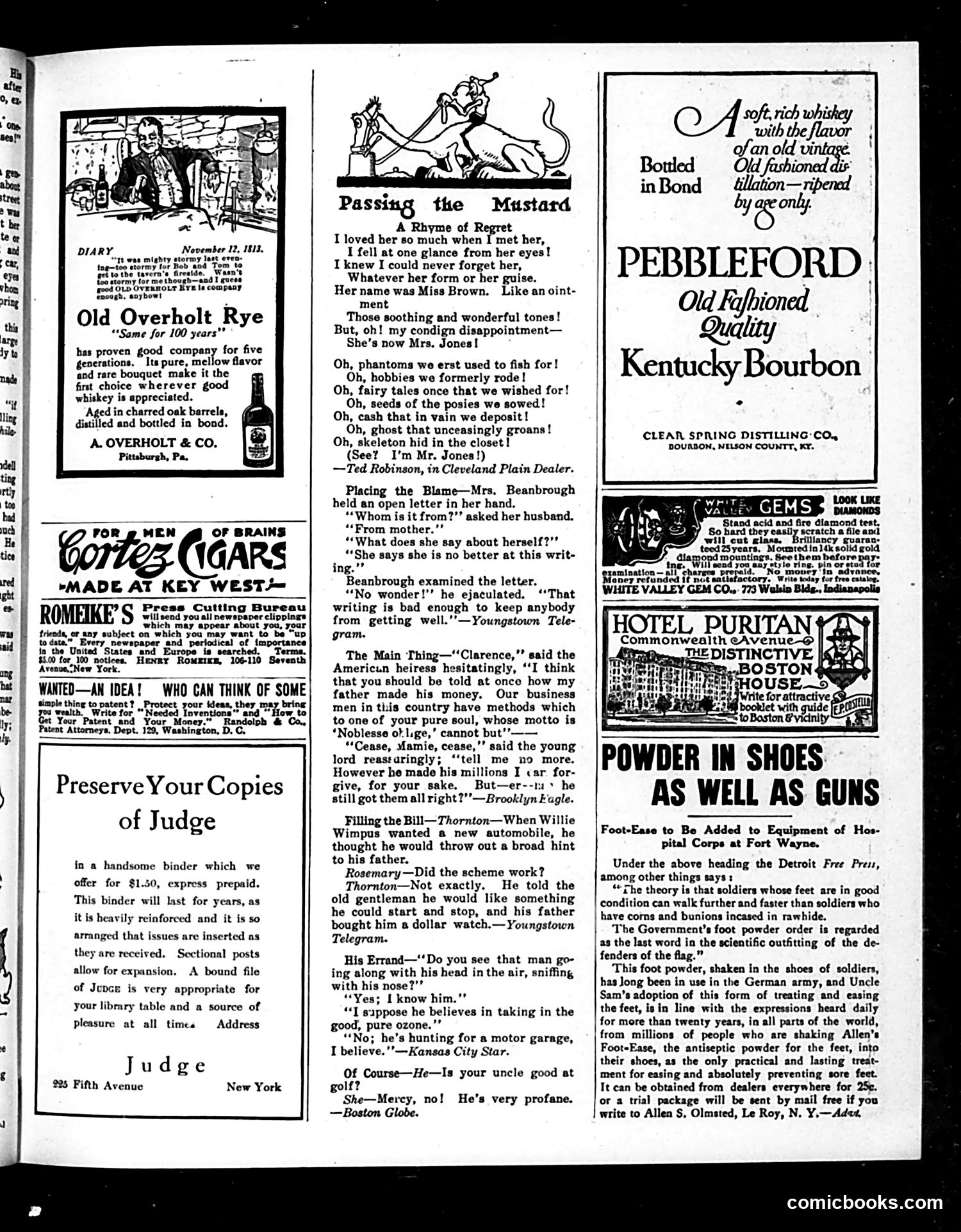
This page is primarily **advertising and light humor**, typical of Judge magazine's format. The central cartoon titled "Passing the Mustard" shows a classical scene of a man and woman, with accompanying verse "A Rhyme of Regret" about lost love—the narrator was infatuated with "Miss Brown" but she married "Mr. Jones," so now he too must be Mr. Jones (presumably, he married her). It's gentle, wistful satire on romantic disappointment and marriage. The page otherwise consists of **whiskey and cigar advertisements** (Old Overholt Rye, Pebbleford Bourbon, Cortes Cigars) and service ads (press clipping bureau, patent attorneys, Judge binder subscriptions). Several **brief humorous anecdotes** appear: a wife's terrible handwriting affecting her mother's recovery, an heiress disclosing her father's dubious business methods, a father buying his son a dollar watch instead of a car, and a man sniffing around for a motor garage. These jokes reflect early 20th-century concerns: correspondence quality, old money versus new wealth, and emerging automobile culture. The page functions as entertainment and commercial space rather than political satire.
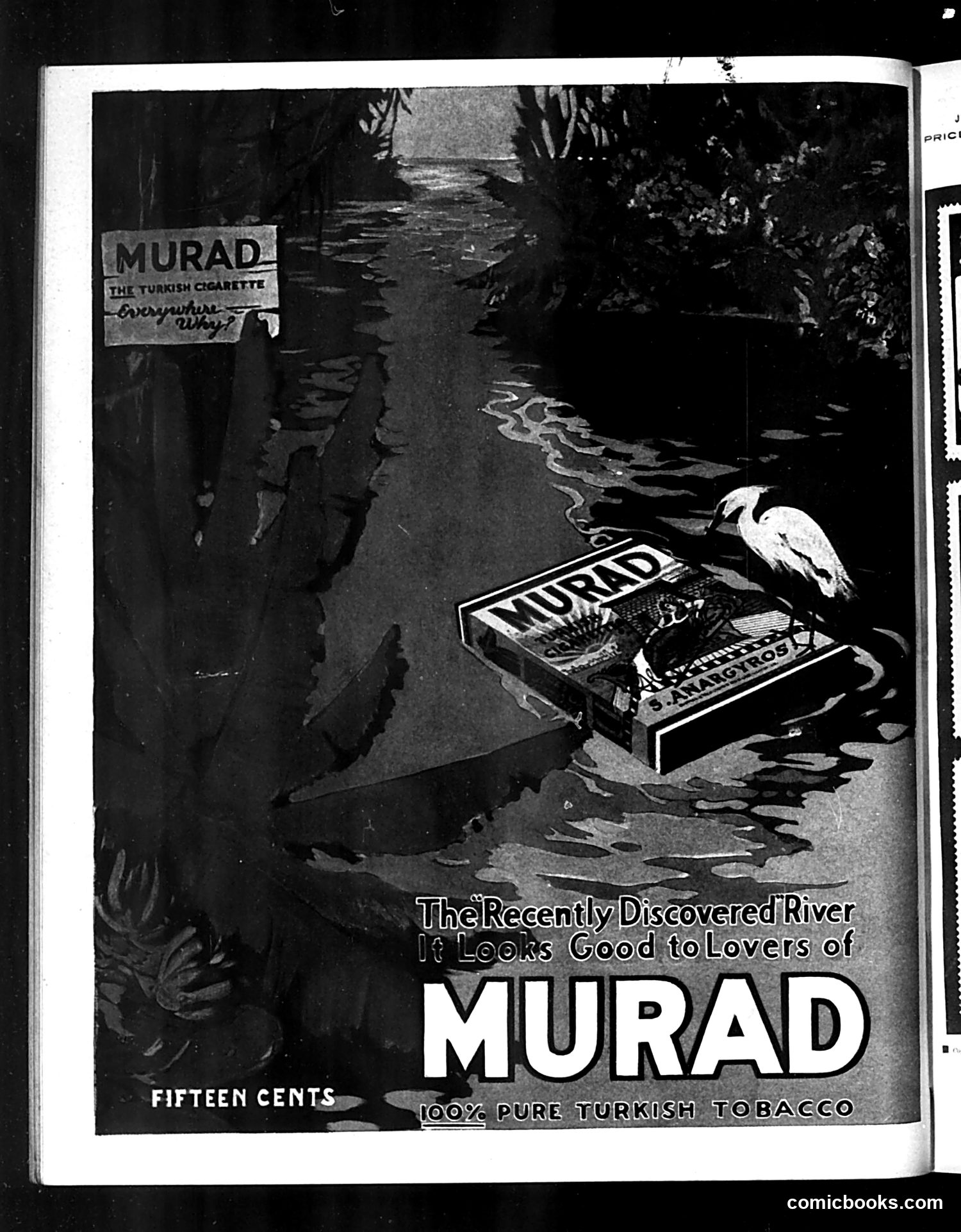
This is a **Murad cigarette advertisement**, not political satire. The ad depicts an exotic, romanticized riverside scene with tropical vegetation, a white bird (possibly a heron or crane), and Murad cigarette packages arranged as the focal point. The copy claims that "The Recently Discovered River" appeals to "Lovers of MURAD—100% Pure Turkish Tobacco," priced at fifteen cents. The advertisement uses orientalist imagery common in early 20th-century marketing, associating the product with exotic, faraway places to create aspirational appeal. This reflects period advertising conventions that exploited romantic notions of the "Orient" to market luxury consumer goods to American audiences, rather than containing political commentary.