
Judge, 1914-07-18 · page 6 of 24
Judge — July 18, 1914 — page 6: what you’re looking at
What you’re looking at
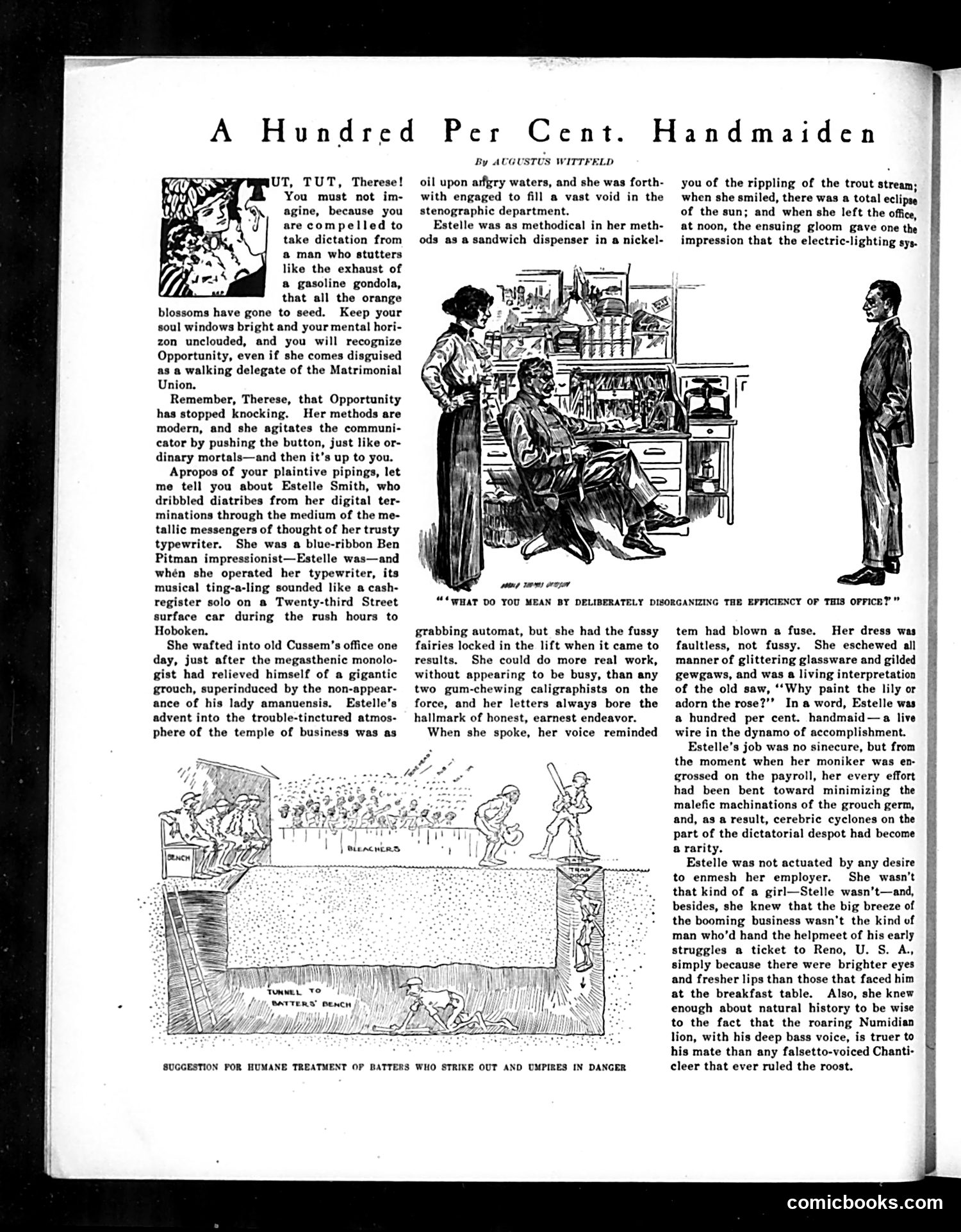
This story satirizes early 20th-century office culture and gender dynamics. The narrative mocks flowery, affected language ("megasthenic monologist," "metallic messengers of thought") while describing Estelle Smith, an exemplary stenographer/secretary who quietly transforms her boss's chaotic office through competence and dedication. The satire operates on multiple levels: it ridicules both pretentious business jargon and the romantic notion that a woman's "100 percent" value lies in selfless labor for her employer. The repeated emphasis on Estelle's invisibly perfect work—her efficiency without appearing busy, her faultless appearance, her devotion to minimizing her boss's moods—suggests ironic commentary on exploitative workplace expectations for women, dressed up in flowery praise. The cartoon showing a man confronting a woman at a desk (captioned about "deliberately disorganizing efficiency") and the separate "suggestion for humane treatment of batters" cartoon appear to address workplace power dynamics and labor issues, though the latter's specific reference is unclear.
📄 Transcribed text from this page (OCR, searchable)
Machine-transcribed from the original scan — historical spelling and the odd misread are preserved.
A Hundred Per Cent. UT, TUT, Therese! You must not im- agine, because you are compelled to take dictation from a man who stutters like the exhaust of a gasoline gondola, that all the orange blossoms have gone to seed. Keep your soul windows bright and your mental hori- zon unclouded, and you will recognize Opportunity, even if she comes disguised as a walking delegate of the Matrimonial Union. Remember, Therese, that Opportunity has stopped knocking. Her methods are modern, and she agitates the communi- cator by pushing the button, just like or- dinary mortals—and then up to you. Apropos of your plaintive pipings, let me tell you about Estelle Smith, who dribbled diatribes from her digital ter- minations through the medium of the me- tallic messengers of thought of her trusty typewriter. She was a blue-ribbon Ben Pitman impressionist—Estelle was—and whén she operated her typewriter, its musical ting-a-ling sounded like a cash- register solo on a Twenty-third Street surface car during the rush hours to Hoboken. She wafted into old Cussem’s office one day, just after the megasthenic monolo- gist had relieved himself of a gigantic grouch, superinduced by the non-appear- ance of his lady amanuensis. Estelle’s advent into the trouble-tinctured atmos- phere of the temple of business was as | BLenchERS. By AUGUSTUS WITTFELD oil upon arfgry waters, and she was forth- with engaged to fill a vast void in the stenographic department. Estelle was as methodical in her meth- ods as a sandwich dispenser in a nickel- Handmaiden you of the rippling of the trout stream; when she smiled, there was a total eclipse of the sun; and when she left the office, at noon, the ensuing gloom gave one the impression that the electric-lighting sys. “*WHAT DO YOU MEAN BY DELIBERATELY DISORGANIZING THE EPPICIENCY OP THIS OFFICE?” grabbing automat, but she had the fussy fairies locked in the lift when it came to results. She could do more real work, without appearing to be busy, than any two gum-chewing caligraphists on the force, and her letters always bore the hallmark of honest, earnest endeavor. When she spoke, her voice reminded BATTERS BENCH SUGGESTION POR HUMANE TREATMENT OP BATTERS WHO STRIKE OUT AND UMPIRES IN DANGER tem had blown a fuse. Her dress was faultless, not fussy. She eschewed all manner of glittering glassware and gilded gewgaws, and was a living interpretation of the old saw, ‘‘Why paint the lily or adorn the rose?’’ In a word, Estelle was a hundred per cent. handmaid—a live wire in the dynamo of accomplishment. Estelle’s job was no sinecure, but from the moment when her moniker was en- grossed on the payroll, her every effort had been bent toward minimizing the malefic machinations of the grouch germ, and, as a result, cerebric cyclones on the part of the dictatorial despot had become a rarity. Estelle was not actuated by any desire to enmesh her employer. She wasn't that kind of a girl—Stelle wasn’t—and, besides, she knew that the big breeze of the booming business wasn't the kind of man who'd hand the helpmeet of his early struggles a ticket to Reno, U. S. A, simply because there were brighter eyes and fresher lips than those that faced him at the breakfast table. Also, she knew enough about natural history to be wise to the fact that the roaring Numidian lion, with his deep bass voice, is truer to his mate than any falsetto-voiced Chanti- cleer that ever ruled the roost. comicbooks.com