
A complete issue · 25 pages · 1914
Judge — June 27, 1914
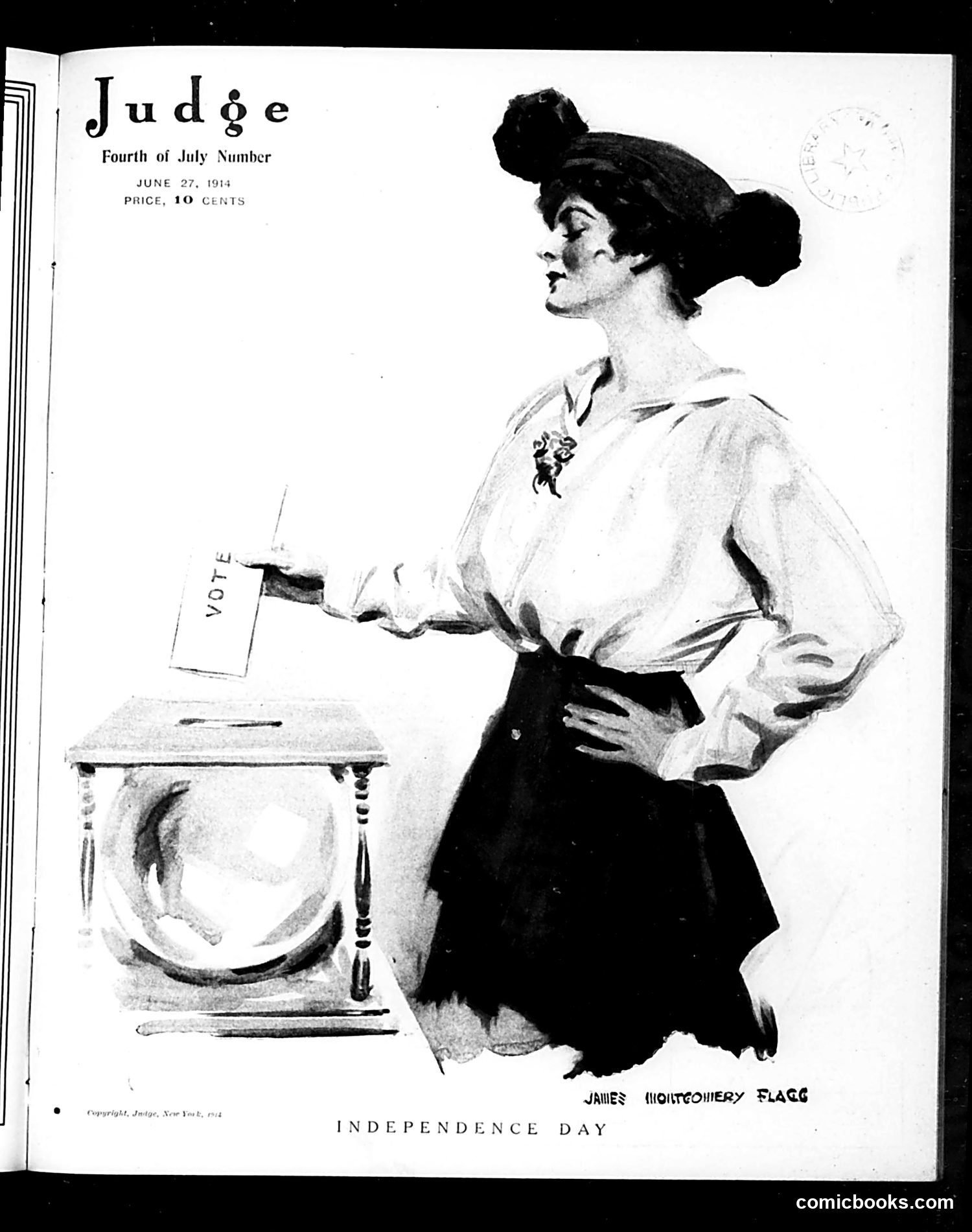
This Judge magazine cover from June 27, 1914 depicts a woman casting a ballot into a voting box, titled "Independence Day." The illustration celebrates women's suffrage—a major political issue of that era. The woman is elegantly dressed in early-1910s fashion (puffy sleeves, Gibson Girl styling), presented as refined and dignified while voting. By linking her voting act to American Independence Day, the artist argues that women gaining voting rights represents true independence and fulfillment of democratic ideals. This appears designed to advocate for women's suffrage, which remained contested in 1914. The cartoon suggests voting represents liberation and equality—framing suffrage as patriotic rather than radical. Women wouldn't gain federal voting rights until the 19th Amendment in 1920.
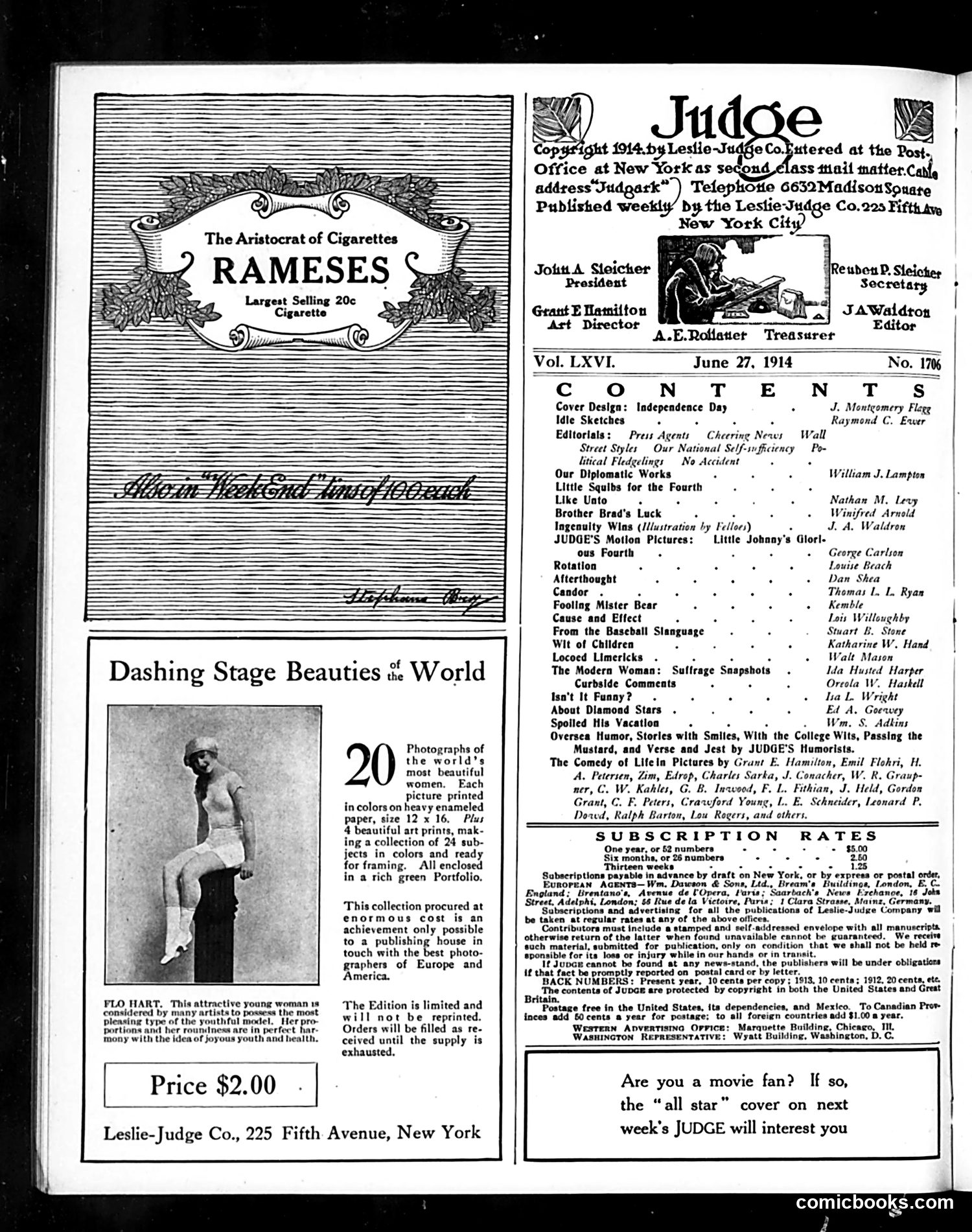
This page is primarily **advertising and editorial content** rather than political satire. The main visual element is an ad for Rameses cigarettes ("The Aristocrat of Cigarettes") and a separate advertisement for a photo collection titled "Dashing Stage Beauties of the World"—featuring 20 photographs of theatrical performers, priced at $2.00. The table of contents lists various articles and illustrations typical of Judge's satirical humor magazine format, but the actual cartoons are not visible on this page. **Historical context**: Published just before World War I's outbreak (July 1914), the magazine would soon become heavily focused on wartime commentary, but this particular issue's surviving page shows the publication's commercial side rather than its satirical content.
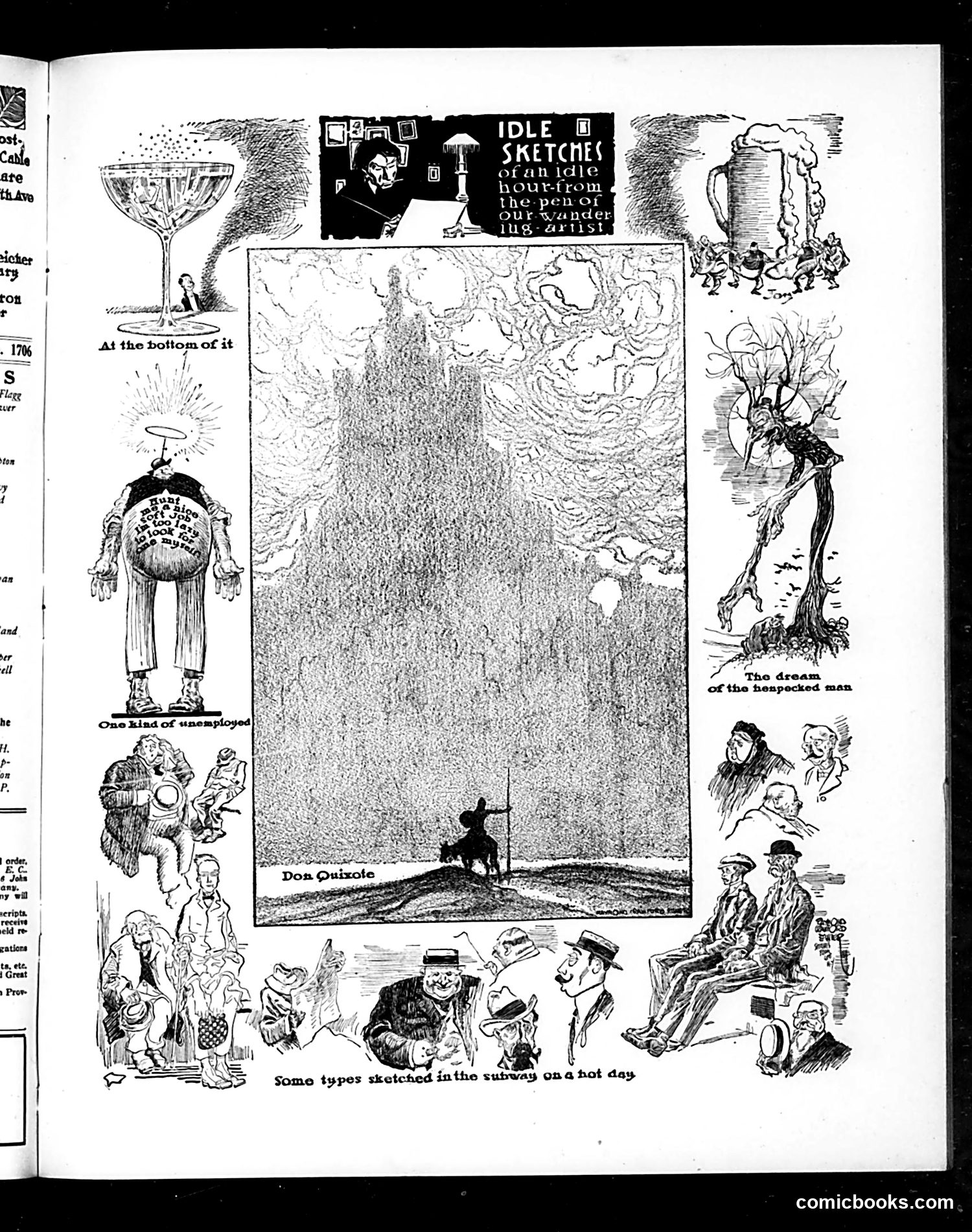
This page presents "Idle Sketches of an Idle Housewife: the pen of our wandering artist," displaying various character studies and vignettes. The central image depicts **Don Quixote** tilting at a windmill—a classic literary reference to futile, quixotic pursuits. Surrounding sketches include social commentary: "One of the unemployed" (a figure with a swollen head labeled with text about employment), "the dream of the henpecked man" (a surreal image of marital troubles), and "Some types sketched in the subway on a hot day" (depicting ordinary commuters). The overall tone is satirical observation of everyday American life—unemployment anxieties, domestic strife, and the tedium of urban transit. The artist uses literary and common-life references to mock social conditions and human folly in an accessible, humorous manner typical of Judge magazine's approach.
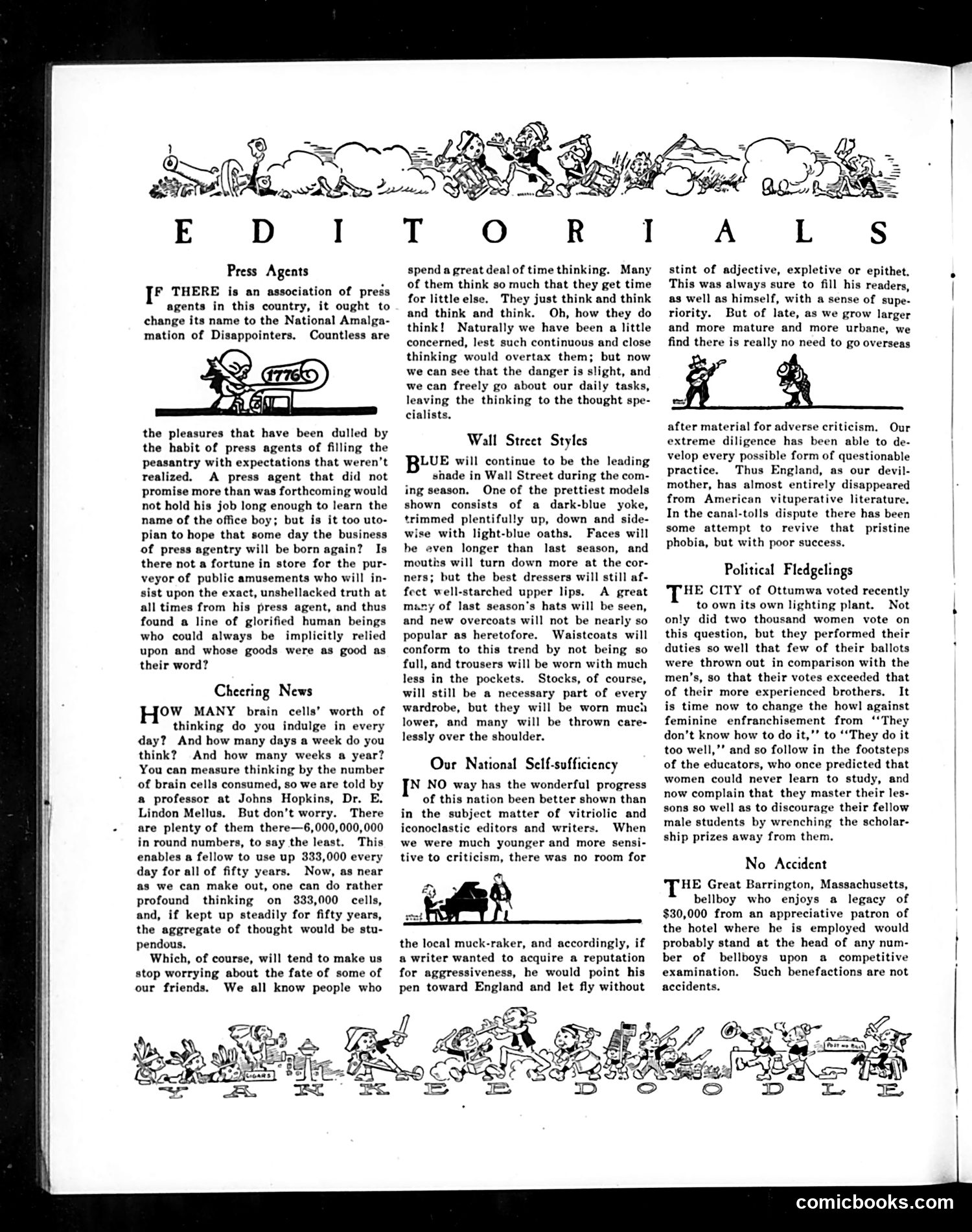
This editorial page contains several satirical columns with accompanying cartoons addressing early 20th-century American social issues: **"Press Agents"** mocks press agents for excessive thinking and overthinking their work, suggesting they've become disconnected from practical reality. **"Wall Street Styles"** satirizes fashion trends among Wall Street financiers, particularly the adoption of blue shades and specific clothing items like light-blue oaths and modified hats—likely poking fun at how financial elites adopt conspicuous fashions. **"Our National Self-sufficiency"** appears to critique American confidence in domestic progress, possibly referencing vitriolic editorial debates of the era. **"Political Fledglings"** discusses women's recent voting participation in Ottumwa, suggesting skepticism about female voters' political effectiveness. The decorative cartoons throughout depict various figures engaged in mundane activities, typical of Judge's visual style for satirical commentary.
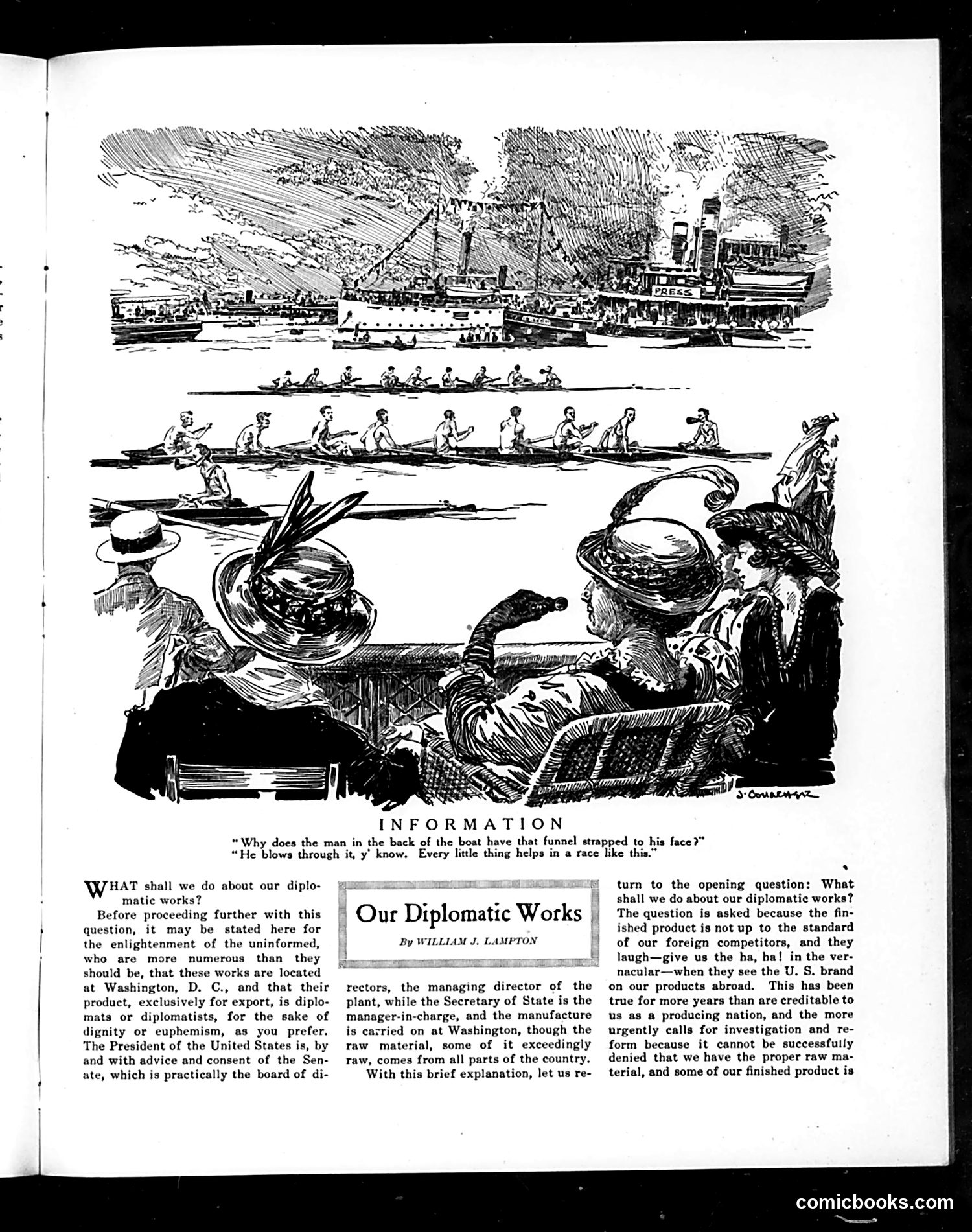
This page combines an editorial article titled "Our Diplomatic Works" by William J. Lampton with a satirical cartoon above it. The cartoon depicts spectators watching a rowing race on the water. The "Information" caption jokes about a man in the boat's stern with a funnel on his face, asking why he's there. The answer—"He blows through it, y'know. Every little thing helps in a race like this"—is absurdist humor mocking competitive desperation. The article below criticizes American diplomatic products and manufacturing quality, suggesting they're inferior to foreign competition. It implies U.S. diplomatic efforts lack proper "raw material" and manufacturing standards, comparing diplomacy to industrial production. The piece appears to advocate for investigation and reform of how American diplomatic work is conducted.
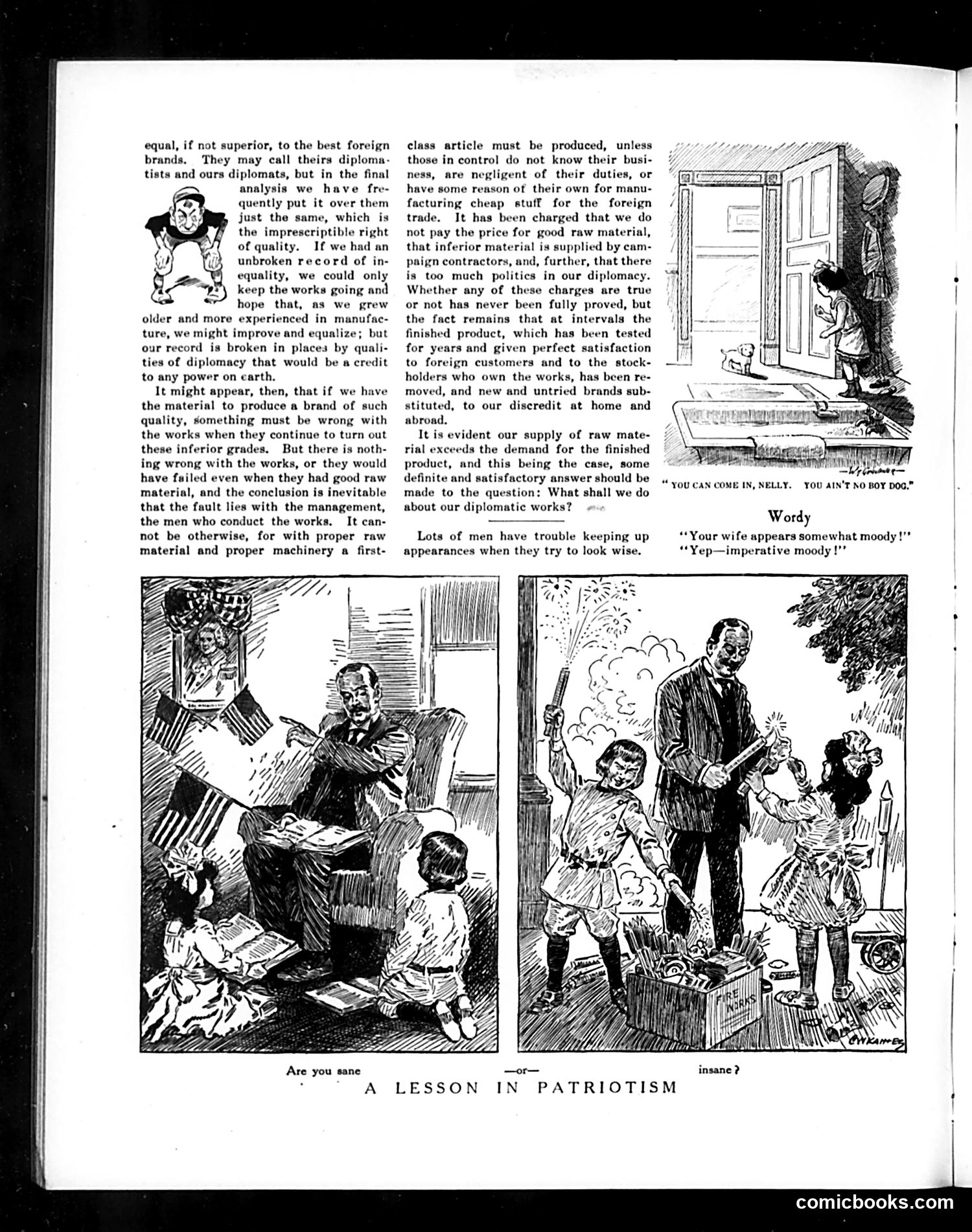
This page critiques American diplomatic incompetence through an extended manufacturing metaphor. The text argues that while America possesses quality raw materials (natural resources/talent), management failures and political corruption produce inferior diplomatic "products" internationally. It charges that campaign contractors supply poor materials, politics corrupts diplomacy, and finished work is repeatedly scrapped and replaced with untried alternatives—damaging American credibility abroad. The bottom cartoon pair titled "A Lesson in Patriotism" illustrates the consequences: the left panel shows a stern father figure disciplining children amid scattered belongings, while the right depicts a man distributing gifts to children outdoors. The contrasting scenes suggest parental chaos versus stability—likely satirizing how erratic diplomatic policy (the "management") undermines American standing like parental inconsistency damages children's security. The "Wordy" joke about appearing wise is unrelated filler.
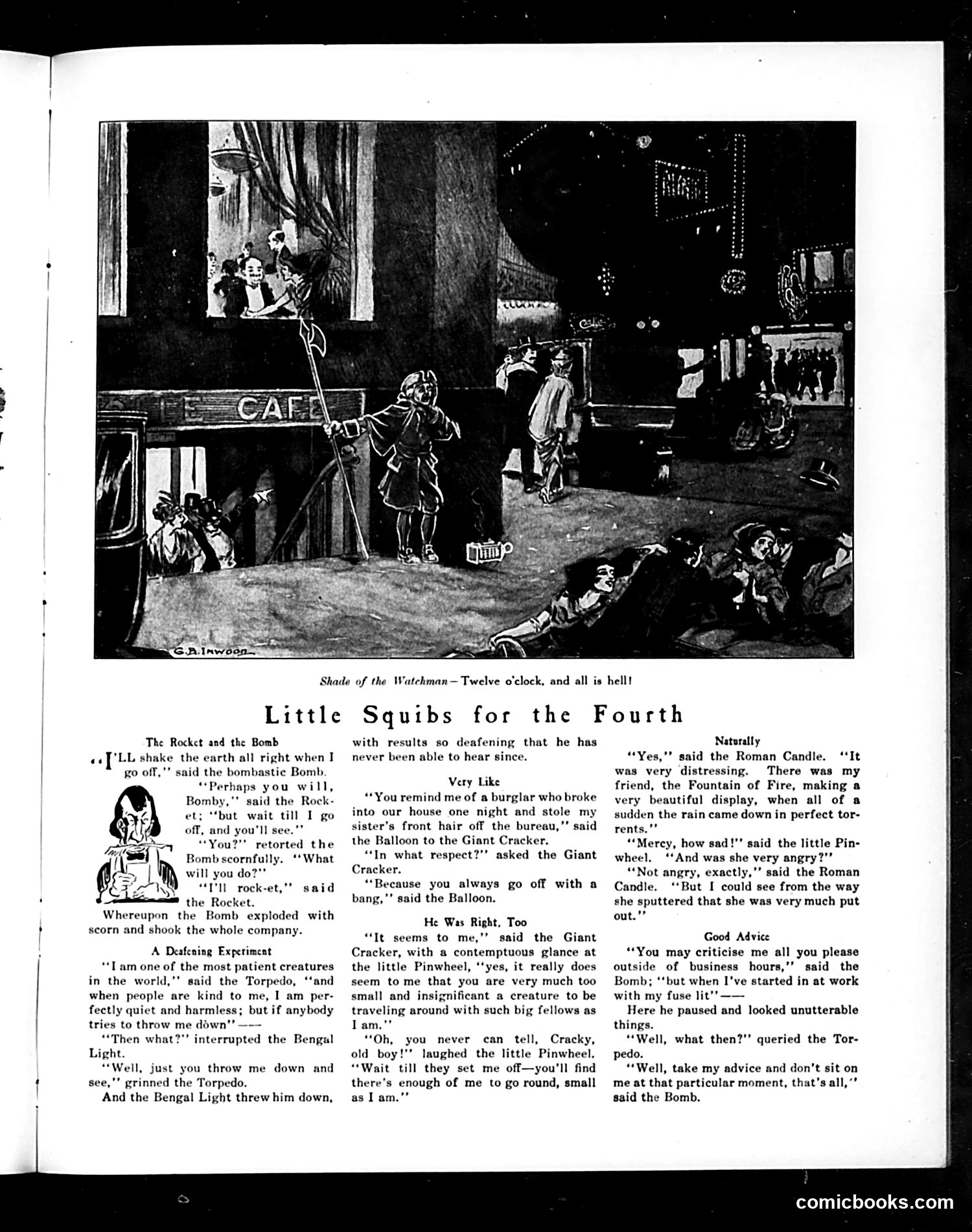
This is a **Fourth of July-themed humor page** from Judge magazine, featuring anthropomorphized fireworks and explosives as characters in witty dialogues. The satirical conceit presents bombs, rockets, torpedoes, and firecrackers as personified speakers debating their respective importance and power. The humor relies on **puns and double meanings**: the Rocket will "rock-et" (play on words), the Balloon notes the Giant Cracker goes off "with a bang" (literal and figurative), and the Bomb warns people not to "sit on me" during its active moment (suggesting danger). The illustration's caption—"Shade of the Watchman—Twelve o'clock, and all is hell!"—plays on the traditional night watchman's call, but here suggests the chaotic noise and mayhem of Fourth of July fireworks celebrations. This appears to be **lighthearted holiday satire** rather than political commentary, using fireworks as a metaphor for unpredictable, volatile personalities and the dangers of Independence Day celebrations.
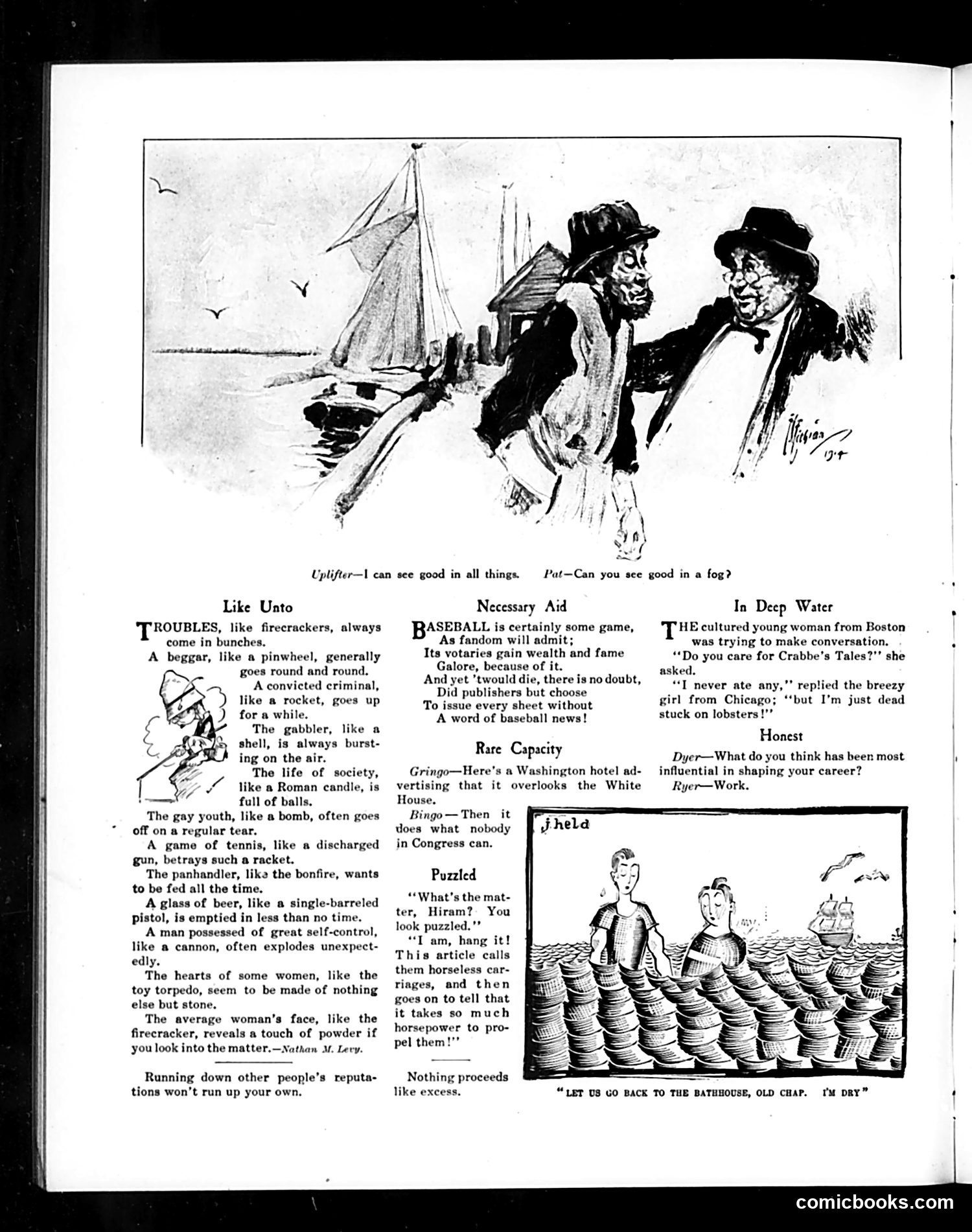
This page from the satirical magazine *Judge* contains multiple humor pieces typical of early 20th-century American wit: **Top Cartoon**: Two well-dressed men discuss optimism and fog—a simple joke about perspective and realism. **"Like Unto"**: A series of witty comparisons between social types and fireworks/explosives. It mocks various character archetypes (beggars, criminals, gossips, women with "stone hearts") using pyrotechnic metaphors. The humor relies on exaggerated social observation. **"Necessary Aid"**: Satirizes baseball's dependence on newspaper coverage for popularity—publishers essentially invented demand for sports news. **"Rare Capacity"**: A joke about Congressional incompetence, suggesting congressmen cannot "overlook" (ignore/rise above) the White House—implying they're beholden to executive power. **"Puzzled"**: Wordplay mocking the term "horseless carriage" while acknowledging these vehicles require horsepower—a transitional-era joke about automobile terminology. **Bottom Cartoon**: Two figures in water; the Chicago girl's crude preference for lobster over refined Boston literature satirizes regional cultural differences.
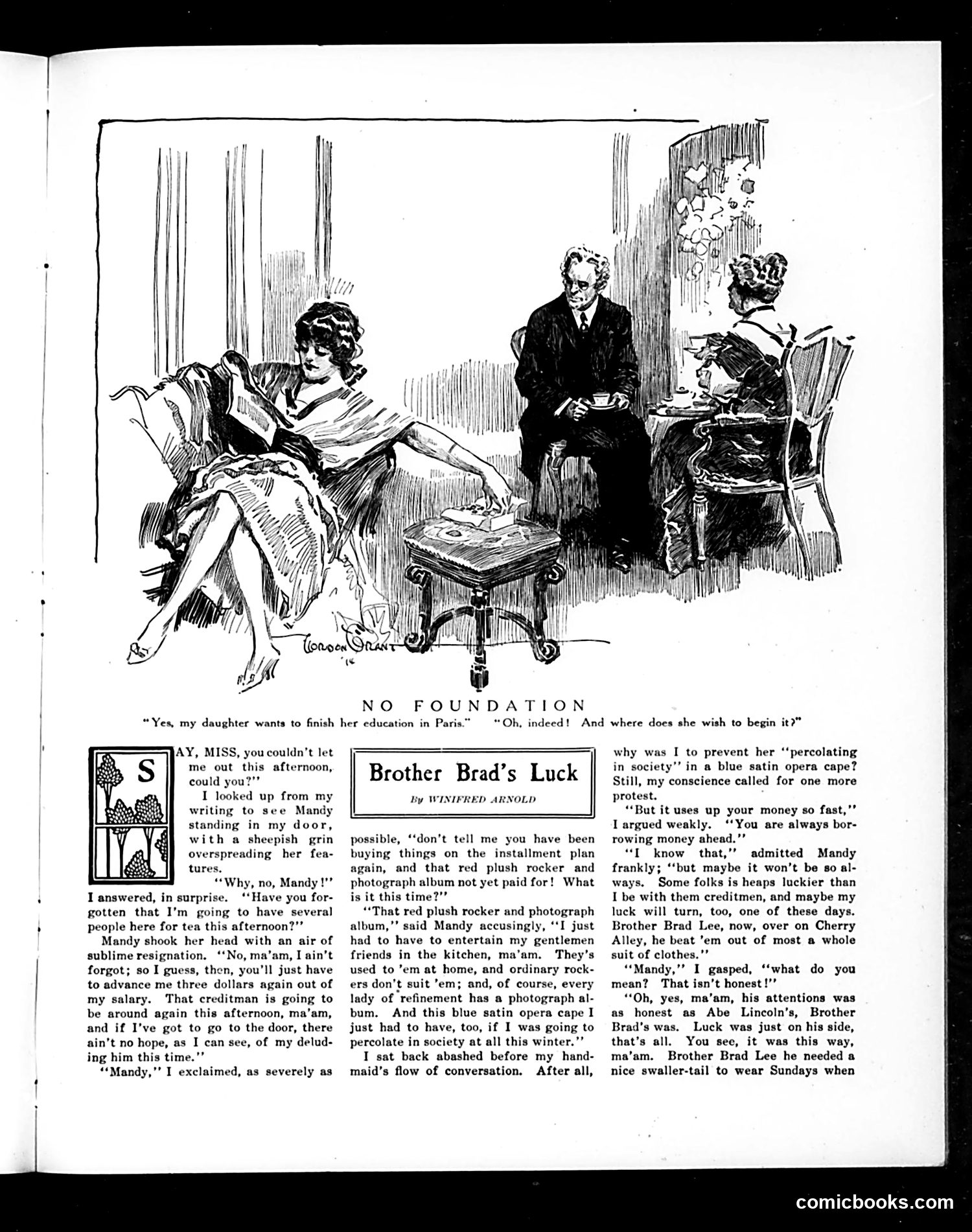
This page contains two pieces: a cartoon illustration with caption and a short story titled "Brother Brad's Luck." ## The Cartoon Shows a social scene where a man and woman discuss a daughter's education in Paris. The satire appears to mock aspirational middle-class pretensions—the mention of Paris education signals social climbing, while the domestic setting suggests modest means. The point seems to be commentary on class aspiration exceeding reality. ## The Story A domestic comedy about a servant named Mandy who constantly buys on installment plans—a red plush rocker, photograph album, and blue satin opera cape—claiming she needs them to "percolate in society." The employer objects to Mandy's debt accumulation, but Mandy references her acquaintance "Brother Brad Lee" who apparently obtained a suit of clothes dishonestly through luck. The satire targets working-class consumer culture and installment buying's appeal to servants and laborers seeking status symbols. It also hints at petty dishonesty as a shortcut to respectability. The humor derives from Mandy's earnest justifications for frivolous spending and her reference to fraud as merely "luck."
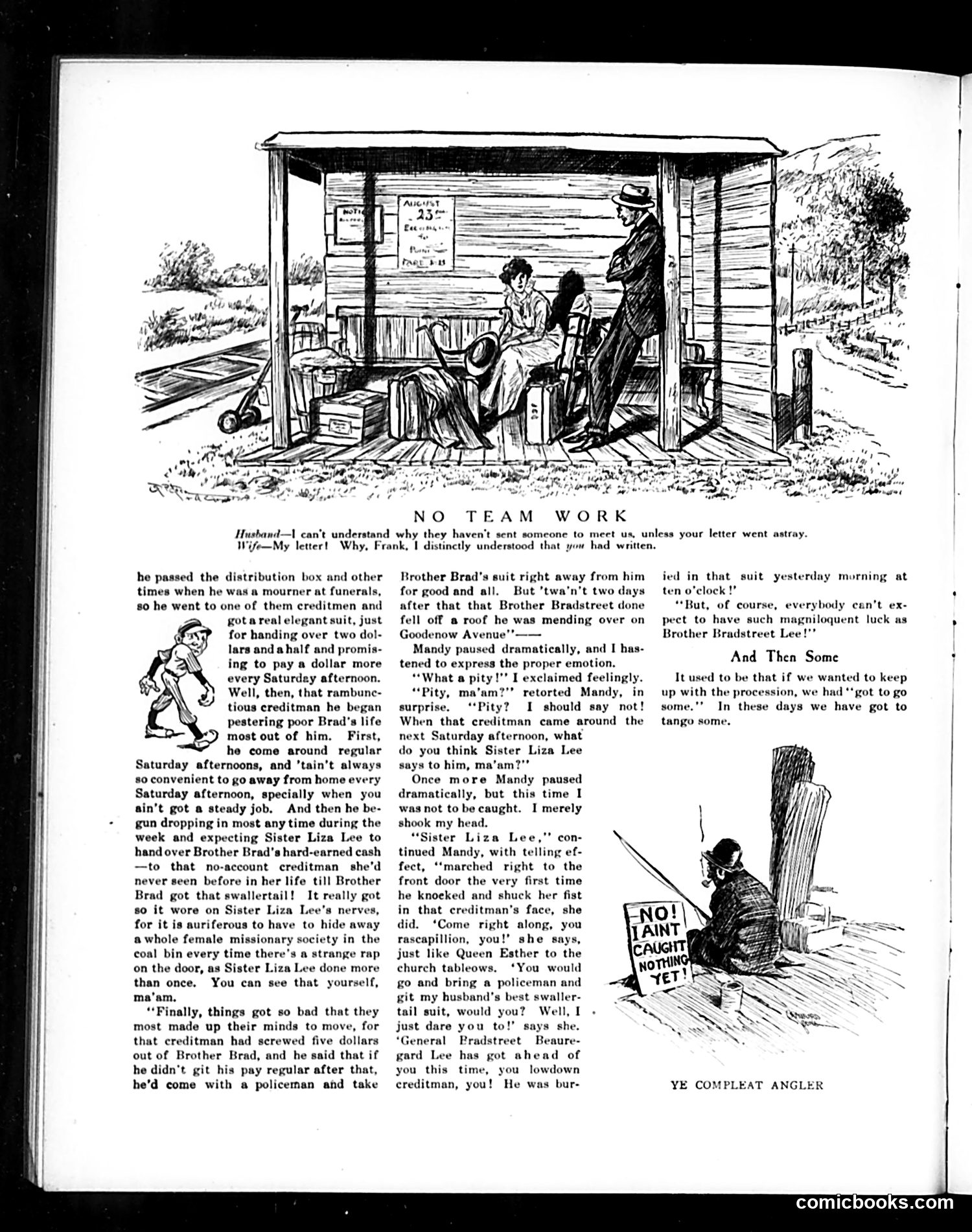
This page contains two distinct pieces satirizing early 20th-century American consumer culture and social friction. **"No Team Work"** (main story): A humorous anecdote about Brother Brad, who purchases an elegant suit on credit from an aggressive creditor. The creditor's relentless collection visits—calling at all hours—disrupts the household so severely that Sister Liza Lee must hide her missionary society in the coal bin. The dark humor peaks when Brother Brad dies after falling from a roof, and Sister Liza Lee triumphantly tells the creditor that Brad was buried in the suit, permanently ending the debt. The satire targets predatory credit salesmen and installment-plan financing, which trapped poor families in cycles of harassment and debt. **"And Then Some"** (brief section): A quip about modern social competition—once people needed to "keep up with the procession" (stay current with fashions/status), but now they must "tango some," referencing the tango dance craze of the era. It mocks how each generation escalates its spending and social performance demands. Both pieces critique consumerism and status-seeking among working-class Americans.
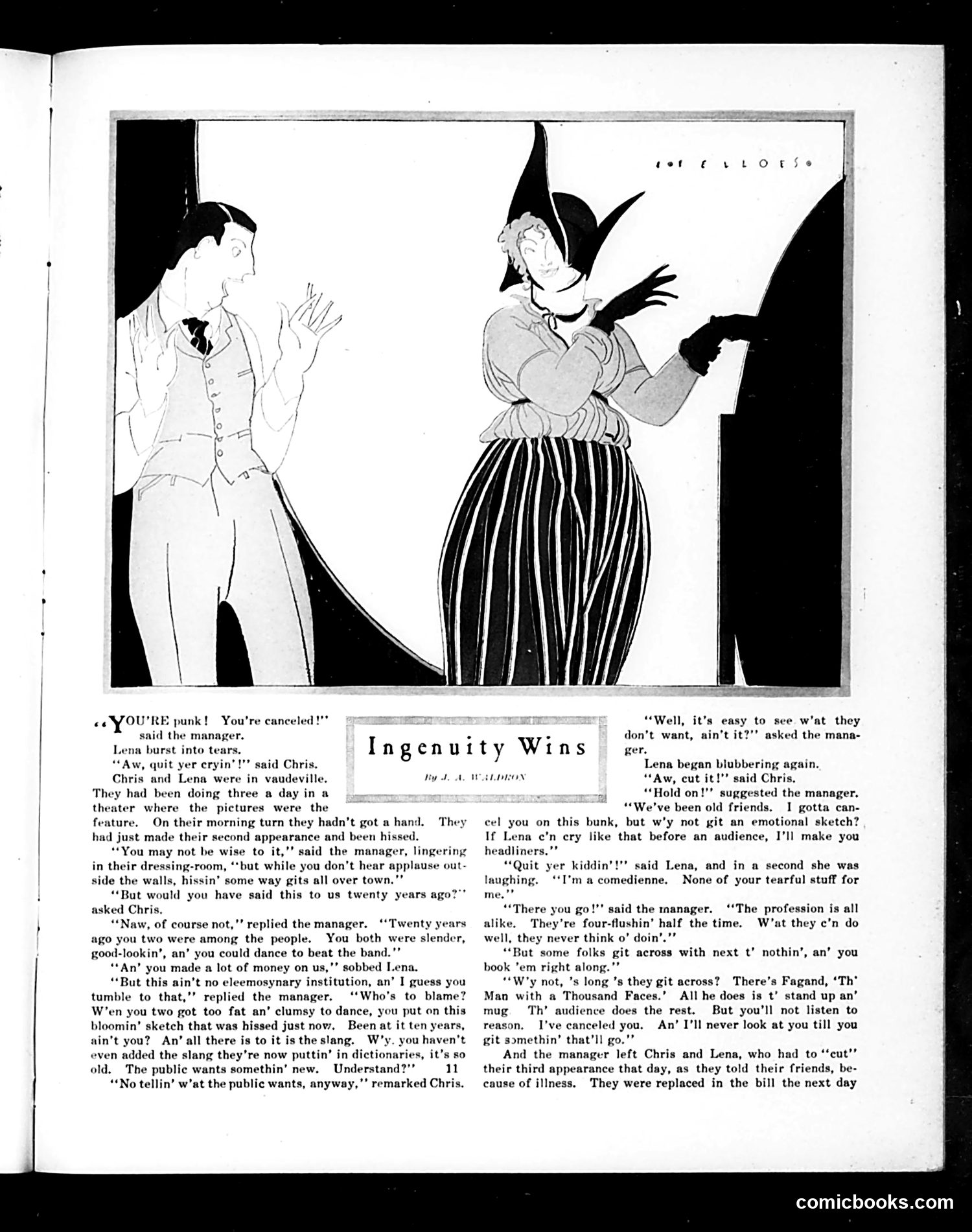
This story satirizes aging vaudeville performers and theatrical economics. Chris and Lena, once attractive dancers, have grown "fat an' clumsy" after ten years and now perform stale, dated comedy sketches that audiences hiss. Their manager cancels them, explaining bluntly that the public demands novelty, not nostalgia. The satire's point: when Lena spontaneously cries—genuinely emotional rather than performing—the manager recognizes commercial potential and reinstates them as "headliners." The irony is sharp: Lena's authentic tears succeed where her deliberate comedy failed. The story mocks both the entertainment industry's ruthless demand for constant innovation and performers' resistance to change. The manager's reference to other successful acts (like Fagand, "The Man with a Thousand Faces") reinforces that ingenuity—adapting to audience taste—determines survival in show business. Chris and Lena's "illness" excuse for missing their third show suggests they've learned their lesson.
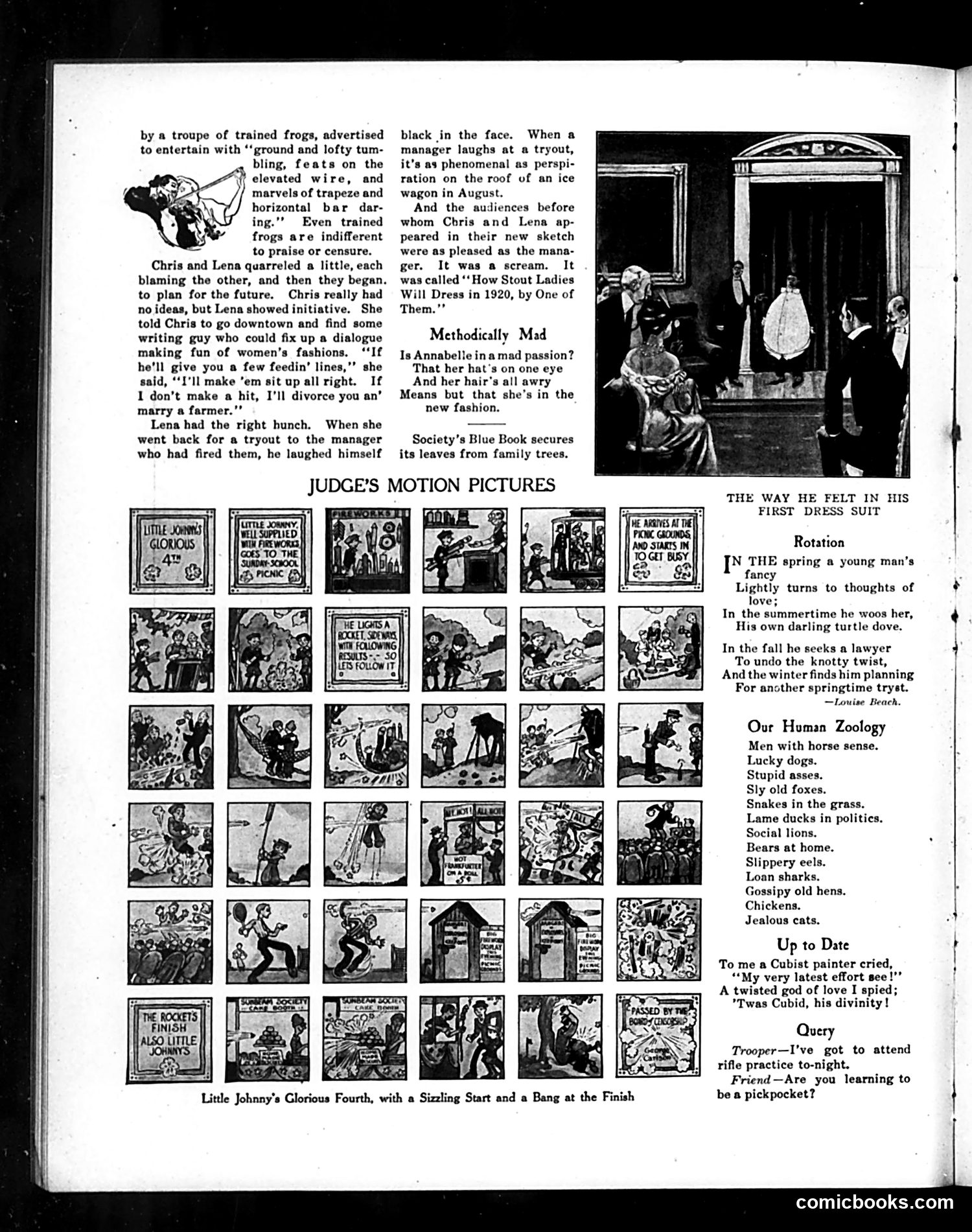
This page contains **entertainment and humor content** rather than political satire. The main feature is Judge's Motion Pictures—a series of small comic strips showing "Little Johnny's Glorious Fourth," depicting Fourth of July celebrations with physical comedy and explosions. The accompanying text discusses vaudeville performers Chris and Lena, who succeed with a sketch mocking women's 1920 fashion trends, particularly "How Stout Ladies Will Dress in 1920." The right column contains **light social humor**: "Rotation" is a poem about young men's romantic cycles across seasons; "Our Human Zoology" plays on animal metaphors for human types (men with "horse sense," people as "snakes," etc.); and brief jokes about Cubist art and military training. The humor targets **1920s fashion absurdities** and **cultural fads** (modernist art, changing courtship patterns) rather than political figures. For modern readers, the satire reflects Jazz Age anxieties about rapidly changing women's styles and youth culture—treating contemporary fashion as inherently ridiculous.
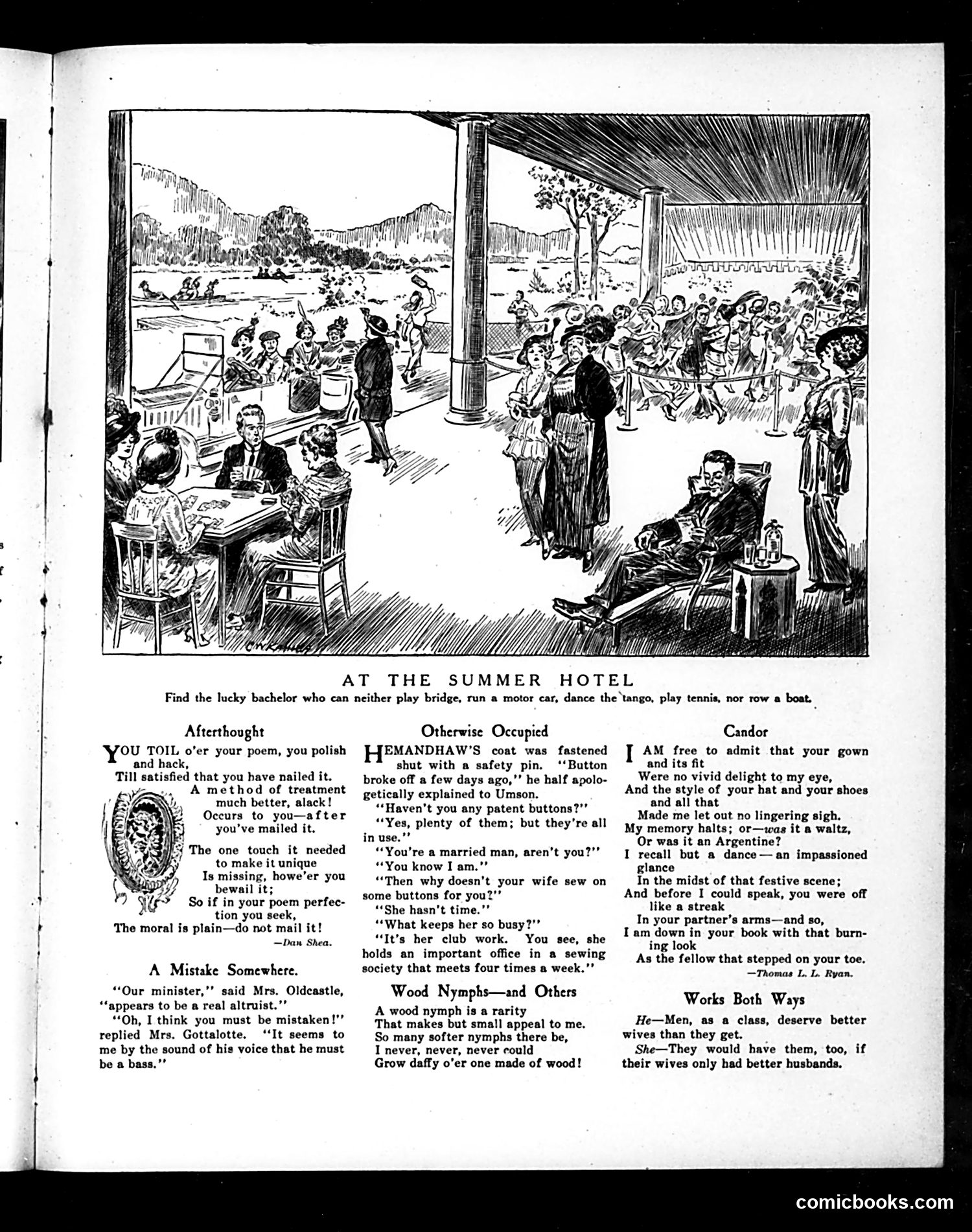
This page features multiple short humorous pieces satirizing early 20th-century social life and gender relations. **Main cartoon**: A visual puzzle asks readers to find "the lucky bachelor" who can do none of the fashionable activities (bridge, motoring, tango dancing, tennis, rowing). The joke satirizes how modern leisure activities had become mandatory social accomplishments—finding someone who avoids all of them is nearly impossible. **Key satirical pieces**: - **"A Mistake Somewhere"**: A pun mocking Mrs. Gottalotte's mishearing "altruist" as "bass" (a musical voice)—light wordplay humor. - **"Otherwise Occupied"**: Jokes about a wife too busy with her *sewing society club work* to actually sew her husband's buttons—ironic commentary on women's clubs as time-wasting rather than productive. - **"Works Both Ways"**: A gender-equality joke where a woman counters men's complaint about wives by noting men also deserve criticism—relatively progressive for the era. The overall tone mocks leisure culture, women's social organizations, and marital dynamics typical of Judge's satirical approach.
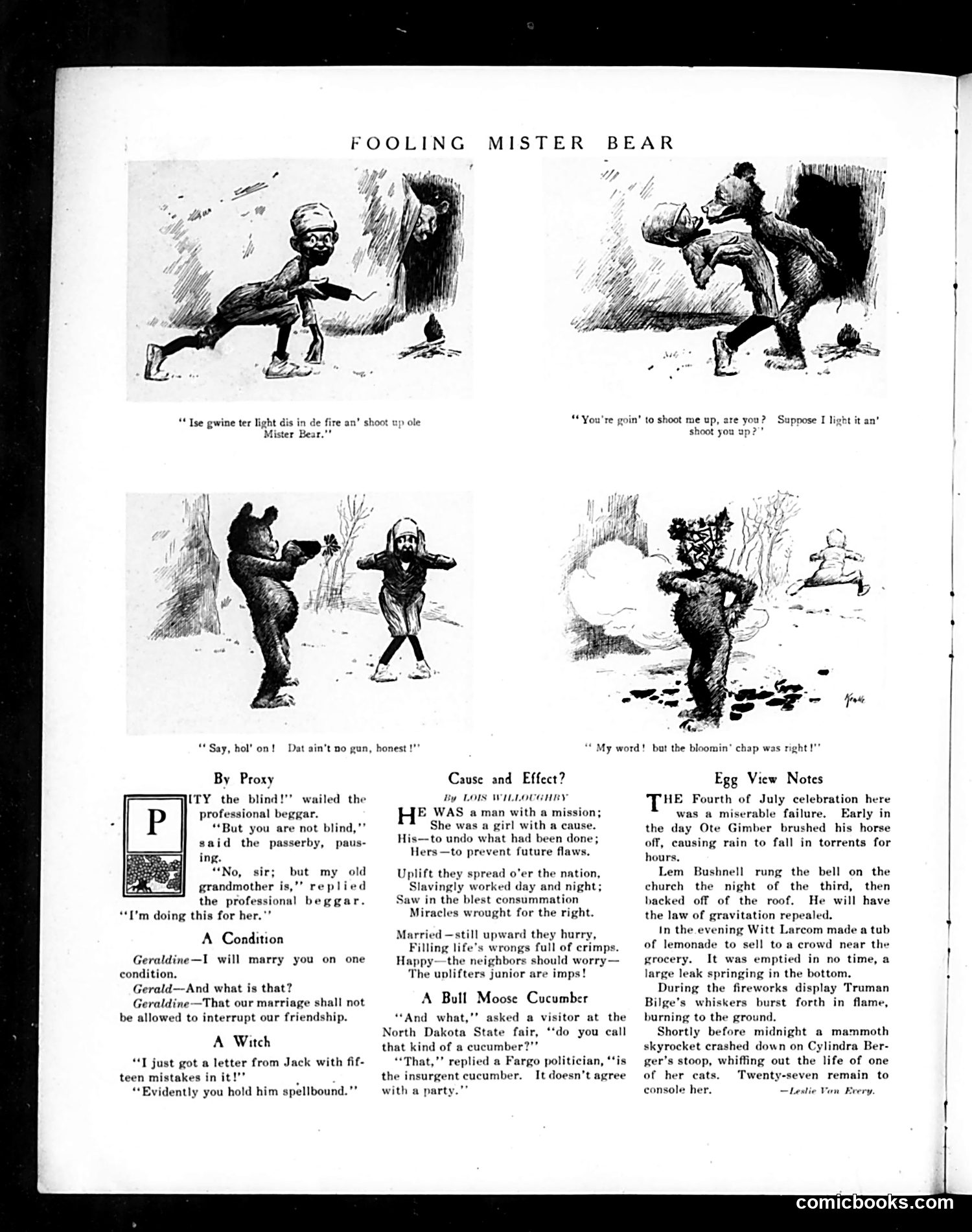
The top cartoon depicts a confrontation between a man and a bear, likely representing a political standoff. The dialect and crude illustration suggest this is racial caricature—a common (and offensive) feature of early Judge satire. The joke appears to be about mutual threats and bluffing: each party warns they'll "shoot" the other, but neither actually can or will, creating a stalemate. The political meaning is unclear without knowing the specific date, but it may reference labor disputes, political conflicts, or tensions between political figures of the era. The lower section contains unrelated short humor pieces and anecdotes typical of Judge's miscellaneous content, including jokes about blindness, marriage, begging, and rural life ("Egg View Notes").
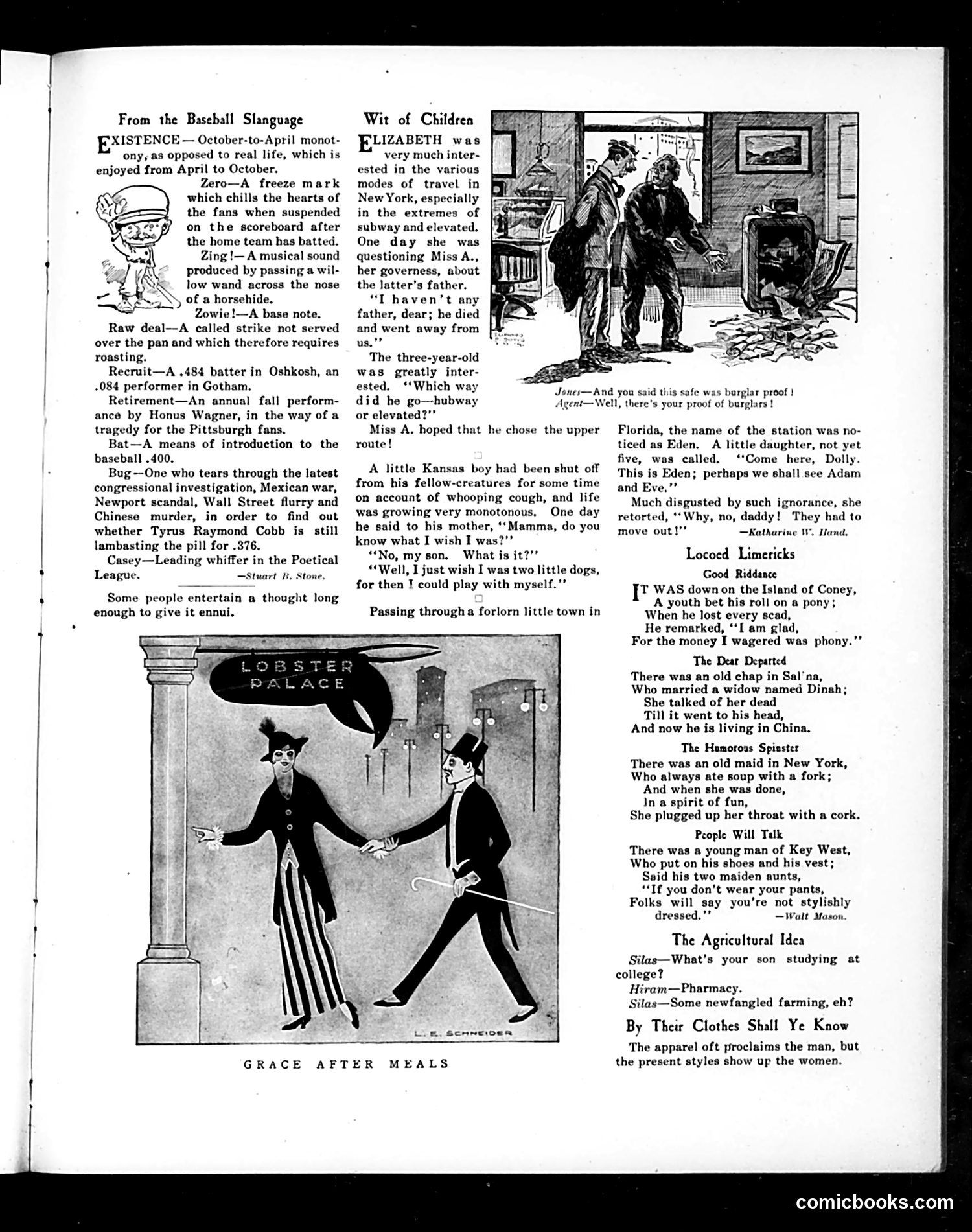
This page combines baseball humor, children's witticisms, and social satire typical of early 20th-century Judge magazine. **"Baseball Slanguage"** offers humorous definitions of baseball terminology—a sport at peak cultural prominence. References like "Tyrus Raymond Cobb" (famous Detroit Tigers player) and "Honus Wagner" (Pittsburgh Pirates legend) anchor the jokes for contemporary readers obsessed with baseball statistics and players. **"Wit of Children"** presents anecdotes where children's literal interpretations expose adult absurdities—a child asking if a dead man went "subway or elevated," or a girl dismissing Eden because "They had to move out!" (implying Adam and Eve relocated). **"Grace After Meals"** cartoon shows well-dressed gentlemen at an upscale restaurant, satirizing pretentious dining etiquette. The **limericks and verses** mock contemporary social types: gamblers, remarried widows, spinsters, and fashion-conscious young men—standard targets of period satire emphasizing propriety and respectability. Throughout, the humor assumes educated, urban readership familiar with baseball, current events, and conventional social expectations.
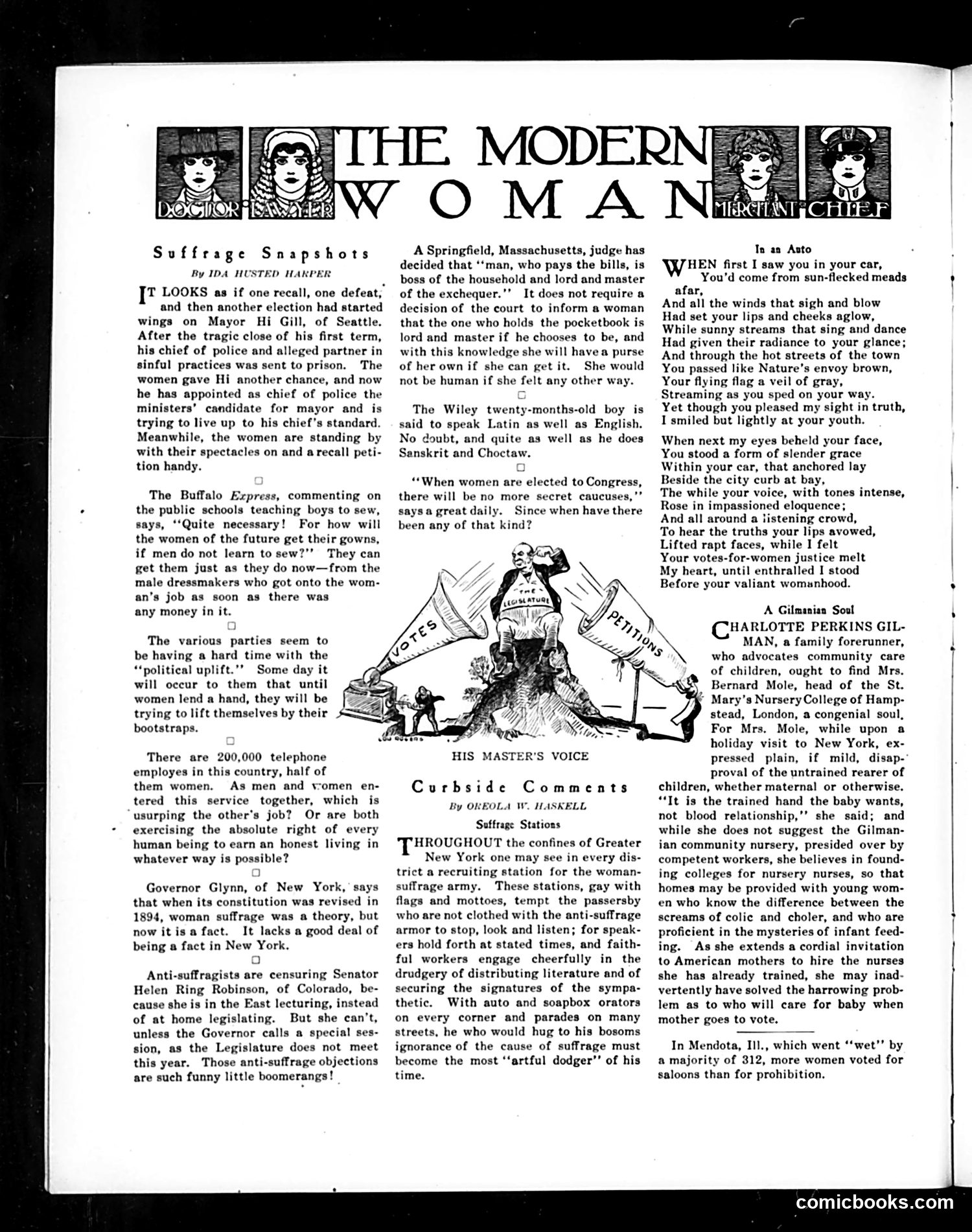
This page from *Judge* magazine satirizes women's suffrage debates through multiple commentaries. The "Suffrage Snapshots" column by Ida Husted Harper critiques anti-suffrage arguments with dry wit—mocking claims that teaching boys to sew harms women (since male dressmakers already dominate), and pointing out that anti-suffragists' objections "boomerang" against their own logic. The central cartoon "His Master's Voice" depicts a woman politician being pulled in opposite directions by competing petitions and demands, suggesting the contradictory pressures women face in politics. The "Curbside Comments" section describes suffrage recruiting stations throughout New York, normalizing women's political activism. Overall, the page presents suffrage as inevitable progress while ridiculing the logical inconsistencies of its opponents—a pro-suffrage stance typical of *Judge* during the Progressive Era.
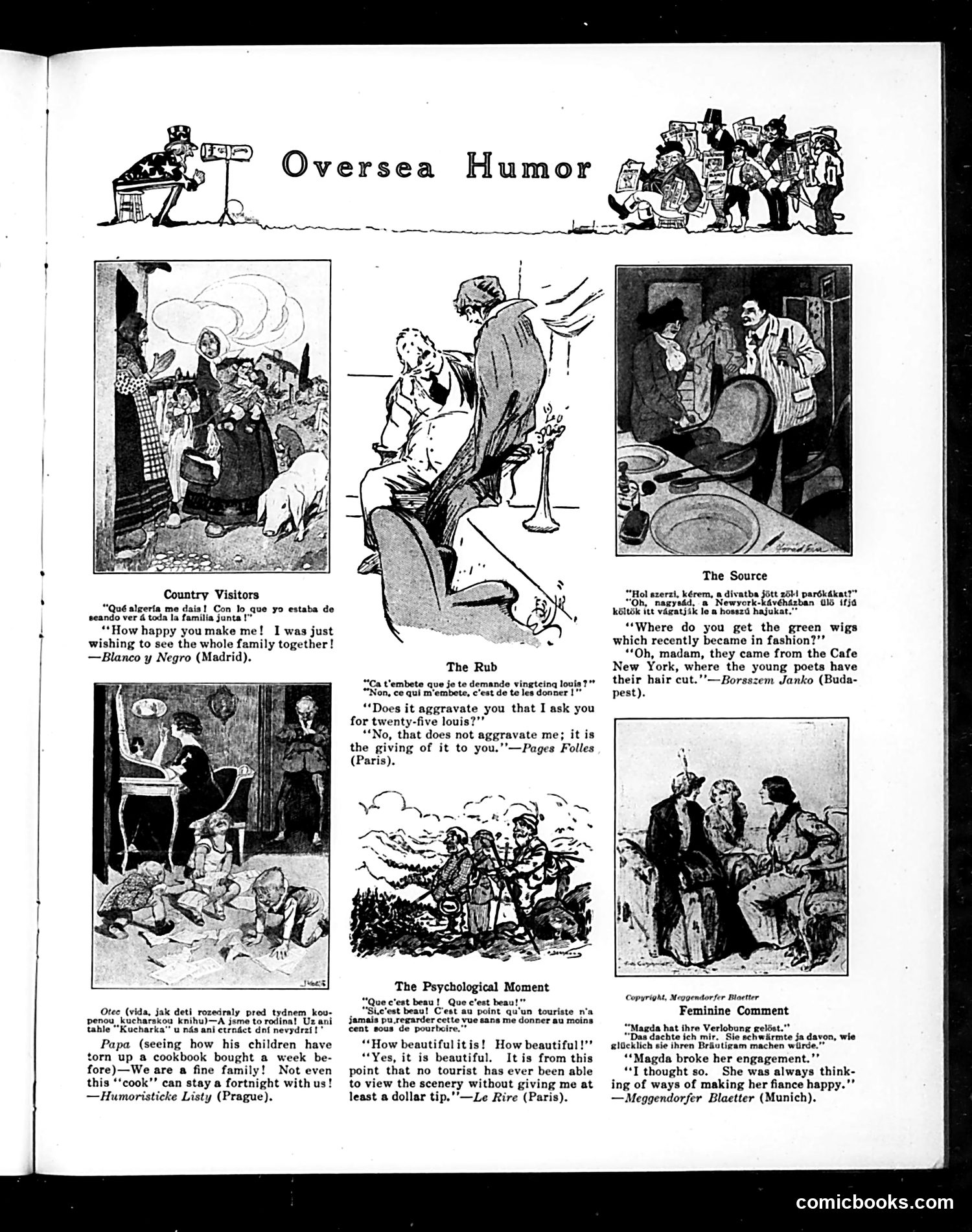
This page collects humorous cartoons and jokes from European publications, translated for American readers. Each depicts domestic situations played for comedy: **Country Visitors** (Madrid/Prague): Rural families visiting the city, with humor about their simple lifestyles—one Spanish family pleased to be together; a Czech father noting his children destroyed a cookbook so thoroughly that even the cook quit. **The Rub** (Paris): A financial joke—a man asks his friend for 25 louis (currency), and the friend's annoyance isn't the request itself, but actually *giving* the money away. **The Psychological Moment** (Paris): A tour guide cynically notes that scenic viewpoints are so beautiful tourists feel obligated to tip generously—the beauty itself is the hustle. **The Source** (Budapest): Young poets from a trendy New York café supposedly dyed their hair green fashionably; women now buy similar wigs there. **Feminine Comment** (Munich): A woman broke her engagement because she'd always fantasized about *improving* her fiancé—now she's lost that purpose. The satire targets vanity, greed, and human nature across cultures.
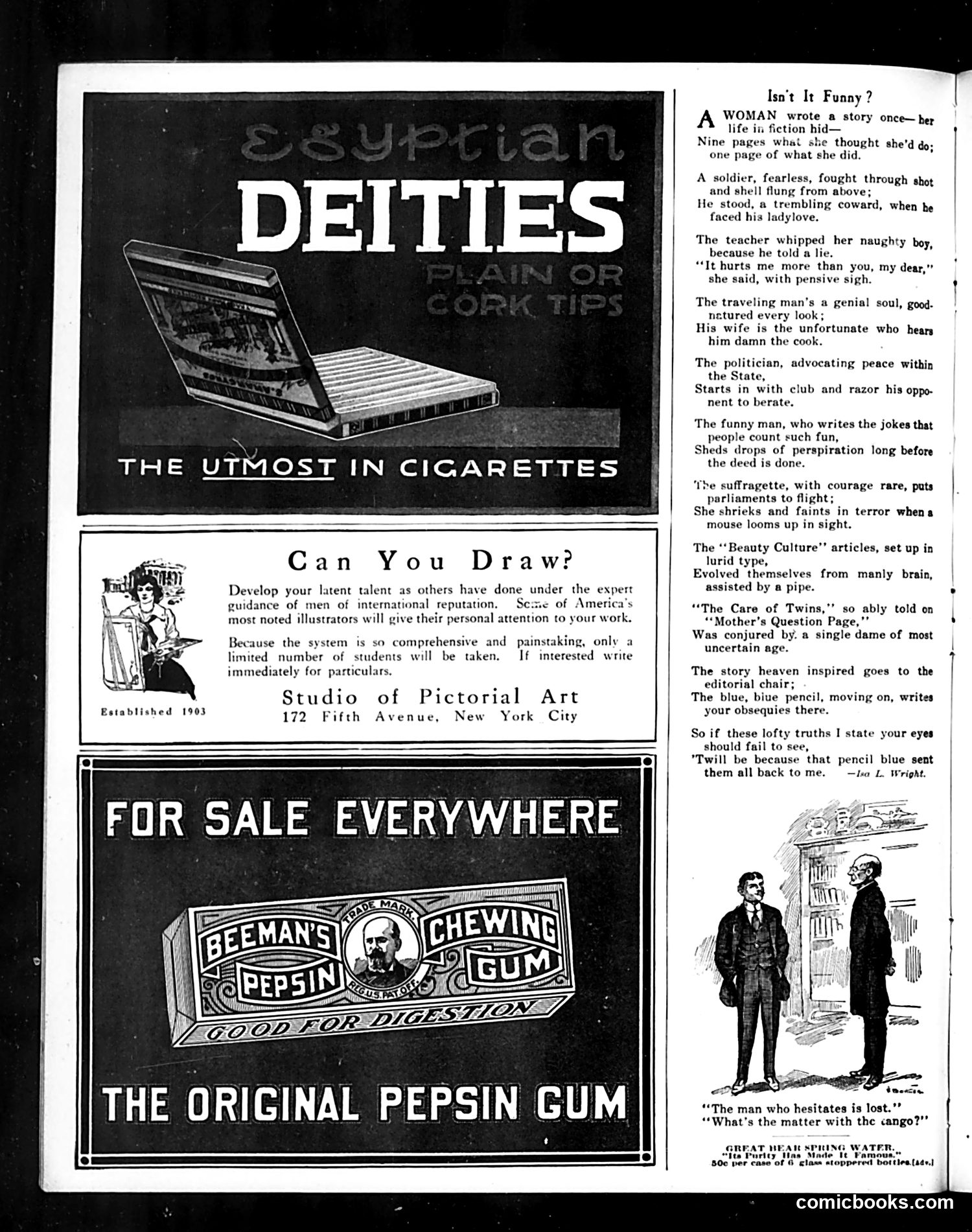
This page presents a satirical poem titled "Isn't It Funny?" that uses ironic contrasts to mock human behavior and social hypocrisy. Each stanza presents an expectation versus reality: - Women claim to live adventurous lives but accomplish little - Soldiers are brave in battle but cowardly in romance - Teachers claim punishment hurts them more than students - Politicians advocate peace while brawling with opponents - Comedians suffer creating jokes people enjoy - Suffragettes demand political rights yet panic at mice - Men write articles credited to women The satire targets gender contradictions, political hypocrisy, and the gap between public personas and private behavior. The final stanzas reference a blue pencil (editorial revision) and include unrelated advertisements, suggesting this is a typical Judge magazine page mixing commentary with commercial content. The cartoon at bottom shows two men—one hesitating at a doorway while the other questions "What's the matter with the cango?"—likely an unrelated gag referencing the popular song "Yes, We Have No Bananas."
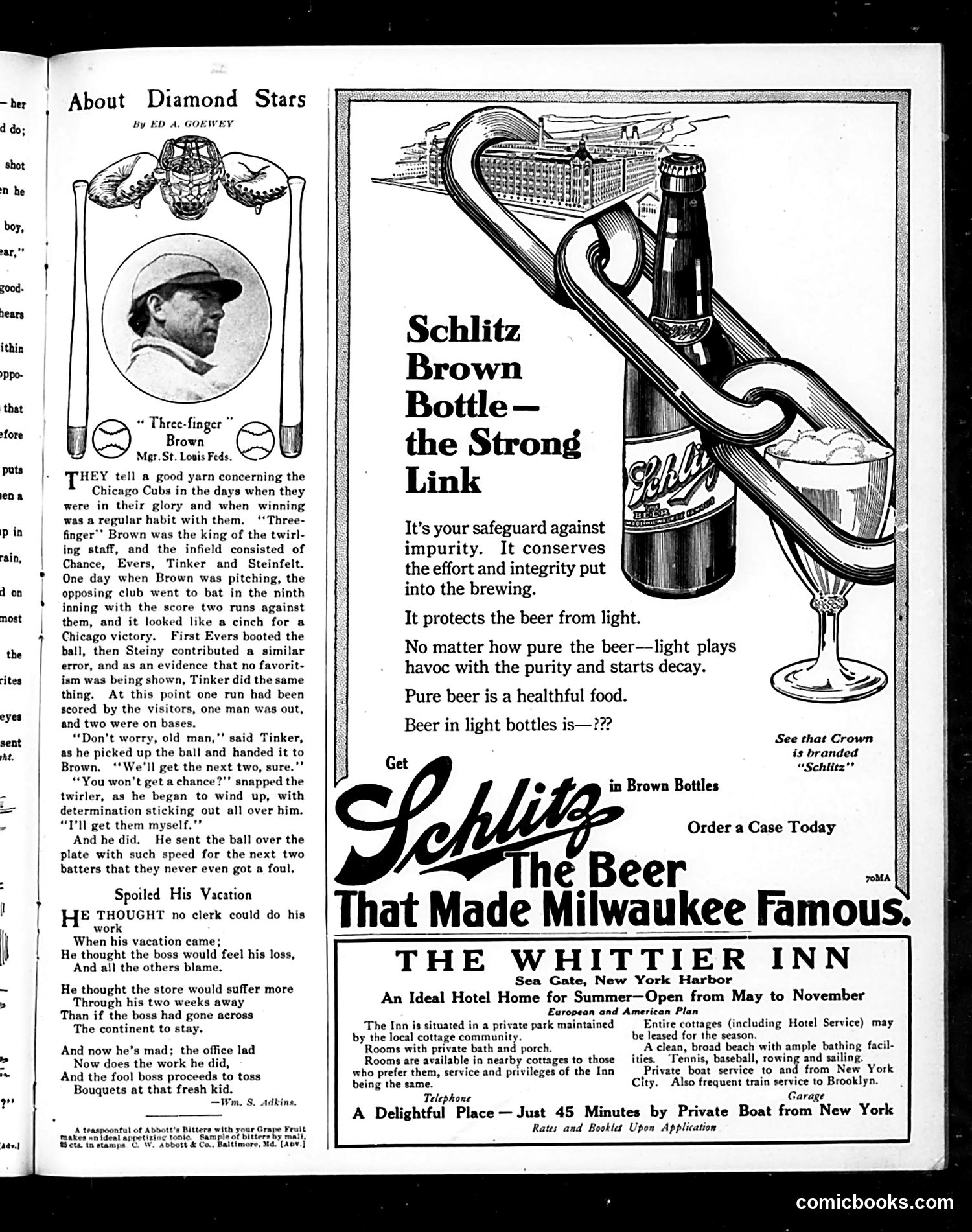
**Left side ("About Diamond Stars"):** This celebrates "Three-Finger" Brown, a real pitcher for the St. Louis Federals and former Chicago Cubs star. The anecdote illustrates his dominance—despite his infielders' errors, he strikes out the final two batters effortlessly. The phrase "three-finger" likely references an injury; Brown was famous despite having lost fingers. The piece nostalgically recalls the Cubs' early 1900s dynasty. Below that, "Spoiled His Vacation" is a brief comedic poem about an employee who took time off, only to discover the young office clerk performed his duties so capably that the boss no longer values him. **Right side:** This is primarily a **Schlitz beer advertisement** claiming the brown bottle protects beer from light damage (a legitimate concern for product quality). A secondary ad for the Whittier Inn resort in Sea Gate, New York rounds out the page. The page blends sports nostalgia with advertising—typical Judge magazine content mixing entertainment, humor, and commercial sponsorship.
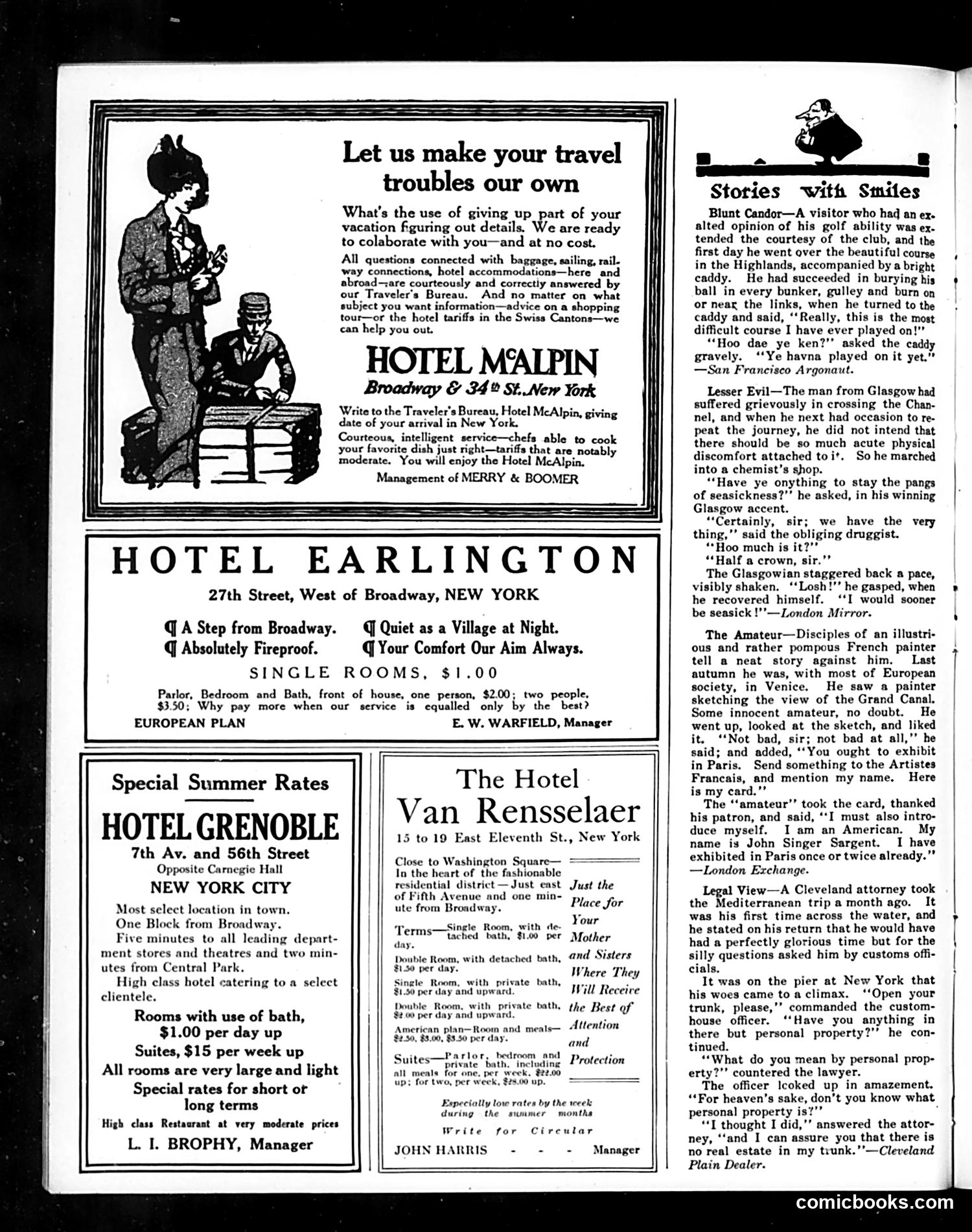
This is primarily an **advertising page** from Judge magazine featuring hotel promotions for New York City establishments (Hotel Malpin, Earlington, Grenoble, and Van Rensselaer). The top advertisement presents the Hotel Malpin's travel bureau service, offering to handle vacation logistics at no cost—a noteworthy convenience given the era's complexity of booking travel. The right column contains **"Stories with Smiles,"** a humor section with three brief anecdotes featuring **Scottish characters** (identified by dialect and accent). These jokes traffic in ethnic stereotyping common to early-20th-century American humor: 1. A Scottish golfer's poor performance elicits a caddy's deadpan retort 2. A Glasgow man seeking seasickness remedy 3. A French painter's encounter with an American The humor relies on **character-based comedy and dialect humor**, particularly Scottish accents and presumed cheapness ("half a crown"). This reflects period attitudes where ethnic/regional caricature served as mainstream entertainment. The page itself contains no political satire—it's commercial content typical of Judge's revenue model.
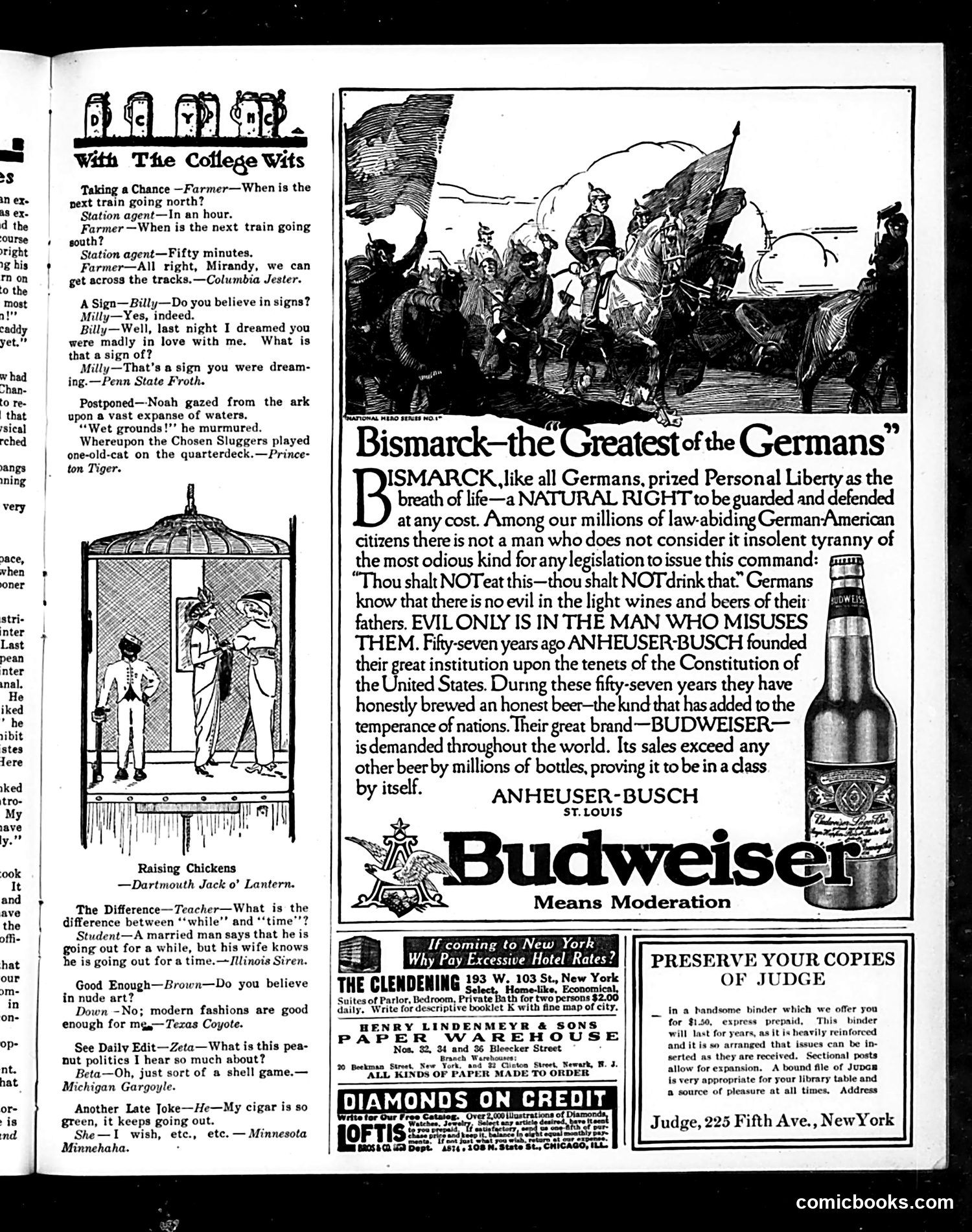
This page contains college humor shorts on the left and a substantial **Budweiser advertisement** masquerading as political commentary on the right. The ad invokes Otto von Bismarck and German-American identity to argue *against* Prohibition. It claims that Germans and German-Americans value "Personal Liberty" and that beer itself is innocent—"evil only is in the man who misuses them." The ad then pivots to praising Anheuser-Busch's 57-year history as an honest American institution. **Historical context**: This appears to be from the Prohibition era (1920-1933 or lead-up), when anti-alcohol legislation was actively debated. The ad strategically appeals to German-American pride and constitutional liberty arguments to oppose dry laws, while positioning Budweiser as patriotic and temperate. The college humor pieces are unrelated jokes from various university magazines—typical light satire about romance, trains, and puns. The page is primarily **advertising disguised as editorial content**, using nationalist sentiment and liberty rhetoric to argue a commercial interest in keeping alcohol legal and available.
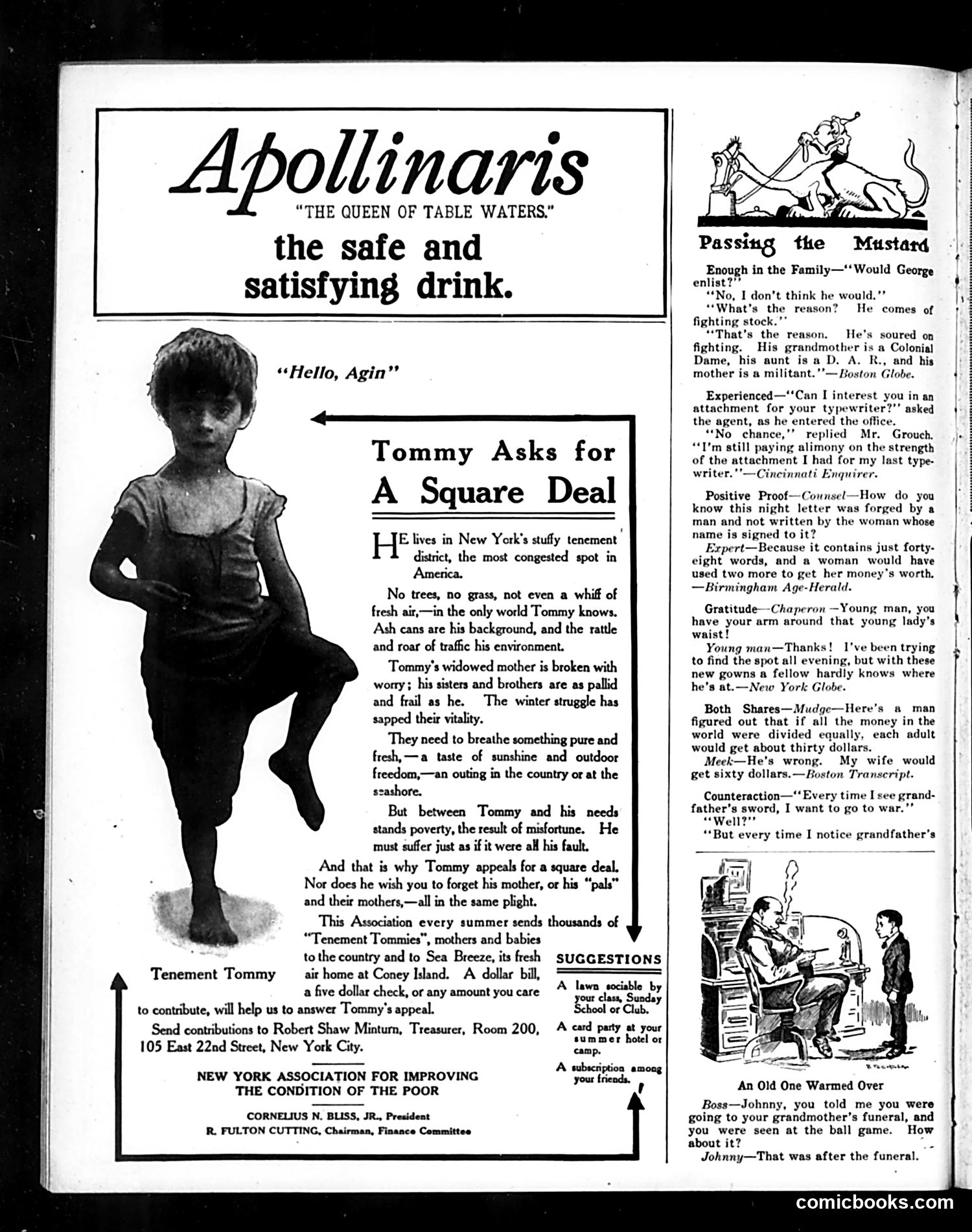
This page is primarily a **charitable fundraising appeal**, not a political cartoon, though it employs Progressive-era social messaging. The central image shows "Tenement Tommy," a malnourished child representing poor urban children trapped in New York's overcrowded tenement districts. The text describes his bleak conditions: no fresh air, grass, or outdoor space—only ash cans and traffic noise. The "square deal" reference invokes **President Theodore Roosevelt's progressive platform** (1901-1909), framing poverty relief as a matter of fairness rather than charity. The appeal argues Tommy's suffering results from circumstance, not fault, and solicits donations to send poor children to the country or Sea Breeze for fresh air and recovery. The **New York Association for Improving the Condition of the Poor** (real organization) uses this emotional appeal to fundraise. Contributors ranged from dollar bills to larger checks. The accompanying humor pieces are unrelated filler—standard magazine content about social etiquette and marital mishaps, typical of *Judge* magazine's miscellaneous satirical content.
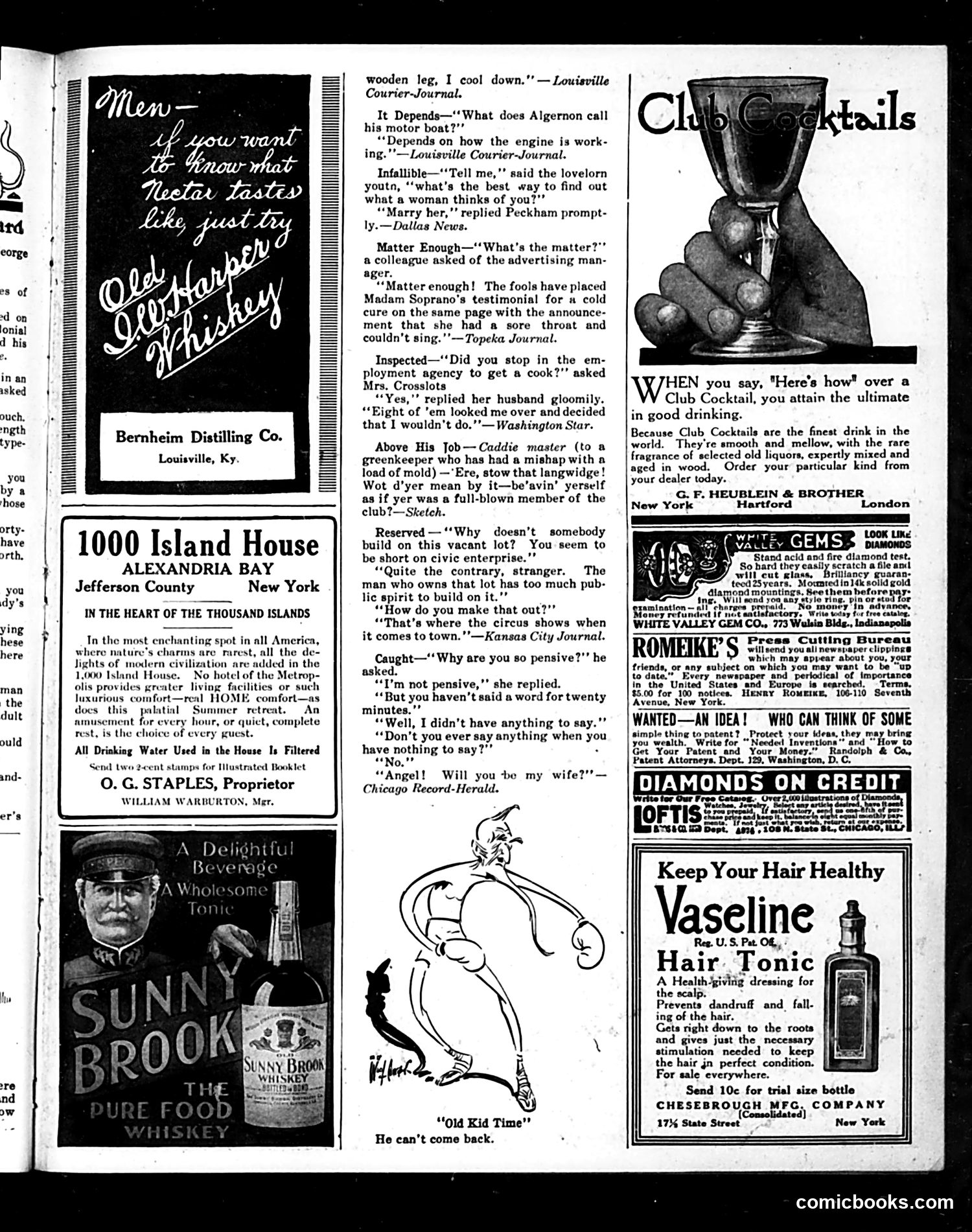
This page primarily contains **short humorous anecdotes and advertisements** from the early 20th century, rather than political satire. The jokes mock everyday situations: a man's jealousy over his wife's motor-boat naming, an advertising manager's embarrassment at placing a singer's cold-cure ad next to her testimonial, a job applicant rejected by eight cooks, and marital miscommunication. These reflect period concerns: automobiles as status symbols, advertising effectiveness, domestic service availability, and gender relations. The cartoons include a caricatured "Old Kid Time" figure (unclear reference) and product advertisements for whiskey, hair tonic, diamonds, and cocktails—typical of Judge's revenue model. The **1000 Island House resort advertisement** emphasizes leisure and comfort for wealthy readers. Overall, this represents Judge's function as middlebrow entertainment for affluent Americans, mixing mild domestic humor with luxury consumer goods.
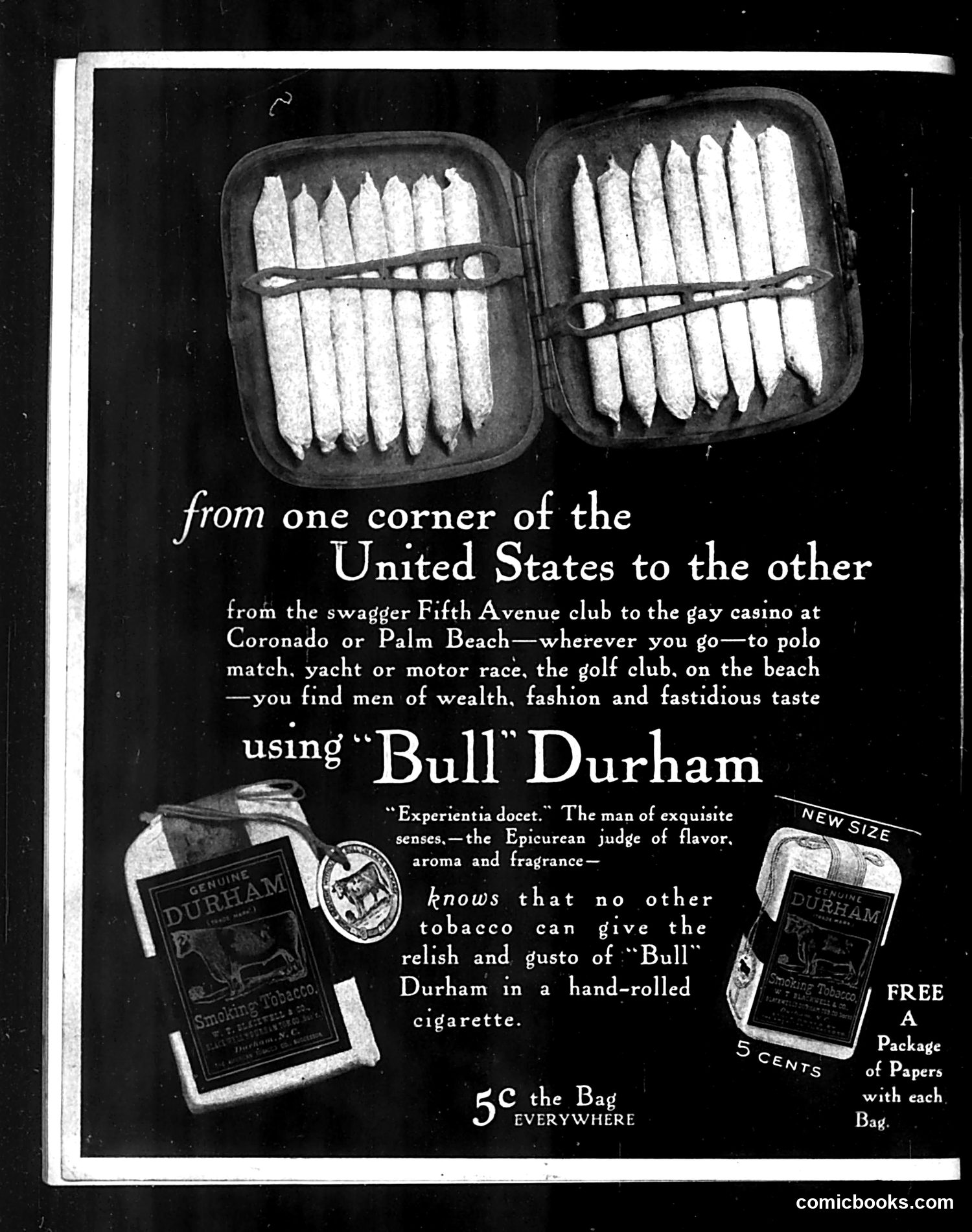
This is primarily a **cigarette advertisement**, not a political cartoon. It's a vintage ad for Bull Durham smoking tobacco, likely from the early 20th century. The ad uses **class-based aspirational marketing**: it associates the product with wealthy, fashionable men frequenting exclusive venues (Fifth Avenue clubs, Palm Beach casinos, polo matches, yacht clubs). The Latin phrase "Experientia docet" ("experience teaches") appeals to the consumer as a refined "Epicurean judge." The visual shows two open pouches of Bull Durham tobacco with rolling papers. The pitch emphasizes hand-rolled cigarettes as a marker of sophistication and taste. **For modern readers**: This reflects an era when tobacco was openly marketed to the wealthy as a luxury good associated with leisure and social status—before cigarette advertising restrictions and health warnings became standard. The gendered, class-conscious marketing strategy would be considered inappropriate today.
I cannot reliably analyze this image. The page appears to be heavily degraded or poorly scanned—it's predominantly black with scattered white speckles and some barely legible text fragments on the left margin. The OCR text provided is also largely garbled and unreadable. While this is identified as a page from *Judge* magazine (a real American satirical publication), I cannot discern any cartoon images, identify figures, or determine what satire or political/social commentary it contains. To provide accurate historical analysis per your rules, I would need a clearer scan or image of this page. If you have a better-quality version available, I'd be happy to analyze it properly.